Posts tagged ‘nuclear energy’

16/02/2015

India seals nuclear energy pact with Sri Lanka, hopes to push back Chinese influence | Reuters

India sealed a nuclear energy agreement with Sri Lanka on Monday, its first breakthrough with the new government of the tiny Indian Ocean island where China has been building ports and highways in a diplomatic push in recent years.

Indian Prime Minister Narendra Modi (R) gestures to Sri Lanka's President Mithripala Sirisena's wife Jayanthi Sirisena (2nd L) as India's President Pranab Mukherjee (L) looks on during Sirisena's ceremonial reception at the forecourt of India's Rashtrapati Bhavan presidential palace in New Delhi February 16, 2015. REUTERS/Adnan Abidi

Under the deal, India will help Sri Lanka build its nuclear energy infrastructure, including training of personnel, the Indian foreign ministry said.

Later, India could also sell light small-scale nuclear reactors to Sri Lanka which wants to establish 600 MW of nuclear capacity by 2030, a Sri Lankan official and an Indian analyst said.

The deal came as Sri Lankan President Maithripala Sirisena began a visit to India, his first trip abroad since he swept to power in January, which has provided New Delhi with an opening to repair ties that had become tense under his predecessor.

“The bilateral agreement on civil nuclear cooperation is yet another demonstration of our mutual trust,” Indian Prime Minister Narendra Modi said in a statement.

India had grown increasingly wary of former president Mahinda Rajapaksa‘s pursuit of closer ties with China, which became a key supporter of the island’s economy after its 26-year-civil war ended in 2009.

China has built a seaport in the south of the country and signed a deal to develop a $1.5 billion port next to the commercial port in Colombo, raising fears Beijing is seeking influence in the island state with which New Delhi has had historical ties.

Ties worsened further after the Rajapaksa government allowed Chinese submarines to dock last year.

Modi said the two countries also agreed to expand defense cooperation, but gave no details. “This is my first visit and it has given very fruitful results,” Sirisena said.

Since coming to power last year, Modi has reached out to neighbors, offering to build power stations and ports, in a bid to push back against China.

Next month he plans to travel to Sri Lanka and the Maldives where too Beijing is seen to be expanding its diplomacy as part of a strategy to build a network of ports in the Indian Ocean through which much of its trade and energy supplies transit.

Sirisena has pledged to pursue a more global foreign policy.

via India seals nuclear energy pact with Sri Lanka, hopes to push back Chinese influence | Reuters.

11/12/2014

The Vladimir Putin and Narendra Modi Agreements in Full – India Real Time – WSJ

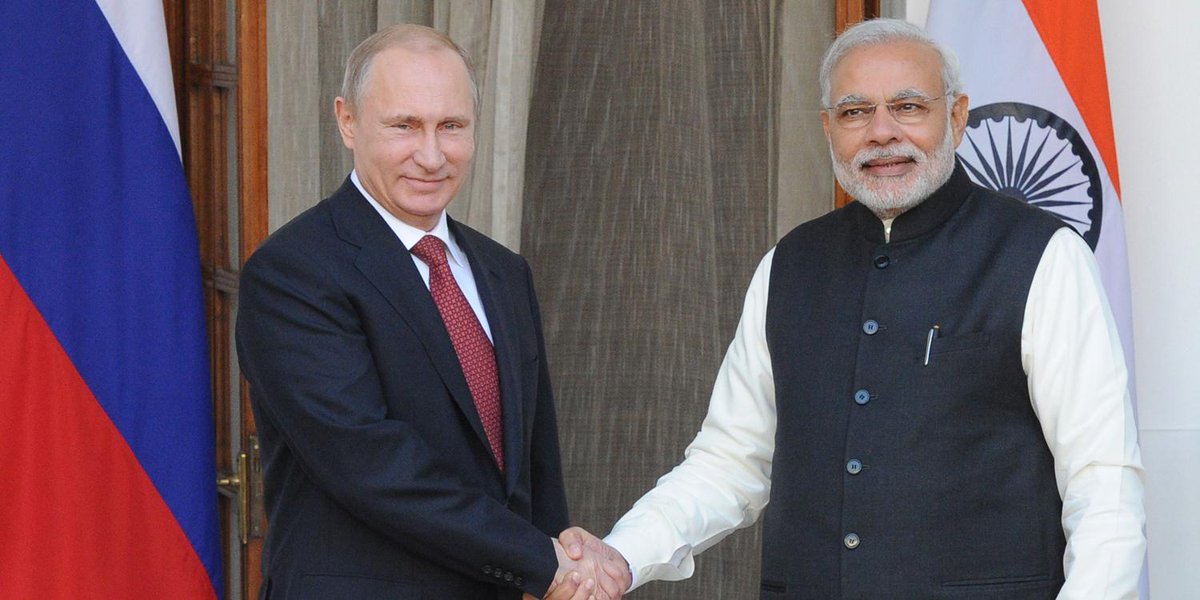
Indian Prime Minister Narendra Modi and Russian Prime Minister Vladimir Putin announced that their countries had signed 20 bi-lateral agreements including memorandums of understanding and commercial contracts on Thursday.

View image on Twitter

During Mr. Putin’s visit to India’s capital, the Russian leader said in a news conference that the documents placed an emphasis on trade and economic issues.

Eight of the agreements signed relate to nuclear power and energy production including a roadmap for bilateral cooperation in the civil nuclear energy sector over the next 20 years. Russia also agreed to supply “major equipment” to the Kudankulam nuclear power plant in Tamil Nadu.

India agreed to identify a second site apart from Kudankulam for Russian-designed nuclear power plants.

Mr. Modi said that they had “outlined an ambitious vision for nuclear energy” and would have “the highest standards of safety in the world.”

A list of the agreements signed is below as provided by India’s Ministry of External Affairs.

via The Vladimir Putin and Narendra Modi Agreements in Full – India Real Time – WSJ.

26/10/2014

Electricity: Generational shift | The Economist

MUCH of what China has achieved in the past three decades—its impressive economic growth, the rise of its global stature and the considerable improvement of living standards for hundreds of millions of people—is attributable to one decision: ditching the Maoist model of central-planning that had shackled the economy. Yet some important industries have yet to embrace the market. Power generation is one. As China struggles to reconcile its soaring energy demand with its need to clean up an increasingly toxic environment, reform is becoming more urgent.

China knows it must reduce its reliance on dirty coal and increase its use of (more expensive) renewable energy. Of the new power-generating capacity that China built last year, renewables such as wind and solar power for the first time accounted for more than the share made up of fossil fuels and nuclear energy.

China wants to satisfy the surging electricity demands of its increasingly urban population and to keep its industries running smoothly. It does both reasonably well and blackouts are rare. But officials fret about how grumpy—and vocal—people are becoming about the poisonous air that envelops so many Chinese cities. (An annual international marathon race, pictured above, took place in Beijing on October 19th in air that was nearly 14 times more polluted than the safety limit recommended by the World Health Organisation.) China is aware that its standing abroad will partly depend on its efforts to limit carbon emissions. This will involve weaning itself off coal, which supplies nearly 80% of its energy.

Progress is being hampered by a largely unreformed power industry dominated by large state-owned enterprises (SOEs) which operate under a mix of rigid planning, secrecy and poor regulation. Power suppliers have too little incentive to compete on price, efficiency or greenness. Two international NGOs, the World Wildlife Fund and the Energy Transition Research Institute, describe the SOEs that control all transmission and distribution and most non-renewable generation as “unregulated corporate monopolies”. Their bosses are usually appointed by the central government, but they often ally with regional leaders to resist oversight by a variety of largely toothless regulators.

One problem is China’s system for “dispatch”; that is, determining which power sources will supply electricity to the grid at any given time. A report by the Regulatory Assistance Project (RAP), an American NGO, notes that in most countries dispatch decisions are made in order to minimise costs (including environmental ones). In China regulations would appear to encourage a similar approach: grid-operators are supposed to give priority to electricity supplied by more efficient and greener producers. In practice, grid-operators are more inclined to help coal-fired plants recoup the cost of their investments. Both sides are members of a cosy club of energy-related SOEs. Even if the grid-operators were to try to stick to the rules, they would struggle. Coal plants can easily conceal how much they waste and pollute.

Generators of wind and solar energy thus find themselves handicapped by more than just the high cost of their technologies. Much of China’s most cleanly produced energy is wasted. For wind power, rates of “curtailment”, or energy generated but not taken up by the grid, have improved in recent years as grid systems have become better able to cope with the technical challenge of handling such unsteady sources of power. But the rate still stands at about 10% nationwide. In Britain it was less than 2% between 2011 and 2013.

The government launched pilot reforms in five provinces in 2007 to encourage more efficient dispatch, but they achieved little and have not been expanded. Max Dupuy of RAP’s Beijing office says the scheme met opposition because of its failure to compensate coal-fired plants for the revenue share lost to clean producers.

via Electricity: Generational shift | The Economist.

Law of Unintended Consequences

continuously updated blog about China & India

ChiaHou's Book Reviews

continuously updated blog about China & India

What's wrong with the world; and its economy

continuously updated blog about China & India