Posts tagged ‘prime minister of india’

04/06/2016

Dam completion signifies growing Indian influence in Afghanistan | Reuters

Prime Minister Narendra Modi visited Afghanistan on Saturday to mark the completion of a nearly $300 million hydroelectric dam project, the latest symbol of Indian investment in its South Asian neighbour.

The dam, originally built in western Herat province in 1976 before being damaged during the civil wars of the 1990s, was rebuilt by some 1,500 Indian and Afghan engineers, according to the Indian Ministry of External Affairs.

“It is symbol of our friendship and would usher in hope, light up homes, nourish the fertile fields of Heart and bring prosperity to the people of the region,” Modi said in a social media post as he departed for Afghanistan, the first stop on a five-country trip.

Afghan President Ashraf Ghani has nurtured closer ties with India in the past year as relations with Pakistan have deteriorated in the face of continued insurgent attacks and border tensions.

Afghanistan has walked a fine line as it accepts Indian aid, with Pakistan historically wary of any Indian influence in Afghanistan.

Salma Dam is another big step in deepening and broadening the relationship between Afghanistan and India,” Ghani said in a post on Twitter.

At more than 100 metres (330 feet) high and 540 metres (1,770 feet) wide, the dam is designed to generate 42 megawatts of power and help irrigate 75,000 hectares of land, according to Modi.

India has poured more than $1 billion into Afghanistan reconstruction projects and humanitarian aid, making it one of the largest donors to the war-torn country.

A new national assembly building in Kabul and major power line and road construction have been among the main projects funded by India.

Source: Dam completion signifies growing Indian influence in Afghanistan | Reuters

08/02/2016

GDP data to show economy racing, realities less rosy | Reuters

India will release data on Monday showing it remains one of the fastest growing economies in the world, but economists are struggling to reconcile that rosy picture with ground realities like weak exports, investment, and flat corporate order books.

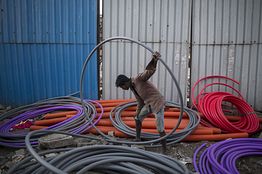
Labourers works at the construction site of a residential building in Mumbai, India, February 4, 2016. REUTERS/Shailesh Andrade

The median estimate from a Reuters poll of economists put GDP annual growth at 7.3 percent in the quarter through December, just below 7.4 percent in July-September.

If the data comes in line with expectations, it would be faster than 6.8 percent growth posted by China in the same quarter.

However, very few economists are ready to take the official data at face value, reckoning that it overestimates the pace of expansion in Asia’s third-largest economy.

“There are inconsistencies between the picture presented by new GDP series and many other tried and trusted real activity indicators,” said Rupa Rege Nitsure, group chief economist, L&T Finance Holdings, Mumbai.

Until a year ago, India was struggling to break out of the longest stretch of below 5 percent growth in a quarter of a century. But a change made a year ago to the method GDP is calculated transformed the lumbering South Asian giant overnight into one of the fastest growing major economies.

Yet, merchandise exports have been falling for the past 13 months. Rural spending is subdued on weak wage growth and two successive droughts.

Corporate order books are flat. While finished goods inventory to sales ratio is showing no improvement, raw material inventory to sales ratio has worsened.

With factories running nearly 30 percent below their capacity, firms are not in a hurry to invest in new plants and machinery. Festering problem of bad loans, meanwhile, has impeded credit flow and delayed full transmission of interest rate cuts.

There are some encouraging signs, however. Robust growth in indirect tax receipts suggest a nascent revival in manufacturing sector. Foreign direct investment is up. Low inflation, thanks largely to a crash in global commodity prices, has helped bolster urban demand.

Source: GDP data to show economy racing, realities less rosy | Reuters

22/01/2016

Prime Minister Narendra Modi flags off Mahanama Express in Varanasi – The Hindu

In his fifth visit to his constituency, Varanasi, after assuming power, Prime Minister Narendra Modi on Friday flagged off a new train, Mahanama Express, connecting the temple town to the national capital through Lucknow. Named after Pandit Madan Mohan Malviya, the founder of the Banaras Hindu University, the train is fully equipped with modern facilities and boasts of bio toilets in every coach and has renovated and refurbished AC-coaches fitted with led screen. The train will run thrice a week and cover the distance from Varanasi to New Delhi in 14 hours.

Prime Minister Narendra Modi interacts with a physically challenged child while distributing assistive devices at a function, in Varanasi on Friday.

Attending the Divyangjan Sashaktikaran Samaroh in Varanasi, Mr. Modi also gave away assisting electronic devices, artificial limbs, tricycles, Braille kits, hearing aids, teaching-learning material kit and other equipment to 9,296 ‘divyangs’ or specially-abled persons.

“When I say let us use the word ‘divyang’ it is about a change in mindset,” Mr. Modi said while reiterating his plea for doing away with the word “viklang” (handicapped) and instead calling the differently-abled as “divyang” (those born with a divine limb/organ).

“Let us not think about what is lacking in a person, let us see what is the extra ordinary quality a person is blessed with,” said Mr. Modi, who personally distributed electronic devices to around a dozen persons.

The PM last visited his constituency in December 2015 along with his Japanese counterpart Shinzo Abe. In his address, Mr. Modi recalled the visit and even praised Mr. Abe for appreciating and mentioning his trip to Varanasi in a speech in Japan. “In one year of this government, 1800 such camps have been held. While in the two decades not even a 100 camps were set up,” Mr. Modi said taking a jibe at previous Congress government’s indifference to the differently-abled. On the way to the function, a bus carrying ‘divyangs’ met an accident injuring around 20 persons. Taking cognizance of the matter, Mr. Modi ordered swift action and officials reached the spot. “Most of the received minor injuries, but some will need to be hospitalized for a few days. The government will make all arrangements for treatment,” Mr. Modi said.

The PM also interacted with ‘divyang’ children who have overcome disabilities relating to speech and hearing with the help of the ADIP (Assistance to Disabled Persons) scheme of the Centre.

“The result of such camps is that middlemen will get eliminated-nut bolts are being tightened and the shops of these middlemen are shutting down. And due to this some people are getting worried but not me. If I am in pained, it is by the plight of the poor in the country,” Mr. Modi said.

Source: Prime Minister Narendra Modi flags off Mahanama Express in Varanasi – The Hindu

06/01/2016

Pathankot attack: Congress asks Modi to ‘fix responsibility’ – The Hindu

Scaling up the offensive against the government over Pathankot terror attack, the Congress on Wednesday asked Prime Minister Narendra Modi to fix responsiblity for the “grave security lapse” and suggested that some heads must roll.

People light candles during a memorial service for the Indian soldiers killed in a militant attack at Pathankot air base, in Mumbai on Tuesday.

“They should realize that it has gone wrong and resignations should happen. If there is a lapse, resignations should happen,” former Home Minister Sushil Kumar Shinde told reporters at the AICC briefing when repeatedly asked whether Congress is demanding resignation of Home Minister Rajnath Singh or Defence Minister Manohar Parrikar into the matter.

“This government has totally failed. It has no system in place to protect the nation,” he added.

AICC Communication Department chairman Randeep Surjewala also said that the Prime Minister should fix the responsibility and take action against the Home and Defence Ministers.

“First responsibility is of the Prime Minister as he is the head of the government. Then Defence Minister and Home Minister are also responsible as they deal with the matter.

The Prime Minister should act decisively and not merely talk. “The Prime Minister should fix responsibility for this negligence and he reaches to the same conclusion that the nation has arrived at that there has been a huge lapse in the nation’s security, he should then take action against the Defence Minister and the Home Minister,” Surjewala said.

The party asked whether the Prime Minister and the BJP government would explain as to who was responsible for the “grave security lapse” as terrorists managed to reach Pathankot Air Base despite advance intelligence alert and reporting of prior incident.

Source: Pathankot attack: Congress asks Modi to ‘fix responsibility’ – The Hindu

30/11/2015

Smog chokes Chinese, Indian capitals as climate talks begin | Reuters

The capitals of the world’s two most populous nations, China and India, were blanketed in hazardous, choking smog on Monday as climate change talks began in Paris, where leaders of both countries are among the participants.

China’s capital Beijing maintained an “orange” pollution alert, the second-highest level, on Monday, closing highways, halting or suspending construction and prompting a warning to residents to stay indoors.

The choking pollution was caused by the “unfavourable” weather, the Ministry of Environmental Protection said on Sunday. Emissions in northern China soar over winter as urban heating systems are switched on and low wind speeds have meant that polluted air has not been dispersed.

In New Delhi, the U.S. embassy’s monitoring station recorded an air quality index of 372, which puts air pollution levels well into “hazardous” territory. A thick smog blanketed the city and visibility was down to about 200 yards (metres).

Air quality in the city of 16 million is usually bad in winter, when coal fires are lit by the poor to ward off the cold. Traffic fumes, too, are trapped over the city by a temperature inversion and the lack of wind.

However, the government has not raised any alarm over the current air quality and no advisories have been issued to the public. Thirty thousand runners took part in a half marathon at the weekend, when pollution levels were just as high.

In Beijing, a city of 22.5 million, the air quality index in some parts of the city soared to 500, its highest possible level. At levels higher than 300, residents are encouraged to remain indoors, according to government guidelines.

The hazardous air underscores the challenge facing the government as it battles pollution caused by the coal-burning power industry and will raise questions about its ability to clean up its economy at the talks in Paris.

Chinese President Xi Jinping and Indian Prime Minister Narendra Modi are both in Paris and both were scheduled to meet U.S. President Barack Obama on Monday to give momentum to the two-week negotiations.

Source: Smog chokes Chinese, Indian capitals as climate talks begin | Reuters

15/11/2015

How Modi Dealt With Pointed Questions From the British Press – India Real Time – WSJ

Narendra Modi hasn’t given a news conference in India since becoming prime minister last year.

So when he arrived in the U.K. on Thursday and addressed the media with his counterpart, David Cameron, British reporters seized the opportunity to ask a few pointed questions.

Referring to recent incidents of religious violence, BBC correspondent Justin Rowlatt kicked off by asking Mr. Modi: “India is becoming an increasingly intolerant place. Why?”

Mr. Modi answered, in Hindi: “India is the land of Buddha. India is the land of Gandhi. And so, it is in our culture and blood that we don’t accept anything against the basic values of society.”

He continued: “For us, every incident is serious. We don’t tolerate it under any circumstances. Law takes strict action and will continue to do so. India is a vibrant democracy, and its constitution provides for the safety of people from all strata of society. We are committed to protecting freedom of thought.”

A little later in the news conference, Guardian reporter Nicholas Watt asked Mr. Cameron what he felt about the visit. “How comfortable do you feel welcoming Prime Minister Modi to this country given that for the first two years of your premiership he was not permitted to visit this country because of his record as chief minister of Gujarat?”

The U.K. distanced itself from Gujarat and Mr. Modi after religious riots in the state that killed more than 1,000 people, mostly Muslims, in 2002, when Mr. Modi was the state’s top official. Mr. Modi has denied wrongdoing and court investigations have said there isn’t enough evidence to prosecute him.

Mr. Watt then asked about Europe’s migrant crisis and the U.K.’s referendum on European Union membership before turning back to India.

“Prime Minister Modi, can I ask you: Tomorrow night you will obviously have a rapturous reception at Wembley Stadium. But there are a number of protesters out today who are saying—and I am wondering what you say to them—that given your record as chief minister of the state of Gujarat, you do not deserve the respect that would normally be accorded to the leader of the world’s largest democracy.”

Mr. Cameron answered by citing Mr. Modi’s “record and historic majority” in the Indian parliament after the 2014 election. Mr. Modi then said he was never denied entry to the U.K. The U.S. refused him a visa in 2005 based on his response to the riots but issued him one in 2014, after he became prime minister.

“To keep the record straight, I would like to give some information,” Mr. Modi said. “I came here in 2003 and received a big welcome and respect, and participated in several programs. The U.K. has never stopped me from coming here, has never imposed any restrictions. I couldn’t come here due to a lack of time. That’s a different issue. So this is a wrong perception. Please correct it.”

Mr. Modi then spoke on the British referendum and proceeded to take a question on trade and economic cooperation from an Indian reporter. He never directly addressed the last part of Mr. Watt’s question.

Source: How Modi Dealt With Pointed Questions From the British Press – India Real Time – WSJ

12/11/2015

LIVE: PM Modi arrives in UK – The Hindu

Indian Prime Minister Narendra Modi’s Air India aircraft made touchdown this morning at 10 a.m. in Heathrow for his long-awaited bilateral level visit to the United Kingdom — his first since becoming Prime Minister.

Prime Minister Narendra Modi and his British counterpart David Cameron with their delegations during talks at 10, Downing Street in London on Thursday. Photo: PMO

He was met at the airport by Hugo Swire, Minister of State for the Foreign Office, and Priti Patel, Minister for Employment and Diaspora Champion in the David Cameron government. His visit carries expectations for agreements and partnerships worth billions of dollars across defence, security, finance and sectors like education, research and health.

Mr. Modi is accompanied by a high power business delegation that included Cyrus P. Mistry, chairman, Tata Sons, Sunil Bharti Mittal, chairman, Bharti Enterprises Limited and N. Chandrasekaran, CEO and managing director of Tata Consultancy Services.

Mr. Modi will be greeted by a Guard of Honour at Westminster,which will be followed by delegation level talks at 10 Downing Street with Mr. Cameron. The two Prime Ministers will address a joint press conference after which Mr. Modi will deliver his speech in parliament. He will also garland the statue of Mahatma Gandhi in Parliament Square. The evening will see important agreements between the two country delegations finalised at Guildhall, City of London. Mr. Modi will stay the night at the Prime Minister’s country residence at Chequers.

The pomp and ceremony attached to the visit is expected to include a special tricolour flypast by the Red Arrows Royal Air Force (RAF) Aerobatic Team over the Buckingham Palace before the Prime Minister sits down for lunch with Queen Elizabeth II ahead of his mega diaspora address at the iconic Wembley Stadium in north London.

Source: LIVE: PM Modi arrives in UK – The Hindu

07/11/2015

Modi pledges 800 billion rupees in relief and development for Kashmir | Reuters

Prime Minister Narendra Modi pledged 800 billion rupees ($12.10 billion) in funds to bolster development and economic growth in Kashmir, a year after the worst flooding in more than a century destroyed half a million homes there.

Addressing several thousand people in a cricket stadium in the northern state’s capital of Srinagar, Modi said he wanted to go beyond helping flood victims. He promised to create jobs for Kashmiri youth by improving education and promoting industries, including tourism and cashmere wool.

“The biggest task at hand here is to find work for the youth of Kashmir and Ladakh … our youth should get the cheapest and the best education, and of global standards,” he said. Ladakh is another mountainous region in the north.

Saturday’s visit is Modi’s first this year to the disputed territory which has been plagued by militant violence for years. Nuclear-armed rivals India and Pakistan both claim Kashmir in full but rule it in part.

Violence in India’s only Muslim-majority region has eased significantly from levels in the 1990s, when armed revolt against Indian rule erupted.

Kashmiris have been protesting against a lack of central aid for last year’s floods that the state government estimates caused $16 billion of damage.

Security forces in Kashmir detained nearly 400 separatists on Friday to prevent them from holding an anti-government protest march during Modi’s visit.

Hours before Modi’s rally, in footage screened on national television, police detained an independent parliamentarian, Engineer Rashid, for protesting with black flags.

Security was tight with paramilitary forces and sharpshooters deployed, while schools and colleges were shut. Internet services were suspended hours before Modi arrived.

In his 40-minute speech, Modi highlighted progress, promising improved road and rail networks, as well as branches of India’s prestigious management and technology institutes.

“Kashmir has suffered a lot … the dreams of several generations have been shattered, but I have the confidence that my Kashmir will rise again,” he said.

Comparing the devastation from the floods to that in his home state of Gujarat after an earthquake in 2001, Modi said: “thousands died … homes were destroyed … nobody believed we would be able to rebuild so quickly.”

India accuses Pakistan of backing the separatist militants fighting security forces in Indian Kashmir. Pakistan denies that saying it only offers diplomatic support to Kashmir’s suppressed Muslims.

Source: Modi pledges 800 billion rupees in relief and development for Kashmir | Reuters

24/08/2015

What the Indian and Pakistani Media Said About Canceled NSA Talks – India Real Time – WSJ

With talks set for Monday between India and Pakistan called off, the blame game is in full swing. Newspapers in both countries spilled a lot of ink on the vitriolic back-and-forth between New Delhi and Islamabad and tried to predict what would happen next.

India’s Amar Ujala, a Hindi-language daily newspaper, said Pakistan’s stubbornness had derailed the planned meeting between the two countries’ national security advisors.

The paper pointed to a joint statement by Indian Prime Minister Narendra Modi and his Pakistani counterpart, Nawaz Sharif, when they agreed to the talks in July, saying the two sides would discuss terrorism. “If Pakistan had an objection, it should not have signed the joint statement,” the paper wrote.

“Pakistan took India’s sovereignty too casually,” said another editorial in Navbharat Times, one of the most-widely read Hindi dailies, referring to a Pakistani demand that its security advisor be allowed to meet separatists from the disputed region of Kashmir ahead of the talks. “Now it can’t expect India to show respect.”

Some in India’s English-language press took a milder tone.

The Times of India, India’s most widely circulated English-language daily described the cancelation of talks as a “temporary setback.” In an editorial, it described the days before the talks were finally called off as a “prolonged game of chicken to see who blinks first.”


“There’s a more than even chance Pakistan will seek to escalate tensions on the so-far quiet northern stretches of the Line of Control,” said the Indian Express in an editorial published Monday referring to the border which divides India-and Pakistan-held Kashmir. The paper advised both countries of the need for “maturity and self-reflection” which it said was “little in evidence this past week.”

On the other side of the border, some in the Pakistani media held India accountable for the failure of the talks.

In an editorial, Dawn, one of Pakistan’s biggest newspapers, said the Indian government’s anger against “a fairly innocuous and standard meeting” between Pakistan and Kashmiri separatists was a sign of Indian Prime Minister Narendra Modi’s “true intentions.”

“He does not really want dialogue with Pakistan, but does not want to be seen rejecting talks outright in front of the international community,” Dawn said.

In Pakistan’s the Nation, an editorial said Pakistan’s decision to pull out of the talks mean it was “finally taking a stand” against India. “Enough is enough,” it said.

India was “not ready to settle” and Pakistan was now quitting its “good cop routine,” something the paper said Monday was the “right move.”

“India will make sure to repackage the situation as Pakistan refusing to talk, rather than India reneging on its promises. As the bigger country, as the more globally popular country, India will get away with that,” the paper concluded.

The Nawa-i-Waqt, a prominent national Urdu-language daily, said in an editorial Sunday that “from day one, it has been India’s policy to indicate its willingness to talk to Pakistan on all issues including Kashmir to deceive the world, but whenever the time nears for talks at any level, it makes some excuse to sabotage them.”

via What the Indian and Pakistani Media Said About Canceled NSA Talks – India Real Time – WSJ.

20/08/2015

What Stands in the Way of Modi’s Digital India – The Numbers – WSJ

Indian Prime Minister Narendra Modi has grand plans to expand the reach of the Internet to his country’s most far-flung citizens.  But some big numbers stand in his way.

1.06 billion

The number of Indians who currently don’t have access to the Internet. India’s offline population is greater than that of China and Indonesia–home to the next two largest unconnected groups–combined.

1 million

The number of miles of fiber optic cable needed to connect 250,000 village clusters in India to the Internet, according to a committee set up to get the project into gear. The original plan estimated that 370,000 miles of cable would do the job.

1%

The proportion of clusters of villages that up to June 30 were fully connected to Internet services in community centers, hospitals and schools under the National Fiber Optic Network that was launched in 2011.

2013

The original deadline for completion of the network. The date has since been shunted back twice and now stands at 2019.

$11.2 billion

The revised budget for the fiber optic network. Almost four times what was originally planned.

via What Stands in the Way of Modi’s Digital India – The Numbers – WSJ.

Law of Unintended Consequences

continuously updated blog about China & India

ChiaHou's Book Reviews

continuously updated blog about China & India

What's wrong with the world; and its economy

continuously updated blog about China & India