Posts tagged ‘United States’

03/10/2016

Furniture Retailing With Chinese Characteristics – China Real Time Report – WSJ

At the opening of Zaozuo’s first furniture store this month in Beijing, a shopper snoozed on a couch while others clambered onto wall-mounted shelves to take selfies perched in chairs.

Welcome to furniture retailing with Chinese characteristics.Online furniture startup Zaozuo Zaohua Zworks Ltd. opened the outlet in an upscale mall after hitting resistance from customers wary of buying bulky items without so much as a feel of the fabric, let alone a bit of shuteye.

Liu Yusi, a 33-year old human-resource executive living in Beijing, said the showroom is a good idea given that buying large pieces of furniture without a test drive can be a leap of faith, although she was a little disappointed there weren’t any beds on display. “Maybe the store is too small,” Ms. Liu said. “But I think a mattress is something you really need to lay on before you decide to buy.”

Zaozuo has tried to distinguish itself from competitors by letting customers vote on the design and style of furniture items at the prototype stage before they’re mass produced, a strategy it says reduces inventory and cuts cost. This is a Chinese adaptation of business models used by the likes of U.S. website Threadless.com — which conducts online polls of crowd-sourced T-shirt designs before producing winning entries – and by crowd-funding sites that have investors vote on ventures they’re willing to fund.

Zaozuo’s customers vote for the designs they’d like to buy. PHOTO: ZAOZUO, DON ARBOUR/THE WALL STREET JOURNAL

The approach has its skeptics. Guangdong Weiyuhua Furniture Co. says it thinks Zaozuo’s voting is a gimmick and questions whether selling furniture online is sustainable. “It targets a few rich people in cities like Beijing or Shanghai,” said company sales manager Li Songzhi. “Traditional furniture companies like ours have real stores all over China.”

With nearly 700 million online users, Chinese consumers are driving explosive growth in the e-commerce sector, undercutting traditional retailers and leaving new online ventures fighting for an edge. Zaozuo co-founders, Stanford business school graduates Shu Wei and Guan Zishan, say China’s struggling manufacturing sector needs a wakeup call as it battles rising debt and excess capacity.“

The old system is not working very well,” said Ms. Shu. “That was the starting point of our business model.”

One potential problem with the company’s voting system is possible voter fraud, says Travis Wu, China research director with consultancy Forrester Research Inc. “In China, everything is a bit tricky, and lots of people try to game the system,” Mr. Wu said. That could see designers tilt results toward their own models, for example, or allow competitors to steer Zaozuo into producing money-losing items, he said.

Another concern: with Zaozuo opening a showroom, it risks driving up costs and undercutting its advantage over traditional furniture makers. Mr. Guan says users must be registered before voting, the company watches carefully for unusual online activity and the new store is not a major investment.

Zaozuo, which attracted several thousand curious shoppers to its store launch on a recent weekend, sees itself inhabiting a competitive space between expensive designer brands and mass marketers like Sweden’s IKEA, a company that attracts its share of showroom lounge lizards. On any given weekend, entire families can be found snoozing on beds in Ikea’s massive showrooms, luxuriating in the air conditioning and enjoying the inexpensive food.

China’s fragmented furniture industry with around 5,000 large companies and combined revenue of 244.5 billion yuan [$37.3 billion] in 2015, up 16.1% increase from the previous year, is tradition-bound and due for a shakeup, say online companies. Internet furniture companies only command a tiny slice of the market but are growing rapidly. Privately held Zaozuo said sales are increasing by 40% annually although it has yet to break even. MZGF Furniture Studio Co., another online firm, said sales have been expanding by as much as 200% year on year in some months.

Zaozuo, which works with 50 Chinese factories and more than 80 European designers, has attracted $17.5 million in venture funding and hopes to eventually go public. Anna Fang, chief executive of venture capital group Zhen Fund, which has invested $1.3 million in Zaozuo, said prospects for the industry are promising but the startup may need to shorten delivery times, which range from three to 35 days. “Ikea can get furniture to you right away,” she added.At its store opening, Zaozuo said it tried to discourage shoppers from getting too comfortable on its furniture. “The customer might be comfortable, but the image is not that good for other customers who can’t feel the fabrics if someone’s sleeping on it,” said Mr. Guan. “Maybe they do it because they’re tired. Shopping can be very tiring.”

Source: Furniture Retailing With Chinese Characteristics – China Real Time Report – WSJ
29/09/2016

Chinese Tourists Encouraged to Behave Ahead of Mass Vacation – China Real Time Report – WSJ

Urinating on the streets of Hong Kong? Hurling hot water at flight attendants? Stealing wood from Lovers’ Beach in Thailand?

These are the kind of mainland-Chinese tourist antics that the motherland is looking to stub out ahead of the week-long national holiday known as Golden Week, when throngs of citizens travel both domestically and abroad.

To help them do so, the China National Tourism Administration and one of China’s dominant online travel firms, Ctrip.com International, are teaming up to find model tourists to promote travel behavior worthy of emulation—and national recognition.

“Civility of Chinese tourists is an important indicator of a country’s soft power and one of the major ways to export a country’s influence,” the tourism administration’s Vice Chairman Wang Xiaofeng said at an event announcing the campaign.

The two organizations, along with state-run newspaper China Daily, are asking the Chinese public to provide examples of what they think is model traveler decorum. Ctrip will give gifts to exemplary participants, such as free travel products and company souvenirs, said Ctrip senior director of investment relations Zhou Shiwei.

“The campaign is about changing the perception of Chinese travelers,” he said. “We definitely want Chinese travelers to be well-received abroad.

”Examples include pictures of Chinese soccer fans who picked up trash in Seoul, even after the Chinese men’s team lost to South Korea earlier this month, or photos of Chinese tourists patiently waiting in line.Ctrip says the campaign is aiming to publish a compilation of guidelines and pictures suggested by Chinese netizens during Golden Week. Chinese tourists can upload pictures via Chinese social-media network Weibo, and to the China Daily website. It is unclear how the photos will be verified.More than 600 million Chinese are expected to travel abroad in the next five years, as China’s middle class grows and visa restrictions ease in some countries welcoming Chinese spending. Last year, about 120 million Chinese traveled overseas—10% more than in 2014, according to the national tourism administration.

Domestically, tourism generated about $620 billion last year, with more than four billion trips taken.

The campaign, entitled “Good Chinese Tourists,” is an addition to other recent efforts the government has put forth to curb travel misbehavior. Last year, it unveiled new measures that allow authorities to track the bad habits of wayward tourists for up to two years.

The tourism administration also recently published a guidebook on civilized tourism, in which it urges tourists to refrain from spitting and littering—common practices back home—and to take photographs only where permitted. “Do not chase, beat or feed animals,” it adds. “Do not be greedy with complimentary items.

”For traveling abroad, the guide includes recommendations that cutting in line is “shameful wherever you are” and suggests that tourists “not leave footprints on toilet seats.”

Source: Chinese Tourists Encouraged to Behave Ahead of Mass Vacation – China Real Time Report – WSJ

27/09/2016

What India’s Decision to Ratify Paris Climate-Change Pact Means – India Real Time – WSJ

India’s announcement that it would ratify the 2015 global agreement on climate change increases the chances that the pact will go into effect this year.

Source: What India’s Decision to Ratify Paris Climate-Change Pact Means – India Real Time – WSJ

15/09/2016

Why water war has broken out in India’s Silicon Valley – BBC News

On Monday afternoon, a school bus was stopped in the Banashankari area in southern Bangalore. Three drunk men got into the bus and asked aloud: “Which child belongs to Karnataka and and which child belongs to Tamil Nadu?”

The 15-odd students, aged between 10 and 14, were stunned. Their school had asked them to leave early because the situation was tense, with violence and arson breaking out in many parts of the city.

“Luckily the driver handled it tactfully. He told the intruders that everyone was a native of Bangalore and that their families supported Karnataka on [water sharing with] Cauvery,” said a parent, not wanting to be identified.

Battle for access

By dusk, dark smoke had filled the Bangalore skies. Some 35 buses had been set on fire by protesters, just because the buses belonged to a travel agency whose owner is Tamil.

Is India facing its worst-ever water crisis?

India to ‘divert rivers’ to tackle droughtEarlier this month India’s Supreme Court ruled that Karnataka must release 12,000 cubic feet of water per second to Tamil Nadu from the Cauvery river until 20 September. Both states say they urgently need the water for irrigation and a battle about access to it has raged for decades.

Karnataka says water levels in Cauvery have declined because of insufficient rainfall

India’s water war

The Cauvery originates in Karnataka and flows through Tamil Nadu before joining the Bay of Bengal.

The dispute over its waters originated in the 19th Century during the British rule between the then Madras presidency (modern day Tamil Nadu) and the province of Mysore (now Karnataka).

Karnataka and Tamil Nadu have both argued that they need the water for millions of farmers in the region.

The Cauvery river water tribunal was set up in 1990 after the failure of several rounds of talks between the two states.

Dozens of meetings have been held to find a settlement to the century-old dispute.

In 2007, the tribunal ruled Tamil Nadu state would get 419bn cubic feet of water a year. Karnataka would get only 270bn.

Karnataka says water levels in the Cauvery have declined because of insufficient rainfall – 42% of the 3,598 irrigation tanks in the state are dry – and that it cannot therefore share water with Tamil Nadu. So Tamil Nadu went to the top court demanding 50,000 cubic feet of water per second.

When the Supreme Court on 2 September asked Karnataka to “live and let live”, the state softened and offered to release 10,000 cubic feet of water per second to Tamil Nadu every day for five days.

On 5 September however, the top court ordered Karnataka to release 15,000 cubic feet of water per second for 10 days. This ruling was later modified to 12,000 cubic feet of water per second until 20 September.

This would mean that nearly a quarter of the water now available in the Cauvery basin will flow into Tamil Nadu.

A truck from neighbouring Tamil Nadu set on fire in Bangalore

Tamil Nadu says it badly needs the river water for irrigation. Drought-hit Karnataka argues that most of the river water is now needed for drinking water supplies in Bangalore and some other cities, leaving no water for irrigation at all.

But even farmers in Tamil Nadu are unhappy with their share.P Ayyakannu, president of the local South Indian Rivers Interlinking Farmers Association, called it “akin to giving pigeon feed to an elephant”.

Rising violenceFeeling let down by the top court’s order, Karnataka is boiling.

The main city of Bangalore is the worst affected: the violence in the technology hub forced the closure of many offices and much of the public transport system. Police have imposed an emergency law that prohibits public gatherings, and more than 15,000 officers have been deployed across the city.

One person was killed when police opened fire on protesters on Monday evening. Buses and trucks bearing Tamil Nadu number plates have been attacked and set on fire. Schools and colleges are closing early and many businesses are shut.

A group of activists belonging to a fringe pro-Karnataka group assaulted an engineering student because he had ridiculed Kannada film stars for supporting the strike on Friday, by posting memes on Facebook. The student was hunted down and forced to apologise.

Across the border, in Tamil Nadu, petrol bombs were hurled at a popular restaurant owned by a resident of Karnataka in Chennai while the driver of a vehicle with Karnataka number plates was slapped and ordered to say “Cauvery belongs to Tamil Nadu”.

Normal life has been disrupted in Bangalore

Protests have shut down Bangalore city

The latest violence brings back memories of the anti-Tamil riots in Bangalore in 1991 over the same issue.

Then, some 200,000 Tamils were reported to have left the city, after incidents of violence and arson targeting them.

There was a proposal in 2013 to set up a panel comprising representatives from the two warring states to resolve disputes over river water sharing.

But successive governments have dragged their feet on this, and the two leaders – Karnataka chief minister Siddaramaiah and his counterpart in Tamil Nadu, Jayaram Jayalalitha – have not reached out to each other to resolve the crisis. And with Delhi reduced to being a reluctant referee, the onus has fallen on the Supreme Court to crack the whip.

Source: Why water war has broken out in India’s Silicon Valley – BBC News

06/09/2016

Early Look: China’s Economy Likely Perked Up as Summer Wound Down – China Real Time Report – WSJ

After a summer lull, China’s economy is likely to have picked up, if only slightly, in August, according to economists.

The stirring in business activity, while lackluster, points to stabilization in the world’s second-largest economy, a survey of 15 economists by The Wall Street Journal showed. August data numbers to be released in coming days are expected to show that factory output improved marginally and new bank credit picked up, while investment and retail sales slowed, though not by much, the survey said.“We expect the upcoming August data release to show China’s economic activity finding a slightly firmer footing after July’s more-than-expected weakening,” said economists at UBS Securities Asia Ltd.

A surprising rise in a key gauge of manufacturing activity earlier this month buoyed the outlook for many economists.Industrial output, a rough proxy for economic growth, likely grew 6.2% in August from a year earlier, compared with a 6.0% increase in July, the survey showed. Fixed-asset investment outside rural households, a key gauge of construction activity, likely expanded 7.9% for the January-to-August period, slightly slower than an 8.1% increase over the first seven months.

Retail sales likely climbed 10.1% in August, a tick down from July’s 10.2% growth.

Among the other positive signs, the consumer-price index, a main gauge of inflation, moderated, likely rising 1.6% from a year earlier last month and slightly slower than the 1.8% growth in July, the survey found. Meanwhile, the producer-price index, a gauge of factory gate prices, likely dropped 0.9% from a year earlier last month, improving from a 1.7% decline in July and continuing a march out of deflationary territory where it has been for more than four years.

The better performance should give policymakers confidence to stay the course and refrain from interest-rate cuts or other aggressive easing measures, economists said.

At the same time, the faint improvements are largely the result of better performance of large firms that benefit more from policy support, economists said, while growing piles of debt and percolating bubbles in the property market are a looming concern for policymakers.

“At this moment, the key constraint faced by China’s monetary policy is not inflation, but the property market and the financial market,” said economists at Macquarie Capital Ltd.

Chinese banks probably gave out 792.5 billion yuan ($118.69billion) in new credit last month, well above July’s 463.6 billion yuan, the survey of economists showed. The economists mainly attributed the rebound to seasonal patterns, since banks tend to pick up the pace of lending at the end of each quarter.

In July almost all the new credit went to medium- and long-term household loans, predominantly mortgage lending. Lending to corporate borrowers, however, recorded a net drain of 2.6 billion yuan, the first negative growth in 11 years.

Household mortgage loans may have continued to surge in August. Recent data show a jump in housing transactions in many cities, and housing prices continue to rise. Credit demand from the corporate sector likely remained sluggish, though may have improved mildly, economists of Standard Chartered Bank.

Trade also remained anemic. Outbound shipments likely declined 4.0% from a year earlier in August, compared with July’s drop of 4.4%, while imports likely dropped by 5.0%, improving notably from July’s 12.5% dip, the same poll showed. Improvements in imports reflect last year’s low base, likely slightly better industrial production activity, and continued easing of import price deflation, UBS economists noted.

That would bring the country’s trade surplus to $59.40 billion last month, widening from July’s $52.31 billion. A large trade surplus should lend support to the country’s hoard of foreign currencies, which is expected to have dropped only slightly last month. The nation’s total reserves likely fell by about $2 billion last month to $3.199 trillion, the survey showed.

Source: Early Look: China’s Economy Likely Perked Up as Summer Wound Down – China Real Time Report – WSJ

03/09/2016

China tourism: Crossing the new glass bridges – BBC News

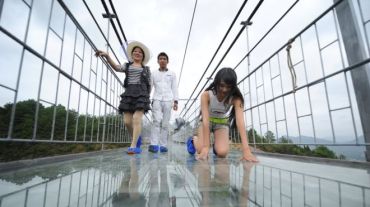
Tourism sites in the central Henan and Hunan provinces have been constructing vertigo-inducing skywalks in a bid to attract visitors.

And it seems to have worked, attracting thrill-seeking tourists and locals, all wanting a chance to experience a bird’s eye view of the Chinese countryside.

One of them is student Li Shu Zhen, 19, from Hangzhou city.

She shared with the BBC her experience of climbing the Brave Man’s Bridge in Pingjiang county, Hunan province.

“You look down and feel a sense of fear, but you quickly recover from that and enjoy the scenery,” she said.

“It was beautiful, almost as if one was walking on air.”

Yoga has been one of the stranger activities performed on the Brave Man’s Bridge

An eating challenge was held on this bridge in Yueyang country – although you might lose your appetite if you look downT

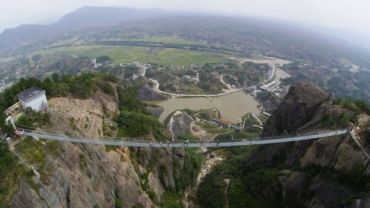
he fully transparent bridge, which measures 300m long (984ft) and 180m high, first opened to the public in September.

It is one of the more popular bridges, with events – like mass yoga displays – often being staged on it.

Local officials say that glass panels were designed to withstand high winds and earthquakes, as well as the “weight of 800 visitors”.

Glass bridge fever has also spread to neighbouring Taiwan, where a 179m-high bridge opened in Nantou county.

Construction has already begun on a second glass bridge above Zhangjiajie valley in Hunan province

‘Even if the glass breaks’

Construction on the latest bridge, touted as the world’s longest glass-bottomed walkway, is also nearing completion.

Standing at 300m high and stretching 375m, the bridge will hang above the Zhangjiajie grand canyon, also in Hunan province.

Gearing up for the bridge’s 2016 opening, officials have even enlisted the public’s help in naming it.

One of its engineers, Yang Guohong, from state-owned China Railway Major Bridge Reconnaissance and Design Institute, said contractors had taken extra safety precautions.

“No matter how the tourists jump on the bridge, it will still be fine,” he told the People’s Daily newspaper.

“The steel structures beneath it are incredibly dense, so even if the glass breaks, visitors won’t fall through.”

Would you dare to walk across?

But architects who spoke to the BBC said that such glass bridges were often “primarily a novelty, built as visitor attractions rather than commuter bridges”.

Architect Keith Brownlie, who was involved in a glass bridge for The London Science Museum, said that the appeal was “thrill”.

“It is the relationship between emotionally driven fear and the logical understanding of safety,” he said. “These structures tread the boundary between those two contrasting senses and people like to challenge their rational mind in relation to their irrational fear.

“Others felt that the bridges symbolised extravagance, especially in China.

“In architecture, glass has always been associated with luxury and often as a display of wealth,” said bridge designer Ezra Groskin.

“Glass floor panels, used in the creation of invisible architecture, are not a new phenomenon. However its use is often restricted due to cost and practicality.”

A terrifying incident last October sent visitors fleeing in fear after a section of a glass bridge in Yuntai mountain, Henan province, cracked

Shattered nerves

But how safe are China’s glass bridges?

An incident in October sent terrified visitors fleeing in fear after part of a glass skywalk in Henan province’s Yuntai Mountain Geological Park cracked, despite only being open for two weeks.

Park officials closed the walkway immediately, later saying there was “no reason for worry” and that the cracks had “no impact on safety”.

But experts questioned the use of glass in an exposed mountain environment.

“While a glass structure designed by a competent engineer and manufactured by a specialist contractor has no greater risk in terms of structural integrity than any other building material, glass can be prone to localised shocks,” noted architect Adam Holicska.

“The use of it in a mountain environment where there is a potential risk of rock impact can make it a questionable choice.

“Architect Keith Brownlie added that the cleaning of glass panels and lack of slip resistance should also be considered in such an environment.”One issue with glass decks is the problem of grip,” he said. “Glass is slippery and so anti-slip properties must be provided,”

The glass-bottomed Brave Man’s Bridge in Hunan province connects two mountains

“Please, no more such bridges,” commented a user on China’s popular micro-blogging site Weibo. “Judging from this incident, it is only a matter of time before more serious accidents and deaths occur.

“But glass bridge enthusiasts remain undeterred.

“I still would not hesitate to visit other glass bridges soon,” Ms Li admitted.

Other netizens on the site also expressed similar opinions.

“I am confident that officials will step up additional measures after that happened,” said one Weibo user.

“Thankfully deaths were avoided but one bad incident should not put one off from conquering such a spectacular bridge.”

Another compared it to other bridges of the world: “If Sydney’s Harbour Bridge experienced a crack, I doubt government officials would close it down. So we should not let such an episode affect our opinions about our unique Chinese structures.”

Source: China tourism: Crossing the new glass bridges – BBC News

26/08/2016

China’s Oil Industry Destined for Big Changes – China Real Time Report – WSJ

China’s largest oil fields are the stuff of Communist Party folklore, but today they’re potent symbols of the challenges facing China’s energy industry.

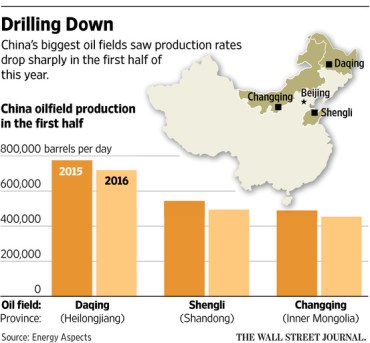
Significant falls in the first half of this year at China’s biggest-producing oil fields — Daqing, Shengli, and Changqing — have solidified a moment anticipated by the global energy industry: Oil production in China is in long-term decline.

The turnabout is jarring for an industry that has long held huge political sway in China. The “Daqing Spirit”– meaning hard work in the face of challenges — has long been celebrated by top leaders. The companies have been held up as critical to fueling China’s economic rise.

The London-based consultancy Energy Aspects compiled data from China’s oil fields. It shows just how great a toll the plunge in crude prices has taken on overall domestic production.

China’s three biggest oil fields experienced production declines of between 7-9% in the first half, according to Energy Aspects. That far outpaced China’s production decline as a whole. Small gains from output in the Xinjiang region and elsewhere haven’t been enough to compensate.

The declines are important, Energy Aspects said in a recent report, “because it symbolizes a significant shift in thinking” by Chinese officials. While the government has a long-held goal of limiting imports — and protecting jobs in places like Daqing — by keeping production high, leaders seem to have realized that track was both unsustainable and expensive.

With global crude prices under $50 per barrel, many aging wells at big oil fields in China lose money with each barrel they pump. Shutting off the taps at home helps to stem losses when cheaper oil can be purchased from overseas.

So what does it mean?In short, the assets that long served as the cornerstone for revenue for companies such as PetroChina are drying up. If China’s energy giants want to be more profitable–as outside investors and China’s government are pressuring them to do–they’re going to need to look to diversify revenue.

That’s likely to include a mix of initiatives, say Chinese executives and analysts. One part of the drive might be trying to secure new oil production overseas. That would mean a renewed push for outbound deals. Big discoveries in Brazil and elsewhere appear particularly attractive to China.

The other path to future growth is more complicated. For example, China’s oil companies are keen to learn how to boost sales and profits at the thousands of retail gas stations across China. Earning more money from sales of Snickers bars or cigarettes would make them somewhat less vulnerable to the vicissitudes of global oil prices.

The bottom line: China’s oil industry, like the economy as a whole, is destined for big changes. Many of those in the coming years will involve a greater global role for the oil giants — PetroChina, Sinopec, and Cnooc — than they currently have today.

The bigger global footprint is inevitable, says one person with ties to China’s top oil executives, as production at home begins to dwindle. The international revenues are needed to stave off a domestic slowdown.

“We are coming. We are coming,” he said.

Source: China’s Oil Industry Destined for Big Changes – China Real Time Report – WSJ
25/08/2016

China’s logistic hub in Djibouti to stabilize region, protect interests – Global Times

About 7,700 kilometers away from Beijing, in Djibouti in the Horn of Africa, China’s first overseas installation for naval vessels is under construction.

Scheduled to be completed in 2017, the base is set to resupply Chinese warships, according to government statements.

But despite Beijing’s insistence that the facility will simply help with escort missions, peacekeeping and humanitarian rescues in the Gulf of Aden and the waters off Somalia, many have argued this move represents Chinese “military expansion” beyond the Asia-Pacific region.

“Through exaggerating or distorting, they attempt to hype the ‘threat of China’ and tarnish China’s image, so as to suppress China’s efforts to build maritime power,” Li Jie, a Beijing-based maritime expert, told the Global Times.

“The base is far less than a military base in its scale and function,” said Zhang Junshe, a researcher from PLA Naval Military Studies Research Institute. “The base will be a logistic hub for Chinese vessels to get replenishment and temporary rest. It differs from US-style military bases, which have become bridgeheads for the country to easily and quickly wield military deterrence or intervention to other territories,” Li noted. The Republic of Djibouti, located in a strategically important position between the Indian Ocean and the Red Sea, hosts the military facilities of several countries, including the US, Japan and France, the country’s former colonial ruler. Italy and Spain also have permanent military installations in the country, according to a recent report by Hong Kong-based Phoenix TV.

These countries have stationed a variety of assets in these bases, including personnel, ships, UAVs and surveillance aircraft which are used for anti-terror and anti-piracy operations in Africa and the Middle East.

International obligations

The news that China will build a “military base” in Djibouti was first revealed in May last year, when Djiboutian President Ismail Omar Guelleh told AFP that “discussions are ongoing,” and China’s presence would be “welcome.

“Since then, it has aroused wide attention and concern. The US even reportedly protested against it. “Washington protested against the China-Djibouti pact and expressed concern over China’s plans to build a military base in the Obock region, but to no avail,” according to an article published in April on foreignaffairs.com, a US-based international affairs news portal.

At a regular press briefing on November 26, 2015, China’s foreign ministry first confirmed that China was negotiating with Djibouti over the construction of a “logistics facility.” Spokesman Hong Lei citied the need to resolve resupply difficulties for Chinese escort vessels, adding “[The facility] will be significant for Chinese army to fulfill its international obligations and safeguard global and regional peace and stability.”

Three months later at a press briefing by Chinese defense ministry on February 25, spokesman Wu Qian told media that China had reached an agreement with Djibouti to build a facility and construction had already begun. According to official figures, China has deployed more than 30,000 personnel on peacekeeping missions, the most of any of the five permanent members of the UN Security Council.Since 2008, China has sent 22 escort fleets, a total of more than 60 vessels, to the Gulf of Aden and Somali waters, escorting more than 6,000 ships from home and abroad.

In March last year, hundreds of Chinese nationals threatened by escalating violence in Yemen were evacuated to Djibouti by their government.

But currently, these fleets need to dock in the ports of other countries to get rest and food supplies. “They need to organize people to purchase food locally. Besides, due to different types of fuels, refueling is also a problem,” Zhang said.

The new base will help China save money. Yang Huawen, a captain from China’s Northern Theater Command who joined a 10-month peacekeeping operation in Mali in 2014, is happy this facility is being built.

“In those tropical areas, the food goes bad quickly. The cost of mending equipment and maintenance is high,” Yang told the Global Times. “Building a logistic hub in the region can provide stable supplies efficiently and economically.”

Djibouti, with a landmass of 23,200 square kilometers of which 90 percent is volcanic desert, is poor in natural resources. Its ability to produce fruits, vegetables, and seafood is limited, according to a Chinese national who has spent time in the country. “Most of its vegetables are imported from its neighbor Ethiopia. Vegetables sell for there as much as five to 10 times what they do on the domestic market in China,” said the person.

Zhang also cited another advantage of the new facility – the Chinese government needn’t conduct diplomatic negotiations with the host country each time its vessels dock in their port.


Source: China’s logistic hub in Djibouti to stabilize region, protect interests – Global Times

25/08/2016

Iran keen to join China in rival to Panama Canal | Business | The Times & The Sunday Times

Iran has expressed interest in joining forces with a Chinese company that plans to build a $50 billion canal across Nicaragua that links the Atlantic and Pacific and rivals the Panama Canal.Mohammed Javad Zarif, the Iranian foreign minister, said that business leaders who went with him to the Central American state this week had discussed teaming up with HKND, a private Hong Kong company that has broken ground on the project but made little progress in the past two years.

Iranian involvement in a Chinese-run strategic waterway may raise concerns in the United States, which was instrumental in building the Panama Canal a century ago.

Daniel Ortega, Nicaragua’s left-wing president, shares Iran’s antipathy towards the US and is favoured for re-election in polls this November.

The project to build the 172-mile waterway has caused controversy at home, where environmentalists say that the route would take supertankers across Lake Nicaragua, bulldoze fragile ecosystems and involve the biggest earth-moving operation in history.

With an estimated 30,000 people likely to be displaced by construction, there have been protests against the canal, although the government insists that more than 80 per cent of the population of the country backs it. Amnesty International has denounced what it called Nicaragua’s “reckless handling” of the project.

There have been doubts about the financial health of Wang Jing, the Hong Kong tycoon behind the canal, and whether he might be backed by the Chinese government, which has massively invested across Latin America and Africa in the past decade.

Mr Wang is understood to have lost more than 80 per cent of his $10 billion fortune as a result of the volatility in the Chinese stock market. The project managers say that it is an international initiative not dependent on the vagaries of the Chinese share prices. After the groundbreaking ceremony in December 2014, the project appeared to have been put on hold, prompting speculation that it had run out of steam.

However, Mr Wang’s HKND group said this year that work on the Pacific terminal and wharf would begin this month, with work on the canal scheduled to start at the end of the year.

Mr Zarif, whose country recently had years of crippling US sanctions lifted, is on a tour of Latin America that began on Monday in Cuba, which has renewed diplomatic ties with the US but has yet to have its own half-century of sanctions lifted.Nicaragua was Mr Zarif’s second stop with an entourage of 120 Iranian business leaders and state economists, and he was scheduled to head on to Ecuador, Venezuela, Bolivia and Chile.

Source: Iran keen to join China in rival to Panama Canal | Business | The Times & The Sunday Times

22/08/2016

Capturing China’s $5 trillion productivity opportunity | McKinsey & Company

It won’t be easy, but shifting to a productivity-led economy from one focused on investment could add trillions of dollars to the country’s growth by 2030.

After three decades of sizzling growth, China is now regarded by the World Bank as an upper-middle-income nation, and it’s on its way to being one of the world’s advanced economies. The investment-led growth model that underpinned this extraordinary progress has served China well. Yet some strains associated with that approach have become evident.In 2015, the country’s GDP growth dipped to a 25-year low, corporate debt soared, foreign reserves fell by $500 billion, and the stock market dropped by nearly 50 percent. A long tail of poorly performing companies pulls down the average, although top-performing Chinese companies often have returns comparable with those of top US companies in their industries. More than 80 percent of economic profit comes from financial services—a distorted economy. Speculation that China could be on track for a financial crisis has been on the rise.

The nation faces an important choice: whether to continue with its old model and raise the risk of a hard landing for the economy, or to shift gears. A new McKinsey Global Institute report, China’s choice: Capturing the $5 trillion productivity opportunity, finds that a new approach centered on productivity could generate 36 trillion renminbi ($5.6 trillion) of additional GDP by 2030, compared with continuing the investment-led path. Household income could rise by 33 trillion renminbi ($5.1 trillion), as the exhibit shows.

Pursuing a new economic model

China has the capacity to manage the decisive shift to a productivity-led model. Its government can pull fiscal and monetary levers, such as raising sovereign debt and securing additional financing on the basis of 123 trillion renminbi in state-owned assets. China has a vibrant private sector, earning three times the returns on assets of state-owned enterprises. There are now 116 million middle-class and affluent households (with annual disposable income of at least $21,000 per year), compared with just 2 million such households in 2000. And the country is ripe for a productivity revolution. Labor productivity is 15 to 30 percent of the average in countries that are part of the Organisation for Economic Co-operation and Development (OECD).

A new productivity-led model would enable China to create more sustainable jobs, reinforcing the rise of the consuming middle class and accelerating progress toward being a full-fledged advanced economy. Such a shift will require China to steer investment away from overbuilt industries to businesses that have the potential to raise productivity and create new jobs. Weak competitors would need to be allowed to fail rather than drag down profitability in major sectors. Consumers would have more access to services and opportunities to participate in the economy.

Making this transition is an urgent imperative. The longer China continues to accumulate debt to support near-term goals for GDP growth, the greater the risks of a hard landing. We estimate that the nonperforming-loan ratio in 2015 was already at about 7 percent, well above the reported 1.7 percent. If no visible progress is made to curb lending to poorly performing companies, and if the performance of Chinese companies overall continues to deteriorate, we estimate that the nonperforming-loan ratio could rise to 15 percent. This would trigger a substantial impairment of banks’ capital and require replenishing equity by as much as 8.2 trillion renminbi ($1.3 trillion) in 2019. In other words, every year of delay could raise the potential cost by more than 2 trillion renminbi ($310 billion). Although such an escalation would not lead to a systemic banking crisis, a liquidity crunch among corporate borrowers and waning confidence of investors and consumers during the recovery phase would have a significant negative impact on growth.

Our report identifies five major opportunities to raise productivity by 2030:

  • unleashing more than 39 trillion renminbi ($6 trillion) in consumption by serving middle-class consumers better
  • enabling new business processes through digitization
  • moving up the value chain through innovation, especially in R&D-intensive sectors, where profits are only about one-third of those of global leaders
  • improving business operations through lean techniques and higher energy efficiency, for instance, which could deliver a 15 to 30 percent productivity boost
  • strengthening competitiveness by deepening global connections, potentially raising productivity by 10 to 15 percent

Capturing these opportunities requires sweeping change to institutions. China needs to open up more sectors to competition, enable

corporate restructuring, and further develop its capital markets. It needs to raise the skills of the labor force to fill its talent gap and to sustain labor mobility. The government will need to manage conflicts among many stakeholders, as well as shift governance and incentives that rewarded a single-minded focus on rising GDP, even as it modernizes its own processes.

Exactly how can China’s economy become more productive? Go to Tableau Public to examine how six industry archetypes contribute to the country’s growth by province.

Source: Capturing China’s $5 trillion productivity opportunity | McKinsey & Company

Law of Unintended Consequences

continuously updated blog about China & India

ChiaHou's Book Reviews

continuously updated blog about China & India

What's wrong with the world; and its economy

continuously updated blog about China & India