Posts tagged ‘United States’

16/06/2016

U.S., India and Japan Begin to Shape a New Order on Asia’s High Seas – India Real Time – WSJ

From the waters of the Philippine Sea this week emerged a partial outline of Washington’s vision for a new Asian maritime-security order that unites democratic powers to contend with a more-assertive and well-armed China.

A U.S. Navy aircraft-carrier strike group along with warships from India and Japan jointly practiced anti-submarine warfare and air-defense and search-and-rescue drills in one of the largest and most complex exercises held by the three countries.

The maneuvers were being tracked by a Chinese surveillance vessel, a U.S. Navy officer aboard the carrier USS John C. Stennis said on Wednesday. Last week, China’s Foreign Ministry spokesman Hong Lei said Beijing hoped the training “will be conducive to regional peace, security and stability.

”Washington and Tokyo have long cooperated closely on defense. And the U.S. has been working to deepen strategic ties with India and to encourage New Delhi to play a more active role, not just in the Indian Ocean but also in the Pacific, as China’s rise shifts the regional balance of power.

Americans are looking for those who can share the burden,” said C. Raja Mohan, director of the Carnegie Endowment for International Peace’s India center. A strengthened three-way partnership among the U.S., Japan and India is “an important strategic shift.”

Source: U.S., India and Japan Begin to Shape a New Order on Asia’s High Seas – India Real Time – WSJ

09/06/2016

China leads resistance to India joining nuclear export club | Reuters

China is leading opposition to a push by the United States and other major powers for India to join the main club of countries controlling access to sensitive nuclear technology, diplomats said on Thursday as the group discussed India’s membership bid.

Other countries opposing Indian membership of the Nuclear Suppliers Group (NSG) include New Zealand, Ireland, Turkey, South Africa and Austria, diplomats said.

The 48-nation NSG aims to prevent the proliferation of nuclear weapons by restricting the sale of items that can be used to make those arms.

India already enjoys most of the benefits of membership under a 2008 exemption to NSG rules granted to support its nuclear cooperation deal with Washington, even though India has developed atomic weapons and never signed the nuclear Non-Proliferation Treaty (NPT), the main global arms control pact.

Opponents argue that granting it membership would further undermine efforts to prevent proliferation. It would also infuriate India’s rival Pakistan, which responded to India’s membership bid with one of its own and has the backing of its close ally China.

“By bringing India on board, it’s a slap in the face of the entire non-proliferation regime,” a diplomatic source from one of a handful of countries resisting India’s push said on condition of anonymity.

A decision on Indian membership is not expected before an NSG plenary meeting in Seoul on June 20, but diplomats said Washington had been pressuring hold-outs, and Thursday’s closed-door meeting was a chance to see how strong opposition is.U.S. Secretary of State John Kerry wrote to members asking them “not to block consensus on Indian admission to the NSG” in a letter seen by Reuters and dated Friday.

China, however, showed no sign of backing down from its opposition to India joining unless Pakistan becomes a member. That would be unacceptable to many, given Pakistan’s track record — the father of its nuclear weapons program sold nuclear secrets to countries including North Korea and Iran.

“China, if anything, is hardening (its position),” another diplomat said.

Most of the hold-outs oppose the idea of admitting a non-NPT state such as India and argue that if it is to be admitted, it should be under criteria that apply equally to all states rather than under a “tailor-made” solution for a U.S. ally.

Mexico’s president said on Wednesday his country supports India’s membership bid, but one Vienna-based diplomat said it still opposed the idea of it joining under conditions that did not apply equally to all.

Source: China leads resistance to India joining nuclear export club | Reuters

09/06/2016

India plans expanded missile export drive, with China on its mind | Reuters

India has stepped up efforts to sell an advanced cruise missile system to Vietnam and has at least 15 more markets in its sights, a push experts say reflects concerns in New Delhi about China’s growing military assertiveness.

Selling the supersonic BrahMos missile, made by an Indo-Russian joint venture, would mark a shift for the world’s biggest arms importer, as India seeks to send weapons the other way in order to shore up partners’ defenses and boost revenues.

The government of Prime Minister Narendra Modi has ordered BrahMos Aerospace, which produces the missiles, to accelerate sales to a list of five countries topped by Vietnam, according to a government note viewed by Reuters and previously unreported.

The others are Indonesia, South Africa, Chile and Brazil.The Philippines is at the top of a second list of 11 nations including Malaysia, Thailand and United Arab Emirates, countries which had “expressed interest but need further discussions and analysis”, the undated note added.

A source familiar with the matter would only say the note was issued earlier this year.New Delhi had been sitting on a 2011 request from Hanoi for the BrahMos for fear of angering China, which sees the weapon, reputed to be the world’s fastest cruise missile with a top speed of up to three times the speed of sound, as destabilizing.

Indonesia and the Philippines had also asked for the BrahMos, which has a range of 290 km and can be fired from land, sea and submarine. An air-launched version is under testing.

Source: India plans expanded missile export drive, with China on its mind | Reuters

08/06/2016

In boost to Paris climate pact, India says it aims to join this year | Reuters

India has agreed to work toward joining the Paris Agreement on climate change this year, India and the United States said on Tuesday, giving a jolt of momentum to the international fight to curb global warming.

At a time of heightened tensions in Asia over China’s assertive pursuit of territory, the two countries also pledged to expand military cooperation and outlined principles for cooperation on cyber issues.

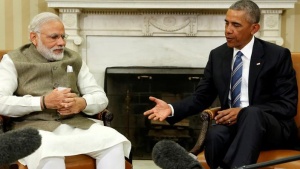
President Barack Obama welcomed Indian Prime Minister Narendra Modi to the White House for their seventh meeting since Modi took office in 2014, underscoring the warm relationship between the leaders and the world’s two largest democracies. Modi is to address the U.S. Congress on Wednesday.

“We discussed how we can, as quickly as possible, bring the Paris Agreement into force,” Obama told reporters. Climate change is a legacy issue for the U.S. president who leaves office in January.

India’s potential entrance into the agreement this year would help accelerate its enactment, perhaps years ahead of schedule. India is the world’s third-largest greenhouse gas emitter after China and the United States.

The two countries also welcomed preparations that could lead to the building of six nuclear reactors in India by U.S.-based Westinghouse, in what would be the culmination of some 10 years of work to resolve civil-nuclear issues.

The joint statement said India and the U.S. Export-Import Bank were working to complete a financing package for the project and that the Nuclear Power Corporation of India and Westinghouse had confirmed engineering and site design work would begin immediately.It said Westinghouse and the Nuclear Power Corporation of India would work toward finalizing the contract by June 2017 – a year later than Westinghouse’s chief executive, Daniel Roderick, said he hoped for in an interview with Reuters in late March.

Modi told an event organized by the U.S. India Business Council that relations between India and the United States were “closer than ever.” He said the planned reactor purchases would mark new era in nuclear and scientific cooperation.Modi’s address to a joint session of Congress will be a significant personal step. Although this has become a tradition for Indian prime ministers, he was once banned from the United States over massacres of Muslims.

More than 1,000 people, mostly Muslims, were killed in sectarian riots in Gujarat in 2002 when Modi had just become the state’s chief minister. Modi has denied any wrongdoing, and India’s Supreme Court in 2010 ruled there was no case.In the joint statement, the United States said it now recognized India as a “Major Defense Partner” and would work on technology sharing “to a level commensurate with that of its closest allies and partners.

“The text of a logistics agreement, which will allow the countries’ militaries to use each other’s land, air and naval bases, would be signed soon, a U.S. official said.

Tensions between the United States and Pakistan as well as regional concerns about China have served as a backdrop to increased security cooperation.Senator John McCain, chairman of the U.S. Senate Armed Services Committee, said the address to Congress was “entirely appropriate” given the new partnership.”

There’s no doubt there are significant tensions and challenges in the region, which argues for closer coordination between our militaries,” he said.While Modi is generally popular with U.S. lawmakers, they criticize what they see as lingering unfriendliness to U.S. firms and a stifling bureaucracy, in spite of Modi’s pro-business image. They also question New Delhi’s record on human rights.Modi got a boost on Tuesday when Amazon Inc AMZN.O Chief Executive Jeff Bezos said his company would invest an additional $3 billion in India, boosting its committed investment in the country to over $5 billion.

Source: In boost to Paris climate pact, India says it aims to join this year | Reuters

08/06/2016

U.S. Firm to Build Six Nuclear Reactors in India – India Real Time – WSJ

The U.S. and India agreed to move ahead with the construction of six nuclear reactors in India by an American company, the first such move since the countries signed a landmark civil nuclear deal in 2008.

The breakthrough capped a wide-ranging White House meeting on Tuesday between President Barack Obama and Indian Prime Minister Narendra Modi, who are seeking closer cooperation as Washington wants to boost New Delhi’s role in counterbalancing China.

The meeting, which included lunch at the White House, will be followed on Wednesday by a speech by Mr. Modi to Congress, wrapping up the Indian leader’s fourth visit to the U.S. as part of an increasingly close relationship that has been sought by both governments.

The warming Indian relationship is backed by the lure of accelerating growth in that country, signs of improvement in the business climate, shared democratic values and some overlapping strategic goals.

By contrast, recent U.S. interactions with China, a far bigger Asian economy and U.S. trading partner whose growth appears to be slowing down, have been marked by strains and warnings over economic and security issues.

Source: U.S. Firm to Build Six Nuclear Reactors in India – India Real Time – WSJ

07/06/2016

Indian solar power | The Economist

NARENDRA MODI, India’s prime minister, visits America for three days this week for talks with Barack Obama. Climate commitments may be one of many topics discussed. Six months ago 187 countries agreed to cut pollution through pledges for the UN climate talks in Paris. The deal adopted there was stronger than many expected, but much remains to be done. Even if countries manage to do all they offered, global warming will likely be held to around 3.5°C above pre-industrial temperatures. Conversely, the Paris deal aims overall to ensure warming does not exceed 2°C.

Unlike America and China, the world’s two largest polluters, India did not pledge a future reduction in aggregate emissions. It offered instead to reduce the intensity of its emissions—the amount of pollution per unit of economic output—by around a third by 2030 as measured against 2005 levels. Its greenest promise was to install 175GW of renewable power by 2022 (most of it solar). This is an enormous undertaking. In 2014, for example, the world’s entire installed solar capacity was 181GW.

The Modi government says the plans are “ambitious but achievable”. The country’s total installed solar power capacity now comes to 5.8GW; to meet its targets it will need to speed up from adding around 4GW a year to adding more than 15GW instead.

Mr Modi believes solar power is the “ultimate solution to India’s energy problem”. Of 250m households in India, 56m do not have access to electricity. The majority are in rural areas where off-grid solar installations, suitable for single homes or small clusters of buildings, could prove particularly helpful.

India’s solar programme is a good way to assess how seriously countries are taking the Paris agreement—particularly given India’s huge population and increasing economic heft. Mr Modi’s moves will illuminate the state of climate diplomacy.

Source: Daily chart: Indian solar power | The Economist

07/06/2016

Is India the Most Attractive Place for Retailers? – India Real Time – WSJ

India has leapt into second place in a ranking of the most-attractive developing economies for retailers compiled by Chicago-based consulting company A.T. Kearney.

The company assessed 30 countries based on economic growth, urban population and ease of doing business, among other factors. China topped the list for the second consecutive year, followed by India, Malaysia, Kazakhstan and Indonesia.

A.T. Kearney said India’s high growth rate, vast pool of consumers and new rules for foreign investors lifted the country up 13 spots in this year’s Global Retail Development Index.“Retail demand is increasingly driven by urbanization, an expanding middle class, and more women entering the workforce,” the A.T. Kearney report said. But it noted that not everything was rosy, saying India remains a “challenging and complex market” with infrastructure bottlenecks.

Some retailers and analysts said they were surprised at India’s sharp move up in the A.T. Kearney ranking.

A rule that requires foreign retailers to source at least 30% of their merchandise locally, for example, has led companies to rethink their big plans for India.

Wal-Mart Stores has shelved plans to open supermarkets in India saying the requirement is near-impossible to meet. French hypermarket chain Carrefour has also shut shop.

Swedish retailer IKEA is struggling to source domestically, as The Wall Street Journal detailed in this front-page story. And government officials said recently they don’t plan to exempt Apple from local-sourcing requirements.

Meanwhile, consultants and retailers are growing increasingly skeptical about the size of India’s middle class. Most of India’s population still lives under $2 a day; only a fraction of its 1.2 billion people can afford a Zara dress or a Starbucks Frappuccino.

A change in A.T. Kearney’s methodology could have boosted India’s fortunes. The company said it tweaked the metrics it used to calculate this year’s index, which “had a substantial impact on the rankings.

”For example, it evaluated countries with a population of over 5 million this year, compared with 3 million last year. As a result, some countries that were ranked highly last year – such as Uruguay in 2nd place, Qatar in 4th place, and Mongolia in 5th  place, weren’t analyzed this year.

Source: Report: Is India the Most Attractive Place for Retailers? – India Real Time – WSJ

27/05/2016

India Inc shows growth spreading by end of Modi’s sophomore year | Reuters

Indian companies are posting their best earnings results since Prime Minister Narendra Modi swept to power two years ago, giving the clearest sign yet that India’s fast, but patchy, economic growth is becoming more broad-based.

Though headline growth figures make India one of the world’s fastest growing economies, weak private investment and low capacity utilization rates have painted a less rosy picture.

Going by India Inc’s surge in profit growth in the first three months of the year, however, the outlook really does seem to be brightening, as benefits feed through from lower interest rates and government spending in infrastructure and defense.

On Tuesday, India will release gross domestic product data for the January-March quarter. Year-on-year growth of 7.5 percent is forecast by a Reuters survey economists, slightly faster than the previous quarter’s 7.3 percent.

“Macro indicators are suggesting that at the ground level the economy is gaining momentum,” said Dhiraj Sachdev, a fund manager at HSBC Asset Management in Mumbai.

“That has also been validated in terms of better corporate earnings in many of the sectors.”

Operating profits for 289 companies that have reported results so far leapt 25.5 percent year-on-year in the March quarter, compared with 1.7 percent growth in the previous quarter, according to Thomson Reuters data.

It is Indian firms’ best showing since the April-June quarter in 2014.

Put alongside the 6.8 percent decline in earnings that data provider Factset reckons companies in the S&P 500 suffered during the same quarter, India’s corporates have some things going in their favor.

India’s broader National Stock Exchange share index .NSEI has surged around 17 percent from a near 2-year low on Feb. 29, outperforming a 7 percent gain by the Asia-Pacific MSCI index excluding Japan .MIAPJ0000PUS.

This week, Morgan Stanley upgraded Indian equities to “overweight” from “equalweight” citing rising dividends, and prospects of a simpler country-wide sales tax, lower interest rates and benign monsoon among its reasons.

Source: India Inc shows growth spreading by end of Modi’s sophomore year | Reuters

25/05/2016

China to replace direct coal combustion with electricity in new plan | Reuters

China will reduce the amount of coal burned directly in industrial furnaces and residential heating systems in order to tackle a major source of smog, the country’s energy regulator said on Wednesday.

The National Energy Administration (NEA) said in a joint announcement with other government bodies that around 700 million to 800 million tonnes of coal is burned directly in China every year, much of it in the countryside, where access to electricity is limited.

Directly burned coal amounts to about 20 percent of China’s total coal consumption volume, much higher than the 5 percent rate in Europe and the United States.

China will aim to replace direct burning with electricity, including renewable power as well as ultra-low emission coal-fired generators, the NEA said.

China currently relies on coal for around 64 percent of its total primary energy needs and for three-quarters of its total power generation. Emissions from the direct combustion of coal are around five times higher than those from coal-fired power plants, which are subject to strict anti-pollution regulations.

During the 2016-2020 period, China plans to raise electricity’s share of the country’s overall energy mix to 27 percent, up about 1.5 percentage points from now and raising total power consumption by around 450 billion kilowatt-hours a year, the NEA said.

Experts have estimated that China will need an additional 600 GW of coal-fired power capacity over the 2015-2030 period in order to replace direct coal combustion.

Source: China to replace direct coal combustion with electricity in new plan | Reuters

24/05/2016

China’s Middle Class Vents Over Growing List of Grievances – China Real Time Report – WSJ

The death here of a 29-year-old man in police custody—a new father and graduate of a prestigious Chinese university—has exposed growing anxieties in the country’s growing middle class, already shaken by a decelerating economy and a disparate series of high-profile incidents threatening their sense of stability.

As WSJ’s Te-Ping Chen reports:

Other wide-ranging targets of recent social-media attention include a violent string of attacks on doctors by embittered patients and their families, a demand that apartment owners in eastern China pay extra to secure the land on which their apartments were already built, confusing changes in college-entrance standards, and fatal chemical explosions wiping out homes.

Such disruptions have come as reminders that rising incomes or better education don’t automatically shield China’s expanding middle-class ranks from danger, whether physical or economic, in a society where the law can be arbitrarily enforced and justice is sometimes brutal.

“There’s a gap between expectation and reality,” said He Yunfeng, who heads Shanghai Normal University’s Institute of Knowledge and Value Sciences. “These kinds of incidents concentrated together have created a kind of panic.” Some critics have begun joking that the Chinese term for middle class— zhongchanjieji—would be better depicted by the term zhongcanjieji, or the “tragic middle class.”

Source: China’s Middle Class Vents Over Growing List of Grievances – China Real Time Report – WSJ

Law of Unintended Consequences

continuously updated blog about China & India

ChiaHou's Book Reviews

continuously updated blog about China & India

What's wrong with the world; and its economy

continuously updated blog about China & India