Posts tagged ‘United States’

23/05/2016

Doubling down | The Economist

“A COLOSSAL roller-coaster” is how a senior engineer described it. He was talking about the railway that China plans to build from the lowlands of the south-west, across some of the world’s most forbidding terrain, into Tibet. Of all the country’s railway-building feats in recent years, this will be the most remarkable: a 1,600-kilometre (1,000-mile) track that will pass through snow-capped mountains in a region racked by earthquakes, with nearly half of it running through tunnels or over bridges. It will also be dogged all the way by controversy.

Chinese officials have dreamed of such a railway line for a century. In 1912, shortly after he took over as China’s first president, Sun Yat-sen called for a trans-Tibetan line, not least to help prevent Tibet from falling under the sway of Britain (which had already invaded Tibet from India a decade earlier). Mao Zedong revived the idea in the 1950s. In the years since, many exploratory surveys have been carried out.

But it is only after building the world’s second-longest railway network—including, in the past few years, by far the biggest high-speed one—that China’s government has felt ready to take on the challenge. It had a warm-up with the construction of the first railway into Tibet, which opened in 2006. That line, connecting Lhasa with Golmud in Qinghai province to the north (and extended two years ago from Lhasa to Tibet’s second city, Shigatse), was proclaimed to be a huge accomplishment. It included the highest-altitude stretch in the world, parts of it across permafrost. It required ingenious heat-regulating technology to keep the track from buckling. Advertisement: Replay Ad China further honed its skills with the opening of a high-speed line across the Tibetan plateau in 2014—though in Qinghai province, rather than in Tibet proper. But neither track had anything like the natural barriers that the Sichuan-Tibet line will face. It will be just under half as long again as the existing line to Tibet, but will take three times longer to build. The second line’s estimated cost of 105 billion yuan ($16 billion) is several times more than the first one. Lhasa is about 3,200 metres (10,500 feet) higher than Chengdu, yet by the time the track goes up and down on the way there—crossing 14 mountains, two of them higher than Mont Blanc, western Europe’s highest mountain—the cumulative ascent will be 14,000 metres. The existing road from Chengdu to Lhasa that follows the proposed route into Tibet is a narrow highway notable for the wreckage of lorries that have careered off it. Some Chinese drivers regard the navigation of Highway 318 as the ultimate proof of their vehicles’, and their own, endurance. Work on easier stretches of the railway line, closest to Lhasa and Chengdu respectively, began in 2014. Now the government appears to be getting ready for the tougher parts. A national three-year “plan of action”, adopted in March for major transport-infrastructure projects, mentions the most difficult stretch: a 1,000km link between Kangding in Sichuan and the Tibetan prefecture of Linzhi (Nyingchi in Tibetan). The plan says this should be “pushed forward” by 2018. It will involve 16 bridges to carry the track over the Yarlung Tsangpo river, known downstream as the Brahmaputra. Dai Bin of Southwest Jiaotong University in Chengdu says the Chengdu-Lhasa line could be finished by around 2030.

Source: Doubling down | The Economist

22/03/2016

Indians Have the Worst Access to Safe Drinking Water in the World – India Real Time – WSJ

India has the highest number of people in the world without access to safe water, a report released to mark World Water Day showed Tuesday.

The country has 75.8 million people, at least 5% of its 1.25 billion population, without access to clean water, the report by WaterAid, a water and sanitation nonprofit headquartered in London, says.

The majority of those people come from impoverished communities–living on around $4.31 a day–and are forced to collect dirty water from open ponds and rivers or spend most of what they earn buying water from tankers, the report  says.

Source: Indians Have the Worst Access to Safe Drinking Water in the World – India Real Time – WSJ

18/03/2016

Deep in a pit | The Economist

COMMUNIST Party give us back our money”, “We want to live, we need to eat!” Such were the slogans daubed on banners that were displayed on March 12th during a protest by thousands of coal miners in the dingy streets of Shuangyashan, a city in Heilongjiang province near the border with Russia.

The demonstrators gathered outside the headquarters of Longmay, the largest mining company in the north-east and Heilongjiang’s biggest state-owned enterprise (SOE). They demanded wages which they said they had not received for at least two months. Some protesters blocked railway lines; others scuffled with police wearing riot gear. Internet censors deleted pictures of the unrest (such as the one shown) as they spread across social media.

The protest was one of the biggest by workers at an SOE for many years. It was an indication of the problems that China’s government will probably face as it seeks to cut excess capacity among SOEs like Longmay and reduce their enormous losses. In February the labour minister, Yin Weimin, said that 1.3m coal workers and 500,000 steel workers could lose their jobs over the next five years.

Other estimates say 3m-5m people may be thrown out of work in these industries as well as in aluminium production and glassmaking. That is far fewer than the tens of millions who lost their jobs during SOE restructuring in the late 1990s. But the economies of some cities, including Shuangyashan, are driven by a handful of large SOEs. In these, downsizing will be traumatic and possibly turbulent.

Labour unrest is rising everywhere as economic growth slows (see chart). Many firms, like Longmay, are reacting to financial distress by paying wages late or not at all. According to China Labour Bulletin, a Hong Kong-based NGO, there were 2,700 strikes last year, twice the number in 2014. In the two months leading up to China’s lunar new-year holiday in early February, there were over 1,000 strikes and protests, 90% of them related to the non-payment of wages. Three days after the protest in Shuangyashan, an almost equally large one began at Tonghua Steel in neighbouring Jilin province, also over wage arrears.

In Shuangyashan (its name, meaning Double Duck Mountains, refers to the shape of two nearby peaks), the authorities have tried to soothe the protesters by giving them overdue pay. Some mine workers say they have now begun receiving their salaries for January, and that they have been assured their pay packets for February will be coming soon. But the government remains nervous of further unrest. On March 15th police were still ubiquitous, on the streets of Shuangyashan as well as outside a nearby mine. In the city centre, a row of women who said the men in their families all worked in mines sat holding placards offering their services as cleaners or house painters. “We have no money to eat. What do they expect us to do?” said one woman angrily before being told by police to stop talking. A man who identified himself as a government official followed your correspondent everywhere.

The protests in Shuangyashan were particularly embarrassing for the party, occurring as they did during the 12-day annual session of China’s parliament, the National People’s Congress (NPC), which ended on March 16th. Every year during the NPC session, officials try even more strenuously than usual to prevent street unrest, lest it tarnish the image of political unity and national prosperity that they want the NPC to project (see article). Party bosses in Heilongjiang will get their knuckles rapped by leaders in Beijing for failing to anticipate this outbreak, which followed months of grumbling among Longmay’s workers about lay-offs and overdue pay. In September, the company said it would shed 100,000 of its 240,000 staff.

Source: Deep in a pit | The Economist

02/03/2016

Indians Are Among the Most Satisfied at Work, Says a Study. Here’s Why – India Real Time – WSJ

Indians are among the most highly stimulated and satisfied at work, a new report claims.

Some 28% of workers in the South Asian nation reported being highly engaged and fulfilled in the office, a full 15% above the global average, in a survey of workers in 17 countries conducted by Ipsos for furniture and workspace systems company Steelcase Inc.

Other nations with the largest proportions of satisfied workers were Mexico, at 22%, the UAE and South Africa, where around one in five people described themselves in that way and Saudi Arabia, with 18%.

American offices came sixth. About 14% of those surveyed there reported being highly engaged and satisfied at work.

Only 4% of Indian workers were highly dissatisfied and disengaged, compared with 11% on average globally.

Indians also provided the second-highest average score, of 7.4, when they rated their quality of life at work out of 10. Only Mexico scored higher with 7.5.

The authors of the report said the secret to the happiness of Indian workers could be to do with the fact the country’s employers haven’t yet embraced open-plan work spaces and also a result of  the hectic pace of life outside the office walls.

Only 14% of the offices the employees worked in were open plan. Meanwhile, 70% of the workers surveyed sat in a private or shared private office at work.

“Culturally, having a workspace of one’s own, even if it is compact and modest, is a signal of belonging and importance, which may explain the overall high degree of workplace satisfaction,” the report said.

In densely populated countries like India, the workplace can be a haven, the report said.

Indians are much more likely to say, for instance, that their work environment allows them to feel relaxed and calm. A total of 73% agreed with that in the survey, much higher than most other countries, the report said.

Workers in Indian offices are also likely to have access to shared spaces like meeting rooms, cafeterias and canteens. They also have the most access to sport or exercise facilities.

Indians’ enthusiasm about their office spaces might be relative. The most highly engaged employees came from emerging economies, the report said.

“Many Indian employees’ expectations may be shaped by their comparatively modest living conditions,” the report said.

And they are more likely to say that they work remotely–55% said they sometimes work away from the office, and 20% said they did so every day.

They also believed that their employer took a genuine interest in employees, with 79% agreeing with the statement.

All of this might reflect employers’ efforts to keep their workers happy, the report said. “In India’s highly competitive and fluid job market, providing a desirable workplace can be a powerful strategy for attracting, retaining and engaging the talent that can help an organization thrive,” the report said.

Source: Indians Are Among the Most Satisfied at Work, Says a Study. Here’s Why – India Real Time – WSJ

23/02/2016

‘Weird’ new buildings banned in Chinese cities| Society

Cities will not be allowed to build more “oversized, xenocentric, weird” buildings devoid of cultural tradition in the future, according to a new directive from the central government.

The State Council, or the cabinet, and the Communist Party of China Central Committee issued the directive on Sunday. It says buildings should be “suitable, economic, green and pleasing to the eye.”

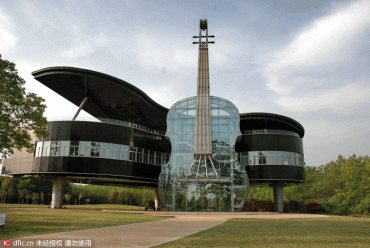
Cities have built some unusually shaped buildings to create memorable skylines in recent years, but many have drawn criticism. Here is one of sixteen very weird buildings in China!'Weird' new buildings banned in Chinese cities

See the other fifteen at:

Source: ‘Weird’ new buildings banned in Chinese cities[12]| Society

20/02/2016

Leaders of Nepal and India mend fences after friction | Reuters

The leaders of Nepal and India have overcome mutual misgivings, India’s foreign secretary said on Saturday, after talks to ease tensions over Nepal’s recently-adopted constitution.

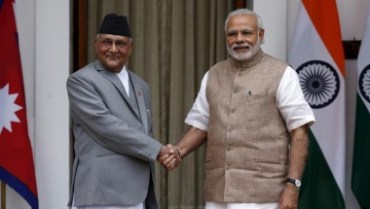
Nepal's Prime Minister Khadga Prasad Sharma Oli (L) shakes hands with his Indian counterpart Narendra Modi during a photo opportunity ahead of their meeting at Hyderabad House in New Delhi, India, February 20, 2016. REUTERS/Adnan Abidi

Prime Minister K.P. Oli visited New Delhi for talks with his Indian counterpart Narendra Modi after a months-long freeze in relations triggered by the grievances of plains dwellers in southern Nepal who have close historical ties to India.

Nepal, which moved from absolute to constitutional monarchy in 1990, made changes to its constitution to ensure greater participation of the Madhesi community in parliament.

But community leaders said the amendments failed to address their central fear that provincial borders would be redrawn in a way that would divide them.

“Our prime minister appreciated the progress made towards consolidation of constitutional democracy in Nepal,” Indian Foreign Secretary Subrahmanyan Jaishankar told a news briefing.

Source: Leaders of Nepal and India mend fences after friction | Reuters

18/02/2016

Is India’s Freedom 251, a $4 Smartphone, Too Good to Be True? – India Real Time – WSJ

A little-known Indian company has announced grand plans to sell millions of made-in-India smartphones for less than $4 a piece, despite the fact that it has only been in the smartphone business for five months and has yet to build a factory.

Ringing Bells Pvt. started taking orders for its Freedom 251 phone on Thursday for 251 rupees ($3.67) each, or less than the price of a McDonald’s Big Mac in the U.S. The company has promised to deliver the phones by June 30–after it builds two manufacturing plants.

Social media lit up with discussion about the device–which the company says will have a four-inch display, 3.2-megapixel camera and 8 gigabytes of storage–after ads for the phone with the tagline “dreams will come true,” appeared in newspapers. Ringing Bells said its phones will have apps that help farmers check soil conditions and fishermen get weather reports.

The company’s website crashed Thursday and it stopped accepting orders for the device as it worked to upgrade its servers, the website said.

At a launch event in a public park Wednesday, thousands turned out to see company President Ashok Chadha unveil a poster-sized image of a phone under a shower of pyrotechnics and confetti. It was an impressive turnout considering only days earlier almost no one had even heard of him, his company or its phone.

Phones given to journalists to try looked as if the branding from another manufacturer had been covered up with white-out on the phone’s front. Indian flag stickers covered the rear. The phones used an Android operating system.

Mr. Chadha said the phone he was sharing was a “beta device.”

Ringing Bells said it would spend 5 billion rupees, or about $73 million, to build the factories. Mr. Chadha said the money will come from the family of Mohit Goel, one of the founders and directors of the company. Mr. Goel’s family owns a farming business, Mr. Chadha said. Attempts to reach Mr. Goel were unsuccessful.

Analysts said they couldn’t see how Ringing Bells could ever make money selling phones for $4.

If Ringing Bells follows through with its plans, the difficulties of setting up manufacturing operations in India could mean it runs into delays that could cause it to miss its June deadline, a spokeswoman for another Indian phone manufacturer said. She said setting up a new factory often takes up to a year.

The company aims produce hundreds of thousands of phones a month and take around 30% of the smartphone market within a year, Mr. Chadha said. Over 100 million smartphones were shipped by manufacturers to retailers in India last year, according to International Data Corp., a research company.

Despite the low price, Mr. Chadha said the company expects to make money on the phones. He said that making the phone using components imported from China would cost about 2,500 rupees per phone. India doesn’t make many components used in phones and other phone sellers in the country import their phones and components from elsewhere.

But Mr. Chadha said he expected to reduce costs through through “economies of scale,” tax breaks for local manufacturing, and other cost-cutting measures. “We are technocrats and have some understanding of international economics,” he said.

Ringing Bells says it will offer a smartphone with a 4-inch display, 3.2 megapixel camera and 8 gigabytes of memory for less than $4. The $33 smartphones powered by Mozilla Corp.’s Firefox operating system have a 3.5 inch display, 2 megapixel camera and 256 megabytes of storage.

Source: Is India’s Freedom 251, a $4 Smartphone, Too Good to Be True? – India Real Time – WSJ

16/02/2016

First train from China to Iran stimulates Silk Road revival – Xinhua | English.news.cn

First cargo train from China to Iran arrived in Tehran on Monday, indicating a milestone in reviving the “Silk Road,” which has opened a new chapter of win-win cooperation between China and Iran.

English: the Silk Road in Central Asia

English: the Silk Road in Central Asia (Photo credit: Wikipedia)

silk road

The train, also referred to as Silk Road train, has passed through Kazakhstan and Turkmenistan to Iran, travelling a distance of 10,399 kilometers. It had left Yiwu city in east China’s Zhejiang Province on January 28.

This train was carrying dozens of cargo containers, according to the deputy of Iran’s Road and Urbanism Minister, Mohsen Pour-Aqaei, who made a welcome speech after the arrival of the cargo train at Tehran Train Station on Monday.

As known to all, ancient Silk Road trade route had served as an important bridge for East-West trade and brought a close link between the Chinese and Persian civilizations.

The “Belt and Road” initiative was raised by Chinese President Xi Jinping in 2013, which refers to the New Silk Road Economic Belt, linking China with Europe through Central and Western Asia, and the 21st Century Maritime Silk Road, connecting China with Southeast Asian countries, Africa and Europe.

“To revive the Silk Road Economic Belt, the launch of the train is an important move, since about 700 kilometers of trip has been done per day,” said Pour-Aqaei, who was present at the welcome ceremony of the train in Tehran’s Railway Station.

“Compared to the sea voyage of the cargo ships from China’s Shanghai city to Iran’s Bandar Abbas port city, the travel time of the train was 30 days shorter,” he said.

Pour-Aqaei, also the Managing Director of Iran’s Railway Company, added that according to the plan, there would be one such a trip from China to Iran every month.

The travel of cargo train from China to Iran is part of a Chinese initiative to revive the ancient Silk Road used by the traders to commute between Europe and East Asia.

Tehran will not be the final destination of these kinds of trains from China, the Iranian deputy minister said, adding that in the future, the train will reach Europe.

This will benefit Iran as the transit course for the cargo trains from the east Asia to Europe, he said.

Chinese ambassador to Iran Pang Sen told Xinhua that as one of the cooperation projects after Chinese President Xi Jinping’s state visit to Iran, the cargo train is playing a important role to promote construction of the “Belt and Road” initiative.

Meanwhile, the railway line from Yiwu to Tehran provides the two countries an express and efficient cargo trade transportation method, Pang said, adding that the countries along the railway line will furthur upgrade rail technology with the aim to make its transportation ability faster and better.

Source: First train from China to Iran stimulates Silk Road revival – Xinhua | English.news.cn

16/02/2016

India and China Have Most Deaths From Pollution – China Real Time Report – WSJ

More than half of the 5.5 million deaths related to air pollution in 2013 happened in India and China, according to a new study.

About 1.4 million people in the South Asian nation and 1.6 million in its northern neighbor died of illnesses related to air pollution in 2013, researchers at the University of British Columbia in Canada said.

The Indian and Chinese fatalities accounted for 55% of such deaths worldwide, the study said.

Researchers studied risk factors for death and disease around the world and found that air pollution, both indoors and outdoors, was one of the leading contributors to global fatalities.

The inhalation of emissions from power plants, vehicles, the burning of crop stubble before replanting, and wood or open fires in homes are some of the leading causes of deaths from air pollution, the report said.

The number of premature deaths linked to air pollution worldwide will increase over the next two decades unless more aggressive targets are set to curb it, researchers studying India and China’s air said at a meeting Friday in Washington D.C.

A major contributor of poor air quality in India is linked to the burning of wood and cow dung for cooking and keeping warm, particularly in the winter months. These methods are popular among India’s rural and urban poor, who don’t have access to electricity or cleaner fuels.

Household air pollution from cooking with wood “is primarily a problem in rural areas of developing countries of the world,” said Michael Brauer, a professor at the University of British Columbia’s School of Population and Public Health, in Canada.

Over the past few months, levels of tiny insidious particles, known as PM 2.5, in the Indian capital New Delhi have often exceeded amounts deemed safe by the United Nations World Health Organization.

Taking their lead from Beijing, Indian authorities in January experimented with restricting cars on roads for two weeks in New Delhi to reduce emission levels. Delhi Chief Minister Arvind Kejriwal said Thursday the city would revive the restrictions for 15 days, starting April 15.

Scientists said vehicle emissions contribute only 20% to 40% of pollution in Delhi, saying other sources of the particulate matter include the burning of dung, rubbish and leaves and the use of diesel backup generators, which kick in when Delhi’s patchy electricity supply cuts out, as well as emissions from small-scale industries such as brick kilns.

A federal environmental court in New Delhi said Feb. 4 it wanted officials to improve air quality by asking authorities to reduce the number of traditional cremations that use wood to burn bodies, a widespread practice in majority Hindu India.

In China, outdoor air pollution from burning coal was found to be the biggest contributor to poor air quality, causing an estimated 366,000 deaths in the country in 2013. Scientists predict 1.3 million premature deaths will take place in China by 2030 if coal combustion remains unchecked.

“One of the unique things about air pollution is you cannot run, you cannot hide from it. We know that if you improve air quality everybody benefits, so from a health perspective reducing levels of air pollution is actually an incredibly efficient way to improve the health of the entire population,” Mr. Brauer said.

Source: India and China Have Most Deaths From Pollution – China Real Time Report – WSJ

15/02/2016

Home on the Range, Chinese Style – China Real Time Report – WSJ

It’s a small step in the right direction, driven more by necessity than enlightened policy.

That’s the view from economists on China’s move this year to put forward a range for its economic growth target rather than a single number. The head of the National Development and Reform Commission, China’s top economic planning agency, said early this month that the 2016 target is likely to be “6.5% to 7%,” the first time in recent memory that China has used such a band. The target is set to be officially released early next month when China’s parliament convenes.

For decades, Beijing beat its annual growth targets without breaking a sweat. More recently, as growth decelerated faster than expected, it has faced growing difficulty hitting its number, so a range provides more wiggle room.

This follows Beijing’s decision to add an “about” to both its 7.5% target in 2014 and its 7% target last year. The adjective proved handy when the actual growth figures wound up falling short both times.

The risk this year, economists say, is that even a 6.5% to 7% target may be too high, heaping pressure on local officials to artificially stimulate growth in ways that increase debt and blunt reform initiatives.

This is also the year that China sets a growth target for the coming five years that’s expected to be 6.5%, in line with a Communist Party goal of doubling per capita income by 2020 over 2010 levels. This benchmark also may be high, analysts said, given China’s many structural problems and so-far limited appetite for reform.

“If they really stick to the 6.5% target by adopting unsustainable policies, throwing up more credit, they face a bigger problem with debt down the road,” said Fitch Ratings Inc. analyst Andrew Colquhoun. “Many emerging market problems in the past have happened when countries veer off and start to believe their own hype on what growth is possible.”

Source: Home on the Range, Chinese Style – China Real Time Report – WSJ

Law of Unintended Consequences

continuously updated blog about China & India

ChiaHou's Book Reviews

continuously updated blog about China & India

What's wrong with the world; and its economy

continuously updated blog about China & India