Posts tagged ‘Vladimir Putin’

08/04/2015

Narendra Modi to hard sell ‘Make in India’ at talks with business leaders in Hannover Messe during Germany visit – The Hindu

Prime Minister will inaugurate the Hannover Messe, considered the largest congregation of business tycoons.

Prime Minister Narendra Modi speaks at an event in New Delhi on Wednesday. Photo: V. Sudershan

Prime Minister Narendra Modi will hard sell India as an attractive investment destination while deliberating with movers and shakers of global business at the Hannover Messe during his three-day trip to Germany beginning Sunday, besides holding talks with its top leadership.

In his maiden visit to the European nation as Prime Minister, Mr. Modi will have a packed schedule and wooing investors and projecting his ambitious “Make in India” initiative will be a major focus area.

Mr. Modi will inaugurate the Hannover Messe, considered the largest congregation of business tycoons, along with German Chancellor Angela Merkel. India is the partner country of the fair this year where over 350 Indian enterprises are participating.

“In January, the world came to vibrant India in Gujarat and now exactly three months later, vibrant India is coming to the world in Germany to Hannover Messe,” German Ambassador Michael Steiner told reporters briefing on Mr. Modi’s trip.

Expecting that Mr. Modi’s visit will take the relationship to a “new level”, Mr. Steiner said Chancellor Merkel will come to India in October for the inter-governmental meeting where all major issues will be deliberated at length.

via Narendra Modi to hard sell ‘Make in India’ at talks with business leaders in Hannover Messe during Germany visit – The Hindu.

08/04/2015

Learning Mandarin in the tundra – Russia invites China into oil business | Reuters

Russia‘s freezing north has never been the most welcoming place for foreign travelers, and its onshore oil riches have always been state secrets. But when the order comes from the Kremlin to open up, people obey.

Pipelines to be laid to transport oil to Vankor are seen at the Rosneft company owned Suzunskoye oil field, north from the Russian Siberian city of Krasnoyarsk, March 26, 2015.  REUTERS/Sergei Karpukhin

Last September, President Vladimir Putin, who has been seeking new markets in Asia for Russian energy exports to replace traditional customers in Europe, announced that he would welcome Chinese investment in Vankor, a vast new oil field in remote eastern Siberia owned by state firm Rosneft.

Since then, delegations from both China and India have been flown out to visit the field in the remote tundra.

Some of the workers, who spend four weeks at a time at the isolated station – where temperatures can fall as low as minus 60 Celcius (minus 76 Fahrenheit) – have duly taken up Mandarin.

“No problem. We will work with the Chinese workers if need be,” said Alexei Zyryanov, deputy head of an oil and gas production unit.

All of Vankor’s output of 440,000 barrels per day of crude is already shipped east, via the East Siberia-Pacific Ocean pipeline, which includes a spur feeding China’s northeast.

But a proposed Chinese investment in a stake in the project would go far further than Moscow has ever gone before to luring Beijing into its hydrocarbon industry.

Rarely has Moscow considered offering an ownership stake in such a big strategic onshore deposit to outsiders, despite decades of interest from Western majors. The offer is the more remarkable for being made to China, a rival for decades with which Russia nearly went to war in the 1960s over a border dispute.

Rosneft confirmed that it has reached a draft agreement to sell a 10 percent stake in Vankor to China.

via Learning Mandarin in the tundra – Russia invites China into oil business | Reuters.

11/12/2014

The Vladimir Putin and Narendra Modi Agreements in Full – India Real Time – WSJ

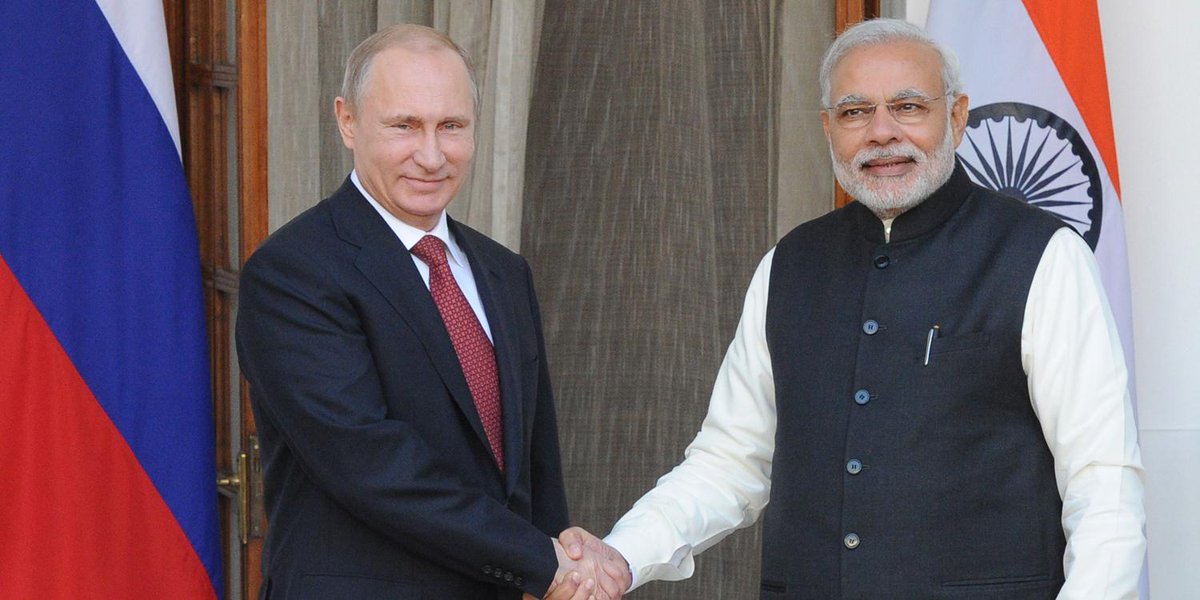
Indian Prime Minister Narendra Modi and Russian Prime Minister Vladimir Putin announced that their countries had signed 20 bi-lateral agreements including memorandums of understanding and commercial contracts on Thursday.

View image on Twitter

During Mr. Putin’s visit to India’s capital, the Russian leader said in a news conference that the documents placed an emphasis on trade and economic issues.

Eight of the agreements signed relate to nuclear power and energy production including a roadmap for bilateral cooperation in the civil nuclear energy sector over the next 20 years. Russia also agreed to supply “major equipment” to the Kudankulam nuclear power plant in Tamil Nadu.

India agreed to identify a second site apart from Kudankulam for Russian-designed nuclear power plants.

Mr. Modi said that they had “outlined an ambitious vision for nuclear energy” and would have “the highest standards of safety in the world.”

A list of the agreements signed is below as provided by India’s Ministry of External Affairs.

via The Vladimir Putin and Narendra Modi Agreements in Full – India Real Time – WSJ.

19/11/2014

Summitry: The Chinese order | The Economist

FOR the past week China’s state media have conveyed an almost imperial choreography playing out in the Great Hall of the People, in Zhongnanhai, the Chinese leaders’ compound next to the Forbidden City in Beijing, and at Yanqi Lake just outside the capital. Every day, on television and in newspapers, President Xi Jinping (above, right) is portrayed receiving lines of grateful world leaders. And every day he is seen arranging prosperity, ordering peace or, in an agreement with Barack Obama, America’s president, (above, left) on carbon emissions, even saving the planet. It escaped no visitor that not since Mao Zedong has a Chinese leader conducted foreign affairs with such eye-catching aplomb. Yet this was not only Mr Xi’s moment, but also China’s—a diplomatic coming-out party of sorts.

On several fronts, a country known for a somewhat reactive diplomacy has made the running. China was host this week to the Asia-Pacific Economic Co-operation—APEC, a regional trade gathering that rarely makes waves. Yet in quick succession China declared free-trade agreements with South Korea and Australia, two sizeable Asian economies, all but signed. It announced a breakthrough with America by promising at last to eliminate tariffs on information-technology products. And to the delight of Asian leaders and of Vladimir Putin, president of Russia (reviled in the West but made welcome in Beijing), Mr Xi announced $40 billion in investments to cement a new commercial “Silk Road” that will run overland through Central Asia and Russia eventually to Europe and by sea through South-East Asia to the Middle East and Africa.

Most strikingly, on November 11th Mr Xi urged APEC’s 21 members to move towards a Free Trade Area of the Asia-Pacific (FTAAP). The commitment to “study” the idea over the next two years is in effect to launch it, and for all that an eventual FTAAP is unlikely to be notable for its high standards, the announcement was intended to stand in contrast to the predicament of the 12-nation Trans-Pacific Partnership, sponsored by America, which remains bogged down in negotiations between America and Japan despite earlier hopes of a breakthrough announcement at APEC.

On security matters, Mr Xi appeared to be making the running, too. There had been a “meeting of minds”, according to Benigno Aquino, president of the Philippines, over disputed reefs in the South China Sea. Most striking, though, was an agreement for China to resume high-level contacts with Japan. China has rationed these, and in 2012 began actively challenging Japan’s control of the Senkaku islands (known as the Diaoyu islands to China) in the East China Sea; ties had been frozen entirely since Japan’s prime minister, Shinzo Abe, visited Tokyo’s Yasukuni shrine last December. The shrine, honouring Japan’s war dead, has militarist overtones.

Yet on November 7th China and Japan announced a four-point agreement to reduce tensions (see article). The signal agreement was later sealed when Mr Xi met Mr Abe for the first time as president. Admittedly, the withering handshake and puckery expression he offered Mr Abe lent the impression of a dog owner obliged to pick up another pooch’s turd.

That breakthrough was downplayed in state media, perhaps because Chinese ultranationalists might perceive in it a climbdown from China’s hard line over the islands, and towards Japan in general. But given much more prominence was the summit between the Chinese and American presidents, their second full one after that at Sunnylands in California in 2013. Again, there were welcome breakthroughs in co-operation. One was the agreement on information technology, which should now clear the way for a World Trade Organisation pact on IT products. Another was that both sides agreed to find common confidence-building and other measures to help avoid misunderstandings or accidental military confrontations on or above the East China Sea and South China Sea, where the United States shadows China’s increasingly assertive military presence.

But the biggest surprise was the agreement on greenhouse gases. China and America are the two biggest polluters, together accounting for 44% of global carbon emissions. Without their commitment to cut emissions, any global target is meaningless. On November 12th Mr Obama announced a “historic” agreement in which America will cut emissions by 26-28% by 2025, compared with 2005 levels, while China promises its emissions will peak around 2030. It gives a big boost to getting a global deal on carbon emissions at a crucial gathering in Paris next year. For China, a huge guzzler of coal, setting a date for emissions to peak is a first, even though it is five years later than the Americans would have liked. To bring down emissions after 2030, it aims for a big growth in nuclear power and for a fifth of its electricity to come from non-fossil fuels.

via Summitry: The Chinese order | The Economist.

19/11/2014

Xi Jinping Visits Tasmania, Is Given (Authentic) Lavender-Filled Teddy Bear – China Real Time Report – WSJ

What does one give to China’s visiting head of state as a keepsake to mark the occasion? Angela Merkel went with an old map that had a less-than-politically correct interpretation of China’s borders. Vladimir Putin presented an example of Russia’s cutting-edge consumer technology. Nahendra Modi handed over a bound copy of the Bhagavad Gita, a sacred Hindu text, in Chinese.

Alighting from his flight to Hobart, the capital of the Australian state of Tasmania, schoolchildren presented President Xi Jinping with a lavender stuffed teddy bear (at 48 seconds). Mr. Xi didn’t appear surprised or puzzled by why he was bring presented with potpourri. Then again, Bobbie Bear is a minor celebrity in China, and has done more than anyone to put Tasmania on the map for Chinese tourists.

Mr. Xi didn’t get to visit Bridestowe Lavender Estate which produces the bears – and where he would have been limited to buying one bear only, a measure taken by the farm’s management late last year to ensure sufficient supply to satisfy the busloads of Chinese tourists. Factories in China have produced knock-offs in numbers that far exceed the farm’s own production capacity, says owner Robert Ravens, which means a visit to Tasmania is the only way to be sure the bear you buy is real.

For Tasmania, Bridestowe holds potential of what China – hungry for clean and healthy produce, and with tourists increasingly willing to travel off the beaten track – can do for a struggling economy.

On Monday, Australian Prime Minister Tony Abbott announced at a dinner for the Chinese first couple at Parliament House that Bridestowe Lavender Estate had won the inaugural Australia-China Achievement Award for entrepreneurship. The award went to the farm for its “pro-active and innovative market entry into China and promoting Tasmania as a destination for Chinese tourists.”

Mr. Xi and his wife’s taking custody of Bobbie rounds out a busy schedule of cuddling as many Australian marsupials as possible. And while Bobbie might not have the same novelty value as Australia’s menu of unique fauna, it’s likely the only one the first couple will be taking home with them.

via Xi Jinping Visits Tasmania, Is Given (Authentic) Lavender-Filled Teddy Bear – China Real Time Report – WSJ.

28/10/2014

Putin Turns to China as Russia’s Economy Is Weakened by Sanctions – Businessweek

Defying the U.S. and Europe is forcing Russian President Vladimir Putin to aid his biggest rival to the east. To avert a recession, Russia is turning to China for investment, granting it once restricted access to raw materials and advanced weapons, say two people involved in planning Kremlin policy who asked not to be identified discussing internal matters. Russia’s growing dependence on China, with which it spent decades battling for control over global communism, may end up strengthening its neighbor’s position in the Pacific. With the ruble near a record low and foreign investment disappearing, luring Chinese cash also may deepen Russia’s reliance on natural resources and derail efforts to diversify the economy.

“Now that Putin has turned away from the West and toward the East, China is drawing maximum profit from Russian necessity,” says Masha Lipman, an independent political analyst in Moscow who co-authored a study on Putin with former U.S. Ambassador Michael McFaul. China is wasting no time filling the void created by the closing of U.S. and European debt markets to Russia’s largest borrowers. A delegation led by Premier Li Keqiang signed a package of deals on Oct. 13 in Moscow. Among them were an agreement to swap $25 billion in Chinese yuan for Russian rubles over three years, a treaty to protect companies operating in Russia and China from having their profits taxed twice, and cooperation on satellite-navigation systems and high-speed rail. To promote trade, Export-Import Bank of China agreed to provide credit lines to state-owned VTB Group and Vnesheconombank, Russia’s development bank, as well as a trade finance deal with Russian Agricultural Bank.

Russia’s economy is more vulnerable than it’s been since the collapse of the Soviet Union in 1991. Unlike then, Russians are united in support of their leader, and with $455 billion in foreign currency and gold reserves, the country isn’t broke, according to Lipman. “The economy was much worse then, but Russia was in a much better position geopolitically because it had the support of the U.S. and Europe,” she says. Putin spokesman Dmitry Peskov didn’t respond to requests for comment.

via Putin Turns to China as Russia’s Economy Is Weakened by Sanctions – Businessweek.

25/05/2014

China and Russia: Best frenemies | The Economist

ON MAY 21st, after a nail-biting session of late-night brinkmanship, China and Russia signed an enormous gas deal worth, at a guess, around $400 billion. Their agreement calls for Russia’s government-controlled Gazprom to supply state-owned China National Petroleum Corporation with up to 38 billion cubic metres of gas a year between 2018 and 2048. The deal capped a two-day visit to China by the Russian president, Vladimir Putin, that included a regional-security summit and joint military exercises off the Chinese coast.

Mr Putin called the deal the biggest in the history of Russia’s gas industry. But it counts, too, for the geopolitics that underpin it. That an agreement should come now, after a decade of haggling, is no accident. The deal will help the Kremlin reduce Russia’s reliance on gas exports to Europe. It is proof that Mr Putin has allies when he seeks to blunt Western sanctions over Ukraine. Both Russia and China want to assert themselves as regional powers. Both have increasingly strained relations with America, which they accuse of holding them back. Just over 40 years ago Richard Nixon and Henry Kissinger persuaded China to turn against the Soviet Union and ally with America. Does today’s collaboration between Russia and China amount to a renewal of the alliance against America?

That is surely the impression Mr Putin wants to create. Ahead of his visit he gushed to Chinese media, saying their country was “Russia’s reliable friend”. Co-operation, he said, is at its “highest level in all its centuries-long history”. From the Chinese side, Xi Jinping chose Russia as the first country he visited on becoming president in 2013.

Commercial ties are growing. China is Russia’s largest single trading partner, with bilateral flows of $90 billion in 2013. Even before the gas deal, the two sides hoped to double that by 2020. If Western banks become more reluctant to extend new loans, financing from China could help Russia fill the gap. China badly needs the natural resources which Russia has in abundance. The gas deal will ease China’s concerns that most of its fuel supplies come through the strategic chokepoint of the Strait of Malacca, and will also enable China to move away from burning so much of the coal that pollutes the air in Chinese cities.

The two have also made common cause in geopolitics. China abstained from a UN security council vote in March that would have rejected a referendum that Russia backed in Crimea before it annexed it. China has also joined Russia in vetoing UN attempts to sanction the regime of Bashar Assad fighting a civil war in Syria. The two have taken similar stances over issues such as Iran’s nuclear programme.

China and Russia share a strong sense of their own historical greatness, now thwarted, as they see it, by American bullying. Both want the freedom to do as they please in their own back yards. Russia’s annexation of Crimea and its manoeuvring in eastern Ukraine have vexed America and Europe and left Mr Putin with even fewer friends than before. China’s push into the East and South China Seas is causing similar concerns in Asia, as smaller neighbours worry about its expansionism.

But the West should not panic. Despite all this, Russia and China will struggle to overcome some fundamental differences. Start with the evidence of the gas deal itself: the fact that it took ten years to do, and that the deal was announced at the last minute, suggests how hard it was to reach agreement. The Chinese were rumoured to have driven a hard bargain, knowing that Mr Putin was desperate to have something to show from his trip.

More a grimace than a smile

In this deal, as elsewhere in the relationship, China has the upper hand. Other supplies of gas are coming online in Australia and Central Asia. And whereas China’s global power is growing, Russia is in decline—corroded by corruption and unable to diversify its economy away from natural resources. The Chinese government will expect the Kremlin to recognise this historic shift—a recipe for Chinese impatience and Russian resentment. Although the two countries are united against America, they also need it for its market and as a stabilising influence. And they are tussling for influence in Central Asia. Their vast common border is a constant source of mistrust—the Russian side sparsely populated and stuffed with commodities, the Chinese side full of people. That is why many of Russia’s tactical nuclear weapons are pointed at China (see article). In the long run, Russia and China are just as likely to fall out as to form a firm alliance. That is an even more alarming prospect.

via China and Russia: Best frenemies | The Economist.

Enhanced by Zemanta
24/05/2014

‘Four Dishes, One Soup’ Not Enough For Sino-Russian Gas Deal Celebration – China Real Time Report – WSJ

Say you’re the leader of the world’s No. 2 economy. You just signed a massive energy deal with your Russian counterpart that has major political and economic implications – and that, under international protocol, calls for a big-time state wingding. At the same time, you’re pushing a government austerity platform to convince your people that their leaders aren’t corrupt fat cats living large off the people.

What to do?

That’s the dilemma Chinese President Xi Jinping faced this week after he reached a 30-year, potentially $400 billion gas supply deal with Vladimir Putin. His answer, it seems, was to split the difference. The state dinner that followed the high-profile deal-signing had enough fancy dishes, tipple and desserts to fail the sort of austerity test Mr. Xi might apply to, say, a banquet thrown by county-level officials in a tier-three burg.

Still, experts said, the wines steered more to the local than to the Bordeaux, and the whole affair fell short of what you might get at a fancy wedding.

After 10 years of difficult negotiation, China and Russia signed a landmark natural-gas contract on Wednesday. The night before, Chinese President Xi Jinping and his wife Peng Liyuan hosted a dinner in Shanghai welcoming more than 300 guests from 46 countries, including Russian President Vladimir Putin.

What dishes were served during the 90-minute dinner?

The dinner was definitely more elaborate than the “four dishes and one soup” set promoted by Xi Jinping as a form of domestic cost-cutting. There were four plates of desserts alone—implying that the anti-corruption rules don’t always apply when it comes to state events, as China doesn’t want to lose face on diplomatic occasions. The six appetizers included mashed green beans, spicy cabbage, sliced whitebait, a pea dish and bamboo shoots with green onions. The five dishes and one soup served included shrimp balls, fried and braised beef, macadamia nuts with greens, flatfish with bean curd sauce, luffa with green beans and mushroom with fish maw. Other dishes included moulded pudding, vegetable dumplings and plates of fruit.

This dinner was intended to be a creative combination of Chinese and western-style cooking, one that highlighted fresh ingredients from southern regions of the Yangtze River. The executive chef behind it, Su Dexing, was also the chief cook for the state banquet during the APEC meeting in 2001, according to Shanghai International Convention Center staff.

As at many state events, China’s ubiquitous luxury liquor Maotai was also served, along with a dry red and dry white wine produced by Cofco Wines & Spirits. According to prices advertised on e-commerce websites, such red and white wine would likely cost between 400-600 yuan ($64-96) per bottle and 300 yuan per bottle, respectively.

Although abundant, the dinner was still simple compared to other options available in Shanghai, where wedding banquets can easily cost a minimum of 500 yuan per person, excluding liquor. In 5-star hotels, such meals might cost more than double that amount.

via ‘Four Dishes, One Soup’ Not Enough For Sino-Russian Gas Deal Celebration – China Real Time Report – WSJ.

Enhanced by Zemanta
26/03/2014

Putin’s Shame: Russia Is Becoming China’s Junior Partner – Businessweek

Russian President Vladimir Putin professes not to care about being ejected—temporarily, at least—from the Group of Eight community over his country’s seizure of Crimea. He says Russia has plenty of other friends in the world. One of them is China, the world’s emerging Communist superpower. Diplomatic and trade relations between Russia and China have strengthened notably over the last couple of decades. Bloomberg News reports today that the “Crimean crisis is poised to reshape the politics of oil by accelerating Russia’s drive to send more barrels to China, leaving Europe with pricier imports and boosting U.S. dependence on fuel from the Middle East.”

From left: Brazilian President Dilma Rousseff, Indian Prime Minister Manmohan Singh, Russian President Vladimir Putin, Chinese President Xi Jinping, and South African President Jacob Zuma at the G-20 Summit in St. Petersburg, Russia, on Sept. 5, 2013

Notice, though, that what Russia is selling to China is oil—not, say, high-tech machinery. In what must be a source of great embarrassment to Putin, Russia has gone from being China’s tutor and guide to being a junior partner whose main value is as a source for raw materials. Look at these two charts, which I put together today using data from the United Nations’ Comtrade database.

The first shows Russian exports to China in 2000. Exports of what the UN calls mineral fuels, oils, distillation products, etc.—mainly oil—constituted 7 percent of total Chinese exports to Russia.

via Putin’s Shame: Russia Is Becoming China’s Junior Partner – Businessweek.

Enhanced by Zemanta
04/03/2014

Is China Siding With Putin in the Ukraine Crisis? – Businessweek

China’s leaders are struggling to come up with a comprehensible position on the crisis in Ukraine. The Chinese might naturally sympathize with Vladimir Putin, someone willing to stick it to Western leaders such as President Obama. However, China has long opposed actions that smack of interference in other countries’ internal affairs, in part to keep outsiders away from such sensitive issues as Tibet and Chinese dissidents.

Chinese Foreign Minister Wang Yi

So for now, the government’s solution seems to be simple: obfuscate. The Chinese and Russian foreign ministers spoke by telephone today, and while Russia’s Sergei Lavrov said afterwards that the two countries are in agreement about the crisis, China’s official spokesman shied away from taking a stand.

First, the Russian take: According to the Voice of America, Putin’s foreign ministry said today, “Russia and China have coinciding views on the situation in Ukraine.”

via Is China Siding With Putin in the Ukraine Crisis? – Businessweek.

Enhanced by Zemanta
Law of Unintended Consequences

continuously updated blog about China & India

ChiaHou's Book Reviews

continuously updated blog about China & India

What's wrong with the world; and its economy

continuously updated blog about China & India