Posts tagged ‘Wenzhou’

26/04/2016

As China’s Economy Slows, Unrest Among Veterans Rises – China Real Time Report – WSJ

Over lunch in a Beijing backstreet, four Chinese veterans raised glasses to toast their reunion with fiery “baijiu” liquor.
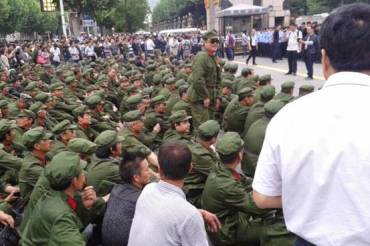
PLA veterans stage a sit-down protest outside government offices in Hubei province on May 4, 2015.

They’d not drunk together since they were in the same army unit, fighting skirmishes with Vietnamese forces in the aftermath of a 1979 border war.

Now in their 50s, they’d come here shortly before an annual parliament meeting in March to fight a different kind of battle – to demand the welfare support that they say was promised to them, and millions of other veterans, on leaving the armed forces years ago.

The four veterans, all from the southern province of Hunan, are an example of the problem facing President Xi Jinping as he prepares to lay off 300,000 out of 2.3 million troops in the biggest restructuring of the People’s Liberation Army, or PLA, since the 1950s.

China already has at least six million PLA veterans on state welfare, thousands of whom have staged well-organized protests in recent years over what they see as insufficient government support. Traditionally the government has offered subsidies to former soldiers and reserved slots for them at state-run companies, though many veterans say officials don’t follow through or that the perks aren’t enough to make ends meet.

Now, with an economic slowdown threatening to cause millions of state sector layoffs, prominent military figures have warned that veterans’ protests could escalate if the government can’t provide jobs or sufficient welfare support for the 300,000 being laid off.

One of the largest veterans’ protests was in June last year when several thousand, mostly veterans of China’s war with Vietnam, wearing uniforms and medals, protested outside offices of the Central Military Commission, which commands the armed forces and is headed by Mr. Xi.

A month earlier, there was another big veterans’ protest outside a Beijing courthouse. Smaller demonstrations occur frequently in other cities, according to experts who monitor them.

Many other veterans have tried to sue the government or lodge formal petitions, as the four in the restaurant did. Before lunch, they said, they’d submitted one at a nearby building that houses the petitions office of the Central Military Commission.

Officials there took the petition and scanned their identity cards, but gave them neither a receipt nor a reply, they said. “They just told us to go back where we came from,” said one of the four, a 54-year-old former worker in a coal-washing plant. “We got the feeling it was useless to go there.”

Source: As China’s Economy Slows, Unrest Among Veterans Rises – China Real Time Report – WSJ

14/08/2015

‘Car suit’ keeps vehicles high and dry during floods, Chinese inventor says | South China Morning Post

A man in eastern China has invented a “suit” for cars he claims protects them from water damage during the floods that regularly inundate the mainland’s coastal cities, an online newspaper reports.

The cover consists of a copolymer thermoplastic material and waterproof zippers. Photo: SCMP Pictures

More than 3,000 vehicles were flooded when Typhoon Soudelor hit Taizhou in Zhejiang province on August 8, Thepaper.cn reports. One photo of the storm that has drawn particular interest online shows a car wrapped in a heavy, water-proof material.

The man behind the idea is Huang Enfu, a businessman who deals in car parts. “News about damaged cars during urban floods regularly appears. Our costal city often sees such floods. That’s why I invented the suit,” Huang was quoted as saying.

The cover consists of a copolymer thermoplastic material and waterproof zippers. A car owner puts the suit down in an empty space, parks the vehicle over top, pulls the sides up and zips it closed.

Huang said he spent more than 1.6 million yuan (HK$1.93 million) and two years coming up with the idea. He has patented the design and sells them for between 1,500 yuan and 2,500 yuan

Residents in mainland cities have long complained urban sewage systems cannot cope with heavy rainfall during the wet season. Drains easily become overloaded and the water levels on flooded main streets can quickly rise past people’s waists.

Huang says his invention will even allow a properly zipped-up car to float if the water levels become too high. Owners can secure the car suit by tying the four attached ropes to a stationary object.

via ‘Car suit’ keeps vehicles high and dry during floods, Chinese inventor says | South China Morning Post.

11/12/2014

Alibaba Tries to Make a Visit to the Doctor Easier – Businessweek

China’s overburdened healthcare system is ripe for reform, and leading technology companies see opportunities in becoming part of the solution.

A Chinese nurse adjusts the infusion rate for a patient at a hospital in Xiangyang city, central China's Hubei province on Jan. 20, 2014.

Take the current system of booking time to see a physician, which is both inefficient and abusive. In order to see a doctor at a leading hospital in Beijing or another major Chinese city, a patient must queue up starting at around 5am and wait in line for several hours just to book an appointment for later that day. Sometimes the patient has the option of buying a hospital slot, typically at an exorbitant fee, from a professional scalper.

In July, Alipay, the popular e-payment system launched by Alibaba Group, began a pilot project to allow patients to book appointments at select hospitals through a smartphone app. A handful of hospitals in Hangzhou, Guangzhou, Kunming, Wenzhou, and Nanchang now participate. It sounds like a simple and intuitive step that should have been tried long ago; notably it’s a technology company, not a medical institution, that’s leading the change.

via Alibaba Tries to Make a Visit to the Doctor Easier – Businessweek.

30/06/2014

Who Needs Science? China Province Orders Water Pollution ‘Swim Test’ – China Real Time Report – WSJ

Zhejiang Province is administering a swim test for its cadres, but not for the purpose you might think.

The coastal province is trying to get officials to jump into local rivers as part of an effort to battle China’s notorious water pollution.

“The public doesn’t get to know what water standards are from data, but from using it. Swimming can be used to judge this, (and) leading officials should do the test,” Zhejiang People’s Congress deputy director Mao Linsheng said at a recent meeting (in Chinese).

It’s not clear exactly what the province hopes to accomplish with the new initiative. There’s a rich political symbolism associated with leaders swimming in rivers in China thanks to Mao Zedong, who took a famous dip in the Yangtze River in 1966, accompanied by a team of bodyguards and 5,000 admirers, to prove he was still robust on the eve of the Cultural Revolution. But the destruction wrought in the decade following the Great Helmsman’s swim makes it a dubious template for today’s officials.

There’s also the question of whether Mao would be willing to swim in any of China’s rivers were he still alive today. Nearly 60% of China’s water is either moderately or seriously polluted, according to the Ministry of Land and Resources’s annual report released this April.

Pollution in Zhejiang appears particularly problematic. Last year, CCTV reported that more than 80% of the waters just off the coast of Zhejiang Province were polluted, threatening the local fishing industry. In March, a river in the city of Wenzhou in Zhejiang caught on fire as a lit cigarette set alight chemical residues floating on its surface.

via Who Needs Science? China Province Orders Water Pollution ‘Swim Test’ – China Real Time Report – WSJ.

12/11/2013

China in numbers: secondhand view with salutary warning | The Times

3,000km . . . is the combined length of bargain-price underpants (if laid end-to-end) sold on Chinese websites between midnight on Sunday and 1am on Monday morning. If all the cut-price bras sold in the same period were piled on top of one another, the resulting pillar of lingerie would be three times the height of Mount Everest.

In those first, financially incontinent 60 minutes of Monday morning, China’s largest handler of online payments took 25 million orders with a combined value of 6.7 billion yuan (£686 million). About 340,000 of those orders were placed in the first minute. It was as if the world were about to end and China suddenly decided that the only hope of salvation lay in half-price knickers.

Astounding numbers of this sort were in plentiful supply on Monday as China delighted in the mad calculus of consumerism. It looks heartily encouraging, but appearances are deceptive. The cause of the online shopping frenzy was a deluge of sales promotions timed to coincide with “Singles Day” — a magnificently contrived “festival” prompted by the date 11.11. The whole thing was invented only four years ago.

Every online retailer in China (and there are an awful lot of them) was slashing prices as part of the fun. By mid-afternoon of Singles Day, the Alibaba online portal said that its sales promotions had generated more than ten billion yuan. That is already more than total online sales in the United States last year on “Black Friday”, the shopping day that follows Thanksgiving and historically is the biggest day for retail in the American calendar.

The temptation is to treat Singles Day as a bellwether, both of the general strength of online retail and of the ability of China’s nascent consumer economy to concoct its own events from thin air and convince people the best way of celebrating them is by shopping.

The reality, though, is less cut and dried. Taobao, the online shopping mall that enjoyed such fantastic sales on Monday, has another internet retail division that is telling a rather different story. For some months now, various courts in China have created online stores on Taobao to conduct what they call “judicial auctions” — sales of the various goods seized by the courts in criminal cases. The Government’s crackdown on corruption, now almost a year old, has swollen the items seized very significantly.

The auction site for the city of Wenzhou alone runs to more than 100 pages of items, including large vintage wine collections, mobile phones, office buildings, wedding rings, watches and even buses. Overwhelmingly, though, the items under the hammer are residential property, mostly medium to high-end flats. Activity in Wenzhou has always been seen as a weather vane for Chinese property prices and the signals are not encouraging.

The flats go on sale on the judicial auction sites with an estimated reserve price and, because the courts want a sale, that price tends to be at a decent discount to the prevailing market price. An additional appeal is that there is also no commission charged.

Yet many do not make the reserve price. Out of a batch of 157 auctions conducted by the Luchent District Court in Wenzhou, 72 fell through because there was no bid at all. Local property agents are starting to get very twitchy over what Taobao is telling them about the secondhand market.

Discounts may work for underpants, but they do not appear to do so for second-hand property. Chinese are still buying newly built apartments with gusto, on the assumption that eventually the resale market will be robust: the auctions seem to be sounding an alarm over that assumption.

via China in numbers: secondhand view with salutary warning | The Times.

16/09/2013

China’s wealthy increasingly attracted to Britain’s elite secondary schools

SCMP: “A decade after Bo Guagua, grandson to a revolutionary hero and son of fallen Communist Party leader Bo Xilai, became the first Chinese to attend Britain’s elite Harrow School, agencies promising access to Britain’s top independent schools are expanding rapidly to cope with rising demand from the growing pool of high-net-worth individuals from China.

handout_tonbridge_36295771.jpg

The London-based education consultancy Gabbitas opened its first office in Shanghai in 2009. Four years later, it also advises well-off parents in Guangzhou, Wenzhou and Dalian on how to get their children into secondary schools once reserved for British and continental European aristocracy.

Within five years the agency plans to open another 12 branch offices, said Sofie Liao, director of Gabbitas in China. Schools like Eton and Harrow “are getting more and more enquiries from Chinese families,” she said, anticipating annual growth rates of 10 to 15 per cent.

Liao’s biggest challenge is to lower parents’ expectations, she said. Parents “have to be realistic,” she said. They “tend to think, you register with Eton and then you need to pack your luggage and go there next year.”

These schools “have royalty, they don’t care how much money you have in your bank account or how many listed companies you have,” Liao said.

She said parents are signing up their children to join the UK’s exclusive schools at a younger age to increase their chances of being accepted. “The youngest students we have are pre-prep school age, two to three years old. They have to wait another 11 years before they can get in.”

“It’s a very long selling cycle,” said Jazreel Goh, director for education marketing at the British embassy in Beijing, adding that such agencies are unlikely to be challenged by the average Chinese rivals.

“The market is a very niche and specialised service. The bar for being a good boarding school agent is set quite high – you have to have the network of boarding schools and you have to know which might suit the applicant,” she said.

Goh estimated that there are about ten professional boarding school agencies in China. The trend she has seen is more upper-middle-class parents signing up with agencies to send their children to the UK.

Students from China, including Hong Kong, make up by far the largest group of foreign students studying at British independent schools, according to a census in January this year surveying more than a thousand schools by the British Independent School Council. Among the 25,912 foreign secondary school children in Britain, 9,623 or 37.1 per cent came from China.”

via China’s wealthy increasingly attracted to Britain’s elite secondary schools | South China Morning Post.

02/10/2012

* China to build more high-speed railways

When these plans have been implemented, China will be the only country to have separate passenger and freight lines. That, in theory, should speed up both types of traffic.

China Daily: “China is aiming to build separate passenger and freight networks within its railway system, one of the world’s busiest. It may come true on some bustling lines in 2015, when a high-speed passenger transport network is expected to become fully operational.

According to a five-year plan on China’s transport system recently approved by the State Council, China’s cabinet, China will create a high-speed railway backbone network featuring four east-west lines and four north-south lines by the end of 2015.

The Ministry of Railways said that the total milage of high-speed railway will reach some 18,000 km by then.

China’s high-speed lines, which should have an average speed of over 200 km per hour, stood at 6,894 km in August, fewer than last year as a speed cut was executed after the Wenzhou accident, according to the ministry.

Railway expert Wang Mengshu said that as new high-speed lines open, transportation capacity will be released from conventional lines, which will gradually turn into freight lines.

“Putting passenger and freight on separate tracks will greatly increase traffic volume,” said Wang, also an academician of the Chinese Academy of Engineering. “The plan indicates that China will continue to develop high-speed trains to address its transportation bottleneck.”

The plan is long-awaited as China’s high-speed railway development has been set back by the Wenzhou collision last July that left 40 dead.

The crash seriously dented China’s enthusiasm for high-speed rail. China halted work on new lines and conducted nationwide safety checks. A total of 54 people, including minister-level officials, were punished following the accident. Local railway bureaus and stations have been ordered to improve train scheduling and management, as well as conduct more intensive work safety training.

A railway ministry report released in July says that signaling and lightning diffusion equipment has been checked and reinforced at more than 1,000 railway stations.

The changes were in response to the two major causes of the Wenzhou accident, management failure and faulty signaling equipment.

via China to build more high-speed railways |Society |chinadaily.com.cn.

29/08/2012

* In China, Sons Fight Railways Ministry Over Crash

NY Times: “Henry Cao has stark memories of the moment the high-speed train he was riding rear-ended another last summer in the eastern city of Wenzhou: the pleasantly hypnotic rocking that gave way to a jolt he likened to an earthquake, followed by blackness and the sensation of falling as the car plummeted 100 feet off a viaduct.

Henry Cao, left, and his brother, Leo, at the site of a train crash that killed their parents and injured Henry in Wenzhou last year.

“We were flying like rag dolls,” he said.

The crash killed 40 passengers, injured 191 and shook the nation’s confidence in its ambitious high-speed rail system. Mr. Cao, 33, a Chinese-American importer from Colorado, barely survived; he lost a kidney and his spleen, and head injuries have left him mired in a perpetual daze, unable to stay awake for more than an hour or two. His parents, naturalized American citizens taking him on a triumphant tour of their native land, were killed.

As Mr. Cao has struggled to recover over the past year, he has found himself drained by a different sort of battle: trying to wrest compensation from the Ministry of Railways, an unbending government behemoth unaccustomed to dealing with determined foreign citizens.

This month Mr. Cao returned to China for the first time since the accident. He and his brother, Leo, came to collect their parents’ remains and to press negotiations with the ministry. “They know how to wear you down,” said Leo Cao, 30. “First they let you scream and yell, then they stall you, and finally they tell you vague and empty words. Now they say, ‘You’re lucky you’re getting anything.’ ”

Their painful and politically fraught odyssey has highlighted the workings of an omnipotent ministry that employs more than two million people and rivals the Chinese military in size and influence. The experience has been disorienting for the Cao brothers, who left China as adolescents two decades ago. “This place is not how I remember it,” said Henry Cao, speaking faintly as his eyes flickered and lost focus. “Everyone is rushing around to make money. Life here is cheap.”

The ministry, which runs its own court system and is largely impervious to oversight, has long been dogged by accusations of corruption. A former rails minister, Liu Zhijun, who was fired five months before the accident, is expected to go on trial next month for charges of taking millions of dollars in bribes and other unnamed “disciplinary violations.”

Zhang Kai, a lawyer who represented a passenger sentenced to three years in prison for slapping a train conductor, described the ministry as a “monster left over from the planned economy era” that resists reform or challenges to its authority. “It is common knowledge that the ministry is responsible for generating maximum profits while supervising itself,” Mr. Zhang said.

In a report released in December, government investigators placed the blame for the Wenzhou accident on flaws in signaling equipment. Investigators say the ministry bypassed safety regulations in its haste to create the world’s largest high-speed railroad network.”

via In China, Sons Fight Railways Ministry Over Crash – NYTimes.com.

Law of Unintended Consequences

continuously updated blog about China & India

ChiaHou's Book Reviews

continuously updated blog about China & India

What's wrong with the world; and its economy

continuously updated blog about China & India