
Photo taken on Feb. 23, 2019 shows a scene of a job fair held in Licang District, Qingdao, east China’s Shandong Province. Several job fairs were held in Qingdao on Saturday. (Xinhua/Li Ziheng)
continuously updated blog about China & India

You will be living in their world, very soon

Beware the Waking Dragon
Photo taken on Feb. 23, 2019 shows a scene of a job fair held in Licang District, Qingdao, east China’s Shandong Province. Several job fairs were held in Qingdao on Saturday. (Xinhua/Li Ziheng)
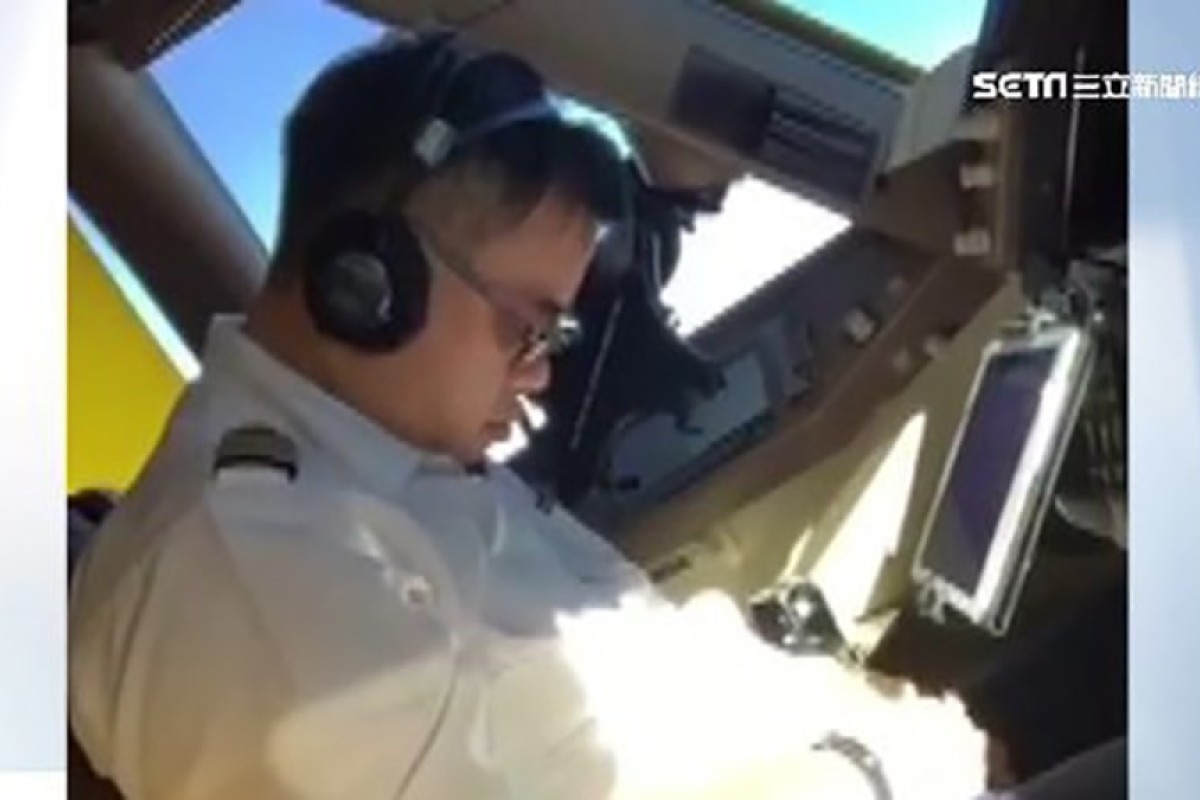
China Airlines, Taiwan’s biggest carrier, says it has punished a pilot after a video of him taking a nap in the cockpit mid-flight was posted online.
His co-pilot, who filmed the incident, has also been reprimanded, local television station SETN reported.
In the video, a middle-aged man in a pilot uniform and headphones appears to be asleep with his head down and eyes closed while in the cockpit of a Boeing 747.
The footage drew attention after it was shown in a report on Taiwanese TV network EBC on Wednesday. The man was identified as Weng Jiaqi, a senior pilot with almost 20 years of experience who was promoted to chief pilot last year.
It was unclear when or on which flight the video was filmed, but the airline confirmed that Weng had reported his behaviour and been punished while his co-pilot had been reprimanded for “improper behaviour”, SETN reported.
Weng, who also supervises training, is a short-haul pilot to cities including Hong Kong, Shanghai, Beijing, Guangzhou, Tokyo, Okinawa and Seoul, according to the EBC report.
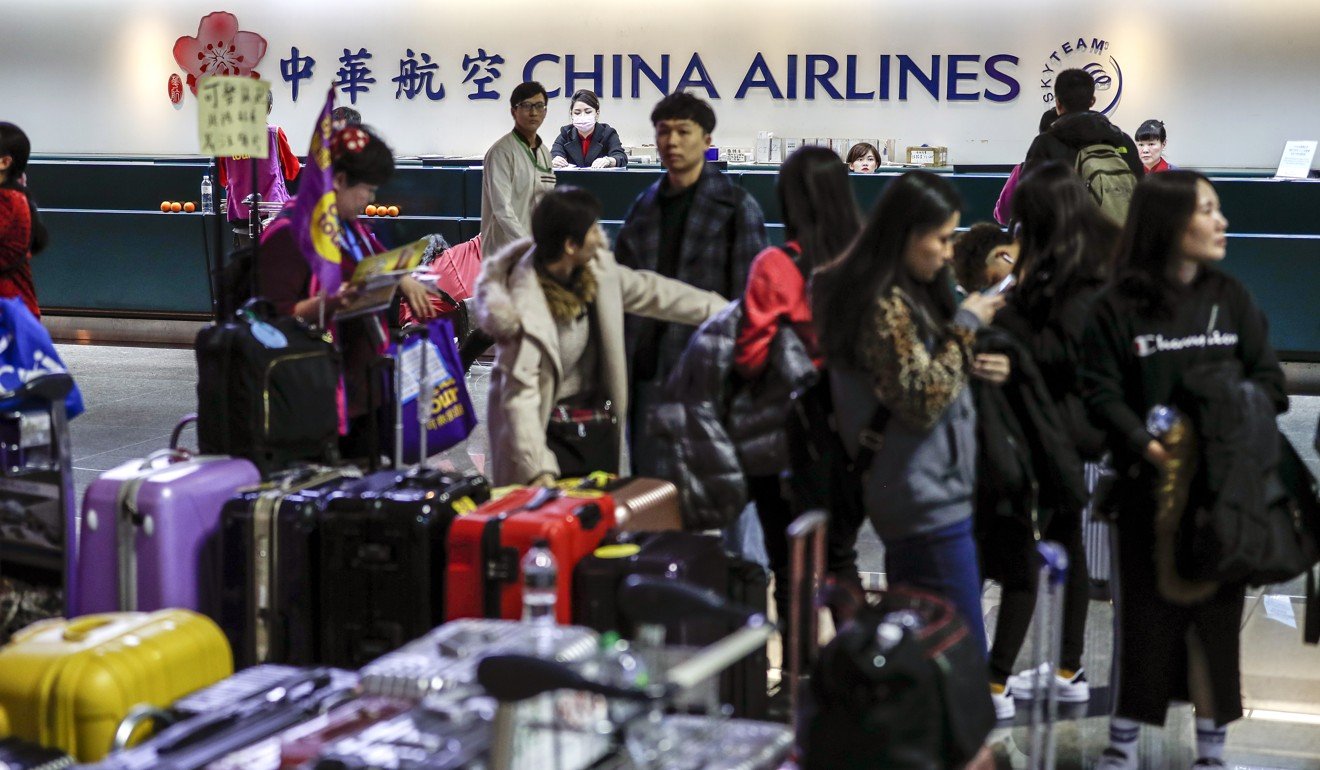
over working conditions and benefits that forced the cancellation of more than 200 flights.
The Taoyuan Union of Pilots began the industrial action on February 8, stranding close to 50,000 passengers and inflicting over NT$500 million (US$16.2 million) in losses on the carrier.
Under a deal signed on February 14, the union agreed not to strike again in the next 3½ years. In return, China Airlines agreed to the union’s main demand to increase the number of pilots on various flights to combat fatigue and improve safety.
Chinese pilots, cabin crew told no more smoking in cockpits on domestic flights
The carrier will roster three pilots on flights of more than eight hours – up from the present two – and will have four pilots on flights over 12 hours, up from three.
China Airlines president Hsieh Shih-chien said the staffing increases were expected to sharply add to the cost of the company’s operations, but the carrier agreed to the terms in the interest of safety.
Source: SCMP
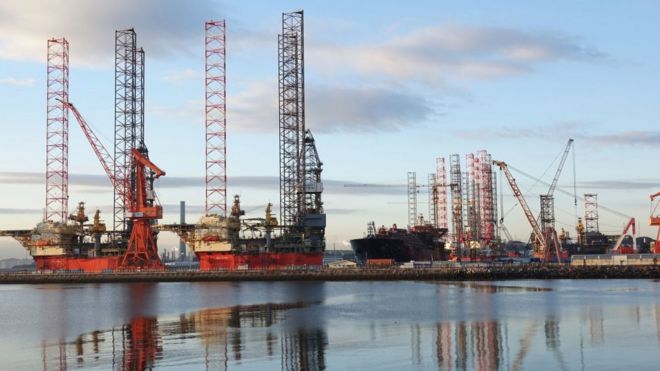 Image copyrightGETTY IMAGES
The Australian government says it is seeking an “urgent” clarification from Beijing over reports that a major Chinese port has halted imports of Australian coal.
Australia is a top supplier of coal to China, its biggest export market.
Beijing has not confirmed the reported halt in the port of Dalian, but called changes in such arrangements “normal”.
Canberra sought to play down speculation on Friday that the matter may be linked to bilateral tensions.
Australian officials said there was “confusion” over the situation, and they were consulting their Chinese counterparts.
“I wouldn’t jump to conclusions. The Australia-China trading relationship is exceptionally strong,” Treasurer Josh Frydenberg told the Australian Broadcasting Corporation.
Fears about the issue have prompted a fall in the Australian dollar.
On Thursday, Reuters reported that China’s Dalian port region would not allow Australian coal to pass through customs.
The news agency quoted officials as saying that only Australian coal had been affected, with no limits placed on Indonesian and Russian shipments.
It said other Chinese ports had delayed Australian coal shipments in recent months.
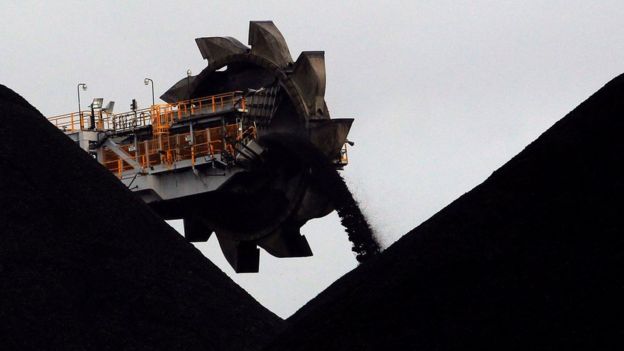 Image copyrightREUTERS
Australian trade officials said they had been notified of recent industry concerns about market access.
When asked about the reported halt, Chinese Foreign Ministry spokesman Geng Shuang offered general comments that authorities sought “to safeguard the rights and interests of Chinese importers and protect the environment”.
Some security analysts in Australia have suggested it could be a tit-for-tat move by China, after Australia blocked tech giant Huawei from providing 5G technology.
“The banning of those coal shipments is a form of coercion against Australia. It’s punishment against states that resist China’s pressure,” said Dr Malcolm Davis, from the Australian Strategic Policy Institute.
Other recent tensions have emerged over allegations – denied by Beijing – of Chinese interference in Australian politics and society.
However others, including the head of the Reserve Bank of Australia, have suggested that China’s concerns about its own coal industry may be behind any such halts.
Blocking “a couple of months of coal exports” would not hurt the Australian economy, said Philip Lowe.
“If it were to be the sign of a deterioration in the underlying political relationship between Australia and China then that would be more concerning,” he said.
Mr Frydenberg said: “We can see these occasional interruptions to the smooth flow but that doesn’t necessarily translate to some of the consequences that aspects of the media might seek to leap to.”
Source: The BBC
WASHINGTON (Reuters) – President Donald Trump said on Friday there was “a very good chance” the United States would strike a deal with China to end their trade war and that he was inclined to extend his March 1 tariff deadline and meet soon with Chinese President Xi Jinping.
“I think that we both feel there’s a very good chance a deal will happen,” Trump said.
Liu agreed there had been “great progress”.
“From China, we believe that (it) is very likely that it will happen and we hope that ultimately we’ll have a deal. And the Chinese side is ready to make our utmost effort,” he said at the White House.
The Republican president said he probably would meet with Xi in March in Florida to decide on the most important terms of a trade deal.
Optimism that the two sides will find a way to end the trade war lifted stocks, especially technology shares. The S&P 500 stock index reached its highest closing level since Nov. 8. Oil prices rose to their highest since mid-November, with Brent crude reaching a high of $67.73 a barrel. [.N] [O/R]
Trump and Treasury Secretary Steven Mnuchin said the two sides had reached an agreement on currency. Trump declined to provide details, but U.S. officials long have expressed concerns that China’s yuan is undervalued, giving China a trade advantage and partly offsetting U.S. tariffs.
Announcement of a pact aimed at limiting yuan depreciation was putting “the currency cart before the trade horse,” but would likely be positive for Asian emerging market currencies, said Alan Ruskin, global head of currency strategy at Deutsche Bank in New York.
“How can you agree to avoid excessive Chinese yuan depreciation or volatility if you have not made an agreement on trade that could have huge FX implications?” Ruskin asked in a note to clients.
In a letter to Trump read aloud by an aide to Liu at the White House, Xi called on negotiators to work hard to strike a deal that benefits both country.
Trump said a deal with China may extend beyond trade to encompass Chinese telecommunications companies Huawei Technologies and ZTE Corp.
The Justice Department has accused Huawei of conspiring to violate U.S. sanctions on Iran and of stealing robotic technology from T-Mobile US Inc.
Chinese peer ZTE was last year prevented from buying essential components from U.S. firms after pleading guilty to similar charges, crippling its operations.
Trump appeared at odds with his top negotiator, U.S. Trade Representative Robert Lighthizer, on the preliminary terms that his team is outlining in memorandums of understanding for a deal with China. Trump said he did not like MOUs because they are short term, and he wanted a long-term deal.
“I don’t like MOUs because they don’t mean anything,” Trump said. “Either you are going to make a deal or you’re not.”
Lighthizer responded testily that MOUs were binding, but that he would never use the term again.
Reuters reported exclusively on Wednesday that the two sides were drafting the language for six MOUs covering the most difficult issues in the trade talks that would require structural economic change in China.
Negotiators have struggled this week to agree on specific language within those memorandums to address tough U.S. demands, according to sources familiar with the talks. The six memorandums include cyber theft, intellectual property rights, services, agriculture and non-tariff barriers to trade, including subsidies.
An industry source briefed on the talks said both sides have narrowed differences on intellectual property rights, market access and narrowing a nearly $400 billion U.S. trade deficit with China. But bigger differences remain on changes to China’s treatment of state-owned enterprises, subsidies, forced technology transfers and cyber theft of U.S. trade secrets.
Lighthizer pushed back when questioned on forced technology transfers, saying the two sides made “a lot of progress” on the issue, but did not elaborate.
The United States has said foreign firms in China are often coerced to transfer their technology to Chinese firms if they want to operate there. China denies this.
The U.S. Chamber of Commerce on Friday urged the U.S. government to ensure the deal was comprehensive and addressed core issues, rather than one based on more Chinese short-term purchases of goods.
China has pledged to increase purchases of agricultural produce, energy, semiconductors and industrial goods to reduce its trade surplus with the United States.
China committed to buying an additional 10 million tonnes of U.S. soybeans on Friday, U.S. Agriculture Secretary Sonny Perdue said on Twitter. China bought about 32 million tonnes of U.S. soybeans in 2017. The commitments are a “show of good faith by the Chinese” and “indications of more good news to come,” Perdue wrote.
China was the top buyer of U.S. soybeans before the trade war, but Beijing’s retaliatory tariffs on U.S. soybeans slashed business that had been worth $12 billion annually.
Source: Reuters
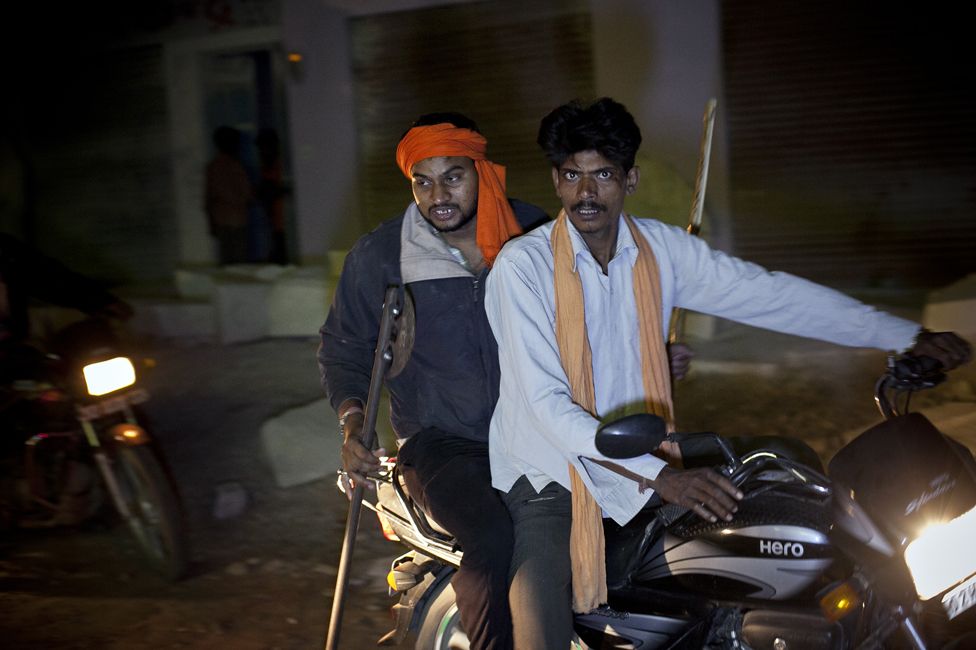 Image copyrightGETTY IMAGES (ALLISON JOYCE)
A Muslim dairy farmer was stopped late one night last July as he led two cows down a track in rural Rajasthan, south of the Indian capital, Delhi. Within hours he was dead, but who killed him, asks the BBC’s James Clayton – the “cow vigilantes” he met on the road, or the police?
It’s 4am and Dr Hassan Khan, the duty doctor at Ramgarh hospital, is notified of something unusual.
The police have brought in a dead man, a man they claim not to know.
“What were the police like when they brought him in? Were they calm?” I ask him.
“Not calm,” he says. “They were anxious.”
“Are they usually anxious?” I ask.
“Not usually,” he says, laughing nervously.
The dead man is later identified by his father as local farmer Rakbar Khan.
This was not a random murder. The story illustrates some of the social tensions bubbling away under the surface in India, and particularly in the north of the country.
And his case raises questions for the authorities – including the governing Hindu nationalist BJP party.
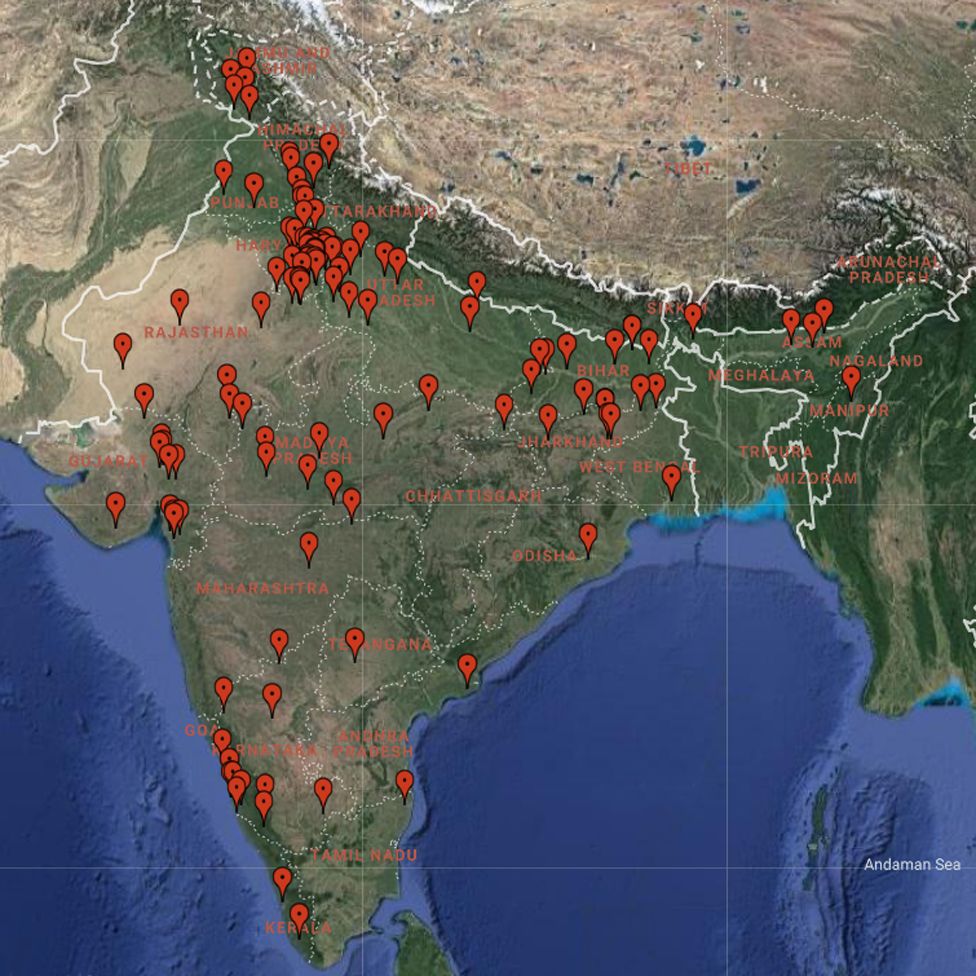 Image copyrightINDIASPEND
He kept cows and he also happened to be a Muslim. That can be a dangerous mix in India.
“We have always reared cows, and we are dependent on their milk for our livelihood,” says Rakbar’s father, Suleiman.
“No-one used to say anything when you transported a cow.”
That has changed. Several men have been killed in recent years while transporting cows in the mainly Muslim region of Mewat, not far from Delhi, where Rakbar lived.
“People are afraid. If we go to get a cow they will kill us. They surround our vehicle. So everyone is too scared to get these animals,” says Suleiman.
Everyone I speak to in the village where the Khans live is afraid of gau rakshaks – cow protection gangs.
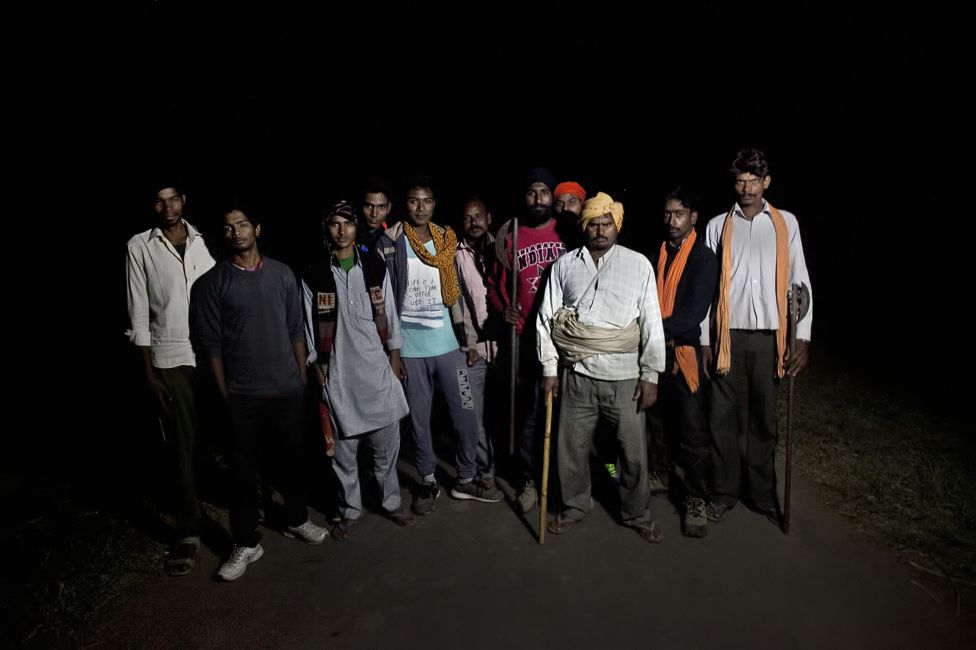 Image copyrightGETTY IMAGES (ALLISON JOYCE)The gangs often consist of young, hardline Hindus, who believe passionately in defending India’s holy animal.
They believe that laws to protect cows, such as a ban on slaughtering the animals, are not being fully enforced – and they hunt for “cow smugglers”, who they believe are taking cows to be killed for meat.
Often armed, they have been responsible for dozens of attacks on farmers in India over the last five years, according to data analysis organisation IndiaSpend, which monitors reports of hate crimes in the media.
On 21 July 2018, Rakbar Khan met the local gau rakshak.

There are some things we know for certain about what happened that night.
Rakbar was walking down a small road with two cows. It was late and it was raining heavily.
Then, out of the dark, came the lights of motorbikes. We know this, because Rakbar was with a friend, who survived.
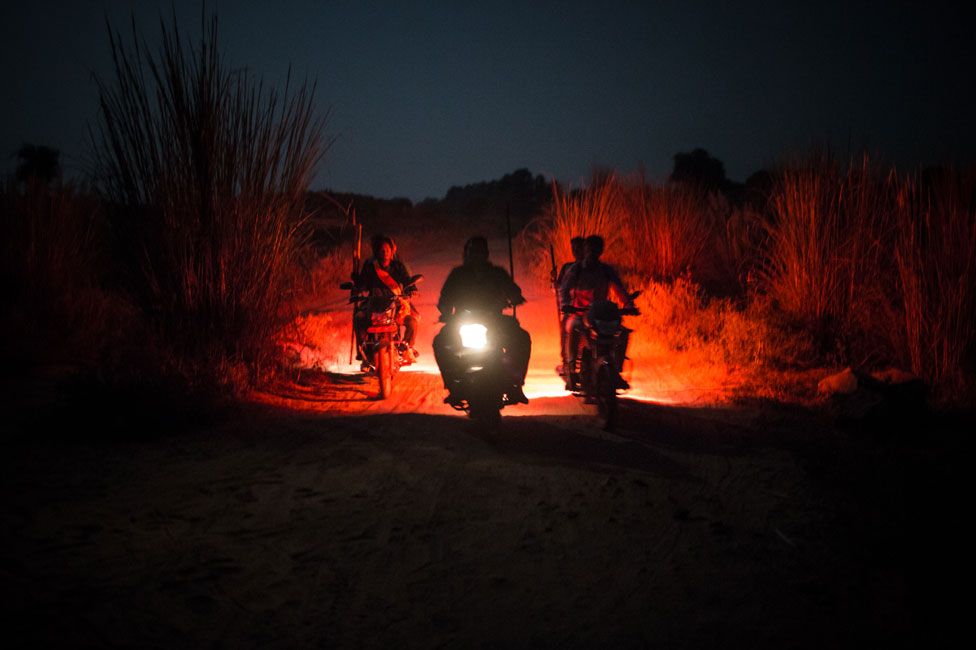 Image copyrightGETTY IMAGES (ENRICO FABIAN)
The gang managed to catch Rakbar, but his friend, Aslam, slipped away. He lay on the ground, in the mud and prayed he wouldn’t be found.
“There was so much fear inside me, my heart was hurting,” he says.
“From there I heard the screams. They were beating him. There wasn’t a single part of his body that wasn’t broken. He was beaten very badly.”
Watch James Clayton’s report for Newsnight, on BBC Two
The documentary India’s Cow Vigilantes can be seen on Our World on BBC World Newsand on the BBC News Channel (click for transmission times)
Aslam says that Rakbar was killed then and there.
But there is evidence that suggests otherwise.
Much of what happened next focuses around the leader of the local cow vigilante group, Nawal Kishore Sharma.
Aslam claims he heard the gang address him by name that night, but when I speak to Sharma, he denies he was there at all.
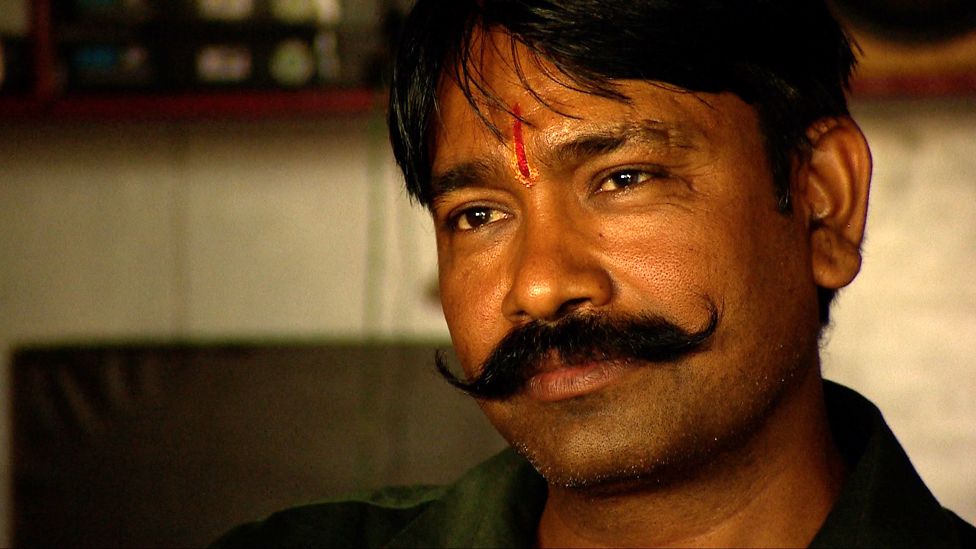
“It was about 00:30 in the morning and I was sleeping in my house… Some of my group phoned me to say they’d caught some cow smugglers,” he says.
According to Nawal Kishore Sharma, he then drove with the police to the spot. “He was alive and he was fine,” he says.
But that’s not what the police say.
In their “first incident report” they say that Rakbar was indeed alive when they found him.
“Nawal Kishore Sharma informed the police at about 00:41 that some men were smuggling two cows on foot,” the report says.
“Then the police met Nawal Kishore outside the police station and they all went to the location.
“There was a man who was injured and covered in mud.
“He told the police his name, his father’s name, his age (28) and the village he was from.
“And as he finished these sentences, he almost immediately passed out. Then he was put in the police vehicle and they left for Ramgarh.
“Then the police reached Ramgarh with Rakbar where the available doctor declared him dead.”
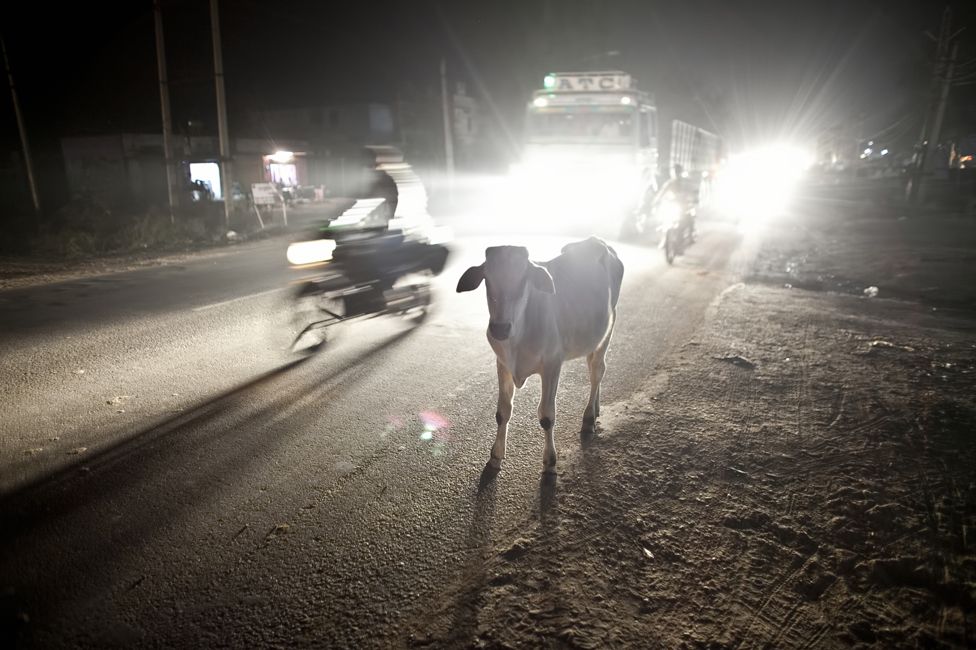 Image copyrightGETTY IMAGES (ALLISON JOYCE)
I go to the hospital in Ramgarh, where Rakbar was taken. Hospital staff are busily going through bound books of hospital records – looking for Rakbar’s admission entry.
And then, there it is. “Unknown dead body” brought in at 04:00 on 21 July 2018.
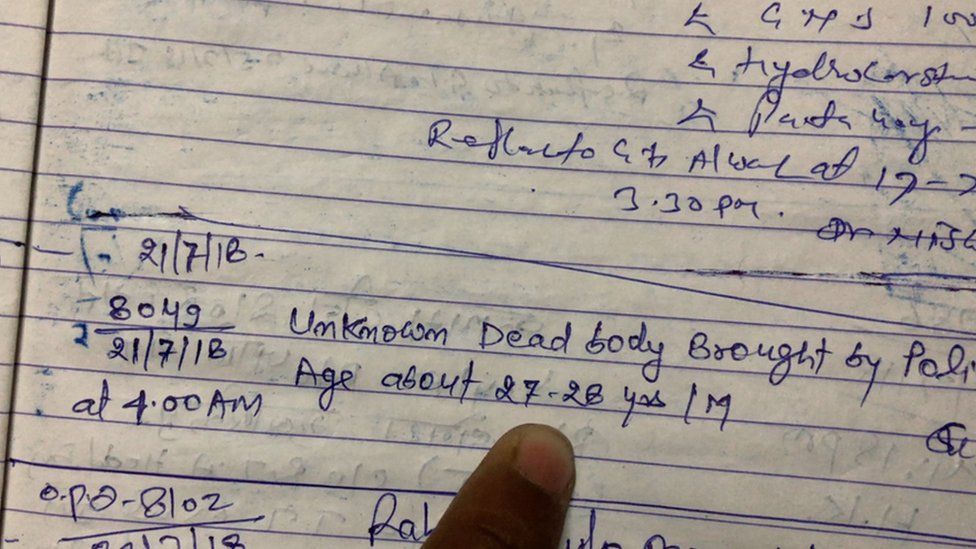
It’s not a long entry, but it contradicts the police’s story, and raises some serious questions.
For a start, Rakbar was found about 12 minutes’ drive away from the hospital. Why did it take more than three hours for them to take him there?
And if the police say Rakbar gave them his name, why did they tell the hospital they didn’t know who he was?
Nawal Kishore Sharma claims to know why. He paints a very different picture of what happened to Rakbar.
He tells me that after picking up Rakbar, they changed his clothes.
He then claims to have taken two photos of Rakbar – who at this point was with the police.
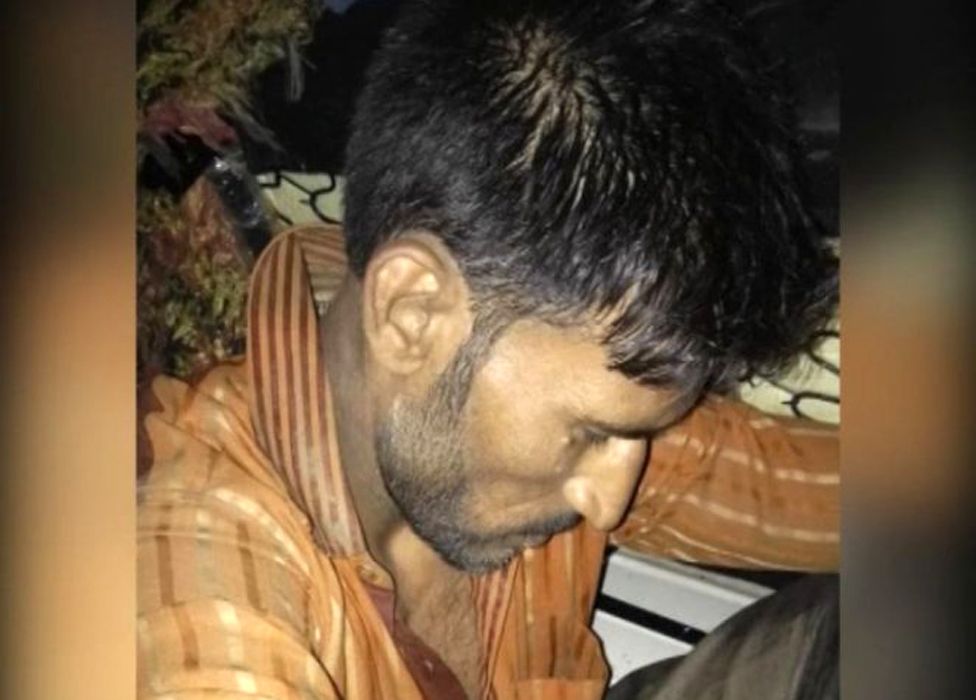
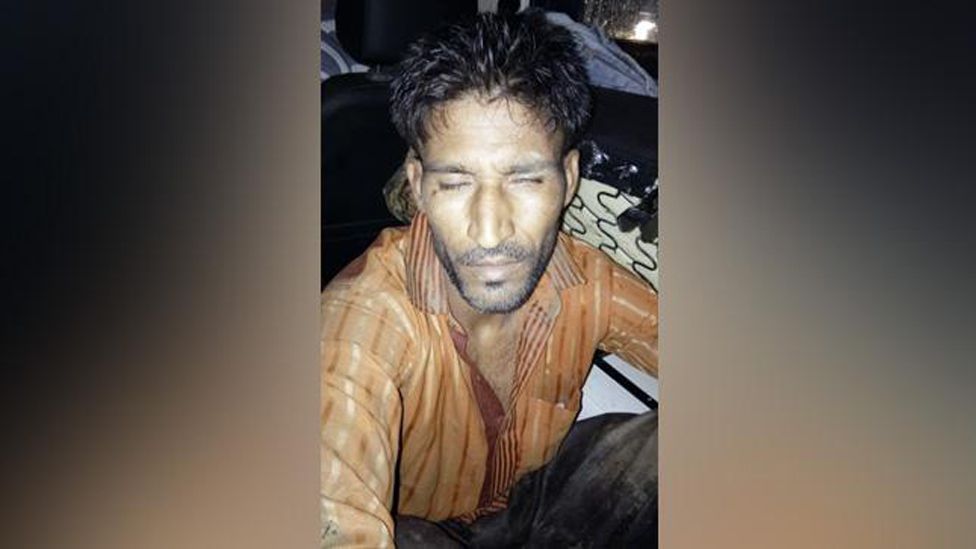
Sharma says that he went to the police station with the police. He claims that’s when the beating really began.
“The police injured him badly. They even beat him with their shoes,” he says.
“They kicked him powerfully on the left side of his body four times. Then they beat him with sticks. They beat him here (pointing at his ribs) and even on his neck.”
At about 03:00 Nawal Kishore Sharma says he went with some police officers to take the two cows to a local cow shelter. When he returned, he says, the police told him that Rakbar had died.
Rakbar’s death certificate shows that his leg and hand had been broken. He’d been badly beaten and had broken his ribs, which had punctured his lungs.
According to his death certificate he died of “shock… as a result of injuries sustained over body”.
I ask the duty doctor at the hospital whether he remembers what Rakbar’s body was like when the police brought it in.
“It was cold,” he says.
I ask him how long it would take for a body to become cold after death.
“A couple of hours,” he replies.
“I don’t want to talk about Rakbar’s case,” says Rejendra Singh, chief of police of Alwar district, which includes Ramgarh.
Since Rakbar’s murder several police officers have been suspended. I want to know why.
He looks uneasily at me.
“There were lapses on the police side,” he says.
I ask him what those lapses were.
“They had not followed the regular police procedure, which they were supposed to do,” he says. “It was one big lapse.”
Three men from Nawal Kishore Sharma’s vigilante group have been charged with Rakbar’s murder. Sharma himself remains under investigation.
The vigilante group and the police blame each other for Rakbar’s death, but neither denies working together that night.
The way Sharma describes it, the police cannot be everywhere, so the vigilantes help them out. But it’s the police that “take all the action” he says.
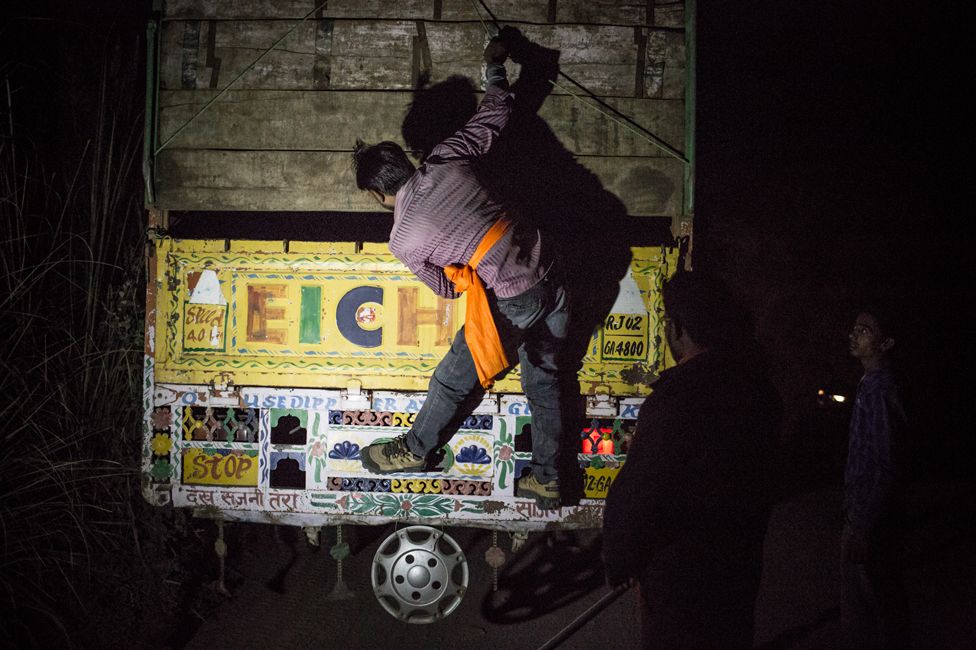 Image copyrightGETTY IMAGES (ENRICO FABIAN)
Across the state there are dozens of formal cow checkpoints, where police stop vehicles looking for smugglers who are taking cows to be killed.
I visited one of the checkpoints. Sure enough police were patiently stopping vehicles and looking for cows.
The night before officers had had a gun battle with a group of men after a truck failed to stop.
These checkpoints have become common in some parts of India. Sometimes they are run by the police, sometimes by the vigilantes, and sometimes by both.
This gets to the heart of Rakbar’s case.
Human rights groups argue that his murder – and others like his – show that in some areas the police have got too close to the gangs.
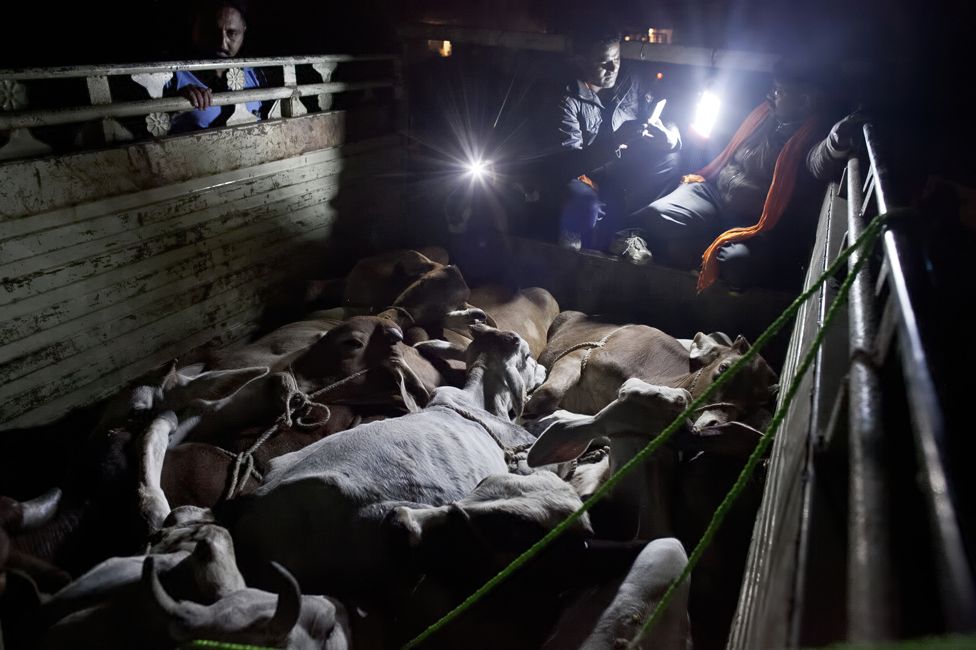 Image copyrightGETTY IMAGES (ALLISON JOYCE)
In some areas, police have been reluctant to arrest the perpetrators of violence – and much faster to prosecute people accused of either consuming or trading in beef, he says.
Human Rights Watch has looked into 12 cases where it claims police have been complicit in the death of a suspected cow smuggler or have covered it up. Rakbar’s is one of them.
But this case doesn’t just illustrate police failings. Some would argue that it also illustrates how parts of the governing BJP party have inflamed the problem.
Gyandev Ahuja is a larger-than-life character. As the local member of parliament in Ramgarh at the time when Rakbar was killed he’s an important local figure.
He has also made a series of controversial statements about “cow smugglers”.
After a man was badly beaten in December 2017 Ahuja told local media: “To be straightforward, I will say that if anyone is indulging in cow smuggling, then this is how you will die.”
After Rakbar’s death he said that cow smuggling was worse than terrorism.
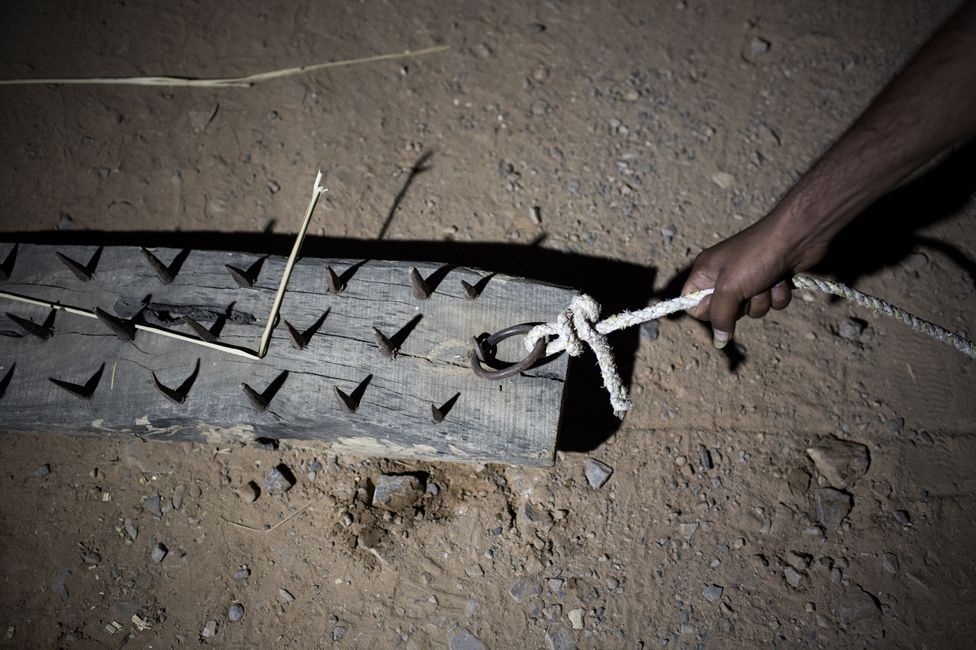 Image copyrightGETTY IMAGES (ENRICO FABIAN)
One of Prime Minister Narendra Modi’s ministers was even photographed garlanding the accused murderers in a cow vigilante case. He has since apologised.
Meenakshi Ganguly of Human Rights Watch says it is “terrifying” that elected officials have defended attackers.
“It is really, at this point of time, something that is a great concern, because it is changing a belief into a political narrative, and a violent one,” he says.
The worry is that supportive messages from some of the governing party’s politicians have emboldened the vigilantes.
No official figures are kept on cow violence, but the data collected by IndiaSpend suggests that it started ramping up in 2015, the year after Narendra Modi was elected.
IndiaSpend says that since then there have been 250 injuries and 46 deaths related to cow violence. This is likely to be an underestimate because farmers who have been beaten may be afraid to go to the police – and when a body is found it may not be clear what spurred the attack. The vast majority of the victims are Muslims.
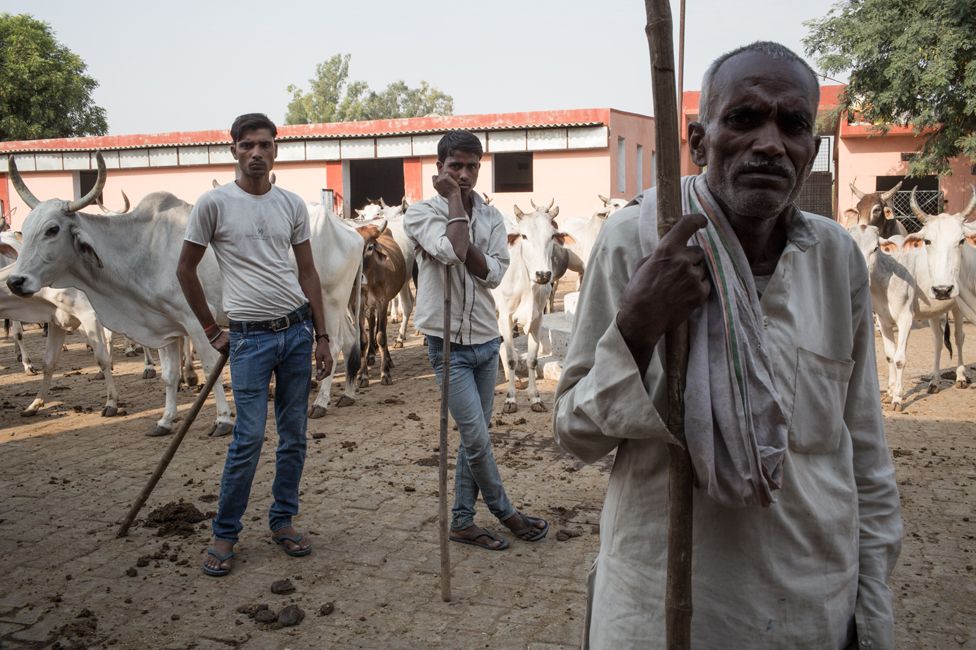 Image copyrightGETTY IMAGES (ENRICO FABIAN)
“To say the BJP is responsible is perverse, inaccurate and absolutely false,” he tells me.
“Many people have an interest in building a statement that the BJP is behind it. We won’t tolerate it.”
I ask him about Gyandev Ahuja’s inflammatory statements.
“Firstly that is not the party’s point of view and we have very clearly and unequivocally always said an individual’s point of view is theirs, the point of view of the party is articulated by the party.
“Has the BJP promoted him or protected him? No.”
But a month after this interview, Ahuja was made vice-president of the party in Rajasthan.
Shortly afterwards, Prime Minister Narendra Modi visited Rajasthan – publicly slapping Ahuja on the back and waving together at crowds of BJP supporters.
In Mewat I speak to Rakbar’s wife, Asmina.
“Show me how you raise seven children without a husband. How will I be able to raise them?” she says, wiping away tears.
“My youngest daughter says that my father went to God. If you ask her, ‘How did he go to God?’ she says, ‘My father was bringing a cow and people killed him.’
“The life of an animal is so important but that of a human is not.”
The trial of the three men accused of his murder has yet to take place, but perhaps we will never know what really happened to Rakbar.
In November 2015, photographer Allison Joyce spent a night following Nawal Kishore Sharma’s vigilantes in the countryside near Ramgarh. One of her photographs shows a police officer embracing Sharma after a shootout between the vigilantes and a suspected cow smuggler.
Though the police now accuse the cow vigilantes of killing Rakbar Khan, and the vigilantes accuse the police, the photograph illustrates just how closely they worked together.
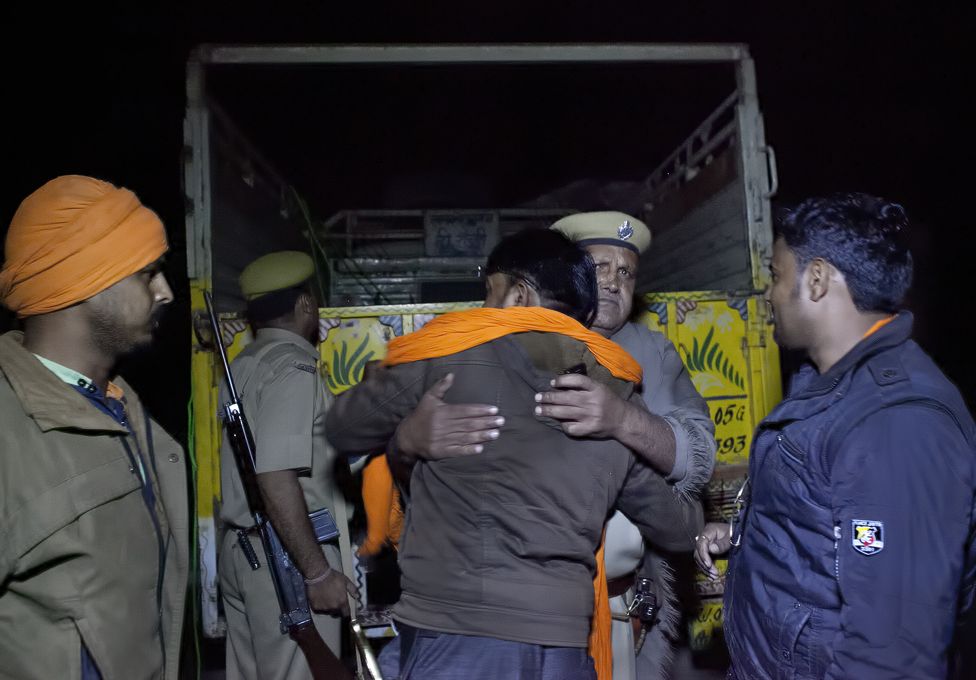 Image copyrightGETTY IMAGES (ALLISON JOYCE)
There are also claims that the police stopped and drank tea instead of taking Rakbar to hospital.
Whatever they did, they did not take Rakbar to hospital immediately.
Source: The BBC
GUWAHATI, India (Reuters) – At least 84 people have died from drinking toxic bootleg liquor in the northeastern Indian state of C, and around 200 others have been hospitalised, a state government minister said on Saturday.
The deaths come less than two weeks after more than 100 people died from drinking tainted alcohol in two northern Indian states, Uttarkhand and Uttar Pradesh.
Police have arrested twelve people in connection with making bootleg alcohol in Assam, a practice local politicians say is rampant in the area’s tea estates, where its is drunk by poorly-paid labourers after a tough day’s work in the plantations.
“Every 10 minutes we are getting reports of casualties from different places. So far about 200 people are in hospital with many of them critical,” Assam Health Minister Himanta Biswa Sarma told Reuters via telephone.
“Doctors from nearby districts and other medical colleges have been rushed in to deal with the crisis,” said Sarma, after visiting patients at Jorhat, located some 300 kilometres east of the state’s financial hub, Guwahati.
Deaths from illegally produced alcohol, known locally as hooch or country liquor, are common in India, where many cannot afford branded spirits.
The death tolls from the two recent incidents, however, are believed to be the deadliest since a similar case killed 172 in West Bengal in 2011.
Dilip Rajbnonshi, a doctor at the government hospital in Golaghat, located some 40 kilometres southwest of Jorhat said the deaths were due to “spurious country liquor”.
“I asked some of the patients why they consume liquor almost everyday and they said after a hard day’s work in the plantations they drink to relieve stress and tiredness,” health minister Sarma said.
Mrinal Saikia, a local lawmaker from the Bharatiya Janata Party – which is in control of the federal and Assam state governments – said alcohol, often laced with cattle feed and battery acid, is being supplied “in gallons” to tea plantation workers.
“This is a big business in areas surrounding tea gardens where people set up illegal distilleries to make country liquor,” he said.
INDIA Updated: Feb 23, 2019 19:11 IST


Prime Minister Narendra Modi on Saturday denounced reported attacks on Kashmiri youths in some parts of the country following Pulwama terror attack killing at least 40 soldiers on February 14. PM Modi said Kashmiri youths should not be targeted anywhere in the country.
Speaking at a public rally in Rajasthan’s Tonk, PM Modi said, “Our fight is against terror, the enemies of humanity… Our fight is for Kashmir not against Kashmir, not against Kashmiris.”
“What happened to Kashmiri youths in the last few days…It does not matter whether the incident was small or big, such things should not happen. Kashmiri youths are victims of terror. Every child of Kashmir is with India in our fight against terror,” said PM Modi.
Former Jammu and Kashmir Chief Minister and National Conference leader Omar Abdullah welcomed the statement of PM Modi. “Thank you @narendramodi Sahib. Aaj aap ne hamaray dil ki baat keh di (you said what I have in my heart),” wrote Abdullah on Twitter soon after the prime minister made the comment at his rally.
PM Modi referred to his congratulatory phone call to Pakistan Prime Minister Imran Khan, when he assumed office after the general elections in Pakistan last year. PM Modi said, “As per protocol, I telephoned Pakistan’s new prime minister. I told him we have fought for long. Let India and Pakistan together fight poverty and illiteracy.”
“Pakistan’s prime minister told me, ‘I am the son of a Pathan. I do what I say.’ It is time to test his words,” PM Modi said at his rally in Rajasthan.
Also read: Centre moves 100 companies of paramilitary forces to Srinagar amid massive crackdown
The prime minister said incidents like these “give power to Bharat ke tukde honge gang” and their supporters. “It is the responsibility of every Indian to protect every laal (child) of Kashmir,” he said.
The prime minister served another warning to Kashmiri separatist leaders, many of whom were stripped of their security cover early this week. The Union home ministry had ordered to review the security provided by the government to the separatist leaders in the wake of Pulwama attack.
PM Modi said, “Action has been taken against separatists and more action will be taken against such people…We can’t keep silent, we know how to crush terror.”
‘Trust Modi Sarkar’
Asserting that the government has moved swiftly to “avenge” Pulwama terror attack, PM Modi said all the major institutions of the world have condemned “the terror attack that was engineered at Pulwama”.
“I am proud that our security forces sent the perpetrators (of Pulwama attack) within 100 hours to where they belong,” he said referring to encounter in Pulwama a day after the terror attack on Jammu-Srinagar highway, where a CRPF convoy carrying more than 2,500 jawans was targeted by a suicide bomber.
Also read:In crackdown in Kashmir, JLKF chief Yasin Malik, Jamaat leaders detained
“Trust the brave soldiers of the country and trust the Modi government…This time, everyone will be taken to justice and complete justice will be served,” said PM Modi adding, “Your pradhan sevak is busy finishing terror…If I am destined to put locks to the factory of terror, so be it.”
He also talked about the steps, the government has taken to put pressure on Pakistan following Pulwama attack. He said, “Pakistan is being accounted for everything that they have done. There is anxiety in Pakistan due to the steps we have taken after the terror attack.”
A day after Pulwama terror attack, the government decided at a meeting of the Cabinet Committee on Security (CCS) to withdraw the most favoured nation (MFN) status granted to Pakistan in 1996. The government also hiked tariff on goods to be imported from Pakistan by 200 per cent.
The external affairs ministry reached out to more than a dozen countries to corner Pakistan, which denied its hand behind the terror attack in Jammu and Kashmir despite Jaish-e-Mohammed, a terror group based out of that country, claimed responsibility for the attack on CRPF jawans.
On Thursday, the United Nations Security Council (UNSC) passed a resolution condemning Pulwama terror attack. The UNSC named Jaish-e-Mohammed in its statement. The UNSC resolution was unanimously approved by all members including China, which has been shielding Jaish-e-Mohammed chief Masood Azhar from being declared as global terrorist by the top UN body.
In the latter half of his public speech, PM Modi sounded poll bugle throwing what appeared as an election slogan, “Modi hai to mumkin hai” (it is possible if Modi is there). He said, “People have faith in the current government because of the work done in last four years. Modi hai to mumkin hai.”
He listed out achievements of his government and talked about schemes such health insurance, One-Rank-One-Pension and electrification among others repeating the same slogan at the end. He also accused the Congress of misleading the people of Rajasthan in last year’s assembly election by making farm loan waiver promise.
Source: Hindustan Times

Prime Minister Narendra Modi addresses Pravasi Bhartiya representatives at Pravasi Bhartiya Kendra in New Delhi on February 23, 2019. (Photo: IANS/PIB)
Prime Minister Narendra Modi will be paying a visit to the ongoing Kumbh Mela at Prayagraj on Sunday where he will take a holy dip at the Triveni Sangam, the confluence of rivers Ganga, Yamuna, and the mythical Saraswati, considered the centre of the earth according to Hindu scriptures.
At Prayagraj, PM Modi will participate in the Swachh Kumbh Swachh Aabhaar event and interact with the “Safai Karmacharis”.
He will later address a gathering and distribute the Swachh Kumbh Swachh Aabhaar awards to safai karmacharis, swachhagrahis, police personnel, and naviks.
The Swachh Kumbh Swachh Aabhaar event is being organized by the Ministry of Drinking Water & Sanitation.
The Kumbh Mela commenced on January 15 (Makar Sankranti) and will conclude on March 4 (Mahashivratri).
Over a period of 49 days of the mega celebration, more than 22 crore devotees have visited the Kumbh Mela.
On Friday, Minister of State for External Affairs General VK Singh led a delegation of around 200 delegates of more than 185 countries to the Kumbh Mela 2019. The foreign representatives took a holy bath at Sangam and witnessed cultural programmes at Sanskriti Gram.
Singh told reporters that the idea behind the visit was to make “them see that Kumbh is not just confluence of rivers but also of different religions and faiths”.
Earlier on Saturday, PM Modi interacted with foreign delegates from 185 countries at Pravasi Bharatiya Kendra in New Delhi where he said that there is a huge potential for tourism in the country.
Source: The Statesman
BEIJING, Feb. 21 (Xinhua) — China highly appreciates Russian President Vladimir Putin’s positive remarks on China-Russia ties as he delivered a state of the nation address, Foreign Ministry spokesperson Geng Shuang said on Thursday.
In the annual address, Putin described the relations of Russia and China as important “stable forces” of the international community.
Geng said the rapid development of China-Russia relations under the strategic guidance of the two heads of state gained not only fruitful achievement at the bilateral level but also injected positive energy in maintaining global strategic stability.
This year marks the 70th anniversary of the two countries’ establishment of diplomatic ties. Geng said that the two countries should take the opportunity to continuously deepen strategic coordination, push for further development of bilateral ties and better benefit the two peoples and safeguard the security and the stability of the world.
Source: Xinhua
Social credit system: China’s richest regions are also home to the most blacklisted firms
22 Feb 2019
China’s wealthiest regions also have the largest number of untrustworthy businesses, according to the government’s social credit system, which rates citizens and companies based on their behaviour.
Jiangsu, the country’s second largest provincial economy – 9.26 trillion yuan (US$1.37 trillion) – accounted for 16.7 per cent of the discredited businesses that were added to the national blacklist last year, more than any other region.
According to a report compiled by the National Public Credit Information Centre that is backed by China’s state planner, the National Development and Reform Commission, Guangdong is next in line.
Guangdong is China’s most prosperous province, Guangdong, but is also home to 12.77 per cent of the total 3.59 million blacklisted firms. The southern province had a gross domestic product of 9.73 trillion yuan last year.
By naming and shaming the millions of Chinese businesses and individuals on the annual blacklist, Beijing hopes to boost “trustworthiness” in Chinese society. Under the system, each of its 1.4 billion citizens is expected to receive a personal trustworthiness score.
“In more developed coastal provinces, businesses have long operated in the grey area between emerging China and established Hong Kong,” said Brock Silvers, managing director of Kaiyuan Capital, a Shanghai-based financial advisory firm.
Silvers said the situation evoked the Chinese saying: “Heaven is high and the Emperor is far away”, which alludes to local officials’ tendency to disregard central government’s directives.
While it was previously not such a faux pas to engage in “untrustworthy” behaviour in attaining economic development, things are now different.
“The ability to cut corners in search of profit isn’t as prized in China’s modern economy, and many of those old traits can now lead companies to be added to Beijing’s blacklist,” Silvers said.
Among the firms named in the hall of shame is Chuangyue Energy Group, from northwest Xinjiang, which topped the list of new cases involving at least 500 million yuan in fraudulent activity.
Chuangyue and its legal representative Qin Yong were reprimanded by the Shenzhen Stock Exchange in 2016 for failing to disclose transactions on time. The transaction involved changes to the shareholding structure of a listed firm in which Chuangyue held interest in, state media reported.
Also on the list was property developer Zhonghong Holding, which was delisted from the Shenzhen exchange late-last year after its shares fell below the par value of 1 yuan for 20 consecutive days.
Zhonghong had posted massive losses, failed to repay loans and halted development projects during 2018.
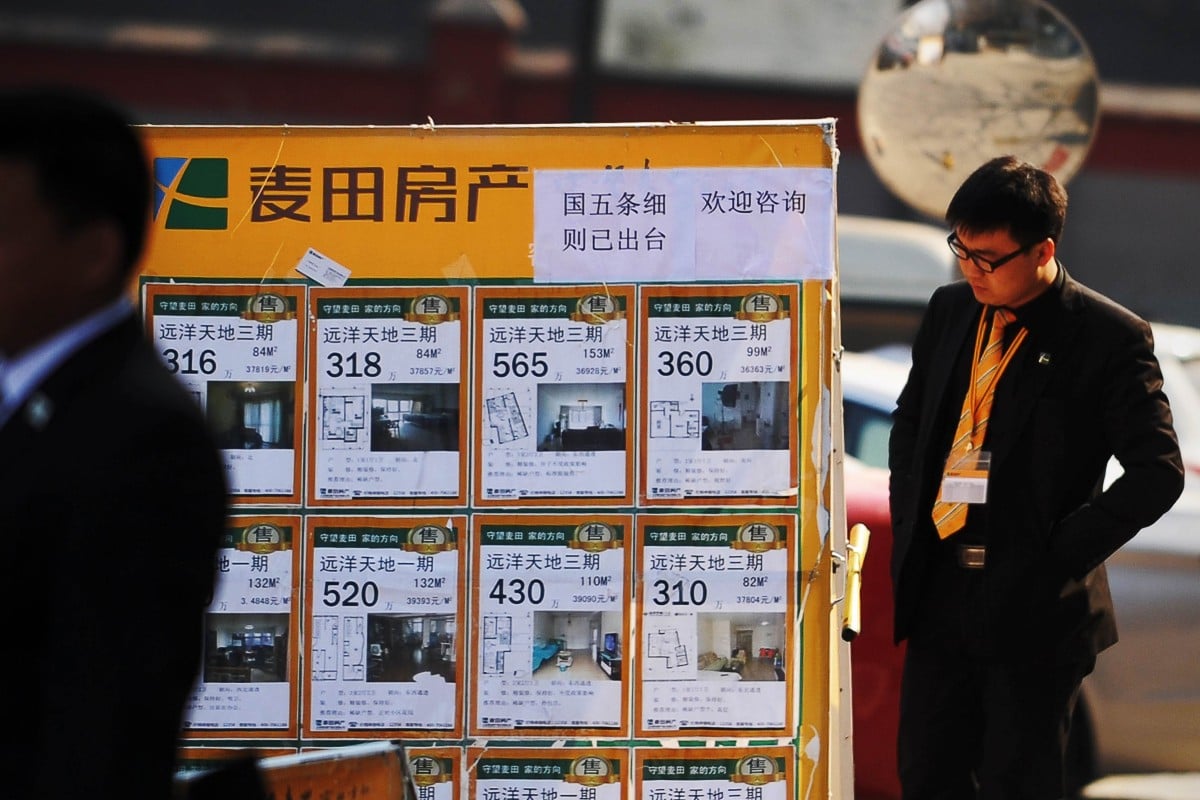
Property brokerage was a hotbed industry for fraudsters. The report named and shamed two agents in Wuhan, An Yi Real Estate Brokerage and Hong Run De Real Estate Brokerage, which Chinese netizens described as “black brokers”.
In one case, Hong Run De subdivided one flat to lease without the owner’s knowledge and consent. To terminate the contract, the owner had to pay “compensation” of 30,000 yuan before they could reclaim the flat.
Other dodgy sectors were health care product makers and peer-to-peer (P2P) lending platforms.
Quanjian Group, a maker of herbal medicines, was accused of making false marketing claims about the benefits of a product that a four-year-old cancer patient drank.

Changsheng Bio-Technology, the major Chinese manufacturer of rabies vaccines, was fined US$1.3 billion in October after it was found to have fabricated records.
A total of 1,282 P2P operators, more than half located in Zhejiang, Guangdong and Shanghai, were placed on the blacklist because they could not repay investors, or were involved in illegal fundraising.
While more individuals and companies were added to the blacklist, others were also removed – 2.17 million. Those removed had paid taxes owed or fines imposed.
Source: SCMP

continuously updated blog about China & India
continuously updated blog about China & India
continuously updated blog about China & India
 CHINDIA ALERT: You'll be living in their world, very soon