Chindia Alert: You’ll be Living in their World Very Soon
aims to alert you to the threats and opportunities that China and India present. China and India require serious attention; case of ‘hidden dragon and crouching tiger’.
Without this attention, governments, businesses and, indeed, individuals may find themselves at a great disadvantage sooner rather than later.
The POSTs (front webpages) are mainly 'cuttings' from reliable sources, updated continuously.
The PAGEs (see Tabs, above) attempt to make the information more meaningful by putting some structure to the information we have researched and assembled since 2006.
BEIJING, May 7 (Xinhua) — China and Japan will hold their 11th round of high-level consultations on maritime affairs in Otaru, Japan, from May 10 to 11, a foreign ministry spokesperson said Tuesday.
Spokesperson Geng Shuang told a routine news briefing that officials from foreign ministries, defense ministries, maritime law enforcement and management departments of both counties will attend the talks.
China expects to fully exchange views with Japan on maritime issues of common concern to strengthen mutual understanding and trust with Japan, Geng said.
The China-Japan high-level consultations on maritime affairs were established in 2012. The last round of consultations was held in Wuzhen of eastern China’s Zhejiang Province last December.
XI’AN, May 7 (Xinhua) — Yan’an, a former revolutionary base of the Communist Party of China (CPC), is no longer labeled “poor,” as its last two impoverished counties have shaken off poverty, the Shaanxi provincial government announced Tuesday.
Yan’an hosted the then headquarters of the CPC and the center of the Communist revolution from 1935 to 1948. The city is now home to more than 350 sites related to the Chinese revolution.
The counties of Yanchuan and Yichuan, with a population of 192,000 and 120,000 respectively and both located along the western bank of the Yellow River, have limited fertile valley fields. Villagers there had been plagued by poverty for decades.
American journalist Edgar Snow wrote in his 1937 book “Red Star over China” that the area was “one of the poorest parts of China” he had seen.
According to the provincial poverty relief office, poverty-stricken residents in the two counties now only account for 1.06 and 0.58 percent respectively of their populations, meeting the country’s requirement for an impoverished county to shake off the title.
An investment of 6.25 billion yuan (920 million U.S. dollars) from the central and local governments has been poured into Yan’an over the past four years.
To make sure that every household can get rid of poverty, the city has sent a total of 1,784 Party chiefs, 1,546 working teams and 37,400 cadres to live in the villages to help with poverty alleviation.
A total of 693 impoverished villages in the city have shaken off poverty, with 195,000 people being lifted out of poverty.
The cradle of the revolution has continued to undergo tremendous changes over the past decades. Improved environment and infrastructure, booming agricultural economy, increasingly affordable education, healthcare, and multiple career choices for rural residents have rejuvenated the city.
Yan’an will continue to help the remaining impoverished people shake off poverty, and strive to enter a moderately prosperous society in all respects with the rest of the country by 2020, said Xu Xinrong, Party chief of the city.
Yang Jiechi (R), a member of the Political Bureau of the Communist Party of China (CPC) Central Committee and director of the Office of the Foreign Affairs Commission of the CPC Central Committee, meets with South Korean National Assembly Speaker Moon Hee-sang in Beijing, capital of China, May 6, 2019. (Xinhua/Liu Bin)
BEIJING, May 6 (Xinhua) — Yang Jiechi, a member of the Political Bureau of the Communist Party of China (CPC) Central Committee, met with Republic of Korea (ROK) National Assembly Speaker Moon Hee-sang here Monday and both sides expressed hope to strengthen bilateral cooperation.
Yang, also director of the Office of the Foreign Affairs Commission of the CPC Central Committee, said China and the ROK are close neighbors, friends and partners, and their bilateral relations enjoy a long history and also potential for future development.
The two sides should continue to deepen bilateral pragmatic cooperation, strengthen multilateral coordination, cement friendly public support, and work together to advance China-ROK relations, said Yang.
Moon Hee-sang said the ROK National Assembly stands ready to make greater efforts to deepen cooperation between the ROK and China in all areas.
The two sides also exchanged views on the Korean Peninsula issue.
Inspired by early colour television, method can create thousands of alloys quickly
Leader of Beijing team says a ‘revolution in material science’ is close to hand
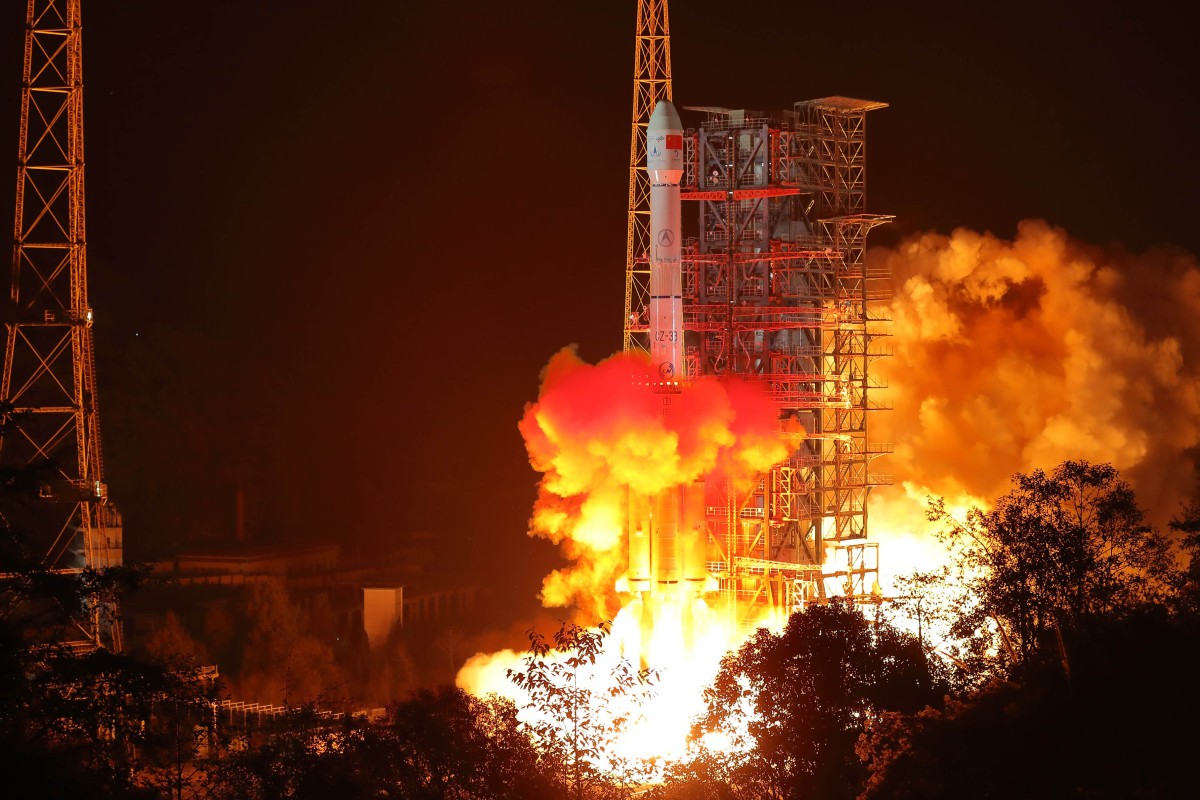
Speedy development of alloys may accelerate programmes to explore the harsh environments of space and ocean depths. Photo: Xinhua
Chinese physicists say they have developed a method that can cut the time involved in the discovery of alloys from years to hours.
The technique has led to the creation of high performance alloys, including the world’s toughest amorphous metal, or metallic glass, for use in extremely hot environments.
The search for an alloy typically takes years, but now it can be done in less than two hours, the Chinese researchers said.
Part of their findings was published in the journal Nature this month.
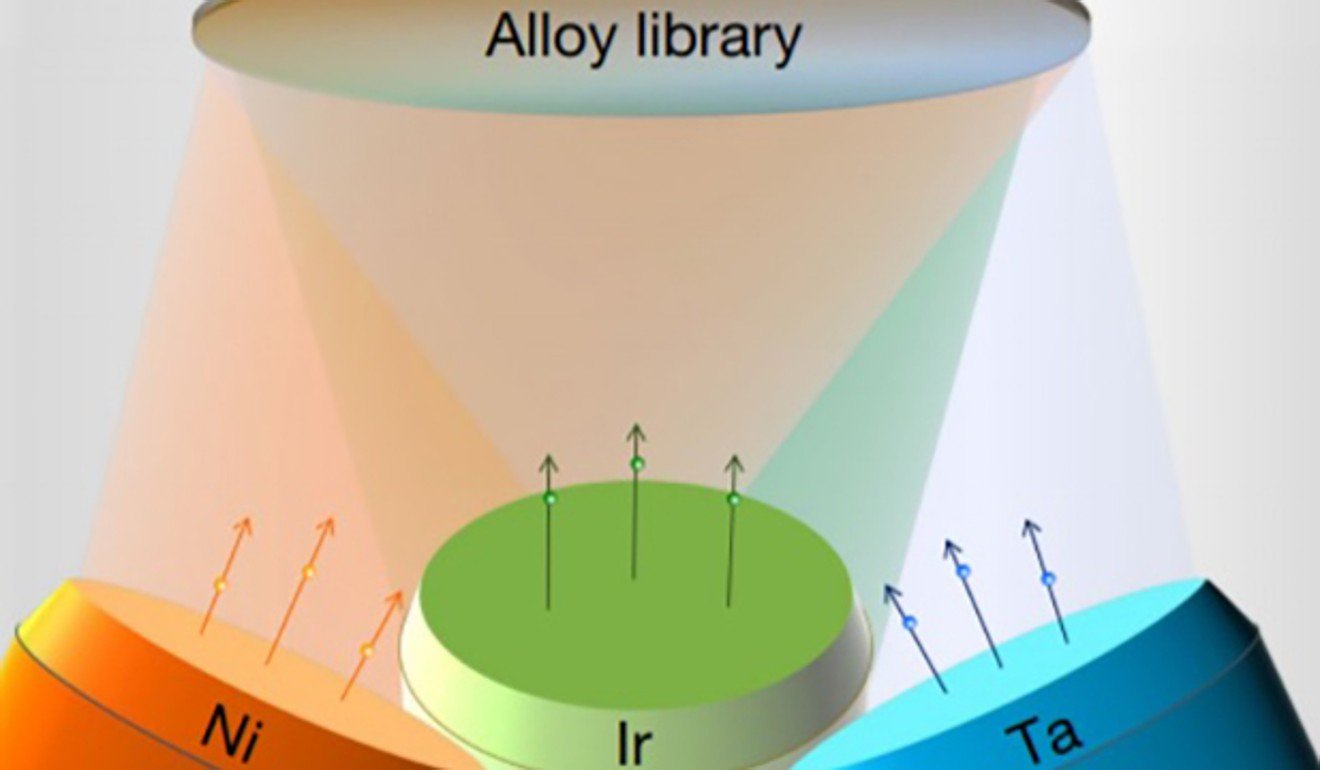
Inspired by the colour gun method used to create images for television sets, the Beijing
In the conventional method, metals needed to be weighed, melted to an alloy and tested for performance. To find the right formula, researchers might need to test more than a thousand combinations and each test might take a day or two.
Professor Wang Weihua, researcher with the institute of physics at the Chinese Academy of Sciences in Beijing and lead scientist of the study, said his team’s research was inspired by early colour televisions, which used three electric devices known as guns that fired red, green and blue light onto the back of the screen to create real-world colours for the viewer.
Wang’s team’s alloy technology also involved three guns, but instead of electronic pulses they fired “bullets” made of different metals. These struck a silicon board simultaneously and fused to form alloys.
Chinese University becomes first in world to build and test its own hypersonic plane
Sensors quickly measured the alloys’ properties and picked the most appropriate for the researchers.
This approach allowed scientists to create more than 1,000 samples, test their performance and select the most promising within a couple of hours.
“We proved it works,” Wang said. “It will increase people’s confidence. There will be a revolution in material science.”
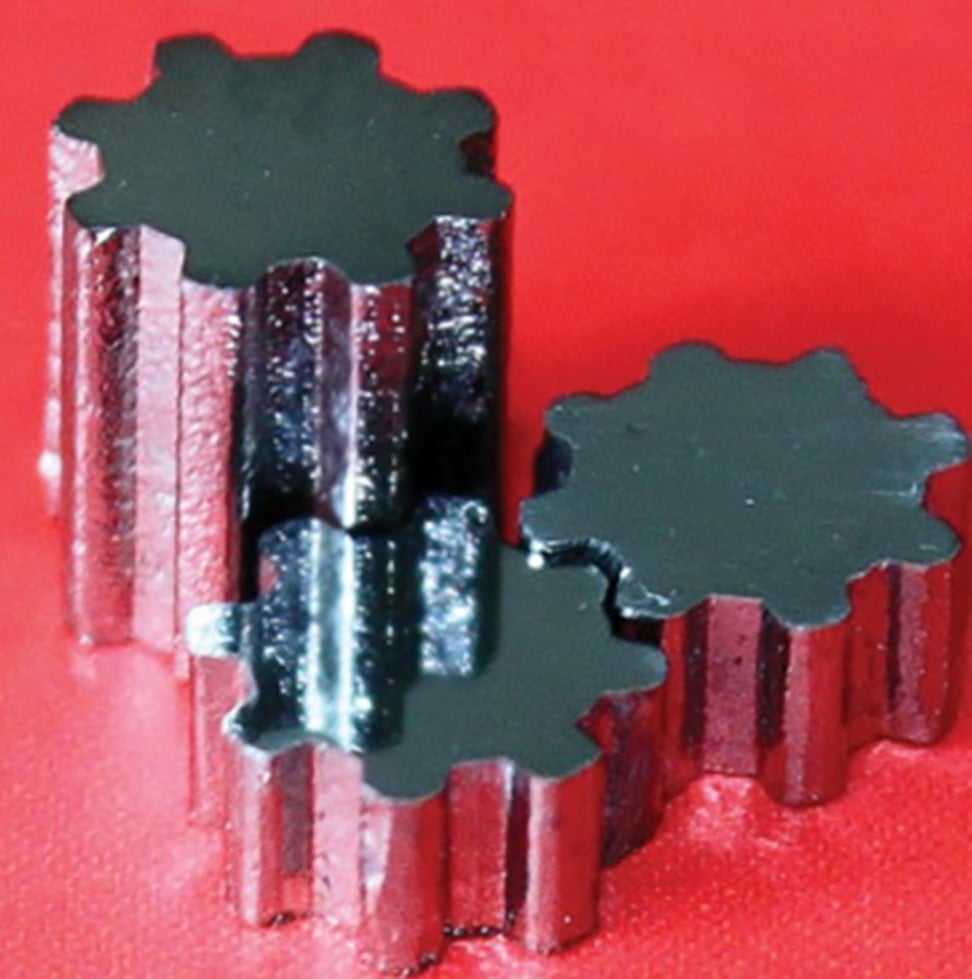
The alloy reported in the Nature paper contained iridium, nickel and tantalum. It had a distorted atomic structure similar to that of glass. Metallic glasses can be extremely strong but they usually weaken by temperatures of 400 degrees Celsius or more.
The Beijing team hopes artificial intelligence, in tandem with its technique, will start a materials revolution. Photo: Handout
The new alloy can maintain a tensile strength nearly eight times that of steel at more than 700 degrees Celsius, researchers said.
It can also remain intact for months in aqua regia, the mixture of nitric acid and hydrochloric acid that can dissolve gold and platinum.
Such properties make the alloy an ideal candidate material for manufacturing critical components for use in harsh environments such as space, ocean depths and battlefields.
“We are introducing artificial intelligence into the design and search for new amorphous metals,” Wang said. “It can further increase the speed of discoveries. In the near future, we may even be able to create material on demand.
It was close to midnight and Vlada, a Serbian engineer, was speeding towards his apartment in Belgrade. He had taken his 20-year-old son out that evening but bombs had started to fall across the Yugoslav capital. The power grid was down and he wanted to get home.
Nato, the world’s most powerful military alliance, had been pummelling Yugoslavia from the skies since late March to try to bring a halt to atrocities committed by President Slobodan Milosevic’s forces against ethnic Albanians in the province of Kosovo. It was now 7 May 1999 and the US-dominated air campaign was only growing more intense.
Vlada’s family had spent many nights in recent weeks huddled with others in the basement of their apartment building as air raid sirens blared outside, praying that an errant missile wouldn’t strike their homes.
They were lucky, some thought, to live just next to the Chinese embassy – an important diplomatic mission. Being there would surely protect them.
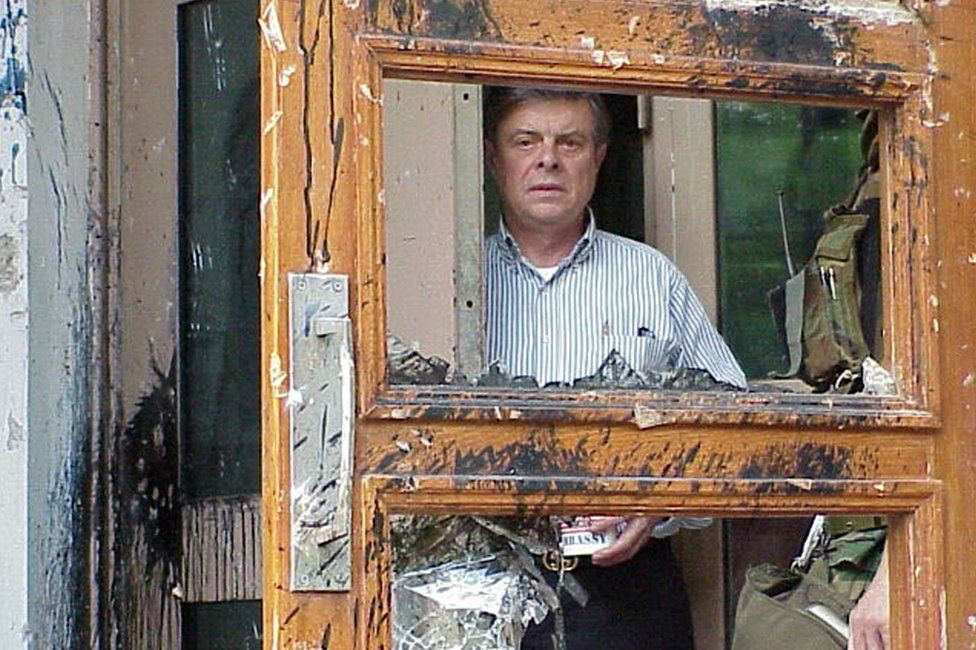
But as Vlada and his son approached the glass doors of their building in the dark, US B-2 stealth warplanes were in the skies above Belgrade. They were locked-on to the precise co-ordinates of a target selected and cleared by the CIA. All Vlada heard at first was the whoosh of an incoming missile. There was no time to move. The doors shattered, spraying glass at them.
“The force of the first bomb lifted us off the ground and we fell… Then one after the other [more bombs landed] – bam, bam, bam. All the shutters on the block were ripped off by the blast, it broke all the windows.”
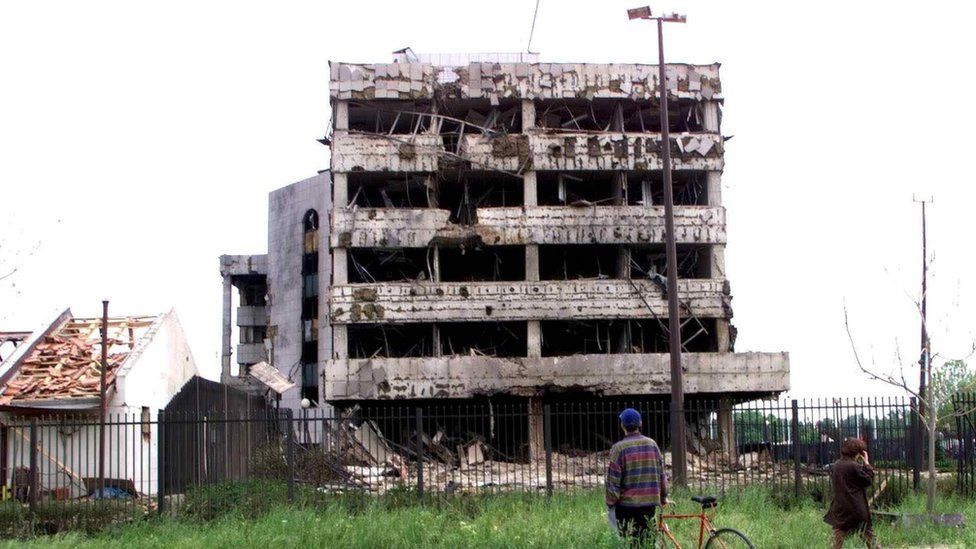
They were terrified but uninjured. All five bombs had hit the embassy, 100 metres away.
The US and Nato were already facing scrutiny over mounting civilian casualties in a bombing campaign conducted without UN authorisation and fiercely opposed by China and Russia. They had now attacked a symbol of Chinese sovereignty in the heart of the Balkans.
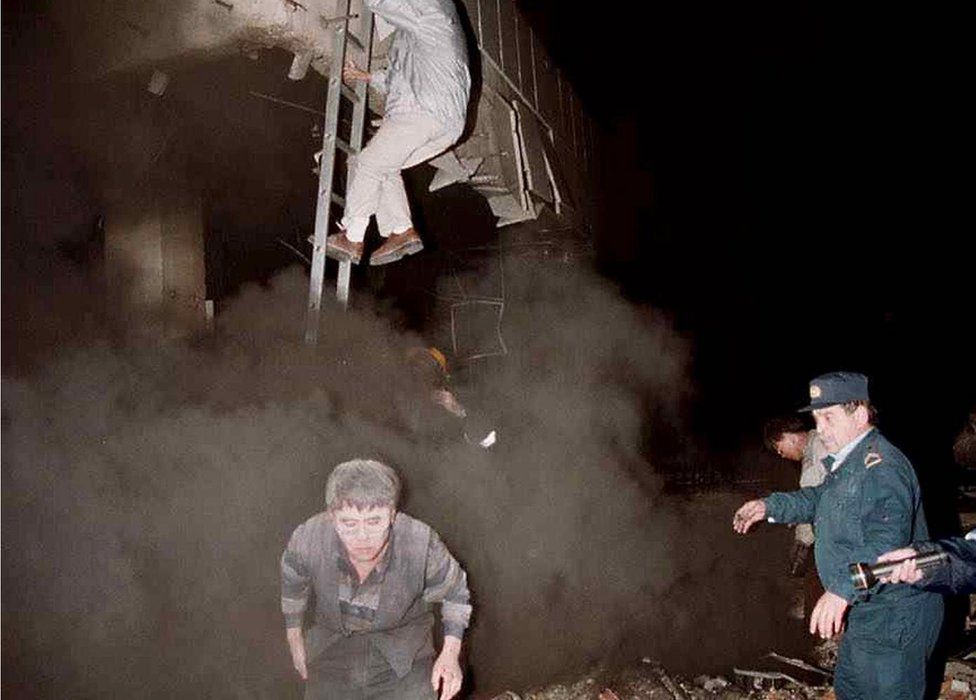
Image copyright SASA STANKOVIC/EPA/REX/SHUTTERSTOCKImage caption Embassy workers escaped through windows after the strikesAcross town, Shen Hong, a well-connected Chinese businessman, was getting word that the embassy had been hit. He refused to believe it. Just a few days earlier, his father had phoned from Shanghai and joked that his son should park his new Mercedes at the diplomatic compound to keep it safe.
“I called a policeman who I knew and he said, ‘Yes, Shen, it’s really hit’. He said come right away, so then I knew it was real, it was true.”
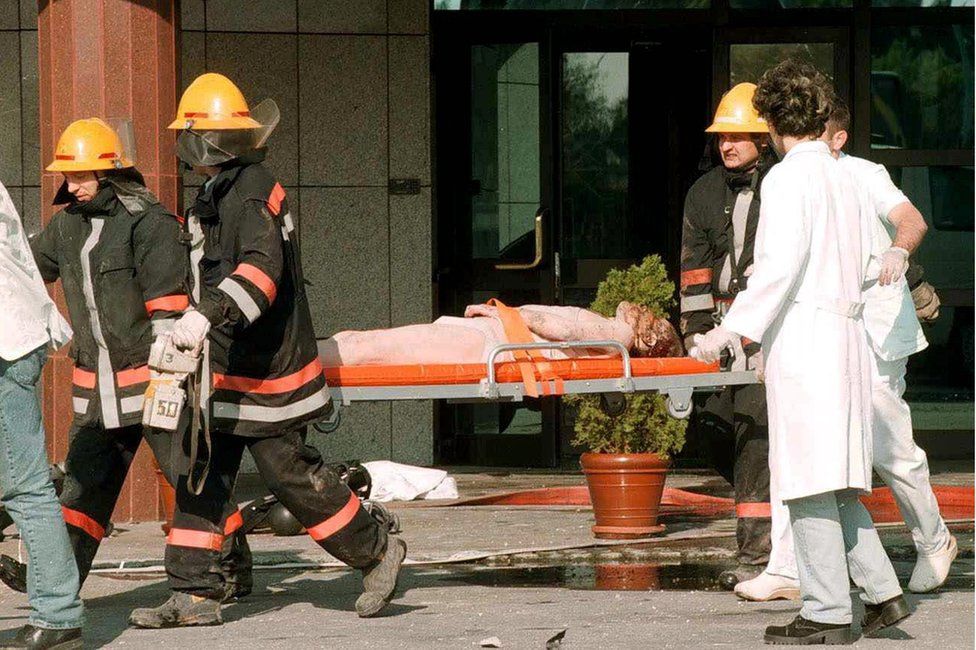
He arrived to a scene of chaos. The embassy was burning; workers covered in blood and dust were climbing out of windows to escape. Politicians close to Milosevic – who had been charged two weeks earlier with crimes against humanity by an international tribunal – were already arriving to denounce the bombing as the latest example of Nato barbarity.
“We could not go inside. There was a lot of smoke, there wasn’t any electricity and we couldn’t see anything. It was horrible,” said Shen.
Image copyright LAZARA MARINKOVICImage caption Shen Hong lost close friends in the bombingHe spotted the cultural attaché, a man he knew, who had knotted together curtains to get out of a first-floor window. “We didn’t see that he was injured and he didn’t notice it either. It was only when I shook his hand that I realised my hands were covered in blood. I told him ‘you’re injured, you’re injured!’ – but when he saw this he passed out.”
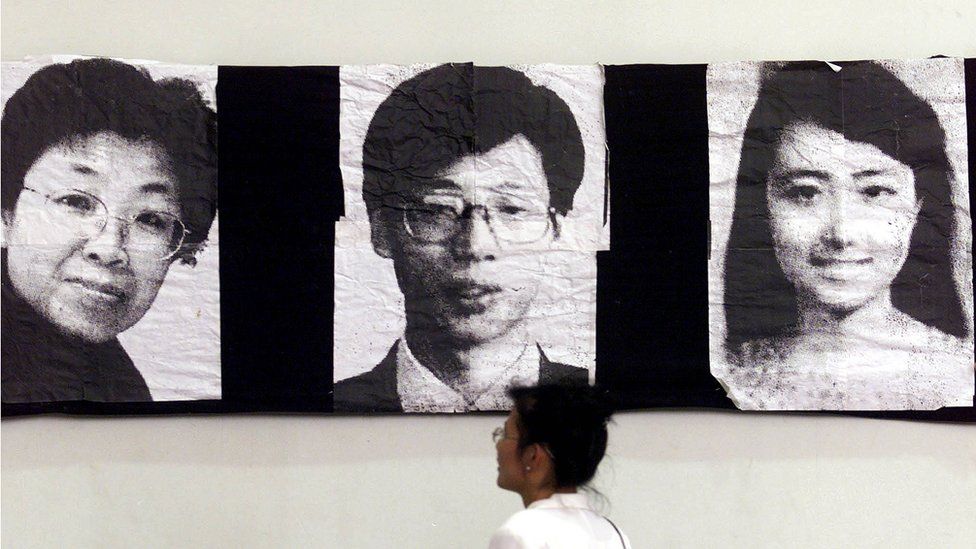
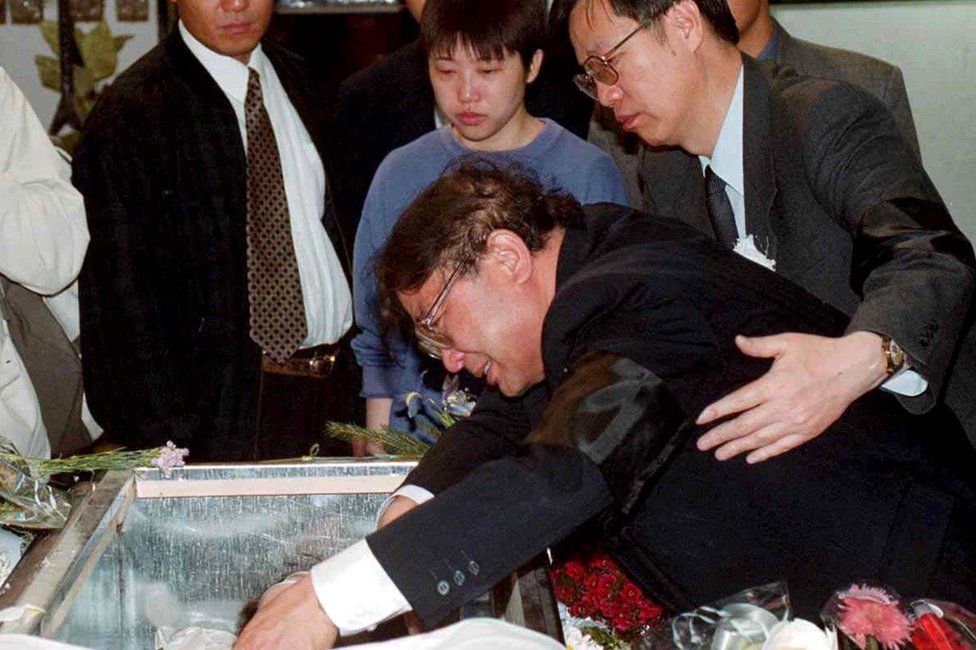
The next day Shen would learn that two close friends – newlywed journalists Xu Xinghu, 31, and Zhu Ying, 27 – had been killed by a bomb that hit the sleeping quarters of the embassy. Their bodies were found under a collapsed wall.
The pair had worked for the Guangming (Enlightenment) Daily – a communist party newspaper. Xu, a language graduate who spoke fluent Serbian, had chronicled life in Belgrade during the bombings in a series of special reports called “Living Under Gunfire”.
Image copyright DRASKO GAGOVIC/EPA
Zhu Ying worked as an art editor in the paper’s advertising department. Her mother collapsed with grief and was sent to hospital when she learned of her daughter’s death so Zhu’s father travelled alone to Belgrade to see the body.
A third journalist, 48-year-old Shao Yunhuan, of the Xinhua news agency, also died. Her husband, Cao Rongfei, was blinded. The embassy’s military attaché, who is believed to have run an intelligence cell from the building, was sent back to China in a coma. In total, three people were killed and at least 20 injured.
For Shen, this was an act of war. The next day he led a protest through the streets of Belgrade carrying a sign reading “NATO: Nazi American Terrorist Organisation”
It was a sign of what was to come.
Image copyright REUTERSImage caption Three journalists were killed in the embassy
Within hours of the bombing, two competing narratives began to emerge. They would harden over the coming months and form the basis of how the incident – which continues to linger over the US-China relationship – remains debated today.
The bombing fuelled speculation, and there was no shortage of unanswered questions and missing pieces that were put together by some to imply a grand conspiracy. Intrigue continued to hang over the incident and, months afterwards, two respected European newspapers suggested the strikes were by design.
But, as former Nato officials point out, in 20 years no clear evidence has come to light proving what almost all of China believes and America strenuously denies: that it was deliberate.
In those first hours after the bombs fell, the US and Nato wasted no time to announce that it was an accident. China’s representative at the UN, meanwhile, denounced a “crime of war” and a “barbarian act”.
In Brussels, Jamie Shea – the British Nato spokesman who became the public face of the war – was woken up in the middle of the night and told he would have to face the world’s press in the morning. The information available in those early hours was thin but he would give one of the first explanations of what had happened, along with an apology. The warplanes, he said from the briefing podium, had “struck the wrong building”.
“It’s like a train accident or a car crash – you know what has happened but what you don’t know is why it has happened,” he says 20 years later. “That took a lot longer to establish… But it was clear right from the get-go, that targeting a foreign embassy was not part of the Nato plan.”
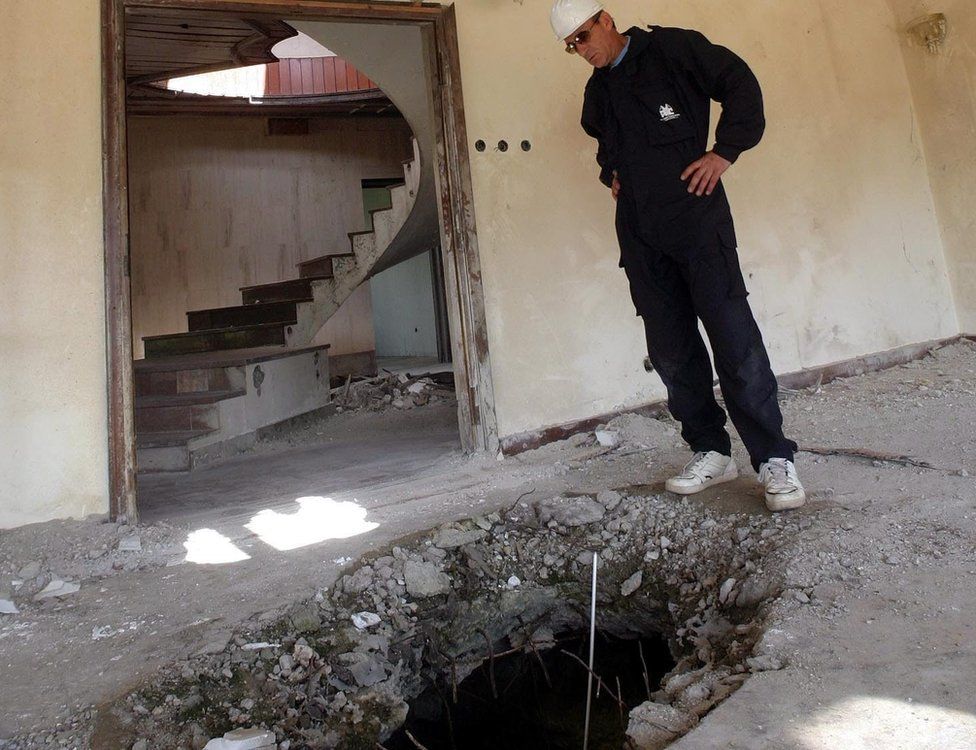
Image copyright BORIS SUBASIC/EPAImage caption The father of Zhu Ying weeps over her coffin in BelgradeIt would take more than a month for the US to give Beijing a full explanation: that a series of basic errors had led to five GPS-guided bombs striking China’s embassy – including one that hurtled through the roof of the ambassador’s residence next to the main building but didn’t explode, likely sparing his life.
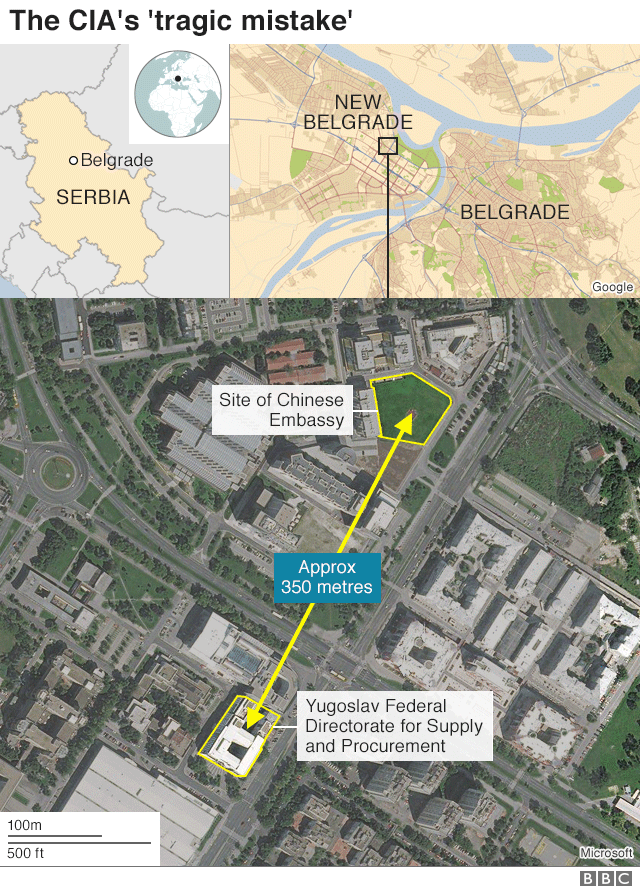
The real target, officials said, was the headquarters of the Yugoslav Federal Directorate for Supply and Procurement (FDSP) – a state agency that imported and exported defence equipment. The grey office building is still there today – hundreds of metres down the road from the embassy site.
Nato had initially hoped the bombing campaign would only last a few days until Milosevic gave up, pulled his forces out of Kosovo and allowed peacekeepers in. But by the time the embassy was hit it had stretched to more than six weeks. In the rush to find hundreds of new targets to sustain the aerial assault, the CIA, which was not normally involved in target-picking, had decided the FDSP should be struck.
But America’s premier intelligence agency said it had used a bad map.
“In simple terms, one of our planes attacked the wrong target because the bombing instructions were based on an outdated map,” US defence secretary William Cohen said two days after the bombing. He was referring to a US government map that apparently did not show the correct location of the Chinese embassy nor the FDSP.
All US intelligence officers had was an address for the FDSP – 2 Bulevar Umetnosti – and a basic military navigation technique was used to approximate its co-ordinates. The technique used was so imprecise, CIA chief George Tenet later said, that it should never have been used to pick out a target for aerial bombing.
To compound the initial error, Tenet said, intelligence and military databases used to cross-check targets did not have the embassy’s new location listed, despite the fact that many US diplomats had actually been inside the building.
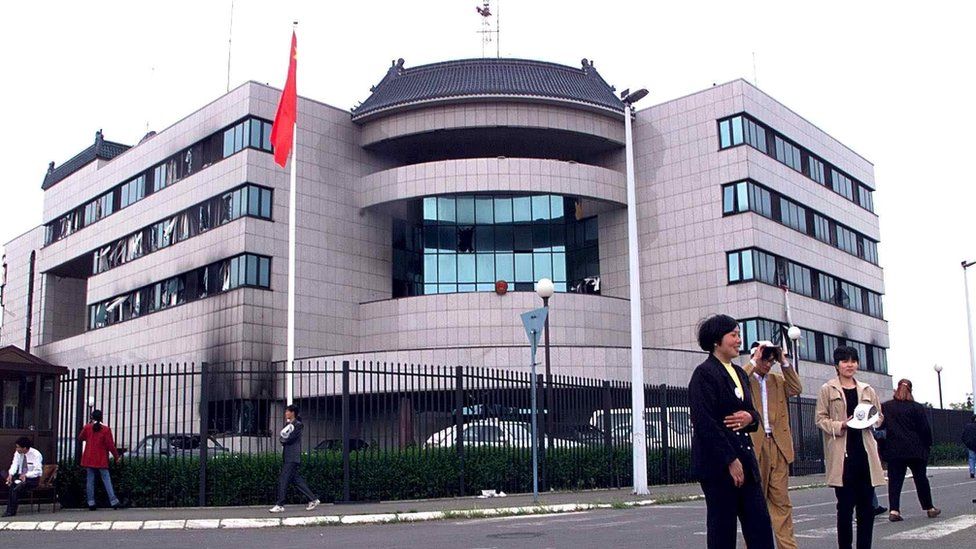
Had anyone on the ground visited the site to be bombed they would have found a gated compound, a five-storey building with a green-tiled oriental sloped roof, a bronze plaque announcing the embassy’s presence and a large, bright red Chinese flag fluttering more than 10 metres in the air.
Image copyright SASA STANKOVIC/EPA/REX/SHUTTERSTOCKImage caption The front of the embassy was largely undamagedThe crux of the CIA’s explanation was hard for many to believe: the world’s most advanced military had bombed a fellow UN Security Council member and one of the most vocal opponents of the Nato air campaign because of a mapping error. China was having none of it. The story, it said, was “not convincing”.
“The Chinese government and people cannot accept the conclusion that the bombing was a mistake,” the foreign minister told a US envoy sent to Beijing in June 1999 to explain what had happened.
But why would the US intentionally attack China?
It wasn’t long after the Sun rose on the morning of Saturday, 8 May 1999, that David Rank, a US diplomat, got out of bed in Beijing.
He turned on the television and switched to CNN. The American news network was carrying live pictures of the smouldering Chinese embassy in pitch-dark Belgrade.
By that afternoon, thousands of irate Chinese protesters would be gathered outside. But Rank, at that stage, was fairly calm. He rang his boss, the head of the political section: “I said, you know, Jim, this is the damndest thing.”
The diplomat rushed from his residence to the embassy down the road, where US officials were trying to figure out what had happened. Something had clearly gone wrong but this must have been, had to have been, a tragic mistake.
“It was so patently obvious that it was a sort of fog of war accident… At that point I didn’t think that down the road this was going to be a major problem. Obviously, it was a major problem, but not the sort of convulsive incident that it turned out to be,” said Rank.
But in the next hours, the shape of how the Chinese government and people would respond started to become clear.
Image copyright PETER ROGERS/GETTY IMAGESRank began receiving calls from liberal Chinese friends who were outraged at the bombing. American journalists got similar calls from Chinese contacts with pro-US views, expressing shock and a sense of betrayal.
Chinese state media was already laying out a clear narrative – the US had breached international law by bombing a Chinese diplomatic outpost. “The language that I heard from lots and lots of Chinese, it was identical. It was the same almost word-for-word lines of real anger,” said Rank.
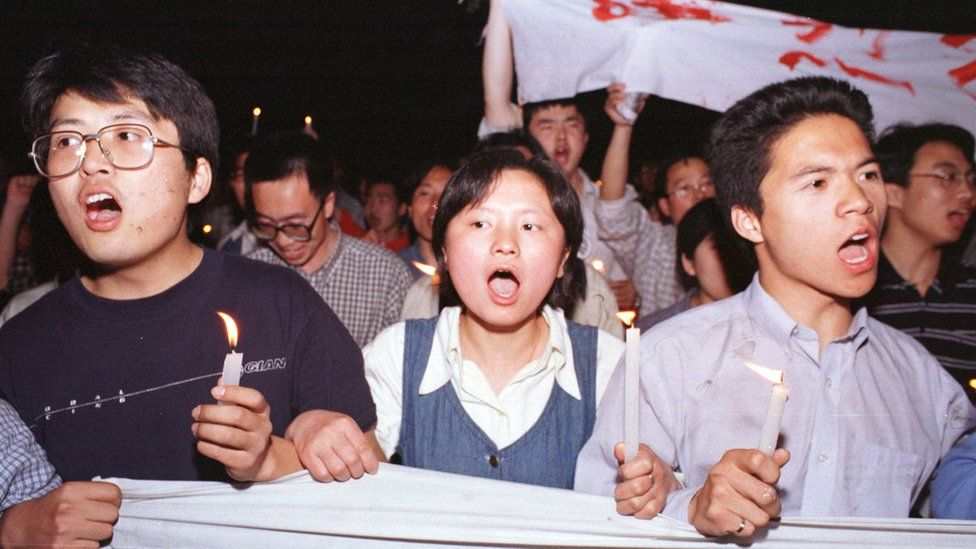
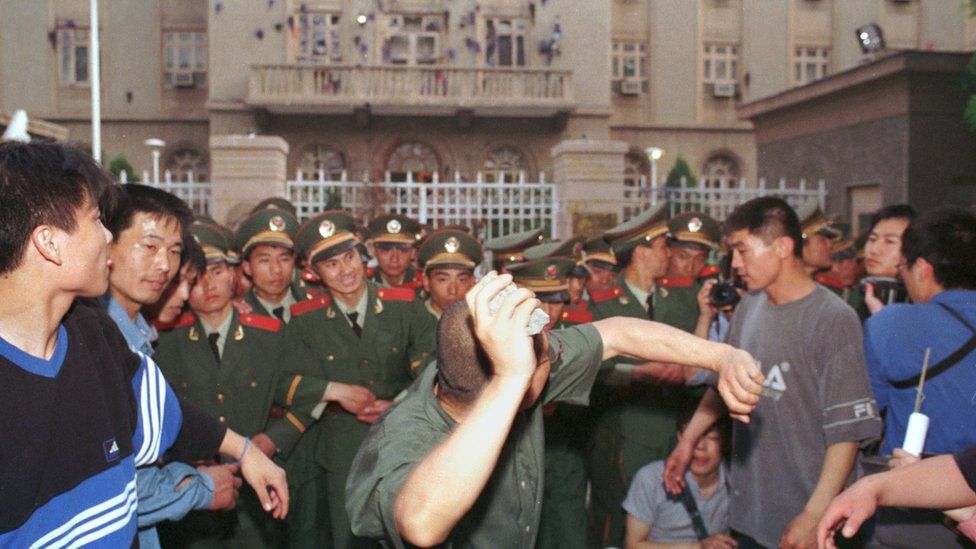
By that afternoon thousands of students were streaming onto the streets of Beijing. They gathered outside the embassy and things quickly turned violent.
“They were pulling up the paving stones. Beijing sidewalks aren’t paved, they have big tiles and they were pulling those up and smashing them and throwing them over the walls.”
Image copyright PETER ROGERS/GETTY IMAGESMany of those bits of concrete were crashing through the windows of a building where more than a dozen embassy staff, including US Ambassador James Sasser, had hunkered down. Embassy cars were being defaced and attacked.
The message was clear: the bombing was intentional and, as one slogan went, “the blood of Chinese must be repaid”. The protests would continue the next day, with even more people – some reports said 100,000 – storming the diplomatic district, and pelting stones, paint, eggs and concrete at the British and American embassies.
“We feel like we’re hostages,” Bill Palmer, an embassy spokesman trapped in one of the buildings, said at the time.
Demonstrations of this scale had not been seen in tightly-controlled China in the decade since students led a pro-democracy uprising in Beijing’s Tiananmen Square in 1989. This time the anger was directed away from the Communist Party but, with the 10th anniversary of the crackdown on students in Tiananmen approaching, the government had to strike a balance between giving vent to public anger and remaining in control.
In a rare TV address Vice-President Hu Jintao endorsed the protests but also warned they had to remain “in accordance with the law”.
Image copyright REUTERSImage caption US Ambassador James Sasser was trapped in the embassy for four days as protests ragedThe uproar was not isolated to Beijing. Crowds also took to the streets of Shanghai and other cities that weekend. In central Chengdu, the US consul’s residence was set alight.
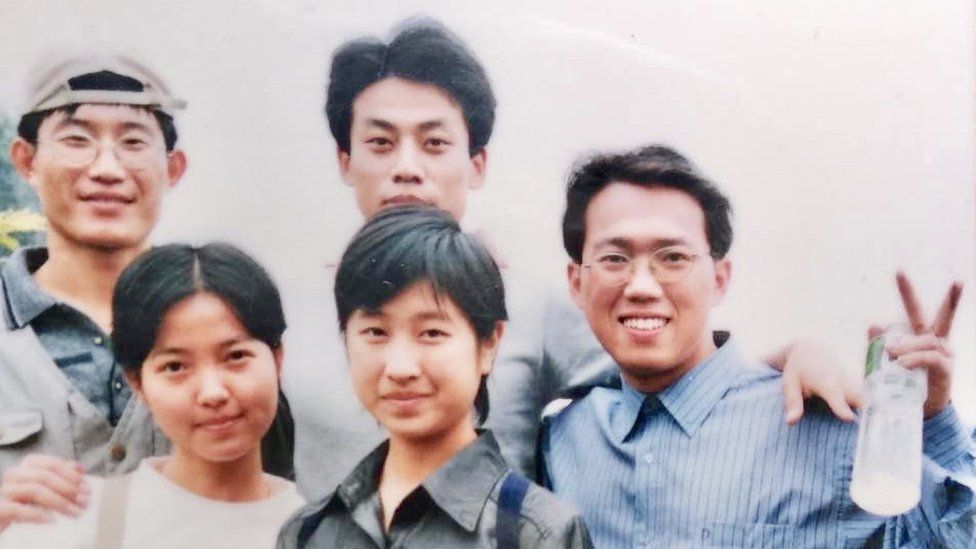
Weiping Qin, a then 19-year-old student leader at the maritime college in southern Guangzhou city, said demonstrators were not informed that Nato had already apologised for what it said was an accident. “The government was hiding this important message. They didn’t tell us – so young people, everybody, felt angry. We just wanted to go in the streets and protest against the United States.”
He said that initially students at his college were told they had to stay in their dormitories. But 24 hours after the bombing, the university leadership told him that they needed 30,000 students in the streets around the US consulate – 500 of whom would come from the maritime college.
The fired-up students drew lots to choose who could attend. They were loaded onto buses and given statements to read that echoed the stilted official language being broadcast by state media. “They gave us long sentences. But in the street, to speak out in long sentences is very hard.” He decided to yell slogans about the evils of Nato and the US instead.
Image copyright WEIPING QINImage caption Weiping Qin (right) was a student leader at Guangzhou Maritime College in 1999“We were just young people and we just felt angry. Our emotions came out like a wave,” said Qin, who now lives in the US and criticises the Chinese government in YouTube videos.
David Rank agreed that the anger was genuine. “I think it would really sell the Chinese people short to say this was manufactured by the system,” he said. “There was real outrage.”
Since the early 1990s, China had embarked on a concerted campaign to instil nationalism and “patriotic education” in its people. The narrative pushed in school textbooks, university classrooms and the media was that China – home to a great and benevolent civilisation – had been subjugated and humiliated at the hands of Western powers. The Belgrade embassy bombing fit the story.
“The anger that ordinary Chinese felt I think can only be understood in that historical context, being socialised to resent the West,” said Peter Gries, a professor of Chinese politics at Manchester University and an expert on Chinese nationalism.
For Liu Mingfu – a retired People’s Liberation Army colonel known for his hardline views of the US – the embassy bombing was part of a series of events that proved the US was engaged in a “new Cold War against China”.
“It was totally intentional. It was a purposeful, planned bombing, rather than an accident,” he said.
China would receive $28m in compensation from the US for the bombing, but had to give back close to $3m for the damage to US diplomatic property in Beijing and elsewhere. The US paid another $4.5m to the families of the dead and injured.
On the day of the bombing, Dusan Janjic, an academic and advocate for ethnic reconciliation in Yugoslavia, was having lunch at an upscale restaurant in central Belgrade with a man he considered a good friend.
Ren Baokai was the military attaché at the Chinese embassy and Janjic said he was surprisingly open with him about the fact that China was spying on Nato and US operations and tracking warplanes from its Belgrade outpost. The attaché invited him to dinner at the embassy that night because he knew he liked Chinese food.
“And I started making jokes. ‘Come on, you’re going to be bombed! I’m not coming!’,” Janjic recalled. He was being facetious: he did not actually think the embassy would be hit.
But Janjic couldn’t make it to dinner and that evening, when the missiles flew into the building, Ren was thrown to the ceiling by the blast and then fell through a crater left by a bomb. He was found in the basement in a coma only the next morning.
Citing Nato sources, they reported that the embassy was being used as a rebroadcast station for Yugoslav army communications and was as a result removed from a prohibited target list. US Secretary of State Madeleine Albright decried the story as “balderdash”, while British Foreign Secretary Robin Cook said there was “not a single shred of evidence” to support it.
But two decades later, Jens Holsoe, Politiken’s correspondent in the Balkans from 1995 to 2004, and John Sweeney, formerly of the Observer and now with the BBC, said they stood by their reporting that the bombing was intentional.
Holsoe said what made him investigate in the first place was CIA Chief George Tenet publicly saying that satellite images gave no indication the target was an embassy – “no flags, no seals, no clear markings” – when in fact all three were present.
One of his sources – a very senior Danish military figure – almost went on the record to confirm publicly that the bombing was intentional, he said. “Then he suddenly backed out and said if he uttered another word to me about this story that not only did he risk being fired but also prosecuted.”
Holsoe said it was clear at the time that there was military co-operation between Serb forces and the Chinese – and that he personally saw military vehicles entering and exiting the Chinese embassy. American officials told the New York Times that after the bombing they learned the embassy was China’s most significant intelligence collection platform in Europe.
“This was, and always will be, a murky story,” said Sweeney.
Ren Baokai survived and was later given the rank of general. He declined an interview with the BBC, saying he was now retired.
The Chinese ambassador who narrowly survived the strike, Pan Zhanlin, denied in a book that the embassy had been used for re-broadcasting and that China, in exchange, had been given parts of the US F-117 stealth fighter jet that Serbian forces had shot down in the early stages of the Nato campaign.
Getty Images
I think it’s complete nonsense – it was a bad map-reading error and a bad mistake.
It’s widely assumed that China did get hold of pieces of the plane to study its technology. It’s also been speculated that China was using the Nato air campaign to test technology to track stealth bombers that are normally undetectable.
But even if all these stories are true – the question remains: would the US really take the risk of bombing a Chinese embassy on purpose?
Even among ex-Yugoslav insiders there is no consensus. One former military intelligence officer told the BBC he believed the bombing was intentional and that the CIA’s explanation was ludicrous; while another, a retired colonel, said he believed America’s story.
“When something bad happens everybody thinks there has to be a secret reason – not a cock-up but a conspiracy,” said the former Nato spokesman Jamie Shea. “I think it’s complete nonsense – it was a bad map-reading error and a bad mistake.”
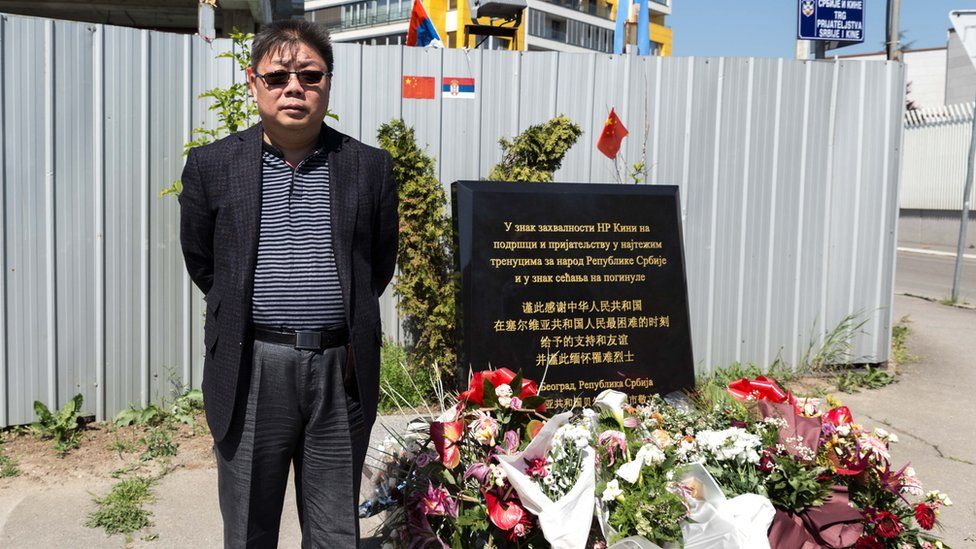
On a sunny day in late April, more than a dozen fresh bouquets were stacked up neatly against the memorial stone, but Shen Hong still felt compelled to re-arrange them. He comes to the site of the embassy bombing regularly, to remember his friends that died. But these days, it’s rare that he is alone.
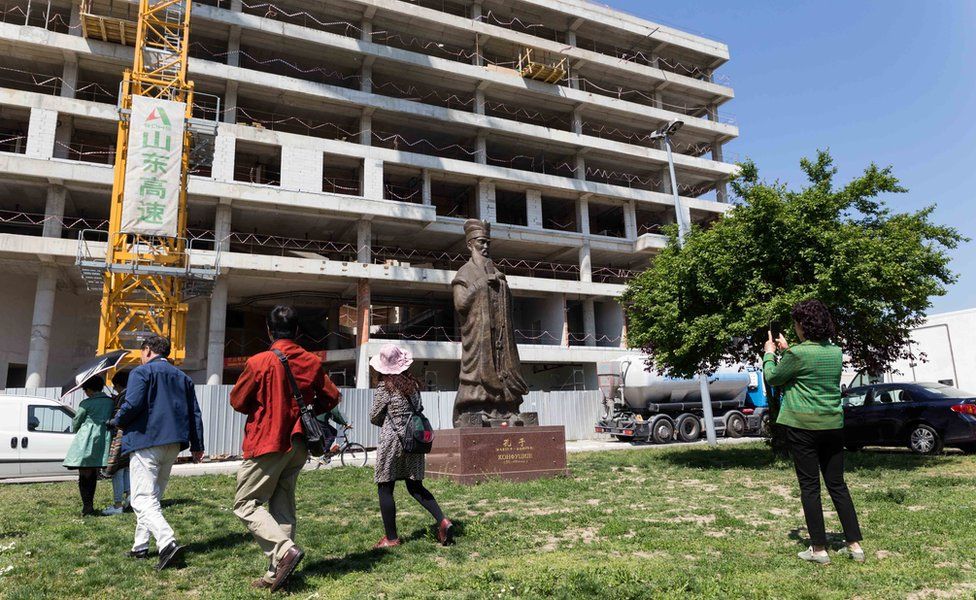
Busloads of Chinese tourists arrive every day to gaze at the memorial and the statue of the Chinese sage and philosopher Confucius that now stands nearby.
A young Chinese couple, Zhang and He, were in Belgrade for their honeymoon and decided to visit the memorial. They are around the same age that Xu Xinghu and Zhu Ying were when they were killed in 1999. “Three of our countrymen died here. We knew about this since we were kids and we came to see it,” said He.
Yang, a guide who was leading some 30 middle-aged Chinese tourists on a two-week bus tour through the Balkans, said the embassy site was a mandatory stop. “Our embassy was destroyed by Americans. Every Chinese knows this.”
Image copyright LAZARA MARINKOVICImage caption The embassy site is being turned into one of the largest Chinese cultural centres in EuropeIn 1999, China was not the economic, technological and military giant it is now. It was focused on getting wealthy and had a much less visible foreign policy. But 20 years later the country knows it sits at the top table with America and its ambitions around the world reflect that.
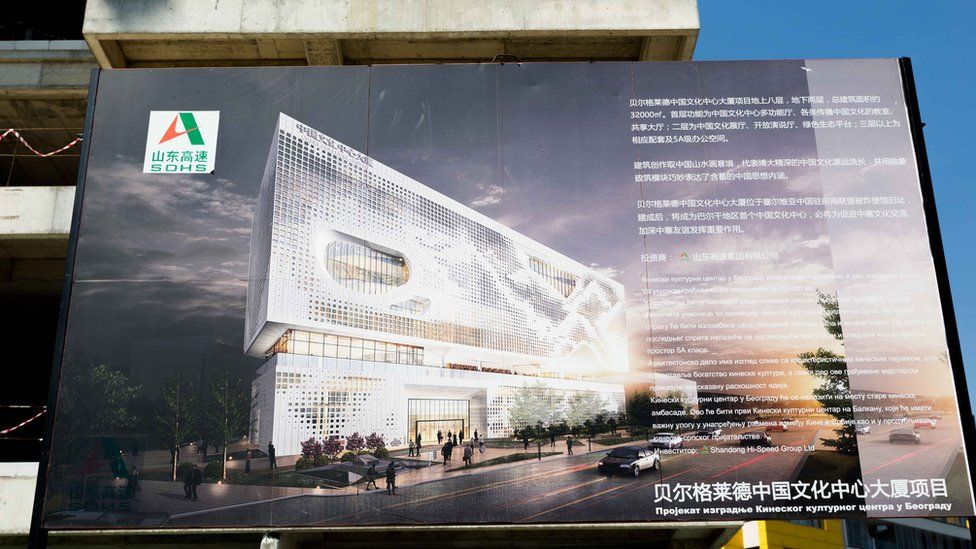
The Belgrade embassy site is being turned into a Chinese cultural centre that will be one of the biggest in Europe. The symbolism is hard to miss: a site of national humiliation and tragedy at the hands of the West re-born as a shiny edifice to China’s glorious history.
It’s a sign that Beijing has no plans to forget a bombing that allows it to paint the US as an imperialist superpower looking to hurt China. Diplomats who have served in Beijing say the incident is still brought up regularly in conversations.
Image copyright LAZARA MARINKOVICBut even those who called for immediate retaliation in 1999 now realise it was fortunate that China’s reaction did not spiral out of control: no Americans were killed during the protests and the compensation agreement allowed Beijing to draw a line – if a thin one – under the incident.
“We were the fastest developing country, every year our economy grew by double-digits. And if we would have stopped that because of war back then, we would have lost a lot,” said Shen, as another group of tourists arrived at the memorial.
“By nature, I’m a radical. I am always more for war than for a conversation. But when I look back, they did a good thing. Because now we can sit equally with the Americans.”
TUCUPITA, Venezuela (Reuters) – The project was meant to feed millions.
In Delta Amacuro, a remote Venezuelan state on the Caribbean Sea, a Chinese construction giant struck a bold agreement with the late President Hugo Chavez. The state-run firm would build new bridges and roads, a food laboratory, and the largest rice-processing plant in Latin America.
The 2010 pact, with China CAMC Engineering Co Ltd , would develop rice paddies twice the size of Manhattan and create jobs for the area’s 110,000 residents, according to a copy of the contract seen by Reuters.
The underdeveloped state was an ideal locale to demonstrate the Socialist Venezuelan government’s commitment to empower the poor. And the deal would show how Chavez and his eventual hand-picked successor, President Nicolas Maduro, could work with China and other allies to develop areas beyond Venezuela’s bounteous oil beds.
“Rice Power! Agricultural power!” Chavez tweeted at the time.
Nine years later, locals are hungry. Few jobs have materialized and the plant is only half-built, running at less than one percent its projected output. It hasn’t yielded a single grain of locally grown rice, according to a dozen people involved in or familiar with the development.
Yet CAMC and a select few Venezuelan partners prospered.
Venezuela paid CAMC at least $100 million (76 million pounds) for the stalled development, according to project contracts and sealed court documents from an investigation by prosecutors in Europe.
The thousands of pages of court papers, reviewed by Reuters, were filed in Andorra, the European principality where prosecutors allege Venezuelans involved in the project sought to launder kickbacks paid to them for helping secure the contract. The material on the China deal, reported here for the first time, includes confidential testimony, wiretap transcripts, bank records and other documents.
Last September, an Andorran high court judge alleged in an indictment that CAMC paid over $100 million in bribes to various Venezuelan intermediaries to secure the rice project and at least four other agricultural contracts.
The indictment charged 12 Venezuelans with crimes including money laundering and conspiracy to launder money. Among those indicted was Diego Salazar, a cousin of a former oil minister who, investigators say, enabled the contracts. Also indicted was the top representative in China at the time of state-run oil company Petroleos de Venezuela SA, or PDVSA.
Sixteen people of other nationalities were also charged and at least four other Venezuelans, one of whom was formerly ambassador in Beijing and is now the country’s top diplomat in London, are under investigation, according to the documents.
The indictment, the names of those charged, and their association with Chinese companies were reported last year by El Pais, the Spanish newspaper. A Reuters review of the case files, which are still under seal in Andorra, gleans how CAMC and other Chinese companies forged ties with many of those charged and paid to win projects the companies often didn’t complete.
The result, according to prosecutors, was a far-reaching culture of kickbacks, paid through offshore accounts, in which well-connected Venezuelan intermediaries milked and ultimately crippled projects that were meant to develop neglected corners of the country.
Among other findings reported here for the first time:
• CAMC agreed to at least five agricultural projects in Venezuela, valued at about $3 billion, that it never completed.
• The company, according to contracts and project documents reviewed by Reuters, received at least half the value of the $200 million contract for the rice project and at least 40 percent of the contract value for the other four developments – a combined total of at least $1.4 billion for work it never finished.
• CAMC paid over $100 million in fees to intermediaries; prosecutors say those payments were kickbacks that helped the company win contracts in Venezuela.
Neither CAMC nor any of its executives were charged in the indictment.
In a statement, the Beijing-based company told Reuters the details and assertions in the case files include “a large number of inaccuracies,” but didn’t elaborate. The company didn’t respond to requests to speak with CAMC executives mentioned in the documents. Reuters couldn’t reach those executives independently.
“Our company operates in Venezuela in adherence to the idea of integrity and strives to complete every construction project with the best technology and management,” the statement said.
China’s Foreign Ministry, in a statement to Reuters, said “reports” about alleged bribery by Chinese companies in Venezuela “obviously distorted and exaggerated facts, with a hidden agenda.” It didn’t specify to what agenda it was referring. Cooperation between the two countries will continue, the statement read, “based on equal, mutually beneficial, and commercial principles.”
Venezuela’s Information Ministry, responsible for government communications, and oil giant PDVSA, a partner in many of the contracts cited in the court case, didn’t respond to Reuters inquiries.
It isn’t clear when any of those charged could face trial. Enric Gimenez, a lawyer in Andorra for Salazar, the Venezuelan who prosecutors say brokered many of the contracts, told Reuters his client is innocent of the charges there.
The leftist regime founded by Chavez and now led by Maduro is facing its most serious threat yet. Opposition lawmakers, with the support of most Western democracies, say Maduro’s re-election last year was illegal and that Juan Guaido, head of the National Assembly, is the country’s rightful leader.
Last week, in a failed uprising, Guaido unsuccessfully sought to rally Venezuela’s military, the lynchpin of support for the unpopular government, against Maduro.
The political crisis was prompted by an economic meltdown of hyperinflation, mass unemployment and an exodus of desperate citizens. Venezuelans suffer regular shortages of food, power and water – basics that were meant to improve through projects like the one in Delta Amacuro.
The dire scarcities and dysfunctional projects, the opposition alleges, illustrate how corruption and crony capitalism helped impoverish the once-prosperous country and many of its 30 million people.
After an ambitious 2007 agreement between China and Venezuela, Chinese companies were announced as partners in billions of dollars’ worth of infrastructure and other projects. Since then, China invested over $50 billion in Venezuela, mostly in the form of oil-for-loan agreements, government figures show.
In a 2017 speech, Maduro said 790 projects with Chinese companies had been contracted in sectors ranging from oil to housing to telecommunications. Of those, he said, 495 were complete. Some developments have stalled because of graft, people familiar with the projects said; others were derailed by incompetence and a lack of supervision.
In Delta Amacuro, even government officials say a mixture of both ruined the rice project. “The government abandoned it,” says Victor Meza, state coordinator for Venezuela’s rural development agency, which worked with CAMC. “Everything was lost. Everything was stolen.”
Prosecutors in Andorra, where secretive banking laws long made it a tax haven, launched their investigation into Venezuelan laundering amid a broader effort to clean up the local financial sector.
The indictment is part of a much larger case in which the prosecutors allege Venezuelan officials between 2009 and 2014 received more than $2 billion worth of “illegal commissions” from contractors, state companies, and other sources, often for enabling transactions with the government.
The payments, the indictment alleges, passed through accounts held at Banca Privada D’Andorra, a local bank known as BPA.
Andorra’s government, after the United States accused BPA of money laundering, took over the bank in 2015. Courts there since then have charged 25 former BPA employees with money laundering in a series of cases, including the one probing the Venezuela contracts. A spokeswoman for Andorra’s government declined to comment for this article.
In addition to the agricultural projects by CAMC, the Andorrans examined two power-plant projects by the company and four other power plants built by Sinohydro Corp, another state-owned Chinese engineering firm. None of those plants ever became fully operational, leaving towns near them subject to regular blackouts.
Sinohydro wasn’t charged in the indictment. The company didn’t respond to calls, emails and faxes seeking comment.
During a recent visit by Reuters to Delta Amacuro, the CAMC rice plant remained unfinished. Only one of its 10 silos, half full, held any grain. Some machinery was running, but processing rice imported from Brazil. The nearby paddies lay fallow, the laboratory incomplete, the roads and bridges unbuilt.
“WE DON’T PRODUCE ANYTHING”
Tucupita, a town of 86,000 residents, is Delta Amacuro’s capital. It hugs the banks of the Cano Manamo, an offshoot of the Orinoco, one of South America’s biggest rivers. Once, Tucupita was a stop for vessels shipping goods from inland factories to buyers in the Caribbean and beyond.
In 1965, the government dammed the Cano Manamo. Boat traffic stopped, fresh water receded and seawater seeped inland, degrading soils. By the time Chavez became president in 1999, little farming remained.
“When I was a kid, there was rice everywhere,” recalled Rogelio Rodriguez, a local agronomist. “Now we don’t produce anything.”
In 2009, Chavez and Xi Jinping, China’s vice president at the time, expanded a joint fund the countries had created with the 2007 development agreement. “Aren’t we grateful to China?” Chavez said at a ceremony with Xi at the presidential palace in Caracas, Venezuela’s capital.
Promising to supply Beijing with oil “for the next 500 years,” Chavez pointed toward Delta Amacuro on a map. “Look, Xi,” he said, announcing an effort to rehabilitate the region.
In attendance were CAMC Chairman Luo Yan and Rafael Ramirez, a Chavez confidante who ran PDVSA and the oil ministry for a decade.
Soon, businesses jostled to get in on the development.
Diego Salazar, a cousin of Ramirez, was well-positioned.
Salazar’s father was a communist guerrilla and author who later became a legislator and Chavez ally. His family ties and connections to lawmakers gave the younger Salazar a valuable address book he wielded at a consulting firm he operated in Caracas.
The firm, Inverdt, was owned by a Panama-based holding company he had established called Highland Assets, according to testimony Salazar gave investigators in Andorra when they first began probing his BPA account. From an office a few blocks from PDVSA headquarters, he met often with Ramirez and other top officials, according to people familiar with his activities.
Ramirez left the ministry in 2014 and was Venezuela’s ambassador to the United Nations until 2017. Since then, Maduro has publicly accused him of unspecified corruption, but Ramirez wasn’t indicted in Andorra and hasn’t formally been charged with any crime in Venezuela. He now lives abroad as an opponent of the government. Ramirez didn’t respond to Reuters emails seeking comment and couldn’t be reached otherwise.
At the time of the ceremony with Xi, Chavez was making PDVSA a hub for a growing array of developments, many of them unrelated to oil. A newly created unit known as PDVSA Agricola, for instance, was tasked with boosting food supply.
The diversification made PDVSA the conduit through which contracts, and a growing sum of money administered by Venezuela’s national development bank, were awarded.
By 2010, the filings say, the bank had received $32 billion from the China Development Bank and another $6 billion from an infrastructure fund created by Chavez.
China Development Bank didn’t respond to Reuters requests for comment.
Salazar began reaching out to Chinese executives, offering his services, as a well-connected consultant, to help broker business in Venezuela. He travelled to China monthly and began paying Venezuelan officials there to forge ties with companies including CAMC.
“My work was to convince them, through meetings, trips, and promotion, to sign contracts,” Salazar told Andorran investigators.
People familiar with the case said Salazar and his alleged associates, before the indictment, agreed to testify in Andorra because they hoped to clear their names.
In his testimony, Salazar told the Andorran investigators he chose BPA as an offshore bank because he knew other wealthy Venezuelans had done so. Nestled in a quiet valley of the Pyrenees, BPA had a reputation as a discrete money manager for clients from high-risk countries.
After Andorra submitted information requests for its case to Caracas, a Venezuelan court in 2017 ordered Salazar arrested on suspicion of corruption, money laundering and conspiracy.
Citing the Andorran probe, the Venezuelan arrest order said Salazar sought to “give legal appearance to funds originating from numerous contracts with Venezuelan state institutions.” A trial date hasn’t been set and Salazar remains jailed in Caracas. A lawyer for Salazar in Venezuela denied the charges before the court.
Gimenez, Salazar’s lawyer in Andorra, in an email to Reuters said Chinese authorities decided which companies would receive funds and that neither Salazar nor his alleged intermediaries could sway that. Inverdt, Salazar’s consulting firm, offered “professional” and “technical” services to many Chinese companies, Gimenez wrote in the email, and that “only a handful of those companies were chosen to carry out works.”
One of Salazar’s intermediaries, the indictment alleged, was Francisco Jimenez, a career engineer who was PDVSA’s envoy in Beijing and who the Andorrans indicted along with Salazar. Salazar first contacted him during a trip to China in 2010, according to testimony Jimenez gave in Andorra.
That March, Jimenez signed a “strategic alliance” with Salazar to promote Inverdt in China. Under the terms of their contract, reviewed by Reuters, Salazar agreed to pay Jimenez $7.38 million in a BPA account that Inverdt helped open. Bank records in the case files show Jimenez later received another $7 million.
Jimenez, who now lives in Panama, didn’t respond to phone calls or text messages from Reuters. Salvador Capdevila, his lawyer in Andorra, declined to comment.
Another official who prosecutors say helped Salazar was Rocio Maneiro, Venezuela’s ambassador to China and now the country’s ambassador to Britain.
Maneiro wasn’t charged in the Andorran indictment; numerous court documents, including a filing by prosecutors in relation to her testimony, refer to her as “under investigation” for payments they say she received from Salazar and for her alleged role helping him make contacts with Chinese companies.
In 2010, bank records contained in the court documents show, Salazar made a transfer of $30,000 to a Chinese account in her name, citing “services provided by Mrs. Maneiro.”
Later, Salazar made deposits totalling $13 million into a BPA account owned by a Panama-based company that Maneiro, in a disclosure document linked to the account, said belonged to her. An internal report from BPA’s anti-money laundering committee, reviewed by Reuters, also listed Maneiro as its owner.
Maneiro, through a lawyer and in a text message to Reuters, denied helping Salazar and receiving payments from him. “Those are assertions with no basis,” she wrote in the message. She told an Andorran judge that the signature on the form about the Panamanian company is forged.
The court has ordered an analysis of the signature.
“A BRIEFCASE FULL OF CONTRACTS”
By early 2010, Salazar’s outreach bore fruit.
Sinohydro, the engineering firm, that March signed a $316 million contract with PDVSA to build a power plant near the city of Maracay.
In the contract, Sinohydro agreed to pay Salazar a 10 percent fee for helping it “gain a favourable and positive position to pursue the contract.” Bank records in the case files show the company paid $49 million into Salazar’s BPA account and another $72 million after Sinohydro secured additional power plant contracts from PDVSA.
Sinohydro eventually built four plants, but none met full contract specifications, engineers say. The plant near Maracay, for example, was meant to generate as much as 382 megawatts, the contract shows. Instead, the plant is producing no more than 140 megawatts, according to Jose Aguilar, a former director at Venezuela’s state power company.
Soon, Salazar’s company was earning over $100 million a year, according to testimony by him and several aides. “He had a briefcase full of contracts,” Luis Mariano Rodriguez, a Salazar deputy also charged in the indictment, told Andorran investigators.
“We made deals with every company possible,” he added. “Some of these companies never actually carried out the projects.”
Reuters was unable to reach Rodriguez, who like Salazar has been charged with money laundering and conspiracy to launder. Gimenez, Salazar’s attorney in Andorra, also represents Rodriguez, and in the email said that Rodriguez, too, is innocent.
As money poured in, Salazar splurged, paying tens of thousands of dollars for hotel stays and spending millions on gifts. For $1 million, he bought 83 Rolex and Cartier watches at a Caracas jeweller, according to an invoice in the filings. In a Rodriguez email to BPA justifying the purchase, he said the watches were “gifted to relatives and friends.”
In April 2010, Andorran police began investigating Salazar. French investigators had asked them about a recent transaction: From his BPA account, Salazar had transferred $99,980 to a Paris hotel employee as a “tip for providing services.” It’s not clear what those services were.
By May, talks for the rice project began.
That month, Rodriguez met with Wang Hong, a CAMC vice president, in Caracas, according to a contract the men signed. In the contract, they agreed that CAMC would pay Salazar’s company 10 percent of the value of the rice contract to help it “win.”
Within months, PDVSA Agricola awarded CAMC the contract, valuing the rice development at $200 million. CAMC signed another agreement with Salazar for help securing additional projects. That June, CAMC made the first of several deposits totalling $112 million to Salazar’s BPA account, bank records show.
Workers broke ground in Delta Amacuro.
By 2012, project documents show, CAMC had received $100 million from the Venezuelan development bank for the undertaking, half that agreed upon. The company shipped excavators, steamrollers and other equipment from China.
But progress was slow.
An excavator bogged down in mud and stayed there. Chinese foremen spoke little Spanish and struggled with local crews, according to engineers who worked on the project.
That November, an Andorran court, on suspicion of money laundering, froze BPA accounts of Salazar, his aide Rodriguez and six other Venezuelans. In 2013, the prosecutors began a years-long effort to interview Salazar and others.
In 2015, the U.S. Treasury Department began pressuring Andorra over alleged money laundering. In a report at the time, the Treasury wrote that BPA facilitated laundering of money from Russia, China and Venezuela.
That March, the Andorran government took over BPA.
Oil prices, which had recently exceeded $100 per barrel, that year fell by more than half. Venezuela’s economy foundered.
CAMC pulled its team of 40 employees from the rice site, people involved in the project said. Locals looted scrap abandoned by CAMC. Jobless workers sold leftover cables and lightbulbs, former managers said.
Still, Maduro has sought to make something of the unfinished project.
In February, Agriculture Minister Wilmar Castro inaugurated the “Hugo Chavez” plant, snipping a ribbon in front of rice sacks emblazoned with Venezuelan and Chinese flags. No one from CAMC attended, according to a person present at the ceremony.
Instead of machinery able to process 18 tonnes each hour, workers are packing imported rice by hand. “There’s not a gram of rice growing anywhere here,” said Mariano Montilla, a 47-year-old local who lives off the few crops he can coax from nearby scrubland.
“It seemed like a revolutionary idea,” he said of Chavez’s initial promise. “Now we’re starving.”
Over the last few days, Prime Minister Narendra Modi and his party’s top leadership have scaled up attacks on the Gandhi family, particularly on former prime minister Rajiv Gandhi.
LOK SABHA ELECTIONSUpdated: May 07, 2019 17:40 IST
HT Correspondent
Hindustan Times, New Delhi
Congress general secretary Priyanka Gandhi Vadra(PTI file photo)
Launching a scathing attack on the ruling BJP, Congress leader Priyanka Gandhi Vadra said on Tuesday that the saffron party’s “arrogance is like that of Duryodhan”, just days after Prime Minister Modi referred to Congress general secretary’s father and former prime minister Rajiv Gandhi “bhrashtachari no 1”.
Without naming anyone, Priyanka Gandhi Vadra said:” This country has never forgiven arrogance. Even Duryodhan had such arrogance, when Lord Krishna tried to make him see sense, he wanted to take him hostage.”
Speaking at a rally in Ambala for party candidate Kumari Selja, Priyanka Gandhi quoted poet Ramdhari Singh Dinkar to reinforce her remarks. “Jab naash manuj par chaata hai, pehle vivek mar jata hai (When doom looms, first thing a human loses is the ability to discern right from wrong).”
Priyanka Gandhi slams BJP, says party’s ‘arrogance like that of Duryodhan’
Priyanka Gandhi launched an attack on BJP while addressing a rally in Ambala.
The party incharge of eastern Uttar Pradesh added: “They never fulfil the promises they make at election time, instead they either seek votes in the name of martyrs or insult the martyr members of my family.”
Over the last few days, Prime Minister Narendra Modi and his party’s top leadership have scaled up attacks on the Gandhi family, particularly on former prime minister Rajiv Gandhi.
At a rally in Uttar Pradesh over the weekend, PM Modi had attacked Congress president Rahul Gandhi who has been hammering the BJP-led national coalition alleging corruption in the Rafale deal.
“Your father was termed Mr Clean by his courtiers, but his life ended as corrupt no 1,” PM Modi said, provoking a sharp response from the Congress and other opposition parties.
As she spoke at an election rally in Bengal on Tuesday, chief minister Mamata Banerjee said PM Modi’s attack was in bad taste. “Rajiv Gandhi died for the country. You may not like him but you should give respect to a departed leader,” Mamata Banerjee said.
The BJP response came soon after. Amit Shah, the party chief and its master strategist, wondered why PM Modi’s comment was made an issue when the latter spoke only the “truth”. “Is it not true that there was a Bofors scandal,” Shah told a public rally in Bengal insisting that the prime minister had only reminded the Congress about one fact. “It is not an insult to remind someone about the truth,” the BJP chief said.
BEIJING, May 5 (Xinhua) — The Chinese mainland’s Taiwan affairs chief on Sunday called on youths on both sides of the Taiwan Strait to jointly shoulder the historic mission of national rejuvenation and contribute to cross-Strait integrated development.
Liu Jieyi, head of the Taiwan Work Office of the Communist Party of China Central Committee and the Taiwan Affairs Office of the State Council, made the remarks at the opening ceremony of a summit on cross-Strait exchange and cooperation among the youths.
Young people on the two sides of the Strait should value this great time, be responsible and do their share in safeguarding and building the common home of compatriots on the two sides of the Strait, Liu said.
“Attempts by the ‘Taiwan independence’ forces to undermine cross-Strait peace and obstruct national development will never be allowed,” he said.
He also pledged to provide better conditions for youths from Taiwan to carry out exchanges, study, work and start businesses on the mainland.
As Saturday marks the centenary of the May Fourth Movement, Liu called on the youths on both sides of the Strait to pass on the May Fourth spirit, which refers to patriotism, progress, democracy and science, with patriotism at the core.
Huang Kunming, a member of the Political Bureau of the Communist Party of China (CPC) Central Committee, also head of the Publicity Department of the CPC Central Committee, speaks at the opening ceremony of the second Digital China Summit in Fuzhou, southeast China’s Fujian Province, May 6, 2019. (Xinhua/Ding Lin)
FUZHOU, May 6 (Xinhua) — China on Monday sounded another heartening note for its development of information technologies, as both companies and the government rush to harness the nationwide tech boom to raise efficiency, buoy public satisfaction and even tackle corruption.
The second Digital China Summit opened Monday in eastern China’s Fujian Province, shedding light on the latest information technologies that have penetrated the country’s government, industries and society.
The Chinese government has expected information technologies to nurture new economic engines and upgrade old industries as the country shunts from the high-speed economic growth to the path of high-quality development.
Huang Kunming, a member of the Political Bureau of the Communist Party of China (CPC) Central Committee, in a keynote speech at the summit called for advancing the building of a digital China and smart society, stressing the role of information technology in promoting high-quality development.
Huang, also head of the Publicity Department of the CPC Central Committee, said China’s advantages in internet technology innovation, technology application and as a huge market should be transformed into advantages in developing a digital economy.
The official called for achieving breakthroughs in core technologies, enhancing protection of intellectual property rights, advancing information infrastructure construction and narrowing digital gaps between urban and rural areas.
A report reviewing the country’s digital development in 2018 was also issued at the summit, pointing to rapid growth in sectors including electronic information manufacturing, software service, communications and big data.
The report published by the Cyberspace Administration of China said the country last year recorded more than 9 trillion yuan (1.3 trillion U.S. dollars) in online retail. China’s digital economy reached 31.3 trillion yuan in scale, accounting for one-third of the national GDP in 2018.
Provincial-level e-government platforms have also slashed time for getting government permits by an average of 30 percent, noted the report.
Trendy technologies from driverless vendor vehicles and facial recognition security checks to 5G networks are being used at the event in the city of Fuzhou. A number of tech companies are displaying their cutting-edge products including Baidu’s driverless vehicles, Huawei’s AI chip “Ascend” and Foxconn’s “future factories.”
Pony Ma, CEO of China’s Internet giant Tencent, said at the summit that the company, by working with Fujian police, has used its facial recognition technology to help 1,000 families find missing family members in the past two years.
Hu Xiaoming, president of Ant Financial that runs the popular online payment network Alipay, said at the event that one of every four Chinese now handles government services on Alipay, making it the country’s largest platform that offers access to government services.
E-GOVERNMENT
One of the major highlights at the summit’s exhibition area are the many e-government apps, which have mushroomed across China to incorporate a wide range of government and public services. They are part of the government’s efforts to cut red tape to benefit residents and businesses alike.
In Fuzhou, the host city of the event, a citizen’s typical day now revolves around the e-Fuzhou app, which allows users to buy bus tickets, pay tuition fees and manage social security accounts without the need of visiting government offices.
A slew of digital technology applications, including the big data credit inquiry system, the online tax bureau, and the paperless customs clearance system, have also been developed in the province over the years.
Dingxi, one of the least developed cities in west China’s Gansu Province, has a booth displaying an online monitoring platform, which it launched last year to allow villagers to scrutinize the management of poverty-relief funds and report any signs of corruption.
“We went door-to-door to teach villagers how to use mobile phones to check the subsidies they are entitled to and the sum other families actually received,” said Yang Sirun, an inspector with the city’s discipline inspection commission.
“In the past, some wealthy families feigned poverty to claim subsistence allowances, while some officials fraudulently pocketed subsidies in the names of families that had moved away. The new platform can easily expose such ‘micro corruption,'” Yang said.
The official said since its launch, over 3,400 officials and residents have voluntarily turned in their illegal gains for fear of being reported. “Many hidden problems were also found during the collation of data from different departments, which proves big data’s power in fighting corruption,” he said.
The summit from May 6 to 8 aims to serve as a platform for issuing China’s policies on IT development and displaying the achievements and experience of e-government and the digital economy.
More than 1,500 officials, company representatives and scholars are attending the event, which is co-organized by the Cyberspace Administration of China, National Development and Reform Commission, Ministry of Industry and Information Technology and Fujian provincial government.
Military exercises this week meant to foster image that Beijing can win a war over the island, analyst says
The PLA is staging live-fire drills at the northern end of the Taiwan Strait this week. Photo: AP
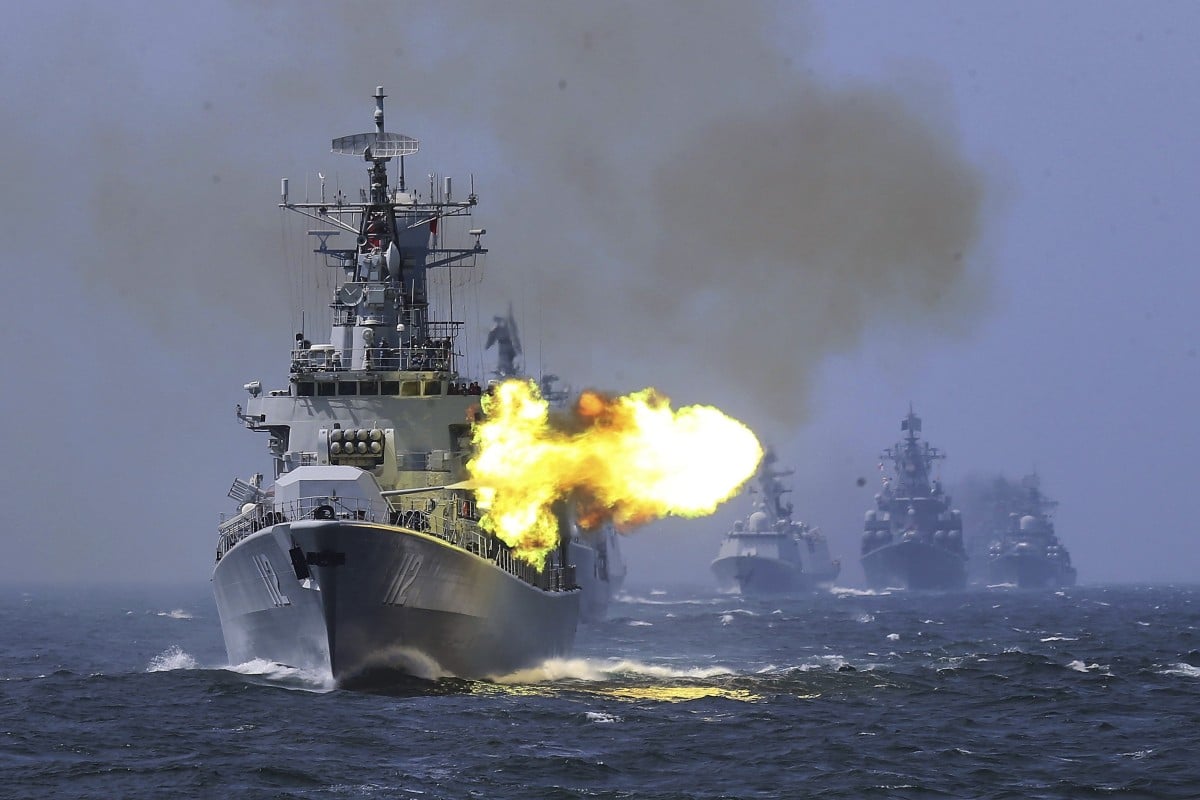
Beijing is conducting live-fire military drills at the northern end of the Taiwan Strait as it signals its resolve to thwart “pro-independence forces” in Taiwan.
Authorities in the small city of Yuhuan, Zhejiang province, notified the public on Sunday that a “no-sail zone” and “no-fishing zone” would be in effect in the area until Friday night.
It said the drills were part of the People’s Liberation Army’s “annual regular exercise plans” and would involve “actual use of weapons”.
“According to the annual [PLA’s] regular training plan … live-fire exercises involving the use of real weapons will be organised … in the designated areas from 6am on May 5 to 6pm on May 10,” the authorities said.
Collin Koh, a military analyst from the S. Rajaratnam School of International Studies at Singapore’s Nanyang Technological University, said the stress on the live-fire manoeuvres suggested the six-day exercise would simulate real combat conditions.
The drills come hard on the heels of an annual report by the Pentagon warning that China was preparing options to unify Taiwan by force, and there was a need to deter, delay or deny any third-party intervention on Taiwan’s behalf.
Under the Taiwan Relations Act, the United States is bound by law to help defend the self-ruled island. Washington is Taipei’s main source of arms, selling the island more than US$15 billion in weaponry since 2010, according to the Pentagon.
Beijing ‘loses all hope for Taiwan’s Tsai Ing-wen’ as she rallies Washington
Taiwan is one of a growing number of flashpoints in the China-US relationship – along with a trade war, Beijing’s growing influence in emerging economies, and its stronger military posture in the South China Sea. On Monday, two guided-missile destroyers, USS Preble and USS Chung-Hoon passed within 12 nautical miles of Gaven and Johnson reefs in the Spratly Islands, drawing immediate criticism from Beijing.
In addition, Taiwan will hold its annual Han Kuang live-fire drills from May 27 to 31 and held a computer-aided one just last month.
A Taiwan affairs analyst from the Chinese Academy of Social Sciences said the drills off Zhejiang were meant to show Beijing’s determination to defend its position on Taiwan.
“Beijing is trying to build up an image that China can win a war over Taiwan and Beijing’s key goal is to contain pro-independence forces, which are the biggest threat now to the peaceful unification process,” the analyst said.
Koh agreed, saying the drill sent a signal to external and domestic parties after the recent high-profile transits of US warships through the Taiwan Strait.
“The messaging to domestic audience is necessary because Beijing can’t be seen as weak following those reported transits by foreign warships – especially the Americans who are seen as supporting Taipei,” Koh said.
“And regarding external audience, the messaging is quite obviously to demonstrate that Beijing is ready to respond more resolutely to future such transits, following the tough verbal responses from Beijing, including its statement that it considers the strait under its jurisdiction and comprise its internal waters.”
Beijing ‘tones down’ response after US warships sail through Taiwan Strait
Relations between Beijing and Taipei have plunged since Tsai Ing-wen from the independence-leaning Democratic Progressive Party won the presidential election in 2016 and repeatedly refused to accept the “1992 consensus”, which Beijing says is the foundation for cross-strait dialogue.
In response, Beijing ramped up pressure against the island, including conducting more military exercises and establishing diplomatic ties with Taipei’s allies.








 CHINDIA ALERT: You'll be living in their world, very soon