Chindia Alert: You’ll be Living in their World Very Soon
aims to alert you to the threats and opportunities that China and India present. China and India require serious attention; case of ‘hidden dragon and crouching tiger’.
Without this attention, governments, businesses and, indeed, individuals may find themselves at a great disadvantage sooner rather than later.
The POSTs (front webpages) are mainly 'cuttings' from reliable sources, updated continuously.
The PAGEs (see Tabs, above) attempt to make the information more meaningful by putting some structure to the information we have researched and assembled since 2006.
MACAO, April 30 (Xinhua) — China International Emergency Medical Team (Macao SAR) successfully passed the evaluation and certification of the World Health Organization (WHO) on Tuesday, becoming the fifth Chinese international emergency medical team, a WHO verification team said in the special administrative region (SAR).
Macao SAR Health Bureau held a press conference on Tuesday afternoon to introduce the preparation work of Macao’s international emergency medical team, and show its facilities and operation to local media.
Ian Norton, a representative from WHO Emergency Medical Team (EMT) Secretariat, told media that the Macao team not only meets the relevant WHO standards, but also has unique advantages in use of languages. Besides their mother tongue, the team members can also speak in English and Portuguese, and can be deployed to Portuguese-speaking countries.
He added that the Macao team will also bring back the experience and expertise they have learned from assistance missions, and better serve Macao and its residents.
The medical team members were drawn from the staff of Health Bureau and Fire Department of Macao SAR government. A total of 120 members were divided into four squads, each consisting of doctors, paramedics, pharmacists, engineers and logistics personnel.
The standard deployment of the whole team covers an area of 3,600 square meters with 41 tents, can diagnose and treat over 100 persons per day, and independently complete the clinical medical work for 14 days.
Macao’s international emergency medical team is the 25th in the world and the fifth in China certified by WHO.
Major highways gridlocked for hours at start of four-day break
Chaos at railway stations as ticket-holding passengers turned away
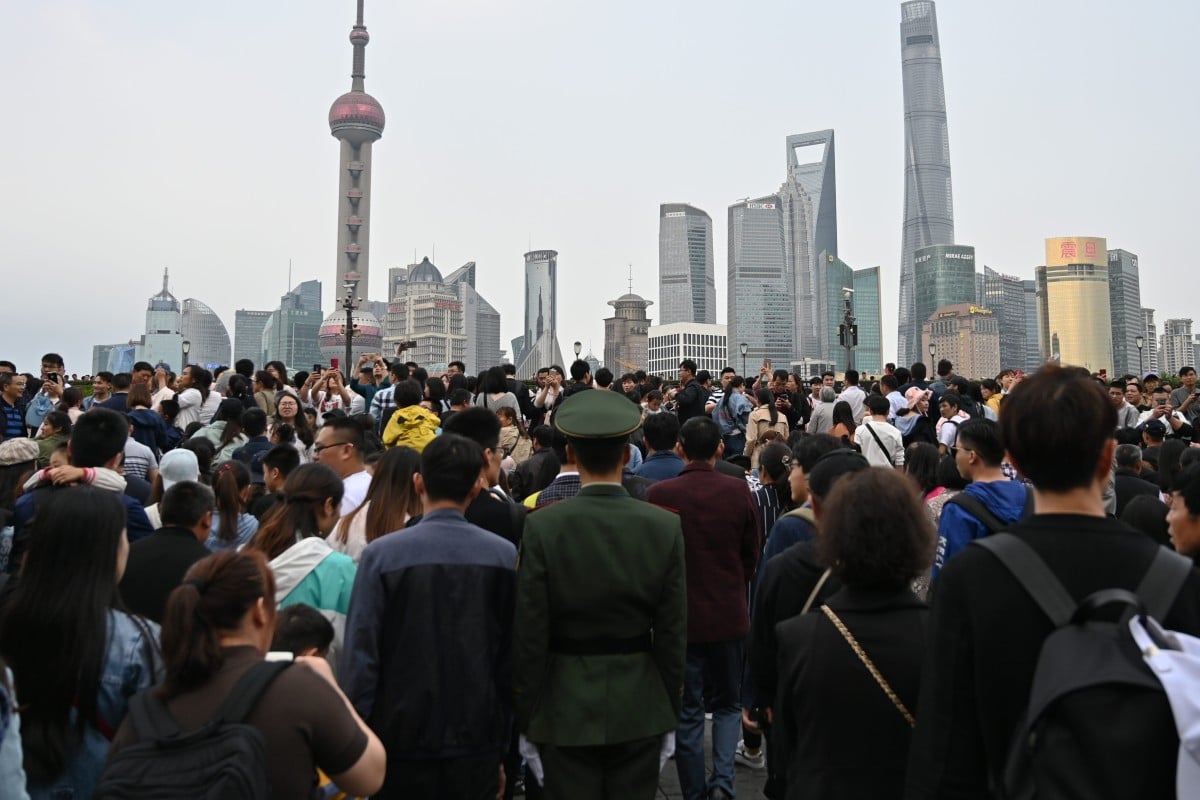
Holiday crowds pack the promenade on the Bund along the Huangpu River in Shanghai on the first day of China’s May break. Photo: AFP
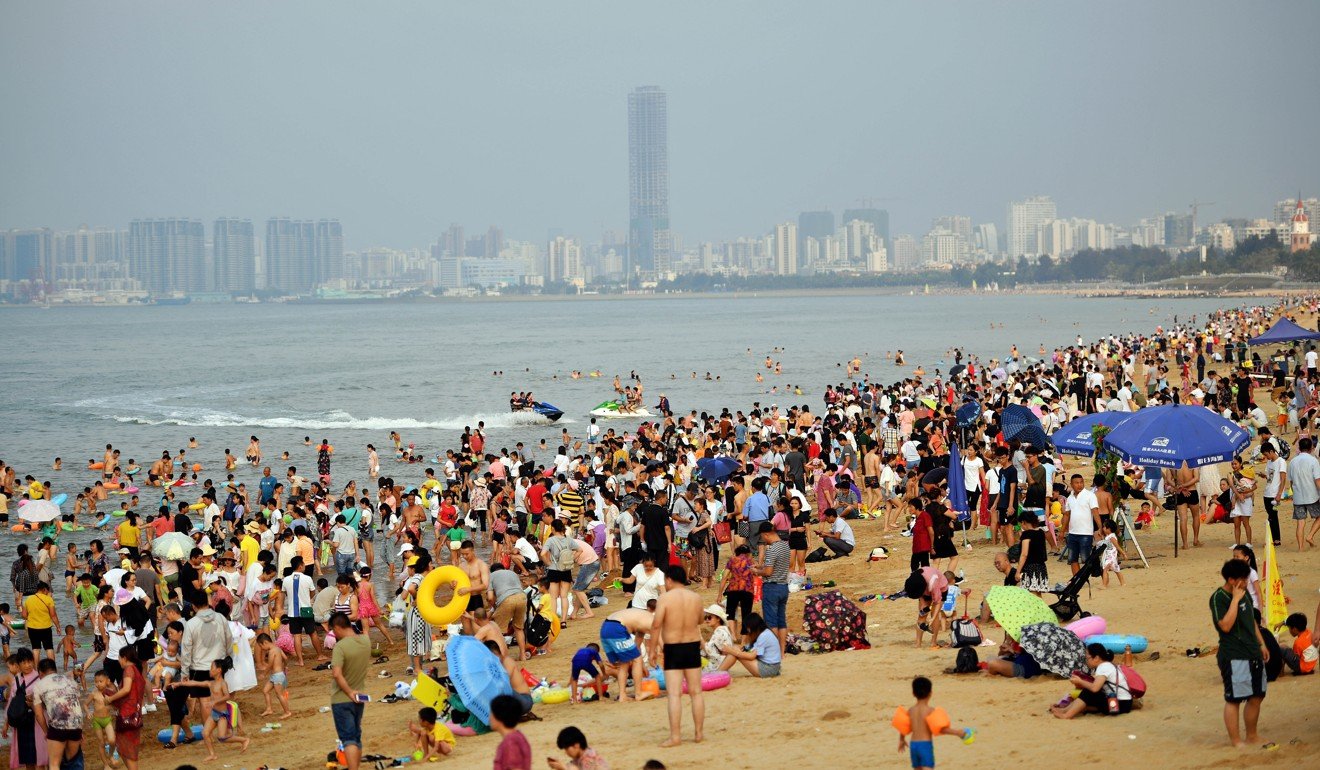
China’s Labour Day holiday started on Wednesday with gridlocked roads and chaos at railway stations as millions of people took advantage of this year’s unusually long break.
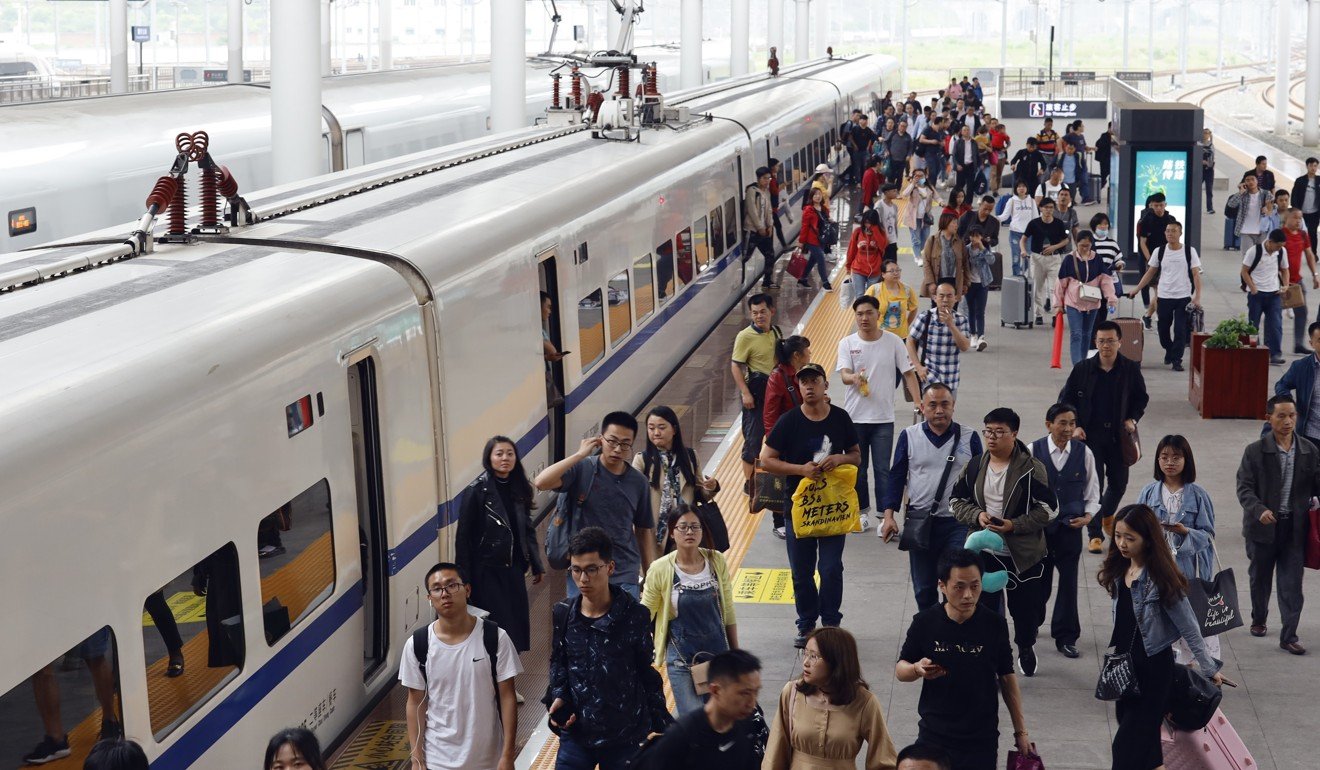
Motorists reported being stuck in traffic jams which did not move for hours, while ticket-holding passengers were turned away from some trains due to severe overcrowding on the first day of the holiday.
Travel agency Ctrip estimated that around 160 million domestic tourists would be travelling over the four-day break, according to data from travel booking platforms.
Forty major highways recorded a 75 per cent spike in traffic on Wednesday, according to Xinhua, as toll fares for cars were suspended for the holiday.
Tourists enjoy the first day of China’s four-day May holiday on a beach in Haikou, Hainan province, southern China. Photo: Xinhua
Monitoring stations on major routes – including the Beijing-Tibet Expressway, the Shanghai-Shaanxi Expressway, Shanghai’s Humin Elevated Road and the Beijing section of the Beijing-Hong Kong-Macau Expressway – recorded a 200 per cent increase in traffic from Tuesday onwards, Xinhua said.
The Ministry of Public Security’s traffic management bureau has warned holiday motorists to drive safely, especially on winding mountainside routes.
Online news portal The Paper reported on Thursday that traffic jams on some major routes were so severe that the drive from Shanghai to Hangzhou, capital of neighbouring Zhejiang province, took some travellers seven hours instead of the usual two.
Passengers board the train at Chongqing North Railway Station in southwest China on Tuesday, hoping to beat the May holiday travel rush. Photo: Xinhua
Meanwhile, more than 54,000 tourists visited the popular Badaling section of the Great Wall on Wednesday, according to Beijing Youth Daily. The attraction’s management team had increased the number of volunteers, parking spaces and shuttle buses to prepare for the influx, the report said.
More than 53,000 tourists had visited the Shanghai International Tourism Resort and Shanghai Disneyland by 4pm on Wednesday, according to data from the Shanghai municipal government’s real-time visitor tracker. The Shanghai Zoo attracted more than 24,000 people, and more than 9,200 visited the Shanghai Science and Technology Museum.
Despite the crowds, no records were broken at the Shanghai attractions, which reached about 70 per cent of their maximum visitor numbers recorded, The Paper reported.
At railway stations, ticket-holding passengers were stopped from boarding trains between Nanjing and the city of Zibo in Shandong province, eastern China, due to severe overcrowding, Beijing Youth Daily reported on Wednesday.
Station staff promised full refunds to customers with pre-booked tickets who were refused entry.
BHUBANESHWAR, India/NEW DELHI (Reuters) – India has evacuated more than 200,000 people along its northeast coastline by boat, bus and train ahead of a severe cyclone due to make landfall on Friday, with many villagers piling household possessions on to trucks before fleeing their homes.
Severe cyclonic storm Fani was lying in the Bay of Bengal about 420 km (260 miles) south-southwest of the Hindu temple town of Puri where special trains were put on to evacuate tourists and the beaches were empty.
In total, about 800,000 people are expected to be evacuated from low-lying areas of the eastern state of Odisha to cyclone shelters, schools and other buildings, authorities said.
“We are maximizing efforts at all levels for evacuation,” Odisha’s Special Relief Commissioner Bishnupada Sethi told Reuters.
Fani was generating maximum sustained winds of 170-180 km (105-111 miles) per hour, the state-run India Meteorological Department said. Cyclone tracker Tropical Storm Risk rated Fani a mid-range category 3 storm.
Authorities have also shut down operations at two major ports – Paradip and Visakhapatnamon – and ships have been ordered to move out to avoid damage.
In Paradip, television footage showed residents piling bicycles, sewing machines and gas cylinders on to small trucks and leaving for any of nearly 900 shelters supplied with food, water and medicines.
Odisha state government has deployed hundreds of disaster management personnel, closed schools and colleges and asked doctors and other health officials not to go on leave until May 15.
India’s cyclone season can last from April to December, when severe storms batter coastal cities and cause widespread deaths and damage to crops and property in both India and neighboring Bangladesh.
Technological advancements have helped meteorologists to predict weather patterns well in advance, giving authorities more time to prepare.
In 1999, a super-cyclone battered the coast of Odisha for 30 hours, killing 10,000 people. A mass evacuation of nearly a million people saved thousands of lives in 2013.
The National Disaster Response Force (NDRF) has sent 50 teams across four coastal states, including Odisha. The NDRF has also put 32 teams equipped with boats, tree cutters, medical supplies, telecoms gear and other equipment on standby.
“I think we are fully prepared,” Satya Narayan Pradhan, NDRF director general, told state TV.
BEIJING, April 30 (Xinhua) — China said Tuesday it hopes that relevant country can do more things conducive to strengthening the mechanism of international arms control and safeguarding international and regional peace and stability.
Foreign Ministry spokesperson Geng Shuang made the comments after U.S. President Donald Trump announced on April 26 that the United States was withdrawing from the Arms Trade Treaty (ATT), which regulates international trade in conventional arms and seeks to prevent and eradicate illicit trade and diversion of conventional arms by establishing international standards governing arms transfers.
“We hope that relevant country can do more things conducive to strengthening the mechanism of international arms control and safeguarding international and regional peace and stability,” Geng said at a daily press briefing.
Calling ATT an important multilateral treaty in the field of conventional arms control, Geng said that China supports the international community taking necessary measures in setting standards for international trade of arms and cracking down on illegal transfer and trafficking of arms.
China supports the purpose and goals of the ATT, and has been attending relevant conferences as an observer, Geng said, adding China has been considering joining the treaty.
Xi Jinping (R), general secretary of the Communist Party of China (CPC) Central Committee and Chinese president, holds talks with Lao President Bounnhang Vorachit, who is also general secretary of the Lao People’s Revolutionary Party Central Committee, in Beijing, capital of China, April 30, 2019. (Xinhua/Li Xueren)
BEIJING, April 30 (Xinhua) — Xi Jinping, general secretary of the Communist Party of China (CPC) Central Committee and Chinese president, held talks here Tuesday with Lao President Bounnhang Vorachit, who is also general secretary of the Lao People’s Revolutionary Party Central Committee.
The two leaders agreed to forge ahead with the efforts in building a community with a shared future for the two countries and work together to usher in a new era for bilateral ties.
After the talks, the two leaders inked an action plan between the CPC and the Lao People’s Revolutionary Party on building a community with a shared future for the two countries.
Noting that this year marks the 10th anniversary of the establishment of the comprehensive strategic cooperative partnership between China and Laos, Xi said as bilateral ties now stand at the best stage in history, China will work with Laos to take the opportunity of signing the action plan to jointly cultivate the bilateral relationship in the new era.
Xi said China and Laos should take strengthening the leadership of the CPC and the Lao People’s Revolutionary Party as guidance and grasp the correct direction of the development of bilateral ties in the new era.
He said the two parties must strengthen their strategic self-confidence and sense of urgency, uphold party leadership and ensure the long-term stability of the two countries, so as to contribute to the development of the socialist cause.
Noting the two sides should maintain close high-level exchanges, Xi said he would like to carry on the good tradition of conducting annual meetings with Bounnhang.
Xi also called on the two sides to deepen theoretical exchanges and strengthen exchanges between their cadres.
China and Laos should accelerate the synergy of each other’s development strategies, promote the construction of economic corridors, expand the radiation and demonstration effects of major projects such as the China-Laos railway, so as to contribute more to regional connectivity, common development and prosperity, Xi said.
The two sides should also closely coordinate and cooperate within multilateral mechanisms such as the United Nations, East Asian cooperation and the Lancang-Mekong cooperation, said the Chinese president.
Bounnhang spoke highly of China’s great achievements in Party and state building and hailed China’s successful experience in poverty alleviation.
He said it is an unshakable policy of Laos to develop its traditional friendship with China. Laos appreciates China’s long-term support and will work with China to give further play to the leading role of the inter-party ties in the development of the state-to-state relationship, and maintain regular high-level meetings between the two parties.
Regarding the Belt and Road initiative, Bounnhang said Laos will continue to accelerate cooperation in major projects, so as to further promote the prosperity of the two countries and the region.
Concerning the action plan, Xi said this is the first time for China and Laos to sign a cooperation document on building a community with a shared future on the bilateral level, which will not only benefit the two parties, countries and peoples, but also serve as a significant exploration in advancing humanity.
Bounnhang said the signing of the action plan will further promote the building of a community with a shared future for humanity.
The two leaders also watched the signing of a series of cooperation documents after the talks.
Xi’s message talks of promoting ‘peaceful development’ as Reiwa era begins in Japan
Analysts see diplomacy as latest steps towards bringing an end to bitter rivalry
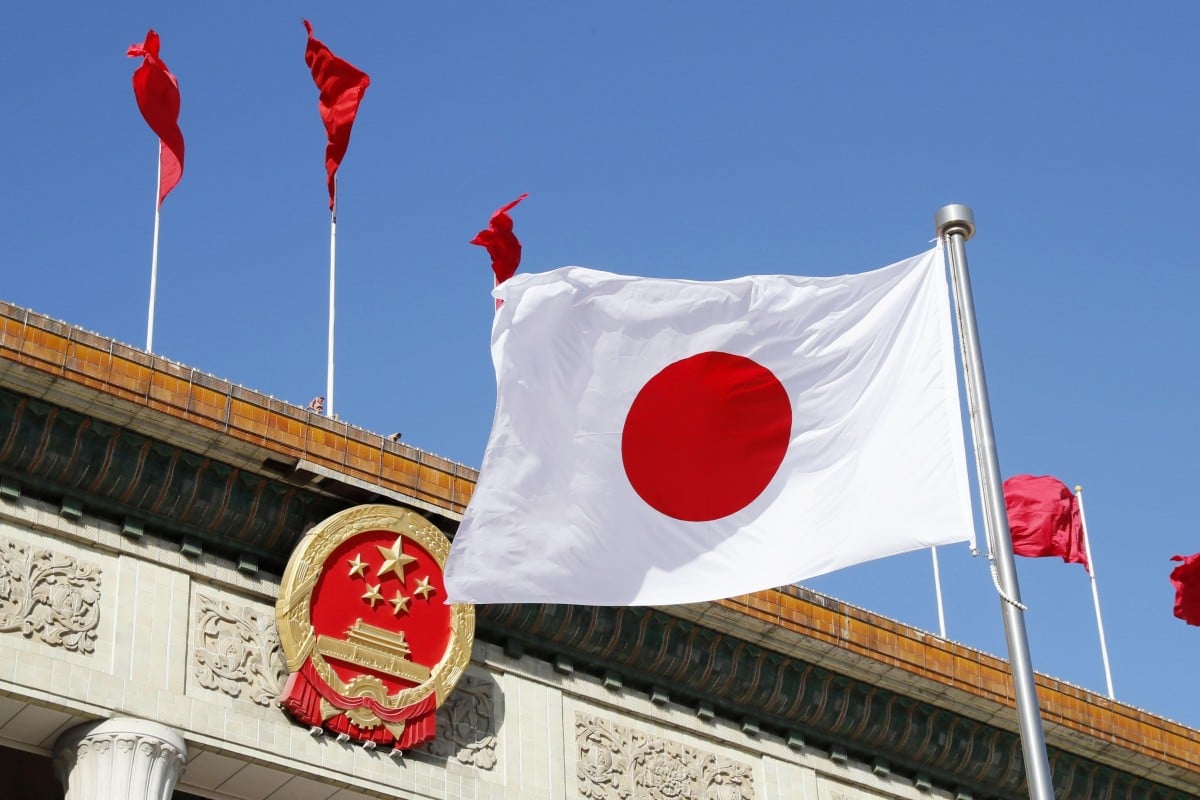
The Japanese flag flies at the Great Hall of the People in Beijing on October to mark the visit of Japanese Prime Minister Shinzo Abe to China. Photo: Kyodo
Chinese President Xi Jinping congratulated Emperor Naruhito on his ascent to the throne of Japan in an effort to strengthen China’s ties with its neighbour and competitor as Beijing’s trade dispute with the United States went on.
Xi sent greetings on Wednesday in which the president stressed the importance of relations between Beijing and Tokyo, China’s state-run Xinhua news agency reported.
The two countries should “work together to promote peaceful development and create a bright future for bilateral relations”, Xi said.
The president also sent a message to Akihito, now Japan’s emperor emeritus, and “expressed his greetings and wishes”, Xinhua said.
Akihito, 85, relinquished the throne to his son at midnight on Tuesday, bringing the Heisei era that spanned his 30-year reign to an end.
Naruhito took the Chrysanthemum Throne to begin the Reiwa era with a pledge to become a “symbol of unity”.
Xi’s message came as China and Japan tried to repair relations damaged by disputes over the East China Sea and the bitter legacy of the second world war.
Washington was locked in a trade tariff war with Beijing, and President Donald Trump’s America First policy had prompted fears about the US’ commitment to Asia at the highest levels of Japanese government. These have pushed Beijing and Tokyo closer and, in October, Japanese Prime Minister Shinzo Abe visited Beijing.
China set to appoint new ambassador to Japan, as Xi Jinping prepares for June visit
Xi was expected to attend a Group of 20 summit to be held in Osaka in June. A source said officials were considering whether Xi would dovetail a state visit to Japan with the summit.
Felix Wiebrecht, a China researcher at the Chinese University of Hong Kong, said in the international environment China was more willing to put a deep-seated rivalry aside and take Japan as a partner.
“Facing increasing tensions with the US, China is naturally turning towards other potential opportunities for cooperation,” Wiebrecht said.
“Xi is indeed very likely to visit Japan this year since it seems that both he and Abe are interested in strengthening their cooperation. A visit this year could be seen as a culmination in normalising their relationship and comes at the right time for China as its conflict with the US intensifies”.
Ryo Hinata-Yamaguchi, a visiting professor at Pusan National University in South Korea and an adjunct fellow at the Pacific Forum foreign policy research institute, said Xi’s message could be seen as Beijing’s expectation on Tokyo to keep relations positive.
“[But] this would raise questions in Japan, particularly regarding regional and bilateral security issues, as well as the trade issues between the US and China,” he said.
As Japan prepares to mark end of an era, a look back at how China started the system
“The big question is whether China – as well as the US – expects Japan to work as some kind of mediator between Beijing and Washington, causing dilemmas for the Japanese government”.
Some observers remarked on the possibility of sideline meeting between the two leaders at Osaka.
“Xi could meet with Abe [at G20] in a bilateral context too,” Zhang Baohui director of the Centre for Asian Pacific Studies at Lingnan University in Hong Kong, said.
He also felt that Xi may make a separate state visit to Japan, after the G20 meeting closed.
“Japan is reportedly interested in having a second and separate visit by Xi later in the year … The Japanese efforts are part of a broader attempt by the Abe administration to improve relations with China,” Zhang said.
“A separate state visit would cement the full recovery of Sino-Japanese relations since the 2012 Diaoyu Islands dispute,” Zhang said.
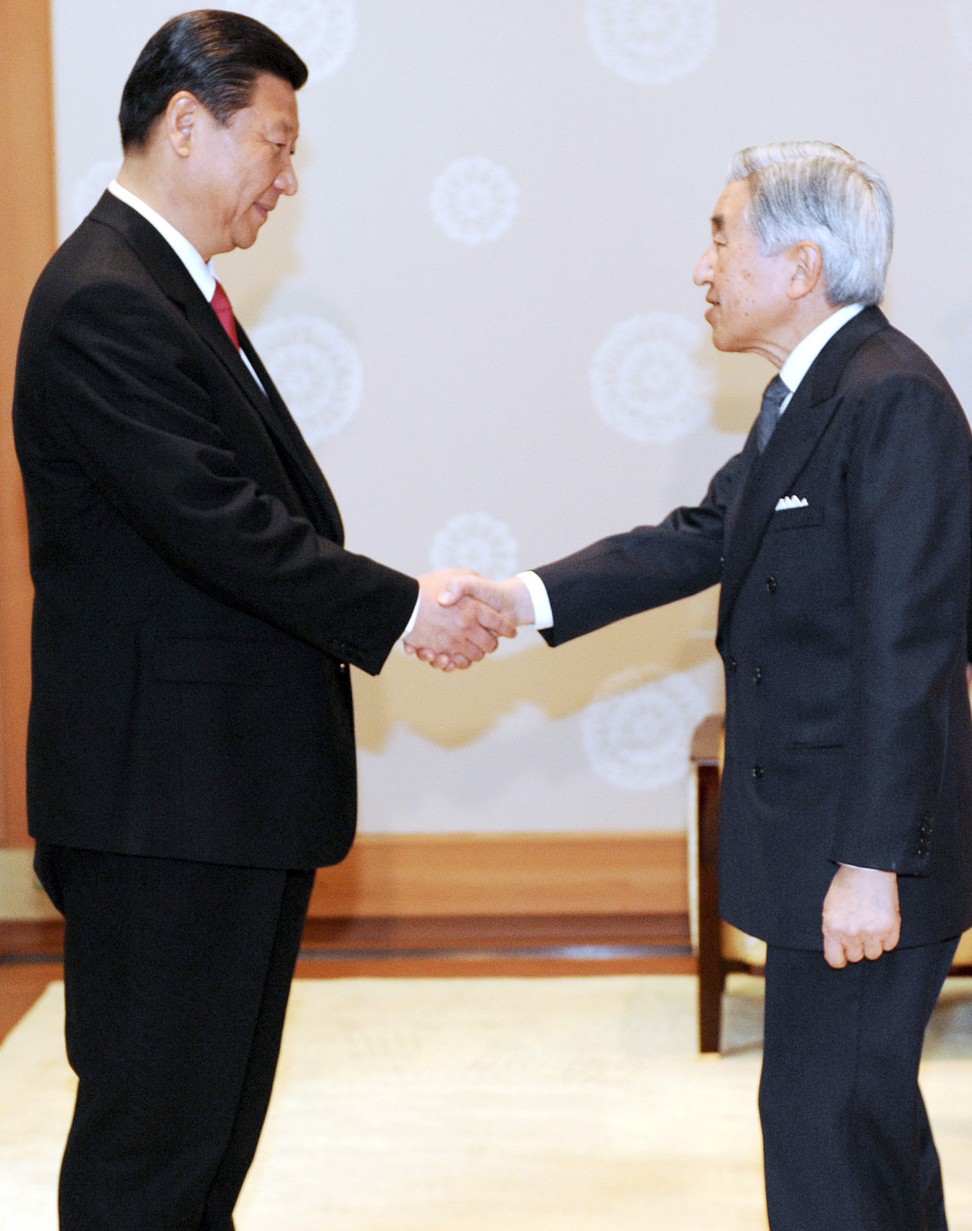
Xi Jinping, then Chinese Vice-President, meets Emperor Akihito in Tokyo in December 2009. Photo: Xinhua
Japan and China both claim the territorial rights over the Senkaku Islands – also known as the Diaoyu Islands – in the East China Sea.
In 2012, Japanese government purchased three of the disputed islands from private owners, which prompted large-scale protests in China. In the following year, Beijing set up the East China Sea Air Defense Identification Zone which included the islands, requiring all aircraft entering the zone to file a flight plan, further intensifying the conflict between the two countries.
Efforts this summer to intensify diplomacy “should bring greater stability to the East China Sea and may even lead to greater Sino-Japanese cooperation on regional issues like economic integration”, Zhang said.
“But Japan’s concern for a rising China and China’s expanding maritime activities in the East China Sea will continue,” Zhang added, noting that Japan has also expanded its military capabilities in disputed areas such as the South China Sea.
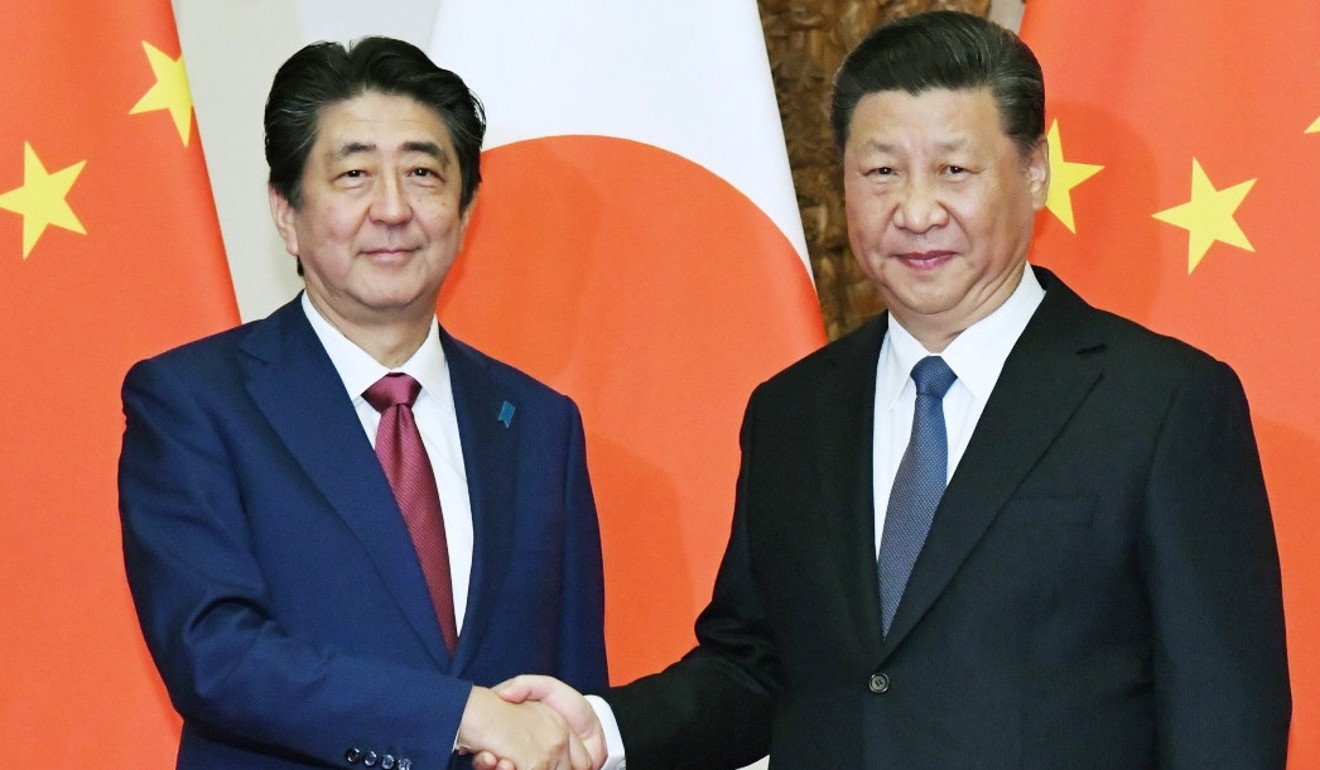
Chinese President Xi Jinping and Japanese Prime Minister Shinzo Abe are likely to continue their diplomacy during and after June’s G20 summit in Osaka. Photo: EPA
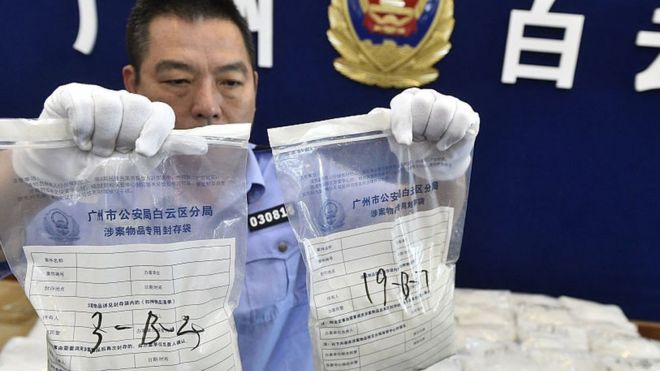
Image copyright GETTY IMAGESImage caption The court said the Canadian was the leader of a drug production and trafficking ring (file pic)
A court in China has sentenced a Canadian citizen to death for producing and trafficking methamphetamine.
Fan Wei is the second Canadian to be sentenced to death this year. Ten others, including five foreigners, were also sentenced on Tuesday.
Relations between Canada and China have been tense since the December arrest of a Huawei executive in Vancouver.
Canada has accused Beijing of arbitrarily applying the death penalty, and have requested clemency for Mr Fan.
In January, another Canadian, Robert Lloyd Schellenberg, had a 15-year jail term increased to a death sentence – prompting condemnation from Canadian Prime Minister Justin Trudeau.
Beijing rejected his comments, saying that Canada was practising “double standards”.
On Tuesday, Foreign Minister Chrystia Freeland told journalists that Canada is “very concerned” by this latest death sentence.
“Canada stands firmly opposed to the death penalty everywhere around the world,” she said.
“We think that this is a cruel and inhumane punishment, which we think should not be used in any country. We are obviously particularly concerned when it is applied to Canadians.”
Global Affairs Canada said in a statement that the country “has raised our firm opposition to the death penalty with China, and will continue to do so”.
The diplomatic agency said representatives attended the 30 April verdict and sentencing trial for Mr Fan, and have called on China to grant clemency to him.
The latest case is likely to further inflame the months-long diplomatic row which started when Meng Wanzhou, the daughter of Huawei’s founder, was arrested in Vancouver on the request of US authorities.
Two other Canadian citizens, former diplomat Michael Kovrig and businessman Michael Spavor, are also being held by China and face accusations of harming national security.
The Jiangmen Intermediate People’s Court in southern Guangdong province said that Fan Wei was the leader of the drugs ring. Another suspect, Wu Ziping, whose nationality was not made clear, was also given a death sentence.
Nine others, including an American and four Mexicans, were given jail terms.
All were detained in 2012 and the trial took place in 2013.
Drug-dealing is punishable by death in China, and at least a dozen foreigners have been executed for drug-related offences. Many more are on death row.
However, the execution of Westerners is less common. One of the most high-profile cases involved British man Akmal Shaikh, who was executed in 2009 despite claims he was mentally ill and an appeal for clemency from the UK prime minister.
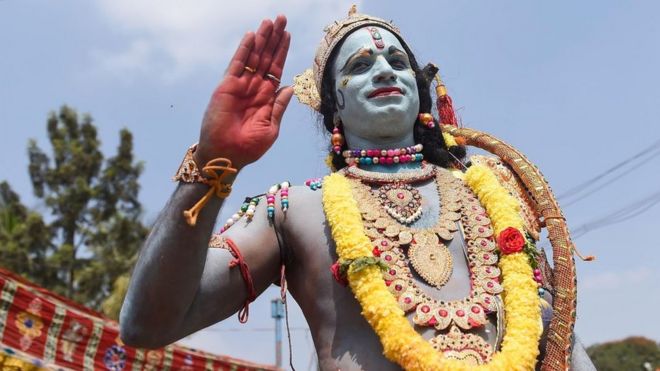
Image copyrightGETTY IMAGESImage captionMany Hindus see the Ramayana’s protagonist, Ram, as a hero
With the Indian general election under way, the Ramayana, a 2,500-year-old Hindu mythological epic, is back in the spotlight. The BBC’s religious affairs reporter Priyanka Pathak explains why.
This year, like in previous elections, the conversation among many hardline Hindus has returned to the epic Ramayana and its protagonist, Ram.
A longstanding demand to construct a temple in the northern city of Ayodhya – a key point of tension between Hindus and Muslims – which Hindus believe is Ram’s birthplace, has become louder in recent months.
Hardline Hindus want the temple built on the same spot where a 16th Century mosque was demolished by Hindu mobs in 1992. They believe the Babri mosque was built after the destruction of a Hindu temple by a Muslim invader.
The governing Bharatiya Janata Party (BJP) has promised, once again, to reconstruct the Ram Mandir (temple) in its election manifesto.
Like in previous elections, they hope that this pledge will draw in more Hindu voters. They also organised Hindu religious festivals on a grand scale in the lead-up to the polls.
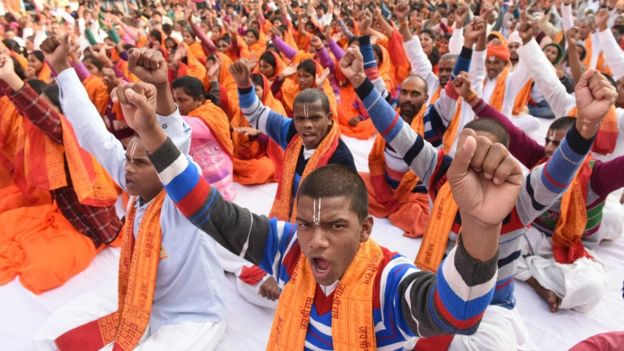
On 12 April, a large gathering of right-wing organisations was held at the iconic Ram Lila Maidan, a sprawling ground named after the god in the centre of the capital, Delhi, to celebrate “Ram’s birthday”.
People dressed in saffron robes wielded swords as they chanted “Jai Shree Ram”, which translates from the Hindi to “Hail Lord Ram”. They shouted slogans, reiterating their promise to Ram that they would reconstruct the temple.
What is the story of the Ramayana?
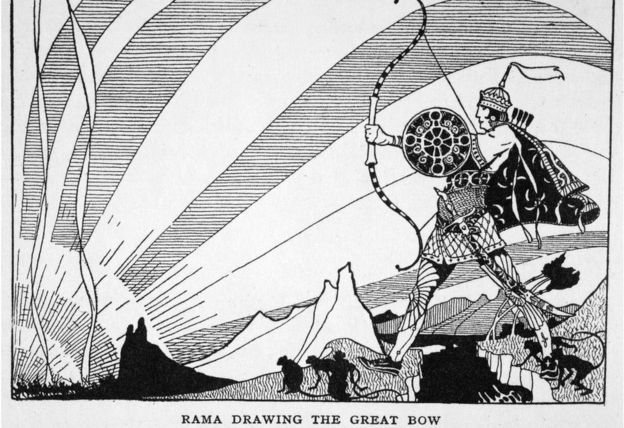
Image copyrightHERITAGE IMAGES/GETTY
The epic tells the story of Ram, a beloved prince who is unaware of his own divinity
On the eve of his coronation, he is banished from his kingdom for 14 years by his father at the behest of his stepmother
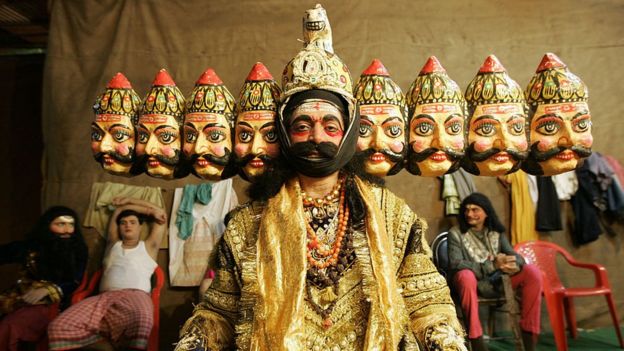
With his wife, Sita, and brother, Lakshman, he wanders through India’s forests – until the 10-headed demon king Ravana abducts Sita
Ram then fights and defeats Ravana to rescue Sita after which he establishes a just kingdom
The story of Ram’s pursuit of righteousness has made him a symbol of self-sacrifice and heroism for many Hindus
He is why this epic remains potent and has dominated India’s political discourse
Experts believe that the movement to build the temple, spearheaded by a powerful Hindu nationalist organisation called the Rashtriya Swayamsevak Sangh (RSS), has helped craft some sort of a collective Hindu identity in India.
This idea is something that the RSS, the ideological fountainhead of the BJP, has cultivated since the early 20th Century.
However, the movement found its zeitgeist moment only a century later.
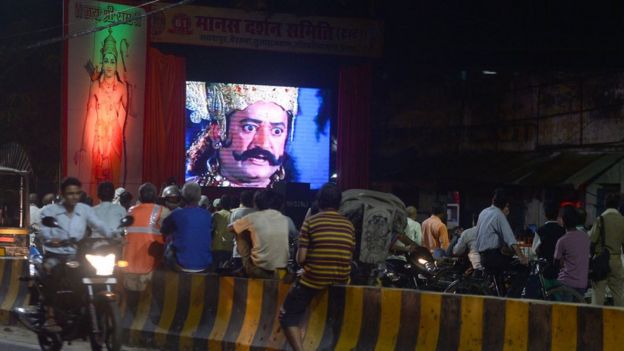
Image copyrightGETTY IMAGESImage caption People in Ahmedabad city sitting along the road and watching a television series on the Ramayana
Several things happened almost concurrently during the late 1980s. First, a television show on the epic reminded 80 million viewers of the story and rekindled a love for its hero.
The serial broadcast a standardised story of the Ramayana, pulled together from many versions and variants. There is no official version of this sprawling epic although historical scholars consider the version by Valmiki, a sage and Sanskrit poet, to be the most authentic.
But really there are as many as 3,000 retellings of the story in around 22 languages, including some that eulogise Ravana while others say it was actually Ram’s brother Lakshman who killed the demon king.
But what the television show did was give India a single narrative of the Ramayana. It also gave a single religion to a country “that was diverse and plural and included many different ways to be Indian”, says Arshia Sattar, a doctorate in south Asian languages, who has translated Valmiki’s Ramayana from Sanskrit into English.
The second big moment came in the late 1980s, when the Congress party led by Rajiv Gandhi – which has always styled itself as secular – decided to lay the foundation stone of the temple in Ayodhya with the help of Vishwa Hindu Parishad (VHP), a right-wing outfit, to woo Hindu votes in a close election.
The plan didn’t work – instead, it paved the way for the BJP, still a young party at the time, to seize what they saw as an opportunity to galvanise Hindu voters.
In September 1989, the party’s then president LK Advani launched a nationwide march for the temple. Bricks began to move from around India for the construction of the temple. The campaign was successful in mobilising communal sentiments and set in motion a series of events that would result in the demolition of the mosque. This, in turn, triggered nationwide riots.
Image copyrightGETTY IMAGESImage captionHindu activists are demanding the construction of the Ram Temple
But in the next elections, the BJP swept the polls. From that moment forward, the party – which was 12 years old at the time – became a national heavyweight.
It took its place as either the party leading the ruling government alliance or as the leading opposition party. For the BJP, the Ayodhya issue became a way to consolidate Hindu votes – something that used to be fragmented along caste lines.
This now well-known version of the epic, championing Ram, also became a convenient point for other Hindu organisations to rally around. This meant that other versions of the epic began to be stamped out.
For instance, in 2011, a Hindu nationalist student union and other affiliated right-wing groups succeeded in forcing Delhi University to drop an essay by the late poet and Ramayana scholar AK Ramanujan, which questioned how many versions of the epic existed, from its history curriculum.
“This may have been part of the general climate of intolerance and the battle over who had the right to tell the country’s history and its myths that was part of the Indian landscape between the 1980s and the 2000s,” literary critic and author Nilanjana Roy wrote of the incident in her blog in 2011.
Image copyrightGETTY IMAGESImage captionRam fights and defeats the ten-headed demon Ravana in the Hindu epic
But for hardline Hindus, the cultural loss of other versions is simply collateral damage.
They believe that a sort of Hindu renaissance can be built around the epic, allowing Hindus to band together and revive their religion as a way of life that they believe was lost and can be re-established.
For instance, in September 2017, the Uttarakhand state minister for alternative medicine, proposed spending $3.6m (£2.8m) to find Sanjeevani – a mythical, glow-in-the-dark herb, described in the epic as having saved Ram and Lakshman from certain death.
The deputy chief minister of Uttar Pradesh has also suggested that science was so advanced during the time of the Ramayana that Sita was actually a test-tube baby. And the vice chancellor of an Indian university has claimed that Ravana, had a fleet of airplanes.
A series of such examples from Indian politicians and scholars can be seen as an attempt to bolster pride in the mythological epic. But they also evoke a nostalgia for a grand past, reawakening hope for a future that repeats the great feats of distance ancestors.
LONDON (Reuters) – Russian-backed Indian refiner Nayara Energy has completed a long-term pre-payment deal with BP and global commodities trader Trafigura for $750 million (£573 million), Nayara’s chief executive said on Wednesday.
The deal, backed by a consortium of international banks, will see the two firms repaid with future gasoline and gasoil over the next four years.
Pre-payments are one the financing mechanisms frequently used in the oil industry.
The total is half the amount originally targeted but is key for asserting the firm’s independence after being previously owned by the debt-laden Essar Group which was wholly dependent on local lenders.
“Nayara Energy is continually looking for innovative opportunities to develop a robust financing framework to strengthen its balance sheet,” CEO B. Anand said in a statement.
“This is truly a benchmark transaction and yet another milestone in our journey towards achieving financial excellence.”
Trafigura and BP closed two similar deals over shorter periods worth $1.45 billion last year.
Nayara, formerly Essar Oil, was taken over by a consortium led by Russian oil major Rosneft in 2017. Rosneft owns 49.13 percent of Nayara, while Russian fund UCP and Geneva-based Trafigura together own a similar share.
The consortium acquired a 400,000 barrel-per-day refinery in Vadinar as well as a port, power plant and 3,500 fuel stations for nearly $13 billion.
Earlier this year, the refiner said it would invest $850 million to build a new refinery and petrochemical plant.





 CHINDIA ALERT: You'll be living in their world, very soon