Archive for May, 2019

29/05/2019

Shangri-La Dialogue: ‘win for China’, as hopes for Japan-South Korea talks fade

  • The Asian security forum in Singapore had been seen as an ideal venue for a breakthrough in the growing diplomatic spat – but Tokyo has got cold feet
  • That will ease the pressure on Beijing in the South China Sea, analysts say
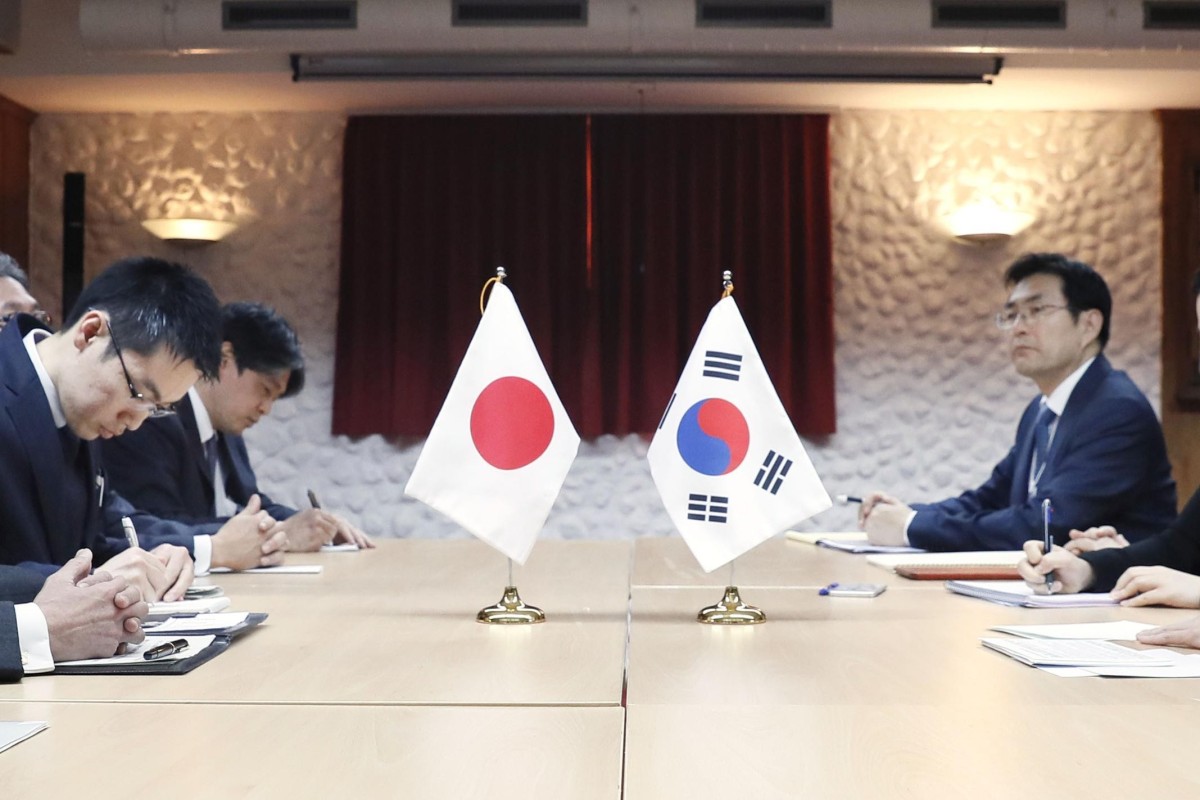
Hopes are fading for a breakthrough in Japan-South Korea relations at the Shangri-La Dialogue in Singapore. Photo: Kyodo
Hopes that

Japan

and

South Korea

could use the Shangri-La Dialogue in

Singapore

to address their growing diplomatic spat are receding.

The three-day Asian security forum, which begins on Friday, had been seen as an ideal neutral venue for the two countries’ defence ministers to hold formal talks on issues including Tokyo’s claim that in January a 
South Korean warship locked its fire control radar

onto a Japanese reconnaissance aircraft.

The issue is one of the biggest deviling the bilateral relationship, alongside Japan’s perception that Seoul has backtracked on a promise to draw a line under Japan’s use of 
Korean sex slaves

– euphemistically known as “comfort women” – in military-run brothels during World War Two.

However, Tokyo appears to have concluded that formal talks on the sidelines of the Shangri-La Dialogue would be premature. The Yomiuri newspaper has reported that a formal meeting will no longer take place and that Takeshi Iwaya and Jeong Kyeong-doo, his South Korean opposite number, will now be restricted to a brief, stand-up exchange of their positions.
Despite the report, South Korean officials were guarded when asked whether the meeting had been shelved. “A detailed plan [on the bilateral talks] has yet to be fixed. Consultations are still underway between authorities of the two countries,” said the South Korean defence ministry spokesperson Choi Hyun-soo on Tuesday.
Analysts suggested Japan had run out of patience with South Korea and that the biggest winner in the stand off between two US allies would be China.
Japanese Defence Minister Takeshi Iwaya. Photo: Kyodo

“My sense is that Japan sees South Korea as not engaging in negotiations on a number of issues and not adhering in good faith to agreements that it has already signed,” said Stephen Nagy, a senior associate professor of international relations at Tokyo’s International Christian University.

Tokyo has been incensed that the administration of

President Moon Jae-in

has gone back on a 2015 agreement that was meant to draw a final line under the “comfort women” issue. Its anger deepened when Seoul said it would not intervene in a South Korean Supreme Court ruling, which ordered Japanese companies to pay up to 120 million won (US$100,000) to each of a dozen

Koreans forced into labour during Japan’s colonial rule

of the Korean peninsula from 1910-1945.

Like its stance on “comfort women”, Japan believed a line had been drawn under the issue, this time in a 1965 pact that normalised relations between the two countries. Seoul argues that the 1965 treaty, which it signed after receiving US$800 million in grants and soft loans from Tokyo as compensation, does not cover individual victims of colonial-era atrocities.
As rift between Japan, South Korea deepens, how hard can Seoul afford to push?

“Japan is not ready to get into any more agreements because it fears that Seoul will not follow through or that they will become politicised in the future,” Nagy said.

“Tokyo wants binding, long-lasting agreements rather than having to renegotiate something each time a new Korean government comes in,” he said.

“The biggest winner in this stand-off between the US’ two most important allies in the region is, of course, China,” he added. “They must be delighted to see this playing out because it means the US is not able to exert nearly as much pressure in areas such as the 

South China Sea

.”

A long-standing strategic aim in US foreign policy circles has been to form a trilateral alliance with South Korea and Japan to present a united front against common security concerns, including China’s growing influence. However, the seeming inability of the two countries to get along has long thwarted this ambition.
“If Japan, South Korea and the US could find a way to cooperate, imagine the influence they could exert over the South China Sea or over 
North Korea

,” Nagy said. “If Japan and Korea could find a way to put their differences aside and with their security capacity, it would be a powerful deterrent to Beijing and Pyongyang.”

South Korean protesters demonstrate against Japan’s use of sex slaves – euphemistically termed ‘comfort women’ in World War II. Photo: AFP

Toshimitsu Shigemura, a professor of international relations at Tokyo’s Waseda University, agreed that the schism between Seoul and Tokyo would be of serious concern to Washington, but he believed that US pressure had already been brought to bear on the two neighbours.

“By avoiding talks in Singapore, Japan is doing its best to avoid public problems between the two sides and I believe that talks are already taking place between the two governments on these issues,” he said.

US wants Japan and South Korea to tag team China. But history is in the way

“The US will have told Tokyo and Seoul that it does not want to see more disagreements and that it is very important that they cooperate and calm things down a bit,” he said.

“I am sure that Washington knows exactly what happened when the Korean warship locked onto the Japanese aircraft in January, but they’re not publicly taking sides and instead they’re telling both governments to put the dispute behind them and to move on,” he added.

Other analysts were more pessimistic.

“The dynamics in domestic politics in both countries are currently overwhelming any diplomatic motives to improve bilateral ties,” said Bong Young-sik, a researcher at the Asan Institute for Policy Studies in Seoul.

Japanese Prime Minister Shinzo Abe. Photo: AFP
“For President Moon Jae-in, Japan-bashing is a useful political card to appeal to his supporters while for

Prime Minister Shinzo Abe

, giving the impression that South Korea is going too far in pressing Japan is also beneficial for his own political gains.”

Professor Ha Jong-moon at Hansin University said there were “no solutions in sight” to resolve the differences over forced labour and wartime sex slavery, but said there would be a chance to “smooth ruffled feathers” at the G20 summit in Osaka, which takes place at the end of June.
The last time the defence ministers of the two countries met was in October last year, when they held talks on the sidelines of the Asean Defence Ministers’ Meeting in Singapore.
Source: SCMP
29/05/2019

Chinese foundation to help poor pupils along Belt and Road

BEIJING, May 28 (Xinhua) — A leading Chinese foundation plans to give about 200,000 aid packages to primary school students in countries along the Belt and Road in 2019, the foundation’s official said Tuesday.

The “care package” is a project carried out by China Foundation for Poverty Alleviation since 2009, providing stationary, textbooks and other everyday items to primary schools in poor rural areas.

Yan Zhitao, deputy secretary-general of the foundation, said the project started reaching out to foreign recipients last year and would expand this year to help overseas pupils in need.

Over the past decade, the care package project has collected donations amounting to 700 million yuan (101 million U.S. dollars) and aided more than 6 million pupils in China.

Source: Xinhua

29/05/2019

Chinese premier meets Nigerien president

CHINA-BEIJING-LI KEQIANG-NIGERIEN PRESIDENT-MEETING (CN)

Chinese Premier Li Keqiang meets with Nigerien President Mahamadou Issoufou in Beijing, capital of China, May 28, 2019. (Xinhua/Pang Xinglei)

Source: Xinhua

29/05/2019

Xi meets representatives of overseas Chinese

CHINA-BEIJING-XI JINPING-OVERSEAS CHINESE-REPRESENTATIVES-MEETING (CN)

Chinese President Xi Jinping, also general secretary of the Communist Party of China (CPC) Central Committee, meets with overseas Chinese representatives who are in Beijing to attend the ninth Conference for Friendship of Overseas Chinese Associations and a plenary session of the board of directors of the China Overseas Friendship Association at the Great Hall of the People in Beijing, capital of China, May 28, 2019. Other Chinese leaders including Wang Yang, a member of the Standing Committee of the Political Bureau of the CPC Central Committee and chairman of the Chinese People’s Political Consultative Conference National Committee, were also present at the meeting. (Xinhua/Li Xueren)

BEIJING, May 28 (Xinhua) — President Xi Jinping on Tuesday met with overseas Chinese representatives who are in Beijing to attend the ninth Conference for Friendship of Overseas Chinese Associations and a plenary session of the board of directors of the China Overseas Friendship Association.

On behalf of the Communist Party of China (CPC) Central Committee and the State Council, Xi, also general secretary of the CPC Central Committee, expressed a warm welcome and sincere congratulations to the representatives and extended greetings to overseas Chinese around the world.

Source: Xinhua

29/05/2019

China, Pakistan vow to further strengthen ties, cooperation

PAKISTAN-CHINA-WANG QISHAN-VISIT

Chinese Vice President Wang Qishan meets with Pakistani President Arif Alvi in Islamabad, Pakistan, May 26, 2019. Wang Qishan visited Pakistan from Sunday to Tuesday and held meetings with Pakistani President Arif Alvi and Prime Minister Imran Khan respectively on further strengthening bilateral relations. (Xinhua/Yan Yan)

ISLAMABAD, May 28 (Xinhua) — Chinese Vice President Wang Qishan visited Pakistan from Sunday to Tuesday and held meetings with Pakistani President Arif Alvi and Prime Minister Imran Khan respectively on further strengthening bilateral relations.

When meeting with the Pakistani president, Wang said China and Pakistan are “iron friends.” Throughout the past 68 years since the establishment of diplomatic ties, the two countries have always respected and supported each other on issues concerning each others’ core interests, forging the sincerest friendship.

In recent years, the development of China-Pakistan relations has kept a good momentum, with mutual political trust further enhanced, pragmatic cooperation continuously deepened and people-to-people exchanges growing more vigorous, Wang said.

He said the development of the China-Pakistan Economic Corridor (CPEC) has made concrete achievements and has become an important hallmark for China-Pakistan friendly cooperation in the new era, adding that his visit was meant for sending out a signal once more to peoples of the two countries and the world that China and Pakistan are all-weather strategic cooperative partners.

Wang said China is willing to strengthen the all-around cooperation with Pakistan in various sectors and at various levels, so as to make the friendship better benefit the two sides and forge a closer China-Pakistan community of shared future in the new era.

For his part, President Arif Alvi extended congratulations to the upcoming 70th anniversary of the founding of the People’s Republic of China. He said Pakistan-China cooperation has become more important in current times. Pakistan is firmly committed to the one-China policy, firmly supports China in safeguarding the country’s core and major interests, he said.

Pakistan wishes to deepen cooperation with China in such areas including agriculture, tourism and trade, with a bid to promote the all-weather strategic cooperative partnership further ahead, said the president, who also expressed appreciation for China’s support to Pakistan and wished China to play a bigger role in international and regional affairs.

After their meeting, the Pakistani president conferred on Wang the Nishan-e-Pakistan, the country’s highest award for foreign leaders.

While meeting with Pakistani Prime Minister Imran Khan, Wang said the prime minister has visited China twice since taking office and reached important consensus with Chinese leaders on further pushing forward the development of bilateral relations.

China is ready to join hands with Pakistan to deepen high-level exchanges, boost strategic communication and pragmatic cooperation as well as closely coordinate in international and regional affairs between the two sides, Wang said.

Wang called on the two sides to work for high-quality CPEC development in the next phase, and make concrete progress in industrial park building and agricultural cooperation.

China will speed up the implementation of social and people’s livelihood projects of early harvest, and discuss the third-party cooperation in the CPEC development, he added.

The Chinese vice president called for strengthened people-to-people and cultural exchanges and collaboration so as to expand the public foundation for the China-Pakistan friendship.

Wang hoped that Pakistan will take effective measures to provide security guarantees for the cooperation and exchanges between the two countries.

Imran Khan, for his part, said that Pakistan adheres to the friendly policy towards China, admires the achievements of China’s reform and opening-up and stands ready to consolidate the traditional friendship with China.

Pakistan also hopes to learn from China in terms of state governance, and enhance exchanges and cooperation in the sectors of agricultural technology, special economic zone development, talent training and anti-corruption.

Noting that fruitful results have been reaped in the CPEC development, the Pakistani prime minister said that the CPEC has played an important role in promoting Pakistan’s economic development and improving people’s livelihood.

He said Pakistan has established a special committee to take charge of inter-department and inter-sector coordination and ensure personnel safety of Chinese institutions in Pakistan.

Pakistan will continue to enhance coordination with China in international and regional affairs so as to enrich bilateral all-weather strategic cooperative partnership.

After the meeting, Wang Qishan and Imran Khan jointly witnessed the signing of bilateral cooperation agreements concerning agriculture, customs and disaster relief.

During his stay in Pakistan, the Chinese vice president also met with local leaders of the Punjab province, addressed the Friends of Silk Road Forum and visited Haier-Ruba Economic Zone.

Source: Xinhua

29/05/2019

The bullying that led this doctor to take her own life

Payal TadviImage copyright FACEBOOK/PAYAL TADVI
Image caption Payal Tadvi was harassed and bullied, her mother says

Three doctors have been arrested in India’s Mumbai city amid allegations that their bullying of a young female colleague led her to take her own life. BBC Marathi’s Janhavee Moole and Pravin Thakre report.

“I used to say I am Dr Payal’s mother. But what do I say now?” Abeda Tadvi asks tearfully.

Her 26-year-old daughter, Payal, took her own life on 22 May after months of alleged harassment over her caste – she belonged to a Scheduled Tribe, a status given to historically disadvantaged tribes.

Payal’s family has accused three of her seniors at the medical college – all women – of bullying her in the months leading up to her death.

Police arrested the three accused women on Tuesday and are investigating the matter, deputy commissioner of police, Abhinash Kumar, told the BBC. But they have denied the allegations in a statement published by the ANI news agency, saying they were being “unjustly” accused and demanded a “fair probe” and “justice”.

Prior to the arrests, Nair hospital, where the women worked, had suspended them. The college had also launched an inquiry into the allegations.

Payal’s death has shocked her colleagues and friends, who have been protesting in front of the hospital and demanding justice on her behalf. And it has shown the persistence of caste discrimination in an unlikely place – a college in Mumbai, India’s financial hub and arguably its most urbanised city.

Presentational white space

Payal was from Jalgaon in northern Maharashtra, the state where Mumbai is located. She married Salman Tadvi, who is a doctor in Mumbai, and moved to the city for a postgraduate medical degree.

She was studying to be a gynaecologist at Topiwala Medical College when she died. She had always wanted to be a doctor, her mother, Abeda, says. Her dream was to provide better healthcare for poor tribespeople.

She belonged to the Tadvi Bhil tribe, one of more than 700 Scheduled Tribes in India. Members of these tribes – who number around eight million, according to the last census in 2011 – are given “reservations” or quotas to rectify the wrongs of India’s enduring caste hierarchies.

Payal was admitted to the college under the quota for Scheduled Tribes. Abeda says she was so proud of her daughter who had achieved so much despite their caste status and how poor they were.

“They taunted her for every small thing”

Abeda says that Payal had told her about the harassment she was facing from three of her seniors.

“She said they taunted her in front of patients for every small thing. They insulted her with slurs, threw files at her face. She said they did not even allow her to eat her meals in peace.”

They also allegedly threatened to prevent her from practising medicine.

Courtesy Tadvi familyImage copyright TADVI FAMILY
Image caption Payal (L) with her mother, Abeda

Abeda, who is being treated for cancer, would often visit Nair hospital, where Payal studied and practised because it is affiliated to her college.

She said she could rarely spend time with her daughter because she was always busy – so Abeda observed her from a distance.

“I saw the way she was being treated and decided to complain, but Payal stopped me,” she said.

Payal feared that such a complaint would hurt the careers of the three women – and that they would end up harassing her even more.

But in December 2018, Abeda and Salman finally spoke to other seniors and professors about the harassment Payal said she was facing.

They demanded that Payal be allowed to work with a different team. She was reassigned, Abeda says, and she appeared a little relieved after that.

But, according to Abeda, the harassment soon resumed and around 10-12 May, Abeda herself filed a written complaint. “But this time they didn’t take it seriously,” she alleges.

Ten days later, Payal took her own life.

‘It’s sad and tragic’

Her death has raised the alarm on the widespread prevalence of bullying in schools and colleges across India. “Ragging”, as it is euphemistically known, is banned but it continues. And students from lower castes often face the brunt of it.

Nair hospital has set up a committee to inquire into the allegations and it is expected to submit a report soon, Dr Ramesh Bharmal, dean of Topiwala college, told the BBC.

“It’s sad and tragic. We are extremely shocked. How does this happen? What could we have done and what should we do now? All this could have been prevented,” he adds.

Salman says that he met Dr Bharmal, who asked him why no-one had approached the dean’s office. Salman told him that they had talked to staff in Payal’s department and that they had followed the procedure.

“Why didn’t they do anything?” he asks.

Members of Bahujan Mukti Party protest against the senior doctors of BYL Nair Hospital for suicide of Dr Payal Tadvi who was harassed by her senior doctor at Bombay Central, on May 25, 2019 in Mumbai, India.Image copyright GETTY IMAGES

Abeda has the same questions: “What else were we supposed to do? Don’t they know what is happening in their college? This was happening in front of their eyes. They should have looked into it.”

Dr Barmal says that the college and hospital do have a system to address complaints of harassment – this includes counselling for new students, a committee to investigate complaints and random checks by supervisors.

“I was not aware. Otherwise this would not have happened. Proper measures could be taken and this…could be avoided,” he adds.

‘She was my backbone’

At the house in Jalgaon, where Payal grew up, relatives and neighbours are all in mourning. And they are eager to speak of Payal. They remember her as intelligent, ambitious and hard working.

They said she was inspired to become a doctor because her younger brother was born with a physical disability that prevented him from walking; and that she always wanted to help people.

Presentational grey line

Read more stories about Indian society

Presentational grey line

Abeda says what happened to Payal has made her wonder about other students from lower castes who are also pursuing a better future.

She thinks of her nieces and nephews, and other children from her tribe.

“Their parents now come to me and ask if they should ask their children to sit at home because they do not trust institutions to take care of them,” Abeda says.

“She was my backbone. She was a backbone for the whole community. She would have been the first female doctor from our tribe. But that dream will now remain unfulfilled.”

Source: The BBC

28/05/2019

Chinese universities asked to improve scientific research administration

BEIJING, May 27 (Xinhua) — China’s Ministry of Education has asked universities to improve administration to boost scientific research.

In a circular, the ministry required simplifying procedures for reimbursement of expenses on research activities which include attending meetings, counseling, purchasing equipment and services, among others.

Internet-based reimbursement is encouraged and approval will also be streamlined, according to the circular.

It also demanded universities improve the system of appointing academic assistants and financial assistants for researchers, and allocate more funds to raise researchers’ bonuses.

The interference with scientific research must be reduced to a minimum, the circular said.

Source: Xinhua

28/05/2019

Top political advisor stresses religious work, poverty alleviation in Tibetan-inhabited regions

CHENGDU, May 27 (Xinhua) — Wang Yang, China’s top political advisor, underlined efforts to curb separatists, maintain normal religious practices and alleviate poverty during a visit to the Tibetan Autonomous Prefecture of Garze in Sichuan Province from Saturday to Monday.

Efforts should be made to guide religious people to willingly uphold the Party’s leadership, promote patriotism and correctly understand the relations between the law and religious doctrines, said Wang, a member of the Standing Committee of the Political Bureau of the Communist Party of China Central Committee and chairman of the Chinese People’s Political Consultative Conference National Committee.

He instructed local authorities to improve the management of temples and counteract infiltration by hostile foreign forces.

Wang also urged them to improve the quality of poverty relief projects, upgrade local infrastructure and public services and allocate more resources to the areas suffering absolute poverty.

Source: Xinhua

28/05/2019

China, Serbia eye closer bilateral tie

CHINA-BEIJING-LI ZHANSHU-SERBIA-MEETING (CN)

Li Zhanshu, chairman of the Standing Committee of the National People’s Congress (NPC), meets with Veroljub Arsic, deputy speaker of the National Assembly of Serbia, at the Great Hall of the People in Beijing, capital of China, May 27, 2019. (Xinhua/Shen Hong)

BEIJING, May 27 (Xinhua) — China’s top legislator Li Zhanshu Monday met with Veroljub Arsic, deputy speaker of the National Assembly of Serbia, here Monday, calling for closer bilateral ties.

Calling China and Serbia “sincere friends of each other,” Li, chairman of the Standing Committee of the National People’s Congress (NPC), said the bilateral comprehensive strategic partnership has been lifted to a new high under the guidance of the two heads of state.

Bilateral pragmatic cooperation has been at the forefront of the Belt and Road cooperation, Li added.

He called on both countries to consolidate traditional friendship, continue to firmly support each other on core interests and issues of major concern, set examples of political mutual trust, common development and people-to-people exchanges so as to build a closer community with shared interests and a shared future.

Li also called on the two legislatures to enhance cooperation in areas including legislation, supervision and governance in order to better implement the consensus of the two heads of state.

Arsic said the National Assembly of Serbia stands ready to intensify exchanges with the NPC and give full play to the cooperation committee between the legislatures of Serbia and China, to make new contributions to boosting practical cooperation between the two countries and friendship between the two peoples.

Source: Xinhua

28/05/2019

China’s navy is being forced to rethink its spending plans as cost of trade war rises

Technological and strategic barriers are also giving PLA Navy pause for thought, analysts say

  • Despite its massive military expansion, China still lags behind the US, observers say
China is keen to expand its naval fleet but doing so is a costly business. Photo: AFP
China is having to reassess its naval shipbuilding plans in the face of economic, technical and strategic challenges at home and abroad, according to military insiders.

While President Xi Jinping’s goal for modernising the military remains a priority, the nation’s top brass are mindful of the high costs of building a new generation of military ships, like aircraft carriers and destroyers.

Beijing has said repeatedly that the impact of its trade war with the United States would be bearable, but observers say the PLA Navy is under pressure to adjust its spending plans because of the uncertainty over the country’s economic outlook, as well as slower-than-expected technological and personnel developments.

“The escalating tension between China and the United States has reminded Beijing’s leaders that they need to be careful how much they spend on new warships,” a military source, who asked not to be named, told the South China Morning Post.
With all its hi-tech equipment an aircraft carrier can cost up to US$7.2 billion to build. Photo: Reuters

With an aircraft carrier, for instance, once the price of the hi-tech weaponry, control and communications systems, and fighter jets had been added to the basic cost of building the hull, it came in at about 50 billion yuan (US$7.2 billion), the person said.

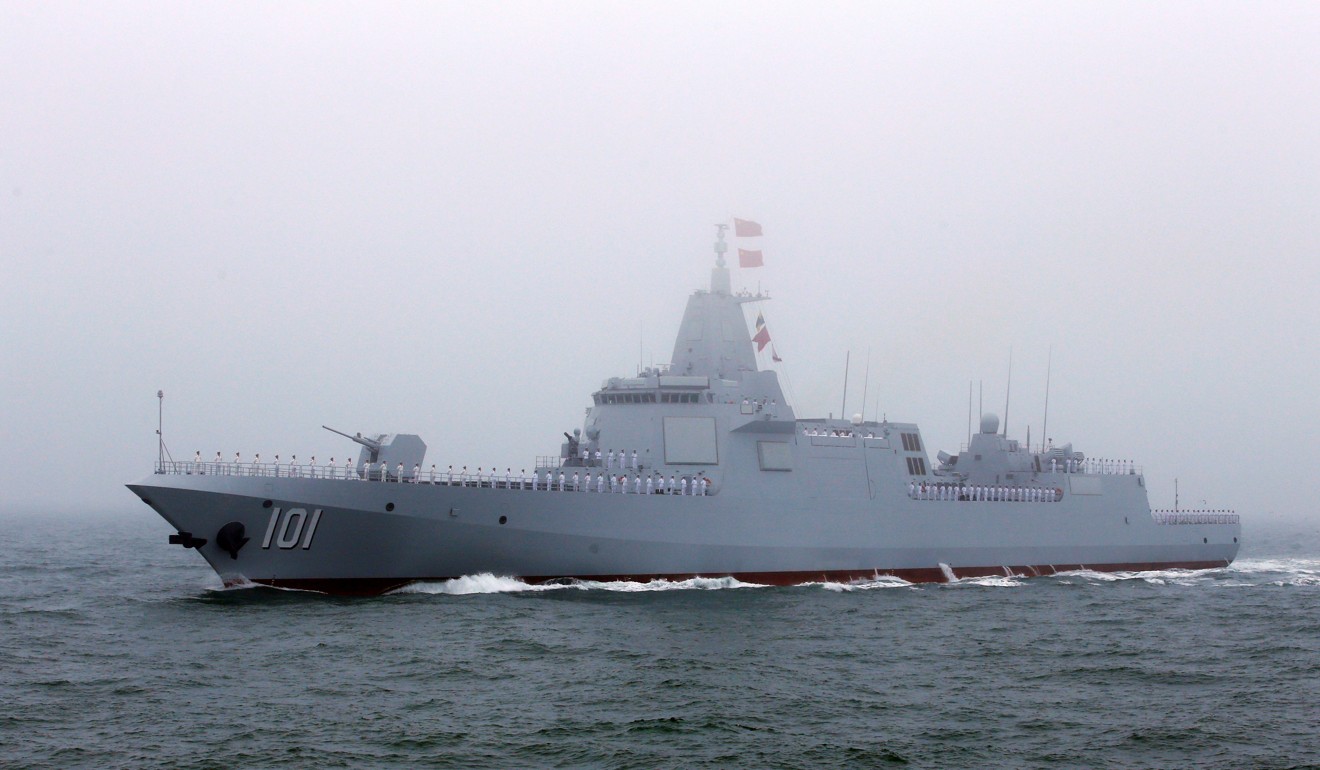
Plans to build eight next-generation Type 055 destroyers, the largest of its class in China’s fleet with a displacement of more than 12,000 tonnes, also needed to be reconsidered, the source said.

Satellite images show progress on China’s Type 002 aircraft carrier

“Each Type 055 costs over 6 billion yuan to build, which is twice as expensive as a Type 052D, the navy’s current main warship,” he said.

But military experts said that it is not just the cost of building vessels that needs to be considered. Operating an aircraft carrier battle group at sea, which comprises the carrier, at least two destroyers, two frigates, several submarines and a supply ship, is hugely expensive.

Then there is the maintenance cost – aircraft carriers spend about half the year in dock undergoing checks and repairs – which puts another immense burden on the navy’s budget.

Despite the numbers involved, Beijing-based naval expert Li Jie said Beijing planned to establish four aircraft carrier battle groups by 2030, with three combat-ready at any given time.

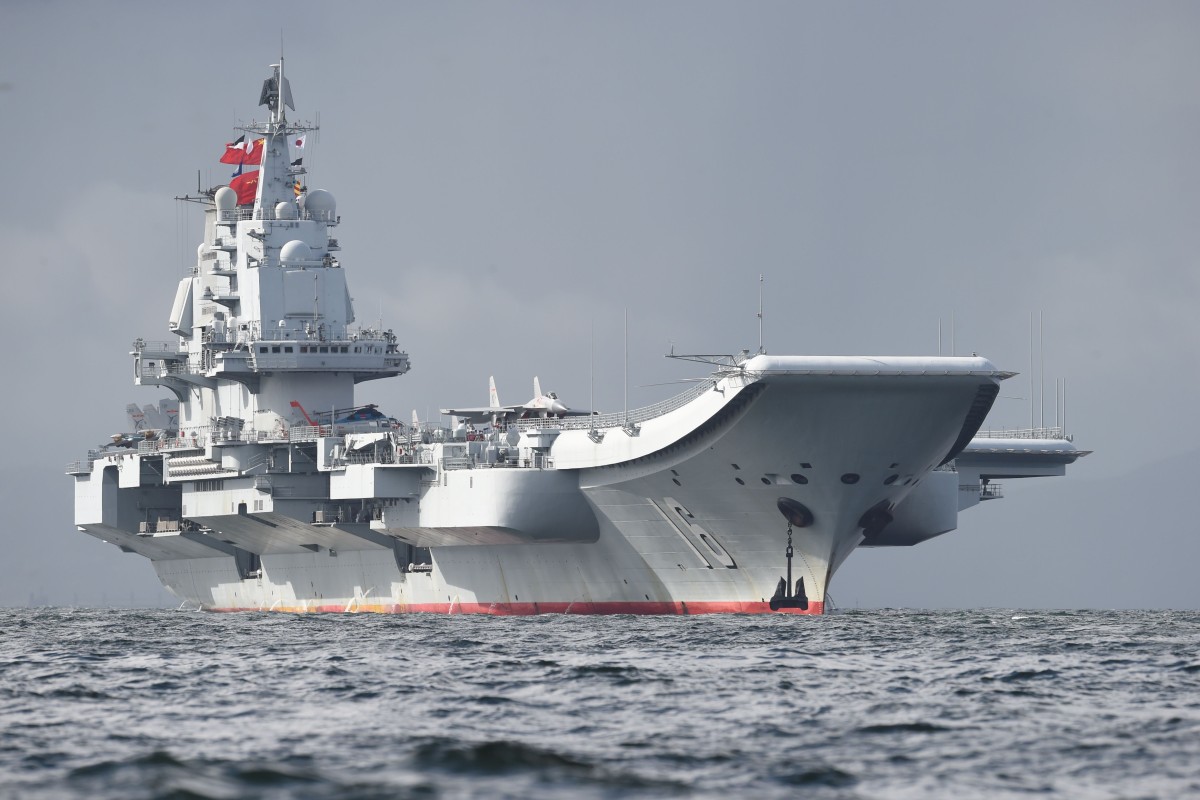
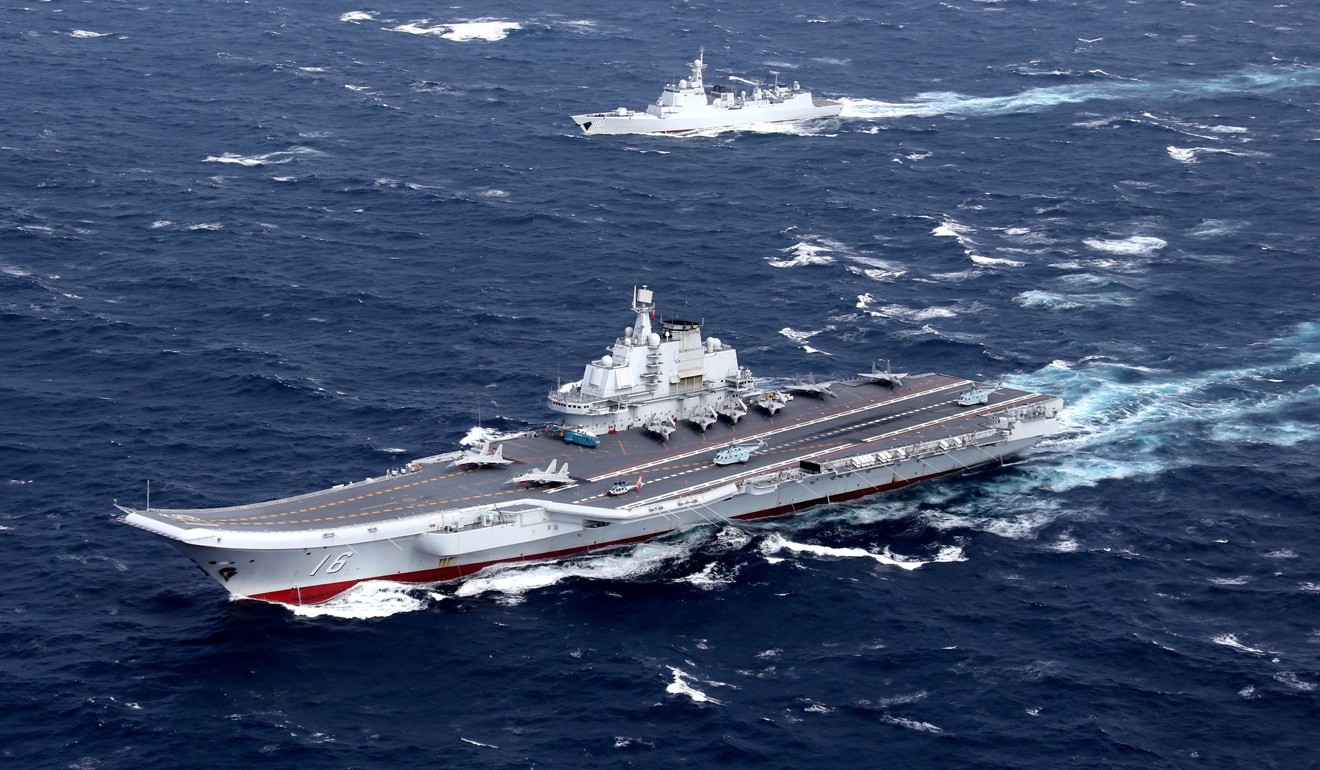
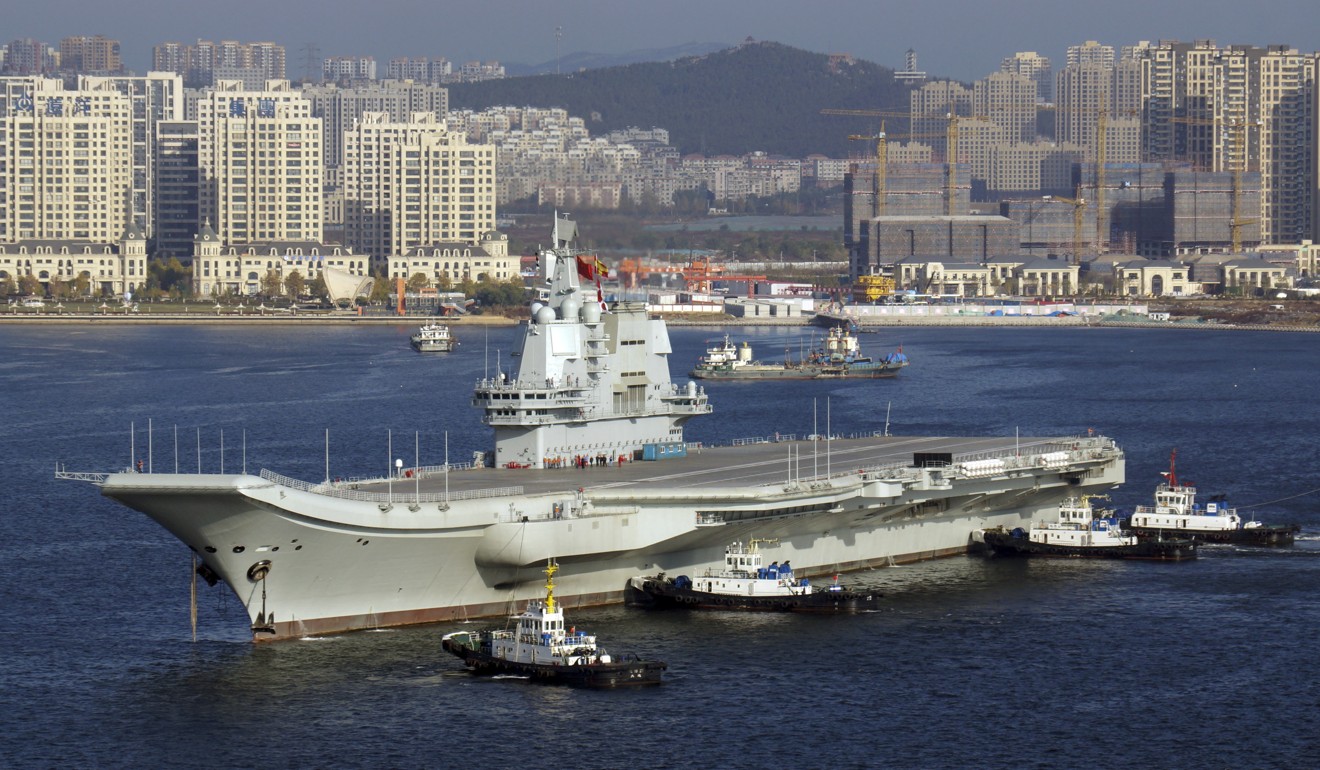
China currently has two aircraft carriers: the 

Liaoning

, a Soviet Admiral Kuznetsov class vessel bought from Ukraine in 1998 that went into service with the PLA Navy in 2012, and the Type 001A, the country’s first domestically developed carrier, and based on the Liaoning’s design.

Another source close to the navy said China also needed to develop more advanced carrier-based aircraft for its Type 075 helicopter ships and Type 002 aircraft carrier, the latter still in development.
“The Type 075 was supposed to be equipped with short take-off and vertical landing aircraft comparable to the US Navy’s F-35B stealth fighter, but China hasn’t yet mastered the technology,” the naval source said.
The F-35 series is the US’s most expensive weapons programme, with a projected cost of more than US$428 billion. Japan plans to buy more than 40 F-35Bs for its two converted Izumo-class multipurpose aircraft carriers.
Footage released of new aircraft carrier in sea trial
Unlike the Liaoning and Type 001A, whose flight decks have a “ski jump” that aircraft like the

J-15 fighters

use for take-off, the Type 002A carrier will be fitted with a catapult system. As a result, the PLA will have to develop a new fighter jet – comparable to the US Navy’s F-18 Super Hornet – to go with it.

“China may need 10 to 20 years to develop a new generation of carrier-based warplanes, meaning the J-15 is likely to be the main warhorse for some time, despite it still having engine and flight control problems,” the naval sources said.
China’s Type 001A aircraft carrier has a “ski jump” that aircraft like the J-15 fighters use for take-off. Photo: Imaginechina

China’s navy has expanded rapidly over the past three decades with annual defence spending rising at double-digit rates between 1989 and 2015 on the back of equally fast economic growth.

As of last year, the PLA Navy had more than 300 ships, compared with the United States’ 287, according to the Centre for Strategic and International Studies in Washington.

In the 2014-18 period, Beijing launched naval vessels with a total weight of 678,000 tonnes, or more than the French, German, Indian, Italian, South Korean, Spanish and Taiwanese navies combined, according to a report by the International Institute for Strategic Studies in London.

According to figures from Beijing, China State Shipbuilding Corporation has built 84 new warships over the past seven years, including four Type 055 destroyers, eight 

Type 052D destroyers

and 60 Type 056 frigates.

Among other naval vessels, China has built four Type 055 destroyers over the past seven years. Photo: Reuters

Despite its prolific output, Beijing-based military expert Zhou Chenming said China still lagged behind the US in terms of its hardware and software technologies.

“A real ‘blue-water fleet’ is able to sail long distances on the high seas, but that requires a comprehensive logistics and support network that the PLA does not have,” he said.

“Beijing is capable of building giant warships with large displacements, but too much of their capacity is taken up by weapons and other equipment, which reduces the amount of space they have for fuel, which in turn limits their range and the amount of time they can remain on the high seas.”

Xi makes peace call as navy powers up for 70th anniversary

China’s advanced warships like the Type 055 and Type 052D had a maximum cruising range of about 6,000 nautical miles, shorter than their American counterparts, Zhou said.

“The Americans have pursued a global strategy and established many overseas naval bases, which allows their ships to make longer voyages and project their power on the high seas. China doesn’t have such an advantage,” he said.

“The PLA Navy has often been stretched, like when it took part in an anti-piracy mission in Somali waters in 2008 and the short range of its vessels was a big hurdle. That’s why

China needed the facility in 

Djibouti

,” he said, referring to the military base set up by the PLA in the tiny African nation in 2017.

China established the maintenance and repair facility after the power system in one of its Guangzhou Type-052B destroyers failed during another anti-piracy mission in the Gulf of Aden in 2010 leaving its crew stranded.

“As Beijing and Djibouti hadn’t formally established military ties at the time, it was the French navy that rescued the sailors on the Guangzhou,” the naval source said. “And that’s what inspired China to set up its own outpost in Djibouti.”

Song Zhongping, a former army officer and military analyst in Hong Kong, said that China’s navy still had a long way to go in operational terms if it wanted to compete with the US.

“America has the world’s largest blue-water navy and more than a century-long history, so its warships have already gone through several rounds of development,” he said.

“Also, US naval vessels are well versed in operating in battle group formation, which is something the Chinese are still learning how to do.”

Adam Ni, a China researcher at Macquarie University in Sydney, said that as well as finding the money to build new warships and maintain its growing fleet, China’s naval chiefs had to balance other considerations.

“There are competing priorities, like maritime corps, naval aviation and submarines,” he said.

With so many demands on its budget, it made sense that the PLA Navy was rethinking its strategic, long-term goals, he said.

Earlier this year, the Jamestown Foundation, an American think tank, said China was planning to quadruple the size of its marine force from two brigades to eight, or about 40,000 troops in total. The military source confirmed that ambition but said that only four of the additional six brigades had been created to date.

“Establishing eight marine brigades is a long-term goal,” he said. “Most of the members of the four new [Marine Corps] brigades were transferred from the army’s amphibious unit.

The movement of amphibious troops from ground to naval forces is part of the PLA reforms launched by Xi in 2015, under which ground forces are being downsized and marine units expanded to protect China’s interests offshore.

Beijing calls for end to ‘provocative actions’ as US warship sails near disputed waters

But Lu Li-shih, a retired lieutenant commander from the Taiwanese navy, said the amphibious operations by ground forces were not the same as those carried out on the high seas. If the PLA marines wanted to compete with their American counterparts, they would have to improve their land, air and sea operational skills.

“If the PLA’s amphibious troops wanted to take back Taiwan by force, for instance, they wouldn’t need the giant Type 075 amphibious helicopter dock; the Type 071 would be good enough,” he said, adding that the Type 071 was the ideal platform for the navy to improve its high seas combat training.

Since last year, the PLA has used the Type 071 to send amphibious troops, naval aviation, missile and strategic support units to the Indian and Pacific oceans for joint open sea combat training, according to the military newspaper PLA Daily.

Each Type 071 vessel can carry 900 troops, as well as four Type 726 landing craft and two helicopters.

“The PLA Navy’s training in recent years shows it has been moving towards the development of integrated command systems to support future battle groups,” Lu said.

Source: SCMP

Law of Unintended Consequences

continuously updated blog about China & India

ChiaHou's Book Reviews

continuously updated blog about China & India

What's wrong with the world; and its economy

continuously updated blog about China & India