Archive for May, 2019

25/05/2019

At Cong’s big meet after poll defeat, Rahul Gandhi’s next move is the focus

Rahul Gandhi, who had fronted the opposition campaign against Prime Minister Narendra Modi, has owned responsibility for the crushing defeat at the meeting.

LOK SABHA ELECTIONS Updated: May 25, 2019 14:07 IST

HT Correspondent
HT Correspondent
Hindustan Times, NewDelhi
Lok Sabah elections 2019,General elections 2019,Congress
Seated next to Rahul Gandhi as he shared his brief analysis of the election is UPA chairperson Sonia Gandhi (Sanjeev Verma/ HT Photo)
Congress president Rahul Gandhi on Saturday is leading a review of his party’s devastating performance in the Lok Sabha elections at a meeting of the Congress Working Committee, or CWC.
Rahul Gandhi, who had fronted the opposition campaign against Prime Minister Narendra Modi, has owned responsibility for the crushing defeat at the meeting. Seated next to Rahul Gandhi as he shared his brief analysis of the election is UPA chairperson Sonia Gandhi and former Prime Minister Manmohan Singh. Sister Priyanka Gandhi Vadra, former minister P Chidambaram and Congress’s leader in the outgoing Lok Sabha Mallikarjun Kharge was also present.
Television channels initially said Rahul Gandhi had offered to resign at the CWC which was rejected by the top panel but later put out a clarification. Three senior Congress including Uttar Pradesh unit chief Raj Babbar, HK Patil, who was tasked to oversee the Karnataka Congress campaign and Odisha Congress chief Niranjan Patnaik have resigned after the election debacle.
The Congress won just about 52 seats in the Lok Sabha in this round of national elections, a shade better than its worst performance ever, in the 2014 elections, when it ended up with 44 seats.
Congress leaders have indicated that the CWC could go for a deeper analysis of the election outcome that goes beyond the obvious. Some drastic action could also follow.
Senior Congress leaders assembled at the party’s Working Committee meeting in New Delhi.

For now, the Congress’s top priority is to get the party fighting fit in Maharashtra, Haryana and Jharkhand that will head to assembly elections later this year. Assembly elections in Jammu and Kashmir are likely to be held anytime soon and Delhi will go to the polls in February next year.

Some new general secretaries and in-charges of states are also expected to be appointed soon.
Gandhi had made it clear at an unusually brief news conference after the poll verdict came on Thursday that the party was determined to fight back. “Have faith and we will work and sort this out in the time to come,” Gandhi said, his message to party workers and supporters. “Love never loses, and I am certain that we will emerge stronger and work better… love will guide us.

The Congress which did not get the post of the Leader of Opposition in the Lok Sabha in 2014 may not get it this time also. A party should get 10 per cent, or 55 of the 543 Lok Sabha seats, to be entitled to the Leader of Opposition designation for its leader.

Rahul Gandhi has already taken responsibility for the party’s performance in the Lok Sabah elections but hasn’t elaborated on the next step yet.

Source: Hindustan Times

24/05/2019

China, Russia vow to strengthen cooperation along Yangtze, Volga rivers

RUSSIA-CHEBOKSARY-WANG YONG-VOLGA-YANGTZE-COOPERATION-MEETING

Chinese State Councilor Wang Yong (L) and Igor Komarov, Russia’s Presidential Plenipotentiary Envoy to the Volga Federal District, co-chair the third meeting of the Council of Cooperation between the upper and middle reaches of the Yangtze River and the Volga Federal District in Cheboksary, Russia, May 23, 2019. (Xinhua/Bai Xueqi)

CHEBOKSARY, Russia, May 23 (Xinhua) — China and Russia pledged to strengthen cooperation along the Yangtze and Volga rivers as local governments from these areas on Thursday signed an array of cooperation deals.

The third meeting of the Council of Cooperation between the upper and middle reaches of the Yangtze River and the Volga Federal District was co-chaired by Chinese State Councilor Wang Yong and Igor Komarov, Russia’s Presidential Plenipotentiary Envoy to the Volga Federal District, in the Russian city of Cheboksary.

Wang said that both sides should work to achieve more outcomes from local governments cooperation and make such partnership a new growth area for China-Russia relations.

Komarov said the unique “Volga-Yangtze” mechanism has been fruitful in trade and investment cooperation as well as people-to-people exchanges, and Russia is ready to work with China for more achievements.

Source: Xinhua

24/05/2019

Chinese vice president holds talks with Brazilian vice president

CHINA-BEIJING-WANG QISHAN-BRAZIL-VP-TALKS-COSBAN-MEETING (CN)

Chinese Vice President Wang Qishan and Brazil’s Vice President Hamilton Mourao hold talks and co-chair the fifth meeting of the China-Brazil High-Level Coordination and Cooperation Committee (COSBAN) at the Great Hall of the People in Beijing, capital of China, May 23, 2019. (Xinhua/Zhang Ling)

BEIJING, May 23 (Xinhua) — Chinese vice president Wang Qishan on Thursday held talks with Brazil’s Vice President Hamilton Mourao in Beijing. They also co-chaired the fifth meeting of the China-Brazil High-Level Coordination and Cooperation Committee (COSBAN).

The Chinese-Brazilian ties have been developing steadily ever since the two countries established diplomatic ties 45 years ago, said Wang, adding that their bilateral relationship has become mature and stable relationship.

The two sides maintain close communication and coordination on major international and regional issues, and have effectively promoted the solidarity and cooperation between developing and emerging market countries, Wang said.

He noted that both sides are committed to promoting development through structural reforms and opening up, and said that China was ready to work with the Brazilian side to make good use of the COSBAN to jointly resist the uncertainty of the external environment, make greater contributions to the recovery of global economy, and create a new era of higher-level, broader areas and more dynamic bilateral relations.

Mourao said Brazil and China respected each other and shared profound traditional friendship. The Brazilian new government attaches great importance to the comprehensive strategic partnership with China and is willing to strengthen dialogue and cooperation between the two countries as well as to promote the integration of the Belt and Road Initiative with Brazil’s development strategy.

Brazil is willing to strengthen cooperation with China in the multilateral arena, maintain the stability of the international system, and make contributions to promote world peace and prosperity, he said.

The two sides agreed to strengthen exchanges and cooperation in various fields, promote trade facilitation, optimize trade structure and promote high-quality growth of bilateral trade, according to a news briefing.

The two sides attach great importance to dovetailing the Belt and Road Initiative with Brazil’s development strategy including the investment partnership projects.

The two sides agreed to continue to cooperate closely under multilateral organizations and frameworks such as the United Nations, the BRICS countries and the World Trade Organization (WTO), jointly maintain multilateralism and free trade, improve global economic governance, and safeguard the multilateral trading system with the WTO as the core to build an open world economy, said the news briefing.

Source: Xinhua

24/05/2019

Chinese police arrest 20 over pornographic live-streaming app that attracted 1 million users

  • Streaming platform Huahua earned US$2.3 million in profit in five months, according to media report
  • Final two suspects arrested in Philippines, police say
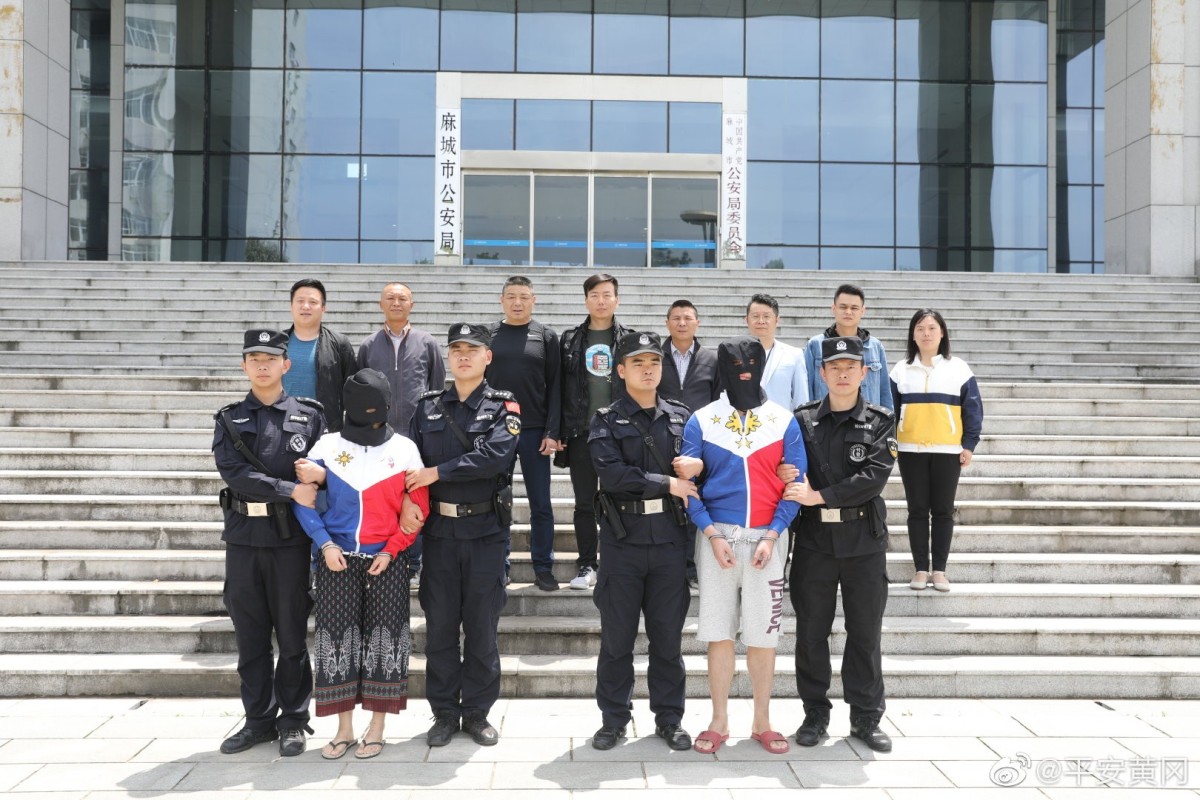
Chinese police with the last two principal suspects in the Philippines on April 26. Photo: Weibo
Chinese police have arrested 20 people from a cross-border group accused of operating illegal live streaming platforms to broadcast pornographic content, according to mainland online news outlet The Paper.
After an investigation lasting over a year, police in Macheng in central China’s Hubei province said they arrested the last two main suspects, a man surnamed Hong and a woman surnamed Li, in the Philippines on April 26.
Their 
live-streaming

platform, which was initially called Huahua, had more than 900,000 registered users, earning the group 16 million yuan (US$2.3 million) in profit in five months from November 2017, according to the report.

The Chinese government announced in February 2018 it was 
launching a campaign

against pornographic and illegal publications to foster a healthy online environment.The next month, Macheng police received a tip-off that people were distributing QR codes to download Huahua in chat groups on the popular Chinese messaging app QQ.

On the Huahua platform, live streamers gave erotic performances, with the most popular streamers drawing more than 2,000 viewers at a time and users able to make requests by paying up to almost 2,000 yuan (US$290).

The group had a structure and rules designed to avoid the police’s attention, the report said. Members did not know each other’s identities and each had only one point of contact.

Some recruited streamers, others promoted the app on social platforms to attract traffic, and members in Mongolia laundered money with foreign bank accounts, while the app’s appearance and servers were changed several times, the report said.

After 18 people were arrested by April 2018 across the country, including in Shanghai and Guangdong, the No 1 suspect, the Mongolia-based Hong, fled to South Korea then to the Philippines, where he met Li and they built a similar app, according to the report.

The report said Hong had owned a company in Shanghai focusing on developing video games before turning to pornographic live streaming to make money quickly when the gaming business struggled.

Source: SCMP

24/05/2019

A pollution crackdown compounds slowdown woes in China’s heartland

ANYANG/SANGPO, China (Reuters) – For years, China’s industrial heartland has been cloaked in smog, its waterways choked with pollution pumped from enormous clusters of factories churning out the mountains of cement and steel needed to build the Chinese economy.

Aiming to tackle what has become a huge public health problem, the authorities have cracked down on polluting industries, targeting provinces like Henan, which has a population of 100 million people and hundreds of factory towns.
According to interviews with factory and business owners, and consumers and workers across Henan, that crackdown – conducted with often heavy-handed local enforcement – is crippling the economies of towns and cities that depend on polluting industries.
Manufacturers across Henan have been particularly hard hit by the new environmental regulations, compounding the pressures the province faces from China’s slowing economy and a grinding trade war with the United States.
It also highlights the trade-off China faces between providing a healthier environment for its citizens and maintaining economic growth in a province whose climb from poverty has lagged that of coastal regions.
China does not provide statistics on the costs of the environmental crackdown, but it has said that short-term pain will lead to long-term growth through an economic “upgrade”.
The information office of the State Council, China’s cabinet, did not respond to a faxed request for comment on the economic effects of the new restrictions.
It’s difficult to get a full picture of Henan’s economy from unreliable official figures, as it is for the whole country. Henan’s official growth rate was 7.6% in 2018, higher than the national rate and down 0.2 of a percentage point from 2017.

But the interviews conducted by Reuters across Henan suggest consumers are spending less, cities are struggling to retool their economies and the pollution crackdown is hurting businesses and employment.

STEEL TOWN PAIN

The steel-producing centre of Anyang, which has long had some of the worst air in China, is one place that has been hit hard by the anti-pollution campaign.

The city of more than 5 million people, dominated by the infrastructure and insignia of the state-owned Anyang Iron and Steel Group, has forced local industry to upgrade equipment and curb pollution, and shut down companies that were unwilling or unable to comply.

Li Huifeng, president of Baoshun High-Tech Corporation, a coking coal company founded by his parents in 1983, said the cost of compliance had been painful.

Baoshun’s huge plant, built in the hills in the west of Anyang, was forced to implement production cuts last winter even though it had installed low-emissions equipment that exceeded required standards.

“Last year, business was really good but this year it is full of uncertainties,” said Li. He added that new efficiency guidelines were likely to result in the closure of many producers of coking coal, which is used in steel production.

Li Xianzhong, the owner of the Xinyuan Steel Mill in Anyang’s western outskirts, said he was facing curbs on production as well as spiralling costs because of the new environmental regulations.

According to industry estimates, environmental costs per tonne of steel produced have risen to around 150 yuan per tonne, up from less than 50 yuan per tonne when the war on pollution was launched in 2014.

“All this equipment needs a lot of capital, and after you’ve invested, the operation costs are also higher,” said Li. “If you don’t meet the standards, you aren’t allowed to operate.”

Near the sprawling Anyang steel plant in the city centre, residents and workers complained that the new environmental inspection rules had made it harder to make a living.

Many small workshops, which often use small metalworking furnaces, have also been targeted.

“Before we would just give them a pack of cigarettes or treat them to a meal and you’d then be fine for a year, but now it’s no use,” said a bicycle repairman, identifying himself by his surname Zhang, whose workshop near the plant was shut by inspectors.

Over the past years, Anyang has tried encouraging new and cleaner forms of economic growth. It has shut hundreds of small polluters in sectors like ceramics and cement, and tried to attract industries like solar panels and electric vehicles by offering incentives and building sprawling new industrial parks.

However, it has struggled to compete with numerous Chinese cities making similar bets, especially as China’s economy slows.

And the results of the anti-pollution efforts have been mixed.

Steel still accounts for more than half of Anyang’s economy – unchanged from a decade ago – and the environment is still bad. The taste of brimstone hangs in the air, and the fairy lights festooned on hundreds of cranes on the city’s skyline could only be dimly seen during a recent visit.
Part of the problem, according to Liu Bingjiang, who heads the Ministry of Ecology and Environment’s air pollution office, is that smog is also blowing in from neighbouring industrial regions, undermining local cleanup efforts.
“All these measures, all these plans are in place, but it still can’t solve the smog,” said Li, the steel mill owner.

SHUTTING DOWN THE BOOTMAKERS

The anti-pollution campaign is also hitting much smaller industrial centres.

Sangpo, a dusty two-street village in northeast Henan, used to live off scores of sheepskin processing factories cranking out winter boots modelled on UGG, the American brand with Australian roots.

While the industry was the main employer in the village, that came with a heavy environmental cost: treating the raw sheepskin consumed copious amounts of water and contaminated the local water supply.

Last July, the government moved to close most of the factories, sending dozens of police cars into Sangpo with sirens wailing to enforce the shutdown.

Government inspectors were installed to keep watch at each factory to ensure compliance with the order. Three factory owners were arrested for violating environmental regulations.

During a visit to Sangpo by Reuters, most factories were idle during what should have been peak production season. Hundreds of workers had left town in search of work elsewhere, leaving behind shuttered shopfronts and deserted roads.

“The village is at a tipping point,” said a former factory owner who only wanted to be identified by his surname, Ding. Most businesses were mostly “more dead than alive,” he added.

Before the factories were shut, the village of 6,500 people, mainly from the Hui Muslim minority, had been punching well above its weight.

It achieved national recognition as a thriving model of e-commerce, winning glowing write-ups in national newspapers after it was named in 2015 by the tech giant Alibaba as central China’s very first “Taobao village” – a designation for top rural sellers on the company’s internet retailing platform.

But that all changed last year as China’s pollution crackdown intensified. The top county-level official, factory owners said, held a town hall meeting and threatened to shut everyone down permanently. A deal was made for 19 of the 135 factories to remain.

Those wanting to stay open agreed to upgrade their businesses and invest in equipment to ensure they met water treatment standards. Factories that opted out were shut, their boilers and processing equipment destroyed.

The government of Mengzhou, which oversees Sangpo, declined to comment when reached by phone. But Mengzhou’s mayor said last year that the crackdown was necessary and in accordance with the popular will, according to a statement on the Mengzhou government website.

Sangpo village’s party chief declined to comment when reached via the Chinese messaging app WeChat. Calls to his cellphone went unanswered.

The county government’s plan is to corral remaining factories into a new industrial zone by the end of the year. But remaining business owners are worried about the slow pace of construction and fear they will be forced to shut.

Ding, the former factory owner, said business owners didn’t expect the crackdown – which has also discouraged lending from banks – to be so harsh.

“Everyone in the village was moaning and sighing but no one thought it would be this extreme,” Ding said.  “We are at our wits’ end.”

Source: Reuters

24/05/2019

Indian forces kill leader of al Qaeda affiliate in Kashmir – police

SRINAGAR (Reuters) – Indian forces have killed the leader of an al Qaeda affiliated militant group in Kashmir, police said on Friday, triggering protests in parts of the disputed region.

Zakir Rashid Bhat, 25, was trapped by security forces in a three-storey house in southern Kashmir late on Thursday, said a senior police officer, adding that the house was set ablaze during the operation.

“As we were clearing debris from the house, he tried to get up. Our troops fired at him and he was killed,” said the officer, who declined to be named because he was not authorised to speak to media.

For decades, separatists have fought an armed conflict against Indian rule in Kashmir, with the majority of them wanting independence for the Himalayan region, or to join New Delhi’s arch rival Pakistan.

India has stepped up an offensive against militants in the Muslim-majority region since a suicide attack in February killed 40 Indian troopers in Kashmir and brought India and Pakistan to the brink of war.

Pakistan denies giving material support to militants in Kashmir but says it provides moral and diplomatic backing for the self-determination of Kashmiri people.

Protests by supporters of Bhat broke out in parts of Kashmir on Thursday and there were reports of demonstrations early on Friday, the police officer said.

Fearing more unrest, authorities said schools were closed and railway services suspended in the affected areas.

Any large scale unrest in the region would be a challenge for Indian Prime Minister Narendra Modi as he prepares for a second term after winning a general election on Thursday.

Bhat, a former commander of the Hizbul Mujahideen, the largest of the militant groups fighting against Indian rule in Kashmir, founded his own group and declared its association with al Qaeda in 2017.

Also known as Zakir Musa, he was seen as a successor to Burhan Wani, a popular Hizbul Mujahideen commander whose death in 2016 sparked clashes that left 90 civilians dead.

Source: Reuters

23/05/2019

Boeing 737 Max: China’s top airlines seek compensation

China’s three biggest airlines are demanding compensation from Boeing over its grounded 737 Max fleet.

Air China, China Southern and China Eastern have filed claims for payouts, according to state media reports.

China’s regulator was the first to ground the fleet in the wake of two deadly crashes involving the US-made aircraft.

It comes on the eve of a meeting of global aviation regulators that will provide an update on the troubled jets.

The Chinese airlines are seeking compensation for losses incurred by the grounded fleet, as well as delayed deliveries of the 737 Max jets, according to reports.

China operates the largest fleet of Boeing 737 Max aircraft and was the first country to take the jets out of service after the Ethiopian Airlines 737 Max 8 crash in March.

The disaster killed all 157 people on board. In October, 189 people were killed in a Lion Air crash involving the same model.

Both crashes were linked to the jet’s Manoeuvring Characteristics Augmentation System, a new feature on 737 Max planes, which was designed to improve the handling of the jet and to stop it pitching up at too high an angle.

Last week, Boeing said it had completed development of a software update for its 737 Max planes.

The planemaker’s entire global fleet of 737 Max aircraft has been grounded since March and the firm is anxious to prove it is safe to return to the skies.

The move by China’s top airlines to seek compensation comes ahead of a closely watched summit of aviation regulators in Texas on Thursday.

The US Federal Aviation Administration (FAA) is due to provide an update on reviews of Boeing’s software fix and new pilot training.

The meeting in Texas will involve 57 agencies from 33 countries, including China, France, Germany and the UK, as well as the European Union Aviation Safety Agency.

But it is unclear if the planes will be back in the air before the end of the critical summer travel season.

Source: The BBC

23/05/2019

Yangtze Delta provinces and municipality see digital economy over 1 trln yuan

NANJING, May 22 (Xinhua) — The digital economy of east China’s Yangtze Delta region including the provinces of Zhejiang and Jiangsu, and Shanghai Municipality exceeded one trillion yuan (145 billion U.S. dollars) respectively, according to a Tuesday summit in Jiangsu.

Statistics show that Jiangsu, Zhejiang and Shanghai saw their digital economy reach 3 trillion yuan, 2 trillion yuan and one trillion yuan respectively in 2018, reporting record growth in the Yangtze Delta region.

“The digital economy is leading today’s scientific and technological revolution and industrial change,” said Yan Li, vice chairman of Jiangsu provincial political consultative conference. “The Yangtze Delta region should cooperate in building a pilot zone of China’s digital economic development,” said Yan.

The region should enhance cooperation in developing infrastructure and cultivating software talents, said Zhou Hanmin, head of Shanghai Institute of Socialism. “Talents are the pillar for the digital economy and the region’s educational sectors should work together to exploit their strength.”

China’s digital economy reached 31.3 trillion yuan (about 4.6 trillion U.S. dollars) in 2018, accounting for 34.8 percent of the country’s total GDP.

Source: Xinhua

23/05/2019

China Focus: China honors amputee demining soldier

BEIJING, May 22 (Xinhua) — Du Fuguo, a soldier who lost his eyes and arms in an explosion during a mine clearance operation, was honored by the Publicity Department of the Communist Party of China Central Committee on Wednesday.

Du, who was a demining soldier of the People’s Liberation Army (PLA), was awarded the title “role model of our times” at a ceremony in Beijing.

Du’s family members and fellow soldiers, as well as representatives from all walks of life, attended the award ceremony.

The 28-year-old soldier was seriously injured in the landmine explosion trying to protect his fellow soldier during the operation in southwest China’s Yunnan Province in October last year.

Du would have finished his military service in December 2018, just two months after the explosion.

In 2015, Du and over 400 fellow soldiers started clearing mines in the border area in Yunnan, where over 100 minefields were located.

“I couldn’t stay calm after getting to know the villagers living in the area suffered three explosions within 10 years,” said Du, who volunteered to participate in the demining operations in 2015.

Du’s father wished to become a solider at an early age, which was not fulfilled, while Du Fuguo joined the PLA in 2010.

“I am reflecting what kind of life is truly meaningful and valuable, and the only standard is what has been done for the country and for the people,” Du wrote in his application submitted for mine clearance operations.

“When the people are in need and the country is calling upon us, there is not even half a step that I can retreat,” he responded when being told mine clearance was dangerous.

A minefield Du worked has deterred local people from growing crops and picking tea. They beat gongs and sounded drums to welcome the arrival of the mine clearance group.

Over the past three years, Du has entered minefields over 1,000 times, defusing more than 2,400 mines and bombs.

“I feel like it is my destiny to carry out this mission and there was a voice calling me to clear the mines,” he wrote in his application.

While various equipment has been developed for mine clearance, it is believed that manual demining remains the most efficient method, albeit the most dangerous.

The explosion happened in an afternoon when Du and a fellow soldier tried to defuse a bomb, but it suddenly exploded and Du quickly protected his colleague who was left with only bruises.

“Step back and I’ll do the job,” Du said before he started the defusing work in which he lost his forearms and eyes.

One month later, in November last year, Du’s team members confirmed that the minefield where the explosion took place was safe to be used as farmland, meaning that the three-year demining operation had finished.

In the area where Du was injured, people have named tea picked this year as “Fuguo.” They are hoping that Du could come back to have a taste of his eponymous tea.

“Despite my lost hands, I have legs to continue chasing after dreams; despite my lost sight, as long as the sun can rise in my heart, my world remains blazing with color,” Du said.

Source: Xinhua

23/05/2019

Hard work got me into Stanford University, says Chinese student in viral video after parents paid US$6.5 million to get her accepted

‘The admissions officers basically do not know who you are’, teenager says in 2017 video in which she also admits her ‘natural IQ isn’t particularly high’

  • Zhao Yusi is one of the students caught up in a US college admissions scandal; her family paid US$6.5 million to admit her to Stanford University
A 2017 video of Zhao “Molly” Yusi, the Chinese student whose family paid US$6.5 million for her fraudulent admission to Stanford University, has gone viral on social media. Photo: Weibo

A video shot in 2017 of Zhao Yusi, the Chinese student whose family paid US$6.5 million for her fraudulent admission to Stanford University, has gone viral on social media. In it, she claims she was accepted because of her “hard work”.

In the 90-minute video, made when she was 17, Zhao offered viewers advice on getting into prestigious American universities while admitting that her “natural IQ isn’t particularly high”.

“I want to tell everyone that getting into Stanford isn’t just a dream. You just need to have a clear goal and work as hard as you can towards it,” she said.

“Some people think, ‘Did you get into Stanford because your family is rich?’ No, the admissions officers basically do not know who you are.”

Zhao, known as “Molly”, said she was awarded a full grant scholarship to Stanford, whose last publicised acceptance rate from 2017 at 4.65 per cent was lower than those of Harvard and Yale, at 5.2 per cent and 6.7 per cent respectively. In comparison, the acceptance rate for Oxford and Cambridge universities is about 20 per cent.

Zhao is one of the students caught up in a US college admissions scandal that resulted in 33 parents, including celebrities, investors, lawyers and company executives, facing fraud charges.

Chinese family reportedly paid US$6.5 million to ‘fixer’ for admission into Stanford

The fixer and the main architect of the scam, college consultant William “Rick” Singer, admitted laundering their payments through his charitable foundation to bribe university administrators and sports coaches to place students.

The international scheme was revealed by the US Justice Department in March, in what was called the biggest criminal case involving college admissions yet.

The alleged payment by Zhao’s family was by far the largest in the case, but neither Zhao nor her family were charged.

Zhao’s mother, identified as “Mrs Zhao”, released a statement through her lawyer on Friday saying that she was “misled” into donating to Singer’s charity, “which was represented to her as a substantial and legitimate non-profit foundation” funding student scholarships at Stanford.

She said that Singer’s college consultancy “did not guarantee admission into any particular school” and that her daughter was also a “victim”.

Zhao Tao, Zhao Yusi’s father, issued a statement on Friday on the website of his company Shandong Buchang Pharmaceuticals, saying that the financing for his daughter’s US university tuition had no relation to the company and would not influence it in any way.

“Matters concerning my daughter studying overseas in the US count as personal and family conduct,” the notice said.

Fired Morgan Stanley adviser seeks to clear name in college scandal

Stanford suspended Zhao Yusi, a second-year student, in March. Sherry Guo, another Chinese student caught up in the scandal, was expelled from Yale after it emerged that her family paid US$1.2 million to Singer to get her in. Like the Zhaos, neither Guo nor her family were charged in the case.

Singer tried to recruit Zhao Yusi to the Stanford sailing team, prosecutors claimed, and bribed a soccer coach at Yale to recruit Guo. The Stanford sailing coach, John Vandemoer, has pleaded guilty in the investigation.

Zhao Yusi’s 2017 video about her Stanford ambitions is a hit online. Photo: Weibo
Lori Loughlin, Felicity Huffman appear in court over college scandal
In the video, Zhao Yusi said that her early academic performance was “mediocre” and that teachers underestimated her, but through studying hard and believing in herself she scored well on the US college admissions test and her high school final exams.
She went to school in Beijing before transferring to continue her high school studies at Wellington College in Berkshire, one of England’s most exclusive boarding schools, with fees of £13,250 (US$17,300) a term, partly to improve her English.
Zhao Yusi said that getting into Stanford was her “No 1 dream” and that she planned to return to China after graduation.
Now, as a result of the admissions scandal inquiry, her future is not so certain.
Source: SCMP
Law of Unintended Consequences

continuously updated blog about China & India

ChiaHou's Book Reviews

continuously updated blog about China & India

What's wrong with the world; and its economy

continuously updated blog about China & India