Chindia Alert: You’ll be Living in their World Very Soon
aims to alert you to the threats and opportunities that China and India present. China and India require serious attention; case of ‘hidden dragon and crouching tiger’.
Without this attention, governments, businesses and, indeed, individuals may find themselves at a great disadvantage sooner rather than later.
The POSTs (front webpages) are mainly 'cuttings' from reliable sources, updated continuously.
The PAGEs (see Tabs, above) attempt to make the information more meaningful by putting some structure to the information we have researched and assembled since 2006.
BEIJING, July 26 (Xinhua) — Chinese President Xi Jinping on Friday sent a message of condolences to Tunisia’s interim President Mohamed Ennaceur over the passing away of President Beji Caid Essebsi.
Xi, on behalf of the Chinese government and people, and also in his own name, expressed deep condolences over the death of Essebsi, and extended sincere sympathy to Essebsi’s family and the Tunisian people.
Essebsi was an outstanding Tunisian statesman, Xi said, adding that he led the Tunisian people in overcoming various challenges facing the country’s development, and made positive efforts in promoting stability and development in his country.
Essebsi committed himself to furthering the development of China-Tunisia relations, and made positive contributions to promoting the two countries’ friendly cooperation and the two peoples’ friendship, Xi said.
China attaches, said Xi, great importance to the development of China-Tunisia relations, and is willing to join efforts with Tunisia to push forward the two countries’ friendly and cooperative relationship.
On the same day, Chinese Premier Li Keqiang sent a condolence message to Tunisian Prime Minister Youssef Chahed over Essebsi’s death, expressing deep condolences to the Tunisian government and extending sincere sympathy to Essebsi’s family.
Aircraft could also be used to counterbalance Japanese and US military activities in the region, analysts say
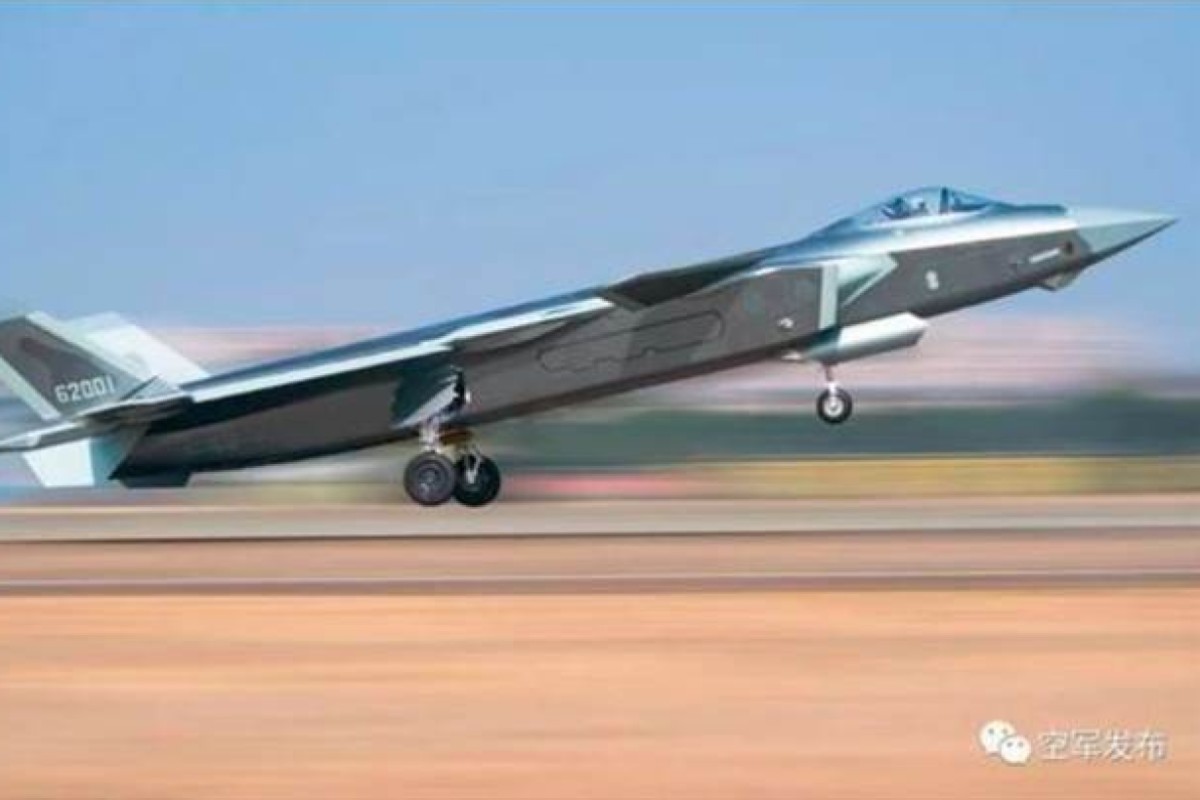
China’s J-20 stealth fighter has gone into service in the Eastern Theatre Command. Photo: PLA Air Force
China’s J-20 stealth fighter has been officially deployed to the country’s Eastern Theatre Command, suggesting it will be focused on the Taiwan Strait and military activities between Japan and the United States, observers said.
The People’s Liberation Army Air Force posted a photo on its social media account this week showing the fifth-generation fighter tagged with the number 62001, designating the aircraft as part of a frontline unit.
Chinese media reported that the stealth fighter had entered the Eastern Theatre Command, which encompasses Taiwan.
Collin Koh, a research fellow at the S Rajaratnam School of International Studies at Nanyang Technological University in Singapore, said the aircraft appeared to have two missions.
“The unit turning operational in Eastern Theatre Command is precisely aimed at Taiwan,” Koh said.
“And to challenge US military activities in Taiwan Strait, besides posing a threat to the median line that Taiwan’s air force patrols along.”
US Air Force gears up for aggressor drills to simulate combat with China’s J-20 fifth-generation fighters
The photo’s release came as China issued a defence white paper, highlighting the risks from “separatist forces”.
In the document, the military said it faced challenges from pro-independence forces in Taiwan but would always defeat those fighting for the island’s independence. It also said there were risks from separatists in the autonomous regions of Tibet and Xinjiang.
A day after the paper was released, an American warship sailed through the Taiwan Strait.
The J-20 is expected to enter mass production this year. If the aircraft was declared ready to go into active operations, it would signal China was a “greater threat” and had “greater capability” in the Pacific, General Charles Brown, the US Air Force’s Pacific commander, said in May.
Brown said US efforts to counter those developments included increasing deployments of next-generation F-35 jets and continuing overflights of strategic areas such as the South China Sea.
China’s J-20 stealth jet may be ready this year, US commander says
According to the US Defence Intelligence Agency, fielding the J-20 would add to what was already the region’s biggest air force and world’s third-largest.
China had more than 2,500 aircraft, including 1,700 combat fighters, strategic bombers, tactical bombers and multi-mission tactical and attack aircraft, in service, the agency said in a report earlier this year.
China’s J-20 fighter was part of a modernisation effort that had been “closing the gap with Western air forces across a broad spectrum of capabilities, such as aircraft performance, command and control and electronic warfare”, the report said.
Macau-based military expert Antony Wong Dong said that in addition to Taiwan, the J-20 fighter could also be used to counterbalance military activities by the United States and Japan.
But Wong added that the Chinese military was still exploring how best the fighter could be used.
“It will take a few years for the aircraft to be fully deployed and to mature. Right now, it’s still in the exploration stage,” he said.
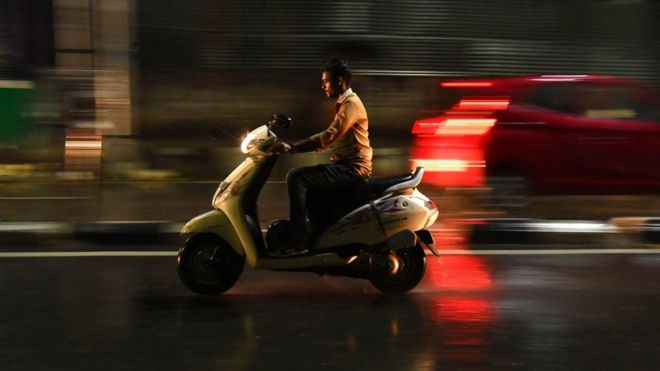
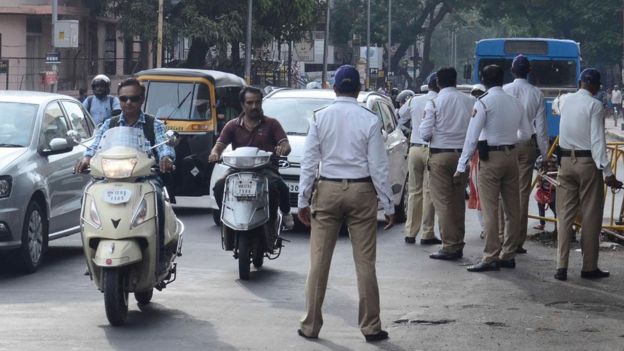
Image copyright GETTY IMAGESImage caption Wearing helmets is mandatory for motorbike riders
Wearing helmets is mandatory for motorbike riders in India. But political interference has made it difficult for police to enforce the law in the western city of Pune, writes independent journalist Omkar Khandekar.
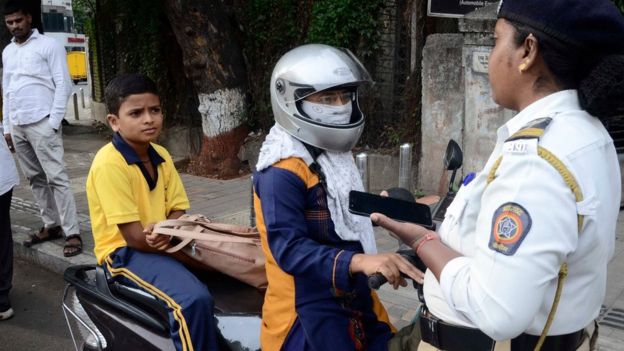
From the sidelines of the noisy Ganeshkhind road in Pune, police constable Sunil Tathe looks at the oncoming traffic with disappointment.
“Up to 70% motorcyclists in the city wore helmets until recently. But ever since we received orders to stop the helmet-enforcement drive, I barely see half of them wearing it,” he says.
Devendra Fadnavis, the chief minister of Maharashtra state (where Pune is located), told the city police to send notices of fine to offenders’ homes instead of stopping them on the road. He gave the order after Pune’s legislators accused the police of harassing people because of the helmet-enforcement drive.
Police across India struggle to enforce the law as riders often don’t wear a helmet. The problem is more severe in smaller towns.
That’s why police in Pune launched the drive to stop and fine offenders on the spot. They believe that sending notices is not as effective.
“You can only penalise someone if their number plate is visible in the CCTV,” said Tathe. “I’ve often come across people who hide or rub off a digit on the number plate. When asked, they say an errant child did it.”
Some took to the streets and held rallies, chanting slogans such as “helmet hatao, Punekar bachao” (get rid of helmets, save Pune’s residents). One “anti-helmet group” even went to a crematorium and staged a mock funeral of helmets.
Image copyright GETTY IMAGESImage caption Pune’s police are struggling to enforce a law that mandates helmets
Vivek Velankar, who heads the “anti-helmet compulsion action committee”, says that their battle has been going on for nearly two decades. Bikers in Pune, he adds, have to ride carefully anyway, considering how congested the city is.
“Wearing helmets, in fact, makes bikers feel a degree of safety,” he says. “That makes them even more reckless.”
One political party organised a motorbike rally where all riders wore the traditional Pune headgear made of cloth, instead of helmets.
And in April, just before the parliamentary elections, advocate Ramesh Dharmavat, a candidate from the fledgling People’s Union Party, contested on the sole issue of banning helmets. He received 547 votes.
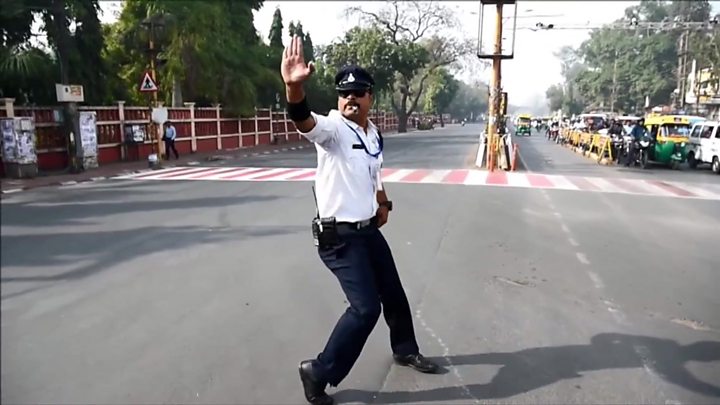
Media caption Traffic cop Ranjeet Singh uses dance moves to manage traffic
Anil Deshmukh, deputy commissioner of Pune traffic police, says most people argue against wearing helmets, which frustrates officers who are enforcing the law.
“There just doesn’t seem to be any logical explanation for such arguments. But here (Pune), they also get political patronage,” he says.
The drive had begun on 1 January and police had fined more than 100,000 people for riding without helmets in the first three months. Even as a section of the city’s population resisted, says Mr Deshmukh, the compliance was around 80% in some areas.
The police also launched a scheme to reward citizens who had no traffic violations on their record. They were given discount coupons to be redeemed at restaurants or shops.
But this changed once police started implementing the chief minister’s order.
Image copyright GETTY IMAGESImage caption Some people refuse to comply with the law
They don’t have the manpower or necessary technology, such as a synchronised signalling system or cameras that automatically recognise number plates.
Nishad Kulkarni, an architect and long-time city resident, says the resistance largely stems from Pune’s history.
“In the 1980s and early 1990s, Pune used to be a city of cyclists. You would frequently use cycles to commute. But that changed in the late 1990s. As the manufacturing and IT boom started, several infrastructure projects and skyscrapers came up. Soon, everyone was driving cars or riding motorbikes before knowing how to behave on roads,” he says.
Many of the city’s residents, according to him, prioritise convenience over safety. “Whenever I’ve seen cops stop these people, they think they know better.
It takes one to know one. “There are 30 people in my own family. I don’t think any one of us wears a helmet,” he says.
Image copyrightWEIBOImage captionLi Yanxia was once hailed as a great philanthropist
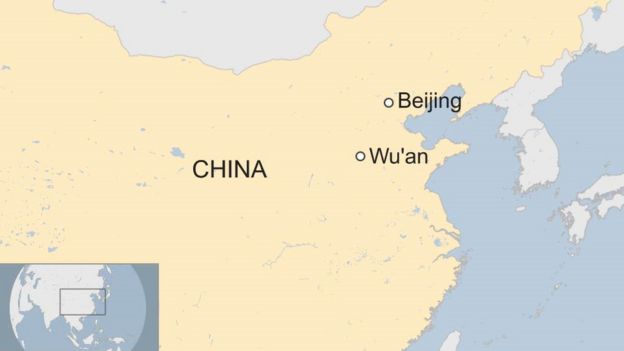
A 54-year-old Chinese woman who was once hailed as a philanthropist for adopting 118 children has been sentenced to 20 years in jail.
Li Yanxia was found guilty at Wu’an Court in Hebei province on Wednesday of extortion, fraud, forgery and disturbing social order.
The former orphanage owner, who was once nicknamed “Love Mother”, was also fined 2.67m yuan (£311,000; $388,000).
Fifteen accomplices, including her boyfriend, were also convicted.
The court found that Li Yanxia – also known as Li Lijuan – had “abused the orphanage’s influence”.
“[She] committed fraud together with the gang amongst other crimes to obtain vast economic benefit,” said a post released by the Wu’an City People’s Court on microblogging site Weibo.
Her boyfriend Xu Qi was charged with disturbing social order, extortion, fraud and intentional injury. He received a sentence of 12.5 years in jail and a fine of 1.2m yuan.
Some of the other 14 accomplices received jail terms of up to four years.
‘Love mother’ who opened a village
Li first shot to fame in 2006 after the media got wind of the fact that she had been adopting dozens of children in her hometown of Wu’an, a small city in the province of Hebei.
She told media outlets that she had once been married but had divorced. Her ex-husband had sold their son to a trafficker for 7,000 yuan, she alleged. She said she had managed to get her son back – and it was then that she decided she wanted to try to help other children.
Over the years she accrued significant wealth, becoming one of the richest women in Hebei. In the mid-1990s she invested in an iron mining company, and eventually became its owner.
“I often saw a five- or six-year-old girl running around the mine. Her father died… her mother ran away… so I took the girl to my home. She was the first child I adopted,” she told local newspaper the Yanzhao Metropolis Daily at the time.
The number of children under her care reached its peak in 2017 with 118 children.
It was in that year that the government received tip-offs from members of the public alerting them to suspicious activities.
In May 2018, police found that she had more than 20 million yuan and $20,000 in her bank accounts, and owned luxury vehicles like Land Rovers and Mercedes Benz.
They found she had been carrying out illegal activities since 2011.
She also manipulated some of her adopted children into hindering work on construction sites – in one instance, making them run under trucks so construction could not continue. Li then blackmailed these construction companies.
The 54-year-old was also found to have gained money on the pretext of building up the “Love Village”.
Li was placed under criminal detention later in May that year.
There were 74 children left in the village when she was detained. They were transferred to various other government and school facilities.
Many on social media in China have condemned her actions, calling her a wolf in sheep’s clothing.
“Disgusting. My uncle actually donated to her [orphanage] before,” said one commenter on Weibo.
“I once called her Love Mother,” said another user. “I want to take it back… there’s no love in her at all. She’s not worthy of that name.”
Image copyright GETTY IMAGESImage caption The fighting left hundreds of casualties on both sides of the Line of Control that divides Kashmir
The war began soon after Zainab Bibi was married in the spring of 1999.
“We were at home and it was night time, around 8pm. We saw shells exploding on the mountaintops, so we rushed to the cave bunkers.”
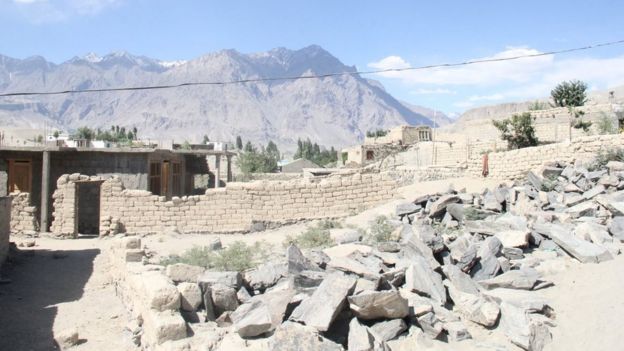
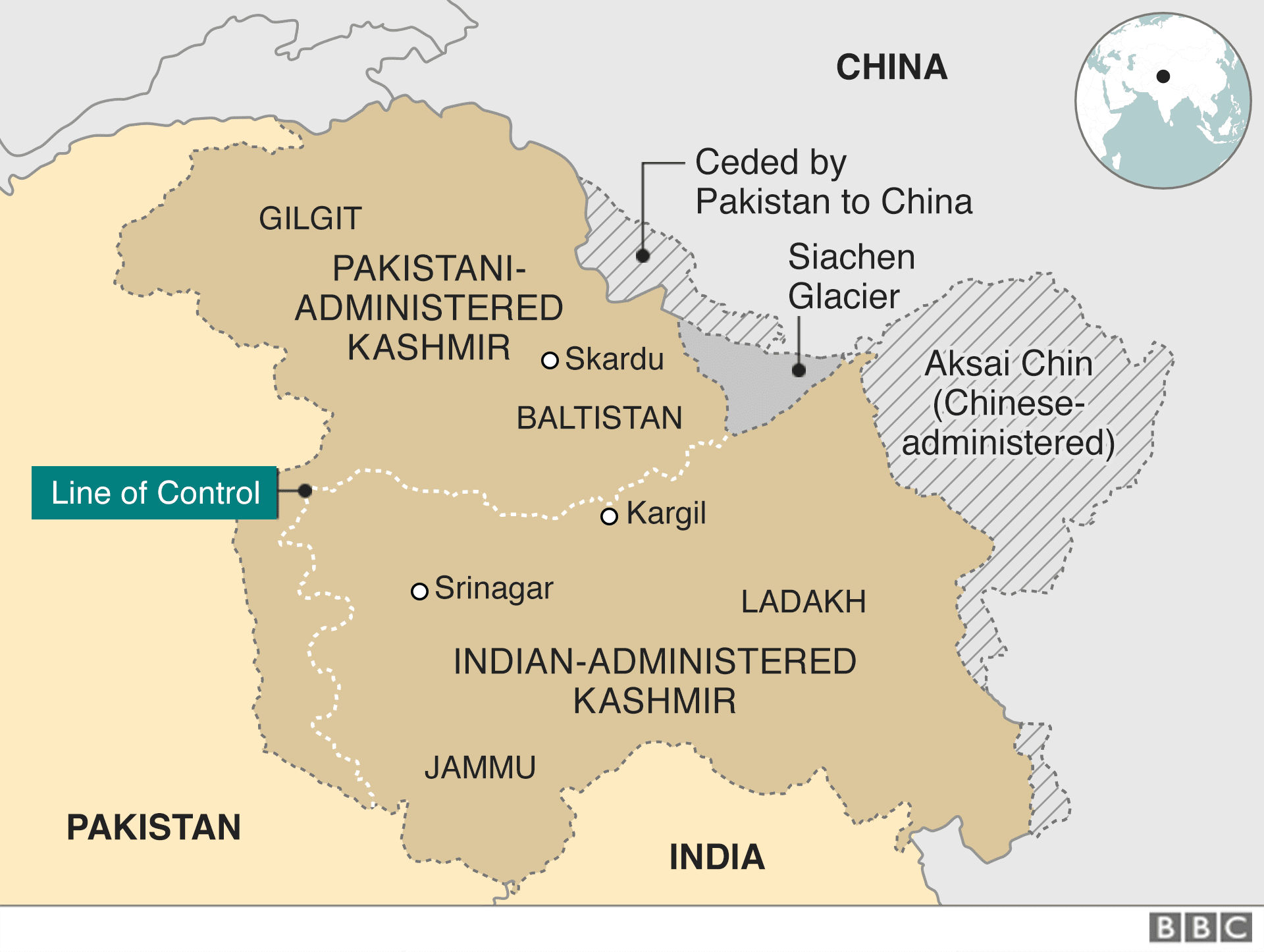
Zainab’s village, Ganokh, found itself in the firing line between India and Pakistan, high in the Himalayas. It’s on the Pakistani side of a ceasefire line dividing Kashmir, which both countries claim.
Twenty years ago, a tactical operation ordered secretly by Pakistan’s generals to occupy heights in Kargil on the Indian side flared into a war they hadn’t expected. It led to defeat and embarrassment, and triggered events that culminated in the country’s third military coup in 50 years.
Thousands of civilians from Zainab’s village and others nearby lost their homes and livelihoods in the conflict. Similar numbers were displaced on the Indian side, but they were able to return after the war.
On the Pakistani side, however, official promises of help in the aftermath of the war never materialised, and many continue to struggle in refugee slums around the country.
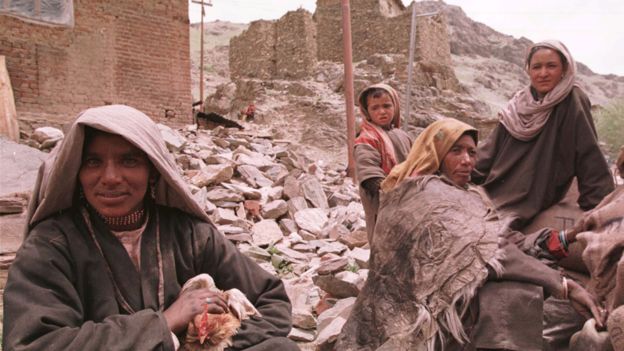
Image caption Zainab Bibi (left) was forced to flee the fighting as a teenager
Zainab says after the first night, the shelling intensified for several days. Soon people she knew were dying.
A shell landed where her grandfather was watering his barley crop above the village, killing him on the spot. Another shell hit a rooftop in the village below, killing two teenage boys sitting in the sun.
As fear spread, army personnel stationed in the area asked the villagers to leave.
“They didn’t say where, or how. We were on our own,” Zainab, who is now 33, tells the BBC in the Pakistani capital Islamabad, where she ended up living. “We picked up some quilts and utensils, and squeezed into a truck crammed with our neighbours. We left our yaks, cows and goats to the care of God.”
They headed for Skardu, some 150km (90 miles) north. They lived there for two months, in a shack offered by a local, until Pakistan announced a ceasefire and ordered its troops to withdraw from the peaks they had occupied on the Indian side.
Image caption Many locals ended up in Skardu, where they are still living in refugee settlements
“When the war ended, many people were in two minds about what to do. One of our neighbours who visited our village said most houses were damaged, orchards destroyed and much of the livestock either killed or lost,” Zainab recalls.
“So my husband decided that we should head to Islamabad where a friend told him he could find work.”
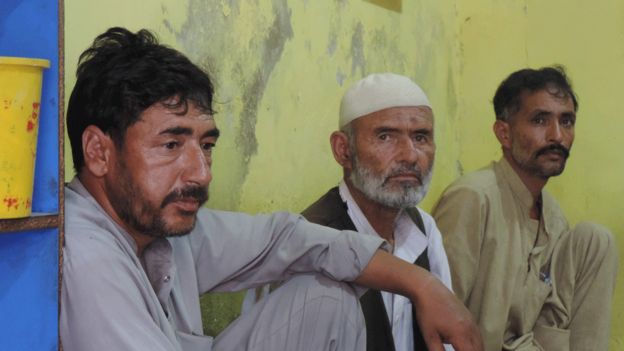
Ghulam Mohammad, who’s from the same valley as Zainab, made a similar decision to flee. He was in his late teens when hostilities broke out and he had to leave his apricot trees and livestock behind in his village, Hargosel.
His parents had already died and he had no siblings so he and other relatives left the village and ended up in Skardu, which had become “crammed with people fleeing the war”, he recalls.
“Some people had put up tents in the desert outside the town. Others didn’t even have that. It was a sad sight.”
Young and lonely, he left the area and went to work in Karachi, a city at the other end of the country.
Zainab Bibi and Ghulam Mohammad come from Kharmang, a valley in the Gilgit-Baltistan region, which shares a border with Kargil on the Indian side.
Once connected to the Buddhist Ladakh region of what is now Indian-administered Kashmir, Gilgit-Baltistan fell on the Pakistani side during the partition of British India in 1947.
However, the area was treated as part of disputed Kashmir under a United Nations resolution passed in 1948.
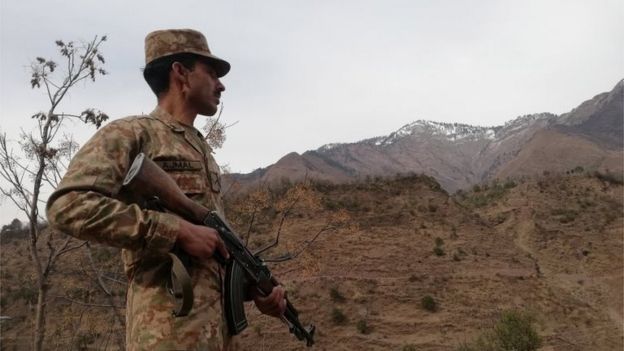
Pakistan’s powerful military tried on at least two occasions – 1947 and 1965 – to send its forces into Kashmir to start a rebellion against Indian rule. On both occasions it publicly denied its direct involvement, saying indigenous Kashmiri rebels were fighting Indian forces.
Image copyright EPAImage caption Pakistan publicly denies its soldiers played a direct role in rebellions against Indian rule in Kashmir
The Kargil war began in a similar fashion.
Thousands of regulars of the paramilitary Northern Light Infantry, drawn exclusively from Gilgit-Baltistan and skilled in high-altitude warfare, were sent in over the winter to occupy military posts the Indians used to vacate in the months of snow.
They established positions on heights ranging from 16,000 to 18,000 feet above sea level. These commanded a view of the Srinagar-Leh highway, a major supply route to troops stationed at Siachen glacier, the world’s highest battlefield, which the Indians occupied in 1984.
When the Indians detected the incursion in early May 1999, Pakistan said they were Kashmiri militants fighting Indian rule.
Observers say the Pakistani aim was to cut Indian supplies to Siachen, inflict heavy losses on Indian troops and pressure them into negotiating a settlement of the Kashmir dispute on Pakistani terms.
They say that given Pakistan’s nuclear test less than a year earlier, its generals were hoping the Indian response would be muted due to the threat of a nuclear war.
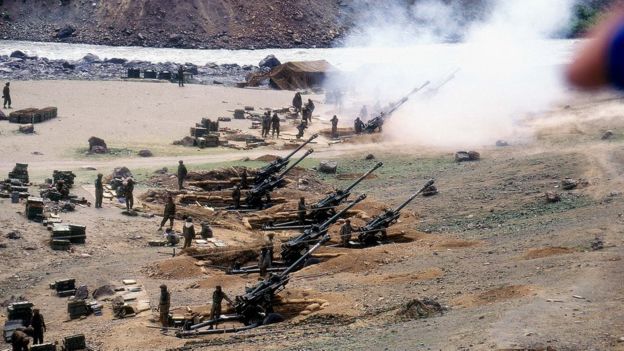
Image copyright THE INDIA TODAY GROUPImage caption India regained Kargil within weeks
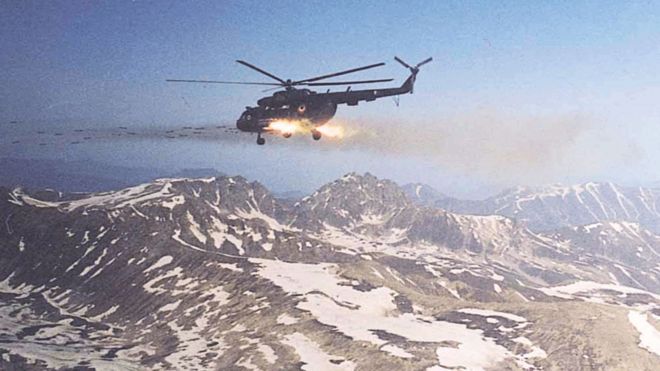
But the Indians hit back hard, sending infantry backed by artillery and air support, thereby turning it into the first full-blooded military conflict between the two countries since the 1971 war that saw the birth of Bangladesh.
By mid-June, the Pakistani positions on the hills began to fall, and there were international calls for Pakistan to withdraw.
Image copyright GETTY IMAGESImage caption Thousands of people were evacuated from their homes on the Indian side too
There is evidence to suggest the Pakistani military leadership had hidden details of the Kargil operation from the government of then Prime Minister Nawaz Sharif. On 4 July he was forced to announce a unilateral ceasefire. His government was toppled in a military coup two months later.
India had fully retaken the Kargil heights by 26 July. It lost more than 500 men in the war, while estimates for Pakistani losses range from 400 to about 4,000.
As for those made homeless by the conflict, thousands remain displaced in Pakistan to this day, still waiting for help.
About 20,000 people from the Kharmang valley had to leave their villages. Twenty years on this displaced population has doubled – and 70% have not returned.
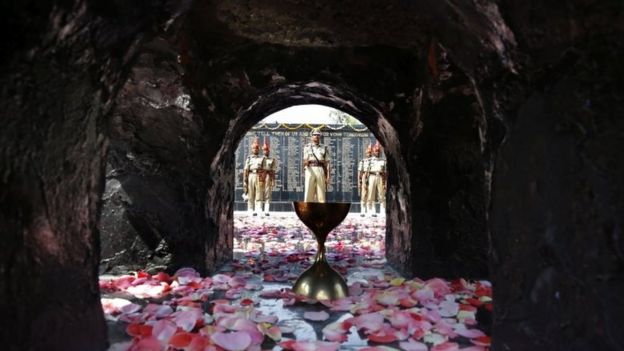
Image copyright EPAImage caption India remembered its dead from the Kargil conflict earlier this week
“This is mainly due to the absence of any government-led rehabilitation programme, or because their lands have been taken over by the army,” says Wazir Farman, a Skardu-based lawyer and member of the independent Human Rights Commission of Pakistan (HRCP).
Three villages closest to the frontline – Gangani, Brolmo and Badigam Bresel – were completely destroyed during the fighting.
Bu-Ali Rizwani, an elder from Brolmo who lives in a refugee colony in Skardu, says the villages remain a no-go area for locals because the military has set up barracks and bunkers in them.
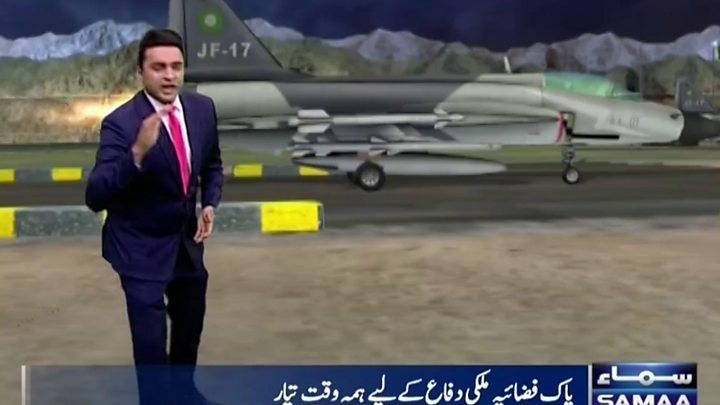
Media caption India and Pakistan’s ‘war-mongering’ media
Protests by the villagers in Skardu in 2003 and 2004 forced the district administration to set up a team including military officials to carry out a survey of their losses. In 2010, a compensation package of 110m rupees (about $680k; £550k) was worked out for the three villages, but the money has not been paid.
“We held meetings with the army force commander in Skardu, with the chief minister in Gilgit, we travelled to Islamabad to discuss the issue with officials of the ministries of defence and Kashmir affairs,” Mr Rizwani says.
“The army told us the government would pay. The Kashmir ministry said the Gilgit-Baltistan government would pay. It said the army would pay. We chased the matter until 2012, and then we gave up.”
In Gulatari region, the military has been delaying payment of a much smaller amount of about 1.9m rupees to residents whose land it acquired to build a jeep track to its forward posts in 1999. The delay has come despite a 2010 court ruling in favour of the landowners.
When contacted, a senior official in the Gilgit-Baltistan government said it was a matter for the military to answer.
The BBC contacted the Pakistani military, which said it would check the details of the cases. It did not provide a response in time for publication. It also provided no comment on the claim that the military’s covert operation in Kargil was hidden from the civilian government.
It’s no surprise to find that locals whose lives were changed forever by the Kargil war feel they have been abandoned.
About half a dozen families returned to Hargosel, but Ghulam Mohammad’s is not among them.
Image caption Ghulam Mohammad (left) and Fida Hussain (centre) fled the village of Hargosel
“I haven’t had the money to repair my house which was damaged during the war,” he says. “Also, the land has turned barren, and since most of my close neighbours haven’t returned, there won’t be farmhands available to make it cultivable.”
Besides, the land above Hargosel is strewn with landmines and unexploded bombs, so animal grazing is a risky business. “Two boys were injured last year when they stepped on a bomb,” Ghulam Mohammad says.
He moved back to Skardu, where he got married in 2004. The BBC spoke to him in Rawalpindi, where he is receiving medical treatment.
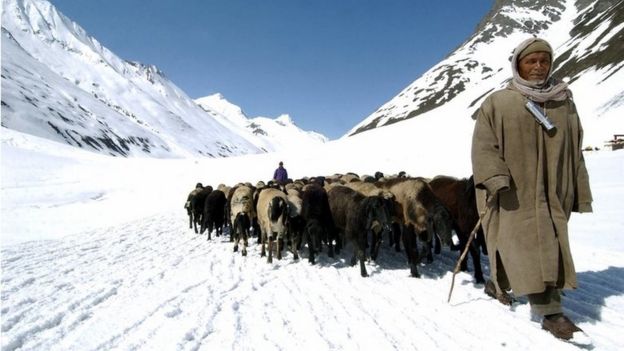
Image copyright AFPImage caption Much of the Kargil area is snowbound for half of the year
Zainab Bibi has other reasons for not going back to her village, though her parents and some of her in-laws have returned.
Over the years she and her husband worked and saved enough money to buy a small hut of their own in an Islamabad slum. Their four children are at school in the capital.
“We have lived a hard life, but everything happened for the best, and I thank God for that,” she says.
And she doesn’t want to go back.
“As a child in my village, I grazed goats and tended our barley crops. I sometimes miss Ganokh, but my children belong in Islamabad, and this is where we’re staying.”
Chinese State Councilor and Foreign Minister Wang Yi(R) meets with Angolan Foreign Minister Manuel Domingos Augusto, who is also Angolan President Joao Lourenco’s special envoy, in Beijing, capital of China, July 23, 2019. (Xinhua/Shen Hong)
BEIJING, July 23 (Xinhua) — Chinese State Councilor and Foreign Minister Wang Yi met with Angolan Foreign Minister Manuel Domingos Augusto here Tuesday, pledging to further develop bilateral ties.
Wang said that China is ready to implement consensus reached by leaders of the two countries and strengthen strategic communication with Angola.
He called on the two sides to press ahead pragmatic cooperation on the platform of the Belt and Road and the Forum on China-Africa Cooperation.
The Chinese side will continue to encourage its enterprises and financial institutions to cooperate with the Angolan side, provide assistance within its capability and facilitate the African country’s economic diversification, Wang said.
Augusto, who is visiting China as a special envoy of Angolan President Joao Lourenco, appreciated China’s long-term support to Angola’s development and voiced his country’s willingness to continue pragmatic cooperation.
Switching first face-to-face gathering since G20 summit from Beijing sends message that ‘trade should be trade, and politics should be politics,’ analyst says
Trade representative Robert Lighthizer and Treasury Secretary Steven Mnuchin are set to meet counterparts Vice-Premier Liu He and Commerce Minister Zhong Shan
Shanghai is China’s global financial hub, while Beijing is viewed as more of a political centre. Photo: Bloomberg
China’s decision to hold next week’s negotiations with the United States in Shanghai could be a fresh sign that Beijing is revising its strategy as it prepares for a protracted trade war, analysts said.
By choosing global financial hub Shanghai rather than the political centre of Beijing, China is trying to play down the political aspects of the talks and emphasise the commercial elements, analysts suggested.
The meeting will be the first face-to-face gathering of the two countries’ trade negotiators since talks collapsed in May without a deal as the US blamed China for renegading on earlier promises, while China blamed the US for being too demanding.
The trade teams have held two phone conversations in July, although neither Washington or Beijing have confirmed the venue or schedule for the talks next week.
Shen Jianguang, the chief economist at JD Digits and a veteran Chinese economy watcher, said China is changing the location of the talks to send a message that “trade should be trade, and politics should be politics”.
He added that the choice of Shanghai implies that China is trying to focus on the technical issues such as the US relaxation of sales restrictions to
and Treasury Secretary Steven Mnuchin are expected to lead the US delegation to meet their Chinese counterparts headed by Vice-Premier Liu He and Commerce Minister Zhong Shan, the South China MorningPostreported earlier this week.
The Shanghai talks will only result in a small stepShen Jianguang
Bloomberg and The Wall Street Journal reported on Wednesday that the talks will take place in Shanghai, and a source confirmed the location to the Post. Hua Chunying, China’s foreign ministry spokeswoman, said on Wednesday that she had no information to provide on the location of the talks.
Chang Jian, chief China economist at Barclays, said that the choice of Shanghai is a sign that the initial goal of the talks would be “smaller”, focusing more on specific import and export arrangements rather than wholesale institutional changes in China’s economic model.
“It shows that China is preparing for a protracted trade talks for years to come,” Chang said. “For China, a precondition for a grand deal is that the US has to lift all tariffs, which the US will find very hard to do.”
Aidan Yao, a senior emerging Asia economist at AXA Investment Managers, said the fact that it took almost a month after the ceasefire agreement reached between President Xi Jinping and US counterpart Donald Trump at the G20 summit in Japan for a face-to-face meeting to take place is already a confirmation of “the deep divide” that remains.
“Without a clear strategy to tackle them, I doubt anyone should hold their breath for a breakthrough” despite certain goodwill gestures in recent days, Yao said.
Without a clear strategy to tackle them, I doubt anyone should hold their breath for a breakthroughAidan Yao
The initial arrangements for the meeting came after the US announced that it would offer exemptions to 110 Chinese products, including medical equipment and key electronic components, from import tariffs. China, meanwhile, said that several companies would buy American agricultural products having already applied for exemptions from the tariffs imposed by Beijing.
Liao Qun, the chief economist at China Citic Bank International, said a change of location could pump “fresh air” into the talks.
“Shanghai is the window of China’s reform and opening up and the country’s economic heart,” Liao said. “It could be a positive change”.
Larry Hu, chief China economist of Macquarie Capital, noted that Shanghai has played a unique role in US-China relations.
“The important Shanghai Communiqué was inked in the city,” Hu said, referring to the diplomatic document signed between China and US in 1972 during president Richard Nixon’s visit to China to meet Chinese chairman Mao Zedong.
The document, which is part of the Three Joint Communiqués, paved the way for Beijing and Washington to establish official diplomatic relationships later that decade.
The Three Joint Communiqués are a collection of joint statements made by the governments of the US and China from 1972, 1979 and 1982.
Image copyright GETTY IMAGESImage caption India wants to move to 30% electric cars by 2030
India is making a big push for electric vehicles, signalling a turning point in its clean energy policy, writes energy writer Vandana Gombar.
In 2017, Transport Minister Nitin Gadkari shocked the automobile industry (and the world) when he announced that he intended for India to move to 100% electric cars by 2030.
“I am going to do this, whether you like it or not. And I am not going to ask you. I will bulldoze it,” he said at an industry conference.
That was an ambitious target given that even the UK and France were hoping to phase out conventional combustion-engine cars only by 2040.
Mr Gadkari and his Bharatiya Janata Party or BJP-led government eventually diluted their plans for electric passenger cars – from 100% the target is now down to 30%.
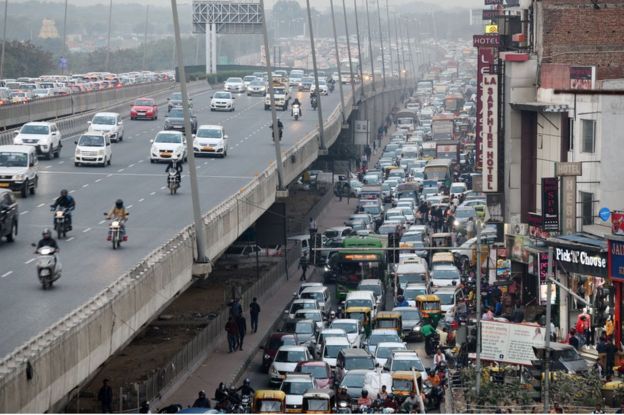
Image copyright GETTY IMAGESImage caption India has some of the world’s most polluted cities, including Delhi
A pushback by the industry and the fear of job losses were among the reasons for the government to do so.
The government has now decided to focus on the segment below cars: two-wheelers, where sales are much higher, and three-wheelers (largely auto-rickshaws).
In the financial year that ended in March, about 3.4 million passenger cars were sold in the country against 21.2 million two-wheelers, according to data released by Indian automobile manufacturers. The number of three-wheelers sold totalled 0.7 million.
The new proposal is to have only electric three-wheelers operating in the country by 2023, and only electric two-wheelers by 2025.
The government seems to have two dominant objectives – to control pollution and take the lead in an emerging industry.
Media caption How an electric car can make money
India wants to become a “global hub of manufacturing of electric vehicles”, Finance Minister Nirmala Sitharaman said in her budget speech earlier this month. The Economic Survey, a government forecast, released a day before the budget envisaged an Indian city possibly emerging as the “Detroit of electric vehicles” in the future.
But it will be a challenge to create a competitive advantage in electric vehicle manufacturing, or even a market for them, given that India does not have the infrastructure or deep pockets that the world’s current leader in electric mobility, China, has.
The American electric carmaker, Tesla, is setting up a manufacturing plant in Shanghai that is expected to be operational by the end of 2019.
India can perhaps learn a few lessons from China. The authorities there spurred sales partly by placing caps on the number of conventional combustion vehicles that can be sold in its most congested and polluted cities. Beijing has also limited the number of electric vehicles that can be sold. Further, car manufacturers now have to ensure that a specified share of their production is of so-called zero emission vehicles.
Another inspiration for India could be Norway, where electric vehicles accounted for half of last year’s total car sales. A phase-out of combustion vehicles in the country is planned by 2025.
Media caption Why is Norway the land of electric cars?
But there are many encouraging signs in India too.
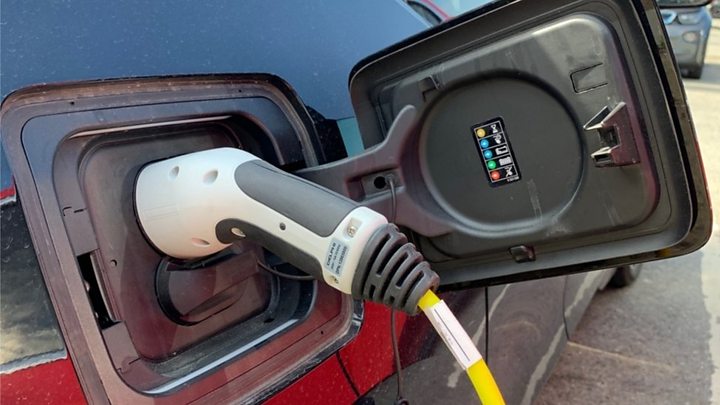
For one, charging stations are being built at government offices, malls and even within neighbourhoods. Government-owned power companies such as Bharat Heavy Electricals and Energy Efficiency Services plan to begin rolling out charging stations soon. The latter is looking at 10,000 stations over the next two years.
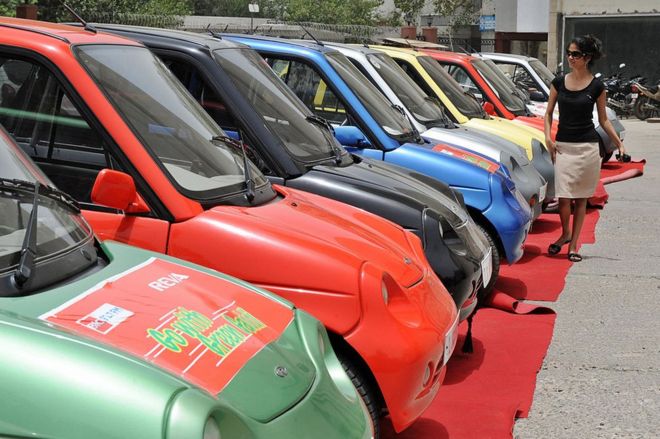
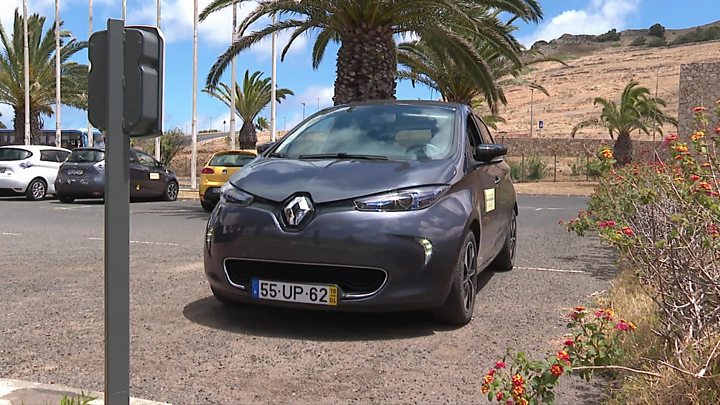
Second, electric vehicle models are proliferating. Hyundai launched its electric Kona car in India in July and Nissan is expected to launch its Leaf model soon. Indian carmakers Mahindra & Mahindra and Tata Motors both sell electric cars.
There are already several models of electric two-wheelers, and bike-sharing companies like Bounce are also going electric. Electric buses too can be spotted in many cities, partly fuelled by incentives. India’s capital, Delhi, is expected to have 1,000 electric buses running on its roads soon.
Even taxi-hailing apps and home delivery services have taken to ferrying parcels and passengers on electric bikes. After a pilot run with electric cabs, Indian ride-hailing giant Ola is now focussing on electric bikes and three-wheelers.
Instead of charging batteries, which could be a time-consuming task, it intends to opt for a battery swapping model where a fully charged battery would quickly replace the discharged one at swapping stations. Bounce too is experimenting with battery swaps.
Image copyright GETTY IMAGESImage caption India sold 3.4 million passenger cars this past financial year
The government is also planning to offer incentives for manufacturing electric vehicles and batteries to boost economic growth and encourage local manufacturing under its Make in India initiative.
The falling cost of batteries could boost India’s electric mobility plans, and make it that much easier for electric vehicles to be competitive with those running on other fuels. And there is the added bonus of cleaner air.
That would push India towards electric mobility in its own unique style and at its own unique pace.
Chinese State Councilor and Foreign Minister Wang Yi (R) meets with Minister of Foreign Affairs and International Cooperation of the United Arab Emirates (UAE) Sheikh Abdullah bin Zayed Al Nahyan in Beijing, capital of China, July 21, 2019. (Xinhua/Yan Yan)
BEIJING, July 21 (Xinhua) — Chinese State Councilor and Foreign Minister Wang Yi met with Sheikh Abdullah Bin Zayed Al Nahyan, minister of Foreign Affairs and International Cooperation of the United Arab Emirates (UAE), here Sunday.
Hailing the UAE as China’s important and reliable partner in the Middle East, Wang said China stands ready to work with the UAE to implement the consensus reached by the two countries’ leaders, deepen their partnership under the Belt and Road Initiative, promote cooperation in various fields, enhance people-to-people exchanges, strengthen cooperation on anti-terrorism and law enforcement, and bring the China-UAE comprehensive strategic partnership to higher levels.
Sheikh Abdullah said the UAE is willing to strengthen cooperation with China in trade, investment, energy, culture, education and third-market cooperation, and to work for closer coordination within the United Nations and in regional affairs.
Huang Kunming (R), a member of the Political Bureau of the Communist Party of China (CPC) Central Committee, a member of the Secretariat of the CPC Central Committee and head of the Publicity Department of the CPC Central Committee, holds talks with Vo Van Thuong, head of the Communist Party of Vietnam (CPV) Central Committee’s Communication and Education Commission, before the fifteenth theory seminar between the CPC and the CPV in Guiyang, capital of southwest China’s Guizhou Province, on July 21, 2019. (Xinhua/Xie Huanchi)
GUIYANG, July 21 (Xinhua) — The Communist Party of China (CPC) and the Communist Party of Vietnam (CPV) held their fifteenth theory seminar on Sunday in Guiyang, southwest China’s Guizhou Province.
The seminar focused on exploring laws of socialist modernization in China and Vietnam.
The opening ceremony of the seminar was attended by Huang Kunming, a member of the Political Bureau of the CPC Central Committee and also a member of the Secretariat of the CPC Central Committee, and Vo Van Thuong, head of the CPV Central Committee’s Communication and Education Commission.
Huang said in his keynote speech that the CPC has led the Chinese people in successfully creating the road of modernization construction with Chinese characteristics that has promoted the fast development of the country, based on the national conditions and by adhering to putting the people first, taking the economic construction as the central task and adhering to the reform and opening up.
Prior to the seminar, Huang, who is also head of the Publicity Department of the CPC Central Committee, held talks with Thuong. They exchanged views on deepening relations between the two parties and two countries and on enhancing media exchanges and cooperation.









 CHINDIA ALERT: You'll be living in their world, very soon