Archive for November, 2019

04/11/2019

Xi Focus: Xi hosts banquet for guests attending int’l import expo

SHANGHAI, Nov. 4 (Xinhua) — Chinese President Xi Jinping and his wife Peng Liyuan hosted a banquet Monday evening in Shanghai to welcome distinguished guests from around the world, who are here to attend the second China International Import Expo (CIIE).

The CIIE is designed to trade goods and services, exchange culture and ideas, welcome visitors from across the globe, benefit the whole world and respond to the aspirations of people from various countries to live a better life, Xi said.

Xi and Peng had photos with foreign leaders and their spouses, including French President Emmanuel Macron, Jamaican Prime Minister Andrew Holness, Greek Prime Minister Kyriakos Mitsotakis and Serbian Prime Minister Ana Brnabic.

On behalf of the Chinese government and people, Xi extended a warm welcome to foreign leaders and guests.

China has made remarkable achievements over the past 70 years since the founding of New China, especially during the country’s 40-strong years of reform and opening up. “From the course of China’s development, we realize that China will do well only when the world does well, and vice versa,” Xi said.

In a short time, the CIIE started from scratch and quickly attracted wide participation of countries and enterprises from all over the world, said Xi, noting that it has become a major initiative in the history of global trade and an important platform for international cooperation in the new era.

By holding the CIIE and proactively expanding imports, China is taking the initiative to pursue a new round of high-level opening up, deepen international cooperation in advancing the Belt and Road Initiative and jointly foster an open global economy, Xi noted.

He expressed his hope that various countries can enhance cooperation and promote the development of the world economy.

The second CIIE will be held in Shanghai between Nov. 5 and 10.

Source: Xinhua

04/11/2019

Seven years on, still no RCEP trade deal, and India pulls out

  • Hopes were high a regional summit could finally wrap up negotiations on the Regional Comprehensive Economic Partnership
  • But despite claims of ‘significant progress’ in the 16-nation talks, India remains a stumbling block
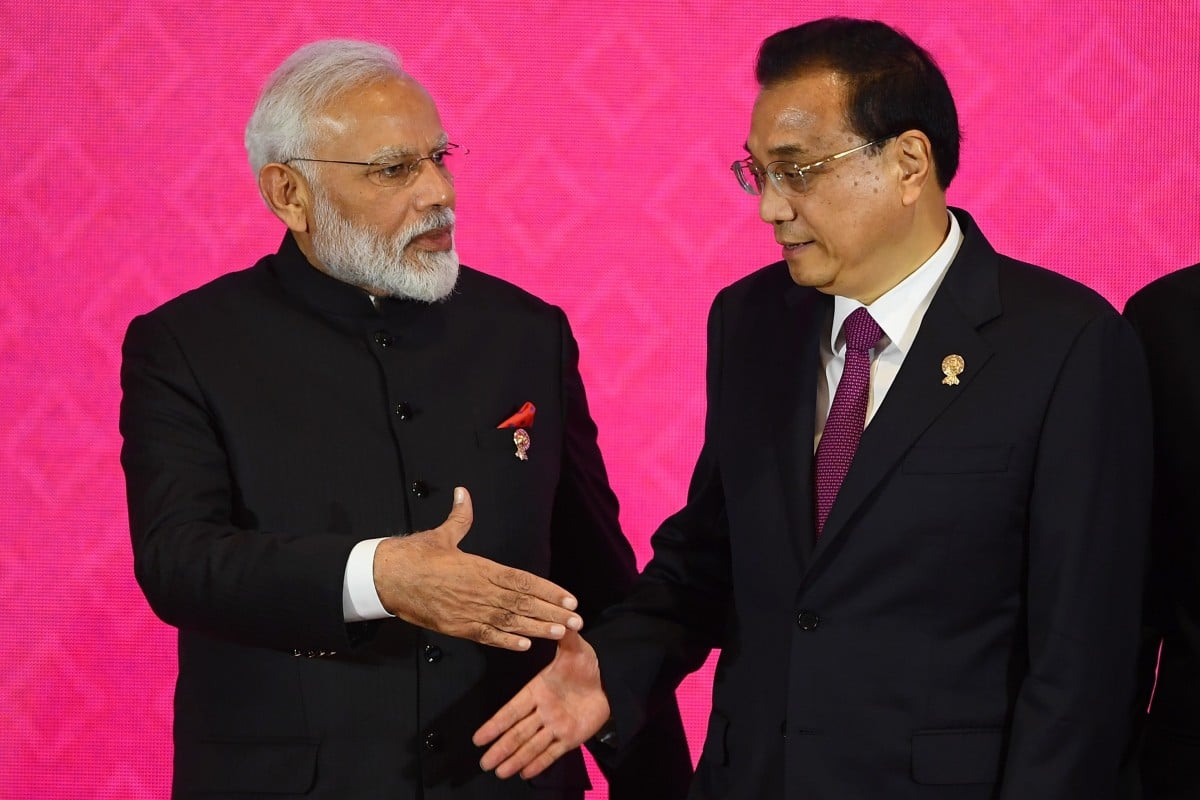
Indian Prime Minister Narendra Modi and China’s Premier Li Keqiang attend the Regional Comprehensive Economic Partnership Summit in Bangkok. Photo: AFP
Fifteen of the countries involved in negotiating a mammoth 16-nation Asian trade pact were on Monday hoping to seal the deal after seven years of talks but faced a fresh setback as India signalled it was pulling out over terms that were against New Delhi’s interests.
A joint statement by all 16 states involved in the Regional Comprehensive Economic Partnership (RCEP) said 15 economies had “concluded text-based negotiations for all 20 chapters and essentially all their market access issues”, and would undertake legal scrubbing of the proposed pact before a formal signing in 2020.
But “India has significant outstanding issues, which remained unresolved”, the statement said.
“All RCEP participating countries will work together to resolve these outstanding issues in a mutually satisfactory way. India’s final decision will depend on satisfactory resolution of these issues.”
Multiple Indian media outlets reported that Prime Minister Narendra Modi had told a Monday evening meeting of leaders from the RCEP countries that “neither the talisman of [Mahatma Gandhi] nor my own conscience permit me to join the RCEP”.

“When I measure the RCEP agreement, with respect to the interest of Indians, I don’t get a positive answer,” he was quoted as saying.

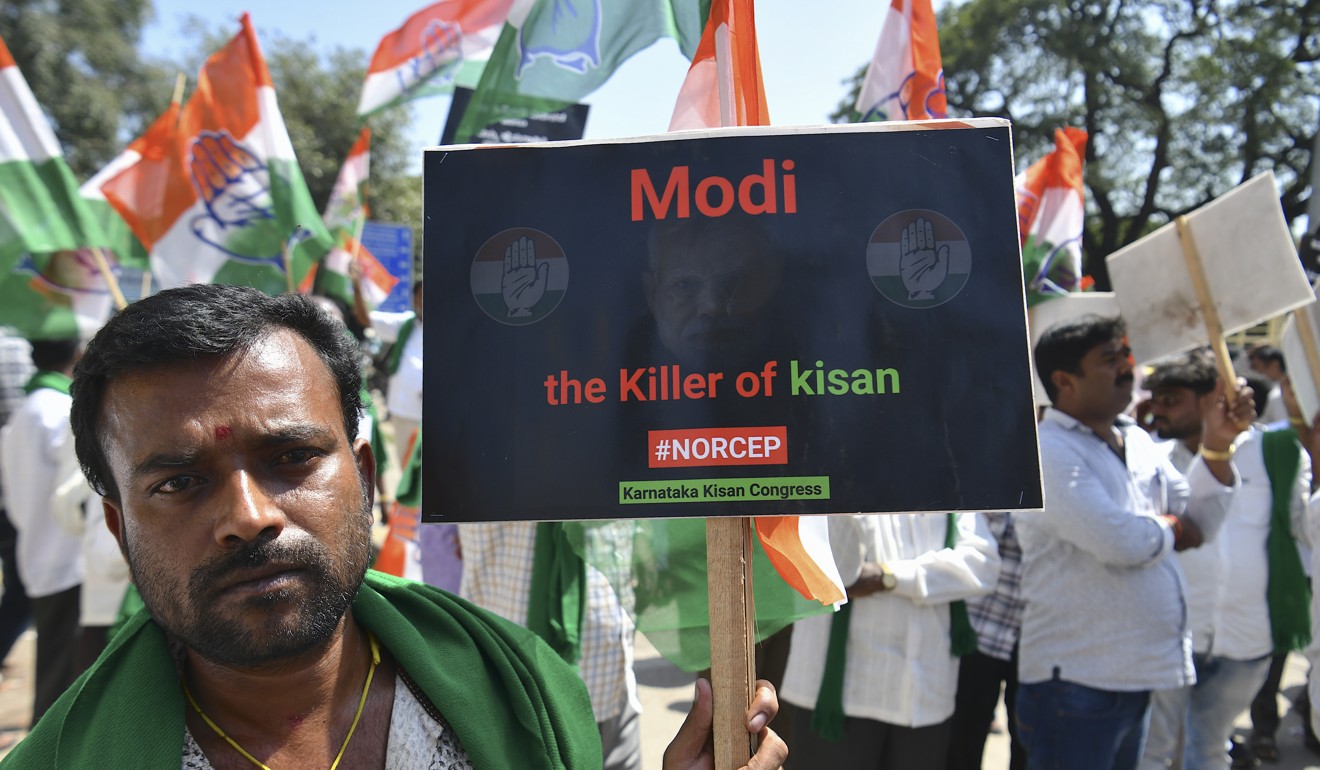
Indians protest against the Modi-led government’s backing of the Regional Comprehensive Economic Partnership. Photo: AFP

Henry Gao, a law professor at the Singapore Management University focusing on international trade law, said an RCEP without India would be “even more worthwhile” for the so-called RCEP-15.

He cited two reasons: India’s “low ambitions” for the pact, and the high level of integration among the countries of East and Southeast Asia which are part of the RCEP-15.

“A mega trade deal like RCEP will only further accelerate the integration process and greatly boost trade and economic growth in the region,” Gao said.

Explained: Regional Comprehensive Economic Partnership (RCEP)
Earlier expectations were that the joint statement would declare at least a “substantial conclusion”, “near conclusion” or “in principle conclusion” of the RCEP, which aims to create a free-trade zone spanning 39 per cent of the world economy.
The phrasing used to describe the progress of negotiations is being closely parsed because, since it requires endorsement from all RCEP countries, it accurately captures the sentiment of all the 16 negotiating teams.
Last year, Singapore, as chair of the Association of Southeast Asian Nations (Asean), pushed for a conclusion of the deal, but eventually the joint statement declared that only “substantial progress” had been made.
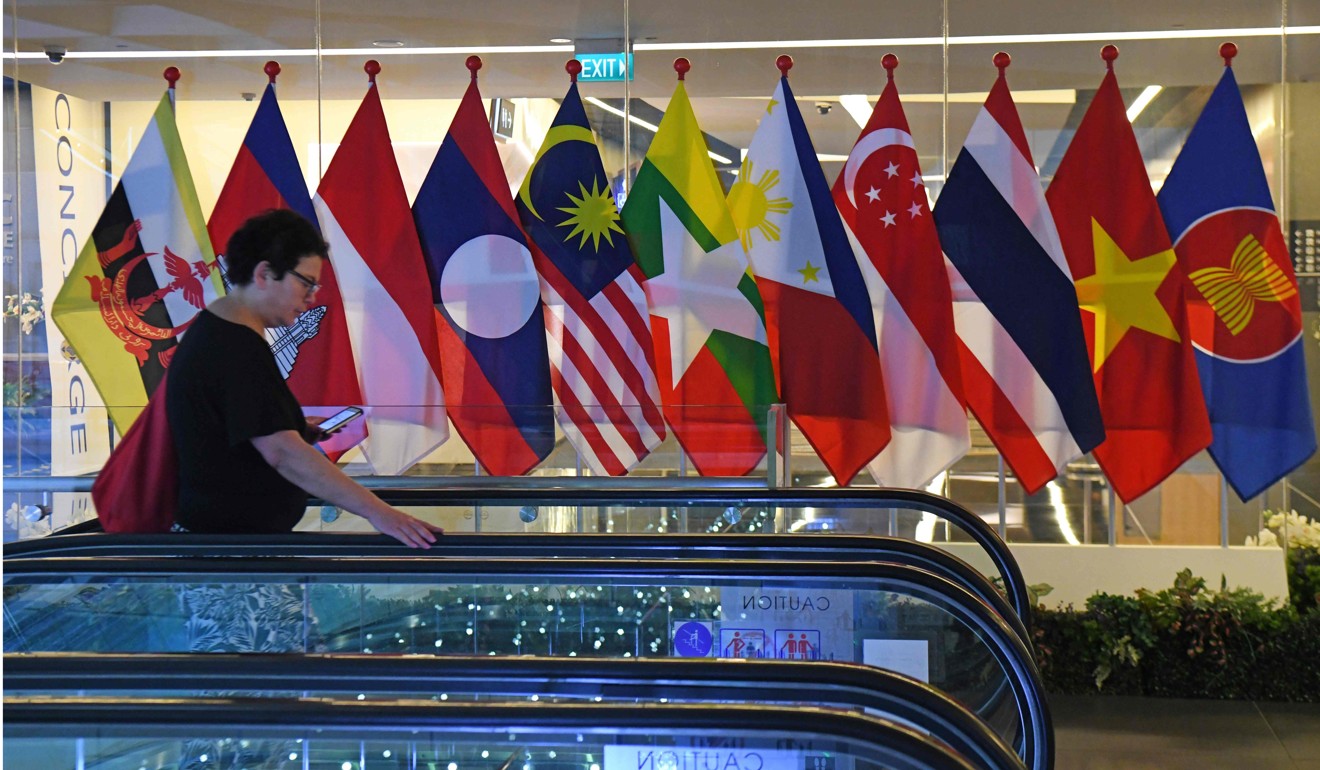
Asean countries plus six others are negotiating the trade pact. Photo: AFP

Indian media, citing government sources, said the pact’s inadequate protection against import surges, the possible circumvention of rules of origin, and a lack of “credible assurances” on market access and non-tariff barriers, proved too much for New Delhi to swallow.

India,

facing fierce domestic criticism for being in the pact despite opposition even from

Modi’s 

Hindu nationalist support base, last week piled on a fresh set of demands that other countries balked at, negotiators from Southeast Asian countries said over the weekend.

Furious efforts that continued up to Sunday night failed to bridge the gap between India and the 15 countries.
India’s concerns about RCEP remain the major obstacle to world’s largest trade deal

Indian critics of the RCEP say the deal will have a ruinous impact on the South Asian economy, which has trade deficits with the other 15 countries.

The biggest opposition has come from the country’s long protected industries, such as its dairy sector, which fears it could be wiped out by lower tariffs on Australian and New Zealand products that would result from the RCEP.

Indian government sources on Monday said the country had not made last-minute demands, but Southeast Asian negotiators said major demands were made as late as Thursday.

Gao, the Singapore-based law professor, said it “makes sense for India to stay out” as it would have faced “a lot of competition from Chinese manufactured products” if it were part of the deal.

“India could temporarily shield its firms from Chinese competition by staying out, but whether this will work in the long term is a different question,” he said.

Source: SCMP

04/11/2019

Hong Kong ‘protest’ cake disqualified from UK competition

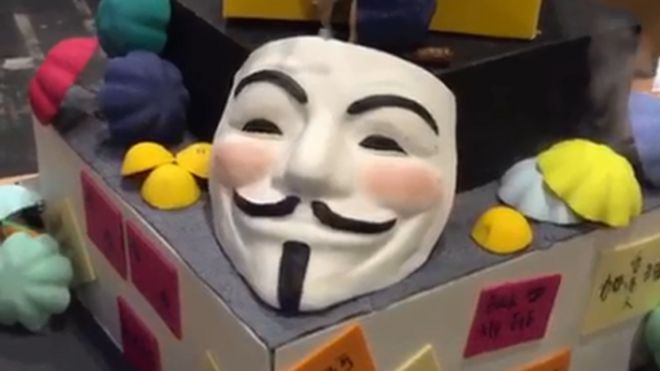
CakeImage copyright 3RD SPACE
Image caption The Guy Fawkes mask has been worn by many protesters during anti government rallies

A Hong Kong protest-themed cake has been disqualified from a cake decorating competition in the UK, in a move that has been referred to as “political censorship”.

It featured protest symbols including umbrellas and a Guy Fawkes mask.

The company behind the cake told the BBC it believed it was pulled after complaints from Chinese competitors.

But the Birmingham competition organisers said it was because one element of the cake was oversized.

Anti-government protests have been taking place in Hong Kong for five months.

They first erupted in June, triggered by a controversial bill that would have allowed extradition to mainland China.

The bill has been withdrawn but the protests have continued, having evolved into a broader revolt against the way Hong Kong is administered by Beijing.

‘Obvious it was an excuse’

The cake was one of many displayed this year at the Cake International competition, held in the city of Birmingham from 1- 3 November.

It draws competitors from all over the world.

The entry by a baker from the 3rd Space cafe in Hong Kong included fake tear gas and a figure made to look like a typical protester clad in black and wearing a hard hat.

CakeImage copyright 3RD SPACE
Image caption A man in a yellow hard hat, carrying an umbrella, was one element of the cake
CakeImage copyright 3RD SPACE
Image caption The cake also had umbrellas which had fake “tear gas” coming out of them

It was inspired by the “streets [of] Hong Kong”, the spokesperson for the cafe told the BBC.

“The design was simply an expression of what is happening at the moment in Hong Kong,” the spokesperson added.

A music box placed inside the cake also played “Glory to Hong Kong”- a tune which has been adopted as the unofficial anthem of the protests – on loop.

But according to 3rd Space, Cake International decided to take action after it received numerous “complaints from Chinese candidates”, who said the cake featured “offensive content… promoting [the] independence of Hong Kong”.

Cake International first decided to turn the music off, before later sending the baker an email telling them that the cake would be “removed”, said 3rd space.

Dozens of people later took to Cake International’s social media platforms complaining, accusing the organisers of pandering to “censorship”.

Cake International later released a statement saying the cake was removed due to complaints, saying that some had threatened to damage the piece.

It clarified that the cake was separately disqualified as one of its elements – a fondant umbrella – had hung over the “allowed area”.

“Oversized exhibits will be disqualified. This entry was not removed as a political statement,” it said in a Facebook post.

However, 3rd space said: “It is obvious that it was an excuse that they came up [with] to cover their political censorship.”

The company said it goes against the principle the competition is meant to uphold to provide an inclusive platform.

Protests in Hong Kong have grown increasingly violent. Over the weekend, five people were injured in a knife attack, and one man had part of his ear bitten off.

The protests have presented a serious challenge to China’s leaders, who have painted the demonstrators as dangerous separatists and accused foreign powers of backing them.

Source: The BBC

04/11/2019

Li urges China, ASEAN to uphold multilateralism, free trade

THAILAND-BANGKOK-LI KEQIANG-CHINA-ASEAN LEADERS' MEETING

Chinese Premier Li Keqiang addresses the 22nd China-ASEAN (10+1) leaders’ meeting in Bangkok, Thailand, Nov. 3, 2019. (Xinhua/Zhai Jianlan)

BANGKOK, Nov. 3 (Xinhua) — Chinese Premier Li Keqiang on Sunday called on China and ASEAN to uphold multilateralism and free trade, resist risks and realize common development at the 22nd China-ASEAN (10+1) leaders’ meeting in Bangkok.

Since China and ASEAN established dialogue relations, they have brought benefits to each other and the wider region, Li said, adding that China always supports ASEAN’s central role in East Asian cooperation.

Noting that the mounting downward pressure on the global economy brings new severe challenges, Li said China and ASEAN countries should jointly uphold multilateralism and free trade, withstand risks and realize common development.

The premier said China and ASEAN countries should stick to the principle of shared benefits and win-win outcomes, and speed up the work to upgrade economic and trade cooperation.

He called for an early conclusion of the negotiations on the Regional Comprehensive Economic Partnership (RCEP) so as to lay the foundation for East Asia’s economic integration, and the implementation of the China-ASEAN Free Trade Area Upgrade Protocol to promote trade and investment liberalization and facilitation.

Li said China and ASEAN countries should enhance strategic mutual trust and safeguard peace and stability in the region.

The Code of Conduct (COC) in the South China Sea is an upgraded version of the Declaration on the Conduct of Parties in the South China Sea (DOC). Last year, China proposed that all parties should try to finish the COC talks in three years. The first reading of the single draft negotiating text of the COC in the South China Sea has been completed ahead of schedule, and the second reading has been launched.

Li said he hopes all sides will actively carry forward the consultations according to the previously agreed timetable, meet each other halfway, and safeguard peace and stability in the South China Sea.

The premier also said China and ASEAN countries need to carry forward their friendship from generation to generation, and stay ready to enhance people-to-people and cultural exchanges in such areas as media, health, education and tourism.

China is willing to train 1,000 administrative health staff and technical professionals in the following three years for ASEAN and will support projects such as the China-ASEAN Young Leaders Scholarship, said the premier.

Stressing that China will unswervingly pursue the path of peaceful development and an opening-up strategy of mutual benefit, Li said China is willing to synergize the Belt and Road Initiative with the development strategies of ASEAN as a whole and its members as well.

He urged to accelerate the construction of the existing economic corridors, promote infrastructure connectivity cooperation, as well as support the building of the Brunei Darussalam Indonesia Malaysia Philippines East ASEAN Growth Area.

Li encouraged innovation cooperation in the areas including digital economy, artificial intelligence, big data and cyber security, and the establishment of a China-ASEAN partnership on blue economy to enhance maritime exchanges and cooperation.

Thailand’s Prime Minister, also the rotating chair of ASEAN, Prayut Chan-o-cha, Philippine President Rodrigo Duterte, Brunei’s Sultan Haji Hassanal Bolkiah, Indonesian President Joko Widodo, Malaysian Prime Minister Mahathir Mohamad, Vietnamese Prime Minister Nguyen Xuan Phuc, Myanmar’s State Counselor Aung San Suu Kyi, Singaporean Prime Minister Lee Hsien Loong, Lao Prime Minister Thongloun Sisoulith and Cambodian Prime Minister Samdech Techo Hun Sen attended the meeting. Li and Prayut co-chaired the meeting.

At the meeting, ASEAN leaders expressed congratulations on the 70th anniversary of the founding of the People’s Republic of China, saying that the ASEAN-China partnership is the most dynamic one in all the partnerships ASEAN has forged.

Speaking highly of the new cooperation progress over the past year, the leaders said their countries would like to take an active role in building the Belt and Road, expand cooperation in areas of inter-connectivity, science and technology innovation, e-commerce, smart cities and blue economy, and increase two-way investment.

They also expressed the hope that the ASEAN-China trade volume can exceed 1 trillion U.S. dollars at an early date.

The leaders also applauded the new progress made in the COC negotiation, saying that their countries would like to maintain the momentum and advance the process.

During the meeting, China and ASEAN agreed to make an action plan to implement The Joint Declaration on China-ASEAN Strategic Partnership for Peace and Prosperity (2021-2025), issued statements on the Belt and Road Initiative, smart cities and media exchanges, and announced that the year 2020 will be the year of China-ASEAN digital economy cooperation.

Li arrived in Bangkok late on Saturday for an official visit to Thailand and a series of events including the 22nd China-ASEAN (10+1) leaders’ meeting, the 22nd ASEAN-China, Japan and South Korea (10+3) leaders’ meeting, and the 14th East Asia Summit.

Source: Xinhua

04/11/2019

Beijing extends sweeteners for Taiwanese weeks before Taipei election

  • Latest measures grant island’s people and enterprises more equal treatment with their mainland counterparts
  • Package in March last year was dismissed by Taiwan’s Mainland Affairs Council as an attempt to buy political support
Taipei’s elections in January could influence the tone of cross-strait relations. Photo: EPA-EFE
Beijing announced a series of sweeteners for Taiwanese businesses and individuals on Monday – including participation in its 5G research and allowing Taiwanese to use mainland consular services – only two months before Taiwan’s critical presidential election.
The latest 26 measures drawn up by 20 government departments, including the State Council’s Taiwan Affairs Office and the National Development and Reform Commission, are designed to attract more Taiwanese to live and work in mainland China, despite worsening cross-strait relations.
But Taiwan’s Mainland Affairs Council criticised the move as an attempt by the Chinese Communist Party to “divide Taiwan internally, and was a further reflection of attempts to try to interfere in and influence Taiwan’s election”.
It follows a similar package of 31 measures unveiled by Beijing in March last year, which included tax incentives, preferential land-use policies for Taiwanese businesses on the mainland and benefits for Taiwanese individuals in studying or living on the mainland.
Taiwan charges pro-Beijing politicians with accepting mainland cash
The latest measures to grant Taiwan-funded enterprises more equal treatment with their mainland counterparts include offering access to research and development in 5G technology, investment in passenger and cargo air services, the establishment of microlending and financing companies and the right to apply for financial guarantees from local government funds.

Taiwanese individuals will also be officially entitled to mainland Chinese consular protection abroad, will be treated the same as their mainland counterparts when buying residential property on the mainland, and will be able to train in Beijing for the 2020 Olympic Games.

Beijing claims sovereignty over self-ruled Taiwan, and has not renounced the use of force to take the democratic island into its fold. Beijing’s ruling Communist Party has stressed its intention to promote “peaceful reunification”, pledging in its communique from the fourth plenary meeting of the party’s elite last week to “deepen cross-strait integration and development” while opposing Taiwanese independence.
The latest measures from Beijing came ahead of Taiwan’s presidential and legislative elections in January. Relations across the Taiwan Strait have been frozen under the administration of independence-leaning Taiwanese President, ostensibly over her refusal to accept the “1992 consensus”, or the understanding that there is only “one China” – something that Beijing considers a prerequisite for any talks with Taipei.

Taiwan’s Mainland Affairs Council said on Monday that the roll-out of the 26 measures one year later was intended to “cover up” the fact that the 31 measures had not been executed properly, and reflected administrative problems on the mainland amid slowing economic growth.

“Even more than that, it also reflects that during this period Taiwanese people have rejected ‘one country, two systems’ and do not agree with the results of the Communist Party’s united front divisions,” the council said.

“We urge the Communist Party officials to specifically implement protections for Taiwanese businesses and Taiwanese people in their investments and lives.”

Joseph Wu, Taipei’s foreign minister, also responded with a tweet written in simplified Chinese – which is used on the mainland – rather than the traditional Chinese used in Taiwan.

“China’s Taiwan Affairs Office came out with 26 measures and last year there were 31 – it looks like there are so many measures,” he wrote. “But we in Taiwan do not need one country, two systems, so there is really no need to be so polite. Giving your people more freedom is also good!”

Ongoing anti-government protests in Hong Kong – which is semi-autonomous from Beijing under the one country, two systems model – have highlighted for many Taiwanese voters the threat from Beijing to the island’s sovereignty.
The latest polling by the MAC found that 89 per cent of respondents opposed the one country, two systems framework that Beijing proposed for Taiwan, up from 75 per cent in a similar survey in January.
Edward I-hsin Chen, a political-science professor at Chinese Culture University in Taipei, said the impact of the 26 measures on the election would depend on how they were implemented, but that one country, two systems was clearly not palatable for Taiwanese voters, whether they supported Tsai’s Democratic Progressive Party (DPP) or the mainland-friendly Kuomintang (KMT).
“Taiwan, of course, will not accept one country, two systems, so these policies will need to be more long-term. Mainland officials did not handle the Hong Kong issue very well, so it will be very hard for one country, two systems in Taiwan – blue and green will both reject it,” he said, referring to the party colours for the KMT and DPP. “But it is good for Taiwanese people and businesses to be able to take part in the 5G sector, and there will be more cooperation in the future.”
Lin Chingfa, former chairman of the Beijing-based Association of Taiwan Investment Enterprises, said he believed the new measures were intended to appeal to Taiwanese youth.
“A very important direction for cross-strait cooperation nowadays is to bridge the opportunities available in mainland China for young people who feel deprived from the slow Taiwanese economy. Some of these policies should be especially appealing to them because it shows that the country hopes to make it more convenient for young Taiwan people willing to come,” Lin said.
He said this approach was especially obvious in the measures that were introduced to provide equal treatment for Taiwan people on the mainland – for example the opportunities for Taiwan people to apply for scholarships and the expansion of places for Taiwanese students at universities.
Source: SCMP
03/11/2019

Chinese State Councilor Wang Yi offers condolences, help to Philippine quake victims

MANILA, Nov. 3 (Xinhua) — Chinese State Councilor and Foreign Minister Wang Yi has offered condolences for the people killed in the series of strong earthquakes that devastated central and eastern Mindanao in the southern Philippines last month, saying China is ready to help the Philippine government in its efforts to rehabilitate the region.

In a message of sympathy sent to Philippine Foreign Secretary Teodoro Locsin on Saturday, Wang said he was shocked to learn that strong earthquakes had hit Mindanao, resulting in casualties and property damage.

“He (Wang) would like to extend sincere sympathy to the victims and the bereaved families,” the Chinese Embassy in the Philippines said in a statement.

“China is willing to offer assistance to the Philippines within our capacity, and believes that under the strong leadership of the Philippine government, the Philippine people will overcome the disaster and return to normal life at an early date,” it quoted Wang as saying.

On Friday, China announced a donation of 3 million yuan (about 434,896 U.S. dollars) to help the quake victims, mostly poor farmers.

The Philippine National Disaster Risk Reduction and Management Council (NDRRMC) said in an updated report on Sunday that the Oct. 29 6.6-magnitude and the Oct. 31 6.5-magnitude earthquakes that hit several central and eastern Mindanao provinces had killed 21 people and injured more than 400 others.

Rescuers were still looking for two missing villagers, the country’s disaster agency said.

The agency said the two tremors also affected more than 178,000 people in 200 villages in the region. Nearly 22,000 displaced people were staying in makeshift tents, it added.

The agency said the quakes also damaged nearly 29,000 infrastructures in the region, mostly houses, school buildings, hospitals, roads and bridges.

Source: Xinhua

03/11/2019

Chinese premier calls for advancing South China Sea COC consultations as scheduled

BANGKOK, Nov. 3 (Xinhua) — Chinese Premier Li Keqiang said Sunday that he hopes all sides will actively carry forward consultations on the Code of Conduct (COC) in the South China Sea according to the previously agreed timetable.

Li made the comment at the 22nd China-ASEAN (10+1) leaders’ meeting in Bangkok.

The South China Sea situation has been generally stable as a result of concerted efforts between China and the Association of Southeast Asian Nations (ASEAN) member states, Li said.

“Last year, I proposed a vision that the COC talks will be completed in three years,” he said, adding that in the past year, the first reading of the single draft negotiating text of the COC in the South China Sea has been completed ahead of schedule, and the second reading has been launched.

The COC is an upgraded version of the Declaration on the Conduct of Parties in the South China Sea (DOC). Relevant sides are expected to follow the DOC principles, resist disruptions, meet each other halfway, and finish the second reading in 2020, Li said.

Li called on all sides to uphold peace, friendship, and cooperation in the South China Sea and safeguard lasting peace, stability in the region.

Source: Xinhua

03/11/2019

Xi stresses people-centered development in urban construction

CHINA-SHANGHAI-XI JINPING-INSPECTION (CN)

Chinese President Xi Jinping, also general secretary of the Communist Party of China Central Committee and chairman of the Central Military Commission, communicates with residents while visiting a section of the Yangshupu Waterworks located in Yangpu Binjiang public space in Shanghai, east China, Nov. 2, 2019. Xi made an inspection tour in China’s economic hub Shanghai Saturday. (Xinhua/Xie Huanchi)

SHANGHAI, Nov. 3 (Xinhua) — Xi Jinping, general secretary of the Communist Party of China Central Committee, said that the concept of people-centered development must be carried out in urban construction.

Xi made the remarks during an inspection tour in China’s economic hub Shanghai Saturday.

“The cities are built by the people and are for the people,” Xi said while visiting a section of the Yangshupu Waterworks located in Yangpu Binjiang public space.

People now have a sense of happiness and gain as the previous rust-belt area, which had witnessed Shanghai’s century-old industrial development, has now turned into a beautiful livable zone, Xi said.

Xi called for efforts to reasonably arrange the space for production, living and ecological purposes and expand public space so that the public would have places for leisure, fitness and entertainment.

“We should let the city become a paradise for the public to comfortably live and work in,” Xi said.

Source: Xinhua

03/11/2019

Machynlleth crocodile skull raid prompts trade warning

Seized crocodile skullImage copyright DYFED-POWYS POLICE
Image caption Trade in some species, including some types of crocodiles, is banned outright

People buying animal “souvenirs” have been warned they must check they are legal after police seized a number of crocodile skulls imported from China.

Police are investigating the finds after searching two properties in Machynlleth, Powys, on Wednesday.

Dyfed-Powys Police and North Wales Police said they had found “numerous” skulls across the searches.

Animal trade charity Traffic said importers and buyers must make sure they had the correct permits.

Richard Thomas, from Traffic, said some people would buy things such as skulls as a “talking point”.

Trade in some species, including some types of crocodiles, is banned outright, but others can be bought and sold as long as the exporting country issues permits.

Earlier this month, police seized a skull of a critically endangered Siamese crocodile from a man in Chippenham, Wiltshire, after he paid about £30 to a buyer in China.

Wiltshire Police said the man bought it as an “unusual” house ornament and had no idea that it was protected.

No further action was taken against him when police decided he had made an honest mistake.

The Convention on International Trade in Endangered Species of Wild Fauna and Flora is the main worldwide agreement controlling trade in wild animals and plants, and is signed by more than 180 countries.

In 2016, the UN estimated that the annual value of illegal wildlife trade was between $7bn-$23bn (£5.4bn-£17.8bn).

Traffic said demand for such items as horns, ivory, bones and skins was “driving unprecedented wildlife population declines”.

Source: The BBC

03/11/2019

China, SE Asian states push trade pact despite India doubts

BANGKOK (Reuters) – Leaders from China and Southeast Asia states called for swift agreement on what could become the world’s largest trade bloc at a regional summit on Sunday, but new demands from India left officials scrambling to salvage progress.

Hopes of finalising the Asia-wide Regional Comprehensive Economic Partnership (RCEP), which is backed by China, have been thrown into doubt at the summit of the Association of Southeast Asian Nations (ASEAN) in Bangkok, Thailand.

Summit host Thailand said late on Sunday that the deal could be signed by February 2020. Thailand had previously said it aimed to conclude negotiations by the end of the year.

New impetus to reach agreement has come from the U.S.-China trade war, which has helped knock regional economic growth to its lowest in five years.

“The early conclusion of RCEP negotiations will lay the foundation for East Asia’s economic integration,” said a statement from China’s foreign ministry after Premier Li Keqiang met Southeast Asian leaders.

But Indian Prime Minister Narendra Modi did not even mention the RCEP deal in opening remarks at a meeting with Southeast Asian leaders and instead spoke only of reviewing the existing trade agreement between ASEAN and India.

Nor did Modi mention the trade bloc, whose 16 countries would account for a third of global gross domestic product and nearly half the world’s population, in Twitter posts after meeting Thai and Indonesian leaders.

An Indian foreign ministry official later told a media briefing “Let’s take all the RCEP questions tomorrow.”

Southeast Asian countries had hoped at least a provisional agreement could be announced on Monday.

But India has been worried about a potential flood of Chinese imports. A person with knowledge of New Delhi’s negotiations said new demands were made last week “which are difficult to meet.”

TRADE WAR IMPACT

Negotiators were meeting into the evening on Sunday to try to come to an agreement, Thai government spokeswoman Narumon Pinyosinwat told reporters on Sunday.

“We don’t have a conclusion yet. Once there is one, it would be announced,” she said. “Commerce ministers are still discussing outstanding issues. The signing is expected around February next year.”

Thai Prime Minister Prayuth Chan-ocha told the formal opening of the ASEAN summit on Sunday that the 16 nations in the potential trade bloc ought to come to agreement this year to stimulate economic growth, trade and investment.

Some countries have raised the possibility of moving ahead without India on forming a bloc that also included Japan, South Korea, Australia and New Zealand.

But Thai commerce minister Jurin Laksanawisit told Reuters on Sunday that India had not pulled out.

Another advantage for Southeast Asian countries from having relative heavyweight India in the trade pact would be less domination by China.

Longstanding rivals China and India, which fought a border war in 1962, clashed verbally in recent days over India’s decision to formally revoke the constitutional autonomy of the disputed Muslim majority state of Kashmir.

The U.S. decision to send a lower level delegation to the summits this year has raised regional concerns that it can no longer be relied on as a counterweight to China’s increasing regional might.

Instead of President Donald Trump or Vice President Mike Pence, the United States will be represented by Commerce Secretary Wilbur Ross and White House national security adviser Robert O’Brien.

At the summit, China’s Premier Li said China was ready to work with countries in the region for long term peace and stability in the South China Sea, where neighbours reject Beijing’s sweeping maritime claims.

Source: Reuters

Law of Unintended Consequences

continuously updated blog about China & India

ChiaHou's Book Reviews

continuously updated blog about China & India

What's wrong with the world; and its economy

continuously updated blog about China & India