Archive for April, 2020

06/04/2020

Three Chinese nationals killed in Democratic Republic of Congo mine attack

  • Official news agency Xinhua says the three died in Saturday’s attack in the province of Ituri
  • Central African country is major source of cobalt and copper but armed rebels pose a persistent risk
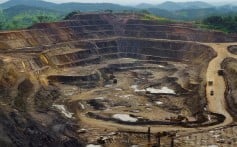
Mines have been targeted by armed rebels in the past. Photo: Reuters

A gun attack in a mining area in the Democratic Republic of Congo (DRC) has killed three Chinese nationals, the official news agency Xinhua reported on Monday.

The attack took place on Saturday in the northeastern province of Ituri, which borders Uganda and South Sudan, Xinhua said, citing the Chinese embassy.

It did not name the mine in question or the company operating it.

The DRC is the world’s biggest producer of mined cobalt – a key ingredient in batteries for electric vehicles – and one of Africa’s biggest copper producers, although its key copper-cobalt producing region is in the southwest, far from the site of the attack.

The country has attracted billions of dollars in investment from Chinese miners in recent years despite security risks.
Congo sends in troops to guard Chinese-owned copper mine amid fears of human rights abuses
20 Jun 2019

Canadian gold miner Banro, which owns mines in Maniema, a DRC province south of Ituri, suspended operations last year after several of its mines were overrun by armed rebels.

The Chinese embassy has asked the Congolese government to “take effective measures to protect the lives and property of Chinese citizens” in the DRC, as well as to expedite an investigation into the killings, Xinhua said, noting that the embassy had repeatedly advised Chinese citizens against travel to Ituri due to the presence of armed groups.

The embassy did not immediately respond to a request for comment on Monday, a public holiday in China.

Source: SCMP

06/04/2020

My Money: ‘People have started leaving their houses again’

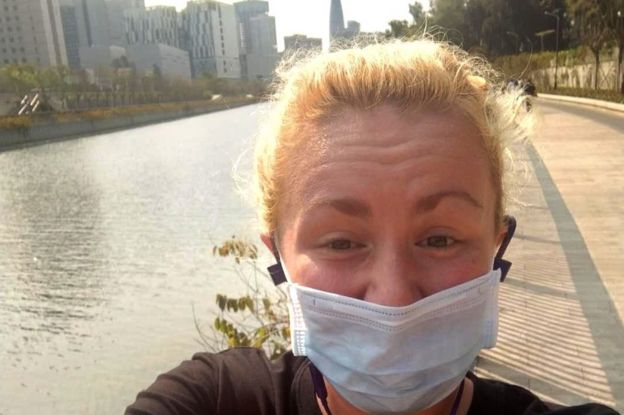
Jen Smith in a maskImage copyright JEN SMITH
Image caption Jen Smith lives in Shenzhen, where it’s compulsory to wear a mask outside at all times

My Money is a series looking at how people spend their money – and the sometimes tough decisions they have to make. Here, Jen Smith, a children’s TV presenter from Shenzhen in southern China, takes us through a week in her life, as the country slowly emerges from the coronavirus pandemic.

Over to Jen…

Monday

Since being in lockdown I’ve been bingeing on Keeping Up With the Kardashians. It starts with one episode after dinner, blink, and suddenly it’s 3am. YouTube, Facebook, Google and Instagram are all banned here, so you’d think I’d be a binge-free socialite after a year and a half living in China. Well, those sites are banned unless you have a VPN – I pay $120 (£97) a year for mine, so Sunday was a late night, with a lie-in until 10.30 this morning.

I go for a run – mask and all, as it’s currently illegal to be outside without one. I make my coffee (bought in the UK), fruit smoothie (about 20 yuan, $2.82, £2.27) and cereal (80 yuan a packet) before cycling to work.

Today is a bit of a crazy day in the studio. I work as a children’s TV presenter. My company has profited from the lockdown as more children are watching the shows non-stop – meaning a rapid turnaround for us.

We shoot two shows from 2-6pm then “break” for a meeting. We discuss tomorrow’s shoot while I eat dinner – homemade aubergine curry. It is normal for the Chinese to eat breakfast, lunch and dinner at work. Normally the company gives all staff 25 yuan through a food-ordering app, and the whole company would eat together. However, because of the current social distancing, that social time is in the far distant past!

I make it home for 8pm, order some deep-fried cauliflower as a snack (45 yuan) and start the inevitable Kardashian binge.

Total spend: 65 yuan ($9.10, £7.37)

Tuesday
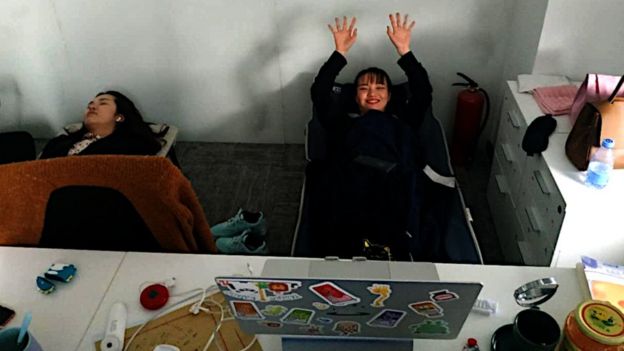
Workers napping in the officeImage copyright JEN SMITH
Image caption Workers often have a midday nap in the office

It’s a much earlier start (7.30am), but the same morning routine. On my cycle to work I notice that the traffic is almost back to normal – Shenzhen is inhabited by well over 12 million people, so as you can imagine rush hour is intense. This doesn’t change the fact that everywhere you go you have to scan a QR code – leaving my apartment, using the walkway by the river, and getting into the building I work in.

After a morning of shooting I eat homemade potato curry and settle down for a nap. Naptime is such a commonality in China that people store camp beds at the office. I order a coffee and banana chips (20 yuan) for a pick-me-up before the afternoon’s shooting.

It’s St Paddy’s Day so I head to the local pubs area, catch dinner at a French restaurant (222 yuan), then a few drinks (25 yuan – mainly bought by men at the bar for us) before a very tipsy cycle home.

Total spend: 242 yuan ($34, £25)

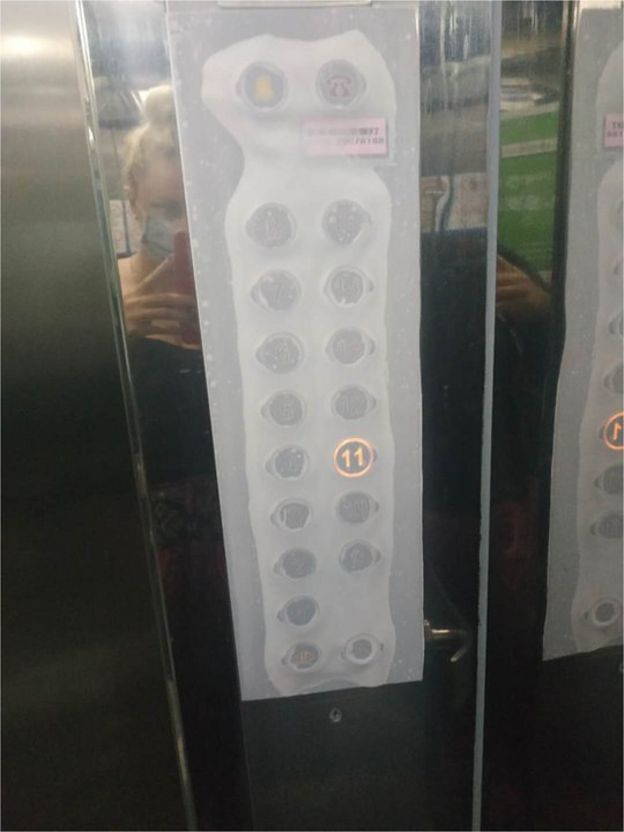
Disposable cover for lift buttonsImage copyright JEN SMITH
Image caption A disposable cover reduces the risk of transmitting the virus by touching lift buttonsPresentational white space
Wednesday

The morning’s shoot (thankfully) was cancelled, so I nursed a hangover in bed until around 11am, at which point I had a phone meeting for a company that I do “plus-size” modelling for (for context I’m a UK size 12). I eat a bowl of cereal and order more cauliflower (45 yuan) while I watch a film.

At 2.30pm an intern picks me up, and we head to the government building to apply for a new work visa. Ironically, the image taken for my visa is Photoshopped to remove wrinkles, freckles and my frizzy hair. When I ask why this is being done for an identification document, the intern replies that the government wants it to be neat, and “the Chinese way” is to have altered photos.

I don’t argue, and have an interview before I hand in my passport. The whole process takes around two hours, so I order food to my house while on the way home (150 yuan for burger, salad and cake!) I take a taxi across town which ends up being 39.05 yuan.

Total spend: 234.05 yuan ($33, £27)

Presentational grey line

My Money

More blogs from the BBC’s My Money Series:

Presentational grey line
Thursday

The day starts at 8.30am with coffee and reading, before I get a manicure (280 yuan). My nail lady has been very worried about the state of my hands during the virus, so she spends a whopping two and a half hours treating them while I watch a film (0.99 yuan – bought by her). Because the manicure was so long I don’t have time to eat lunch before our fitness shoot, which runs from 2-5.30pm. I then have an appointment to sign into a building which I’ll shoot in tomorrow.

The building is near a supermarket called Ole (one of the only western supermarkets), and I pick up groceries for 183 yuan before heading home to cook, listen to podcasts and prep for the big day of shooting on Friday.

Total spend: 463 yuan ($64, £52.5)

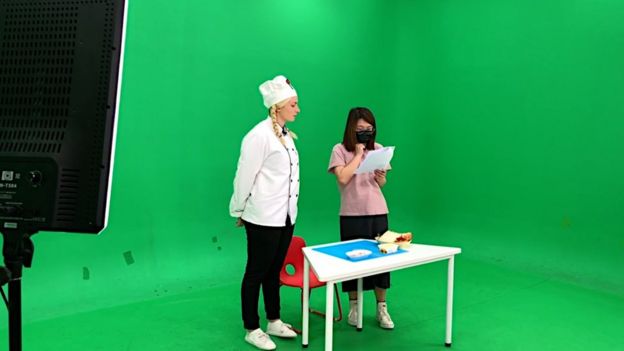
Jen Smith filming a TV show in front of a green screenImage copyright JEN SMITH
Image caption Jen filming in front of a green screen – a more colourful digital background will be added later in post-production
Friday

Fridays are generally my busiest day. The way the Chinese seem to function, is a boss will say “I want this done now” and then employees rush to finish it. Generally, they will write scripts on Monday and Tuesday, discuss Wednesday, then we shoot later in the week. The poor editors, despite mandatory office hours during the week, then have to work tirelessly through the weekend to achieve a Sunday evening deadline.

I start with mashed avocado and a hard-boiled egg before work. The morning shoot runs from 9.30-11.40am, and I have an early lunch – homemade curry again, before my regular nap time. The afternoon shoot is three hours, so I have time to pop home and shower before a live stream at 6pm. I take a taxi to and from the live stream which ends up being 28 yuan.

Total spend: 28 yuan ($3.92, £3.18)

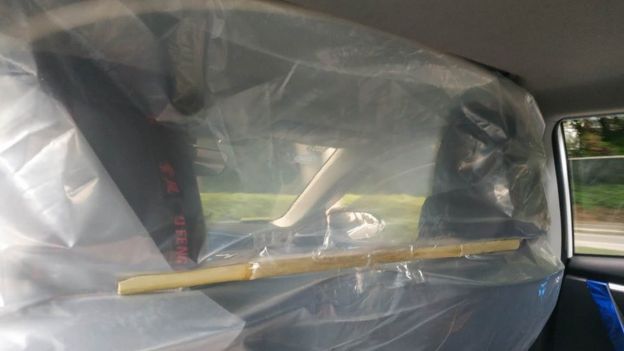
Plastic sheeting attached to car seats in a taxiImage copyright JEN SMITH
Image caption A taxi driver has improvised a screen to reduce the risk of picking up Covid-19 from a passenger
Saturday

Finally the weekend! Although things are slowly getting better in China after the coronavirus outbreak, there’s still not too much to do. So I use this time to write, play my piano and generally chill inside. Around 3pm, I venture outside to the shops to pick up some snacks (159.60 yuan) before settling in to ring my family back in the UK with a homemade cocktail – a friend of mine in Canada is doing a daily live stream, “quarantinis” where he teaches you how to make cocktails!

What’s interesting is that a lot of people have started leaving their houses again, but it is still illegal to go outside without a mask on, and temperature checks are taken everywhere. I was even refused entry to a building due to being foreign. I imagine this is because recently the only new cases are being brought in by non-Chinese travelling back to China.

Total spend: 159.60 yuan ($22, £18)

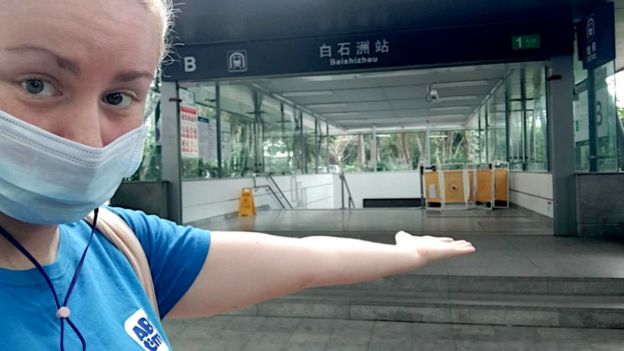
Jen Smith in front of an empty Metro stationImage copyright JEN SMITH
Image caption Shenzhen’s Metro system is still very quiet
Sunday

It’s another slow day for me as many foreigners have not yet returned to China, so most of my friends are out of the country. I start the day by reviewing potential scripts.

This takes me to 1.30pm without realising I haven’t eaten. I decide to go for a quick run and I return to eat mashed avocado and a hard-boiled egg.

I home-bleach my hair with products bought in the UK, then head back to editing again. About half way through the afternoon I take a little break to practice Chinese. I use an app which is fantastic and free! Definitely worth everyone downloading this during social distancing so you can learn new skills!

For dinner I order online again, a three-dish meal for 160 yuan.

Total spend: 160 yuan ($22.4, £18)

Overall weekly spend: 1352 yuan ($189, £153)

Source: The BBC

06/04/2020

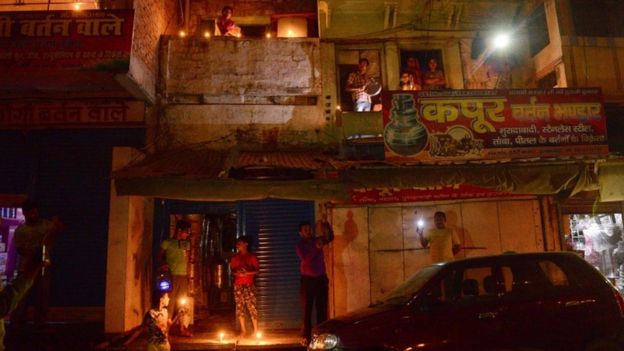
Coronavirus: India holds lights-off vigil as Modi calls for unity

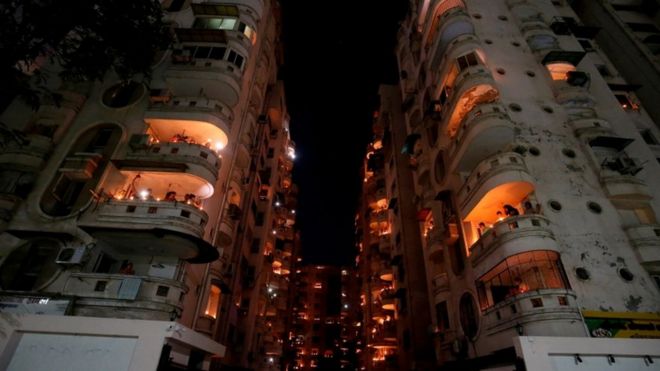
People stand on their balconies and light candles and oil lamps in IndiaImage copyrigh tREUTERS
Image caption India’s prime minister called on the country to “challenge the darkness” of coronavirus

Indians have turned off their lights for a nationwide candle-lit vigil, heeding a call for unity as the country battles coronavirus.

Prime Minister Narendra Modi asked India’s 1.3 billion citizens to observe nine minutes without electricity at 21:00 local time (16:30 GMT) on Sunday.

He urged them to “challenge the darkness” of Covid-19 by lighting candles and lamps.

Millions responded, lighting up the night sky in a show of unity.

“Salute to the light of the lamp which brings auspiciousness, health and prosperity, which destroys negative feelings,” Mr Modi tweeted at the time of the vigil.

Residents light candles and turn on their mobile phone lights in IndiaImage copyright GETTY IMAGES
Image caption Millions of Indians observed the nine-minute vigil called for by Mr Modi

There have been more than 3,500 confirmed infections and around 100 deaths from Covid-19 in India, the latest figures from Johns Hopkins University say.

The true figures, however, are thought to be far higher. India has one of the lowest testing rates in the world, although efforts are under way to ramp up capacity.

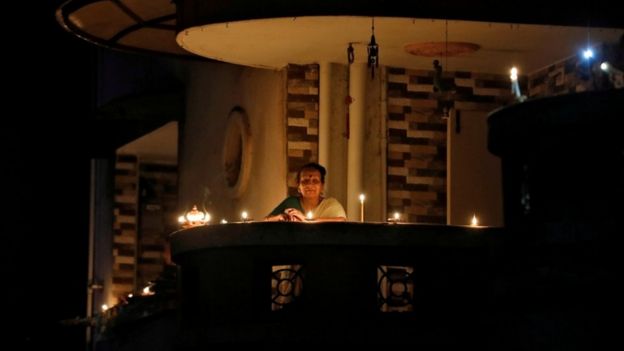
A woman stands on a balcony after lighting an oil lamps in IndiaImage copyright REUTERS
Image caption India has been under lockdown since 25 March

There are fears that a major outbreak in the country – one of the world’s most densely populated – could result in a humanitarian catastrophe.

People are banned from leaving their homes under the lockdown measures. All non-essential businesses have been closed and almost all public gatherings are banned.

Media caption As cases of coronavirus rise and the virus hits India’s congested slums, will the country cope?

But the shutdown sparked an exodus from major cities such as Delhi, forcing thousands of migrant labourers to walk hundreds of kilometres to their native villages.

Last week, Mr Modi apologised for the impact of the strict stay-at-home measures, saying there was “no other way” to stop the spread of the virus.

The PM said the restrictions would remain in place for 21 days, but officials have warned that the lockdown could be extended in parts of the country.

Source: The BBC

06/04/2020

South Korea reports fewer than 50 new coronavirus cases

SEOUL (Reuters) – South Korea reported fewer than 50 new coronavirus cases for the first time since its peak at the end of February as daily infections in Asia’s largest outbreak outside China continued to trend downward.

The Korea Centers for Disease Control and Prevention (KCDC) said on Monday there were 47 new infections as of midnight on Sunday compared with 81 recorded a day earlier, taking the national cumulative tally to 10,284.

The death toll rose by three to 186, while another 135 people have recovered from the virus for a total of 6,598.

South Korea has largely managed to bring the epidemic under control for now, with around 100 or fewer new daily cases for the past month, but it was the first time the rate of daily cases dropped below 50 since 909 were reported on Feb. 29.

But officials urged even greater vigilance, saying a large epidemic could reemerge at any time, with smaller outbreaks in churches, hospitals and nursing homes, as well as infections among travellers, continuing to arise.

A fall in daily demand for tests to some 6,000 from around 10,000 over the weekend contributed to the decline in numbers, Vice Health Minister Kim Gang-lip said.

“We are taking great caution against any optimistic expectations with this one-off figure,” he told a regular briefing.

BREAKING OUT OF ISOLATION

On Saturday, the government extended its intensive social distancing campaign by two weeks, citing sustained infections among small clusters and travellers.

South Koreans had refrained from socialising in February when the number of patients exponentially rose, but more people started going out recently as the weather became warmer and fatigue grew about social distancing, Kim said.

The movement of citizens spiked about 20% over the weekend compared to the end of February, he said, citing data from the state-run statistics agency and SK Telecom, the country’s largest mobile operator.

Starting Sunday, the government toughened penalties for those who violate self-quarantine rules to up to 10 million won ($8,100) in fines or one year in prison from 3 million won ($2,400) in fines.

Authorities have reported several cases of breaching quarantine rules over the past few days. The Gunpo city government south of Seoul said on Sunday it has filed a complaint with police against a couple in their 50s and their children who broke away from isolation and went out even after testing positive for the virus.

A Korean student residing in the United States sparked public uproar after taking fever remedy before flying home late last month. The student was found to have contracted the virus, putting some 20 other people who took the same flight in self quarantine.

“We cannot maintain social distancing for ever,” Kim said. “But it is the most effective measure to help protect others and yourself.”

Source: Reuters

05/04/2020

Spain’s health workers overburdened and undersupplied in coronavirus fight

  • More than 15,000 workers infected as hospitals struggle with a lack of test kits and protective gear
  • Chronic shortages are forcing emergency teams to ration equipment and come up with their own makeshift solutions
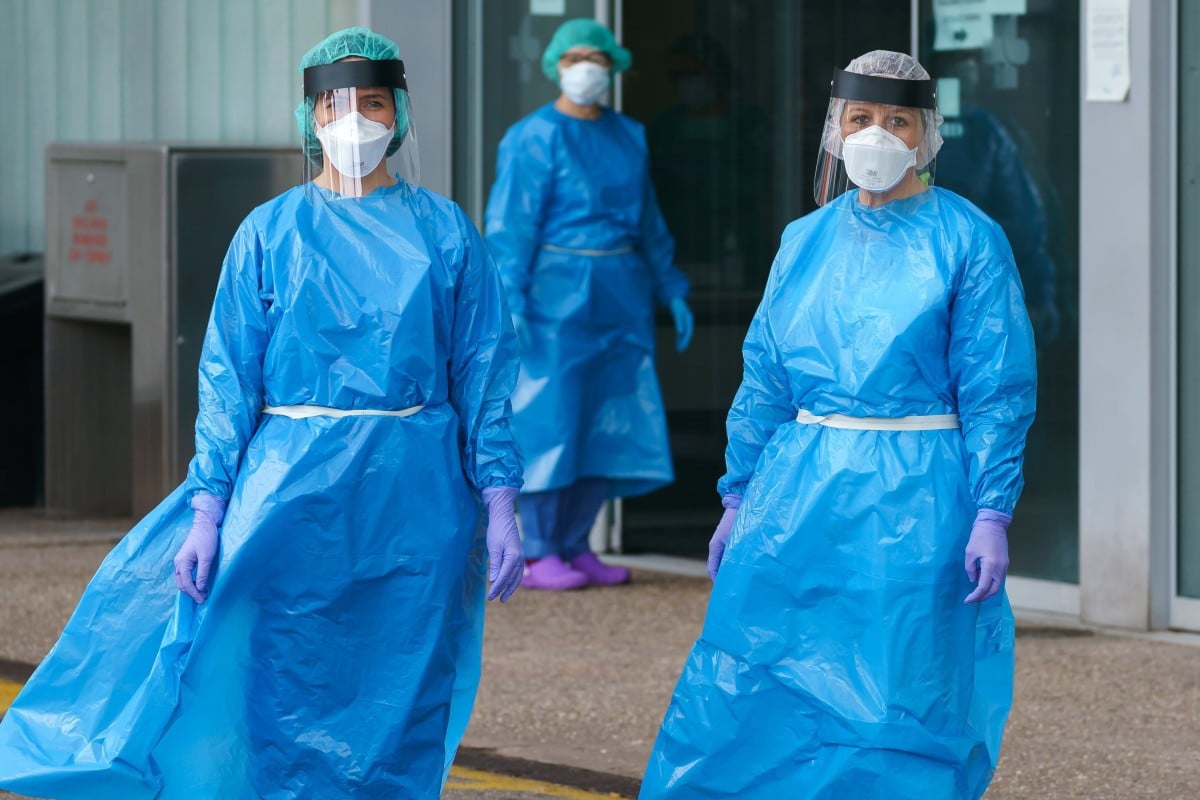
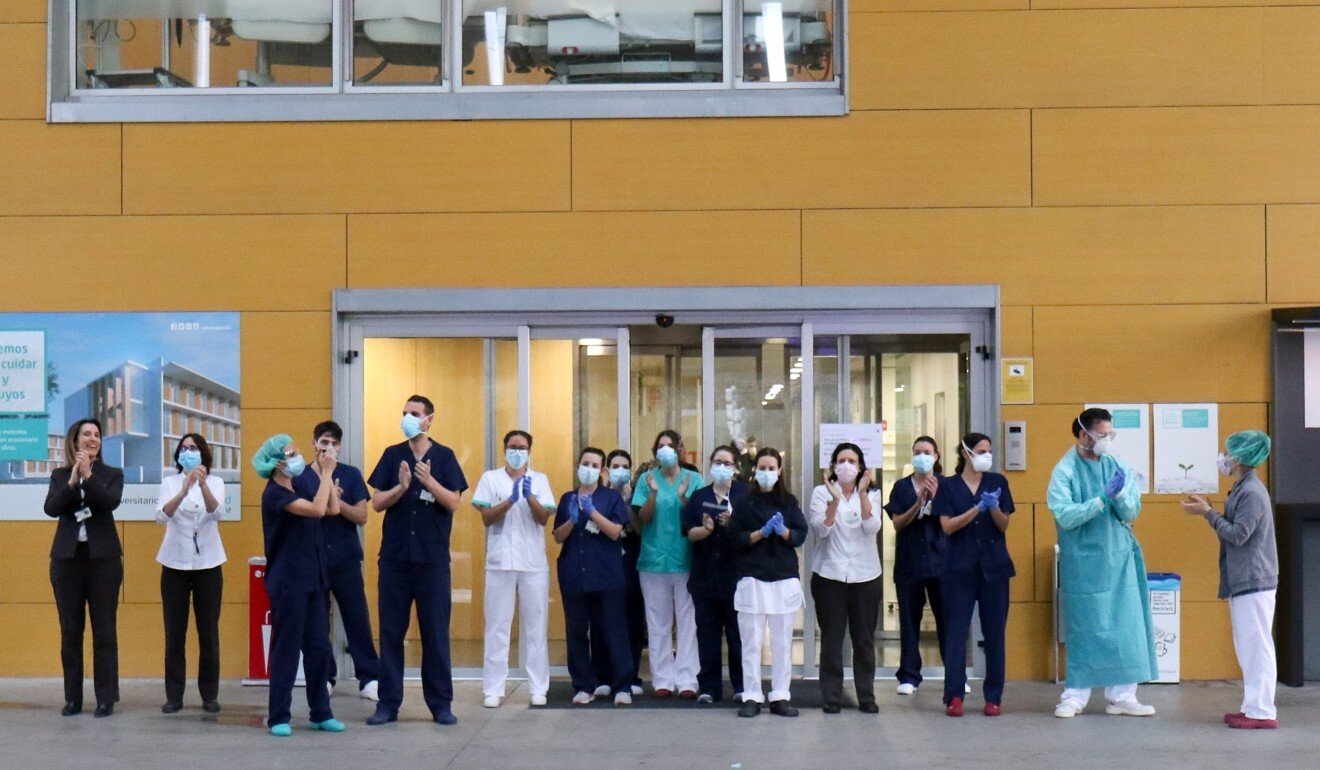
Health workers in protective gear outside an emergency entrance to a hospital in northern Spain. Photo: AFP
Overburdened hospitals and a shortage of protective measures and tests are taking a toll on Spanish medical professionals who are contracting Covid-19 – the illness caused by the new coronavirus – at an alarming rate.
To date, more than 15,000 health professionals in Spain – about 14 per cent of the national total – have been infected. In contrast, Italy reported that health workers accounted for about 10 per cent of its infections.
“I have tried to be careful, but when you work in a hospital, no one can guarantee that one of your colleagues doesn’t have the virus in the asymptomatic phase,” said ambulance crew member Xevi Mateu, who tested positive for the virus a week ago.

Mateu, who lives and works in Catalonia, said he thought he might have got infected during a meal break at the hospital or while on duty in the cramped space of an emergency vehicle.

Europe faces Easter indoors as Spain’s virus cases surge past 100,000

2 Apr 2020

Information on how to protect himself from the rampaging pandemic was conflicting, he said, and with no guarantee on future supplies he was forced to ration his use of protective equipment as soon as the demand for ambulance services began to exceed capacity.

Albert Gual, another emergency worker in Catalonia, said protocols had changed since he first started transferring Covid-19 patients to hospital, and he believes the shortage of protective equipment is to blame.

“At the beginning of the crisis, we threw away the glasses, the medical suit and the mask after one use. Now we are using one mask per day, until the stock runs out,” Gual said.

“Yesterday I talked to a colleague from the emergency service who told me they are overwhelmed – without material, without resources, without people. The medical suits are reused and sterilised until they have holes,” he said.

There have also been reports of doctors and nurses in Spain making their own protective clothing out of bin liners.

To ease the burden on Spain’s medical workforce, retirees have been asked to return to practice and newly licensed personnel have been recruited to make up the shortfall. One of the new recruits is Candela Lebrero, who completed her medical degree last year and is now a nurse at a hospital in Madrid.

The Spanish capital has seen the country’s largest number of infections – with more than 36,000 – and staff at the Madrid Principe de Asturias Hospital, where Lebrero works have been among those falling ill from the disease.

Reports of an overload of patients were very real, she said, with emergency rooms forced to send less serious cases to “medicalised hotels” and additional hospital wards switched to caring for Covid-19 patients.

As for rapid testing, it “hadn’t arrived yet” at Lebrero’s hospital, which was relying on PCR tests – the swab technique which identifies the presence of any genetic material belonging to the virus – as a diagnostic for both patients and health personnel who presented with symptoms, she said.

Similar problems have been reported across Spain and last week the health ministry’s coordinator for the emergency response, Fernando Simon, acknowledged the difficulties for health care workers to access protective equipment.

On March 25, Simon admitted the jump in infections among medical staff was due to “a market access problem” as supplies “are scarce and there is non availability” – a problem not limited to Spain.

“We are on the way to a solution,” he said. On Monday, Simon also tested positive for the disease.

While equipment shortages are a global problem, Spain was hit particularly hard after its two largest distributors of medical supplies – located in France and Germany – were ordered to stop selling by their governments in early March, fearful of depleted stocks in their own countries as the pandemic spread.

The decision, which was criticised for being contrary to the spirit of the European Union, forced the Spanish government to turn to other measures, including the purchase of 432 million (US$467 million) worth of supplies from China.

A freight corridor was also opened to speed deliveries, and Spanish manufacturers were put on a “war footing” to urgently switch to making medical supplies. The car industry is now turning out respirators and gels, while textile manufacturers have turned their hand to producing gowns and face masks.

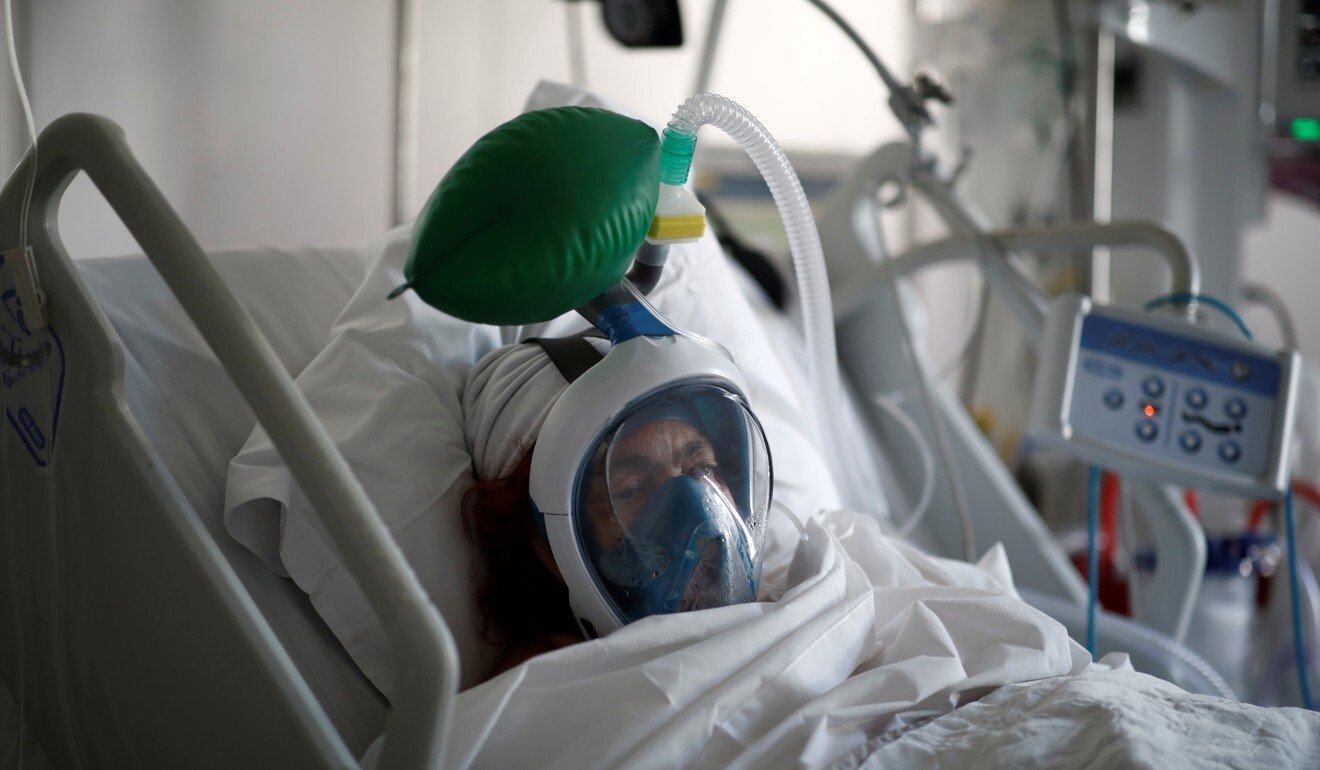
Sports equipment chain Decathlon has even adapted its snorkel goggles for medical use and donated its entire stock to Spanish hospitals.

A Covid-19 patient wears a full-face snorkelling mask which has been converted into a ventilator. Photo: Reuters
The scramble to address shortages in Spain’s overstretched health system has not been without problems. Last week, the government withdrew 58,000 Covid-19 rapid test kits
 it bought from a Chinese company, after their accuracy rate was reported to be just 30 per cent.
China said the kits were not approved for sale and not included in supplies sent by Beijing to Spain.
It is not clear if the supplies from China have arrived, but on the ground medical personnel said they had not yet seen the equipment.
“It is assumed that the new ones have already arrived, but they have to pass the approval of the Carlos III Public Health Institute [a Spanish public health research institute], and their use is not yet widespread,” Laura Díez, press officer for the State Confederation of Medical Unions said.
“Their arrival will improve the situation since at least it would be known if someone in contact with the infected could transmit the disease, especially health personnel,” she said.
Medical staff in Spain acknowledge the daily applause from the public which has become a feature of the coronavirus pandemic. Photo: DPA
Several health organisations have appealed to the courts in their desperate bid to get hold of protective equipment. A Madrid court did accept the argument by an association of doctors that the authorities should be forced to provide adequate supplies to all health personnel.
But the Supreme Court refused to support the claim, saying it recognised the government was doing everything it could.
“We presented precautionary measures and they were dismissed, we have filed an appeal,” Díez said.
“At the moment we have no answer. Authorities said that planes with the material are arriving, but at the hospitals, they are not seen.”
Spain says Covid-19 can lead to closer ties with Chinese medical suppliers
29 Mar 2020

Meanwhile, the General Councils of Dentists, Nurses, Pharmacists, Doctors, and Veterinarians, which represent more than 700,000 health professionals in Spain, expressed its “absolute rejection” of new guidelines for medical workers set by the health ministry.

In a notice issued on Friday, the ministry said that health professionals that had not been tested for Covid-19 but who took time off should return to work seven days after the onset of symptoms as long as they did not have a fever or respiratory problems.

Once back at work, they should wear a surgical mask for 14 days from the onset of symptoms and avoid contact with other people.

The general councils said some of the guidelines represented “a serious risk” to the health of professionals and their patients.

Ambulance worker Mateu is currently in isolation at home as he recovers from the disease, but his thoughts are with his colleagues and their daily struggle. He said he thanked his supervisors and coordinators for working hard every day.

With so many of the staff themselves sick, there was a lot of stress on those who were still at work, he said.

“I have the feeling that the effort and management is not being done from the top down, but from the bottom up: from us who work directly with the patients, our supervisors and they are continuing the chain of gestures and efforts,” he said.

Source: SCMP

05/04/2020

Coronavirus: from China to the US, consumer behaviour radically altered as world retreats into ‘survival mode’

  • The coronavirus pandemic has completely changed patterns of consumer psychology across the world, experts say
  • Complexity of the crisis, the number of variables and its magnitude make a consumer recovery unprecedented and difficult to predict
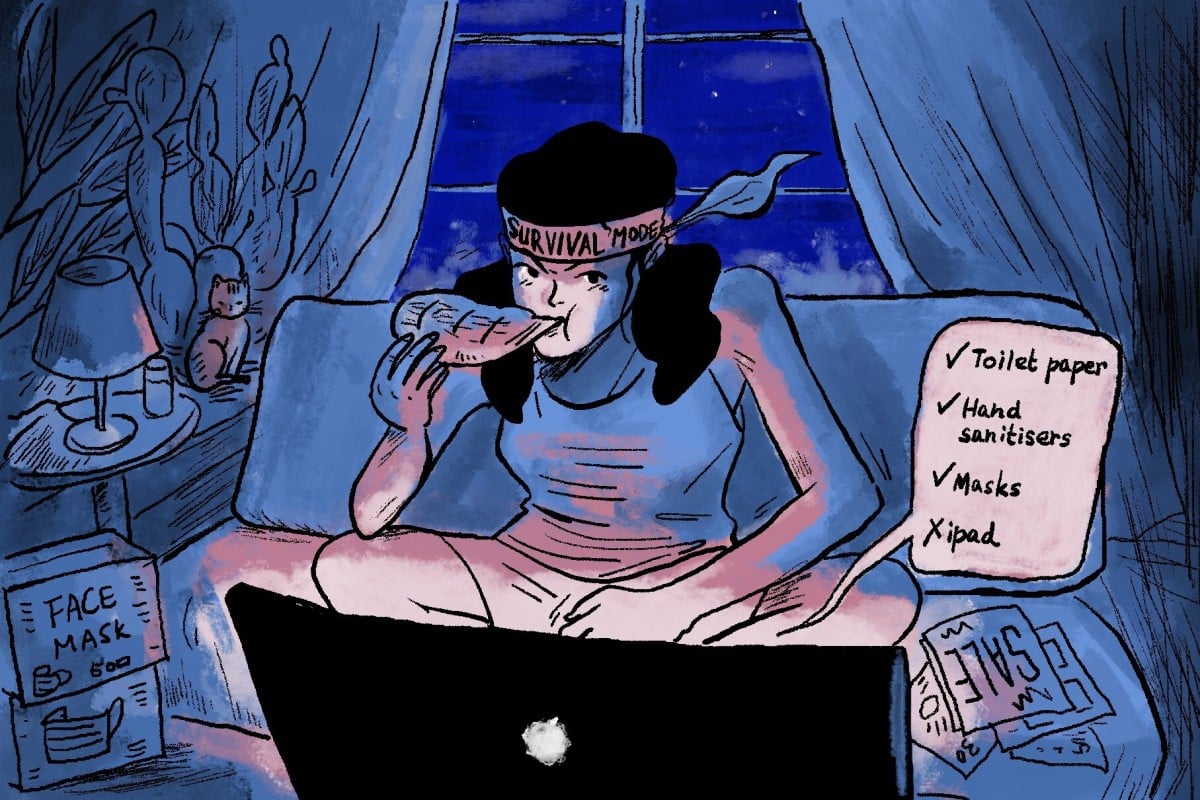
The coronavirus has caused panic buying around the world as consumers frantically stockpile of goods such as toilet paper, hand sanitisers and masks. Illustration: Brian Wang

Before the coronavirus crisis began rippling through the global economy, Susan Wang had big plans for 2020.

Not only was she going to buy a new Apple MacBook and iPad, plus a projector so she could host friends for movies at home, but she was set on making a career move.

“I was planning to change my job, but my headhunter told me that all recruitment has been postponed to the second quarter,” said the 27-year-old who works for a British company in Hong Kong.

“Our headquarters in London has a plan for redundancy, too. It is better to save some money in case I get laid off.”

As Covid-19 spreads across the world, sending stock markets reeling and prompting big companies to slash jobs, Wang has become increasingly frugal like scores of other consumers from China to the United States.

She has stopped eating at restaurants and now tries to keep her weekly food bill under HK$500 (US$64), whereas in the past she wouldn’t think twice about spending HK$100 per meal.

Amid mounting uncertainty, the coronavirus pandemic – which has claimed the lives of more than 41,000 people and infected at least 842,000 worldwide – is fundamentally changing consumer behaviour in Asia, Europe and North America.

Consumer experts said the 2009 global financial crisis, the Great Depression that started in 1929 and the September 11 terrorist attacks give some clues about how and when global consumption might recover. But the complexity of this crisis, the number of variables and its magnitude make this consumer recovery unprecedented and difficult to predict, they added.

Coronavirus: What impact will the economic fallout from the Covid-19 pandemic have on you?
“The coronavirus pandemic has completely changed patterns of consumer behaviour all over the world. People are afraid, and when people are afraid, they go into survival mode,” said Jesse Garcia, a Los Angeles-based consumer psychologist, who is also the CEO of market consulting firm My Marketing Auditors.
Hong Kong’s retail sales

plummeted a record 44 per cent in February and those figures are only expected to get worse, with sales forecast to slump between 30 and 40 per cent in the first half of the year, according to the Hong Kong Retail Management Association.

In the US, retail sales dropped by 0.5 per cent in February, even before many states had issued stay-at-home orders to protect the world’s largest economy. The decline was the biggest fall since December 2018.

Experts say non-essential products and services are set to be worst affected by the coronavirus pandemic, while goods and services that can be consumed at home will see a spike in sales.

The coronavirus pandemic has completely changed patterns of consumer behaviour all over the world. People are afraid, and when people are afraid, they go into survival mode – Jesse Garcia

“Online consumer behaviour is frenetic,” said Ross Steinman, a professor of psychology at Widener University in the US state of Pennsylvania. “Consumers are refreshing and refreshing and refreshing websites to secure grocery delivery times, purchase paper towels from their usual big box retailer and scavenge for rice and canned soup from third party sellers on Amazon.

“A pronounced spike in coronavirus cases will only amplify the freneticism.”

So far, one of the biggest shortages for consumers is toilet paper. Television stations across the globe have beamed images of empty supermarket shelves and huge queues as people hoard toilet paper rolls, masks and hand sanitiser.
The frantic stockpiling can be explained by a psychological concept called informational conformity, said Vicki Yeung, associate professor at the Department of Applied Psychology at Lingnan University in Hong Kong.

A pronounced spike in coronavirus cases will only amplify the freneticism – Ross Steinman

“When people lack knowledge and are in an uncertain situation, they tend to follow the group’s behaviour and blindly conform, but once they obtain more information, and digest and process the situation, the panic gradually fades away,” she said.
“During this Covid-19 pandemic, people generally feel jittery and anxious because they feel their sense of control has disappeared.”
Unlike other recent global crises such as the September 11 attacks, the coronavirus is less a one-time sharp shock to the system and more of a rolling source of anxiety that could retreat and resurface repeatedly, consumer behaviour experts said.
This was the pattern with the Black Death plague that hit Europe in 1347 and returned episodically over many years, ultimately killing millions of people.

During this Covid-19 pandemic, people generally feel jittery and anxious because they feel their sense of control has disappeared – Vicki Yeung

“It may be we’ll have to shut down things again in October or August. And this could go on for years,” said Charley Ballard, an economist with Michigan State University in the US. “The more that happens, the more damage it does to buoyant consumer psychology.”

Furthermore, relative to the 2009 financial crisis and even the Great Depression, when much of the damage was concentrated at least initially in the financial sector, this crisis has seen virtually the entire economy grind to a halt all at the same time, devastating employment and consumption.

Last week, a record 3.3 million Americans applied for unemployment benefits within one week, as restaurants, hotels, barber shops, gyms and retail outlets shut down in a nationwide bid to stem the pandemic. The previous record of 695,000 was set in 1982.

On Tuesday, Goldman Sachs predicted the US jobless rate will hit 15 per cent in the second quarter of this year from the coronavirus economic freeze, and could rise further beyond that to near the historic peak of 24.9 per cent seen in 1933 during the Great Depression. Economists at the St. Louis district of the US Federal Reserve projected unemployment could cost as many as 47 million jobs in the US this year, sending the unemployment rate past 32 per cent before making a sharp recovery.

US now has world’s most coronavirus cases, surpassing China
China’s unemployment rate jumped to 6.2 per cent for January and February from 5.2 per cent in December and 5.3 per cent a year earlier. It was the highest level since records began in 2016, but did not include China’s estimated 291 million migrant workers.
Consumer spending accounts for more than 60 per cent of the Chinese economy and drives 70 per cent of the US economy. But with the pandemic causing many people to go into hibernation and likely to lead to cycles of job cuts, economists have predicted a consumer-led global recession by the second quarter of this year.
Just how long it will take for consumer behaviour to return to normal depends on each person’s psychological resilience, including how quickly they can adapt to change, how optimistic they are and whether they can adopt strategies to regain a sense of control, Yeung said.
Anirban Mukhopadhyay, chair professor of marketing at  Hong Kong University of Science and Technology said as long as the coronavirus threat was still present, people would remain fearful to some extent. But he added that people were resilient.
Satellite images show world sites deserted amid coronavirus pandemic
“Human beings adapt to events and stimuli over time,” Mukhopadhyay said. “Research has shown that even people who win lotteries tend to return to their earlier levels of life satisfaction after some months, as do people who have to have amputations.
“So even if the source of the fear does not go away, we learn to live with it.”

Ballard, from Michigan State University, estimated it could take upwards of two years for American consumers to feel secure enough in their jobs and gain enough confidence to fully open their wallets. A longer and more episodic duration for the disease could push that higher, he added.

Further complicating the consumer picture, he said, is that many supply chains are at risk of breaking. And consumers will be wary of spending for a while in many traditional areas, including crowded sporting events and concerts, restaurants and flights.

A new phase of coronavirus blame game: what is the legacy of Covid-19 on global supply chains?
Some experts have even suggested that consumer behaviour may be permanently changed as a result of the pandemic.
“It seems very unlikely that people will get back to life as it was before, once the coronavirus is over,” said Andreas Kappes, a lecturer in psychology at City University of London.
“People’s behaviour is extremely orthodox, often referred to as the status quo bias and captured in expressions like ‘past behaviour best predicts future behaviour.’ Now, the crisis forces us to change our behaviour, radically, and we might discover that new way suits us better.”
Source: SCMP
05/04/2020

China’s Huangshan mountains swamped with visitors as country tries to ease coronavirus lockdown

  • Pictures of packed trails over the weekend highlight difficulties in maintaining social distancing while trying to get back to normal
  • Attraction in Anhui province said it would be forced to close on Sunday after exceeding its 20,000-visitor limits
== PICTURE CAPTURED FROM WEIBIO == Huangshan Mountains in China’s Anhui province was forced to close after tens of thousands of people flocked to the popular mountain range over the weekend, highlighting the difficulties in getting the country’s social life back to normal while keeping the coronavirus outbreak under control.  Huangshan, or the Yellow Mountains, located in southern Anhui province in eastern China, said in a notice today that it had to close because the number of visitors had reached its limit of 20,000 for the day. Tourists are advised to visit the site on other days or try travelling to other sites.   Since April 4, the Anhui government has been offering free access to 29 tourist sites in the Huangshan region, including the Yellow Mountains, to local residents for 2 weeks, in a bid to drum up more business since its reopening in late February as it seeks to get its economy back to normal.  Photo: WEIBIO
== PICTURE CAPTURED FROM WEIBIO
Huangshan Mountains in China’s Anhui province was forced to close after tens of thousands of people flocked to the popular mountain range over the weekend, highlighting the difficulties in getting the country’s social life back to normal while keeping the coronavirus outbreak under control. Huangshan, or the Yellow Mountains, located in southern Anhui province in eastern China, said in a notice today that it had to close because the number of visitors had reached its limit of 20,000 for the day. Tourists are advised to visit the site on other days or try travelling to other sites. Since April 4, the Anhui government has been offering free access to 29 tourist sites in the Huangshan region, including the Yellow Mountains, to local residents for 2 weeks, in a bid to drum up more business since its reopening in late February as it seeks to get its economy back to normal. Photo: WEIBIO

A popular mountain range in southeast China was forced to close after tens of thousands of people flocked to its trails over the weekend.

The crowds flocking to the Huangshan, or Yellow Mountains, in Anhui province highlight the difficulties the country may face in future as it tries to get back to normal while keeping Covid-19 under control.

Starting from Saturday, the Anhui provincial government had been offering free entry to 29 sites, including Huangshan, to boost visitor numbers.

Visitors were asked to show their health status on an app, wear surgical masks and their body temperatures had to be checked before entering the site.

But on Sunday the park authorities said it would have to close because the number of visitors had reached its daily limit of 20,000 and urged people to visit other sites or come to the mountains at another time.
Coronavirus: China pulls the plug on wasteful, unnecessary research into Covid-19
5 Apr 2020

Pictures and video circulated on the social media platform Weibo showing packs of visitors walking up the mountain range over the three-day Ching Ming festival.

“Tourism has been hit hard, and also its related industries,” said one Weibo comment. “But the epidemic isn’t over. If you must open the sites, you have to restrict the flow [of tourists], and those visitors from outside.”

As of Sunday, the number of confirmed cases being treated in the country had fallen to 2,382, according to the National Health Commission, but the total number of imported cases rose to 913.

Police try to hold back visitors to the mountain range. Photo: Weibo
“I think China is keeping a close eye on Covid-19 detections and may need to tune the social distancing measures that are needed to keep Covid-19 contained. For now, it may be OK to relax some measures, but those measures should be tightened if case numbers pick up,” said Benjamin Cowling, a professor of epidemiology and biostatistics at Hong Kong University.

“I would not be surprised if most countries continue to prohibit mass gatherings for the rest of 2020,” said Cowling, adding that temperature checks at entrances would be a good idea, but it might not be sufficient to protect visitors.

Coronavirus: Beijing’s ban on foreign travellers comes into force months after it criticised other countries for ‘isolating China’

27 Mar 2020

Anhui, which shares its western border with Hubei province, the initial centre of the outbreak, last reported a new infection on Feb 27, according to official figures. The province reported a total of 990 cases of Covid-19, including six deaths.

China’s tourism and cultural sectors are among the worst hit as a result of the outbreak.

A number of Shanghai’s popular tourist spots, including the Shanghai Oriental Pearl Tower and Shanghai Jinmao Tower had to close again last week only two weeks after reopening.

Dai Bin, president of the China Tourism Academy, a research institute under the Ministry of Culture and Tourism, told a forum in February that he expected domestic tourism would contract as much as 56 per cent in the first quarter and 15.5 per cent for the whole year.

Dai also estimated that annual income loss from tourism could hit 1.2 trillion yuan (US$169 billion) this year.

Source: SCMP

05/04/2020

As Trump administration debated travel restrictions, thousands streamed in from China

(Reuters) – In defending his strategy against the deadly coronavirus, President Donald Trump repeatedly has said he slowed its spread into the United States by acting decisively to bar travelers from China on Jan. 31.

“I was criticized by the Democrats when I closed the Country down to China many weeks ahead of what almost everyone recommended. Saved many lives,” he tweeted, for instance, on March 2.

But Reuters has found that the administration took a month from the time it learned of the outbreak in late December to impose the initial travel restrictions amid furious infighting.

During that time, the National Security Council staff, the state department and other federal agencies argued about everything from how best to screen for sick travelers to the economic impact of any restrictions, according to two government officials familiar with the deliberations.

The NSC staff ultimately proposed aggressive travel restrictions to high-level administration officials – but it took at least a week more for the president to adopt them, one of the government officials said.

In meetings, Matthew Pottinger, deputy national security adviser and a China expert, met opposition from Treasury Secretary Steven Mnuchin and National Economic Council director Larry Kudlow, said two former NSC officials and one of the government officials involved in the deliberations. The two top aides were concerned about economic fallout from barring travelers from China, the sources said.

Each day that the administration debated the travel measures, roughly 14,000 travelers arrived in the United States from China, according to figures cited by the Trump administration. Among them was a traveler who came from Wuhan to Seattle in mid-January, who turned out to be the first confirmed case in the United States.

On Jan. 22, Trump downplayed the threat posed by the virus, telling CNBC from the World Economic Forum in Davos, Switzerland, “We have it totally under control.”

The battle within the White House over whether and how to stop infected travelers from China lasted nine more days.

On Jan. 31, Trump issued a proclamation barring entry of non-U.S. citizens, other than the immediate family of citizens and permanent residents, who had traveled to China within the last two weeks. The restrictions have since been expanded to many other countries.

It is unclear when the president was made aware of the NSC’s proposal and what prompted his decision to act, but the decision followed the World Health Organization’s declaration the day before that the epidemic was a “public health emergency of international concern.”

U.S. Centers for Disease Control and Prevention officials told Reuters that they contributed to the decision as part of the administration’s newly convened coronavirus task force.

A Treasury Department spokesperson said that Mnuchin “never objected to the decision to restrict flights from China.”

A White House spokesman, Judd P Deere, said: “Any suggestion that Larry Kudlow objected to restricting flights from China to contain COVID-19 and protect the health of the American people is completely false. Larry fully supported the President’s bold decision.”

In a statement, NSC spokesman John Ullyot said that the council’s early meetings about the coronavirus involved great expertise and robust discussion and were professional.

As of April 4, the coronavirus has infected more than 300,000 people in the United States, and killed over 8,000, according to the Reuters coronavirus tracker. The country has more cases than anywhere else in the world.

The sources for this story, former NSC members, public health officials and others involved in, or briefed on, the administration’s response, spoke on condition of anonymity because they were not authorized to comment on the record.

POPPING A FLARE

The NSC, which operates within the White House to coordinate policies and recommendations involving national security across agencies, was at the center of the effort to formulate the early response to the outbreak.

The council was first notified of the outbreak on the morning of Dec. 31, according to one of the government officials involved, when an NSC official was forwarded an email from a Department of Health and Human Services (HHS) attache in Beijing that had been sent to senior HHS officials the night before.

The “pop-a-flare” notice, as it is known, described strange cases of pneumonia that could not be definitively traced to seasonal flu, said the government official, who saw the message. The email said the Chinese would soon be notifying the World Health Organization, the official said.

On Jan. 3, Dr. Gao Fu, head of China’s disease control agency, informed his U.S. counterpart, Dr. Robert Redfield, director of the CDC, in an emotional telephone call that the outbreak was growing out of control, according to the same federal official and a former NSC official. Both said they had been informed of the details.

Gao’s agency did not respond to a request for comment.

Ullyot, the NSC spokesman, disputed the timeline, saying the council did not learn of the coronavirus outbreak until Jan. 3. The CDC, a part of HHS, confirmed to Reuters that it learned of an outbreak in late December and that the call with Gao occurred Jan. 3.

Health agencies were scrambling to gather information, the two government officials involved in the deliberations said. Questions went back to the U.S. Embassy in Beijing, and experts across the government: How many travelers arrive daily from Wuhan, China, the initial site of the outbreak? What U.S. airports do they fly into? What would be the pros and cons, including costs, of any travel restriction?

In discussions with the NSC, public health officials, including from HHS and CDC, initially argued for the targeted approach of medically screening travelers from Wuhan, as they sifted through information about where and how quickly the virus was spreading, one of the government officials involved said. Public health officials tend not to favor border closures because they can restrict medical response and divert limited resources.

The NSC’s Pottinger was pushing hard for strict travel restrictions – expressing doubt about the truth of the data China was releasing, according to the official.

There was “a lot of yelling, a sign of frustration,” said a former NSC staffer who was not in the meetings but got messages from colleagues in attendance expressing dismay. The person described the messages but did not share them with Reuters. The two current federal officials confirmed the acrimony.

The NSC struggled to reconcile conflicting viewpoints, the two government officials involved said.

The debate delayed the screening of travelers from China by at least a week, one of the officials said. CDC officials ultimately announced enhanced medical screenings for travelers from Wuhan at three international airports, in Los Angeles, San Francisco and New York’s John F. Kennedy, on Jan. 17, expanding them to 20 U.S. airports by Jan. 28.

At one point, during a meeting, Pottinger snapped at health officials that their approach “really has to take a step back,” so that national security interests could shape the response, the official said.

The CDC declined to comment on the debate.

Some former NSC officials who spoke to Reuters traced what they saw as an ineffective response by the council in part to structural changes in 2018 in which former National Security adviser John Bolton had folded the council’s Global Health Security and Biodefense directorate into a larger operation, with the result that pandemic planning was not as great a priority. Others said that, under Bolton, the NSC worked effectively on biopreparedness, but after he departed it lost a number of important experts.

NSC spokesman Ullyot rejected as false the suggestion that the council lacked expertise. The council is staffed by officials with “extensive experience in virology, infectious disease epidemiology, global health security, public health, and emergency response,” he said.

The NSC’s own public health experts were involved in the discussions from the beginning, advocating “early and often” for traveler screening and raising the issue of banning flights from Wuhan, he said.

While the conflict soured the interactions, one of the government officials involved said, data soon emerged that led the health agency officials to agree with Pottinger: A travel restriction for all of China was needed. They saw that there were thousands of travelers arriving daily from Wuhan’s Hubei province to the United States, as well as a rising number of Covid-19 cases reported by the Chinese government beginning in mid-January, the source said.

In its statement to Reuters, the CDC did not directly address what led to its ultimate decision to support the travel restrictions.

By Jan. 24, the staff of the NSC had proposed restricting flights from China, said the government official involved in the deliberations. But as Pottinger met with deputies from other cabinet-level agencies, the recommendation met with resistance because of concerns about spooking the markets and scaring the public, three sources with knowledge of the deliberations told Reuters.

STILL DIVIDED

With opinions still divided, the matter went to top White House aides, at which point Treasury Secretary Mnuchin and National Economic Council director Kudlow argued strongly against the travel restrictions, said two former NSC officials and the government official involved in the deliberations.

In addition to the impact on the stock market, the two top aides expressed concern about the supply chain for everything from semiconductors to ingredients for pharmaceuticals, said one of the government officials involved in the deliberations.

Pottinger was “pleading with Mnuchin and others” to stop travelers from coming, the former NSC official said.

By then, the first known patient in the United States – a man in his 30s who had traveled from Wuhan to Seattle on Jan. 15 – tested positive for the coronavirus disease, COVID-19.

He had slipped through travel screenings because his trip had been broken up, so the Wuhan origin of his trip had not been obvious to customs agents, said the government official with knowledge of the deliberations.

At the World Economic Forum in Davos, Switzerland, President Trump told CNBC on Jan. 22: “It’s one person coming in from China, and we have it under control. It’s going to be just fine.”

On Jan. 29, the Council of Economic Advisers, which advises the president on economic policy, presented an analysis describing a worst-case scenario of what a pandemic and travel restrictions could do to the economy, according to one of the government officials involved in the deliberations, who read it. The report supported Kudlow and Mnuchin’s arguments against such restrictions and “scared everyone,” the source said.

The next day, at an afternoon meeting of the White House’s newly formed coronavirus task force, as well as other attendees, travel restrictions were still being debated, according to the government official involved in the deliberations and a former NSC official who learned of the meeting from former colleagues.

During the meeting, Mick Mulvaney, then President Trump’s chief of staff, entered the room, telling a smaller group, including Pottinger: “The president wants to see you now,” according to the official involved in the deliberations and the former NSC officials.

Mulvaney referred questions to the White House, which did not respond.

Trump issued the order the next day. By then, the novel coronavirus was already carving a lethal path through a Seattle nursing home.

Source: Reuters

05/04/2020

Philanthropists step up citizens’ diplomacy with gifts even as US, Chinese diplomats play the blame game amid coronavirus pandemic

  • The philanthropic foundations of Jack Ma and Joe Tsai, two of China’s wealthiest technology entrepreneurs, have donated 23 million face masks, 2,000 ventilators and 170,000 pieces of protective gear to New York
  • The donation, the biggest by private citizens to the epicentre of the global coronavirus pandemic, was described by New York Governor Andrew Cuomo as ‘really good news’
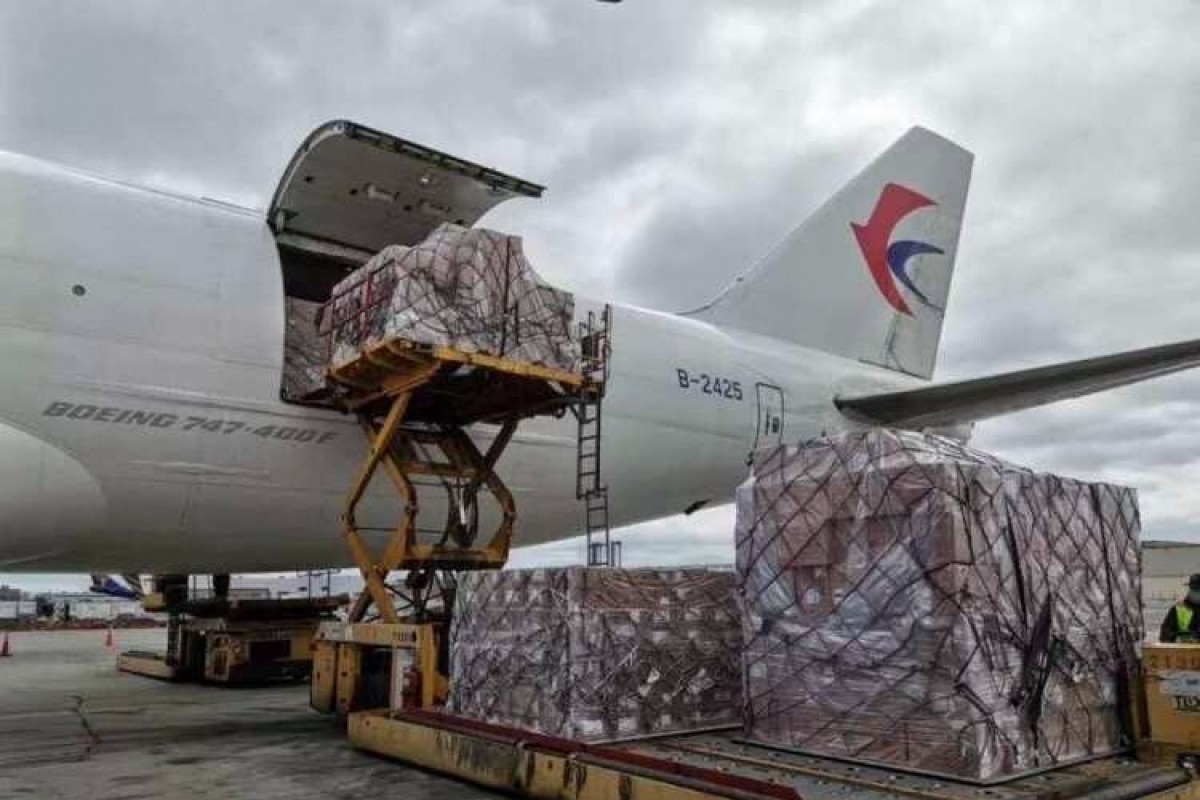
A shipment of 1,000 ventilators donated by Jack Ma Foundation and Joe Tsai Foundation, has arrived in New York. Photo: Handout
Chinese philanthropists are stepping up their donation of protective gear, essential medical and diagnostic kits to the United States, Europe and Asian countries, despite rising acrimony between diplomats and government officials looking to pin blame amid the world’s worst pandemic in decades.
The private foundations of Jack Ma and Joe Tsai, co-founders of this newspaper’s owner Alibaba Group Holding and two of China’s wealthiest technology entrepreneurs, have donated a combined 23 million face masks, 2,000 medical ventilators and 170,000 pieces of protective gear to New York city.
The first 1,000 medical ventilators arrived today, with another 1,000 on the way, for a total donation valued at US$50 million, according to a person familiar with the matter.

Delivery of the essential materials, made possible by behind-the-scene manoeuvres by the donors and officials from both the Chinese and US sides due to import and export regulatory hurdles, highlights the role of civil diplomacy in dealing with the global public health crisis.

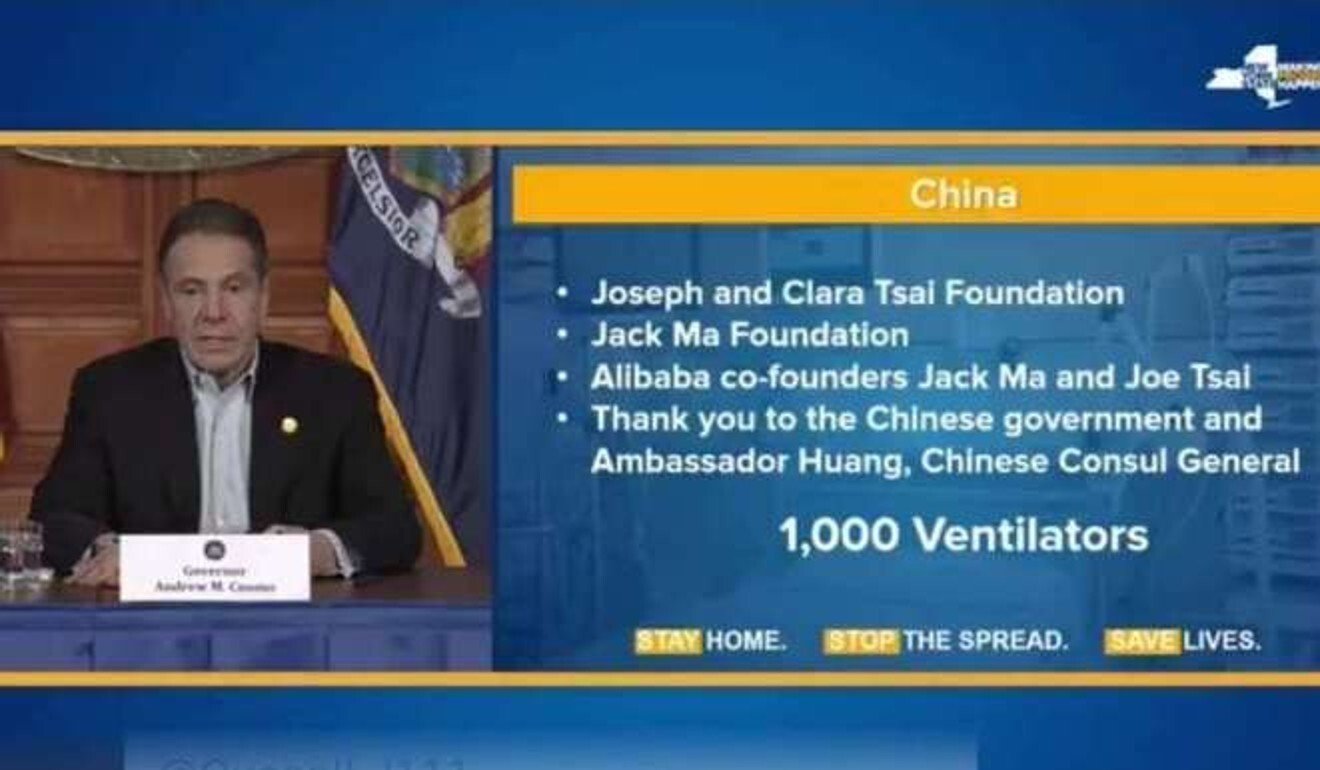
New York Governor Andrew Cuomo thanks the Chinese government for the 1,000 ventilators donated by Jack Ma Foundation and Joe Tsai Foundation, which arrived in New York on Saturday. Photo: Handout
The gesture comes as diplomats of both countries, and even government officials including the US president and his secretary of state, have engaged in a tit-for-tat war of words, as they attempt to pin the blame for the worlds worst pandemic in decades on each other.
Confirmed cases in the US have soared and surpassed China as the new global epicentre. In the US there are nearly 310,000 cases and nearly 8,500 people have died so far from the Covid-19 disease.

Jack Ma is a friend of mine and he’s made it very possible to get about 1,000 ventilators from China. But that was from him and my other friend [Tsai] that was really a gift – Andrew Cuomo, governor of New York

Andrew Cuomo, governor of New York, thanked the Chinese government for easing the transfer of the ventilators to the hard-hit state, the current epicentre of the coronavirus outbreak in the US.

He said the donations were “really good news”, as the state pushes up against the apex of the outbreak, which is likely to hit in about seven days.

“This is a big deal, and this is going to make a significant difference for us,” Governor Andrew Cuomo said on Saturday.

“Jack Ma is a friend of mine and he’s made it very possible to get about 1,000 ventilators from China. But that was from him and my other friend [Tsai] that was really a gift. And we appreciate it very much.”

One of the challenges in making the donation possible was the fact that the US had previously blocked China-made “KN95” standard masks, only allowing “3M N95” masks to be used. Although the two masks have different standards, they essentially have the same performance. On Friday, the US Food and Drugs Administration issued an emergency use authorisation for KN95 masks.

Alfred Wu, associate professor in Lee Kuan Yew School of Public Policy at National University of Singapore, said that what China is doing with its so-called masks diplomacy is very clear. “But given the emergency situation in New York, whatever channel – private or public sources – the equipment comes from, should not matter, especially those for medical workers,” he said.

Separately, the western state of Oregon has also said that it would send 140 ventilators to New York.

The state, like other areas of the US, is facing shortages of medical gear, including masks and ventilators.

“We are not yet at the apex. We are getting closer,” Cuomo said, adding that this was good as it gave the authorities more time to prepare.

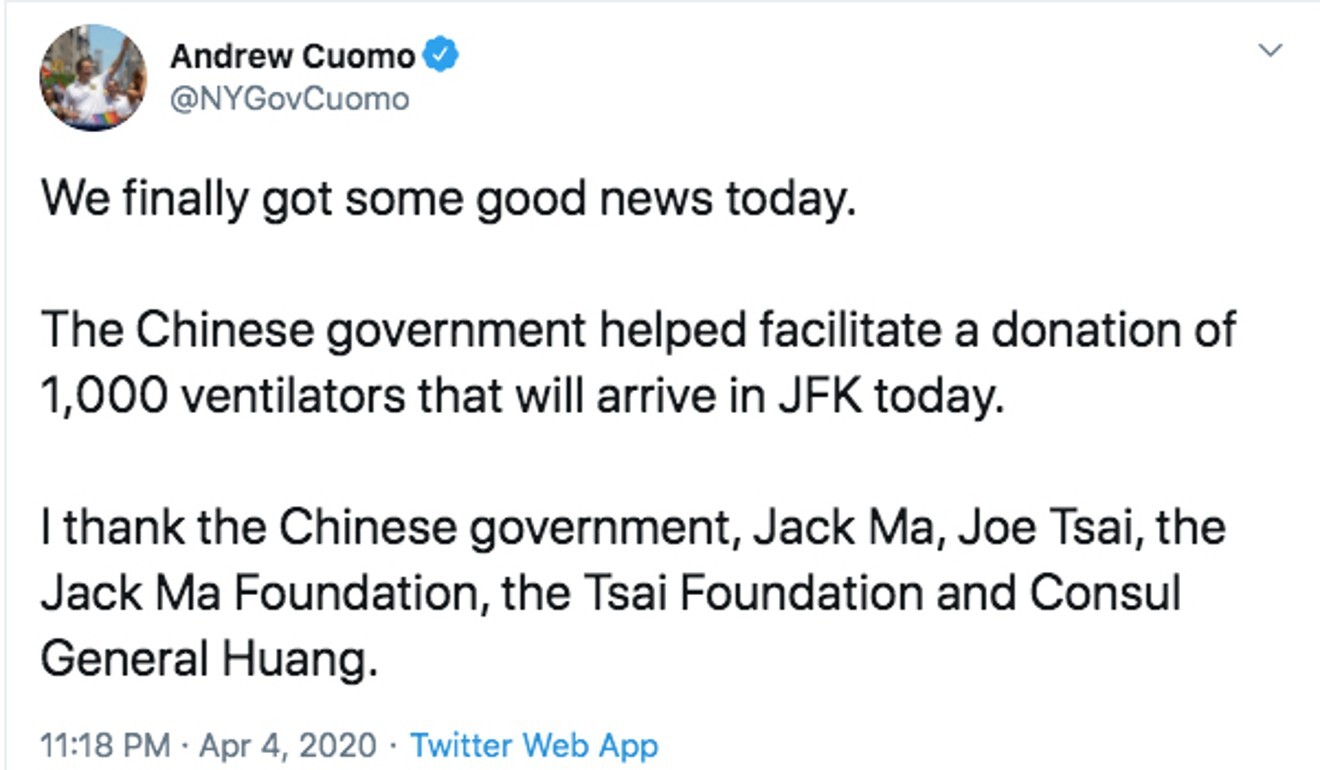
A tweet from New York Governor Andrew Cuomo thanking the Chinese government for the 1,000 ventilators donated by Jack Ma Foundation and Joe Tsai Foundation. Photo: Twitter
Cuomo said 113,704 people in New York have tested positive for the coronavirus, with 15,000 having been hospitalised The state’s death toll saw a significant spike on Saturday to reach 3,565, up from 2,935 the previous day.
The White House has been criticised for not better coordinating the supply of medical goods to states, who are competing with each other on the open market.
NUS’ Wu said that tussle between the federal and state governments in the US on key decisions on acquiring medical supplies was not helping the fight against the pandemic. “Unlike in China, where the central government has the say over local governments, in the US, when it comes to public health provision, the power belongs to the state,” he said.

Meanwhile, Cuomo acknowledged that he asked the White House and others for help negotiating the ventilators.

Trump said he would like to hear a more resounding “thank you” from Cuomo for providing medical supplies and helping quickly to add hospital capacity.

Source:SCMP

05/04/2020

Mainland China sees rise in new coronavirus cases

BEIJING (Reuters) – Mainland China reported 30 new coronavirus cases on Saturday, up from 19 a day earlier as the number of cases involving travellers from abroad as well as local transmissions increased, highlighting the difficulty in stamping out the outbreak.

The National Health Commission said in a statement on Sunday that 25 of the latest cases involved people who had entered from abroad, compared with 18 such cases a day earlier. Five new locally transmitted infections were also reported on Saturday, all in the southern coastal province of Guangdong, up from a day earlier.

The mainland has now reported a total of 81,669 cases, while the death toll has risen by three to 3,329.

Though daily infections have fallen dramatically from the height of the epidemic in February, when hundreds of new cases were reported daily, Beijing remains unable to completely halt new infections despite imposing some of the most drastic measures to curb the virus’ spread.

The so-called imported cases and asymptomatic patients, who have the virus and can give it to others but show no symptoms, have become among China’s chief concerns in recent weeks. The country has closed off its borders to almost all foreigners as the virus spread globally, though most of the imported cases involve Chinese nationals returning from overseas.

The central government also has pushed local authorities to identify and isolate the asymptomatic patients.

The health commission said 47 new asymptomatic cases were reported in the mainland on Saturday, compared with 64 a day earlier.

Source: Reuters
Law of Unintended Consequences

continuously updated blog about China & India

ChiaHou's Book Reviews

continuously updated blog about China & India

What's wrong with the world; and its economy

continuously updated blog about China & India