Chindia Alert: You’ll be Living in their World Very Soon
aims to alert you to the threats and opportunities that China and India present. China and India require serious attention; case of ‘hidden dragon and crouching tiger’.
Without this attention, governments, businesses and, indeed, individuals may find themselves at a great disadvantage sooner rather than later.
The POSTs (front webpages) are mainly 'cuttings' from reliable sources, updated continuously.
The PAGEs (see Tabs, above) attempt to make the information more meaningful by putting some structure to the information we have researched and assembled since 2006.
Embassy in France removes ‘false image’ on Twitter in latest online controversy amid accusations of spreading disinformation
After months of aggressive anti-US posts by Chinese diplomats Beijing is cracking down on ‘smear campaigns’ at home
Beijing’s ‘Wolf Warrior’ diplomacy has coincided with a rise of nationalist content on Chinese social media. Photo: Reuters
Beijing is battling allegations that it is running a disinformation campaign on social media, as robust posts by its diplomats in Western countries promoting nationalist sentiment have escalated into a spat between China and other countries, especially the United States.
In the latest in a series of online controversies, the Chinese embassy in France claimed its official Twitter account had been hacked after it featured a cartoon depicting the US as Death, knocking on a door marked Hong Kong after leaving a trail of blood outside doors marked Iraq, Libya, Syria, Ukraine and Venezuela. The inclusion in the image of a Star of David on the scythe also prompted accusations of anti-Semitism.
Top China diplomats call for ‘Wolf Warrior’ army in foreign relations
25 May 2020
“Someone posted a false image on our official Twitter account by posting a cartoon entitled ‘Who is Next?’. The embassy would like to condemn it and always abides by the principles of truthfulness, objectivity and rationality of information,” it said on Monday.
The rise of China’s aggressive “Wolf Warrior” diplomacy has been regarded by analysts as primarily aimed at building support for the government at home but the latest incident is seen as an attempt by Beijing to take back control of the nationalist narrative it has unleashed.
Florian Schneider, director of the Leiden Asia Centre in the Netherlands, said the removal of the embassy’s tweet reflected a constant concern in Beijing about the range of people – including ordinary citizens – who were involved in spreading nationalistic material online.
“The state insists that its nationalism is ‘rational’, meaning it is meant to inspire domestic unity through patriotism but without impacting national interests or endangering social stability,” he said.
“This makes nationalism a mixed blessing for the authorities … if nationalist stories demonise the US or Japan or some other potential enemy, then any Chinese leader dealing diplomatically with those perceived enemies ends up looking weak.
“Trying to guide nationalist sentiment in ways that further the leadership’s interests is a difficult balancing act and I suspect this is partly the reason why the authorities are currently trying to clamp down on unauthorised, nationalist conspiracy theories.”
Too soon: Chinese advisers tell ‘Wolf Warrior’ diplomats to tone it down
The report came after months of social media posts – including by Chinese diplomats – defending China against accusations it had mishandled the coronavirus pandemic and attacking the US and other perceived enemies.
In March, Chinese foreign ministry spokesman Zhao Lijian promoted a conspiracy theory on Twitter suggesting the virus had originated in the US and was brought to China by the US Army. His comments were later downplayed, with China’s ambassador to the US Cui Tiankai saying questions about the origin of the virus should be answered by scientists.
Schneider said this showed that the state-backed nationalistic propaganda online was at risk of backfiring diplomatically.
“The authorities have to constantly worry that they might lose control of the nationalist narrative they unleashed, especially considering how many people produce content on the internet, how fast ideas spread, and how strongly commercial rationales drive misinformation online,” he said.
Last month, a series of widely shared social media articles about people in different countries “yearning to be part of China” resulted in a diplomatic backlash against Beijing. Kazakhstan’s foreign ministry summoned the Chinese ambassador in April to lodge a formal protest against the article.
Following the incident, the Cyberspace Administration of China, the country’s internet regulator which manages the “firewall” and censors material online, announced a two-month long “internet cleansing” to clear privately owned accounts which engage in “smear campaigns”.
The article had at least 100,000 readers, with 753 people donating money to support the account. According to Xigua Data, a firm that monitors traffic on Chinese social media, the account garnered more than 1.7 million page views for 17 articles in April.
According to a statement from WeChat, the account was closed for fabricating facts, stoking xenophobia and misleading the public.
A journalism professor at the University of Hong Kong said this case differed from the Chinese embassy’s tweet, despite both featuring anti-US sentiment.
Masato Kajimoto, who leads research on news literacy and the misinformation ecosystem, said the closure of the WeChat account seemed to be more about Chinese authorities feeling the need to regulate producers of media content whose motivations were often financial rather than political.
“I would think the government doesn’t like some random misinformation going wild and popular, which affects the overall storylines they would like to push, disseminate and control,” he said.
One way for China to respond to the situation was to fact-check social media and to position itself as a protector facts and defender of the integrity of public information, he said.
“In the age of social media, both fake news and fact-checking are being weaponised by people who try to influence or manipulate the narrative in one way or another,” Kajimoto said.
“Not only China but also many other authoritarian states in Asia are now fact-checking social media. Governments in Singapore, Thailand, Indonesia and other countries all do that.
“Such initiatives benefit them because they can decide what is true and what is not.”
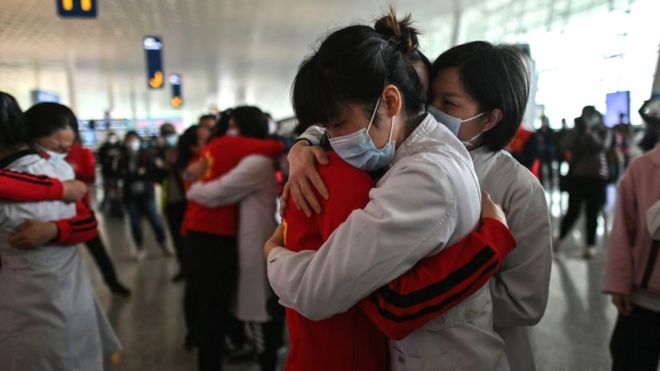
Image copyright GETTY IMAGESImage caption The Chinese city of Wuhan recently lifted its strict quarantine measures
The Chinese city of Wuhan, where the coronavirus originated last year, has raised its official Covid-19 death toll by 50%, adding 1,290 fatalities.
Wuhan officials attributed the new figure to updated reporting and deaths outside hospitals. China has insisted there was no cover-up.
It has been accused of downplaying the severity of its virus outbreak.
Wuhan’s 11 million residents spent months in strict lockdown conditions, which have only recently been eased.
The latest official figures bring the death toll in the city in China’s central Hubei province to 3,869, increasing the national total to more than 4,600.
China has confirmed nearly 84,000 coronavirus infections, the seventh-highest globally, according to Johns Hopkins University data.
What’s China’s explanation for the rise in deaths?
In a statement released on Friday, officials in Wuhan said the revised figures were the result of new data received from multiple sources, including records kept by funeral homes and prisons.
Deaths linked to the virus outside hospitals, such as people who died at home, had not previously been recorded.
Media caption Learn how Wuhan dealt with the lockdown
The “statistical verification” followed efforts by authorities to “ensure that information on the city’s Covid-19 epidemic is open, transparent and the data [is] accurate”, the statement said.
It added that health systems were initially overwhelmed and cases were “mistakenly reported” – in some instances counted more than once and in others missed entirely.
A shortage of testing capacity in the early stages meant that many infected patients were not accounted for, it said.
A spokesman for China’s National Health Commission, Mi Feng, said the new death count came from a “comprehensive review” of epidemic data.
In its daily news conference, the foreign ministry said accusations of a cover-up, which have been made most stridently on the world stage by US President Donald Trump, were unsubstantiated. “We’ll never allow any concealment,” a spokesman said.
Why are there concerns over China’s figures?
Friday’s revised figures come amid growing international concern that deaths in China have been under-reported. Questions have also been raised about Beijing’s handling of the epidemic, particularly in its early stages.
In December 2019, Chinese authorities launched an investigation into a mysterious viral pneumonia after cases began circulating in Wuhan.
China reported the cases to the World Health Organization (WHO), the UN’s global health agency, on 31 December.
But WHO experts were only allowed to visit China and investigate the outbreak on 10 February, by which time the country had more than 40,000 cases.
The mayor of Wuhan has previously admitted there was a lack of action between the start of January – when about 100 cases had been confirmed – and 23 January, when city-wide restrictions were enacted.
Around that time, a doctor who tried to warn his colleagues about an outbreak of a Sars-like virus was silenced by the authorities. Dr Li Wenliang later died from Covid-19.
Wuhan’s death toll increase of almost exactly 50% has left some analysts wondering if this is all a bit too neat.
For months questions have been asked about the veracity of China’s official coronavirus statistics.
The inference has been that some Chinese officials may have deliberately under-reported deaths and infections to give the impression that cities and towns were successfully managing the emergency.
If that was the case, Chinese officials were not to know just how bad this crisis would get in other countries, making its own figures now seem implausibly small.
The authorities in Wuhan, where the first cluster of this disease was reported, said there had been no deliberate misrepresentation of data, rather that a stabilisation in the emergency had allowed them time to revisit the reported cases and to add any previously missed.
That the new death toll was released at the same time as a press conference announcing a total collapse in China’s economic growth figures has led some to wonder whether this was a deliberate attempt to bury one or other of these stories.
Then again, it could also be a complete coincidence.
China has been pushing back against US suggestions that the coronavirus came from a laboratory studying infectious diseases in Wuhan, the BBC’s Barbara Plett Usher in Washington DC reports.
US President Donald Trump and some of his officials have been flirting with the outlier theory in the midst of a propaganda war with China over the origin and handling of the pandemic, our correspondent says.
Mr Trump this week halted funding for the World Health Organization (WHO), accusing it of making deadly mistakes and overly trusting China.
“Do you really believe those numbers in this vast country called China, and that they have a certain number of cases and a certain number of deaths; does anybody really believe that?” Mr Trump said at the White House on Wednesday.
On Thursday, UK Foreign Secretary Dominic Raab said: “We’ll have to ask the hard questions about how [coronavirus] came about and how it couldn’t have been stopped earlier.”
But China has also been praised for its handling of the crisis and the unprecedented restrictions that it instituted to slow the spread of the virus.
Image copyright GETTY IMAGESImage caption The Chinese city of Wuhan recently lifted its strict quarantine measures
The Chinese city of Wuhan, where the coronavirus originated last year, has raised its official Covid-19 death toll by 50%, adding 1,290 fatalities.
Wuhan officials attributed the new figure to updated reporting and deaths outside hospitals. China has insisted there was no cover-up.
It has been accused of downplaying the severity of its virus outbreak.
Wuhan’s 11 million residents spent months in strict lockdown conditions, which have only recently been eased.
The latest official figures bring the death toll in the city in China’s central Hubei province to 3,869, increasing the national total to more than 4,600.
China has confirmed nearly 84,000 coronavirus infections, the seventh-highest globally, according to Johns Hopkins University data.
What’s China’s explanation for the rise in deaths?
In a statement released on Friday, officials in Wuhan said the revised figures were the result of new data received from multiple sources, including records kept by funeral homes and prisons.
Deaths linked to the virus outside hospitals, such as people who died at home, had not previously been recorded.
Media caption Learn how Wuhan dealt with the lockdown
The “statistical verification” followed efforts by authorities to “ensure that information on the city’s Covid-19 epidemic is open, transparent and the data [is] accurate”, the statement said.
It added that health systems were initially overwhelmed and cases were “mistakenly reported” – in some instances counted more than once and in others missed entirely.
A shortage of testing capacity in the early stages meant that many infected patients were not accounted for, it said.
A spokesman for China’s National Health Commission, Mi Feng, said the new death count came from a “comprehensive review” of epidemic data.
In its daily news conference, the foreign ministry said accusations of a cover-up, which have been made most stridently on the world stage by US President Donald Trump, were unsubstantiated. “We’ll never allow any concealment,” a spokesman said.
Why are there concerns over China’s figures?
Friday’s revised figures come amid growing international concern that deaths in China have been under-reported. Questions have also been raised about Beijing’s handling of the epidemic, particularly in its early stages.
In December 2019, Chinese authorities launched an investigation into a mysterious viral pneumonia after cases began circulating in Wuhan.
China reported the cases to the World Health Organization (WHO), the UN’s global health agency, on 31 December.
But WHO experts were only allowed to visit China and investigate the outbreak on 10 February, by which time the country had more than 40,000 cases.
The mayor of Wuhan has previously admitted there was a lack of action between the start of January – when about 100 cases had been confirmed – and 23 January, when city-wide restrictions were enacted.
Around that time, a doctor who tried to warn his colleagues about an outbreak of a Sars-like virus was silenced by the authorities. Dr Li Wenliang later died from Covid-19.
Wuhan’s death toll increase of almost exactly 50% has left some analysts wondering if this is all a bit too neat.
For months questions have been asked about the veracity of China’s official coronavirus statistics.
The inference has been that some Chinese officials may have deliberately under-reported deaths and infections to give the impression that cities and towns were successfully managing the emergency.
If that was the case, Chinese officials were not to know just how bad this crisis would get in other countries, making its own figures now seem implausibly small.
The authorities in Wuhan, where the first cluster of this disease was reported, said there had been no deliberate misrepresentation of data, rather that a stabilisation in the emergency had allowed them time to revisit the reported cases and to add any previously missed.
That the new death toll was released at the same time as a press conference announcing a total collapse in China’s economic growth figures has led some to wonder whether this was a deliberate attempt to bury one or other of these stories.
Then again, it could also be a complete coincidence.
But China has also been praised for its handling of the crisis and the unprecedented restrictions that it instituted to slow the spread of the virus. WHO Director General Dr Tedros Adhanom Ghebreyesus has hailed China for the “speed with which [it] detected the outbreak” and its “commitment to transparency”.
US President Donald Trump this week halted funding for the WHO, accusing it of making deadly mistakes and overly trusting China.
“Do you really believe those numbers in this vast country called China, and that they have a certain number of cases and a certain number of deaths; does anybody really believe that?” Mr Trump said at the White House on Wednesday.
On Thursday, UK Foreign Secretary Dominic Raab said: “We’ll have to ask the hard questions about how [coronavirus] came about and how it couldn’t have been stopped earlier.”
UNITED NATIONS, Feb. 7 (Xinhua) — A Chinese UN envoy on Friday refuted accusations by the United States over China’s counter-terrorism efforts in its northwestern region of Xinjiang.
At a Security Council meeting on the threat posed by the Islamic State, Wu Haitao, China’s deputy permanent representative to the United Nations, said the remarks by the U.S. representative regarding Xinjiang are “unwarranted.”
Senior Policy Advisor for U.S. UN Mission Michael Barkin, who addressed the council earlier than Wu, claimed that “Uighurs” (Uygurs) and other Muslims have been “detained in internment camps under the guise of counter-terrorism” in Xinjiang.
He labeled China’s counter-terrorism measure as “confinement that is based and imposed on the basis of ethnicity and religion.”
Wu said that Barkin’s “attacks” are “completely baseless, and represent a wanton interference in China’s internal affairs and a brazen attempt to provoke confrontation.”
In nature, he said, the issues Xinjiang faces are not about ethnic group or religion or human rights, but rather they are about counter-terrorism.
Recalling the past, Wu said that for some time, Xinjiang suffered frequent terrorist attacks, which seriously jeopardized the lives and property of all ethnic communities and gravely violated human dignity.
“In response, China has taken resolute, law-based measures to combat terrorism and extremism, eliminating to the extent possible the breeding ground and conditions for terrorism and extremism, effectively curbing the trend of rampant terrorist activities and safeguarding citizens’ basic rights, including the right to life and development,” Wu expounded.
“Those measures have produced good results,” he said. “At present, the situation in Xinjiang is largely stable, and local economy continues to grow. People of all ethnic groups live in harmony. The region has been free of terrorist attacks for over three years.”
He noted relevant policies and measures against terrorism and extremism in Xinjiang constitute a crucial part of the global counter-terrorism efforts.
The Chinese envoy also rejected the remarks of Britain’s representative, who echoed the U.S. stance.
“Regrettably, Britain once again blindly followed the footsteps of the United States and put up unfounded charges against China,” Wu said.
He expressed the hope that Britain has “recorded our positions on this matter,” urging Britain not to use the Security Council “to make trouble, to spread rumor and to interfere with the internal affairs of China.”







 CHINDIA ALERT: You'll be living in their world, very soon