Chindia Alert: You’ll be Living in their World Very Soon
aims to alert you to the threats and opportunities that China and India present. China and India require serious attention; case of ‘hidden dragon and crouching tiger’.
Without this attention, governments, businesses and, indeed, individuals may find themselves at a great disadvantage sooner rather than later.
The POSTs (front webpages) are mainly 'cuttings' from reliable sources, updated continuously.
The PAGEs (see Tabs, above) attempt to make the information more meaningful by putting some structure to the information we have researched and assembled since 2006.
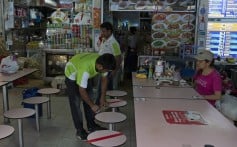
Anyone caught breaking Singapore’s social distancing rules could be jailed from Friday, as the city state ramped up its coronavirus defence and announced the introduction of distance learning for schools.
Under updates to its powerful infectious diseases law, anyone who intentionally sits less than 1 metre away from another person in a public place or on a fixed seat demarcated as not to be occupied, or who stands in a queue less than a metre away from another, will be guilty of an offence.
Offenders can be fined up to S$10,000 (US$6,990), jailed for up to six months, or both. The rules, in place until April 30, can be applied to individuals and businesses.
The news was followed later by an announcement from the education ministry that starting from April, schools will start conducting one day of home-based learning for students per week.
Singapore’s new social distancing laws send needed signal, experts say
27 Mar 2020
“The recent spike in imported cases signals a new phase in our nation’s fight against Covid-19. To support further safe distancing, schools will progressively transit to a blended learning model, starting with one day of home-based learning a week,” the ministry said in a statement.
It added schools will remain open for students whose parents are not able to secure alternative childcare arrangements.
Hundreds of thousands of students in Singapore returned to class on Monday after a week of school holidays, despite growing calls for schools to be closed.
Singapore is one of the few jurisdictions in the region that has yet to suspend schools, unlike Hong Kong, Thailand, Indonesia, and Malaysia.
Education Minister Ong Ye Kung had earlier cited scientific evidence, saying that the pneumonia-like Covid-19 illness does not affect the young as much as adults.
Authorities in the city state, however, have said that suspending schools and closing workplaces are among the next steps to be taken should the situation worsen. Singapore has confirmed 683 cases so far, of which 172 have recovered and two died.
Global condom shortage looms amid virus lockdowns
A global shortage of condoms is looming, the world’s biggest producer said, after a coronavirus lockdown forced it to shut down production.
Malaysia’s Karex makes one in every five condoms globally. It has not produced a single condom from its three Malaysian factories in the past 10 days because of the lockdown imposed by the government to halt the spread of the virus.
That’s already a shortfall of 100 million condoms, normally marketed internationally by brands such as Durex, supplied to state health care systems such as Britain’s NHS or distributed by aid programmes such as the UN Population Fund.
“We are going to see a global shortage of condoms everywhere, which is going to be scary,” Karex Chief Executive Goh Miah Kiat said this week.
“My concern is that for a lot of humanitarian programmes deep down in Africa, the shortage will not just be two weeks or a month. That shortage can run into months.”
The other major condom-producing countries are China, where the coronavirus led to widespread factory shutdowns, and India and Thailand, which are seeing infections spiking only now.
Goh said Karex was in the process of appealing to the government for an exemption to operate under specific conditions. Malaysia is approving other essential goods producers to operate with half of their workforce.
“The good thing is that the demand for condoms is still very strong because like it or not, it’s still an essential to have,” Goh said. “Given that at this point in time people are probably not planning to have children. It’s not the time, with so much uncertainty.”
China to ban most foreign arrivals
China has banned most foreigners from entering the country in an effort to block the spread of the coronavirus through imported cases.
With several exceptions, including transit visas and foreigners arriving via Hong Kong and Macau with short-term entry permits, entry visas issued to foreigners will be suspended as an “interim measure”, according to a statement late on Thursday by the country’s foreign ministry.
“In view of the rapid spread of the new coronavirus epidemic worldwide, China has decided to temporarily suspend entry of foreigners with currently valid visas and residence permits in China,” the ministry said.
“This is an interim measure that China has to take in order to respond to the current epidemic situation, with reference to the practice of many countries,” it added. “The Chinese side will adjust the above measures according to the epidemic situation through separate announcements.”
Pakistan aid workers lack basic kit
Pakistan’s biggest charity, famous for its emergency services for the poor, is kitting staff out in raincoats and rubber boots in the battle against the coronavirus as it can’t get hold of proper personal protective equipment, the organisation says.
Pakistan has reported the highest number of coronavirus infections in South Asia, with 1,179 cases and nine deaths, but health experts say there is a lack of public awareness about the virus and the cash-strapped government is ill-prepared to tackle it.
The Edhi Foundation has for decades stepped in to help when government services fail communities and it runs the country’s largest ambulance service.
Now it has had to train dozens of staff on how to handle suspected coronavirus patients. But providing them with proper protection is a problem given a nationwide shortage of the equipment.
“We’ve compromised on certain things and use alternatives,” Facial Edhi, head of the Edhi Foundation, said at his office in Karachi, Pakistan’s biggest city, on Thursday.
“Full aprons are in short supply in the market.”
He said he was confident the raincoats would work just as well.
South Korea pleads with residents to stay indoors
Authorities in South Korea pleaded with residents on Friday to stay indoors and avoid large gatherings as new coronavirus cases hovered close to 100 per day.
South Korea reported 91 new infections on Friday, taking the national tally to 9,332, the Korea Centres for Disease Control and Prevention said. The country has reported similar daily numbers for the past two weeks, down from a high of over 900 in late February.
The government has sought to convince a restless public that several more weeks of social distancing and self-isolation may be needed to allow health authorities to tamp down the smaller but still steady stream of new cases.
“As the weather is getting nicer, I know many of you may have plans to go outside,” said Yoon Tae-ho, director general for public health policy at the health ministry. “But social distancing cannot be successful when it’s only an individual, it needs to be the whole community.”
Coronavirus: California officials alarmed by rate of infection
27 Mar 2020
Italy reports 662 new deaths, with uptick in new cases
Italy is reporting an uptick in new novel coronavirus infections, after four consecutive days in which new cases had decreased.
The country now has 62,013 active cases, a daily increase of 4,492, the Italian Civil Protection Agency said in its bulletin.
On Wednesday the daily variation was 3,491, on Tuesday 3,612, on Monday 3,780, on Sunday 3,957, and on Saturday a record 4,821.
There are also 662 new fatalities, bringing the total death toll to 8,165, while overall infections, including deaths and recoveries, have risen to 80,539, a daily increase of 8.3 per cent.
Recoveries are up by around 11 per cent to 10,361, while the number of intensive care patients – a closely watched figure given the shortage of hospital beds – has risen by 3.5 per cent, to 3,612.
Russia closes all restaurants nationwide
Russia is temporarily closing restaurants nationwide for a nine-day period starting on Saturday to prevent the spread of the coronavirus.
Restaurants will still be able to provide delivery services during that time, according to the decree by Prime Minister Mikhail Mishustin, published on his website on Friday.
Russia has reported more than 800 cases of coronavirus, predominantly in Moscow, which has seen at least two virus-related deaths. Mayor Sergei Sobyanin has warned that the actual number of cases is probably “significantly more”.
The country has already prohibited regular international flights, and imposed strict quarantine measures for anyone entering the country and anyone who could have been exposed to someone infected with the virus – though has not yet opted to impose lockdown measures like those seen elsewhere.
Coronavirus containment measures spark prison protests across Italy as nation goes into lockdown
First casualty in Kenya
Kenya has recorded its first coronavirus death as a rapid rise in confirmed cases puts Africa’s fragile health systems to the test.
Kenyan Health Cabinet Secretary Mutahi Kagwe said a 66-year-old Kenyan man died on Thursday afternoon despite treatment in an intensive care unit.
Kagwe said the man, who arrived into the country on March 13 from South Africa via Swaziland, was a diabetic. Also on Thursday, three women aged between 30 and 61 tested positive for Covid-19, the disease caused by the coronavirus, taking the country’s total to 31.
Kenya is the second country in East Africa and the 15th on the continent to confirm a coronavirus-related death. Algeria has the highest death toll in Africa with 25 fatalities, while Egypt has reported 24 and Morocco 11.
About a week ago, the continent of 54 countries had reported fewer than 300 cases. But by Friday Africa had 3,221 confirmed cases and 87 deaths. WHO regional director for Africa Matshidiso Moeti said on Thursday that the situation in Africa was “evolving very quickly in terms of geographic spread and the increasing number of cases”.
Australian military to enforce quarantine
The Australian military will help enforce the quarantine of travellers returning to the country, with the prime minister unveiling strict new measures and door-to-door checks on Friday to rein in the spread of Covid-19.
With some two-thirds of Australia’s 3,000 Covid-19 cases still linked to overseas travel, Scott Morrison said 14-day home quarantines would now be actively policed with the help of the military.
Thousands of citizens and residents are still arriving in Australia every day and there have been instances of return travellers repeatedly breaking a promise to stay at home.
Morrison said all returnees arriving after midnight Saturday would now be kept in hotels in the city of arrival for the duration of their quarantine.
Those already on Australian soil and under orders to self-quarantine for two weeks will face active checks, he said.
Quarantine measures will be getting “a lot tougher and a lot stricter,” Morrison said, adding the Australian Defence Force would “assist in the compliance with these arrangements.”
Afghanistan to release 10,000 prisoners
Afghanistan will release at least 10,000 prisoners over the age of 55 in an attempt to prevent the spread of the coronavirus, officials said on Thursday.
“The president has issued a decree that several thousand prisoners will be released soon due to coronavirus,” an official in President Ashraf Ghani’s office said.
Those released will not include members of Islamist militant groups the Taliban or Islamic State, and the process will be completed within 10 days, said two government officials.
Afghanistan has reported 91 cases of coronavirus and three deaths. The country’s western Herat province has recorded at least 54 of the 75 total cases reported in the last week.
International aid groups in recent weeks have raised concerns about the possibility of the coronavirus spreading in prisons across Afghanistan.
The US invaded Afghanistan weeks after the September 2001 attacks in New York by the Afghanistan-based al-Qaeda group.
More than 2,400 US troops have been killed during the conflict. About 12,000 are still stationed in the country. President Trump has promised to put an end to the conflict.
What happened in Doha?
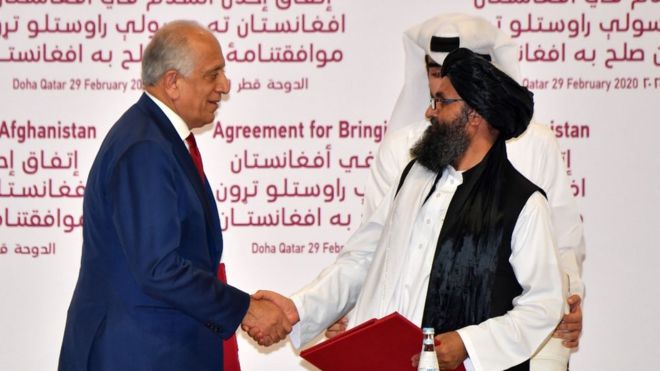
The deal was signed by US special envoy Zalmay Khalilzad and Taliban political chief Mullah Abdul Ghani Baradar with Mr Pompeo as a witness.
In a speech, Mr Pompeo urged the militant group to “keep your promises to cut ties with al-Qaeda”.
Meanwhile US Defence Secretary Mark Esper was in the Afghan capital Kabul alongside Afghanistan’s President Ashraf Ghani – whose government did not take part in the US-Taliban talks.
Mr Esper said: “This is a hopeful moment, but it is only the beginning. The road ahead will not be easy. Achieving lasting peace in Afghanistan will require patience and compromise among all parties.” He said the US would continue to support the Afghan government.
What’s in the agreement?
Within the first 135 days of the deal the US will reduce its forces in Afghanistan to 8,600, with allies also drawing down their forces proportionately.
The move would allow US President Donald Trump to show that he has brought troops home ahead of the US presidential election in November.
The deal also provides for a prisoner swap. Some 5,000 Taliban prisoners and 1,000 Afghan security force prisoners would be exchanged by 10 March, when talks between the Taliban and the Afghan government are due to start.
The US will also lift sanctions against the Taliban and work with the UN to lift its separate sanctions against the group.
Landmark deal rife with uncertainties
This historic deal has been years in the making, as all sides kept seeking advantage on the battlefield.
The agreement is born of America’s determination to bring troops home and a recognition, at least by some Taliban, that talks are the best route to return to Kabul.
It’s a significant step forward, despite deep uncertainty and scepticism over where it will lead. When the only alternative is unending war, many Afghans seem ready to take this risk for peace.
Taliban leaders say they’ve changed since their harsh rule of the 1990s still seared in the memory of many, and most of all Afghan women.
This process will test the Taliban, but also veteran Afghan leaders of the past, and a new generation which has come of age in the last two decades and is hoping against hope for a different future.
How did US-Taliban talks come about?
Since 2011, Qatar has hosted Taliban leaders who have moved there to discuss peace in Afghanistan. It has been a chequered process. A Taliban office was opened in 2013, and closed the same year amid rows over flags. Other attempts at talks stalled.
In December 2018, the militants announced they would meet US officials to try to find a “roadmap to peace”. But the hard-line Islamist group continued to refuse to hold official talks with the Afghan government, whom they dismissed as American “puppets”.
Media caption The view from Lashkar Gah province on whether peace with the Taliban is possible
Following nine rounds of US-Taliban talks in Qatar, the two sides seemed close to an agreement.
Washington’s top negotiator announced last September that the US would withdraw 5,400 troops from Afghanistan within 20 weeks as part of a deal agreed “in principle” with Taliban militants.
Days later, Mr Trump said the talks were “dead”, after the group killed a US soldier. But within weeks the two sides resumed discussions behind the scenes.
A week ago the Taliban agreed to a “reduction of violence” – although Afghan officials say at least 22 soldiers and 14 civilians have been killed in Taliban attacks over that period.
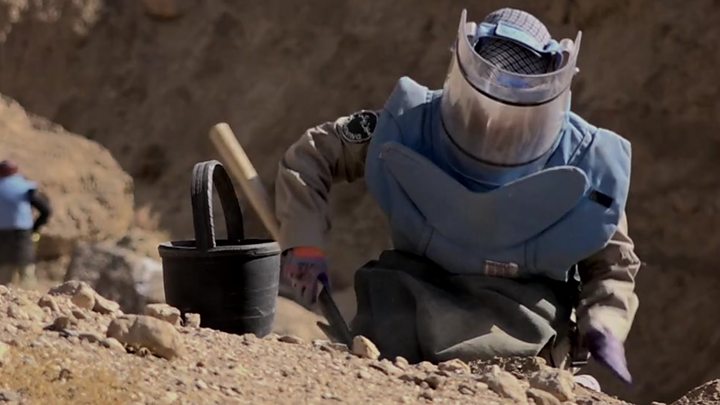
Media caption Meet Fatima and Fiza, some of the women removing landmines in Afghanistan
It began when the US launched air strikes one month following the 11 September 2001 attacks and after the Taliban had refused to hand over the man behind them, Osama bin Laden.
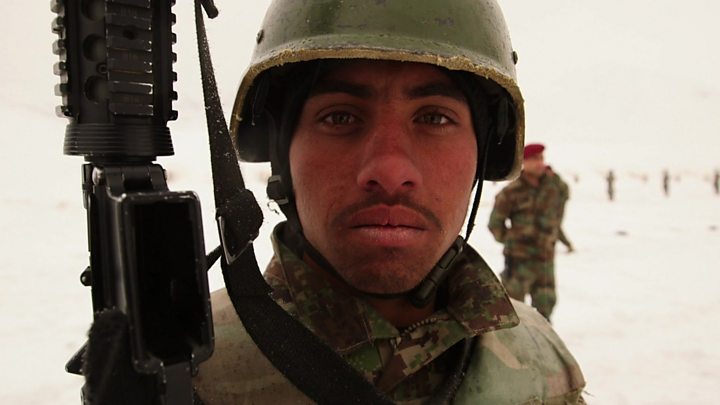
Media caption Tens of thousands of Afghan soldiers have been killed and injured. This is their story
The US was joined by an international coalition and the Taliban were quickly removed from power. However, they turned into an insurgent force and continued deadly attacks, destabilising subsequent Afghan governments.
The international coalition ended its combat mission in 2014, staying only to train Afghan forces. But the US continued its own, scaled-back combat operation, including air strikes.
The Taliban has however continued to gain momentum and last year the BBC found they were active across 70% of Afghanistan.
Media caption Zan TV presenter Ogai Wardak: “If the Taliban come, I will fight them”
Nearly 3,500 members of the international coalition forces have died in Afghanistan since the 2001 invasion.
The figures for Afghan civilians, militants and government forces are more difficult to quantify. In a February 2019 report, the UN said that more than 32,000 civilians had died. The Watson Institute at Brown University says 58,000 security personnel and 42,000 opposition combatants have been killed.
Why has the war lasted so long?
There are many reasons for this. But they include a combination of fierce Taliban resistance, the limitations of Afghan forces and governance, and other countries’ reluctance to keep their troops for longer in Afghanistan.
At times over the past 18 years, the Taliban have been on the back foot. In late 2009, US President Barack Obama announced a troop “surge” that saw the number of American soldiers in Afghanistan top 100,000.
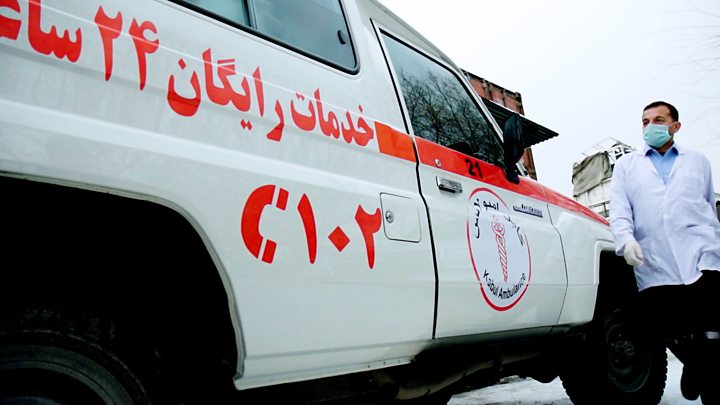
Media caption The BBC was given exclusive access to spend a week with ambulance workers in Afghanistan.
The surge helped drive the Taliban out of parts of southern Afghanistan, but it was never destined to last for years.
The BBC World Service’s Dawood Azami says there are five main reasons the war is still going on now. They include:
a lack of political clarity since the invasion began, and questions about the effectiveness of the US strategy over the past 18 years
the fact each side is trying to break what has become a stalemate – and that the Taliban have been trying maximise their leverage during peace negotiations
an increase in violence by Islamic State militants in Afghanistan – they’ve been behind some of the bloodiest attacks recently
There’s also the role played by Afghanistan’s neighbour, Pakistan.
SEOUL/BEIJING (Reuters) – South Korea aims to test more than 200,000 members of a church at the centre of a surge in coronavirus cases, as countries stepped up efforts to stop a pandemic of the c that emerged in China and is now spreading in Europe and the Middle East.
More than 80,000 people have been infected in China since the outbreak began, apparently in an illegal wildlife market in the central city of Wuhan late last year.
China’s death toll was 2,663 by the end of Monday, up 71 from the previous day. But the World Health Organization (WHO) has said the epidemic in China peaked between Jan. 23 and Feb. 2 and has been declining since.
RELATED COVERAGE
Britain advises travellers self isolate after north Italy trips
Italy reports coronavirus case in Sicily, first south of Rome
See more stories
However, fast-spreading outbreaks in Iran, Italy and South Korea, and first cases in several Middle East countries, have fed worries of a pandemic, or worldwide spread of the virus.
“We are close to a pandemic, but there is still hope the epidemics in Iran, Italy, South Korea, etc. can be controlled,” said Raina MacIntyre, head of the Biosecurity Programme at the Kirby Institute at the University of New South Wales.
South Korea has the most virus cases outside China and reported its tenth death and 144 new cases, for a total of 977. President Moon Jae-in said the situation was “very grave”.
In Europe, Italy has become a new front line, with 220 cases reported on Monday, up from just three on Friday. The death toll in Italy is seven.
Global stock markets stabilised on Tuesday after a wave of early selling petered out and Wall Street futures managed a solid bounce after a sharp selloff the previous day on fears about the spreading coronavirus.
“If travel restrictions and supply chain disruptions spread, the impact on global growth could be more widespread and longer lasting,” said Jonas Goltermann, senior economist at research consultancy Capital Economics in London.
PUBLIC ANXIETY
About 68% of South Korea’s cases are linked to the Shincheonji Church of Jesus, where the outbreak is believed to have begun with a 61-year-old woman. It is not known how she became infected.
The church said it would provide authorities the names of all its members in South Korea, estimated by media at about 215,000 people. The government would test them all as soon as possible, the prime minister’s office said.
“It is essential to test all of the church members,” it said in a statement. Authorities said they were testing up to 13,000 people a day.
The U.S. and South Korean militaries have said they may cut back joint training due to the virus, in one of the first concrete signs of its fallout on global U.S. military activities.
The disclosure came during a visit to the Pentagon on Monday by South Korean Defence Minister Jeong Kyeong-doo, who said 13 South Korean troops had the virus.
The U.S. military said a woman who tested positive for the virus had visited one of its bases in the hard-hit city of Daegu. It was the first infection connected to U.S. Forces Korea, which has about 28,500 American troops on the peninsula.
The U.S. military urged troops to “use extreme caution” off base, while the U.S. Centers for Disease Control and Prevention said Americans should avoid non-essential travel to South Korea.
IRAN ISOLATION
Outside mainland China, the outbreak has spread to about 29 countries and territories, with a death toll of about three dozen, according to a Reuters tally.
Afghanistan, Bahrain, Iraq, Kuwait and Oman reported their first new coronavirus cases, all in people who had been to Iran where the toll was 14 dead, media said, and 61 infected.
The outbreak threatens to isolate Iran further. The United Arab Emirates, which has 13 virus cases, suspended all flights with Iran for at least a week, state media said.
Iraq extended an entry ban on travellers from China and Iran to those from five other countries over virus fears, its health ministry said.
In Japan, which has reported four deaths and 850 cases mostly linked to a cruise ship, Health Minister Katsunobu Kato said it was too early to talk about cancelling the Tokyo Olympics due to start on July 24.
The United States pledged $2.5 billion to fight the disease, with more than $1 billion going toward developing a vaccine, with other funds earmarked for therapeutics and the stockpiling of personal protective equipment such as masks.
China reported a rise in new cases in Hubei province, the epicentre of the outbreak. But excluding those, China had just nine new infections on Monday, its fewest since Jan. 20.
With the pace of new infections slowing, Beijing said restrictions on travel and movement that have paralysed economic activity should begin to be lifted.
“Low-risk areas … are to restore order in production and life, cancel transport restrictions and help enterprises,” state planner official Ou Xiaoli told a briefing.
An insect-killing fungus has been turned into a mass-produced biopesticide that will face its biggest challenge in East Africa
Current swarm has put 13m people at risk of famine and this will be the first large-scale test of its effectiveness
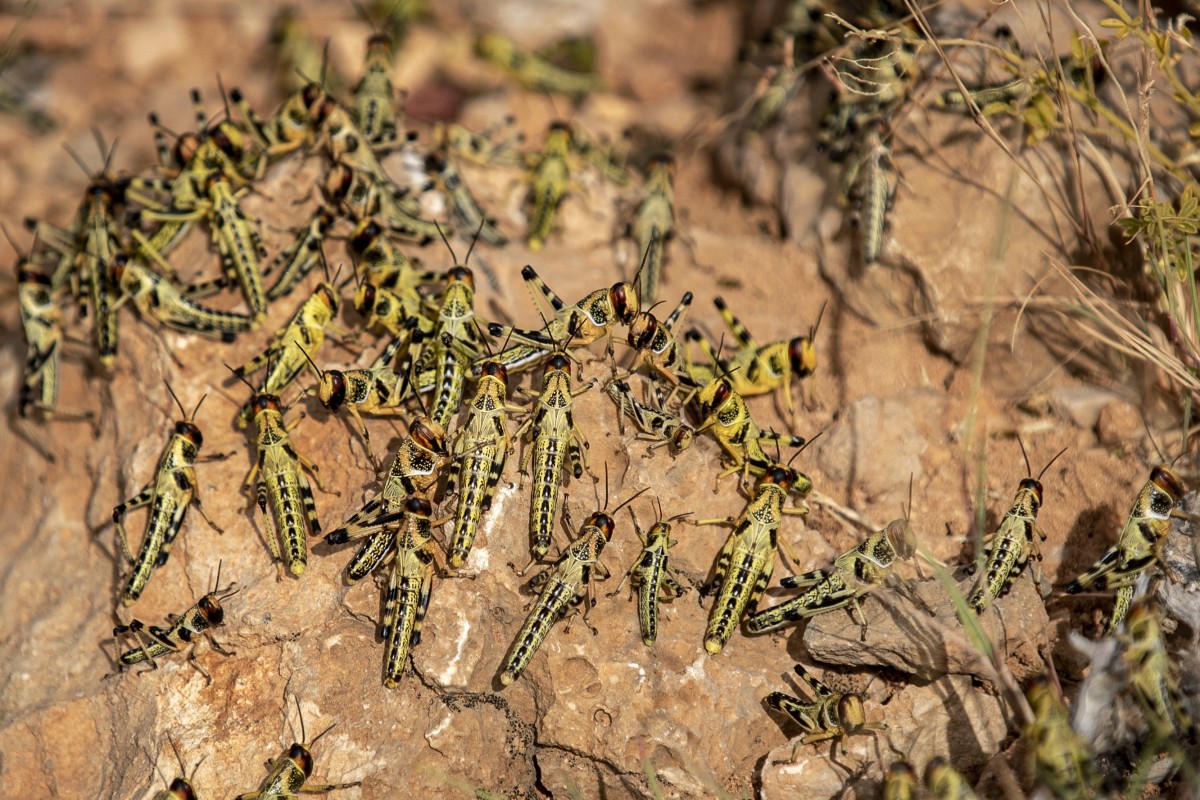
Young locusts in Somalia, where the fungus will be used to try to kill them. Photo: AP
Chinese factories are producing thousands of tonnes of a “green zombie fungus” to help fight the swarms of locusts in East Africa.
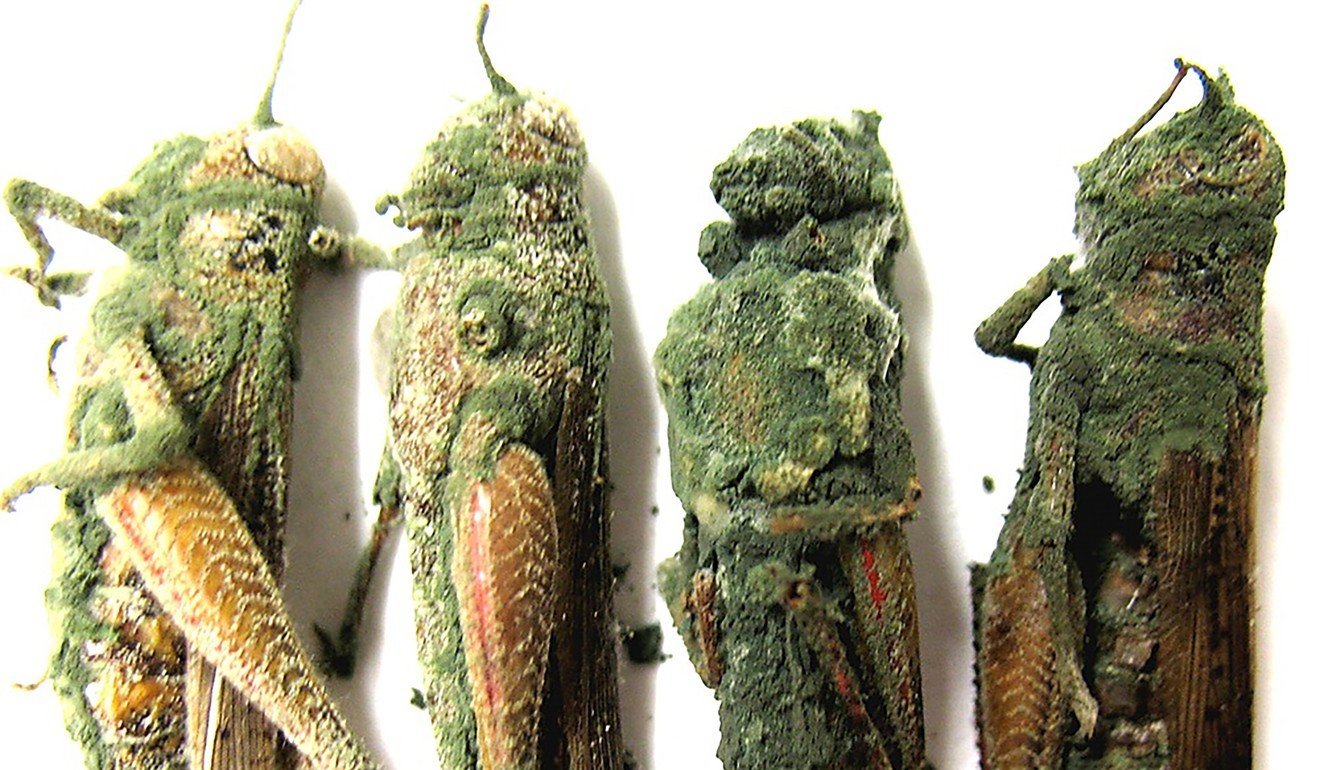
Metarhizium is a genus of fungi with nearly 50 species – some genetically modified – that is used as a biological insecticide because its roots drill through the insects’ hard exoskeleton and gradually poisons them.
In China it was named lu jiang jun, which means green zombie fungus, because it gradually turns its victims in a green mossy lump.
There are now dozens of factories across the country dedicated to producing its spores and despite the curbs introduced to stop the spread of Covid-19, many of them have resumed operations and are shipping thousands of tonnes to Africa.
Plague fears as massive East Africa locust outbreak spreads
11 Feb 2020
These factories are set up in a similar way to breweries, growing the spores on rice which is kept in carefully controlled conditions to ensure the correct temperature and humidity.
Each plant can produce thousands of tonnes of fungi powder per year, each gram of which contains tens of billions of spores.
“I am sending off a truckload right now. Our stock is running out,” said the marketing manager of a production plant in Jiangxi province. “Some customers need it urgently. They need it to kill the locusts.”
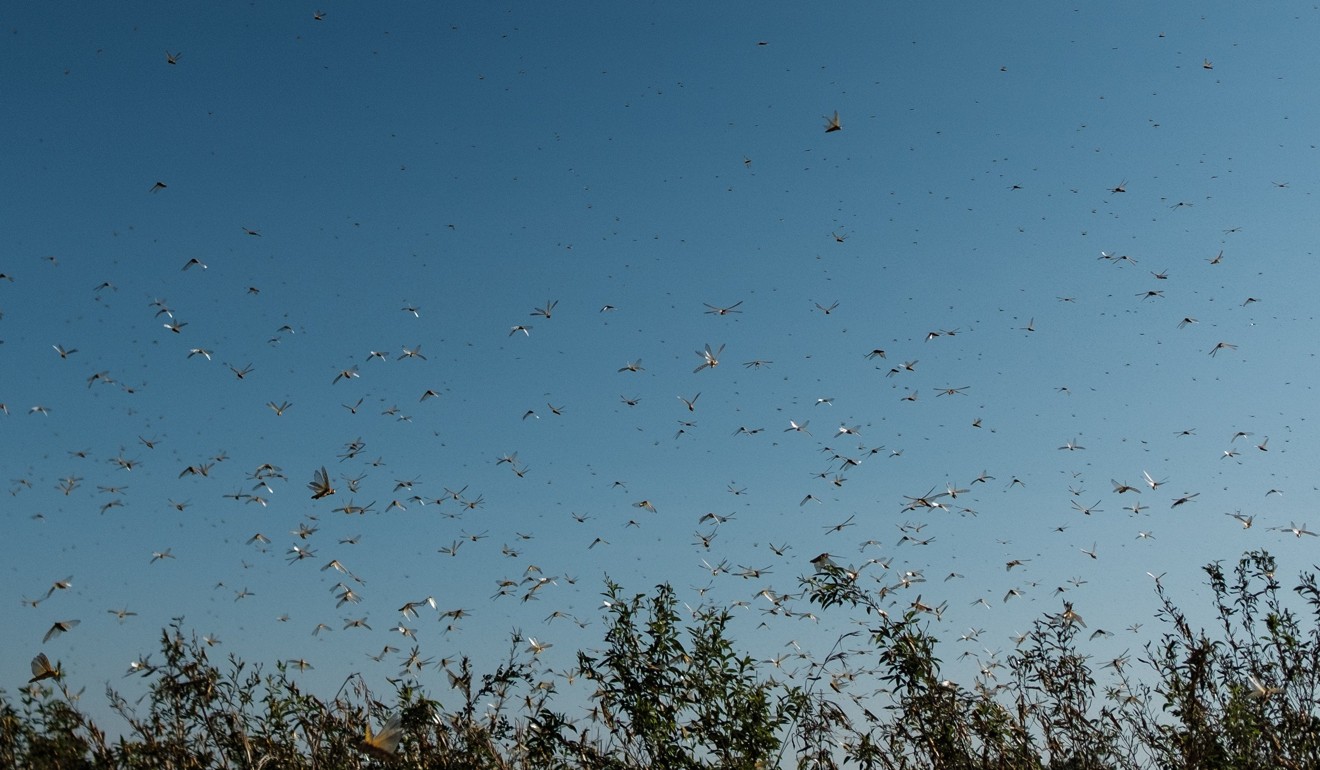
The need is particularly pressing in East Africa at the moment, where abnormally high levels of rainfall during the dry season allowed hundreds of billions of locusts to hatch in recent months.
So far the swarms have devastated crops in countries such as Ethiopia, Kenya, Somalia and Uganda and are moving on to neighbouring countries.
Up to 13 million people face the risk of famine in East Africa. Photo: AFP
The UN’s Food and Agriculture Organisation (FAO) has warned the situation could be the “worst in decades” and the resulting famine may affect 13 million people and cause international food prices to soar.
Last week, Science magazine reported that the Somalian government, working with the FAO, was preparing to a metarhizium species that only kills locusts and grasshoppers in what it described as the largest ever use of biopesticides against the insects.
Scientists do not believe that the fungus will be enough to solve the problem – monitoring the outbreak and targeting their breeding grounds will be more important in the long-run – but if it proves effective it could be an important weapon to target future outbreaks.
It will take time to gauge the effectiveness, partly because each fungus will take several days to take effect and partly because of the sheer scale of the challenge; a single swarm in Kenya was estimated to contain between 100 billion and 200 billion locusts.
By fair means or fowl: how Chinese herdsmen are planning to stop a locust invasion
17 Apr 2018
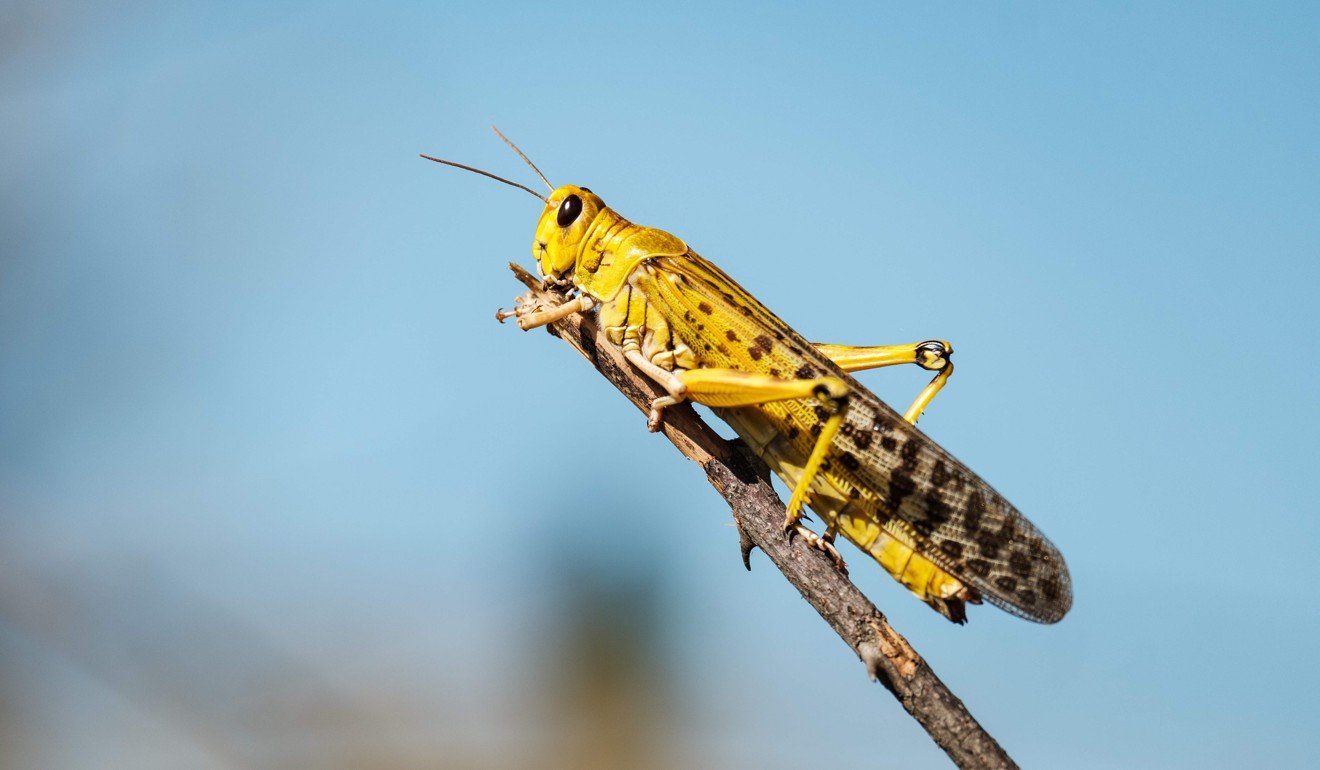
The locusts have also swept eastward into the Middle East, travelling up to 150km (90 miles) a day, and are moving closer to China now that they have now reached some of its neighbours, including India and Pakistan.
At present China’s agriculture ministry believes some locusts may follow the monsoon into the country but “the chances of them causing damage is very small”.
Most scientists agree the swarms will not have lasting effect on food production but say developing countries can tap into China’s cutting-edge anti-locust technology.
Radar stations have been set up all the way along China’s western and southern borders to detect possible clouds of locusts, while unmanned devices lure the insects into traps to collect data about their species population and size.
A locust being eaten inside out by the metarhizium fungi. Photo: Chinese Academy of Sciences and the University of Maryland
The data is streamed to the ministry’s programme command, which is responsible for the planning and coordination of the national efforts to prevent an outbreak.
The scientists also said that planes loaded with biological and chemical sprays were standing by.
Today, most locust outbreaks happen in developing countries that do not have advanced monitoring networks and some of them are unable to produce pesticides on a mass scale, according to Li Hu, an associate professor with the China Agricultural University in Beijing.
The Chinese locust treatment technologies were highly advanced, and usually cheaper than competing solutions from the West, he said.
Chinese researchers are now working with colleagues in other countries to help them solve the problem.
One disadvantage of the Chinese research is that it is mostly focused on local species, or the East Asia migratory locust. The desert locusts currently swarming East Africa have different genes and behaviour, and Li warned that some methods that work in China might not work elsewhere.
A giant indoor farm in China is breeding 6 billion cockroaches a year. Here’s why
26 Apr 2018
There were some sightings of the species reported in Yunnan and Tibet in the past, but they did not build up to large colonies, Professor Kang Le, lead scientist of the locust research programme with the Institute of Zoology at the Chinese Academy of Sciences in Beijing, told China Science Daily last week.
The vast west China region of Xinjiang, which shares a border with eight countries, is currently too cold for a locust migration, but once temperatures start to rise in the spring it could see locusts swarming across the border with Afghanistan.
Shi Wangpeng, a senior government locust expert, told China Business Network on Sunday that China should be on high alert because many Afghan farms had already been affected.
“These areas share a long border with us, there are almost no barriers,” he was quoted as saying by the Shanghai-based magazine.
China has a long and bitter history of locust swarms, with more than 840 being recorded in the official records over the past 2,700 years.
One famine, in the year 628 was so devastating that even the Tang dynasty emperor Taizong was reported to have run short of food and resorted to eating the insects to survive.
China has a long and bitter history of locust swarms. Photo: AFP
This, in turn, means that China’s rulers have long been looking for innovative ways to solve the problem
In the past farmers tried remedies such as building huge fires, burying the insects in ditches or trying to kill them with sticks.
In one campaign organised by prime minister Yao Chong in 715, the farms collected 9 million sacks of dead locusts and managed to save a significant proportion of their crops, according to historic text.
In more recent times more sophisticated technologies have been deployed to tackle the menace.
Some researchers have spent decades chasing locust colonies and studying their individual and collective behaviour everywhere from coastal areas to inland deserts, and in 2014 Chinese scientists released the world’s most comprehensive genetic map of locusts.
Researchers have also developed chemical agents that can disorient swarms of locusts and disperse them.
Chinese scientists first became interested in the green zombie’s potential in the 1980s after discovering that South Pacific islanders had been using them to kill insects on coconut trees.
Research by US scientists confirmed its effectiveness in the 1990s and the Chinese started importing the fungus from the United States and Britain.
Their experiments led to the development of newer and deadlier strains and mass production started in the past decade.
Other fungi or bacteria can be used to fight locusts, and some laboratories are working with agricultural technology companies to modify their genes to turn them into more deadly or precise killers.
One genetically engineered species of microsporidia, another type of insect-killing fungus, for instance, can generate three times as many as the spores to those produced by nature species, according to a document from the China Association of Agricultural Science Societies last year.
While it remains to be seen whether the current swarms will reach China, these treatments have been effective in the past and there has not been a locust outbreak in China for a decade.
In the Chinese city of Wuhan, where the virus emerged, the authorities earlier announced that some non-residents would be allowed to leave if they showed no symptoms of the virus.
However, local officials now say that order was made without authorisation and has been revoked.
The city has been in lockdown since January 23, with authorities cutting off transport links in and out of the city.
More than 2,500 people have died from the virus in mainland China, with some 77,150 cases confirmed cases reported.
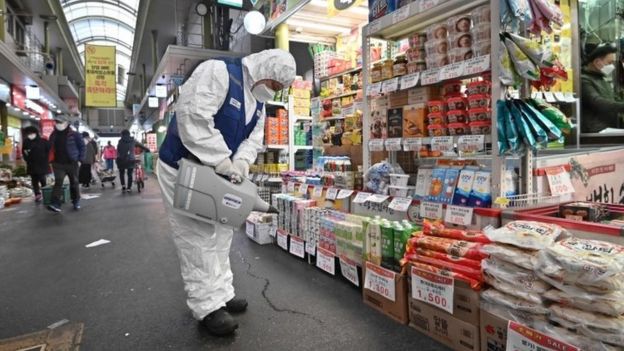
Image copyright AFPImage caption A worker sprays disinfectant to help prevent the spread of the novel coronavirus at a market in Seoul
What is the situation in North Korea?
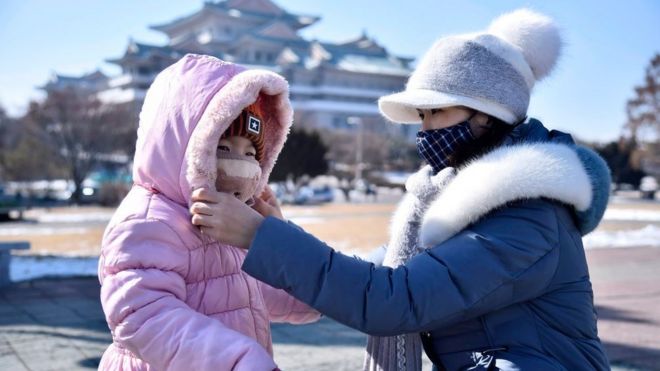
North Korea has not confirmed any cases but the country shares a long and often porous border with China. There are concerns that North Korea, which is subject to international sanctions, lacks the health infrastructure to test and treat those infected and that any outbreak could quickly spread unchecked.
At the moment, all foreigners coming into the country must be quarantined for 30 days.
There are relatively few foreigners in North Korea, and only around 200 Westerners, according to one expert.
North Korean authorities have also cancelled the annual Pyongyang marathon, which typically sees people from all over the world participating.
Around 3,000 people in North Pyongan province – a north-western region bordering China – are also now under monitoring for reportedly showing suspected symptoms, said state media.
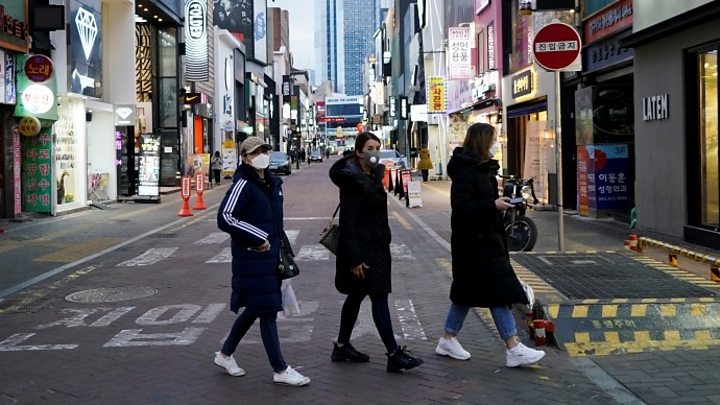
What about South Korea?
Media caption People in Daegu have voiced concern over the spread of the virus
South Korea has the largest number of confirmed cases outside China, after a huge spike in the past week.
Before last Wednesday, the country had recorded just 31 cases. That number has now jumped to 763.
Eight new cases of the virus have been reported in the army, and one in the navy, air force and marine corps – bringing the number to 11.
But the biggest virus clusters have been linked to a hospital and a religious group near the south-eastern city of Daegu.
A handful of South Korea airlines, including Korean Air Lines – the country’s biggest airline – has suspended flights going to Daegu, which has a population of around 2.5m.
Korean Air says the suspension will last until March 27
What’s happening in Italy?
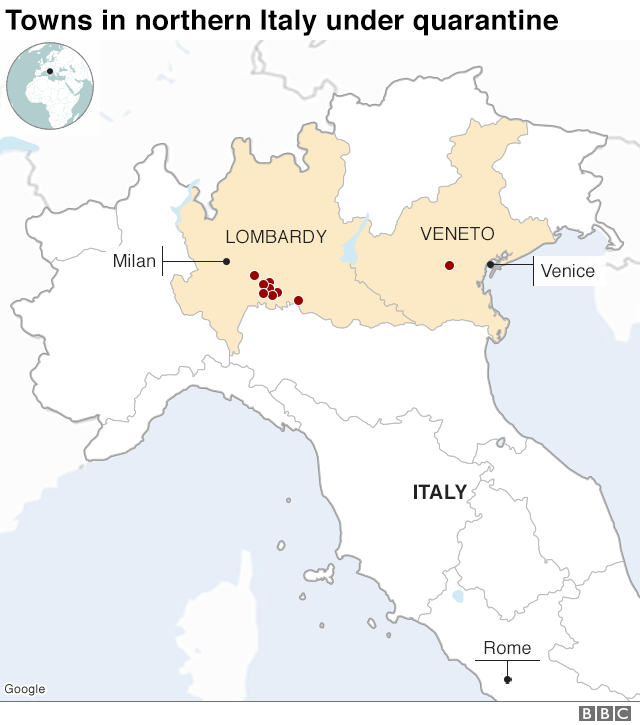
Italian officials have introduced sweeping measures to control what is now the worst outbreak of the coronavirus in Europe – at least three people have died and more than 150 cases confirmed.
In the regions of Lombardy and Veneto, a lock-down is in place in several small towns. For the next two weeks, 50,000 residents will not be able to leave without special permission.
Even outside the zone, many businesses and schools have suspended activities, and sporting events have been cancelled – including several top-flight football matches.
Officials have yet to find the first carrier of the virus in the country.
World edges closer to coronavirus pandemic
Analysis by Fergus Walsh, medical correspondent
The combined situation in South Korea, Iran and Italy points to the early stages of pandemic. This means a global outbreak, with the coronavirus spreading in the community in multiple parts of the world.
In each of these countries we are seeing spread of the virus with no connection to China. The lockdown efforts in Italy mirror those that have happened in China.
The situation in Iran is especially worrying, because the health authorities have reportedly said the virus has spread to multiple cities, and it appears the first case in Lebanon is linked to a traveller from Iran.
If we have a pandemic, it will still be important to limit the speed of spread of the virus.
If countries could hold it somewhat at bay until the end of winter, there is a hope that warmer temperatures will reduce the time the virus can survive in the air, as we see with seasonal flu. But this may not be certain.
What’s the latest from Iran?
Iran said on Sunday it had 43 confirmed cases of the virus, most of them in the holy city of Qom. Eight of those infected have died, the highest number of deaths outside China.
Iraq, Pakistan, Armenia and Turkey have closed their borders with Iran, and Afghanistan has suspended air and road travel to and from Iran.
What about China, where the outbreak started?
China’s President Xi Jinping has described the outbreak as the “largest public health emergency” in the country’s recent history.
Speaking on Sunday, he acknowledged “shortcomings” in China’s response and said lessons must be learned.
China reported 409 new infections on Monday, the bulk of which were from Wuhan.
But outside China, cases with no clear link to that country or other confirmed cases continue to rise, prompting concern from the World Health Organization (WHO).
BEIJING/SEOUL (Reuters) – Italy, South Korea and Iran reported sharp rises in coronavirus infections on Monday, triggering concern from the World Health Organization (WHO), but China relaxed some curbs on movement, including in Beijing, as the rate of new infections there eased.
The virus has put Chinese cities into lockdown, disrupted air traffic to the workshop of the world and blocked global supply chains for everything from cars and car parts to smartphones.
The surge of cases outside mainland China triggered steep falls in global share markets and Wall Street stock futures as investors fled to safe havens. Gold soared to a seven-year high, oil tumbled nearly 4% and the Korean won KRW= fell to its lowest level since August.[MKTS/GLOB]
But U.S. Treasury Secretary Steven Mnuchin cautioned against jumping to conclusions about the impact on the global economy or supply chains, saying it was simply too soon to know.
RELATED COVERAGE
Ireland cautions against travel to coronavirus-hit areas of Italy
France blocks passengers on board bus from Italy after one falls ill
The World Health Organization (WHO) said it no longer had a process for declaring a pandemic, but that the coronavirus outbreak remained an international emergency.
“We are specially concerned about the rapid increase in cases in … Iran, Italy and the Republic of Korea,” WHO head Tedros Adhanom Ghebreyesus told a news conference in Sweden via video link from Geneva.
South Korea reported 231 new cases, taking its total to 833. Many are in its fourth-largest city, Daegu, which became more isolated with Asiana Airlines (020560.KS) and Korean Air (003490.KS) suspending flights there until next month.
Iran, which announced its first two cases last Wednesday, said it had confirmed 43 cases and eight deaths. Most of the infections were in the Shi’ite Muslim holy city of Qom.
Elsewhere in the Middle East, Bahrain and Iraq reported their first cases and Kuwait reported three cases involving people who had been in Iran.
Saudi Arabia, Kuwait, Iraq, Turkey, Pakistan and Afghanistan imposed restrictions on travel and immigration from Iran. Afghanistan also reported its first case, officials said.
The WHO has been saying for weeks that it dreads the disease reaching countries with weak health systems.
Europe’s biggest outbreak is in Italy, with some 150 infections – compared with just three before Friday – and a fifth death.
‘SEVERE AND COMPLEX’
Scientists around the world are scrambling to analyze the virus, but a vaccine is probably more than a year away.
“Worryingly, it seems that the virus can pass from person to person without symptoms, making it extremely difficult to track, regardless of what health authorities do,” said Simon Clarke, an expert in cellular microbiology at the University of Reading in Britain.
China postponed the annual meeting of its parliament in Beijing.
But there was a measure of relief for the world’s second-largest economy as more than 20 province-level jurisdictions, including Beijing and Shanghai, reported zero new infections, the best showing since the outbreak began.
President Xi Jinping urged businesses to get back to work, though he said the epidemic was still “severe and complex, and prevention and control work is in the most difficult and critical stage”.
Excluding the central Hubei province, center of the outbreak, mainland China reported 11 new cases, the lowest since the national health authority started publishing nationwide daily figures on Jan. 20.
The coronavirus has infected nearly 77,000 people and killed more than 2,500 in China, most in Hubei.
Overall, China reported 409 new cases on the mainland, down from 648 a day earlier, taking the total number of infections to 77,150 cases as of Feb. 23. The death toll rose by 150 to 2,592.
Outside mainland China, the outbreak has spread to about 29 countries and territories, with a death toll of about two dozen, according to a Reuters tally.
Xi said on Sunday the outbreak would have a relatively big, but short-term, impact on the economy and the government would step up policy adjustments to help cushion the blow.
Mnuchin, speaking to Reuters in the Saudi city of Riyadh, said he did not expect the coronavirus to have a material impact on the Phase 1 U.S.-China trade deal.
“Obviously that could change as the situation develops,” he added.
In northern Italy, authorities sealed off the worst-affected towns and banned public gatherings across a wide area, halting the carnival in Venice, where there were two cases.
Austria briefly suspended train services over the Alps from Italy after two travelers coming from Italy showed symptoms of fever.
Both tested negative for the new coronavirus but Austrian Interior Minister Karl Nehammer said a task force would meet on Monday to discuss whether to introduce border controls.
Japan had 773 cases as of late Sunday, mostly on a cruise ship quarantined near Tokyo. A third passenger, a Japanese man in his 80s, died on Sunday.
In South Korea, authorities reported a seventh death and dozens more cases on Monday. Of the new cases, 115 were linked to a church in the city of Daegu.
Drone footage showed what appeared to be hundreds of people queuing in a neat line outside a Daegu supermarket under the winter sunshine to buy face masks. ( tmsnrt.rs/37WP6lA )
Image copyright ANIImage caption Ms Leona was charged with sedition at a protest event in Bangalore city
An Indian woman has been arrested and charged with sedition for chanting “long live Pakistan” at a protest in the southern city of Bangalore.
Amulya Leona was participating in a demonstration against a controversial citizenship law, which critics say discriminates against Muslims.
Her comments were immediately condemned by a prominent local Muslim politician.
Asaduddin Owaisi, who was at the rally, said neither he nor his party supported India’s “enemy nation Pakistan”.
Muslim politicians in Hindu-majority India are often targeted as being “pro-Pakistan” by political rivals, particularly in the last few years. The neighbouring countries have a historically tense relationship, fighting three wars since Pakistan’s formation following the partition of India in 1947.
After the incident at the protest against the Citizenship Amendment Act (CAA) went viral, Ms Leona and her family were the target of massive outrage.
Clips of her comment were circulated widely, and her father has complained that a group of people came to his house and forced him to chant “hail mother India”. They also told him that he had not brought his daughter up properly and threatened him against getting bail for her.
Police in the district told BBC Hindi that they are investigating his complaint, adding that Ms Leona would be produced before a judicial magistrate in 14 days.
What is the CAA?
The law offers amnesty to non-Muslim illegal immigrants from three countries – Pakistan, Bangladesh and Afghanistan.
It amends India’s 64-year-old citizenship law, which currently prohibits illegal migrants from becoming Indian citizens.
Media caption Anti-citizenship law protests spread across Indian cities
It also expedites the path to Indian citizenship for members of six religious minority communities – Hindu, Sikh, Buddhist, Jain, Parsi and Christian – if they can prove that they are from Muslim-majority Pakistan, Afghanistan or Bangladesh. They will now only have to live or work in India for six years – instead of 11 years – before becoming eligible to apply for citizenship.
The government says this will give sanctuary to people fleeing religious persecution, but critics argue that it will marginalise India’s Muslim minority.
SRINAGAR/NEW DELHI, India (Reuters) – More than two dozen diplomats are visiting Indian-administered Kashmir, New Delhi said on Wednesday, as the country tries to reassure foreign allies following several months of unrest in the contested territory.
The group includes European diplomats, some of whom declined a previous invitation from New Delhi to visit the region. A proposed vote in the European Union parliament next month could chastise India for its actions in Kashmir.
The Muslim-majority Himalayan region is claimed by India and arch-rival Pakistan and has been in turmoil since New Delhi stripped it of special status and clamped down on communication and freedom of movement in August.
India has since eased those restrictions, and restored limited internet connectivity last month, ending one of the world’s longest such shutdowns in a democracy.
But many political leaders, including three former chief ministers of Jammu & Kashmir state, are still in detention without charge six months after the crackdown, and foreign journalists have so far been denied permission to visit the region.
Representatives from countries including Germany, Canada, France, New Zealand, Mexico, Italy, Afghanistan and Austria are on a two-day visit to “witness for themselves the progressive normalisation of the situation,” India’s foreign ministry said in a statement on Wednesday.
Representatives from several countries, including Germany’s ambassador Walter Lindner, were pictured on a traditional wooden shikara boat on Dal Lake, in Kashmir’s main city of Srinagar.
“We are interacting with the traders, businesswomen and entrepreneurs in Srinagar about the status of business and tourism,” Afghanistan’s envoy Tahir Qadiry said in a tweet on Wednesday.
Sources familiar with the itinerary said the trip will also include meetings with the Indian army and government officials, as well as journalists and civil society groups selected by the security services.
Last month fifteen foreign envoys visited Kashmir – a trip participants characterised as tightly-choreographed with no room for independent meetings.
“Things looked calm, but we only had a very short time out the window of the car to assess the situation,” said a diplomat who attended the previous trip.
“They told the truth, but not necessarily the whole truth,” he added of his meetings with delegates.
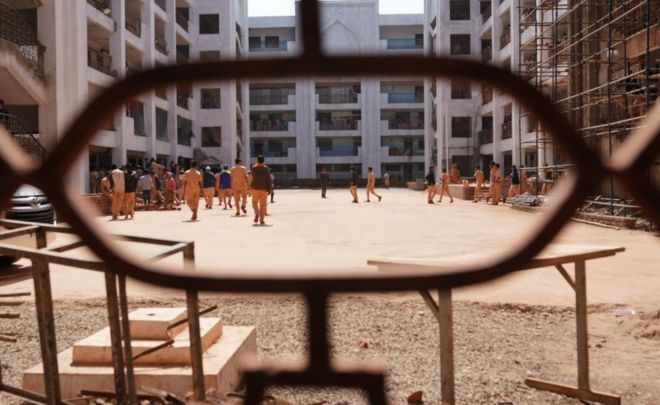
Image caption A play staged at Shaheen School has led to the arrest of a parent and a teacher
An Indian school play involving nine to 12-year-olds became the subject of national attention after it landed a young mother and a teacher in jail. BBC Telugu’s Deepthi Bathini reports.
“I’m not sure how I ended up here,” says 26-year-old Nazbunnisa, a single mother who did not give her last name and who works as a domestic help.
She was arrested on 30 January, along with Farida Begum, a teacher at her daughter’s school. The charge against them: sedition, which the women, both Muslim, deny.
They spoke to the BBC in a prison official’s office at Bidar district jail in the southern state of Karnataka. Both were on the verge of tears – they said they are trying to be “strong”, but their lives have suddenly turned “upside down”.
Their bail hearing is scheduled for Tuesday. Their lawyer says the charge of sedition is being misused.
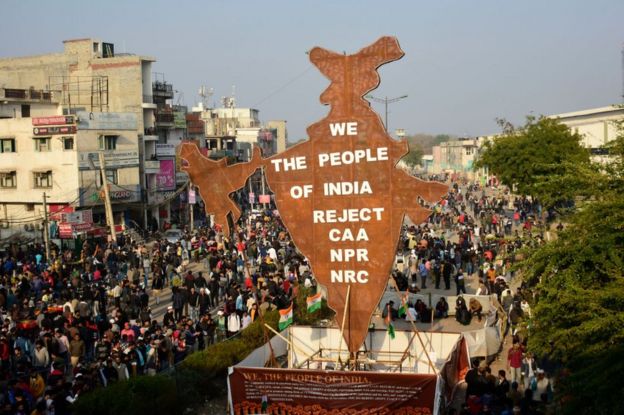
Image copyright GETTY IMAGESImage caption The citizenship law has sparked huge protests
The two women are accused of spreading “false information” and of “spreading fear among [the] Muslim community” and of using children to insult India’s Prime Minister, Narendra Modi.
Their ordeal began with a play put on by the students and staff at Shaheen School in Bidar, where Ms Nazbunnisa’s daughter studies and Farida Begum, 52, teaches.
The play was about a controversial new citizenship law, which has polarised India since it was passed in December by the governing Hindu nationalist Bharatiya Janata Party (BJP).
The Citizenship Amendment Act (CAA), offers amnesty to non-Muslim immigrants from Pakistan, Bangladesh and Afghanistan. It sparked fear among India’s 200 million-plus Muslims as it came in the wake of the government’s plans to introduce a National Register of Citizens (or NRC) based on those who can prove their ancestors were Indian citizens.
Authorities are yet to clarify what documents would be needed to prove citizenship, but taken together, the measures have spurred massive protests – critics say the government is marginalising Muslims while offering a path to citizenship for people of other religious communities who fail to make it on to the NRC.
The governing BJP denies these charges, and insists India’s Muslims have nothing to worry about.
So, given the contentious subject, after one of the parents streamed the school play live on Facebook, the recording quickly went viral. Local resident Neelesh Rakshal was among those who watched it.
Mr Rakshal, who describes himself as a social activist, says he became furious over a scene where a man approaches an elderly woman and tells her that Narendra Modi wants Muslims to produce documents proving their Indian citizenship and that of their ancestors, and if they fail to do so, they will be asked to leave the country.
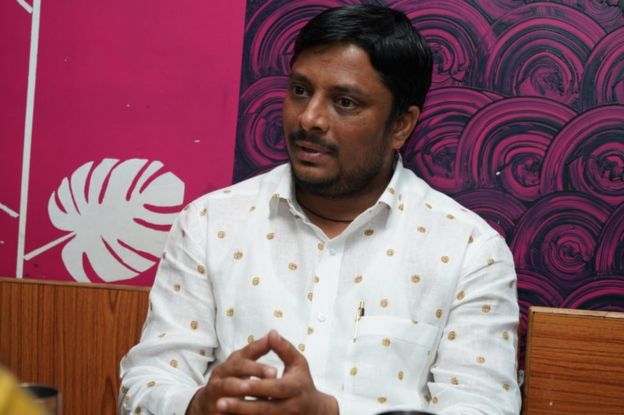
Image caption Mr Rakshal says the play “spreads hatred”
The woman responds that she has been in India for generations and would have to dig up the graves of her ancestors to look for documents. She then says a “boy who was selling tea”, a reference to Mr Modi who has said he used to sell tea as a teenager, is now demanding that she show him her documents.
“I will ask him for his documents and if he doesn’t show them to me, I will hit him with slippers,” she adds.
Mr Rakshal says he immediately registered a police complaint against the school for “using children in a school play to abuse the prime minister and also for spreading hatred”.
The complaint named the school management and the parent who streamed the play. While several members of the school management and the president of the school have also been charged with sedition, police told the court they are still looking for them.
“We do not know for what reason sedition charges have been invoked against the school. It is beyond the imagination of any reasonable person. We will fight it in court,” the school’s CEO, Thouseef Madikeri, says.
Image copyright GETTY IMAGESImage caption School officials allege that they are being targeted because most of the students are Muslim
Police also questioned students – videos and screen grabs of CCTV footage showing them speaking to students were shared widely on social media, prompting criticism.
Mr Madikeri alleges that on one occasion, police in uniform questioned students, with no child welfare officials present – an accusation denied by police superintendent DL Nagesh.
“The students were questioned five times. It’s mental harassment to students and this may have an impact on them in [the] long run,” Mr Madikeri says.
The Karnataka State Commission for Protection of Child Rights has asked police to explain why they questioned students so many times. Police say it was because not all the students were available at the same time.
Mr Madikeri told the BBC it was the questioning of students that led to the arrest of Farida Begum and Ms Nazbunnisa.
One parent whose child was questioned says she is now scared of going to school.
“My daughter told me police repeatedly asked her to identify the teachers and others who might have taught them the [play’s] dialogues,” he said.
“I do not understand what was wrong in the play. Children have been seeing what has been happening around the country. They picked up the dialogues from social media.”
Image caption Farida Begum’s husband is worried about what will happen
Ms Nazbunnisa is also perplexed as to why she was arrested.
“My daughter was rehearsing for the play at home,” she says. “But I did not know what it was about, or what this controversy about CAA or NRC is about. I did not even go to see her play.”
Ms Nazbunnisa has met her daughter only once since she was jailed: “It was just for a few minutes, and even then only through a window. I held back my tears. I did not want to scare her further.”
The girl is staying with a friends of the family – they told the BBC she is having nightmares and often wakes up crying for her mother.
“She has been pleading that her mother not be punished for her mistake. She is sorry for what has happened,” one of them says.
Farida Begum, who suffers from high blood pressure, says she is “scared of what the future holds”. Her husband, Mirza Baig, says he fears that his wife being in jail will affect his daughter’s marriage prospects.
NEW DELHI (Reuters) – Violent clashes erupted in Delhi between police and hundreds of university students on Friday over the enactment of a new citizenship law that critics say undermines India’s secular foundations.
The unrest has already led Japanese Prime Minister Shinzo Abe to cancel a planned visit to India from Sunday.
The new law offers a way to Indian citizenship for six minority religious groups from neighbouring Bangladesh, Pakistan and Afghanistan including Hindus and Christians, but not Muslims.
RELATED COVERAGE
Explainer: What does India’s new citizenship law mean?
Clashes erupt in New Delhi between students, police over citizenship law
See more stories
Police fired tear gas and used baton charges to disperse scores of students demonstrating at Jamia Millia Islamia university in the heart of Delhi over the law.
Protesters attacked cars in the capital, and several people were injured and taken to hospital.
Zakir Riyaz, a PhD student in social work, said the new law made a mockery of India’s religious openness.
“It goes against the whole idea of a secular India,” he said, speaking by phone from the Holy Family Hospital in New Delhi where 15 of his fellow students were admitted after being injured in a police baton charge.
Police barricades were knocked down and streets were strewn with shoes and broken bricks. An official at the university dispensary said that more than 100 students had been brought in with injuries but all had been discharged.
Parvez Hashmi, a local politician who went to the protest site to speak to police, said about 50 students had been detained.
Students said it was meant to be a peaceful protest, with them trying to go from Jamia University to Parliament Street to show their opposition to the legislation. But police pushed them back, leading to clashes.
Critics of Prime Minister Narendra Modi’s government say it is promoting a Hindu-first agenda for India and that the citizenship law excluding Muslims showed a deep-seated bias against India’s 170 million Muslims.
Imran Chowdhury, a researcher, said “either give citizenship to refugees of all religions or none at all. The constitution is being tampered with in the name of religion.”
Modi’s ruling Bharatiya Janata Party denies any religious bias but says it is opposed to the appeasement of one community. It says the new law is meant to help minority groups facing persecution in the three nearby Muslim countries.
ABE CANCELS
The United Nations human rights office voiced concern that the new law is “fundamentally discriminatory in nature”, and called for it to be reviewed.
Two people were killed in India’s Assam state on Thursday when police opened fire on mobs torching buildings and attacking railway stations in protest at the new citizenship rules signed into law on Thursday.
Japan’s Prime Minister Shinzo Abe cancelled a trip to Assam for a summit with his Indian counterpart Narendra Modi that had been due to begin on Sunday.
Japan has stepped up infrastructure development work in Assam in recent years, which the two sides were expected to highlight during the summit. Abe had also planned to visit a memorial in the nearby state of Manipur where Japanese soldiers were killed in World War Two.
“With reference to the proposed visit of Japanese PM Abe Shinzo to India, both sides have decided to defer the visit to a mutually convenient date in the near future,” Indian foreign ministry spokesman Raveesh Kumar said in a tweet.
Japan’s Chief Cabinet Secretary Yoshihide Suga said both countries would decide on the appropriate timing for the visit although nothing has been decided yet.
A movement against immigrants from Bangladesh has raged in Assam for decades. Protesters there say granting Indian nationality to more people will further strain the state’s resources and lead to the marginalisation of indigenous communities.












 CHINDIA ALERT: You'll be living in their world, very soon