Chindia Alert: You’ll be Living in their World Very Soon
aims to alert you to the threats and opportunities that China and India present. China and India require serious attention; case of ‘hidden dragon and crouching tiger’.
Without this attention, governments, businesses and, indeed, individuals may find themselves at a great disadvantage sooner rather than later.
The POSTs (front webpages) are mainly 'cuttings' from reliable sources, updated continuously.
The PAGEs (see Tabs, above) attempt to make the information more meaningful by putting some structure to the information we have researched and assembled since 2006.
“The central government and I are totally committed to constitutionally safeguard the political, linguistic, cultural and land rights of the Assamese people,” he tweeted.
However, with internet and mobile services shut down, it is unlikely residents would have been able to read the message.
The chief minister of Assam was stranded at the airport for several hours on Wednesday because roads were blocked by protests.
What do protesters want?
They want the bill to be repealed, as they say their ethnic and cultural identity is under threat from illegal migration.
Essentially, they do not want any migrants – regardless of religion – to be allowed into the state.
The National Register of Citizens (NRC) is a list of people who can prove they came to the state by 24 March 1971, a day before neighbouring Bangladesh became an independent country.
In the run-up to its publication, the BJP had supported the NRC, but changed tack days before the final list was published, saying it was error-ridden.
The reason for that was a lot of Bengali Hindus – a strong voter base for the BJP – were left off the list, and would possibly become illegal immigrants.
The CAB is seen as being linked to the register, although it is not the same thing.
It will help protect non-Muslims who are excluded from the register and face the threat of deportation or internment.
Has the bill been challenged?
The Indian Union Muslim League, a political party, has petitioned the country’s top court to declare the bill illegal.
In their petition to the Supreme Court, the Indian Union Muslim League argued that the bill violated articles of equality, fundamental rights and the right to life.
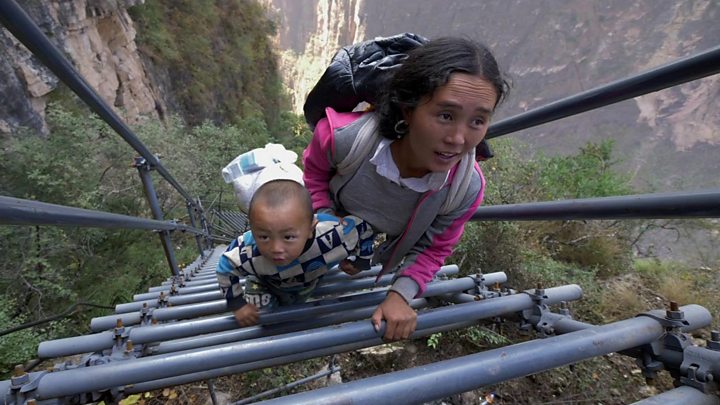
Image copyright FENG VIDEOImage caption Wu Huayan ate only rice and chillies in order to save money to help her ill brother
Well-wishers have donated almost a million yuan to a Chinese student who was hospitalised after living on 2 yuan ($0.30, £0.20) a day for five years.
The case of Wu Huayan shocked Chinese people after it hit the headlines earlier this week.
The 24-year old woman became seriously malnourished while struggling to study and support her sick brother.
Ms Wu’s story also sparked anger at authorities for failing to recognise her plight and help her much earlier.
After the story was reported, donations began pouring in for the college student in the city of Guiyang – reportedly totalling some 800,000 yuan ($114,000, £88,000).
What is Wu Huayan’s story?
Earlier, this month, the young woman went into hospital after having difficulty breathing, according to Chinese media.
She was only 135cm (4ft 5ins) tall, weighing barely more than 20kg (43 pounds; three stones).
The doctors found she was suffering from heart and kidney problems due to five years spent eating minimal amounts of food. She said she needed to save money to support her sick brother.
Wu Huayan lost her mother when she was four and her father died when she was in school.
She and her brother were then supported by their grandmother, and later by an uncle and aunt who could only support them with 300 yuan ($42, £32) each month.
Most of that money went on the medical bills of her younger brother, who had mental health problems.
This meant Ms Wu spent only 2 yuan a day on herself, surviving largely off chillies and rice.
The siblings are from Guizhou, one of the poorest provinces in China.
Media caption China’s uphill struggle fighting extreme poverty
What has the reaction been?
The case sparked an outpouring of concern – and anger at authorities.
Many people on social media said they wanted to help with donations, and many voiced concern about her college not helping her.
One user called her situation “worse than that of refugees in Afghanistan”, while another pointed to the extravagant cost of China’s 70th anniversary celebrations, saying the money could have been better spent.
Others expressed their admiration at her efforts to help her brother, while also persevering with her studies in college.
Aside from the donations on crowd funding platforms, her teachers and classmates donated 40,000 yuan ($5,700; £4,400), while local villagers collected 30,000 yuan to help her.
Officials released a statement saying Ms Wu had been receiving the minimum government subsidy – thought to be between 300 and 700 yuan a month – and was now getting an emergency relief fund of 20,000 yuan.
“We will keep following the case of this strong-minded and kind girl,” the Tongren City Civil Affairs Bureau said.
“We will actively co-operate with other relevant departments to solve the problem according to the minimum living standard and temporary assistance responsibility that the civil affairs department bears.”
Dubbed “Little Wang”, his story also went viral, leading to international donations from people impressed by his resilience, and shocked at his poverty.
Image copyright PEOPLE’S DAILY
While China’s economy has skyrocketed over the past decades, poverty has not disappeared, and inequality has grown.
One major reason cited is the huge divide between rural and urban areas.
As a point of comparison, in rural region of Guizhou where Ms Wu lives, that figure is around 16,703 yuan.
China has moved from being “moderately unequal in 1990 to being one of the world’s most unequal countries,” according to a 2018 report by the International Monetary Fund.
According to the National Bureau of Statistics in 2017, 30.46 million rural people were still living below the national poverty line of $1.90 a day.
China has previously pledged to “eliminate” poverty by 2020.
Chinese State Councilor and Foreign Minister Wang Yi (R) meets with Pakistani Prime Minister Imran Khan on the sidelines of the United Nations General Assembly high-level week, at the UN headquarters in New York, on Sept. 23, 2019. (Xinhua/Han Fang)
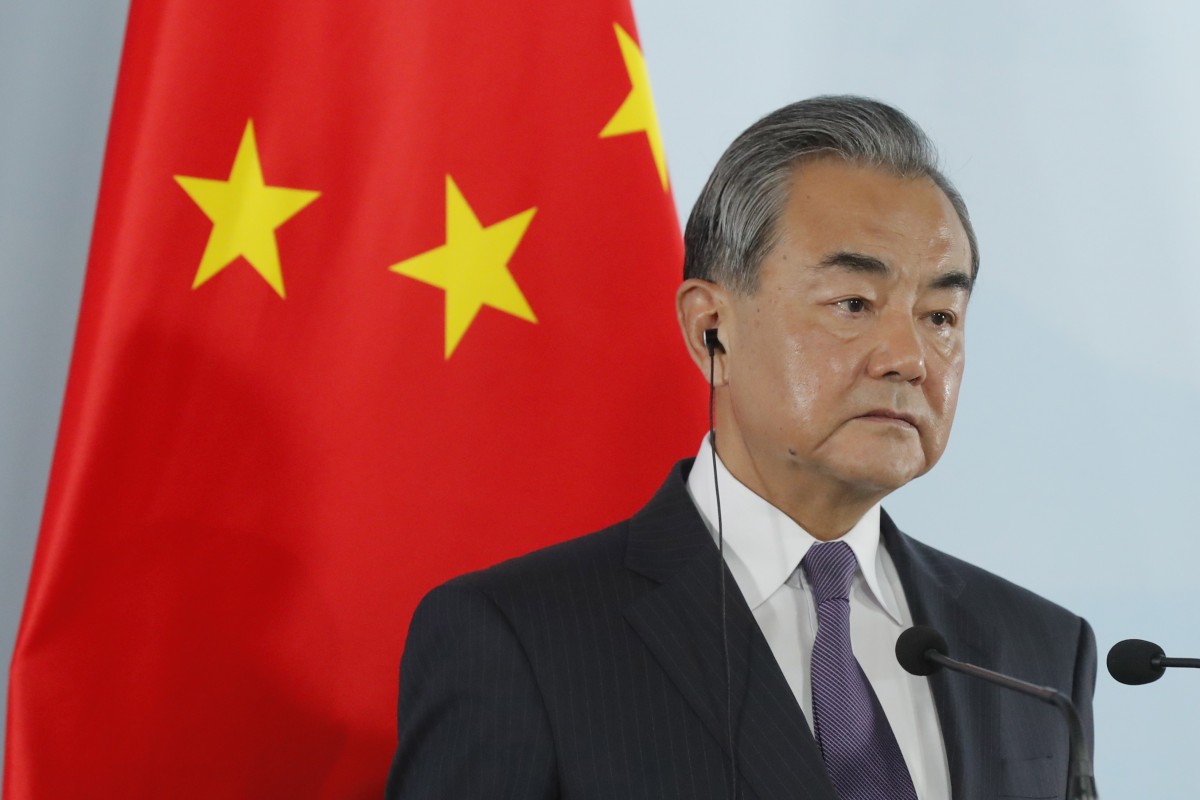
UNITED NATIONS, Sept. 23 (Xinhua) — Chinese State Councilor and Foreign Minister Wang Yi on Monday said China and Pakistan hold all-weather strategic cooperative partnership and the friendship between the two countries is unbreakable.
Meeting with Pakistani Prime Minister Imran Khan on the sidelines of the UN General Assembly high-level week, Wang said the two countries have always enjoyed mutual trust, mutual understanding and mutual support.
He said China will continue to support Pakistan’s efforts to uphold its territorial sovereignty and national dignity. China-Pakistan cooperation has contributed significantly to Pakistan’s national development and improvement of its people’s livelihood.
Wang added that the two sides should work together to build the China-Pakistan Economic Corridor (CPEC) into a model for high-quality development projects under the Belt and Road Initiative.
Khan, for his part, said Pakistan will firmly push forward the transformation and upgrading of the CPEC and continue to make every effort to ensure the safety of Chinese projects, enterprises and personnel in Pakistan.
He said that Pakistan and China are close friends, and Pakistan thanks the Chinese government and people for standing firmly with the Pakistani people in the most difficult time.
He added that China’s support and assistance are of great significance to Pakistan’s national security and development.
Pakistan will spare no effort in maintaining bilateral friendship and will not allow any external forces to interfere in or sabotage the development of bilateral relations.
Khan introduced Pakistan’s views on the current situation in Kashmir. Wang reiterated China’s principled position on the issue.
The two sides also exchanged views on Afghanistan, Iran and other issues.
Chinese State Councilor and Foreign Minister Wang Yi (L), Pakistani Foreign Minister Shah Mahmood Qureshi (C) and Afghan Foreign Minister Salahuddin Rabbani attend the 3rd China-Afghanistan-Pakistan Foreign Ministers’ Dialogue in Islamabad, capital of Pakistan, Sept. 7, 2019. (Xinhua/Liu Tian)
ISLAMABAD, Sept. 8 (Xinhua) — The 3rd China-Afghanistan-Pakistan Foreign Ministers’ Dialogue was held here in Islamabad on Saturday, and the three sides stressed the need to jointly safeguard regional peace and stability amid the changing and complicated circumstances.
The situation in south Asia is going through profound and complicated changes, Chinese State Councilor and Foreign Minister Wang Yi said at the meeting.
Progress has been achieved in the peace talks between the United States and the Afghan Taliban, and there is an important opportunity for Afghanistan’s peace and reconciliation, he noted.
Meanwhile, some historical disputes have again escalated, undermining peace and stability in the region, Wang said.
In the international arena, unilateralism, protectionism and hegemony have threatened and challenged the interests of developing countries, he added.
China, Afghanistan and Pakistan are close neighbors with a shared future, Wang said. The three countries share the aspirations to safeguard regional peace and achieve lasting stability, the need to push forward Belt and Road development and regional connectivity, as well as the expectation to achieve sustainable development and improve people’s livelihood.
The three sides should work together and make new efforts to push forward the Afghan-led and Afghan-owned reconciliation process in Afghanistan, improve the relations between Afghanistan and Pakistan, promote trilateral practical cooperation as well as jointly combat terrorism, among others, he said.
For their part, Afghan Foreign Minister Salahuddin Rabbani and Pakistani Foreign Minister Shah Mehmood Qureshi made positive assessment on the progress achieved in cooperation and exchange on the three major themes within the framework of the China-Afghanistan-Pakistan Foreign Ministers’ Dialogue, namely political mutual trust and reconciliation, development cooperation and connectivity, and security cooperation and fighting terrorism. They also spoke highly of China’s contribution in pushing forward the cooperation among the three countries.
The two foreign ministers said China, always a good neighbor and a trustworthy friend of Afghanistan and pakistan, has long played an important and positive role in promoting Afghanistan’s peace and reconciliation process, pushing forward the improvement of the relations between Afghanistan and Pakistan and maintaining peace and stability in the region.
With the complicated regional situation which is undergoing fast change, Afghanistan and Pakistan are willing to boost communication and coordination with China so as to deepen cooperation in such fields of economy and trade, people to people exchange, communication and connectivity, jointly build the Belt and Road, join hands in combating terrorism including the East Turkestan Islamic Movement, maintaining regional peace and stability as well as promoting regional development and prosperity, they said.
The foreign ministers from China, Afghanistan and Pakistan reached agreement on pressing forward the realization of lasting peace and stability in Afghanistan through the Afghan-led and Afghan-owned reconciliation process and implementing common connectivity programs with international financial institutions including the World Bank, among others.
The three foreign ministers also agreed to hold the 4th China-Afghanistan-Pakistan Foreign Ministers’ Dialogue in 2020 in China.
He is expected to join a trilateral dialogue with his counterparts from Pakistan and Afghanistan, and observers say he may try to mediate in Kashmir dispute
Trip also includes a stop in Nepal that could pave way for a visit by Xi Jinping
Chinese Foreign Minister Wang Yi may try to act as a negotiator in the Kashmir dispute. Photo: EPA-EFE
Chinese Foreign Minister Wang Yi began a four-day trip to Pakistan and Nepal on Saturday, amid escalating tensions between Islamabad and New Delhi over
Wang was expected to join a trilateral dialogue with the foreign ministers of Pakistan and Afghanistan in Islamabad, foreign ministry spokesman Geng Shuang said on Friday. He will also travel to Nepal.
Beijing has criticised India’s decision last month to strip the Jammu and Kashmir autonomous state of its special status and break it into two federally controlled territories, calling it “unacceptable”.
China also formally backed Pakistan’s request for the United Nations Security Council to hold “closed consultations” on the revocation of the state’s autonomy.
Meanwhile, observers say the Chinese foreign minister could attempt to act as a negotiator in the complex border dispute.
“Wang might try to play a role to mediate between the two sides to resolve the crisis,” said Wang Dehua, head of the Institute for South and Central Asia Studies at the Shanghai Municipal Centre for International Studies. “This has been China’s long-held position on the issue.”
Pang Zhongying, an international relations researcher at Ocean University of China in Qingdao, agreed.
“[Indian Prime Minister] Narendra Modi has visited China a couple of times and it is likely [Chinese President] Xi Jinping will visit India soon,” he said. “If Xi is to visit India later this year, China may try to contain its differing views with India on Kashmir.”
Modi has proposed an informal summit with Xi later this year that may be held in the religious hub of Varanasi, Modi’s parliamentary constituency. New Delhi said in May that Indian officials were working with the Chinese side to finalise the details, but Beijing has yet to confirm Xi’s visit.
India dismisses Beijing’s concerns over Kashmir because ‘it won’t have any impact on China’
Wang Yi was also due to visit India later this month for border talks, but the trip had to be postponed at the request of New Delhi because of scheduling problems, Hindustan Times reported, citing China’s foreign ministry.
The row over Kashmir has escalated in the past month. Pakistani Prime Minister Imran Khan said on Friday that Islamabad would make the fullest possible response to New Delhi’s actions in disputed Kashmir and that the global community would be responsible for any “catastrophic” aftermath.
Since Modi withdrew special rights for Indian-administered Kashmir on August 5, India has flooded the Kashmir valley with troops, restricted the movements of residents and cut off communication.
Both India and Pakistan claim the whole of Kashmir, which was partitioned between the two following the end of British rule in 1948, and they have subsequently fought wars over the territory.
China has its own territorial dispute with India over the part of Kashmir it controls. In early August, Chinese foreign ministry spokeswoman Hua Chunying
and said it was not binding. Beijing later appeared to soften its rhetoric, with Hua calling for a solution through dialogue and negotiation, without criticising either side.
The Chinese foreign minister will also visit Nepal, where he is expected to meet his counterpart, the president and prime minister. The trip could pave the way for an expected visit by Xi to Nepal.
A recent joint exercise in Tajikistan is the latest example of Beijing’s growing security and economic interests in the former Soviet republic
Analysts say Moscow may not be happy about China’s growing reach in the lawless, mountainous area and will be keeping an eye on the situation
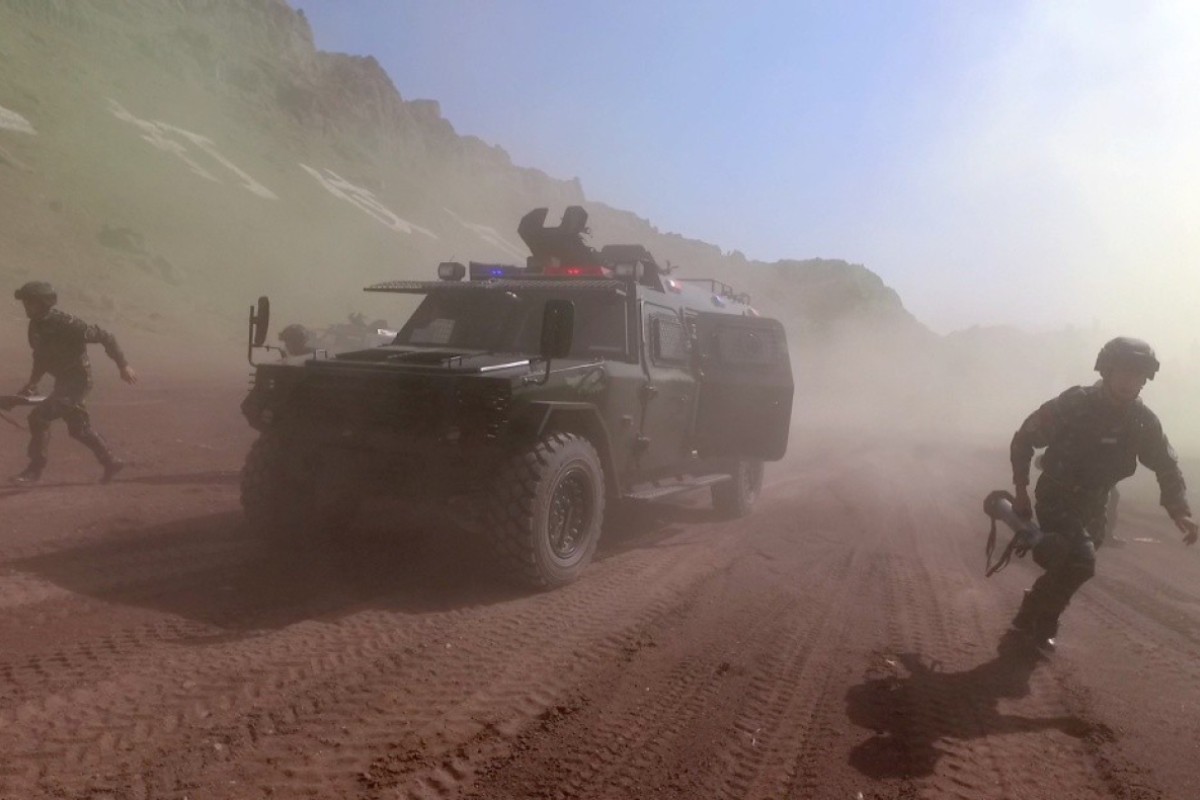
Chinese and Tajik troops completed a joint exercise earlier this month in the mountainous region of Gorno-Badakhshan. Photo: Xinhua
China is increasing its military and economic presence in parts of central Asia that Russia has traditionally considered its sphere of influence – a development some analysts believe could cause concern in Moscow.
While Russia’s influence remains strong in many former Soviet republics, China is steadily building up its military and economic influence in Tajikistan, particularly in the remote, mountainous areas on its western borders where central government authority is weak.
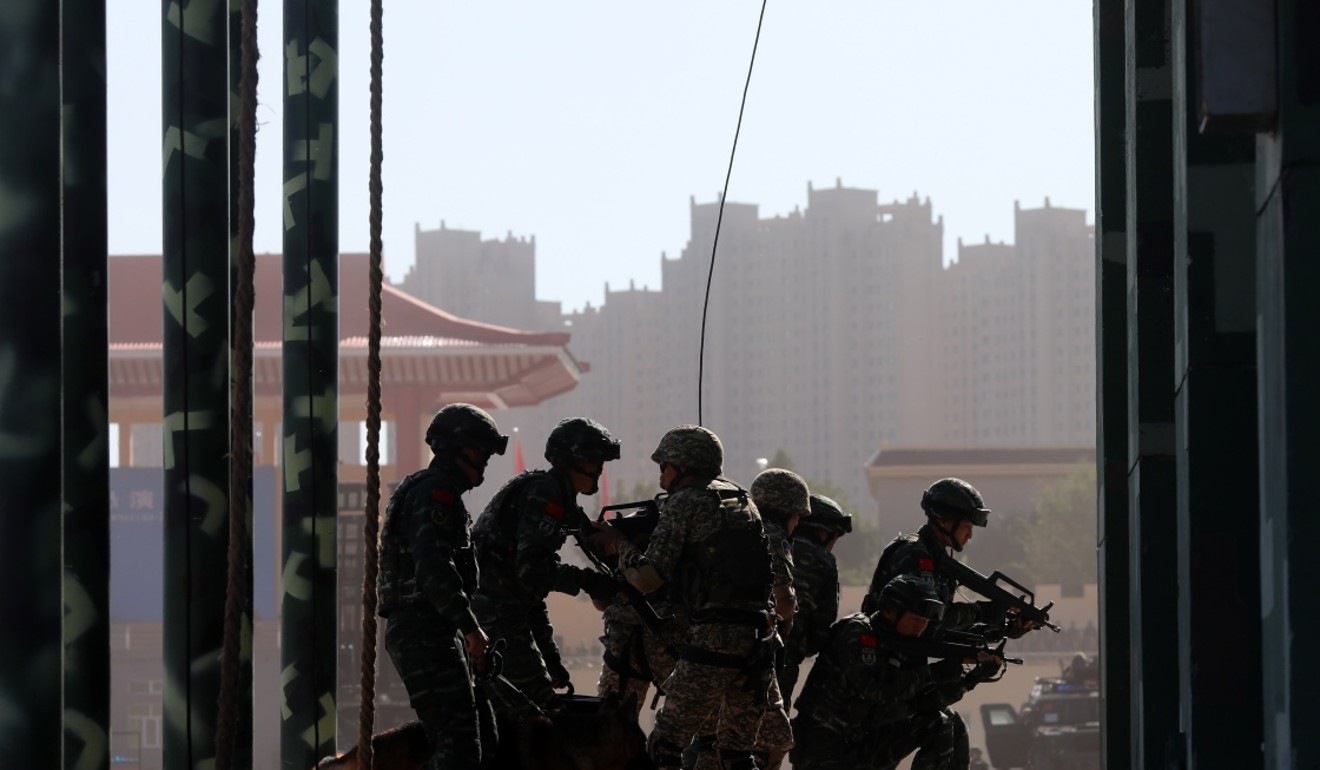
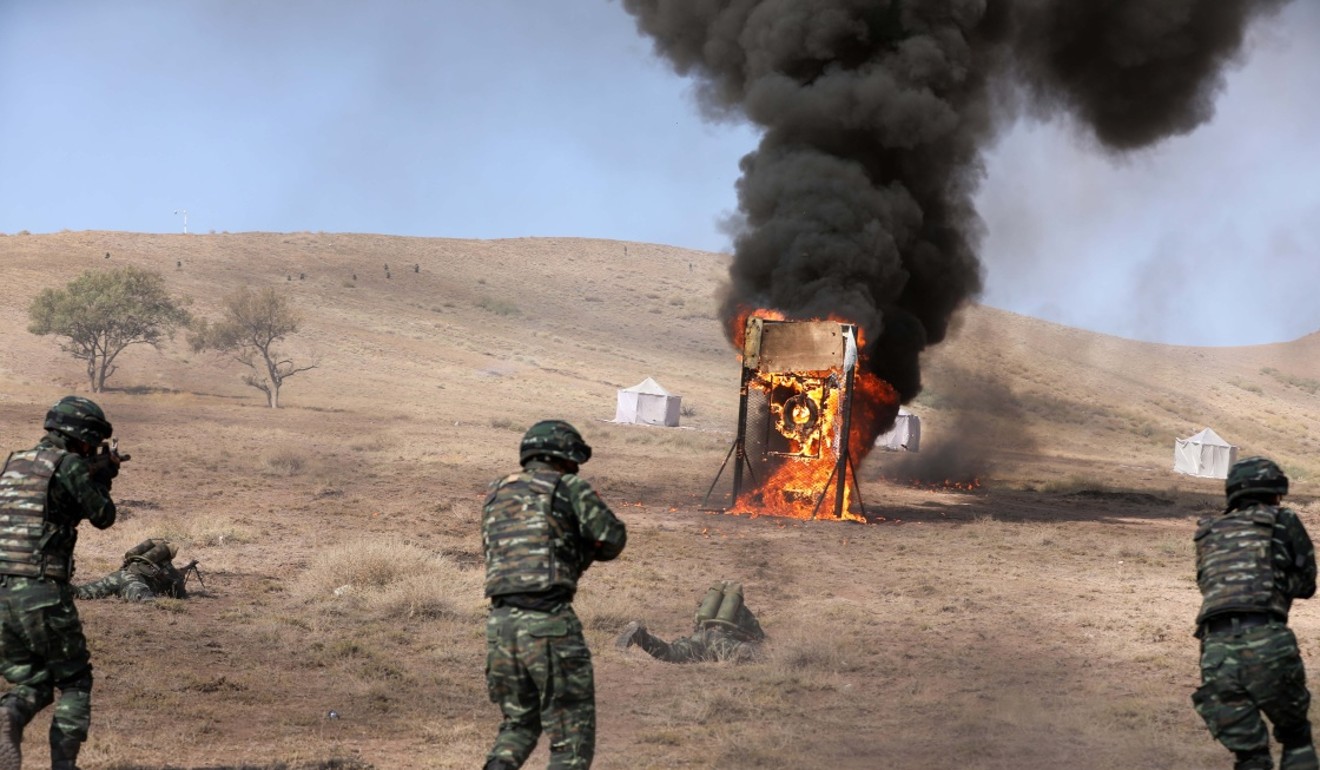
Chinese troops recently concluded a joint drill in eastern Tajikistan involving 1,200 troops from both countries.
The eight-day exercise that finished on August 13 was conducted in the autonomous Gorno-Badakhshan autonomous region, a sparsely populated territory in the high Pamir mountains, which borders China’s Xinjiang region and Afghanistan.
China has been increasing its security presence in the strategically sensitive region. Photo: Xinhua
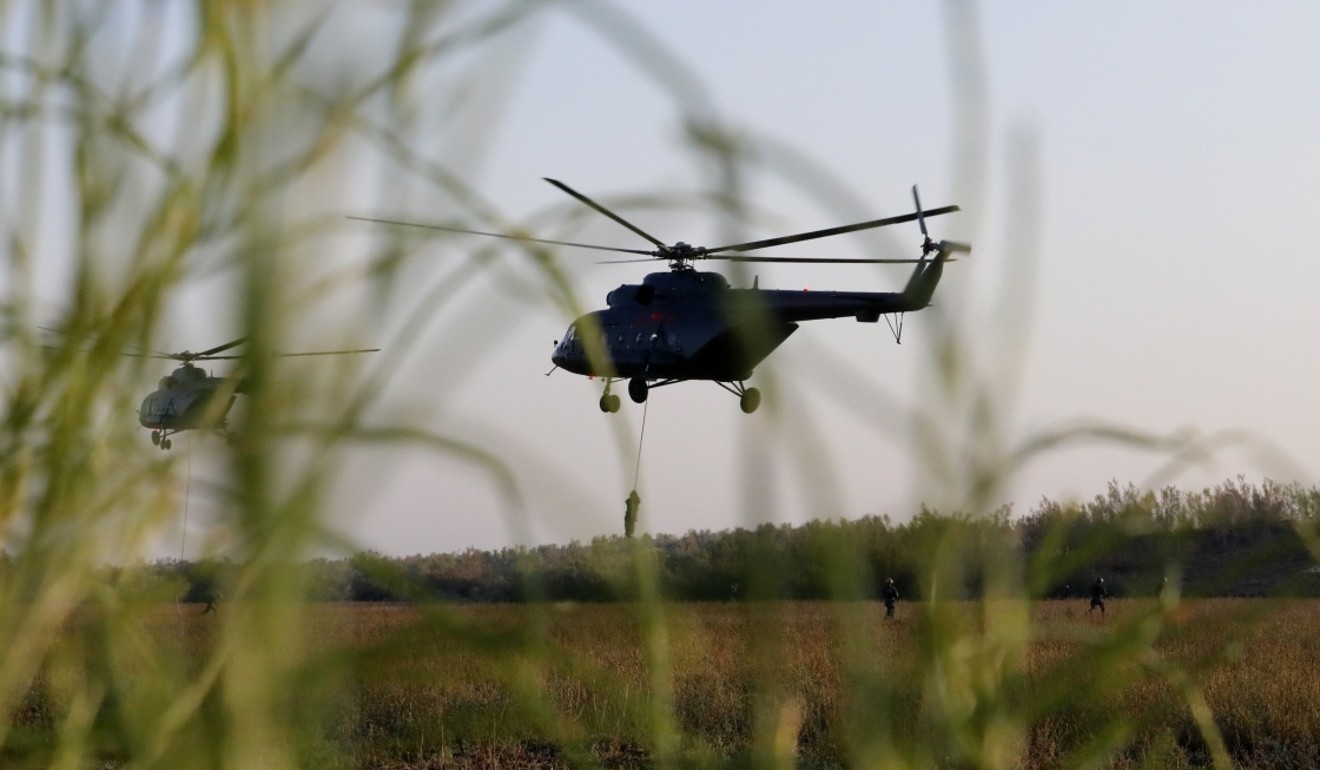
Although this year’s exercise involved fewer troops than the 10,000 involved in a previous drill three years ago, it tested the use of advanced aerial vehicles and ground reconnaissance technology to monitor the area.
The landlocked country is strategically important for China, which is worried that the porous borders will serve as an entry point for drugs and Islamic militants into Xinjiang, where its deradicalisation strategy has led to the detention of a million Muslim minorities in reeducation camps.
It also sits along the trade routes China hopes to develop under the Belt and Road Initiative – Beijing’s flagship plan to expand its global influence through infrastructure, trade and investment – but the area has long been plagued by lawlessness and outbreaks of violence.
The recent exercise tested aerial surveillance techniques. Photo: Xinhua
Artyom Lukin, a professor of international politics at Far Eastern Federal University in Vladivostok, said Russia was not happy about the deployment of Chinese forces in Tajikistan.
“Russia has traditionally considered Central Asia, including Tajikistan, as its sphere of political-military influence,” he said.
Observers said other Central Asian republics – such as Kazakhstan, Uzbekistan and Kyrgyzstan – are likely to stay within Moscow’s orbit, but China is steadily building closer security ties with Tajikistan.
In February, China’s defence ministry denied that it was building a base and stationing troops in the country, but defended its closer military cooperation with Tajikistan.
The recent training exercise was conducted in an area Russia has long seen as part of its sphere of influence. Photo: Xinhua
China has long-standing security interests in the country and in 2016 it agreed to finance 11 border outposts and a training centre for guards along the Afghan border.
This was part of a deal Beijing made through the Quadrilateral Cooperation and Coordination Mechanism – which also involves Pakistan, Afghanistan and Tajikistan – to strengthen cooperation in combating terrorism and improving security.
China has also overtaken Russia economically, becoming the largest foreign investor in Tajikistan in 2016, accounting for 30 per cent of Tajikistan’s total direct accumulated investments, state news agency Xinhua reported.
Banned Muslim political party blamed for deadly attack on tourists in Tajikistan
China’s direct investment in Tajikistan was worth US$95 million in 2017, according to the latest available figures. China has also grown to become the country’s third largest trading partner with bilateral trade reaching around US$1.5 billion in 2018.
A recent opinion piece published by the Russian state-owned news agency Sputnik suggested China may be “getting carried away” by its investments in the region.
The article suggested that China’s growing presence in the country could lead to a “partial loss” of Tajikistan’s sovereignty and argued that Beijing may want to take control of the border with Afghanistan.
China also has economic interests to protect. Photo: Xinhua
But Lukin said even though this growing involvement may be an irritant for Russia, the strategic partnership between China and Russia will remain strong.
The two countries remain the key players in the Shanghai Cooperation Organisation, an economic and security alliance that includes the Central Asian republics and India and Pakistan.
Why Chinese investors are struggling to gain a foothold in Tajikistan
Lukin said: “Moscow no doubt understands that in terms of security, Tajikistan’s border, adjacent to China’s Xinjiang and Afghanistan, is truly a vital concern for Beijing.
“The presence of Chinese troops could actually benefit Russia, because it will be China bearing the costs of policing Tajikistan’s mountainous border areas.”
Stephen Blank, a former professor at the US Army War College and a specialist in Eurasian security, said that while Russia has mostly stayed silent about China’s presence in Tajikistan, it was closely watching the situation.
“What happens in the long run depends on how far China goes to extend its military presence in Central Asia. And if it keeps extending, it may well provoke some expression of concern in Russia beyond the silence that has hitherto been the case,” Blank said.
Chinese troops could play an increasing role in policing the area in future. Photo: Xinhua
“[The recent drills] look like conventional war-fighting exercises as much as anti-terrorist operations and suggest that China may have bigger contingencies than anti-terrorism in mind.”
Mathieu Duchatel, director of the Asia programme at the Institut Montaigne, a French think tank, said both Russia and China share similar concerns about terrorism and drug trafficking in Central Asia.
He said Russia had not objected to the security pact with Pakistan, Afghanistan and Tajikistan because there are more important strategic priorities in China-Russia relations.
“Overall, Russia’s acceptance of a security role for China in Central Asia shows how Russia realistically adjusts to the changing balance of power with China, and is able to avoid a zero-sum game on issues where parallel efforts by China and Russia can serve Russian security interests,” he said.
Chinese State Councilor and Foreign Minister Wang Yi (R) meets with Frederica Mogherini, High Representative of the European Union (EU) for Foreign Affairs and Security Policy, in Bangkok, Thailand, Aug. 1, 2019. (Xinhua/Zhang Keren)
BANGKOK, Aug. 1 (Xinhua) — China and the European Union (EU) on Thursday agreed to continue safeguarding the Joint Comprehensive Plan of Action (JCPOA), or the Iran nuclear deal, during a meeting here Thursday between Chinese State Councilor and Foreign Minister Wang Yi and European Union (EU) High Representative for Foreign Affairs and Security Policy Federica Mogherini.
Regarding the Iran nuclear issue, both sides also agreed to safeguard the United Nations-centered multilateralism and oppose the campaign of “maximum pressure,” while calling on relevant parties to maintain restraint and prevent the escalation of the situation.
With regard to the China-EU ties, Wang said China is pleased to see the successful change of leadership of the EU institutions, and expects the EU to achieve greater achievement in promoting integration and addressing challenges.
China will maintain the stability and continuity of its policies toward the EU and provide continuous support in the European integration process, for the unity and growth of the EU, and a more important role by Europe in international affairs, Wang said.
China hopes that the new EU institutions will also maintain continuous and forward-looking policies towards China, he said.
China is willing to join hands with EU to actively implement the outcome of meetings between Chinese and EU leaders, follow the right direction of China-EU relations, enhance communication and cooperation, and push forward the democratization of international relations and multi-polarization of the world, safeguard multilateralism and free trade, and jointly push for greater development of China-EU relations in the new era, said Wang.
For her part, Mogherini said the new EU leadership will continue attaching importance to relations with China, and is willing to deepen cooperation with China and implement the leaders’ consensus, so as to expand EU-China connectivity and advance the healthy and stable development of EU-China relations.
Both sides also exchanged views on international and regional issues including the Afghanistan issue.
Settlements along the route linking Europe and Asia thrived by providing accommodation and services for countless traders
Formally established during the Han dynasty, it was a 19th-century German geographer who coined the term Silk Road
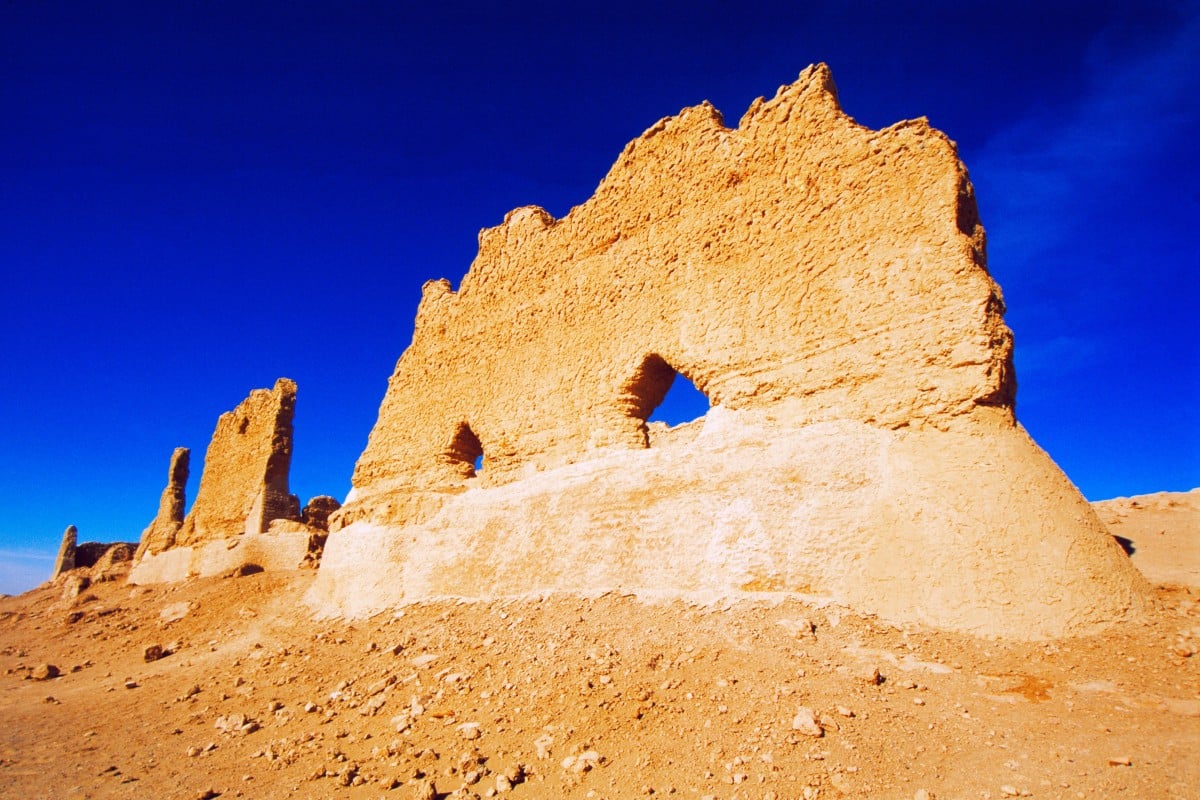
The ruins of a fortified gatehouse and customs post at Yunmenguan Pass, in China’s Gansu province. Photo: Alamy
We have a German geographer, cartographer and explorer to thank for the name of the world’s most famous network of transcontinental trade routes.
Formally established during the Han dynasty, in the first and second centuries BC, it wasn’t until 1877 that Ferdinand von Richthofen coined the term Silk Road (historians increasingly favour the collective term Silk Routes).
The movement of merchandise between China and Europe had been taking place long before the Han arrived on the scene but it was they who employed troops to keep the roads safe from marauding nomads.
Commerce flourished and goods as varied as carpets and camels, glassware and gold, spices and slaves were traded; as were horses, weapons and armour.
Merchants also moved medicines but they were no match for the bubonic plague, which worked its way west along the Silk Road before devastating huge swathes of 14th century Europe.
What follows are some of the countless kingdoms, territories, (modern-day) nations and cities that grew rich on the proceeds of trade, taxes and tolls.
China
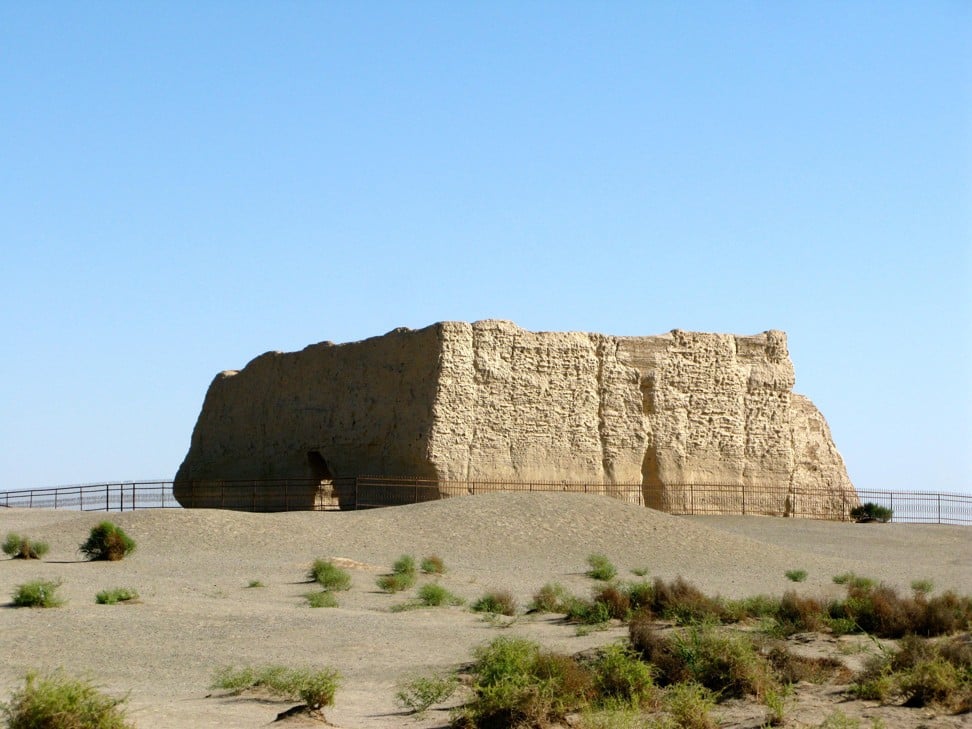
A watchtower made of rammed earth at Dunhuang, a desert outpost at the crossroads of two major Silk Road routes in China’s northwestern Gansu province. Photo: Alamy
Marco Polo worked in the Mongol capital, Khanbaliq (today’s Beijing), and was struck by the level of mercantile activity.
The Venetian gap-year pioneer wrote, “Every day more than a thousand carts loaded with silk enter the city, for a great deal of cloth of gold and silk is woven here.”
Light, easy to transport items such as paper and tea provided Silk Road traders with rich pickings, but it was China’s monopoly on the luxurious shimmering fabric that guaranteed huge profits.
So much so that sneaking silk worms out of the empire was punishable by death.
The desert outpost of Dunhuang found itself at the crossroads of two major Silk Road trade arteries, one leading west through the Pamir Mountains to Central Asia and another south to India.
Built into the Great Wall at nearby Yunmenguan are the ruins of a fortified gatehouse and customs post, which controlled the movement of Silk Road caravans.
Also near Dunhuang, the Mogao Caves contain one of the richest collections of Buddhist art treasures anywhere in the world, a legacy of the route to and from the subcontinent.
Afghanistan
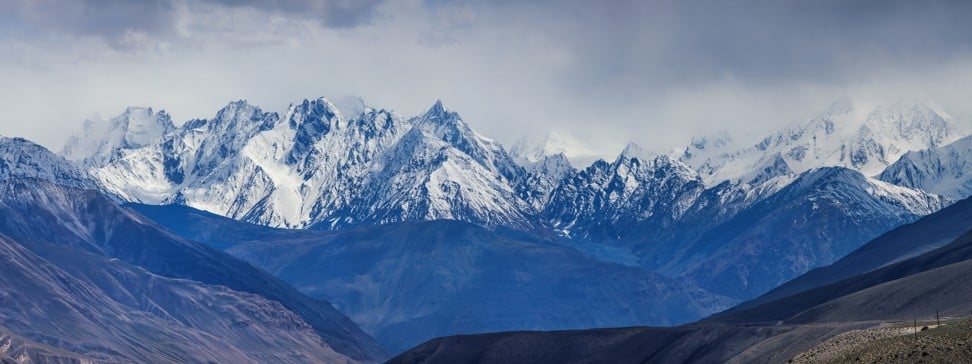
Afghanistan’s mountainous terrain was an inescapable part of the Silk Road, until maritime technologies would become the area’s undoing. Photo: Shutterstock
For merchants and middlemen hauling goods through Central Asia, there was no way of bypassing the mountainous lands we know today as Afghanistan.
Evidence of trade can be traced back to long before the Silk Road – locally mined lapis lazuli stones somehow found their way to ancient Egypt, and into Tutankhamun’s funeral mask, created in 1323BC.
Jagged peaks, rough roads in Tajikistan, roof of the world
Besides mercantile exchange, the caravan routes were responsible for the sharing of ideas and Afghanistan was a major beneficiary. Art, philosophy, language, science, food, architecture and technology were all exchanged, along with commercial goods.
In fact, maritime technology would eventually be the area’s undoing. By the 15th century, it had become cheaper and more convenient to transport cargo by sea – a far from ideal development for a landlocked region.
Iran
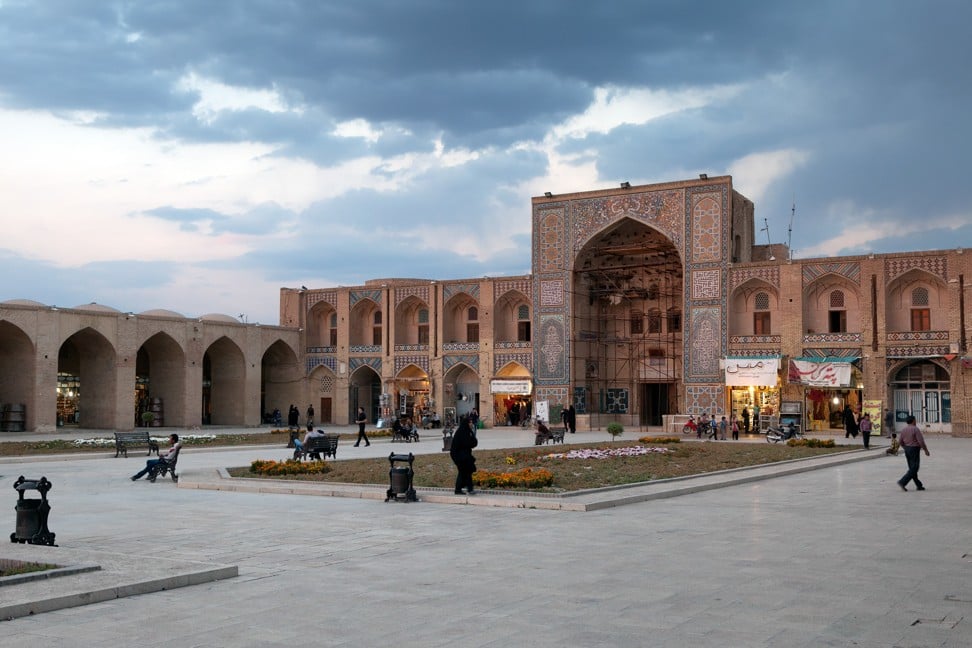
The Ganjali Khan Complex, in Iran. Photo: Shutterstock
Thanks to the Silk Road and the routes that preceded it, the northern Mesopotamian region (present-day Iran) became China’s closest trading partner. Traders rarely journeyed the entire length of the trail, however.
Merchandise was passed along by middlemen who each travelled part of the way and overnighted in caravanserai, fortified inns that provided accommodation, storerooms for goods and space for pack animals.
The good, bad and ugly sides to visiting Chernobyl and Kiev
With so many wheeler-dealers gathering in one place, the hostelries developed into ad hoc marketplaces.
Marco Polo writes of the Persian kingdom of Kerman, where craftsmen made saddles, bridles, spurs and “arms of every kind”.
Today, in the centre of Kerman, the former caravanserai building forms part of the Ganjali Khan Complex, which incorporates a bazaar, bathhouse and mosque.
Uzbekistan
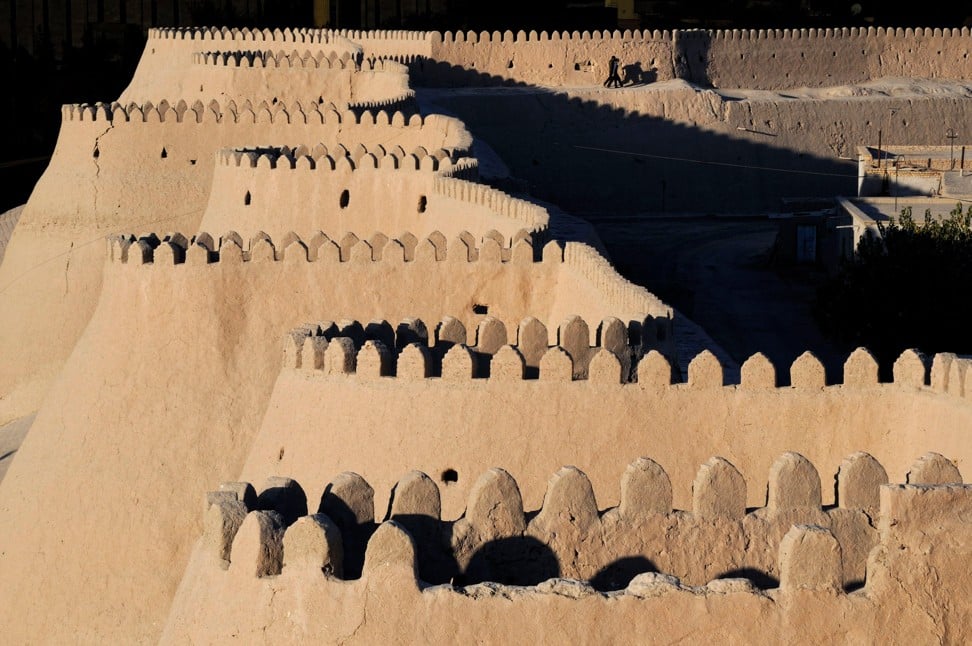
A fort in Khiva, Uzbekistan. Photo: Alamy
The double-landlocked country boasts some of the Silk Road’s most fabled destinations. Forts, such as the one still standing at Khiva, were built to protect traders from bandits; in fact, the city is so well-preserved, it is known as the Museum under the Sky.
The name Samarkand is also deeply entangled with the history of the Silk Road.
The earliest evidence of silk being used outside China can be traced to Bactria, now part of modern Uzbekistan, where four graves from around 1500BC-1200BC contained skeletons wrapped in garments made from the fabric.
Three thousand years later, silk weaving and the production and trade of textiles remain one of Samarkand’s major industries.
Georgia
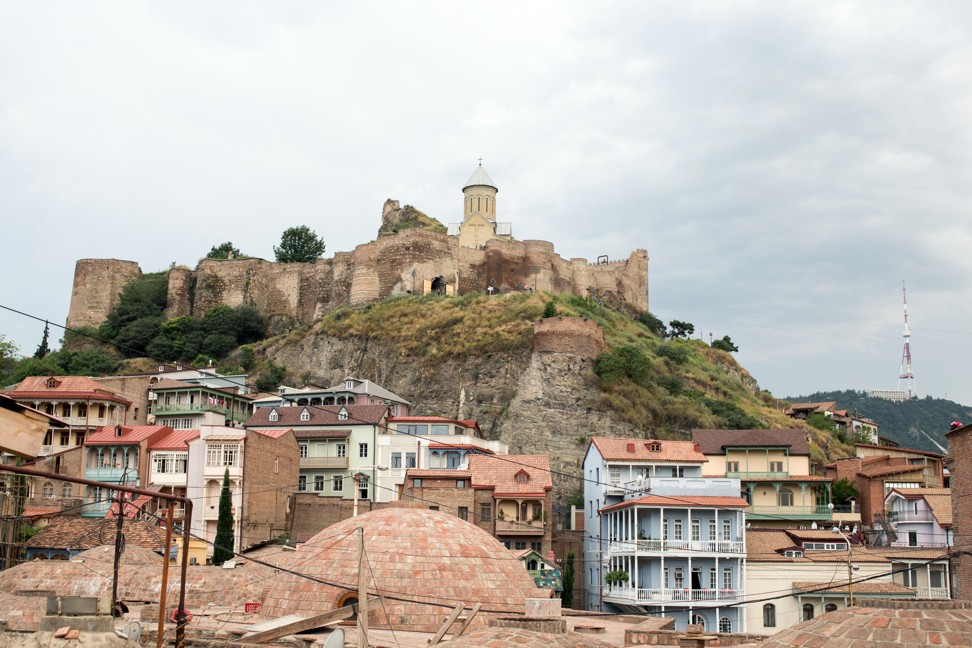
A street in old town of Tbilisi, Georgia. Photo: Alamy
Security issues in Persia led to the opening up of another branch of the legendary trade route and the first caravan loaded with silk made its way across Georgia in AD568.
Marco Polo referred to the weaving of raw silk in “a very large and fine city called Tbilisi”.
Today, the capital has shaken off the Soviet shackles and is on the cusp of going viral.
Travellers lap up the city’s monasteries, walled fortresses and 1,000-year-old churches before heading up the Georgian Military Highway to stay in villages nestling in the soaring Caucasus Mountains.
Public minibuses known as marshrutka labour into the foothills and although the vehicles can get cramped and uncomfortable, they beat travelling by camel.
Jordan
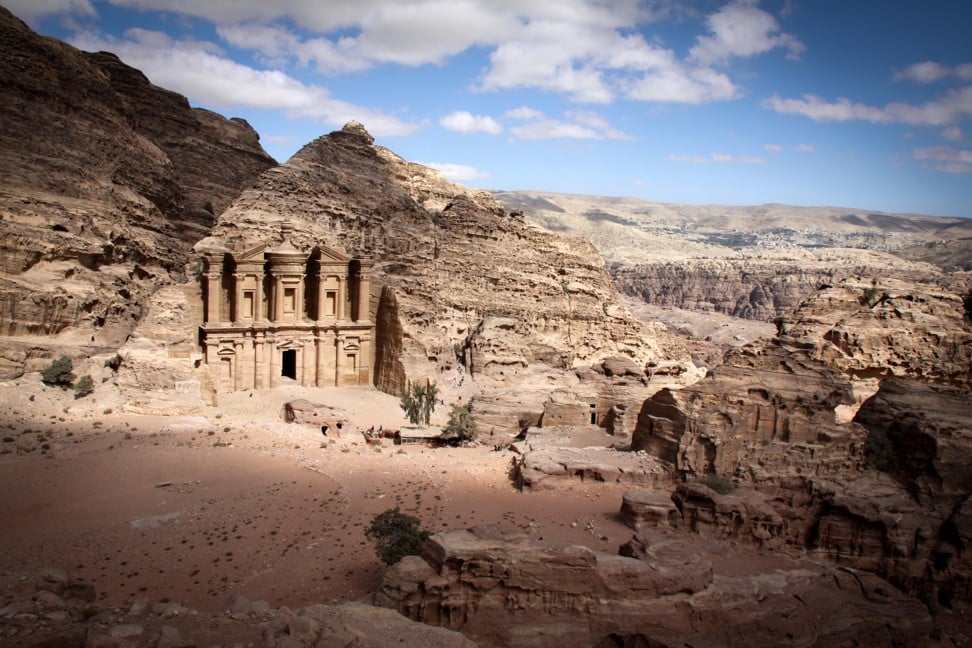
Petra, in Jordan. Photo: Alamy
The location of the Nabataean capital, Petra, wasn’t chosen by chance.
Savvy nomadic herders realised the site would make the perfect pit-stop at the confluence of several caravan trails, including a route to the north through Palmyra (in modern-day Syria), the Arabian peninsula to the south and Mediterranean ports to the west.
Huge payments in the form of taxes and protection money were collected – no wonder the most magnificent of the sandstone city’s hand-carved buildings is called the Treasury.
The Red Rose City is still a gold mine – today’s tourists pay a hefty
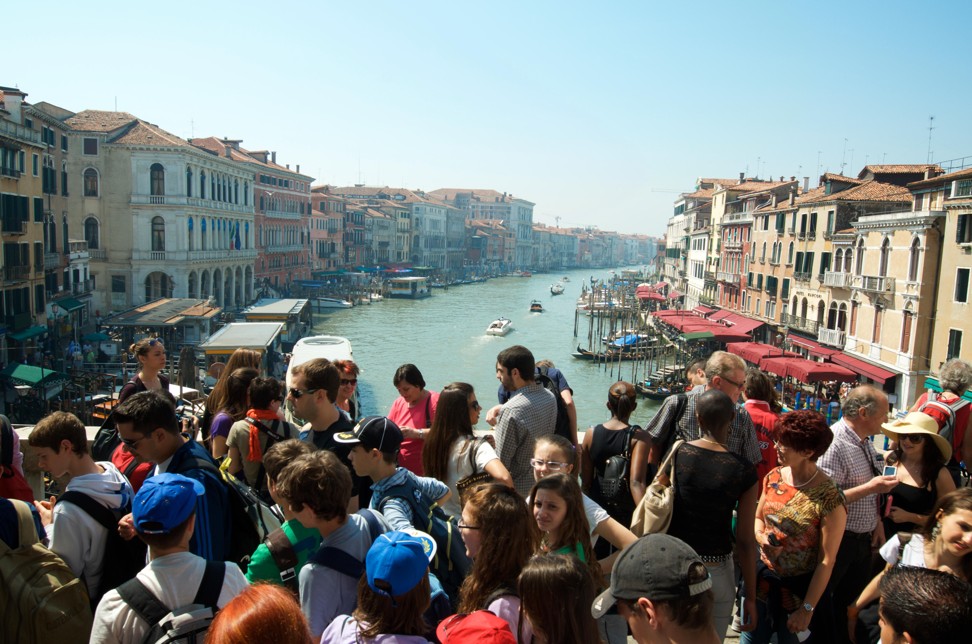
Trade enriched Venice beyond measure, helping shape the Adriatic entrepot into the floating marvel we see today.
Besides the well-documented flow of goods heading west, consignments of cotton, ivory, animal furs, grapevines and other goods passed through the strategically sited port on their way east.
Ironically, for a city built on trade and taxes, the biggest problem Venice faces today is visitors who don’t contribute enough to the local economy.
A lack of spending by millions of day-tripping tourists and cruise passengers who aren’t liable for nightly hotel taxes has prompted authorities to introduce a citywide access fee from January 2020.
Two thousand years ago, tariffs and tolls helped Venice develop and prosper. Now they’re needed to prevent its demise.
BEIJING (Reuters) – China recently played host to a Taliban delegation as part of efforts to promote peace and reconciliation in Afghanistan, China’s foreign ministry said on Thursday.
Representatives of the Taliban, who have been fighting for years to expel foreign forces and defeat the U.S.-backed government in Kabul, have been holding talks with U.S. diplomats for months.
The focus has been the Taliban demand for the withdrawal of U.S. and other foreign forces, in exchange for guarantees that Afghanistan will not be used as a base for militant attacks.
Taliban negotiators have also met senior Afghan politicians and civil society representatives, including in Moscow recently, as part of so-called intra-Afghan dialogue to discuss their country’s future.
Chinese foreign ministry spokesman Lu Kang told a daily news briefing that Abdul Ghani Baradar, the Taliban representative in Qatar, and some of his colleagues had recently visited China, though he did not say exactly when.
Chinese officials met them to discuss the Afghan peace process and counter-terror issues, Lu told the briefing, without saying who met the delegation.
“China pays great attention to the evolving situation in Afghanistan in recent years. We have always played a positive role in the Afghan peace and reconciliation process,” Lu said.
China supports Afghans resolving their problems themselves through talks, and this visit was an important part of China promoting such peace talks, he said.
“Both sides believe that this exchange was beneficial and agreed to keep in touch about and cooperate on continuing to seek a political resolution for Afghanistan and fighting terrorism.”
China’s far western Chinese region of Xinjiang shares a short border with Afghanistan.
China has long worried about links between militant groups and what it says are Islamist extremists operating in Xinjiang, home to the mostly Muslim Uighur people, who speak a Turkic language.
China, a close ally of Pakistan, has been deepening its economic and political ties with Kabul and is also using its influence to try to bring the two uneasy neighbours closer.
The Chinese government’s top diplomat, State Councillor Wang Yi, visited Kabul last December.
Chinese President Xi Jinping meets with Afghan President Mohammad Ashraf Ghani in Bishkek, Kyrgyzstan, June 13, 2019. (Xinhua/Xie Huanchi)
BISHKEK, June 13 (Xinhua) — Chinese President Xi Jinping and his Afghan counterpart, Mohammad Ashraf Ghani, met here Thursday, pledging joint efforts to promote bilateral relations.
Xi congratulated Afghanistan on the 100th anniversary of its independence and wished the country an early restoration of peace, stability and development.
China and Afghanistan are neighbors that enjoy traditional friendship and strategic partnership of cooperation, Xi said.
China is willing to deepen the mutually beneficial cooperation with Afghanistan in various sectors within the framework of the Belt and Road Initiative (BRI), steadily promote practical cooperation in economy and trade, and support the two countries’ enterprises to strengthen cooperation based on the principles of mutual benefit and win-win outcomes, he said.
Xi said China will, as always, continue to help Afghanistan build its capacity in fighting terrorism and maintaining stability.
He called on the Afghan side to continue to firmly support China in its fight against the terrorist force of East Turkistan Islamic Movement (ETIM).
The Chinese side firmly supports a comprehensive and inclusive Afghan-led and Afghan-owned peace and reconciliation process, and will continue to actively encourage and promote talks through various channels to help the Afghan people achieve internal dialogue, Xi said.
China supports Afghanistan and Pakistan to improve relations, enhance mutual trust and carry out cooperation, and is ready to further promote the China-Afghanistan-Pakistan trilateral cooperation, he said.
Ghani conveyed congratulations on the 70th anniversary of the founding of the People’s Republic of China.
By proposing to build a community with a shared future for mankind and supporting the economic globalization, China has set an example of promoting the construction of a new type of international relations in the 21st century, Ghani said.
Ghani thanked China for the active role it has played in his country’s peace process and in safeguarding regional peace and stability, adding that Afghanistan is committed to fighting, side by side with China, against the “three forces” including the ETIM.
Afghanistan stands ready to align its plan of reconstruction and development with the BRI and set up an even closer trade and economic partnership with China, Ghani added.


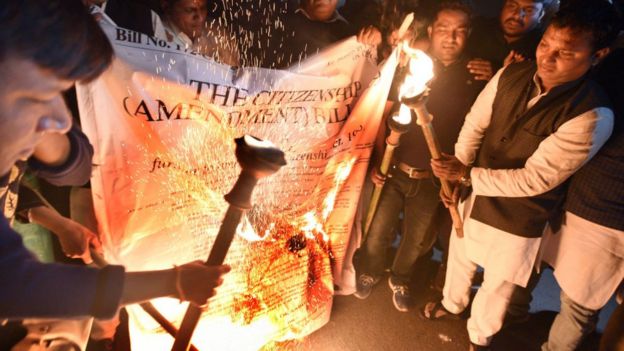 Image copyright GETTY IMAGES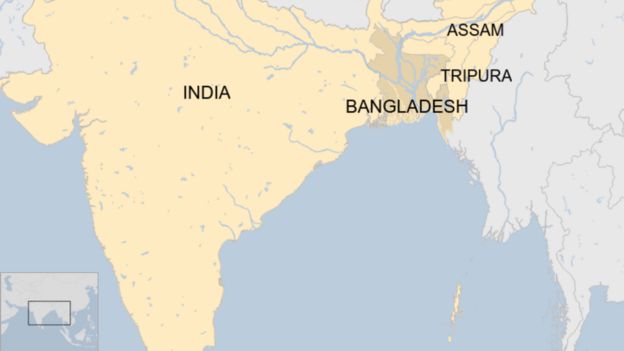







 CHINDIA ALERT: You'll be living in their world, very soon