08/04/2020
- Wuhan, where the first cases of the novel coronavirus were detected, is ending a 76-day lockdown
- A day before the lockdown was fully lifted, Tencent announces a slew of initiatives focused on helping to revive the digital industry in the city
Passengers leaving Wuhan city are pictured at the Hankou Railway Station in Wuhan city, central China’s Hubei province, on Wednesday morning, April 08, 2020. Photo: SCMP/Simon Song
A day before China
lifted a months-long lockdown of Wuhan city, the initial epicentre of the coronavirus pandemic, Chinese internet giant
Tencent Holdings pledged to invest in digital government, online education and artificial intelligence (AI) in the city, among other fields.
“During the epidemic, Tencent has been supporting Hubei and Wuhan’s fight against the virus through funds and technology,” the company best known for its gaming business said in a statement posted on Tuesday on WeChat. “In the future, we will also fully support Wuhan’s post-pandemic reconstruction and continue to support the development of Wuhan’s digital industry.”
China’s major tech companies have played a big role in the fight against the coronavirus, and are now playing their part in the economic recovery of Wuhan and other areas that have suffered under extended travel restrictions and business closures.
Last week, China’s biggest e-commerce services providers Alibaba Group Holding,
and Pinduoduo each announced their own initiatives to help revive sales of farm goods from Hubei as the province emerges from its months-long lockdown.
Popular mobile payments app Alipay also created a dedicated section for Wuhan merchants to allow users to buy from merchants in the city, and offered loans to small local merchants in need of financial support, according to an Alipay statement. Alipay is operated by Ant Financial, an affiliate of Alibaba, which owns the South China Morning Post.
How tech has helped China in its public health battle with coronavirus
Wuhan, an industrial powerhouse for the steel, semiconductors and automotive sectors, is emerging from an unprecedented lockdown which began on January 23 and prevented people from moving in and out of the city.
Since restrictions began easing gradually in late March, business activity has shown signs of recovery: Tencent’s mobile payment platform WeChat Pay recorded a 162 per cent increase in offline transactions in a 10-day period from March 25, compared to the same period the previous month, according to a separate statement by Tencent on Wednesday.
Searches for “work resumption certificates” – which businesses need to submit to local authorities to prove their staff can safely restart work – also increased 320 per cent on Baidu, China’s biggest search engine, in the past month, Baidu said in a report on Wednesday.
Tencent declined to provide specific details regarding the size of its latest investment in Wuhan or a timeline for its implementation, but said in the statement that it will involve closer cooperation with city authorities in the areas of digital government, education, smart mobility, AI and cybersecurity to help the city with its digital industries.
Among these initiatives, it will push ahead with a plan to build a headquarters focusing on digital industries in Wuhan, specifically digitalisation for the government and smart city initiatives.
It will also establish a base in Wuhan for its online education initiatives, set up an AI lab and cybersecurity academy and build a school focusing on smart mobility in collaboration with Chinese carmaker Dongfeng Motor Corporation, the company said in the statement.
Source: SCMP
Posted in academy, AI, Alibaba, Alibaba Group Holding, Alipay, artificial intelligence (AI), automotive, “work resumption certificates”, Baidu, businesses, carmaker, City, coronavirus, Coronavirus pandemic, cybersecurity, digital government, digital industries, digitalisation, Dongfeng Motor Corporation, E-commerce, economic recovery, education, emerges, epicentre, financial support, Hankou Railway Station, headquarters, hubei province, Internet giant Tencent, invest, JD.com, loans, local authorities, lockdown, merchants, mobile payments app, online education, Pinduoduo, pledges, reconstruction, restart, school, search engine, sectors, Semiconductors, services providers, small local merchants, smart mobility, south china morning post, Steel, TENCENT, Uncategorized, WeChat, work, Wuhan |
Leave a Comment »
30/08/2019
- ‘Forbes’ magazine reported that China’s central bank will launch its own sovereign digital currency to coincide with the Singles’ Day online shopping festival
- The People’s Bank of China is seeking to address financial risks and counter the current dominance of the US dollar
The Singles’ Day is a holiday celebrated in China on November 11 and has become the largest online shopping day in the world. Photo: Simon Song
China’s desire to launch the world’s first government-backed digital currency could see the possible rival to Facebook’s Libra be launched in time for November’s Singles’ Day online shopping festival despite a Chinese media report playing down the timing as “inaccurate speculation”.
Several central bank officials have publicly spoken out over the past several weeks about the need for China to launch its own digital currency since Facebook unveiled its plans for Libra, and the People’s Bank of China (PBOC) appear to be making rapid progress ahead of an expected launch.
Forbes magazine reported this week, citing a source who previously worked for the Chinese government, that China’s central bank could launch the digital currency as soon as November 11 as its bids to address financial risks and to counter the current dominance of the US dollar.
The PBOC did not respond to a faxed request for comment on the Forbes story, although Sina.com said that the report was “inaccurate speculation” citing an unnamed source close to the central bank.
China’s central bank is expected to distribute its digital currency through the big four state-owned banks – the Industrial and Commercial Bank of China, China Construction Bank, the Agricultural Bank of China, and the Bank of China – and mobile payments systems Alipay and WeChat Pay, as well as UnionPay, the state-supported credit card provider, according to the Forbes report. Alibaba is the owner of the South China Morning Post.
Ma Changchun, deputy chief of the Payment and Settlement Division of the PBOC, said at the start of August that a digital currency prototype existed and that the central banks’ Digital Money Research Group had already fully adopted
blockchain architecture to ensure its use in retail transactions.
“The People’s Bank digital currency can now be said to be ready,” said Ma on August 11.
The People’s Bank digital currency can now be said to be ready Ma Changchun
Former central bank governor Zhou Xiaochuan said last month that, in addition to central banks, “commercial entities” should be allowed to issue banknotes backed by their own private currency assets, although he did not elaborate on what kind of “commercial entities” might be appropriate to issue a digital currency in China.
China is also ready to make Shenzhen a pilot zone for digital currency as part of plans for the city to become a socialist model city, according to a statement summarising a meeting between the Shenzhen party secretary Wang Weizhong and central bank governor Yi Gang released on Thursday.
The PBOC implemented a blanket crackdown in China on trading of cryptocurrency, including bitcoin, which are not backed by any government, viewing them as risks to China’s financial stability and security. At the same time, in 2014 the central bank created its own academy to study digital currencies and the related blockchain technology.
Neil Woodfine, director of marketing at blockchain start-up Blockstream, said a digital currency created by the PBOC would be “just like cash” and “would be fully controlled by the central bank.”
“If it’s digital instead of physical, they can close accounts and monitor all activities [in the entire financial system]. Commercial bank deposits are difficult for them to monitor, control or pull information out of for verification because the numbers are in each bank’s data centre,” Woodfine said.
Wang Xin, director of the central bank’s research bureau, said last month that
to create its own digital currency have pushed Beijing to speed up its own digital currency plan as Libra could potentially pose a challenge to Chinese cross-border payments, monetary policy and even financial sovereignty.
Leonhard Weese, the president of the Bitcoin Association of Hong Kong, said that a government-backed digital currency may enhance the PBOC’s control of China’s monetary system, cutting reliance on commercial banks to transmit changes in monetary policy.
“It would be similar to just killing the commercial banks,” Weese said.
which would be a non-sovereign digital currency controlled by a Swiss-based company, has come under intense scrutiny by regulators and central banks worldwide. Last month, the Group of Seven industrialised nations, known as the G7, called for urgent regulatory measures and other types of action to address serious concerns over Libra.
Central banks, however, have expressed interest in launching their own digital currencies to counter the US dollar and to gain more control of their own monetary systems.
Mark Carney, governor of the Bank of England, argued last week that the US dollar, the current dominant reserve currency, could be replaced by a global digital alternative to tackle ultra-low interest rates.
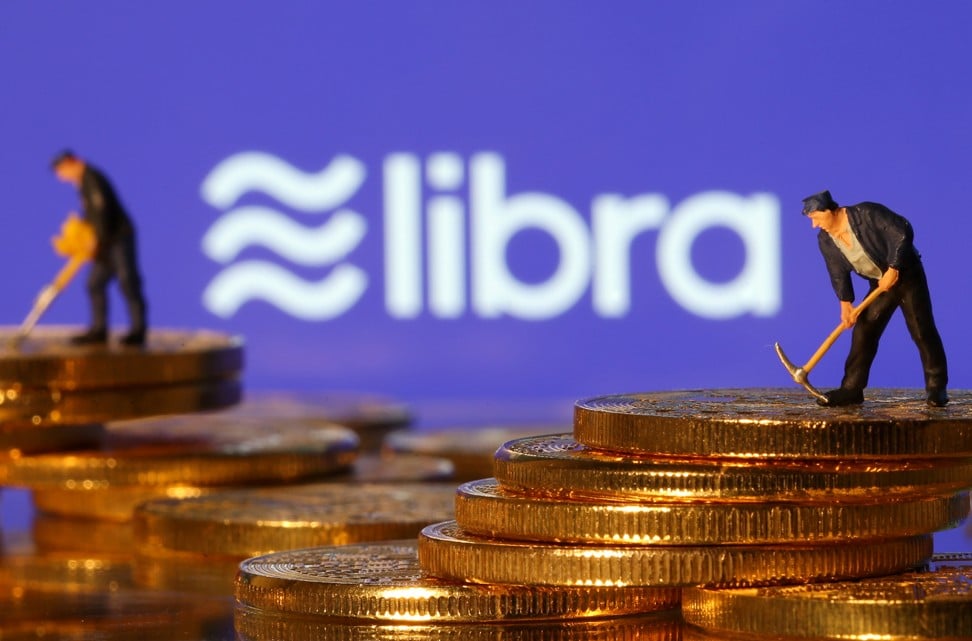
Facebook’s Libra, which is expected to be launched next year, will be pegged to a basket of convertible currencies – so it could serve as a stable online currency – while its payments will be endorsed by Visa and Mastercard. Photo: Reuters
A digital currency “could dampen the domineering influence of the US dollar on global trade”, Carney said last week at the US Federal Reserve’s annual conference, adding that a digital currency has the edge to counter shocks emanating from the US through trade and exchange rates.
Daniel Wang, chief executive and co-founder of blockchain start-up Loopring, said that a Chinese government-backed digital currency may provide a new way for the yuan to compete globally.
“If the central bank wants to increase the global competitiveness of the yuan through its digital currency, only an open and standard-based competitor carries any hope,” said Wang.
A digital yuan would “remain a sovereign currency under a centralised sovereign,” continuing to require the trust from users in the Chinese central bank and government institutions behind it, Wang added.
Alfred Schipke, senior resident representative for China at the International Monetary Fund (IMF), said that the bank is “open” to digital currencies, including the one being developed by China’s central bank.
The IMF in principle is looking at these things favourably. It’s a two-way process where we learn from China, which is often at the forefront of development. Alfred Schipke
“We don’t have a specific view on a particular currency, we haven’t looked at the details of the latest proposals from China,” Schipke said on Thursday. “The IMF in principle is looking at these things favourably. It’s a two-way process where we learn from China, which is often at the forefront of development.”
Blockstream’s Woodfine said that Beijing’s move also reflects a growing concerns among central banks that a financial disaster is on the horizon.
The 30-year US Treasury bond yield fell to an all-time low 1.976 per cent on Thursday, while yields around the world also plunged to multi-year or record low, triggering rising fears over a global recession.
Central banks around have also been driving down interest rates, with the PBOC recently unveiling a key interest rate reform that effectively cuts borrowing costs for companies to boost its slowing economy.
“We’ll see a move by governments and central banks to take back control over the financial system and use that power to direct their economies, continuing to pump money into the system to keep it afloat,” Woodfine added.
“A digital currency would be the perfect channel for helicopter money,” he said in reference to the idea that a central bank could stimulate the economy by giving out large quantities of money to the public, as if dumped from the sky. “They can send out free money to consumers.”
Source: SCMP
Posted in Agricultural Bank of China, Alibaba, Alipay, autumn, Bank of China, Bank of England, Bitcoin, Bitcoin Association of Hong Kong, blockchain architecture, blockchain technology, Blockstream, Central bank, China alert, China Construction Bank, Commercial bank deposits, cross-border payments, cryptocurrency, digital currency, Digital Money Research Group, Facebook, Facebook’s Libra, financial sovereignty, Forbes, Forbes magazine, G7, governor, Group of Seven industrialised nations, Industrial and Commercial Bank of China (ICBC), International Monetary Fund (IMF), launching, Libra, Loopring, Mark Carney, MasterCard, Monetary policy, Payment and Settlement Division, PBOC, People’s Bank of China (PBOC), pilot zone, Reserve currency, Shenzhen, Sina.com, Singles Day, south china morning post, sovereign digital currency, Swiss-based company, to beat, Uncategorized, UnionPay, US dpllar, US Federal Reserve, US Treasury bond, verification, Visa, WeChat Pay |
Leave a Comment »
01/03/2019
ANKARA (Reuters) – Turkey risks jeopardising economic ties with China if it keeps criticising Beijing’s treatment of Uighur Muslims, China’s envoy to Ankara warned, just as Chinese firms are looking to invest in Turkish energy and infrastructure mega-projects.
Last month Turkey broke a long silence over the fate of China’s Uighurs, saying more than one million people faced arbitrary arrest, torture and political brainwashing in Chinese internment camps in the country’s northwestern Xinjiang region.
Turkey’s Foreign Minister Mevlut Cavusoglu repeated Ankara’s concern at a United Nations meeting this week, calling on China to respect human rights and freedom of religion.
China has denied accusations of mistreatment and deems criticism at the United Nations to be interference in its sovereignty. Beijing says the camps are re-education and training facilities that have stopped attacks previously blamed on Islamist militants and separatists.
“There may be disagreements or misunderstandings between friends but we should solve them through dialogue. Criticising your friend publicly everywhere is not a constructive approach,” said Deng Li, Beijing’s top diplomat to Ankara.
“If you choose a non-constructive path, it will negatively affect mutual trust and understanding and will be reflected in commercial and economic relations,” Deng, speaking through a translator, told Reuters in interview.
For now, Deng said that many Chinese companies were looking for investment opportunities in Turkey including the third nuclear power plant Ankara wants to build.
Several Chinese firms including tech giant Alibaba, are actively looking at opportunities in Turkey after the lira’s sell-off has made local assets cheaper.
In addition to Alibaba, which last year purchased Turkish online retailer Trendyol, other companies holding talks included China Life Insurance and conglomerate China Merchants Group, Deng said.
GAPING DEFICIT
Deng said Chinese banks wanted to invest in Turkey, following the lead of Industrial and Commercial Bank of China (ICBC) which bought Tekstilbank in 2015.
Chinese investment in Turkey would help narrow Ankara’s gaping current account deficit, which stood at $27.6 billion last year. Turkey’s trade deficit with China alone stood at $17.8 billion last year, according to Trade Ministry data.
In January, Turkey’s Finance Minister Berat Albayrak said it was “impossible” for Turkey to maintain such a trade deficit with China and other Asian countries, saying the government was considering taking measures.
Deng said he did not expect Turkey to take protectionist steps. “Both countries are strictly against such policies, and both economies need an open world economy,” he said.
He also called on Turkey to adopt Chinese payment platforms such as WeChat and AliPay. “People don’t want to pay in cash and the population here is very young so they wouldn’t have trouble adapting to new technologies,” Deng said.
Good diplomatic and political ties, however, would remain crucial for developing economic ties and attracting more Chinese investment, he said, adding that he had raised the issue with Cavusoglu on Tuesday, a day after the foreign minister’s intervention at the United Nations.
“The most important issue between countries are mutual respect,” he said. “Would you stay friends if your friend criticized you publicly every day?
Source: Reuters
Posted in Alibaba, Alipay, Ankara, Beijing, Berat Albayrak, Cavusoglu, China alert, China Life Insurance, China Merchants Group, Deng Li, diplomat, energy and infrastructure, Industrial and Commercial Bank of China (ICBC), Mevlut Cavusoglu, Tekstilbank, Trendyol, Turkey, Turkey’s Finance Minister, Turkey’s Foreign Minister, Turkish Uighur, Uighurs, Uncategorized, United Nations, WeChat, Xinjiang |
Leave a Comment »





 CHINDIA ALERT: You'll be living in their world, very soon