Chindia Alert: You’ll be Living in their World Very Soon
aims to alert you to the threats and opportunities that China and India present. China and India require serious attention; case of ‘hidden dragon and crouching tiger’.
Without this attention, governments, businesses and, indeed, individuals may find themselves at a great disadvantage sooner rather than later.
The POSTs (front webpages) are mainly 'cuttings' from reliable sources, updated continuously.
The PAGEs (see Tabs, above) attempt to make the information more meaningful by putting some structure to the information we have researched and assembled since 2006.
– The last nine poverty-stricken county-level regions in east China’s Anhui Province have been removed from the country’s list of impoverished counties.
– This marks that all county-level regions in the Yangtze River Delta, consisting of Shanghai and the provinces of Jiangsu, Zhejiang and Anhui, have been officially lifted out of poverty for the first time in history.
HEFEI, April 29 (Xinhua) — Sitting in front of his smartphone, Zhang Chuanfeng touts dried sweet potatoes to viewers on China’s popular video-sharing app Douyin, also known as TikTok.
“These are made from sweet potatoes I grew myself. They are sweet and have an excellent texture,” said Zhang while livestreaming in Tangjiahui Township of Jinzhai County in east China’s Anhui Province. Tucked away in the boundless Dabie Mountains, the township used to have the biggest poor population in the county.
Aerial photo taken on April 16, 2020 shows residential buildings in Dawan Village of Jinzhai County, east China’s Anhui Province. (Xinhua/Liu Junxi)
Jinzhai County is among the last nine county-level regions in Anhui that have been removed from the country’s list of impoverished counties, according to an announcement issued by the provincial government Wednesday. They are also the last group of county-level regions that bid farewell to poverty in the Yangtze River Delta.
E-COMMERCE
Zhang might seem like a typical e-commerce businessman reaping success in China’s booming livestreaming industry. But his road to success has been a lot bumpier: he suffers from dwarfism.
A little more than 1.4 meters tall, Zhang has a babyface, making him “look like a junior school student,” he said. But the man, 38, is the father of a nine-year-old boy.
For Zhang, life was tough before 2014. “Nobody wanted me because of my ‘disabilities’ when I went out to look for jobs,” he said. “I was turned down again and again.”
Zhang was put on the government’s poverty list in 2014 as China implemented targeted poverty-relief measures. With the help of local officials, he got a bank loan of 10,000 yuan (about 1,400 U.S. dollars) and bought 22 lambs. He tended the animals whole-heartedly and seized every opportunity to learn how to raise them more professionally.
Zhang Chuanfeng feeds his lambs in Zhufan Village of Jinzhai County, east China’s Anhui Province, April 26, 2017. (Xinhua/Zhang Duan)
Within a year, the number of his lambs expanded to hundreds. In 2016, Zhang’s earnings exceeded 100,000 yuan, more than enough for him to cast off poverty.
Riding on this success, Zhang began to seek new opportunities. He rented a shop and started selling products online to embrace an e-commerce strategy the local government introduced in 2017.
More than 100 online shops, including Zhang’s, in the county have helped more than 7,000 poverty-stricken households sell about 73 million yuan worth of local specialties since 2018. Zhang alone earned 500,000 yuan from a sales revenue of 5 million yuan last year.
A villager arranges local specialties for sale at Dawan Village of Jinzhai County, east China’s Anhui Province, April 17, 2020. (Xinhua/Liu Junxi)
WICKERWORK SUCCESS
About 100 km north of Jinzhai lies Funan, a place that used to be vulnerable to constant floods.
Zhang Chaoling, who lives by the Huaihe River in Funan County, had to flee her hometown at a young age due to floods, but has flourished on a willow plantation along the river later.
“The land is largely covered by silt following continual flooding in the past. It is an ideal place to plant willows and make wickerwork,” Zhang said.
Zhang left her hometown for Guangzhou in 1993 and found a job in a garment factory. A few years later, she founded a trading company with her husband in Guangzhou, selling wickerwork products from her hometown to other countries.
Zhang returned to her hometown and set up a wickerwork production base in 2011. Funan is famous for its delicate wickerwork. Skilled craftsmen traditionally use local willow as a raw material to weave products such as baskets, furniture and home decorations.
A villager arranges wickerwork products in Funan County, east China’s Anhui Province, April 15, 2020. (Photo by Zhou Mu/Xinhua)
“The flood is well controlled now. I remember the last huge flood came in 2007,” Zhang said.
Taking advantage of the fertile land along the Huaihe River, she plants over 130 hectares of willow trees and employs hundreds of locals mostly in their 50s and 60s.
“I can process 100 to 150 kg of willow twigs per day, from which I make around 80 yuan,” said Geng Shifen, who peels willow twigs with a clamp next to the plantation.
A total of 130,000 people are engaged in the wickerwork industry in Funan, creating an output of nearly 9 billion yuan in 2019, and helping 15,000 locals shake off poverty, local statistics showed.
POVERTY REDUCTION FEAT
The Anhui provincial government Wednesday announced that its last nine county-level regions including Jinzhai and Funan are removed from the country’s list of impoverished counties.
This marks that all 31 impoverished county-level regions in Anhui have shaken off poverty, echoing China’s efforts to eradicate absolute poverty by the end of 2020.
With the announcement, all county-level regions in the Yangtze River Delta have been officially lifted out of poverty for the first time in history.
A bus runs on a rural road in Jinzhai County, east China’s Anhui Province, April 17, 2020. (Xinhua/Liu Junxi)
Covering a 358,000-square-km expanse, the Yangtze River Delta, consisting of Shanghai and the provinces of Jiangsu, Zhejiang and Anhui, is one of the most populated and economically dynamic areas in China, contributing one-fourth of the country’s GDP.
Anhui had a population of 63.65 million as of 2019, official data showed. The poor population in the province had decreased from 4.84 million in 2014 to 87,000 in 2019, and the poverty headcount ratio had been reduced from 9.1 percent to 0.16 percent during the period, according to the provincial poverty relief office.
A county can be removed from the list if its impoverished population drops to less than 2 percent, according to a national mechanism established in April 2016 to eliminate poverty in affected regions. The ratio can be loosened to 3 percent in the western region.
By the end of 2019, 5.51 million people in China were still living in poverty.
“We will continue our work to prevent people from returning to poverty, and help the remaining poor population shake off poverty by all means,” said Jiang Hong, director of the Anhui provincial poverty relief office.
Concerns are rising that China is repeating its mistake of a decade ago by pursuing short-term debt-fuelled economic growth at the cost of long-term sustainability
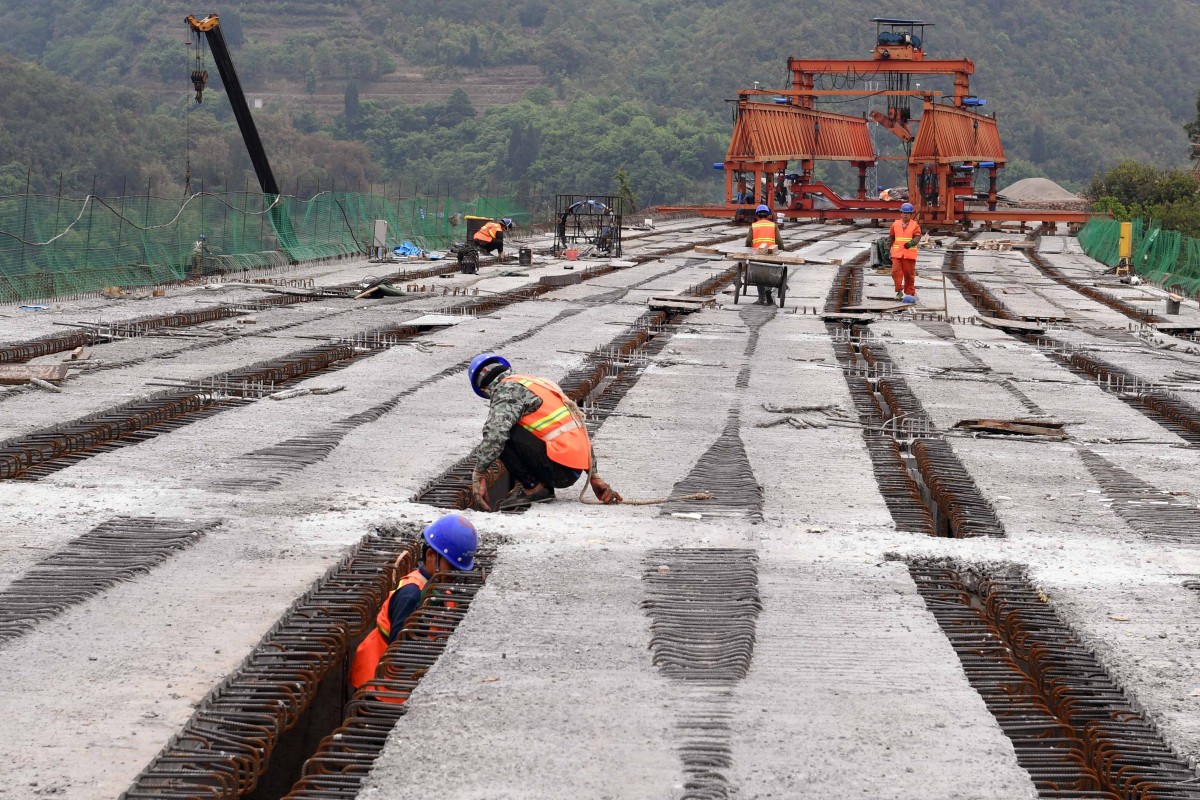
Local governments are stepping up spending on infrastructure projects in a bid to offset the slowdown caused by the coronavirus outbreak and subsequent lockdowns
Construction of high-speed railways, motorways and airports is an old tactic that Beijing dusted off after the pandemic led to a 6.8 per cent economic contraction in the first quarter. Photo: Xinhua
China’s huge stockpile of local government debt, one of the biggest “grey rhino” risks threatening the Chinese economy’s future, is set to rise steeply as local authorities rush to increase capital spending to help offset the damage caused by the coronavirus outbreak.
As Beijing discusses increasing the central government budget deficit and monetary policy easing to spur economic growth, many local governments see the situation as a golden opportunity to realise their investment ambitions, fanning concerns that China is repeating its mistake of a decade ago by pursuing short-term debt-fuelled economic growth at the cost of long-term sustainability.
In one of the latest investment drives, the southeastern province of Fujian announced on Sunday that it had signed contracts for 391 new projects with a combined investment value of 783.6 billion yuan (US$110.6 billion). Projects undertaken by central government-owned companies, which received significant lending support in the first quarter, accounted for more than half of the promised investment in Fujian, some 92 projects worth 424.5 billion yuan.
The landlocked eastern province of Anhui is also planning 2,583 new projects this year at a cost of 450 billion yuan, a third of which have been created in the last two weeks.
Construction begins for major sea crossing to link Shenzhen and Zhongshan in Greater Bay Area
In addition to work on existing construction projects, costing around 850 billion yuan, the province has also prepared a list of 3,300 reserve projects with a total investment value of 5.4 trillion yuan (US$762 billion) which could theoretically be started at any point in the future, pending government approval and funding support.
“The most powerful and effective way to offset the economic slowdown is to increase the size of investments,” Wang Qikang, an official with the Anhui economic planning office said on Friday. “[We] must quicken the pace of construction, working day and night to win back the lost time [from the coronavirus lockdowns].”
Construction of high-speed railways, motorways and airports is an old tactic that Beijing dusted off after the pandemic led to a 6.8 per cent economic contraction in the first quarter.
Infrastructure construction has already been hit hard amid the lockdowns, plunging 19.7 per cent in the first three months of the year compared to a year earlier.
Many [local governments] are still striving to achieve a high growth rate without the guidance of a national [gross domestic product] target – Liu Xuezhi
“The investment stimulus mindset has hardly been eradicated at the local level,” said Liu Xuezhi, a senior researcher with the Bank of Communications in Shanghai. “In particular, many [local governments] are still striving to achieve a high growth rate without the guidance of a national [gross domestic product] target.”
Before the start of the coronavirus outbreak, Beijing was thought to be targeting a
of around 6 per cent this year after achieving 6.1 per cent in 2019, although many local governments appear to be setting their own annual targets still using the original expected goal as a guide.
However, that target was never made public because the meeting of the
scheduled for early March, where the growth target would normally have been released, was postponed due to the virus.
The government announced on Wednesday that the NPC will be held from May 22, when a new, likely lower, growth target could be announced.
China’s first-quarter GDP shrinks for the first time since 1976 as coronavirus cripples economy
International rating agency Moody’s warned that greater infrastructure spending would result in higher debt for regional and local governments, increasing their financial risks amid a sharp slowdown in tax revenues.
“Such investments are less likely to be a main support measure [chosen by Beijing] now given the government’s focus on avoiding a rapid increase in leverage and asset price inflation,” Moody’s analysts Michael Taylor and Lilian Li said on Tuesday.
At the end of March, local government debt stood at 22.8 trillion yuan (US$3.2 trillion), according to the Ministry of Finance. But implicit liabilities, which are hidden in local financing vehicles, state firms and public-private partnership projects, are believed to be much larger, with some estimates pointing towards an additional debt of over 30 trillion yuan.
Chinese central bank governor Yi Gang, along with other officials, have already warned against excessive economic stimulus, saying it would add risks to China’s financial system.
A key risk is that local governments are front-loading China’s long-term investment plan, especially in the railway sector, with more than 357 railway projects proposed by local governments.
Shandong province, for example, is preparing to build four new railway lines, including the Shandong portion of a second high-speed railway between Beijing to Shanghai.
“There is still a chance for infrastructure investment growth to hit 10 per cent if the government releases 2 trillion yuan (US$282 billion) in funding through local special purpose bonds and special treasury bonds,” said Haitong Securities’ chief economist Jiang Chao on Monday.
However, a local government debt monitoring report issued on Tuesday by the National Institution of Finance and Development warned that China’s local government fiscal situation is worsening rapidly as expenses surge and revenues drop.
“All levels of local governments in China will face huge debt repayment pressure in five years,” warned Yin Jianfeng, deputy director of the Beijing-based think-tank.
Suspects rounded up after people complain of being duped into making donations to support non-existent temples
One woman says she handed over US$4,600 after being told that charitable gesture would help her live to be 400
One victim of the alleged scams said she was told she could live for 400 years if she handed over her money. Photo: Thepaper.cn
Police in southeast China have detained 100 people on suspicion of being part of a criminal network that cheated members of the public out of 50 million yuan (US$7 million) by preying on their superstitions and generosity.
Authorities in Ningguo, Anhui province launched an investigation in May after receiving a number of complaints about the activities of several groups posing as fortune-tellers on social media platforms like Weibo, financial news outlet Caijing reported on its website on Tuesday.
One of the groups, which operated on the Twitter-like service under the name “Kanxiang Zen Master”, was run by a local man surnamed Zhang and had 12 million followers, the report said.
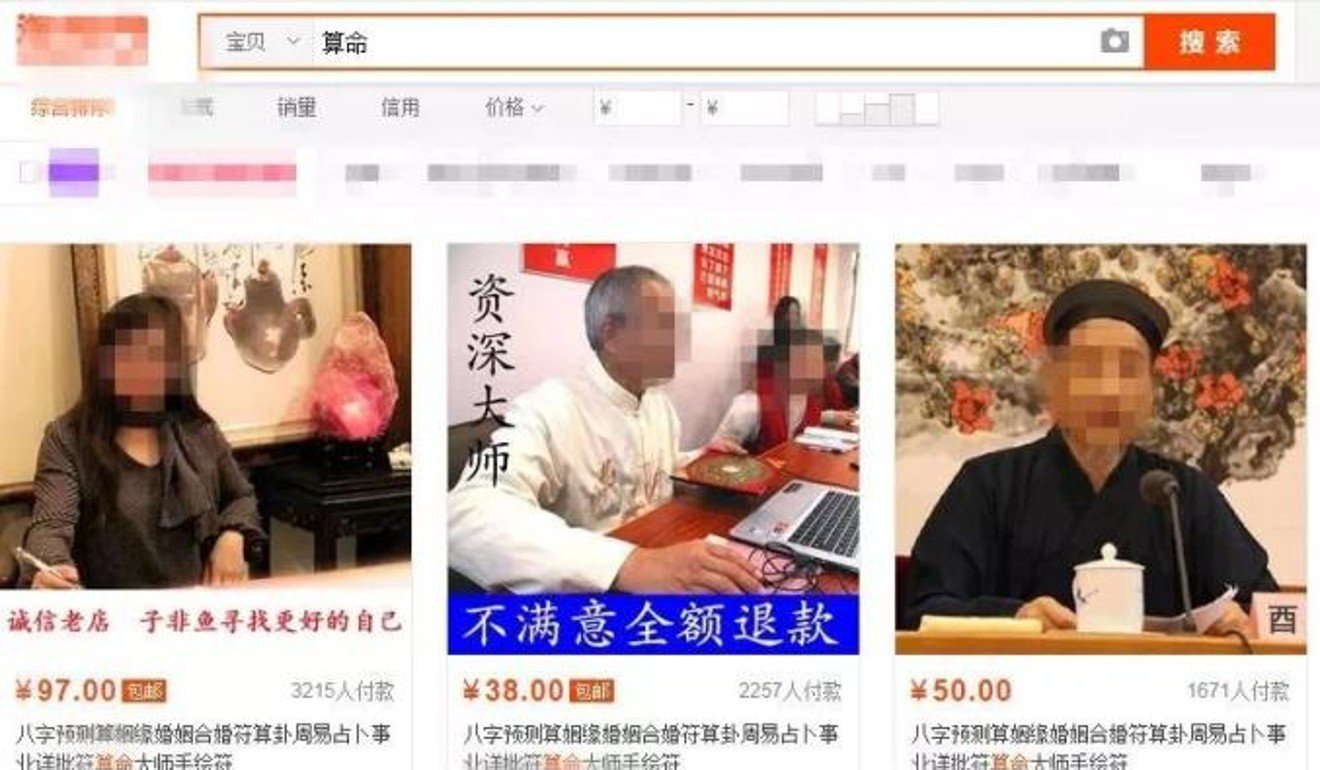
Adverts for online fortune-telling services are common in China. Photo: Thepaper.cn
In one alleged scam, members of the group were told they would receive good luck if they made a donation to support a “famous temple”. But when a man who gifted 10,000 yuan via WeChat Pay checked on the address of the recipient, he found it was a residential address in the city of Xuancheng and not a place of worship, the report said.
When police investigated, they found Zhang had links to seven criminal groups in Anhui and neighbouring Jiangsu province, which between them operated about 60 fortune-telling accounts on Weibo, several of which had more than 10 million followers. The Kanxiang Zen Master account has since been removed from the platform.
Six Chinese wanted for internet scam arrested in Vanuatu
A number of the gangs were registered as media companies and operated as semi-professional organisations with formal recruiting procedures and regular conferences to plan their fraudulent activities, the report said, adding that they had been operating for at least two years.
Police in July staged a series of raids to round up the suspects and confiscated associated equipment, including computers, vehicles and mobile phones, the report said.
Authorities in Ningguo have appealed for more victims to come forward.
A separate report by Shanghai-based news outlet Thepaper.cn said that some of the suspects also used e-commerce sites such as Taobao and the messaging service WeChat to promote their fortune-telling services.
Taobao is owned by Alibaba Group, which also owns the South China Morning Post.
In one case, a woman from the city of Changshu in Jiangsu said she made multiple payments – totalling about 33,000 yuan – to a fortune-teller she met on WeChat who said the money would be used to buy incense for use in offerings to the gods.
She said she reported the alleged fraud after starting to doubt the fortune-teller’s claims, including one that said if she made the donations she could live for up to 400 years.
Alibaba, Weibo and Tencent, which owns WeChat, have been contacted for comment.
March 8 has devolved into a prime time for online sales campaigns and advertising rather than a moment to celebrate the achievements of women, critics say
Job seekers look at the job advertisements at a job fair for women on the International Women’s Day in Huaibei, Anhui province, on Friday. Photo: Reuters
Every year around March 8, the internet in China is plastered with references to International Women’s Day.
Online commerce sites promote discounts on items from jewellery to massage machines to electronics; groups and individuals post “supportive” comments for the women in their lives; and retailers roll out advertising campaigns with “feminist” messages.
But critics say the true meaning of the day is being lost and the annual commemoration has become less of a chance to celebrate women’s achievements and more of an excuse to push spending.
It has also spawned a phenomenon called “Girls’ Day”, that reinforces the social preference for youth and beauty, they say.
International Women’s Day was first organised by the former Socialist Party of America in New York in 1909 and later became a fixture on calendars among socialists and in communist countries before being adopted by the United Nations in 1975 .
When marrying young is the norm, courageous Chinese women take back control by asking parents to “Meet me halfway”
In China, it has been celebrated since 1924, with women using the day to highlight the need for their rights.
But in recent years, it has also become a tradition for the Chinese public to celebrate March 7, the day before the official women’s day, as “Girls’ Day”, and for commercial platforms to brand March 8 as “Goddesses’ Day” or “Queens’ Day”, and offer discounts to attract sales.
Guo Jing, founder of No 74 Career Women’s Legal Hotline, said the commercial campaigns were diluting the original spirit of the day.
“Women’s day was meant to celebrate the spirit of women fighting for their rights, encouraging women’s independence and empowerment, that they can have all sorts of lives and not be a part attached to men,” Guo said.
“[The campaigns] give the impression that girls are innocent, without social experience, and ‘women’ are older, less attractive.”
Women need opportunities at work, at home and in public life, a rights advocate says. Photo: EPA
Even international firms have come under fire for linking their products with Girls’ Day. On Thursday, in an advertisements for the film Captain Marvel, Marvel Studios’ China team wrote on Weibo, “Happy Girls’ Day! Captain Marvel Brie Larson sends her wishes to all girls in China.”
Commenters said the first Marvel movie to showcase a woman superhero was undermining its message by highlighting a day with a mixed meaning.
“The film basically sells feminism, yet you are talking about Girls’ Day?” one comment said.
China gender and sexuality centre shuts down as censorship chill spreads
Other firms, such as sportswear company Nike, won a round of applause for breaking stereotypes with Dream Crazier video. The video centred on breakthroughs from female athletes around the globe, complete with Nike’s slogan, “Just do it”.
Feng Yuan, the co-founder of Beijing-based group Equality, which is dedicated to women’s rights and gender equality, said many shop owners or platforms wanted to turn any special day into a shopping bonanza, but they only appeared to be trying to please women.
“We should be alerted that the names of ‘Girls’ Day’ or ‘Goddess’s Day’ indicate that many regard women only as consumers, caretakers or an ‘empty vases’,” Feng said.
The focus on women’s appearance was driven home on Thursday night in a fumbled attempt by a university in the country’s north to mark the day. In a Weibo post, Shandong University claimed it was the founder of Girls’ Day on March 7, and the original meaning was “three plus seven equals 10. You score 10 out of 10 points for sweetness.” It claimed the day was for university students to care for women and for female students to showcase their attractiveness.
The post quickly met with criticism. The Intellectuals, an online media outlet, said “the day recognises women’s achievements, regardless of their nationality, ethnicity, language, culture, economic and political standing. It originated from North America and Europe’s workers’ movements in the early 20th century.
“Whether you call it Girls’ Day or Queens’ Day, it’s an insult to the true spirit of the day.”
On campuses throughout the country, it has become a tradition for banners with supportive messages to be put up on buildings and message boards. But rather than celebrating women, many of the banners sexualise them in what critics say amounts to a form of sexual harassment.
“I’ve met scores of women in the spring, but I’d rather be sleeping with you,” one banner read.
The sexualisation of the event is compounded by jokes online that play on the Chinese word for “day” and “sex” to suggest that the real meaning of the day is to “welcome girls into womanhood”.
Women’s rights advocates say the public needs to sever the sexual and commercial ties to the day and focus on the many areas in which women’s rights need to be improved.
How a Chinese #MeToo musical whipped up a storm before the censors stepped in
That includes the lifting of a ban on the official Weibo account of Feminist Voices, which before it was shut down without explanation on women’s day last year, had some 180,000 followers and published articles on sexual harassment, women’s rights or workplace equality.
More broadly, in 2018, women still on average made less than 80 per cent of the average salary for men, according to a report by Chinese recruitment platform Zhipin.com. The report said women tended to hit a glass ceiling for promotion and pay due to the demands of marriage and child rearing.
Women’s rights have gained some attention this week as national lawmakers and advisers have met in Beijing for their annual gatherings. Huang Xihua, a National People’s Congress delegate from Huizhou in Guangdong province, ignited debate at the congress with a called for the two-child policy to be scrapped and for unmarried women to be granted equal rights to have children.
Feng, from Equality, was clear about what still needed to be done.
“For women’s day, we don’t need flowery words of praise, but more women-friendly and gender-equal policies, giving women an equal position and opportunity in family, career and public lives,” she said.
BEIJING, Feb. 24 (Xinhua) — China’s national observatory on Sunday forecast that some northern and eastern parts of the country would be shrouded in smog in the coming days while snow will hit western regions.
Thick smog will envelop northern and eastern areas including Hebei and Shandong provinces until Thursday, according to the National Meteorological Center (NMC).
From Sunday night to Monday morning, thick fog will be seen in the provinces of Henan, Anhui, Jiangsu, Shanghai and Hubei, reducing visibility in some areas to less than 200 meters, the NMC said.
From Sunday night to Tuesday, snow will hit west China’s Tibet, Qinghai and Gansu, while rain will soak the south from Tuesday to Wednesday.
Bad weather could disrupt traffic after the Spring Festival holiday when many people are returning to work after the break.
China’s Spring Festival travel rush started from Jan. 21 and will last till March 1.





 CHINDIA ALERT: You'll be living in their world, very soon