30/04/2020
WASHINGTON (Reuters) – President Donald Trump said on Wednesday he believes China’s handling of the coronavirus is proof that Beijing “will do anything they can” to make him lose his re-election bid in November.
In an interview with Reuters in the Oval Office, Trump talked tough on China and said he was looking at different options in terms of consequences for Beijing over the virus. “I can do a lot,” he said.
Trump has been heaping blame on China for a global pandemic that has killed at least 60,000 people in the United States according to a Reuters tally, and thrown the U.S. economy into a deep recession, putting in jeopardy his hopes for another four-year term.
The Republican president, often accused of not acting early enough to prepare the United States for the spread of the virus, said he believed China should have been more active in letting the world know about the coronavirus much sooner.
Asked whether he was considering the use of tariffs or even debt write-offs for China, Trump would not offer specifics. “There are many things I can do,” he said. “We’re looking for what happened.”
“China will do anything they can to have me lose this race,” said Trump. He said he believes Beijing wants his Democratic opponent, Joe Biden, to win the race to ease the pressure Trump has placed on China over trade and other issues.
“They’re constantly using public relations to try to make it like they’re innocent parties,” he said of Chinese officials.
He said the trade deal that he concluded with Chinese President Xi Jinping aimed at reducing chronic U.S. trade deficits with China had been “upset very badly” by the economic fallout from the virus.
A senior Trump administration official, speaking on condition of anonymity, said on Wednesday that an informal “truce” in the war of words that Trump and Xi essentially agreed to in a phone call in late March now appeared to be over.
The two leaders had promised that their governments would do everything possible to cooperate to contain the coronavirus. In recent days, Washington and Beijing have traded increasingly bitter recriminations over the origin of the virus and the response to it.
However, Trump and his top aides, while stepping up their anti-China rhetoric, have stopped short of directly criticizing Xi, who the U.S. president has repeatedly called his “friend.”
Trump also said South Korea has agreed to pay the United States more money for a defense cooperation agreement but would not be drawn out on how much.
“We can make a deal. They want to make a deal,” Trump said. “They’ve agreed to pay a lot of money. They’re paying a lot more money than they did when I got here” in January 2017.
The United States stations roughly 28,500 troops in South Korea, a legacy of the 1950-53 Korean War that ended in an armistice, rather than a peace treaty.
Trump is leading a triage effort to try to keep the U.S. economy afloat through stimulus payments to individuals and companies while nudging state governors to carefully reopen their states as new infections decline.
Trump sounded wistful about the strong economy that he had enjoyed compared with now, when millions of people have lost their jobs and GDP is faltering.
“We were rocking before this happened. We had the greatest economy in history,” he said.
He said he is happy with the way many governors are operating under the strain of the virus but said some need to improve. He would not name names.
Trump’s handling of the virus has come under scrutiny. Forty-three percent of Americans approved of Trump’s handling of the coronavirus, according to the Reuters/Ipsos poll from April 27-28.
But there was some good coronavirus news, as Gilead Sciences Inc said its experimental antiviral drug remdesivir was showing progress in treating virus victims.
Trump has also seeking an accelerated timetable on development of a vaccine.
“I think things are moving along very nicely,” he said.
At the end of the half-hour interview, Trump offered lighthearted remarks about a newly released Navy video purportedly showing an unidentified flying object.
“I just wonder if it’s real,” he said. “That’s a hell of a video.”
Source: Reuters
Posted in 1950-53 Korean War, 60,000, accelerated timetable, according, accused, acting, active, afloat, agreed, Americans, anonymity, another, anti-China, antiviral drug remdesivir, approved, April, armistice, at least, “will do anything they can”, Beijing, believed, believes, bid, bitter, China, China's handling, China’s, Chinese President Xi Jinping, chronic, companies, compared, considering, coronavirus, debt write-offs, decline, deep recession, defense cooperation agreement, democratic, development, early, economic fallout, enjoyed, enough, essentially, faltering, four-year term, GDP, global pandemic, handling, hopes, individuals, informal, Interest, jeopardy, jobs, Joe Biden, killed, leaders, legacy, letting, lost, meddling, millions, money, Navy video, new infections, November, now, nudging, often, opponent, origin, Oval Office, pay, peace treaty, People, phone call, prepare, President, President Donald Trump, pressure, progress, proof, putting, race, re-election, recriminations, reopen, Republican, Reuters, Reuters tally, Reuters/Ipsos poll, rhetoric, South Korea, specifics, spread, state governors, states, stations, stimulus payments, strong economy, tariffs, thrown, to lose, to make, tough, Trade, trade deficits, triage, troops, truce, Trump, Trump administration, two, U.S. economy, U.S. election, Uncategorized, unidentified flying object, United States, Vaccine, victims, Virus, wants, war of words, Washington, Wednesday, win, wistful, World |
Leave a Comment »
21/09/2019
ALMATY/NUR-SULTAN (Reuters) – Police detained dozens in Kazakhstan’s two largest cities on Saturday as they took part in the latest protest against China’s influence in the Central Asian republic.
Neighbouring China is already one of Kazakhstan’s largest investors and trade partners and a plan to relocate a number of Chinese plants and factories to the former Soviet republic has faced public opposition.
The latest round of protests on Saturday was organised by supporters of Mukhtar Ablyazov, a fugitive banker living in France who has been the fiercest critic of Kazakhstan’s first president, Nursultan Nazarbayev.
Nazarbayev resigned last March after running the oil-rich nation for almost thirty years, but retains sweeping powers as the head of the security council and the ruling Nur Otan party.
Kazakh authorities consider Ablyazov’s political movement extremist and involvement in its activities a crime. Authorities have detained 57 people and may be charged, the interior ministry said.
“You know that as of today’s date at 2 p.m. the banned DCK in Kazakhsan was called upon to gather… we (the police) asked people to disperse, and those who didn’t, were taken to the district offices for questioning,” Bakytzhan Malybayev, first deputy chief of Nur-Sultan police, told reporters. “We will carry out questioning and then the people will be released.”
Reuters reporters witnessed several arrests in Nur-Sultan and Almaty. In Kazakhstan’s capital Nur-Sultan, police detained a man with a banner reading: “Let’s not give way to Chinese expansion” and “The old man is the enemy”, an anti-Nazarbayev slogan. Several people chanted:”Freedom to political prisoners”.
Some protesters tried to escape as police moved in and smashed the windows of a police bus.
In Almaty, protesters were quickly taken away to police buses as they began chanting slogans against Chinese expansion and “Old man, go away!”
China is a major investor in Kazakhstan’s energy sector and buys oil and gas from the mostly Muslim nation of 18 million, but critics accuse some Chinese companies – as well as Western ones – of hiring too few local staff and paying them less than foreign workers.
Source: Reuters
Posted in Almaty, anti-China, Central Asian republic, detained, Dozens, Kazakhstan, Mukhtar Ablyazov, Muslim nation, Nur-Sultan, Nursultan Nazarbayev, Old man, go away!, protests, Uncategorized |
Leave a Comment »
19/05/2019
- General will spend five days meeting top Chinese leaders including President Xi Jinping
- Mission seeks to patch up wounds caused by Brazilian President Jair Bolsonaro’s anti-China rhetoric
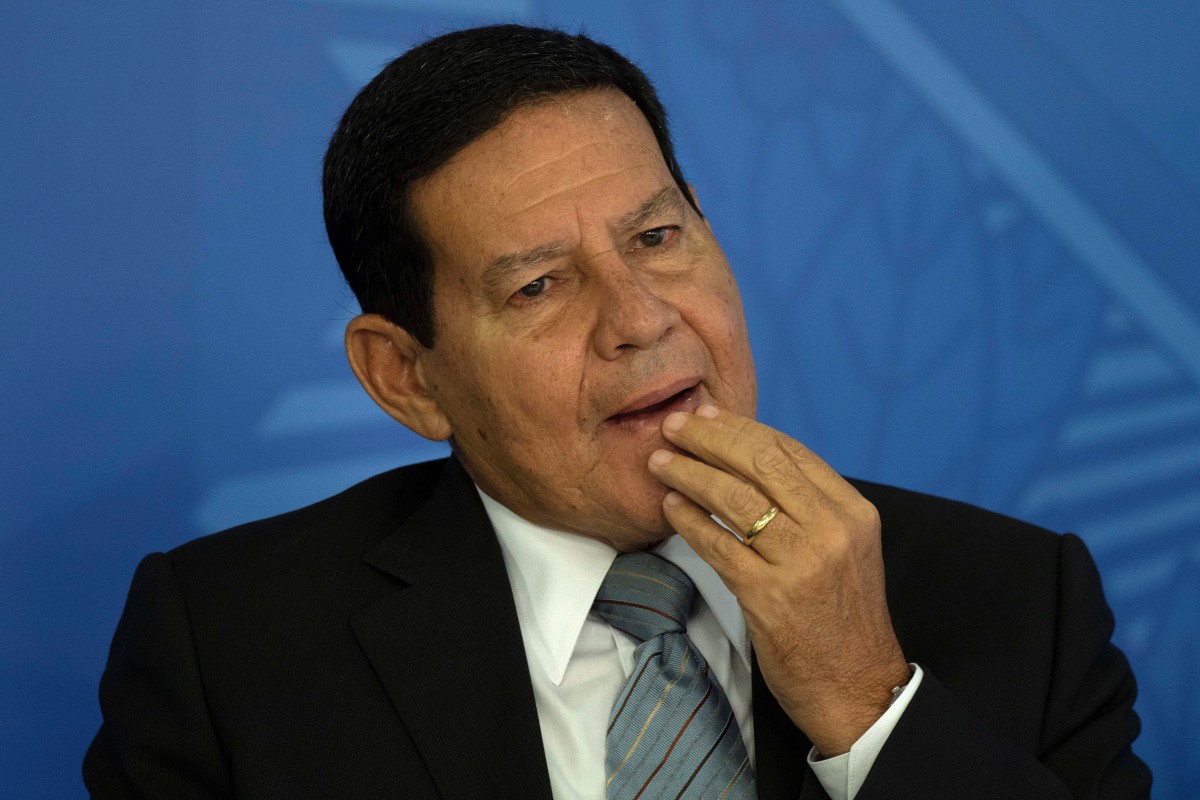
Hamilton Mourao favours maximising engagement with China. Photo: EPA-EFE
Brazil’s vice-president is expected to land in Beijing on Sunday on a mission to patch up wounds caused by President Jair Bolsonaro’s lacerating anti-China rhetoric.
General Hamilton Mourao will spend five days in China rubbing shoulders with some of the country’s most powerful leaders, culminating in an audience with President Xi Jinping, in an effort to shore up the relationship between the two emerging market giants. Bolsonaro himself is due to visit later this year, while Xi is due to visit Brasilia in November for the BRICS summit.
China – Brazil’s most important trading partner for the past decade – remains a sensitive subject in the Bolsonaro administration. While Mourao and the other business-oriented members of government favour maximising engagement with the Asian giant, Bolsonaro and his more radical appointees view China with a high degree of suspicion, as a predatory economy that wishes not merely to invest in Brazil, but to own it.
“The Chinese can buy in Brazil, but they can’t buy Brazil,” the president said at a breakfast with journalists last month.
Brazilian President Jair Bolsonaro said last month that the “Chinese can buy in Brazil, but they can’t buy Brazil”. Photo: AFP
Still, in comparison with his pre-election criticism of China as “heartless”, Bolsonaro in office has dialled down his anti-Beijing sentiment. Mourao’s visit is part of an effort to reset that relationship.
“The Chinese understand that Mourao plays a central role in toning down Bolsonaro’s rhetoric,” said Oliver Stuenkel, a specialist on BRICS – an association of five major emerging economies, namely Brazil, Russia, India, China and South Africa – at the FGV business school. “They know that the Mourao-China relationship will be fundamental.”
Should China be worried about Bolsonaro’s bromance with Trump?
Speaking to reporters recently, Mourao recognised the need to balance the Bolsonaro administration’s desire to pivot towards the United States with practical considerations of China’s economic significance.
“The US are the champions of democracy and freedom and our government has left it very clear what this represents,” the vice-president said. “But on the other side we have to be sufficiently pragmatic to understand the importance of China for Brazil’s economic development.”
Chinese investment in Brazil reached almost US$134 billion between 2003 and 2018, Brazilian government figures showed.
Chinese President Xi Jinping is expected to meet the visiting Brazilain vice-president. Photo: AP
While the trade war between the US and China may offer Brazil some short-term gains, particularly for its agricultural sector, the downsides outweigh the benefits, according to Renata Amaral, a foreign trade analyst at Barral MJorge consultancy.
“In truth this war is no good for anyone,” she said.
Mourao said that Brazil was monitoring the situation “critically and cautiously”.
Why US-China trade war could be good for Brazil
From the Chinese perspective, Beijing is looking for Brazil’s formal support for its “Belt and Road Initiative” – Chinese President Xi Jinping’s signature global infrastructure megaproject. Asked whether Brazil might sign up to the programme, Mourao said that any agreement would have to be approved by Bolsonaro in the second half of the year.
After trips to the Great Wall of China and the Shanghai Stock Exchange, Mourao will meet Xi, in a clear sign of Brazil’s importance to China. “The visit of vice-president Mourao will reinforce mutual political confidence, deepen our friendly cooperation and add new dimensions to our strategic partnership,” according to Chinese foreign ministry spokesman Geng Shuang.
With Beijing both uncertain about the direction of Brazilian foreign policy under Bolsonaro and eager to strike deals on infrastructure and food security, it makes sense for the Chinese to roll out the red-carpet for Mourao, according to Hussein Kalout, a specialist in foreign policy and a researcher at Harvard.
China trade vs economic growth: the dilemma for Brazil’s president
While the federal government remains ambivalent about its relationship with China, some of Brazil’s powerful state governors are seeking to develop their own relationship with the Asian country. One of them is Carlos Massa Ratinho Junior, the governor of the southern state of Parana, who travelled to China recently to discuss agriculture and railroad projects.
“We’re open to talk with any country that wants to and understands that the state of Parana is the best to place to invest in Brazil,” the governor said in an interview, adding that his actions did not conflict with the federal government’s stance towards Beijing.
But in a sign of the domestic pressure Bolsonaro is under not to abandon entirely his sceptical attitude to China, Luiz Philippe de Orleans e Braganca, the vice-president of the lower house’s foreign affairs committee and a lawmaker from Bolsonaro’s own party, said the government should set limits to the partnership.
“It’s good to talk to China, but it depends what is being discussed,” he said. “For example, the 5G network set up by China is dangerous because it will give the Chinese more information about Brazilian citizens than the Brazilian government.”
Source: SCMP
Posted in anti-China, Brasilia, Brazil, Brazilian President, BRICS summit, Carlos Massa Ratinho Junior, China alert, FGV business school, Geng Shuang, Great Wall of China, Hamilton Mourao, India alert, Jair Bolsonaro, mend, Parana, President Xi Jinping, relations, rhetoric, Russia, Shanghai Stock Exchange, South Africa, Uncategorized, Vice President |
Leave a Comment »




 CHINDIA ALERT: You'll be living in their world, very soon