Chindia Alert: You’ll be Living in their World Very Soon
aims to alert you to the threats and opportunities that China and India present. China and India require serious attention; case of ‘hidden dragon and crouching tiger’.
Without this attention, governments, businesses and, indeed, individuals may find themselves at a great disadvantage sooner rather than later.
The POSTs (front webpages) are mainly 'cuttings' from reliable sources, updated continuously.
The PAGEs (see Tabs, above) attempt to make the information more meaningful by putting some structure to the information we have researched and assembled since 2006.
WASHINGTON (Reuters) – President Donald Trump said on Wednesday he believes China’s handling of the coronavirus is proof that Beijing “will do anything they can” to make him lose his re-election bid in November.
In an interview with Reuters in the Oval Office, Trump talked tough on China and said he was looking at different options in terms of consequences for Beijing over the virus. “I can do a lot,” he said.
Trump has been heaping blame on China for a global pandemic that has killed at least 60,000 people in the United States according to a Reuters tally, and thrown the U.S. economy into a deep recession, putting in jeopardy his hopes for another four-year term.
The Republican president, often accused of not acting early enough to prepare the United States for the spread of the virus, said he believed China should have been more active in letting the world know about the coronavirus much sooner.
Asked whether he was considering the use of tariffs or even debt write-offs for China, Trump would not offer specifics. “There are many things I can do,” he said. “We’re looking for what happened.”
RELATED COVERAGE
China says it has no interest in meddling in U.S. election
“China will do anything they can to have me lose this race,” said Trump. He said he believes Beijing wants his Democratic opponent, Joe Biden, to win the race to ease the pressure Trump has placed on China over trade and other issues.
“They’re constantly using public relations to try to make it like they’re innocent parties,” he said of Chinese officials.
He said the trade deal that he concluded with Chinese President Xi Jinping aimed at reducing chronic U.S. trade deficits with China had been “upset very badly” by the economic fallout from the virus.
A senior Trump administration official, speaking on condition of anonymity, said on Wednesday that an informal “truce” in the war of words that Trump and Xi essentially agreed to in a phone call in late March now appeared to be over.
The two leaders had promised that their governments would do everything possible to cooperate to contain the coronavirus. In recent days, Washington and Beijing have traded increasingly bitter recriminations over the origin of the virus and the response to it.
However, Trump and his top aides, while stepping up their anti-China rhetoric, have stopped short of directly criticizing Xi, who the U.S. president has repeatedly called his “friend.”
Trump also said South Korea has agreed to pay the United States more money for a defense cooperation agreement but would not be drawn out on how much.
“We can make a deal. They want to make a deal,” Trump said. “They’ve agreed to pay a lot of money. They’re paying a lot more money than they did when I got here” in January 2017.
The United States stations roughly 28,500 troops in South Korea, a legacy of the 1950-53 Korean War that ended in an armistice, rather than a peace treaty.
Trump is leading a triage effort to try to keep the U.S. economy afloat through stimulus payments to individuals and companies while nudging state governors to carefully reopen their states as new infections decline.
Trump sounded wistful about the strong economy that he had enjoyed compared with now, when millions of people have lost their jobs and GDP is faltering.
“We were rocking before this happened. We had the greatest economy in history,” he said.
He said he is happy with the way many governors are operating under the strain of the virus but said some need to improve. He would not name names.
Trump’s handling of the virus has come under scrutiny. Forty-three percent of Americans approved of Trump’s handling of the coronavirus, according to the Reuters/Ipsos poll from April 27-28.
But there was some good coronavirus news, as Gilead Sciences Inc said its experimental antiviral drug remdesivir was showing progress in treating virus victims.
Trump has also seeking an accelerated timetable on development of a vaccine.
“I think things are moving along very nicely,” he said.
At the end of the half-hour interview, Trump offered lighthearted remarks about a newly released Navy video purportedly showing an unidentified flying object.
“I just wonder if it’s real,” he said. “That’s a hell of a video.”
Dutch inquiry follows recall of 600,000 face masks
Ambassador rejects concerns China has a political agenda alongside medical support
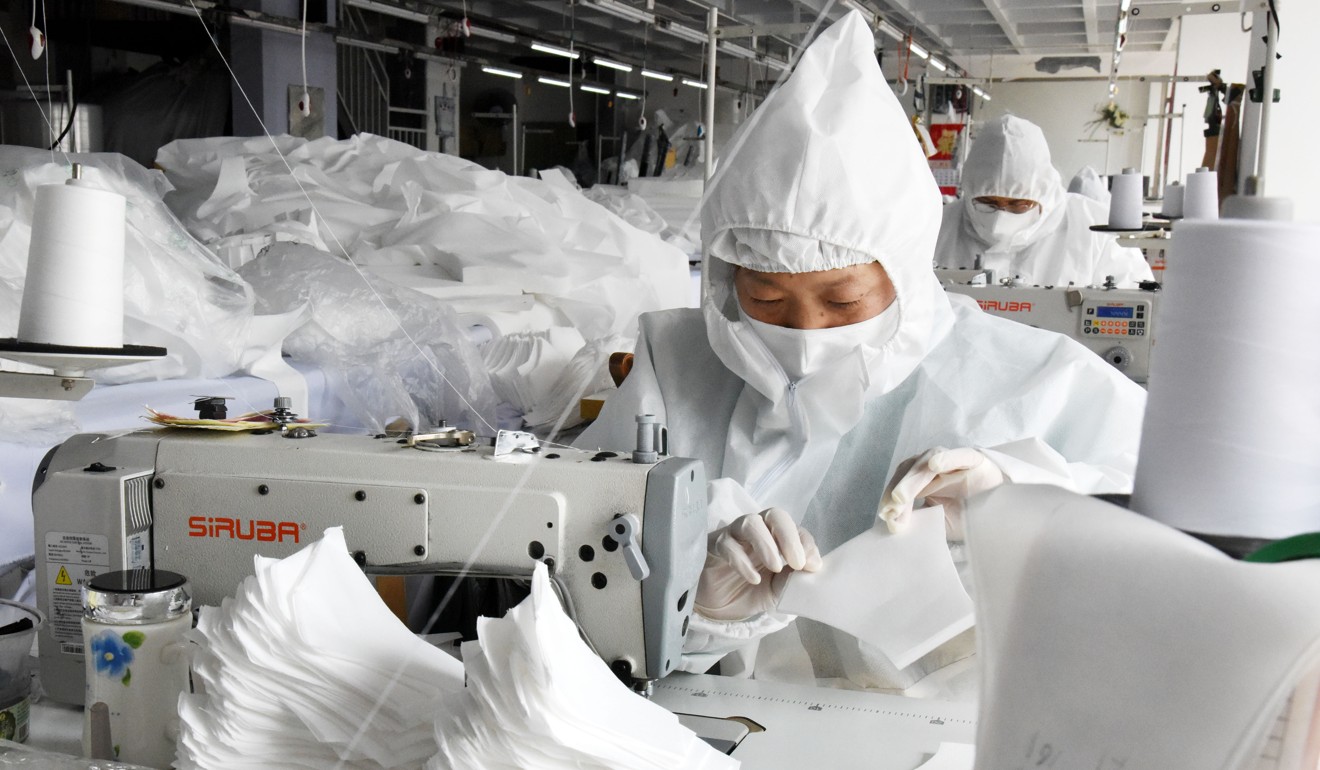
In early March, China’s daily output of face masks reached 116 million units. Photo: Xinhua
China’s embassy in the Netherlands said on Monday that it was closely following a Dutch investigation into reportedly defective masks imported from China and called for the issue not to be politicised.
Xu Hong, China’s ambassador to the Netherlands, made the comment after Dutch officials recalled more than 600,000 face masks which were found to be unsuitable for intensive care medical staff.
“The embassy paid high attention to the March 28 news about the ‘defective’ masks that Dutch government purchased from China, and contacted the Dutch Ministry of Foreign Affairs and the Ministry of Health in the first time to verify the information,” Xu said, according to a statement published on the embassy’s website.
Xu said he had spoken by telephone with the Dutch Minister for Medical Care and Sport Martin van Rijn, on Sunday about the issues and said “if necessary” China would help the Dutch investigation into the quality of the masks.
Netherlands recalls 600,000 face masks from China due to low quality
29 Mar 2020
According to the Dutch Ministry of Health, Welfare and Sport, the masks did not fit well and the filters did not function properly. It was not immediately clear whether the batch in question was given to the Netherlands as a donation or had arrived through a commercial transaction.
“The Netherlands is still looking into the situation, and if there is any further information, it will inform the Chinese side in the first time,” Xu said.
China has ramped up medical assistance abroad where the novel coronavirus pandemic has shown no signs of easing, but China’s efforts have run into rising concerns about the poor quality protective gear and test equipment it offered.
In early March, China’s daily output of face masks reached 116 million units. Picture: Xinhua
Xu also rejected concerns that China had a political agenda accompanying its medical support. He called for its assistance in not to be politicised.
“The reason why China supports the Netherlands and other countries to fight the pandemic is very simple: we are trying to save lives,” Xu said.
“There is no ‘geopolitical consideration’ as a few claimed. It is normal if some problems arise during the cooperation. These problems can be solved in an objective manner, but should not be politicised.”
It is not the first time European countries have had problems with coronavirus-related medical equipment manufactured in China.
Why China’s ‘mask diplomacy’ is raising concern in the West
The company said it would replace the test kits sent to Spain.
On Thursday, the Chinese embassy in Spain said on Twitter that the Bioeasy test kits had not been approved by China’s National Medical Products Administration and were not included in the medical supplies sent by the Chinese government to Spain.
Separately, the Philippines’ health department on Sunday apologised for comments it had made a day earlier that two batches of coronavirus test kits provided by China were substandard, and acknowledged that the quality of the test kits did meet global standards.
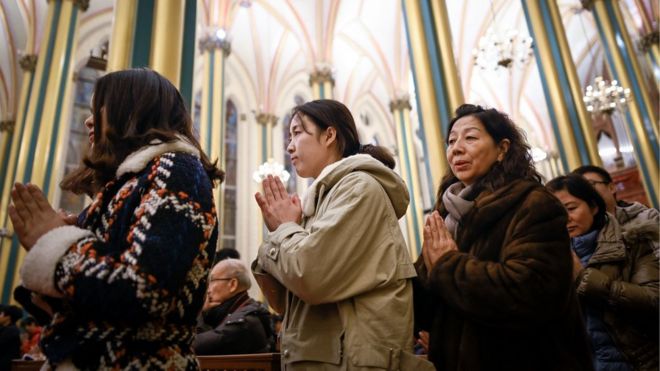
Image copyright GETTY IMAGESImage caption Christmas in Beijing: Catholics attend mass on 24 December 2018
A bishop has been ordained with the blessing of both the Pope and the Chinese state for the first time under a new deal.
Religious organisations in China must be approved by the state, leading to a decades-long row with the Vatican.
But a deal was agreed last September, giving the Vatican a say in the bishops appointed by the state church.
Yao Shun received the papal mandate for his ordination as bishop in China’s Inner Mongolia region.
The country is home to about 12 million Catholics – split between the Chinese Patriotic Catholic Association and an underground church loyal to the Vatican.
For decades, members of the underground church have only recognised the authority of the pope, while members of the state church have refused it. The relationship between the Holy See and Beijing has been strained by the disagreement since the 1950s.
In practice, the Vatican has recognised many Chinese bishops over the years on an individual, informal basis, including several last year as part of the deal.
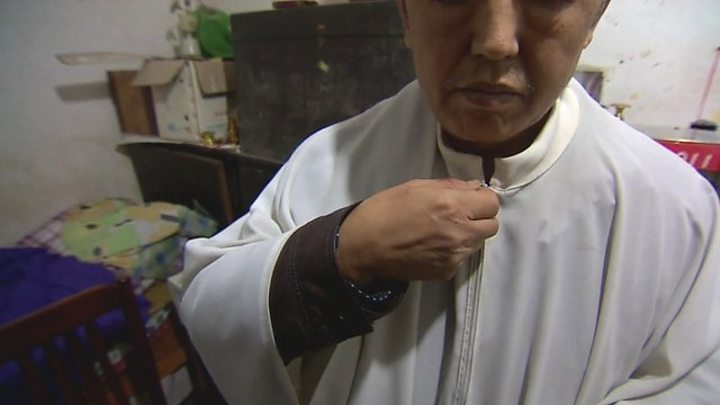
Media caption Father Dong Guanhua has been kicked out of the Chinese Catholic church for calling himself a bishop
The Vatican confirmed the new bishop’s ordination – referring to him as Antonio Yao Shun – as “the first to take place in the framework of the Provisional Agreement between the Holy See and the People’s Republic of China”.
But the deal between the two remains controversial among some Catholics.
Cardinal Joseph Zen from Hong Kong – where Chinese rules on state churches do not apply – accused the Vatican of “selling out” when details of the deal became clear in January 2018.
He said that the decision to reconcile with Beijing meant that retiring bishops of the underground church, faithful to Rome, would now be replaced by state-approved appointees.
Catholic news outlet Crux, meanwhile, reported that Bishop Shun had been chosen by the Vatican some time ago, before the agreement came into effect – and so his ordination is not a true test of the new mechanism.
But Bishop Shun’s ordination may be a notable moment in the reconciliation between the two countries.
In the past, Chinese state bishops were excommunicated from the Catholic Church for their role in ordaining new bishops outside of the papal mandate.
The relationship between China and the Vatican is further complicated by the Vatican’s diplomatic relations with Taiwan, which China considers to be a breakaway province destined for reunification at some future date.



 CHINDIA ALERT: You'll be living in their world, very soon