Chindia Alert: You’ll be Living in their World Very Soon
aims to alert you to the threats and opportunities that China and India present. China and India require serious attention; case of ‘hidden dragon and crouching tiger’.
Without this attention, governments, businesses and, indeed, individuals may find themselves at a great disadvantage sooner rather than later.
The POSTs (front webpages) are mainly 'cuttings' from reliable sources, updated continuously.
The PAGEs (see Tabs, above) attempt to make the information more meaningful by putting some structure to the information we have researched and assembled since 2006.
TOKYO (Reuters) – Uncertainty over Japan’s economic outlook is “extremely high” as the coronavirus pandemic hits output and consumption, central bank Governor Haruhiko Kuroda said, stressing his readiness to take additional monetary steps to prevent a deep recession.
While aggressive central bank actions across the globe have eased financial market tensions somewhat, corporate funding strains were worsening, Kuroda told a quarterly meeting of the Bank of Japan’s regional branch managers on Thursday.
“The spread of the coronavirus is having a severe impact on Japan’s economy through declines in exports, output, demand from overseas tourists and private consumption,” he said.
Japan recorded 503 new coronavirus infections on Wednesday – its biggest daily increase since the start of the pandemic – as a state of emergency took effect giving governors stronger legal authority to urge people to stay home and businesses to close.
In contrast to stringent lockdowns in some countries, mandating fines and arrests for non-compliance, enforcement will rely more on peer pressure and a deep-rooted Japanese tradition of respect for authority.
RELATED COVERAGE
Head of Japan junior coalition partner wants to consider more economic steps
Some firms in central Japan cutting back on capex: BOJ official
The balancing act underscores the difficulty authorities have in trying to contain the outbreak without imposing a mandatory lockdown that could deal a major blow to an economy already struggling to cope with the virus outbreak.
Hideaki Omura, the governor of the central Japan prefecture of Aichi, said he would declare a state of emergency for his prefecture on Friday.
Omura said Aichi, which includes the city of Nagoya and hosts Toyota Motor Corp, was talking with the central government about being included in the national state of emergency as well, but felt he could not wait any longer to restrict movement.
“Looking at things the past week and watching the situation – the rise in patients, the number without any traceable cause – we judged that it was a very dangerous situation and wanted to make preparations,” he told a news conference.
Even with less stringent restrictions compared with other countries, analysts polled by Reuters expect Japan to slip into a deep recession this year as the virus outbreak wreaks havoc on business and daily life.
Shares of Oriental Land Co (4661.T) fell on Thursday after the operator of Tokyo Disneyland said it would keep the amusement park shut until mid-May.
Entertainment facility operator Uchiyama Holdings (6059.T) said it was closing 43 karaoke shops and 11 restaurants until May 6.
“For the time being, we won’t hesitate to take additional monetary easing steps if needed, with a close eye on developments regarding the coronavirus outbreak,” Kuroda said.
Kuroda’s remarks highlight the strong concern policymakers have over the outlook for Japan’s economy and how companies continue to struggle to generate cash, despite government and central bank promises to flood the economy with funds.
At its policy meeting later this month, the BOJ is likely to make a rare projection that the world’s third-largest economy will shrink this year, sources have told Reuters.
The BOJ eased monetary policy in March by pledging to boost purchases of assets ranging from government bonds, commercial paper, corporate bonds and trust funds investing in stocks.
The government also rolled out a nearly $1 trillion stimulus package to soften the economic blow.
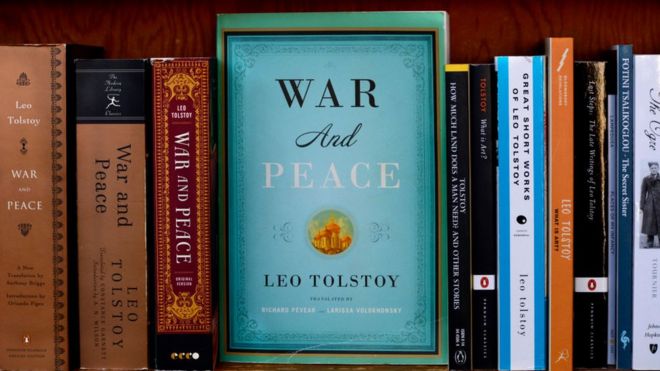
Leo Tolstoy’s War and Peace is in the news in India after a judge asked an activist to explain why he had a book “about war in another country”.
Vernon Gonsalves had appeared in the high court in Mumbai city on Wednesday for a hearing on his bail plea.
The judge’s question sparked a flurry of tweets, with users both outraged and bemused by it.
Five activists, including Mr Gonsalves, were arrested in August 2018 in connection with caste-based violence.
Police raided and searched their homes at the time and submitted a list of books, documents and other belongings to the court. The public prosecutor told the court that police had found “incriminating evidence” in Mr Gonsalves’ home, including “books and CDs with objectionable titles”.
“Why were you having these books and CDs at your home? You will have to explain this to the court,” the judge told Mr Gonsalves.
Police said that all five activists incited Dalits (formerly untouchables) at a large public rally on 31 December 2017, leading to violent clashes that left one person dead. They accused them of “radicalising youth” and taking part in “unlawful activities” which led to violence and showed “intolerance to the present political system”.
The arrests had been criticised by many at the time who saw them as an attack on free speech, and even a “witch hunt” against those who challenged the governing Bharatiya Janata Party (BJP).
So the judge’s question quickly made news and War and Peace was soon trending on Twitter.
The tweets ranged from jokes to shock over the state of India’s judiciary.
Others wondered how they would fare in a courtroom given what’s on their bookshelf, and some have issued a call out asking people to share books from their own “subversive” collection.
Two people have been arrested in India’s Bihar state after a group of men shaved the heads of two women as “punishment” for resisting rape.
The group, which included a local official, ambushed the mother and daughter in their home with the intent of raping them, police said.
When the women resisted, they assaulted them, shaved their heads and paraded them through the village.
Police say they are searching for five others involved in the incident.
“We were beaten with sticks very badly. I have injuries all over my body and my daughter also has some injuries,” the mother told the ANI news agency.
The women also said that their heads were shaved in front of the entire village.
“Some men entered the victims’ home and tried to molest the daughter,” a police officer told local media, adding that her mother helped her fight off the men.
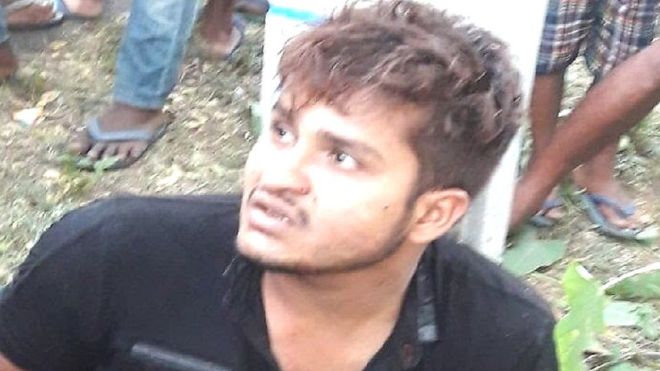
Image copyright BBC HINDIImage caption A video showing Ansari pleading for his life has been widely circulated on social media
Indian police have arrested five people after a Muslim man was beaten to death by a mob.
Tabrez Ansari, 24, died days after being attacked by people who accused him of stealing a motorcycle in the eastern state of Jharkhand.
A video showing Ansari pleading for his life, and being forced to say chants praising Hindu gods has been widely circulated on social media.
His family alleges that police denied him treatment despite his injuries.
His wife Shahista Parveen told the BBC that Ansari had been tied to an electricity pole overnight and only handed to police the next day who then arrested him for theft.





 CHINDIA ALERT: You'll be living in their world, very soon