27/10/2019
LANZHOU, Oct. 26 (Xinhua) — Dunhuang Academy China and Peking University have signed an agreement to establish a research center for Dunhuang studies, aiming to nurture more high-level research talent in the area.
Rong Xinjiang, a professor with Peking University, and Zhao Shengliang, the head of the Dunhuang Academy, will be the directors of the new center.
With a focus on the documents of Dunhuang and grottoes art, Dunhuang studies is an emerging interdisciplinary subject that covers areas such as history, geography, archeology and art.
The Dunhuang Academy, located in northwest China’s Gansu Province, administers the Mogao Grottoes, a renowned UNESCO World Heritage site that showcases the cultural integration and mutual learning among different civilizations along the ancient Silk Road.
The Mogao Grottoes are home to a priceless collection of Buddhist artwork — more than 2,000 colored sculptures and 45,000 square meters of murals — in 735 caves carved along a cliff by ancient worshippers.
Peking University is a pioneer of Dunhuang studies in China, with scholars of its predecessor beginning research in the area in the early 20th century.
Source: Xinhua
Posted in archeology, Art, Buddhist artwork, China alert, cultural integration, different civilizations, Dunhuang, Dunhuang Academy China, establishes, Gansu Province, geography, grottoes art, History, Lanzhou, Peking University, Research Center, studies, Uncategorized, unesco world heritage site |
Leave a Comment »
15/09/2019
- An increasing proportion of young people no longer willing to wait tables in China as restaurant owners look to new technology for answers
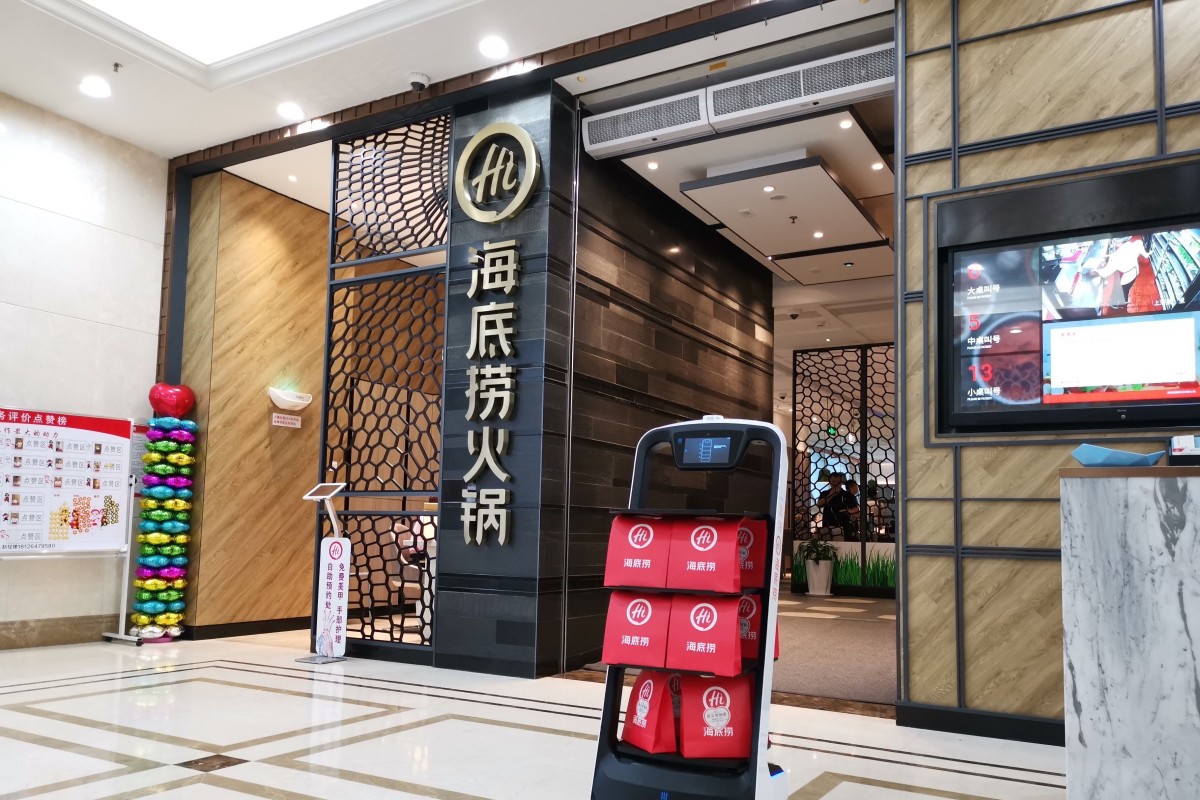
Catering robots developed by Pudu Tech, the three-year-old Shenzhen start-up, have been adopted by thousands of restaurants in China, as well as some foreign countries including Singapore, Korea, and Germany. Photo: Handout
Two years ago, Bao Xiangyi quit school and worked as a waiter in a restaurant for half a year to support himself, and the 19 year-old remembers the time vividly.
“It was crazy working in some Chinese restaurants. My WeChat steps number sometimes hit 20,000 in a day [just by delivering meals in the restaurant],” said Bao.
The WeChat steps fitness tracking function gauges how many steps you literally take and 20,000 steps per day can be compared with a whole day of outdoor activity, ranking you very high in a typical friends circle.
Bao, now a university student in Hangzhou, Zhejiang province, quit the waiter job and went back to school.
“I couldn’t accept that for 365 days a year every day would be the same,” said Bao. “Those days were filled with complete darkness and I felt like my whole life would be spent as an inferior and insignificant waiter.”
Olivia Niu, a 23-year-old Hong Kong resident, quit her waiter job on the first day. “It was too busy during peak meal times. I was so hungry myself but I needed to pack meals for customers,” said Niu.
Being a waiter has never been a top career choice but it remains a big source of employment in China. Yang Chunyan, a waitress at the Lanlifang Hotel in Wenzhou in southeastern China, has two children and says she chose the job because she needs to make a living.
Catering robots developed by Pudu Tech, the three-year-old Shenzhen start-up. Photo: Handout
Today’s young generation have their sights on other areas though. Of those born after 2000, 24.5 per cent want careers related to literature and art. This is followed by education and the IT industry in second and third place, according to a recent report by Tencent QQ and China Youth Daily.
Help may now be at hand though for restaurants struggling to find qualified table staff who are able to withstand the daily stress of juggling hundreds of orders of food. The answer comes in the form of robots.
Japan’s industrial robots industry becomes latest victim of the trade war
Shenzhen Pudu Technology, a three-year-old Shenzhen start-up, is among the tech companies offering catering robots to thousands of restaurant owners who are scrambling to try to plug a labour shortfall with new tech such as machines, artificial intelligence and online ordering systems. It has deployed robots in China, Singapore, Korea and Germany.
With Pudu’s robot, kitchen staff can put meals on the robot, enter the table number, and the robot will deliver it to the consumer. While an average human waiter can deliver 200 meals per day – the robots can manage 300 to 400 orders.
“Nearly every restaurant owner [in China] says it’s hard to recruit people to [work as a waiter],” Zhang Tao, the founder and CEO of Pudu tech said in an interview this week. “China’s food market is huge and delivering meals is a process with high demand and frequency.”
Pudu’s robots can be used for ten years and cost between 40,000 yuan (US$5,650) and 50,000 yuan. That’s less than the average yearly salary of restaurant and hotel workers in China’s southern Guangdong province, which is roughly 60,000 yuan, according to a report co-authored by the South China Market of Human Resources and other organisations.
As such, it is no surprise that more restaurants want to use catering robots.
According to research firm Verified Market Research, the global robotics services market was valued at US$11.62 billion in 2018 and is projected to reach US$35.67 billion by 2026. Haidilao, China’s top hotpot restaurant, has not only adopted service robots but also introduced a smart restaurant with a mechanised kitchen in Beijing last year. And in China’s tech hub of Shenzhen, it is hard to pay without an app as most of the restaurants have deployed an online order service.
Can robots and virtual fruit help the elderly get well in China?
China’s labour force advantage has also shrank in recent years. The working-age population, people between 16 and 59 years’ old, has reduced by 40 million since 2012 to 897 million, accounting for 64 per cent of China’s roughly 1.4 billion people in 2018, according to the national bureau of statistics.
By comparison, those of working age accounted for 69 per cent of the total population in 2012.
Other Chinese robotic companies are also entering the market. SIASUN Robot & Automation Co, a hi-tech listed enterprise belonging to the Chinese Academy of Sciences, introduced their catering robots to China’s restaurants in 2017. Delivery robots developed by Shanghai-based Keenon Robotics Co., founded in 2010, are serving people in China and overseas markets such as the US, Italy and Spain.
Pudu projects it will turn a profit this year and it is in talks with venture capital firms to raise a new round of funding, which will be announced as early as October, according to Zhang. Last year it raised 50 million yuan in a round led by Shenzhen-based QC capital.
To be sure, the service industry is still the biggest employer in China, with 359 million workers and accounting for 46.3 per cent of a working population of 776 million people in 2018, according to the national bureau of statistics.
And new technology sometimes offers up new problems – in this case, service with a smile.
“When we go out for dinner, what we want is service. It is not as simple as just delivering meals,” said Wong Kam-Fai, a professor in engineering at the Chinese University of Hong Kong and a national expert appointed by the Chinese Association for Artificial Intelligence. “If they [robot makers] can add an emotional side in future, it might work better.”
Technology companies also face some practical issues like unusual restaurant layouts.
“Having a [catering robot] traffic jam on the way to the kitchen is normal. Some passageways are very narrow with many zigzags,” Zhang said. “But this can be improved in future with more standardised layouts.”
Multi-floor restaurants can also be a problem.
Dai Qi, a sales manager at the Lanlifang Hotel, said it is impossible for her restaurant to adopt the robot. “Our kitchen is on the third floor, and we have boxes on the second, third, and fourth floor. So the robots can’t work [to deliver meals to downstairs/upstairs],” Dai said.
But Bao says he has no plans to return to being a waiter, so the robots may have the edge.
“Why are human beings doing something robots can do? Let’s do something they [robots] can’t,” Bao said.
Source: SCMP
Posted in ability, adopted, Art, artificial intelligence (AI), Bao Xiangyi, Beijing, careers, catering robots, CEO of Pudu tech, China alert, China Youth Daily, Chinese Academy of Sciences, Chinese Association for Artificial Intelligence, Chinese University of Hong Kong, complain, darkness, delivering meals, education, foreign countries, Germany, guangdong province, Haidilao, Hangzhou, hotpot restaurant, hundreds of orders, industrial robots industry, IT industry, Italy, Japan, juggle, Keenon Robotics Co, Korea, labour shortfall, Lanlifang Hotel, literature, machines, mechanised kitchen, online ordering systems, plug, Pudu Tech, QC capital, qualified table staff, quit, Restaurant, restaurants, robots, school, Shenzhen, Shenzhen Pudu Technology, SIASUN Robot & Automation Co, Singapore, smart restaurant, South China Market of Human Resources, Spain, start up, tencent qq, trade war, Uncategorized, university student, US, Verified Market Research, victim, waiter, WeChat, Wenzhou, worked, zhejiang province |
Leave a Comment »
10/09/2019
- Expensive presents are officially discouraged but have become the norm at many schools on day of appreciation for educators
Students at Yangzhou Technical Vocational College form the Chinese characters for “Hello Teacher” to mark China’s Teachers’ Day. Photo: Handout
Despite a decade of official discouragement, parents in China have been struggling with one of the biggest dilemmas of the school year – how to mark the country’s annual Teacher’s Day.
Ellen Yuan agonised for a day and a night before sending her son off to kindergarten on Tuesday with a 1,000 yuan (US$140) gift card in his bag for the teacher.
It was the boy’s second week of attendance and Yuan had given no thought to any Teacher’s Day obligations –until she learned that several of her friends had been busy over the weekend preparing gifts for their children’s teachers.
“It makes me feel that I am being a drag on my son if I don’t do so,” said Yuan, who works for a foreign company in Shanghai.
Respecting teachers has traditionally been a fundamental social norm in China but gift giving on the special day for educators has gone beyond an expression of appreciation by their students, as parents have taken over with ever more expensive gifts – and sometimes cash – which they hope will mean their kids are well taken care of while at school.
What gift, how expensive it should be, and how to deliver it have become the biggest questions for many parents in the run-up to September 10 each year, even though the education ministry and its subordinate bodies have repeatedly issued directives over the past decade to ban teachers accepting gifts.
Yuan said one of her friends had bought a body care set worth more than 600 yuan for each of her child’s three teachers, another had bought an 800 yuan gift card, while a third had given the head teacher a 1,000 yuan bottle of perfume.
Some parents had delivered the presents directly to the school, while others had asked their children to take the gifts to their teachers. Yuan’s plan was to message the teacher and tell her to take the gift card from her son’s bag.
“I know it’s bad. I don’t want my kid to know that,” Yuan said.
Hundreds of teachers protest in China over poor pay
The question of whether parents should give gifts on Teacher’s Day was one of the hottest topics on Weibo, China’s Twitter-like social media platform, attracting more than 15 million views as of Tuesday afternoon.
“Of course we should not, but I don’t dare to ignore it,” one user said, winning more than 10,000 likes.
Chu Zhaohui, a researcher at the National Institute of Education Sciences, said the gift-giving trend had been partly driven by a “keeping up with the Joneses” mentality.
“Everybody has given a gift. Would my child be specially treated if I don’t? This is a common concern,” Chu said. As a result, the purpose of gift giving on Teacher’s Day had become about protecting the children’s interests instead of a sincere expression of gratitude, he said.
But not every teacher gets presents – with gifts usually reserved for those teaching the “main subjects” of mathematics, Chinese and English, which count the most in high school and college entrance examinations.
Emily Shen, an English teacher from a middle school in Hangzhou, in the eastern province of Zhejiang, said she also prepared gifts for the teachers of her two kids. “Some chocolate for them to take to school. And I myself would give a gift card to each of those who teach the main subjects,” she said.
Zhuang Ke, a music teacher at a primary school in Jiaxing, also in Zhejiang province, admitted she was embarrassed by the parents’ different treatment of teachers of “less important” subjects like her’s. “It’s always nice to receive presents. But teachers who teach music, art and PE are often forgotten,” she said.
Chinese kindergarten teacher fired for hot sun punishment
State broadcaster CCTV said in a commentary on its website on Sunday that “all forms of behavior that attempt to ruin normal teaching order and interfere in equality by sending gifts should be resolutely abandoned”. A similar message was run by a series of official media outlets at local level.
“The most fundamental way to stop parents from sending gifts is to treat the students equally and fairly every day, so that parents conclude it makes no difference whether they give a gift,” Rednet.cn, the official news portal of Hunan province, said on Monday.
Although some teachers have made it explicit to students that they will refuse presents on Teacher’s Day, Yuan said her son’s teacher accepted the gift, as did the teachers of her three friends’ children.
Source: SCMP
Posted in Art, bag, body care set, bottle of perfume, Chinese, chinese parents, Chocolate, college entrance examination, commentary, day of appreciation, discouraged, educators, English, Expensive presents, fired, foreign company, forgotten, fundamental way, gift card, gift etiquette, Hangzhou, High school, hot sun punishment, Hunan Province, Jiaxing, keeping up with the Joneses, kindergarten, mathematics, mentality, middle school, music, music teacher, National Institute of Education Sciences, norm, official news portal, officially, PE, poor pay, primary school, Protest, Rednet.cn, schools, Shanghai, sincere expression of gratitude, state broadcaster CCTV, struggle, teacher, Teacher’s Day, Uncategorized, website, Weibo, Yangzhou Technical Vocational College, zhejiang province |
Leave a Comment »
06/09/2019
- Researchers bend super-thin sheet using a single electrically charged atom in breakthrough that could eventually pave the way for powerful new computer processors
- Success follows decades of fruitless attempts by scientists around the world
The team from the Chinese Academy of Sciences conducted the “world’s smallest work of origami” with a sheet of graphene. Photo: Handout
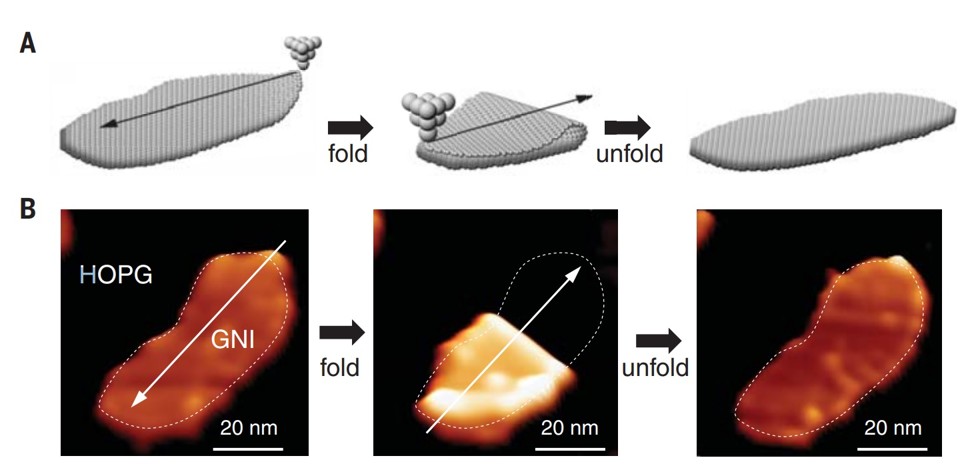
Chinese scientists have taken the ancient art of origami to the atomic level by finding a way to fold microscopically small graphene, according to a new study.
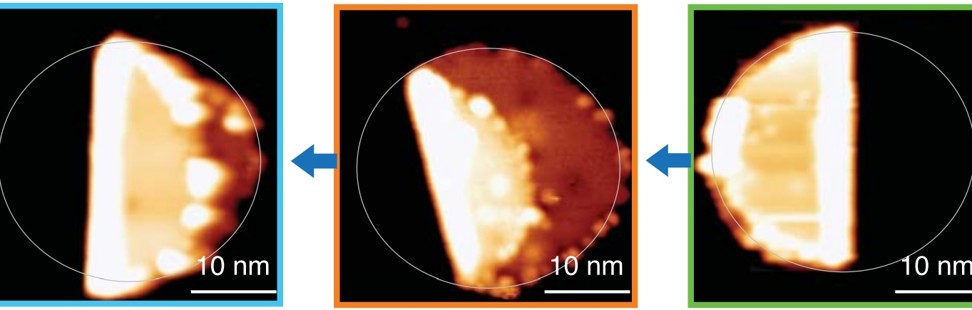
The team managed to fold a 20 nanometre wide sheet of graphene into various shapes and forms using an extremely sharp needle with a single electrically charged atom at the tip, according to a paper published in the latest edition of Science magazine.
The breakthrough could eventually enable a host of technological advances, including the development of faster and more powerful computer processors, the researchers said.
“This is the world’s smallest origami work,” said Dr Du Shixuan, the study’s lead scientist, adding that the team hoped to build on their success by making the graphene equivalent of a paper aeroplane.
Unlike previous experiments, in which the folding occurred randomly or by accident, the new technology allows scientists to control the transformation with atomic-scale accuracy, according to Du, from the Institute of Physics at the Chinese Academy of Sciences in Beijing.
Microscopic images of the graphene folding process. Photo: Handout
Zhang Gengmin, a professor of physics at Peking University, said the team had managed something that other scientists had spent years trying to achieve.
Zhang, who was not involved in the study, said part of the difficulty was that atomic particles were influenced by quantum mechanics, a branch of physics whose laws are counter-intuitive to our daily experience.
In practice this means that folding a graphene sheet in one direction might cause it go in another direction or simply break apart.
Could these crystals be the next leap forward in China’s laser technology?
The new technology developed by Du’s team could have some critical applications, according to Zhang, who works at the university’s nano devices laboratory.
For instance, folding a sheet of graphene – formed from a single layer of latticed carbon atoms – into a “magic angle” will make it superconductive, a unique physical state that allows electrons to pass through without any resistance.
“It is a significant piece of work,” he said.
The 20 nanometre wide sheet was folded into various shapes. Photo: Handout
The paper by Du’s team withheld some of the technical details of their experiment, which means that other scientists may not be able to replicate the process simply by reading the paper.
Du defended the secrecy as a standard practice and necessary measure to maintain China’s lead in this field.
She said that the team’s success was down to many factors – including the hardware used, the strength of the electric current and the experience of the operator – and there were also lessons to be taken from their previous failed attempts.
The researchers said they hoped the technology would be used to improve the design and manufacturing of computer processors.
Chinese, US scientists develop AI technology to help detect submarines in uncharted waters
At present, commercial processors are made using a large piece of silicon board known as a wafer.
But as the size of components such as transistors shrink, it has become increasingly difficult to improve the speed and performance of the computer due to the challenges of controlling the structure and properties of each component on a near-atomic scale
The new technology could give designers more freedom to develop a “dream chip” by building a central processing unit on an atom-by-atom basis from the bottom up.
But Du said the commercial application of the new technology could be years away.
Her team folded the graphene sheets manually, one at a time, but mass production would need the development of new manufacturing methods to do it automatically. At present “we are working on it”, Du added.
Source: SCMP
Posted in AI technology, Art, Atomic origami, Beijing, Chinese Academy of Sciences, Chinese scientists, folding graphene, graphene, Institute of Physics, master, new computer processors, Peking University, Science, submarines, superconductive, Uncategorized, uncharted waters, US scientists |
Leave a Comment »
08/07/2019
- Settlements along the route linking Europe and Asia thrived by providing accommodation and services for countless traders
- Formally established during the Han dynasty, it was a 19th-century German geographer who coined the term Silk Road
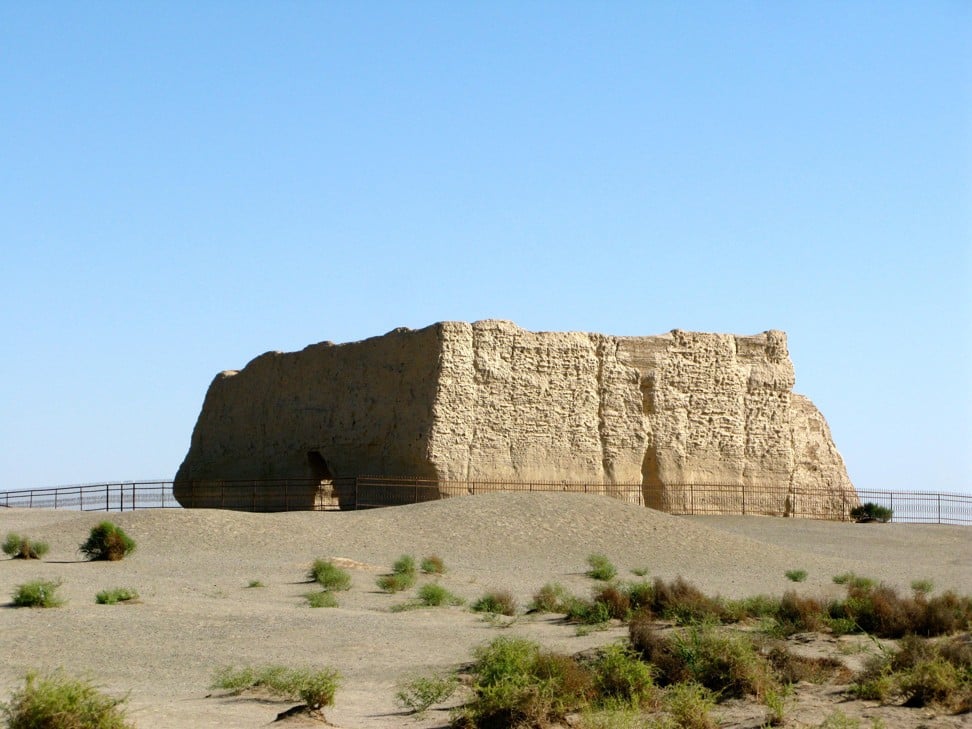
The ruins of a fortified gatehouse and customs post at Yunmenguan Pass, in China’s Gansu province. Photo: Alamy
We have a German geographer, cartographer and explorer to thank for the name of the world’s most famous network of transcontinental trade routes.
Formally established during the Han dynasty, in the first and second centuries BC, it wasn’t until 1877 that Ferdinand von Richthofen coined the term Silk Road (historians increasingly favour the collective term Silk Routes).
The movement of merchandise between China and Europe had been taking place long before the Han arrived on the scene but it was they who employed troops to keep the roads safe from marauding nomads.
Commerce flourished and goods as varied as carpets and camels, glassware and gold, spices and slaves were traded; as were horses, weapons and armour.
Merchants also moved medicines but they were no match for the bubonic plague, which worked its way west along the Silk Road before devastating huge swathes of 14th century Europe.
What follows are some of the countless kingdoms, territories, (modern-day) nations and cities that grew rich on the proceeds of trade, taxes and tolls.
China
A watchtower made of rammed earth at Dunhuang, a desert outpost at the crossroads of two major Silk Road routes in China’s northwestern Gansu province. Photo: Alamy
Marco Polo worked in the Mongol capital, Khanbaliq (today’s Beijing), and was struck by the level of mercantile activity.
The Venetian gap-year pioneer wrote, “Every day more than a thousand carts loaded with silk enter the city, for a great deal of cloth of gold and silk is woven here.”
Light, easy to transport items such as paper and tea provided Silk Road traders with rich pickings, but it was China’s monopoly on the luxurious shimmering fabric that guaranteed huge profits.
So much so that sneaking silk worms out of the empire was punishable by death.
The desert outpost of Dunhuang found itself at the crossroads of two major Silk Road trade arteries, one leading west through the Pamir Mountains to Central Asia and another south to India.
Built into the Great Wall at nearby Yunmenguan are the ruins of a fortified gatehouse and customs post, which controlled the movement of Silk Road caravans.
Also near Dunhuang, the Mogao Caves contain one of the richest collections of Buddhist art treasures anywhere in the world, a legacy of the route to and from the subcontinent.
Afghanistan
Afghanistan’s mountainous terrain was an inescapable part of the Silk Road, until maritime technologies would become the area’s undoing. Photo: Shutterstock
For merchants and middlemen hauling goods through Central Asia, there was no way of bypassing the mountainous lands we know today as Afghanistan.
Evidence of trade can be traced back to long before the Silk Road – locally mined lapis lazuli stones somehow found their way to ancient Egypt, and into Tutankhamun’s funeral mask, created in 1323BC.
Jagged peaks, rough roads in Tajikistan, roof of the world
Besides mercantile exchange, the caravan routes were responsible for the sharing of ideas and Afghanistan was a major beneficiary. Art, philosophy, language, science, food, architecture and technology were all exchanged, along with commercial goods.
In fact, maritime technology would eventually be the area’s undoing. By the 15th century, it had become cheaper and more convenient to transport cargo by sea – a far from ideal development for a landlocked region.
Iran
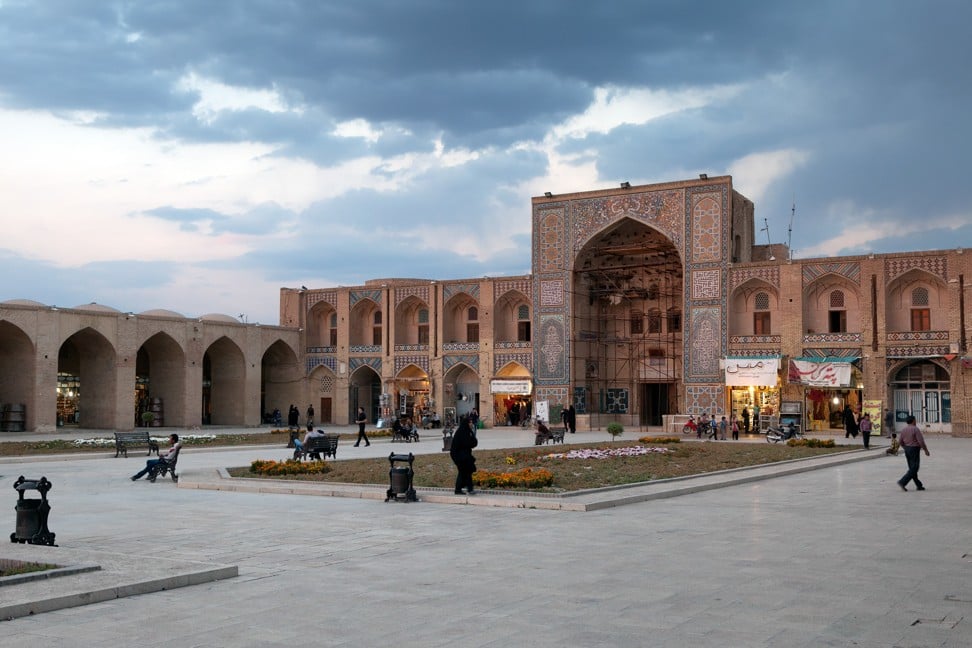
The Ganjali Khan Complex, in Iran. Photo: Shutterstock
Thanks to the Silk Road and the routes that preceded it, the northern Mesopotamian region (present-day Iran) became China’s closest trading partner. Traders rarely journeyed the entire length of the trail, however.
Merchandise was passed along by middlemen who each travelled part of the way and overnighted in caravanserai, fortified inns that provided accommodation, storerooms for goods and space for pack animals.
The good, bad and ugly sides to visiting Chernobyl and Kiev
With so many wheeler-dealers gathering in one place, the hostelries developed into ad hoc marketplaces.
Marco Polo writes of the Persian kingdom of Kerman, where craftsmen made saddles, bridles, spurs and “arms of every kind”.
Today, in the centre of Kerman, the former caravanserai building forms part of the Ganjali Khan Complex, which incorporates a bazaar, bathhouse and mosque.
Uzbekistan
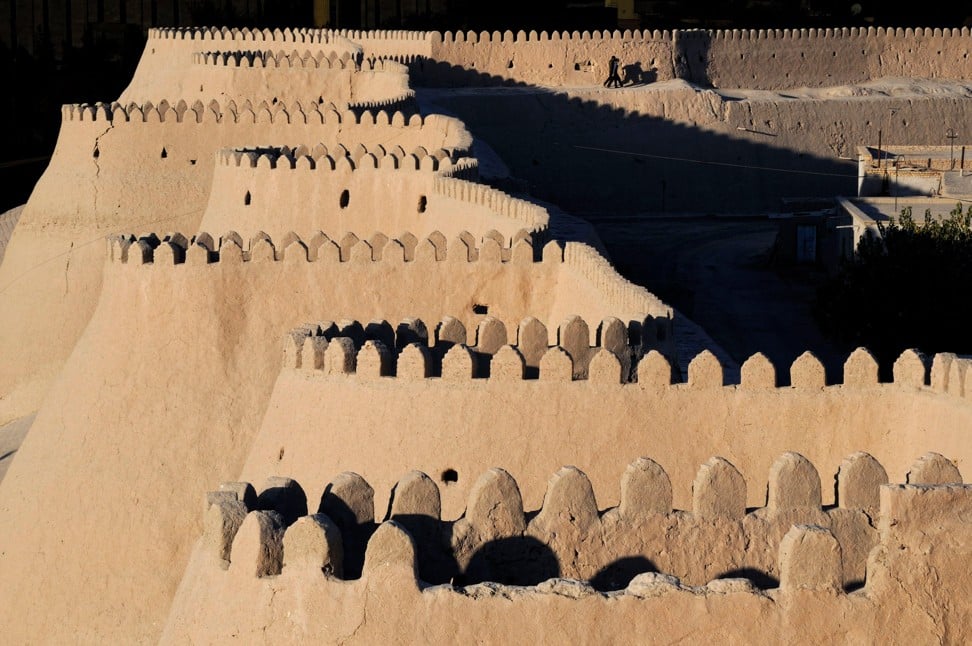
A fort in Khiva, Uzbekistan. Photo: Alamy
The double-landlocked country boasts some of the Silk Road’s most fabled destinations. Forts, such as the one still standing at Khiva, were built to protect traders from bandits; in fact, the city is so well-preserved, it is known as the Museum under the Sky.
The name Samarkand is also deeply entangled with the history of the Silk Road.
The earliest evidence of silk being used outside China can be traced to Bactria, now part of modern Uzbekistan, where four graves from around 1500BC-1200BC contained skeletons wrapped in garments made from the fabric.
Three thousand years later, silk weaving and the production and trade of textiles remain one of Samarkand’s major industries.
Georgia
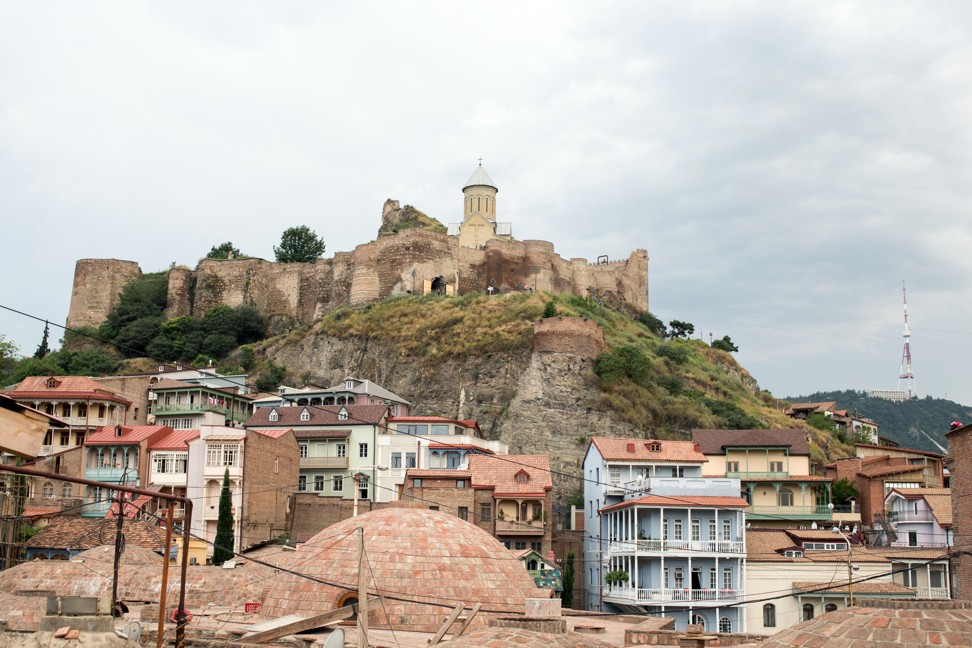
A street in old town of Tbilisi, Georgia. Photo: Alamy
Security issues in Persia led to the opening up of another branch of the legendary trade route and the first caravan loaded with silk made its way across Georgia in AD568.
Marco Polo referred to the weaving of raw silk in “a very large and fine city called Tbilisi”.
Today, the capital has shaken off the Soviet shackles and is on the cusp of going viral.
Travellers lap up the city’s monasteries, walled fortresses and 1,000-year-old churches before heading up the Georgian Military Highway to stay in villages nestling in the soaring Caucasus Mountains.
Public minibuses known as marshrutka labour into the foothills and although the vehicles can get cramped and uncomfortable, they beat travelling by camel.
Jordan
Petra, in Jordan. Photo: Alamy
The location of the Nabataean capital, Petra, wasn’t chosen by chance.
Savvy nomadic herders realised the site would make the perfect pit-stop at the confluence of several caravan trails, including a route to the north through Palmyra (in modern-day Syria), the Arabian peninsula to the south and Mediterranean ports to the west.
Huge payments in the form of taxes and protection money were collected – no wonder the most magnificent of the sandstone city’s hand-carved buildings is called the Treasury.
The Red Rose City is still a gold mine – today’s tourists pay a hefty
. The Nabataeans would no doubt approve.
Venice
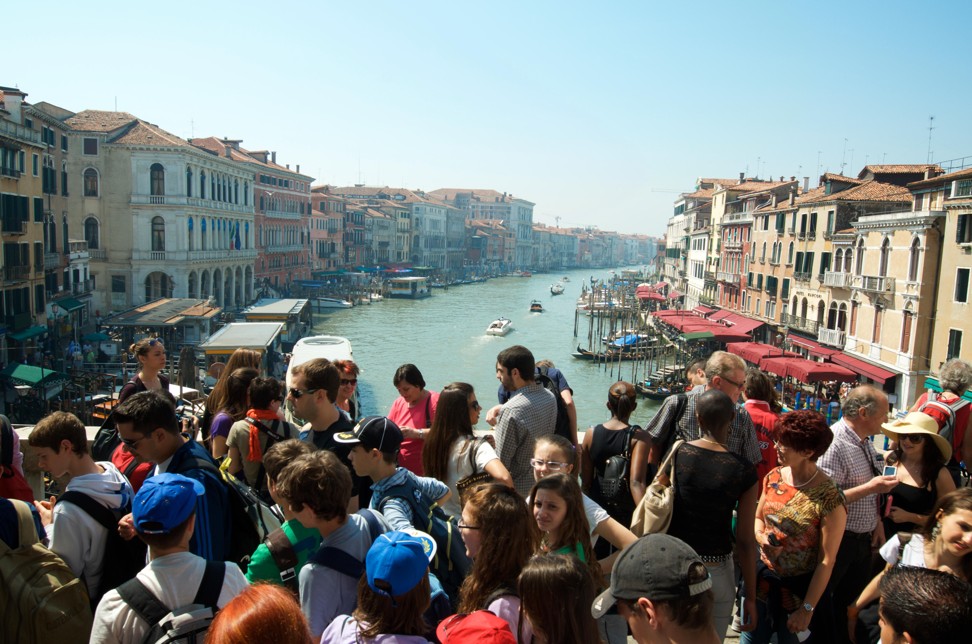
Tourists crowd onto Venice’s Rialto Bridge. Photo: Alamy
Trade enriched Venice beyond measure, helping shape the Adriatic entrepot into the floating marvel we see today.
Besides the well-documented flow of goods heading west, consignments of cotton, ivory, animal furs, grapevines and other goods passed through the strategically sited port on their way east.
Ironically, for a city built on trade and taxes, the biggest problem Venice faces today is visitors who don’t contribute enough to the local economy.
A lack of spending by millions of day-tripping tourists and cruise passengers who aren’t liable for nightly hotel taxes has prompted authorities to introduce a citywide access fee from January 2020.
Two thousand years ago, tariffs and tolls helped Venice develop and prosper. Now they’re needed to prevent its demise.
Source: SCMP
Posted in accommodation, Adriatic, Afghanistan, architecture, armour, arms, Art, Asia, Bactria, bandits, bathhouse, bazaar, Beijing, bridles, bubonic plague, Buddhist art treasures, camels, caravanserai, caravans, carpets, Caucasus Mountains, Chernobyl, cloth of gold, commercial goods, craftsmen, Death, Dunhuang, Egypt, Europe, exchanged, Ferdinand von Richthofen, floating marvel, Food, fort, from China to Italy, funeral mask, Ganjali Khan Complex, Gansu Province, garments, Georgia, Georgian Military Highway, German geographer, glassware, Gold, goods, Great Wall, grew rich, Han Dynasty, horses, hostelries, iran, Jordan, Kerman, Khanbaliq, Khiva, Kiev, languages, lapis lazuli, Marco Polo, maritime technology, marketplaces, marshrutka, medicines, Merchandise, Mesopotamian region, Mogao Caves, Mongol capital, Mosque, Museum under the Sky, Nabataean capital, pack animals, Palmyra, Pamir Mountains, paper, Persian kingdom, Petra, philosophy, punishable, Red Rose City, Rialto Bridge, saddles, Samarkand, Science, Silk Road, Silk Road destinations, silk worms, skeletons, slaves, sneaking, Space, spices, spurs, storerooms, Syria, Tajikistan, Tbilisi, Tea, Technology, towns, Trade, traders, Tutankhamun, Uncategorized, Uzbekistan, Venetian gap-year pioneer, Venice, weapons, Yunmenguan Pass |
Leave a Comment »








 CHINDIA ALERT: You'll be living in their world, very soon
Chinese parents struggle with Teacher’s Day gift etiquette
Despite a decade of official discouragement, parents in China have been struggling with one of the biggest dilemmas of the school year – how to mark the country’s annual Teacher’s Day.
Ellen Yuan agonised for a day and a night before sending her son off to kindergarten on Tuesday with a 1,000 yuan (US$140) gift card in his bag for the teacher.
It was the boy’s second week of attendance and Yuan had given no thought to any Teacher’s Day obligations –until she learned that several of her friends had been busy over the weekend preparing gifts for their children’s teachers.
“It makes me feel that I am being a drag on my son if I don’t do so,” said Yuan, who works for a foreign company in Shanghai.
Respecting teachers has traditionally been a fundamental social norm in China but gift giving on the special day for educators has gone beyond an expression of appreciation by their students, as parents have taken over with ever more expensive gifts – and sometimes cash – which they hope will mean their kids are well taken care of while at school.
What gift, how expensive it should be, and how to deliver it have become the biggest questions for many parents in the run-up to September 10 each year, even though the education ministry and its subordinate bodies have repeatedly issued directives over the past decade to ban teachers accepting gifts.
Yuan said one of her friends had bought a body care set worth more than 600 yuan for each of her child’s three teachers, another had bought an 800 yuan gift card, while a third had given the head teacher a 1,000 yuan bottle of perfume.
Some parents had delivered the presents directly to the school, while others had asked their children to take the gifts to their teachers. Yuan’s plan was to message the teacher and tell her to take the gift card from her son’s bag.
“I know it’s bad. I don’t want my kid to know that,” Yuan said.
But not every teacher gets presents – with gifts usually reserved for those teaching the “main subjects” of mathematics, Chinese and English, which count the most in high school and college entrance examinations.
Emily Shen, an English teacher from a middle school in Hangzhou, in the eastern province of Zhejiang, said she also prepared gifts for the teachers of her two kids. “Some chocolate for them to take to school. And I myself would give a gift card to each of those who teach the main subjects,” she said.
Zhuang Ke, a music teacher at a primary school in Jiaxing, also in Zhejiang province, admitted she was embarrassed by the parents’ different treatment of teachers of “less important” subjects like her’s. “It’s always nice to receive presents. But teachers who teach music, art and PE are often forgotten,” she said.
Chinese kindergarten teacher fired for hot sun punishment
State broadcaster CCTV said in a commentary on its website on Sunday that “all forms of behavior that attempt to ruin normal teaching order and interfere in equality by sending gifts should be resolutely abandoned”. A similar message was run by a series of official media outlets at local level.
“The most fundamental way to stop parents from sending gifts is to treat the students equally and fairly every day, so that parents conclude it makes no difference whether they give a gift,” Rednet.cn, the official news portal of Hunan province, said on Monday.
Although some teachers have made it explicit to students that they will refuse presents on Teacher’s Day, Yuan said her son’s teacher accepted the gift, as did the teachers of her three friends’ children.
Source: SCMP
Posted in Art, bag, body care set, bottle of perfume, Chinese, chinese parents, Chocolate, college entrance examination, commentary, day of appreciation, discouraged, educators, English, Expensive presents, fired, foreign company, forgotten, fundamental way, gift card, gift etiquette, Hangzhou, High school, hot sun punishment, Hunan Province, Jiaxing, keeping up with the Joneses, kindergarten, mathematics, mentality, middle school, music, music teacher, National Institute of Education Sciences, norm, official news portal, officially, PE, poor pay, primary school, Protest, Rednet.cn, schools, Shanghai, sincere expression of gratitude, state broadcaster CCTV, struggle, teacher, Teacher’s Day, Uncategorized, website, Weibo, Yangzhou Technical Vocational College, zhejiang province | Leave a Comment »