Chindia Alert: You’ll be Living in their World Very Soon
aims to alert you to the threats and opportunities that China and India present. China and India require serious attention; case of ‘hidden dragon and crouching tiger’.
Without this attention, governments, businesses and, indeed, individuals may find themselves at a great disadvantage sooner rather than later.
The POSTs (front webpages) are mainly 'cuttings' from reliable sources, updated continuously.
The PAGEs (see Tabs, above) attempt to make the information more meaningful by putting some structure to the information we have researched and assembled since 2006.
The tech investment push is part of a fiscal package waiting to be signed off by the National People’s Congress, which convenes this week
This initiative will reduce China’s dependence on foreign technology, echoing objectives set forth previously in the ‘Made in China 2025’ programme
A conductor rehearses the military band on the sidelines of the National People’s Congress in Beijing’s Great Hall of the People in March of last year. China’s legislature is expected to sign off on a massive tech-led stimulus plan. Photo: AP
Beijing is accelerating its bid for global leadership in key technologies, planning to pump more than a trillion dollars into the economy through the roll-out of everything from next-generation wireless networks to artificial intelligence (AI).
In the master plan backed by President Xi Jinping himself, China will invest an estimated 10 trillion yuan (US$1.4 trillion) over six years to 2025, calling on urban governments and private hi-tech giants like Huawei Technologies to help lay 5G wireless networks, install cameras and sensors, and develop AI software that will underpin
and Huawei to SenseTime Group at the expense of US companies.
As tech nationalism mounts, the investment drive will reduce China’s dependence on foreign technology, echoing objectives set forth previously in the “Made in China 2025”
programme. Such initiatives have already drawn fierce criticism from the Trump administration, resulting in moves to block the rise of Chinese tech companies such as Huawei.
How will China’s annual legislative meetings affect the stock investor? Five key industries to watch
18 May 2020
“Nothing like this has happened before, this is China’s gambit to win the global tech race,” said Digital China Holdings chief operating officer Maria Kwok, as she sat in a Hong Kong office surrounded by facial recognition cameras and sensors. “Starting this year, we are really beginning to see the money flow through.”
The tech investment push is part of a fiscal package waiting to be signed off by China’s legislature, the National People’s Congress, which convenes this week. The government is expected to announce infrastructure funding of as much as US$563 billion this year, against the backdrop of the country’s worst economic performance since the Mao era.
The nation’s biggest purveyors of cloud computing and data analysis Alibaba, the parent company of the South China Morning Post, and Tencent Holding will be linchpins of the upcoming endeavour. China has already entrusted Huawei, the world’s largest telecommunications equipment supplier, to help galvanise 5G. Tech leaders including Pony Ma Huateng and Jack Ma are espousing the programme.
Maria Kwok’s company is a government-backed information technology systems integration provider, among many that are jumping at the chance. In the southern city of Guangzhou, Digital China is bringing half a million units of project housing online, including a complex three quarters the size of Central Park in New York City. To find a home, a user just has to log on to an app, scan their face and verify their identity. Leases can be signed digitally via smartphone and the renting authority is automatically flagged if a tenant’s payment is late.
China is no stranger to far-reaching plans with massive price tags that appear to achieve little. There is no guarantee this programme will deliver the economic rejuvenation its proponents promise. Unlike previous efforts to resuscitate the economy with “dumb” bridges and highways, this newly laid digital infrastructure will help national champions develop cutting-edge technologies.
“China’s new stimulus plan will likely lead to a consolidation of industrial internet
providers, and could lead to the emergence of some larger companies able to compete with global leaders, such as GE and Siemens,” said Nannan Kou, head of research at BloombergNEF, in a report. “One bet is on industrial internet-of-things (IoT) platforms, as China aims to cultivate three world leading companies in this area by 2025.”
China is not alone in pumping money into the technology sector as a way to get out of the post-coronavirus economic slump. Earlier this month, South Korea said AI and wireless communications would be at the core of it its “New Deal” to create jobs and boost growth.
Nothing like this has happened before, this is China’s gambit to win the global tech raceMaria Kwok, COO at Digital China Holdings
The 10 trillion yuan that China is estimated to spend from now until 2025 encompasses areas typically considered leading edge, such as AI and IoT, as well as items such as ultra-high voltage lines and high-speed rail, according to the government-backed China Centre for Information Industry Development. More than 20 of mainland China’s 31 provinces and regions have announced projects totaling over 1 trillion yuan with active participation from private capital, a state-backed newspaper reported on Wednesday.
Separate estimates by Morgan Stanley put new infrastructure at around US$180 billion each year for the next 11 years – or US$1.98 trillion in total. Those calculations also include power and rail lines. That annual figure would be almost double the past three-year average, the investment bank said in a March report that listed key stock beneficiaries including companies such as China Tower Corp, Alibaba, GDS Holdings, Quanta Computer and Advantech Co.
Beijing’s half-formed vision is already stirring a plethora of stocks, a big reason why five of China’s 10 best-performing stocks this year are tech plays like networking gear maker Dawning Information Industry and Apple supplier GoerTek. The bare outlines of the master plan were enough to drive pundits toward everything from satellite operators to broadband providers.
China’s telecoms carriers push to complete ‘political task’ of 5G network roll-out amid coronavirus crisis
6 Mar 2020
It is unlikely that US companies will benefit much from the tech-led stimulus and in some cases they stand to lose existing business. Earlier this year, when the country’s largest telecoms carrier China Mobile awarded contracts worth 37 billion yuan for 5G base stations, the lion’s share went to Huawei and other Chinese companies. Sweden’s Ericsson got only a little over 10 per cent of the business in the first four months. In one of its projects, Digital China will help the northeastern city of Changchun swap out American cloud computing staples IBM, Oracle and EMC with home-grown technology.
It is in data centres that a considerable chunk of the new infrastructure development will take place. Over 20 provinces have launched policies to support enterprises using cloud computing services, according to a March research note from UBS Group.
Tony Yu, chief executive of Chinese server maker H3C, said that his company was seeing a significant increase in demand for data centre services from some of the country’s top internet companies. “Rapid growth in up-and-coming sectors will bring a new force to China’s economy after the pandemic passes,” he told Bloomberg News.
From there, more investment should flow. Bain Capital-backed data centre operator ChinData Group estimated that for every one dollar spent on data centres another US$5 to US$10 in investment in related sectors would take place, including in networking, power grid and advanced equipment manufacturing. “A whole host of supply chain companies will benefit,” the company said in a statement.
There is concern about whether this long-term strategy provides much in the way of stimulus now, and where the money will come from. “It’s impossible to prop up China’s economy with new infrastructure alone,” said Zhu Tian, professor of economics at China Europe International Business School in Shanghai. “If you are worried about the government’s added debt levels and their debt servicing abilities right now, of course you wouldn’t do it. But it’s a necessary thing to do at a time of crisis.”
Digital China is confident that follow-up projects from its housing initiative in Guangzhou could generate 30 million yuan in revenue for the company. It is also hoping to replicate those efforts with local governments in the northeastern province of Jilin, where it has 3.3 billion yuan worth of projects approved. These include building a so-called city brain that will for the first time connect databases including traffic, schools and civil matters such as marriage registry. “The concept of smart cities has been touted for years but now we are finally seeing the investment,” said Kwok.
Wuhan, where the first cases of the novel coronavirus were detected, is ending a 76-day lockdown
A day before the lockdown was fully lifted, Tencent announces a slew of initiatives focused on helping to revive the digital industry in the city
Passengers leaving Wuhan city are pictured at the Hankou Railway Station in Wuhan city, central China’s Hubei province, on Wednesday morning, April 08, 2020. Photo: SCMP/Simon Song
A day before China lifted a months-long lockdown of Wuhan city, the initial epicentre of the coronavirus pandemic, Chinese internet giant Tencent Holdings pledged to invest in digital government, online education and artificial intelligence (AI) in the city, among other fields.
“During the epidemic, Tencent has been supporting Hubei and Wuhan’s fight against the virus through funds and technology,” the company best known for its gaming business said in a statement posted on Tuesday on WeChat. “In the future, we will also fully support Wuhan’s post-pandemic reconstruction and continue to support the development of Wuhan’s digital industry.”
China’s major tech companies have played a big role in the fight against the coronavirus, and are now playing their part in the economic recovery of Wuhan and other areas that have suffered under extended travel restrictions and business closures.
and Pinduoduo each announced their own initiatives to help revive sales of farm goods from Hubei as the province emerges from its months-long lockdown.
Popular mobile payments app Alipay also created a dedicated section for Wuhan merchants to allow users to buy from merchants in the city, and offered loans to small local merchants in need of financial support, according to an Alipay statement. Alipay is operated by Ant Financial, an affiliate of Alibaba, which owns the South China Morning Post.
How tech has helped China in its public health battle with coronavirus
23 Mar 2020
Wuhan, an industrial powerhouse for the steel, semiconductors and automotive sectors, is emerging from an unprecedented lockdown which began on January 23 and prevented people from moving in and out of the city.
Since restrictions began easing gradually in late March, business activity has shown signs of recovery: Tencent’s mobile payment platform WeChat Pay recorded a 162 per cent increase in offline transactions in a 10-day period from March 25, compared to the same period the previous month, according to a separate statement by Tencent on Wednesday.
Searches for “work resumption certificates” – which businesses need to submit to local authorities to prove their staff can safely restart work – also increased 320 per cent on Baidu, China’s biggest search engine, in the past month, Baidu said in a report on Wednesday.
Tencent declined to provide specific details regarding the size of its latest investment in Wuhan or a timeline for its implementation, but said in the statement that it will involve closer cooperation with city authorities in the areas of digital government, education, smart mobility, AI and cybersecurity to help the city with its digital industries.
Among these initiatives, it will push ahead with a plan to build a headquarters focusing on digital industries in Wuhan, specifically digitalisation for the government and smart city initiatives.
It will also establish a base in Wuhan for its online education initiatives, set up an AI lab and cybersecurity academy and build a school focusing on smart mobility in collaboration with Chinese carmaker Dongfeng Motor Corporation, the company said in the statement.
BEIJING, Dec. 21 (Xinhua) — Ask the silver-haired residents of the elderly care community Yinheyuan in central Beijing what they know about artificial intelligence (AI), and they will probably throw the question to the smart speakers within their reach.
These smart speakers, capable of interacting with users with voice-recognition technologies, are also part of the answer. Via voice command, senior residents can control lights, TVs and other home appliances, order food or ask for help.
AI is no longer a technical term used exclusively by professionals in China. Both young and old are enjoying the benefits of the growing smart economy.
After personal computers (PC), PC internet and mobile internet, the growth focus of China’s digital economy is shifting to smart technologies like AI, said Baidu Chairman and CEO Robin Li at the World Internet Conference in October.
In the smart economy era, Li predicted a declining reliance on cellphones and a rising popularity of other smart devices. AI chips, cloud computing services, among others, would become the new digital infrastructure, while innovative businesses will flourish as transport, health, education and other sectors go smart.
Wearable devices, smart home appliances, autonomous driving and smart cities are among the fastest-growing fields in the smart economy.
China is the largest smart speaker market in the world, accounting for 36 percent of global shipments in the third quarter of 2019, according to global market firm Strategy Analytics. It found in a July and August survey that 63 percent of Chinese people without a smart speaker planned to buy one within the following year. Another 22 percent planned to make a purchase later on.
Chinese firms are stepping up investment in 5G, AI and the Internet of Things to gain a foothold in the emerging field. By end-June, China had over 1,200 AI-related enterprises, according to the Ministry of Industry and Information Technology.
Baidu launched its autonomous driving open platform ApollBo in 2017 to coordinate cross-sector efforts in this field. It has launched several L4 autonomous driving vehicles in partnership with leading automobile companies, and a fleet of Apollo-powered robotaxis are now taking test runs in central China’s Changsha.
Nurturing a smart economy is also on the government agenda. China has passed a guideline to boost the integration of AI and the real economy this year, and plans to build some 20 national AI innovative development pilot zones by 2023.
The country’s AI sector is forecast to be worth more than 160 billion yuan (about 22.83 billion U.S. dollars) in 2020, spurring related sectors to exceed 1 trillion yuan, said Lin Nianxiu, deputy director with the National Development and Reform Commission, citing industrial data.
Lin said China would focus on 100 firms dedicated to AI technologies and relevant applications, improve the industrial ecosystem, facilitate the deep integration of AI and the real economy, and intensify its international collaboration on AI technology, standards, industries, laws and regulations and ethics.
This is the third instalment in a four-part series examining the brewing US-China tech war over the development and deployment of artificial intelligence tech
The US is home to five of the world’s top 10 universities in the AI field, which includes computer vision and machine learning, while China has three
For those Chinese with long-term plans to stay in the US, a major obstacle lies in getting work visas, especially in the current trade war environment. Illustration: Perry Tse
After working in the United States for more than a decade, Zheng Yefeng felt he had hit a glass ceiling. He also saw that the gap in artificial intelligence between China and the US was narrowing.
Last year Zheng, who worked as a researcher at Siemens Healthcare in New Jersey, made a decision that addressed both problems. He accepted an offer to head up the medical research and development team at Tencent’s YouTu artificial intelligence lab in Shenzhen, known as China’s Silicon Valley.
“There was almost no room for promotion if I stayed in the US,” he said, expressing a common dilemma faced by experienced Chinese tech workers in America.
With the US-China trade war leading to tighter scrutiny of Chinese nationals working in the US tech industry, people like Zheng are moving back to China to work in the burgeoning AI sector, especially after Beijing designated AI a national priority. The technology’s varied applications have attracted billions of dollars of venture capital investment, created highly valued start-ups like SenseTime and ByteDance, and sparked a talent war among companies.
That has created an odd symbiotic relationship between the two countries vying for AI supremacy. The US, with its superior higher education system, is the training ground for Chinese AI scientists like Zheng, who obtained a PhD from the University of Maryland after earning bachelor’s and master’s degrees at China’s premier Tsinghua University.
“Many professors in China have great academic ability, but in terms of the number [of top professors], the US is ahead,” said Luo Guojie, who himself accepted an offer from Peking University to become an assistant professor after studying computer science in the US.
Among international students majoring in computer science and maths in US universities, Chinese nationals were the third largest group behind Indians and Nepalese in the 2018-2019 academic year, representing 19.9 per cent, according to the Institute of International Education.
[To build] the best universities is not easy. The university is a free speech space, whereas in China, this is not the case Gunther Marten, a senior official with the European Union delegation to China
The South China Morning Post spoke with several Chinese AI engineers who decided to stay and work in the US after their studies. They only agreed to give their surnames because of the sensitivity of the issues being discussed.
A 25-year-old Beijinger surnamed Lin graduated from one of China’s best engineering schools in the capital before heading to a US university for a master’s degree in computer science in 2017. Like some of his peers, he found the teaching methods in China to be outdated.
“It’s hard to imagine that a final exam of a coding course still asked you to hand write code, instead of running and testing it on a computer,” said Lin, who now works as a software engineer for Google in Silicon Valley.
“Although we still had to take writing tests [in the US], we had many practical opportunities in the lab and could do our own projects,” he added.
A Facebook software engineer surnamed Zhuang had a similar experience at his university in Shanghai.
“Many engineering students [in China] still get old-school textbooks and insufficient laboratory training,” he said. “Engineering practices for AI have been through a fast iteration over the past few decades, which means many Chinese students are not exposed to the most updated knowledge in the field, at least not in the classroom.”
Zhuang also noted out that many classes in China are taught in Chinese, meaning engineering graduates are not fluent in English, the preferred language of the global AI research community.
The US is home to five of the world’s top 10 universities in the AI field, which includes computer vision and machine learning, while China has three. Carnegie Mellon University (CMU) in Pennsylvania ranks No 1 while China’s Tsinghua University is No 2, according to CSrankings, which bases the list on papers published since 2009.
US tech chief: China is threatening US’ lead in global AI race
With its top institutions and an open culture that encourages freedom of speech, including unfettered internet access, the US has become a magnet for the brightest AI students the world over.
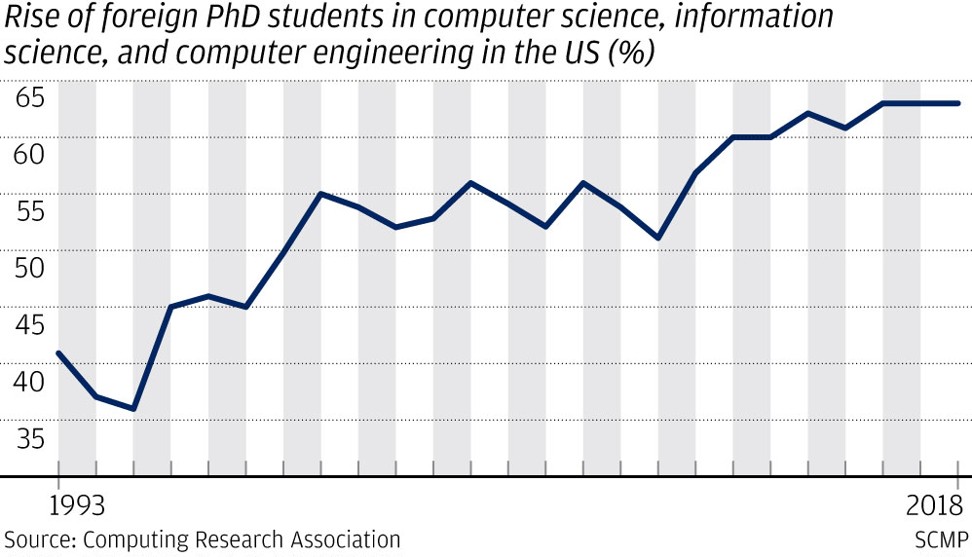
In 2018, 62.8 per cent of PhD degrees and 65.4 per cent of master’s degrees in computer science, information science and computer engineering programmes in the US were granted to “non-resident aliens”, according to a survey by the Computing Research Association.
“[To build] the best universities is not easy,” Gunther Marten, a senior official with the European Union delegation to China, said on the sidelines of the World Internet Conference in Wuzhen in October. “The university is a free speech space, whereas in China, this is not the case.”
When these US-educated AI scientists finish studying, most take advantage of a rule allowing them to stay in the country for three years to gain work experience.
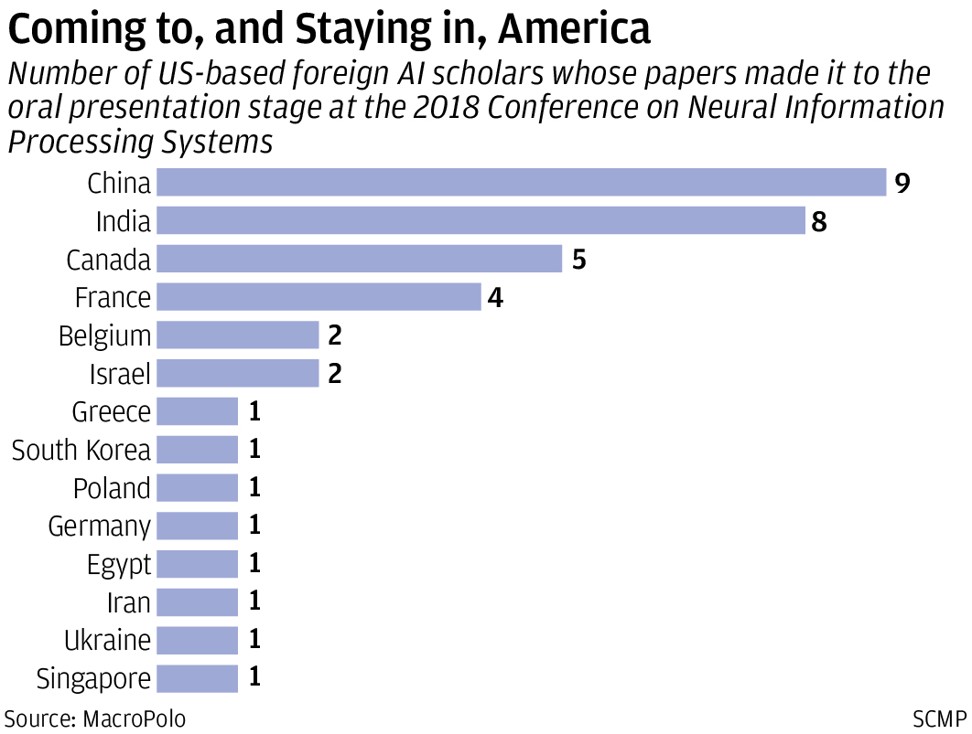
Of the foreign nationals taking part in last year’s Conference on Neural Information Processing Systems (NIPS), a major machine learning event for AI professionals, 87 per cent of those whose papers made it to the oral presentation stage went to work for American universities or research institutes after earning their PhD, according to MacroPolo, a think tank under the Paulson Institute.
“China has many great universities and companies, especially in certain subfields of AI such as computer vision, but many people remain hesitant to move to China due to the political environment, quality of life concerns and workplace issues,” said Remco Zwetsloot, a research fellow at Georgetown University’s Center for Security and Emerging Technology (CSET).
China’s PhD students miserable, yet hopeful: survey
Some of the US-trained Chinese AI engineers told the Post they were scared off by China’s “996” working culture: 9am to 9pm, six days a week. Tech firms in China typically expect their employees to work long hours to prove their dedication.
Lin, the Beijinger who now works for Google, used to be an intern at one of China’s largest internet giants. “I worked from the time I woke up until going to bed,” he said, “At Google, I’ve been confused because many people here only work till 5pm but Google is still a global leader.” Lin said he would be happy to return to China if the 996 work culture eases.
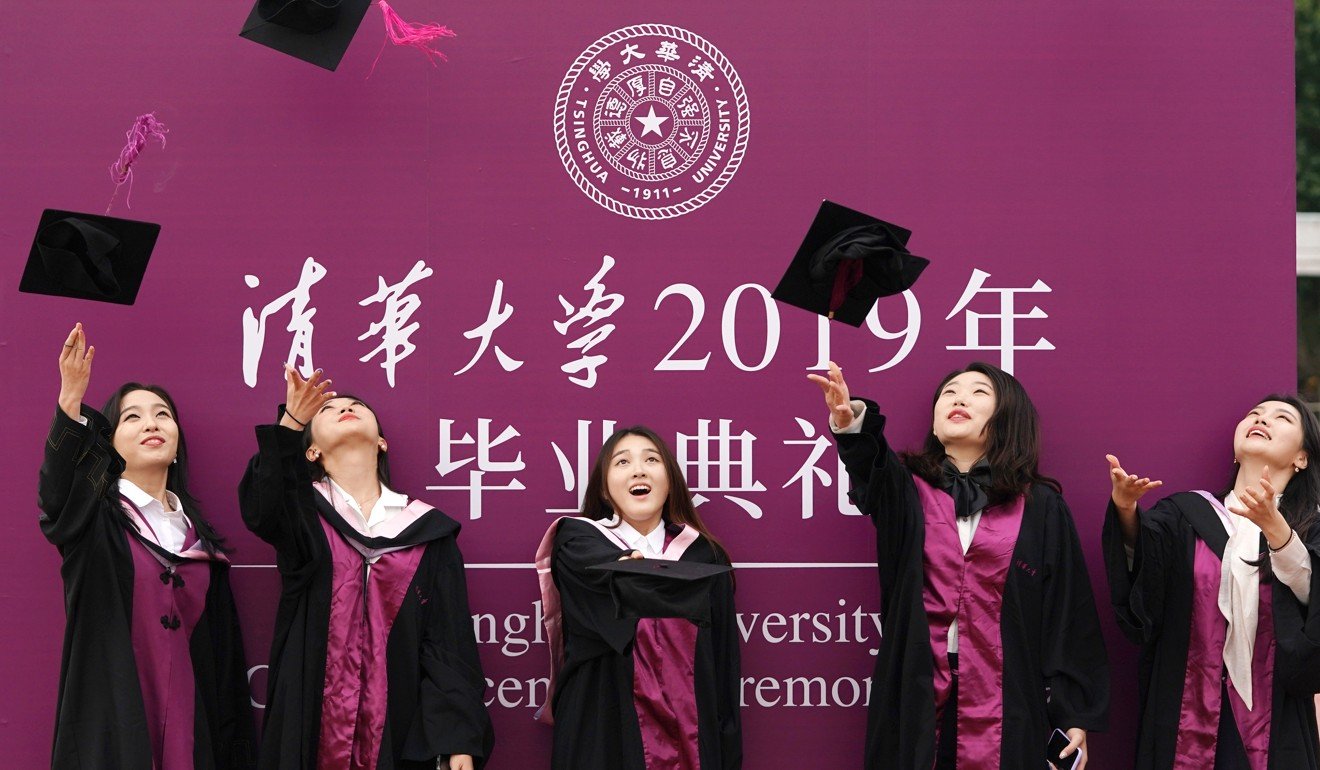
Graduates throw their caps in the air as they pose for a group photo during the 2019 commencement ceremony of Tsinghua University in Beijing. Tsinghua ranks as China’s top university for AI. Photo: Xinhua
Chen, a female postgraduate student at Carnegie Mellon, who recently accepted a job offer from Google, once interned at Beijing-based AI unicorn SenseTime, where she worked from 10am to between 8pm and 10pm most days.
A SenseTime spokesperson said the company has adopted flexible working hours for its employees.
Besides a better work-life balance, Chinese graduates look for jobs in Silicon Valley because of the higher pay.
“If you include pre-tax income, many of us get offers that pay more than 1 million yuan (US$142,000) a year but in China the salaries offered to the best batch of fresh undergraduates are about 200,000 to 300,000 yuan (US$28,000 to US$43,000),” Chen said.
Still, for those Chinese with long-term plans to stay in the US, a major obstacle lies in getting work visas, especially in the current trade war environment. Most AI-related workers are on H-1B visas that allow US companies to employ non-US nationals with expertise in specialised fields such as IT, finance and engineering.
However, the number of non-immigrant H-1B visas granted has started to fall since 2016, when it peaked at 180,000, according to the US Department of State, and US tech companies have complained that a policy shift by the Trump administration has made the approval process longer and more complicated.
In 2017, President Donald Trump requested an overhaul of the H-1B visa programme, saying he did not want it to enable US tech companies to hire cheaper foreign workers at the expense of American jobs. He also wants to give priority to highly skilled people and restrict those wanting to move to the US because of family connections.
Science graduates from overseas countries can stay in the US with their student visas for up to three years while competing for the hard to get work visas, which are granted based on undisclosed mechanisms. Overseas students already working in the US can apply for so-called green cards, which offer permanent residency.
After working for a major US tech company for almost three years on a student visa, one Chinese software engineer, who spoke to the Post on condition of anonymity, said she was relocated to the US firm’s Beijing office last year after failing to obtain a H-1B work visa.
“While there might be individual cases, it seems like the current tensions have not – at least as of a few months ago – led to noticeable changes in the overall number of Chinese students staying in the US after graduating,” said CSET’s Zwetsloot.
Some Chinese AI scientists use Twitter to announce their decision to stay. Chen Tianqi, who just obtained a PhD at the University of Washington in Seattle, and Jun-Yan Zhu, a CMU and UC Berkeley alumnus currently working at Adobe, each tweeted that they would join Carnegie Mellon as assistant professors next year.
To achieve the goal of turning China into “the world’s primary AI innovation centre” by 2030, according to a 2017 blueprint issued the State Council, the central government has stepped up efforts to attract US-educated talent.
The Thousand Talents Plan has seen more than 6,000 overseas Chinese students and academics return since its was established in 2008, but because of escalating tensions with the US, Beijing has played down the initiative.
Longer term, Beijing’s willingness to invest significant sums into the AI sector could see more Chinese return for the better employment opportunities. Between 2013 and the first quarter of 2018, China attracted 60 per cent of global investment in AI, according to a Tsinghua University report.
China’s spending on AI may be far lower than people think
Chinese authorities are investing heavily in the sector, with the city of Shanghai setting up a 10 billion yuan (US$142 million) AI fund in August and Beijing city government announcing in April it would provide a 340 million yuan (US$48 million) grant to the Beijing Academy of Artificial Intelligence.
“More and more senior people like me have come back, and some start their own businesses,” said Zheng, the Siemens Healthcare researcher who joined Tencent. “It’s easier for Chinese to seek venture capital in China than in other countries.”
Image copyright REUTERSImage caption Landslides are common in India after heavy rains
Landslides are common in rural and mountainous areas of India, especially after heavy rain. Scientists now say they have developed a low-cost technology for detecting them, using a motion sensor commonly found in smartphones.
The device is currently being trialled in more than 20 locations in the Himalayan state of Himachal Pradesh, where landslides kill dozens of people every year.
Scientists say they are hopeful that it will help drastically reduce the deaths and damage caused by these natural disasters.
An accelerometer is a type of motion sensor which measures changes in velocity. In smartphones, this is what allows people to use compass and maps applications and even flip their screens horizontally or vertically.
But now scientists from the Indian Institute of Technology (IIT) in Himachal Pradesh’s Mandi district have found that with some modifications, it can be used as a low-cost early warning system for landslides.
They told BBC Click’s Shubham Kishore that it will cost an estimated 20,000 rupees (£218; $282) to manufacture – a fraction of the cost of existing technologies.
Authorities say the frequency of landslides in Himachal Pradesh is due to its mountainous terrain and the instability of the Himalayas, which is a relatively young mountain range.
However, excessive rain, rampant deforestation, and unauthorised construction has exacerbated the problem.
Image copyright IIT MANDIImage caption One of the devices being fitted
The Environmental Information (ENVIS) centre for the Ministry of Environment and Forest said in a report that casualties from landslides were also growing because “the increase of road connectivity and number of vehicles plying on these roads in the state, means the number of road accidents and loss of precious human lives is increasing day by day”.
This is because landslides frequently wash away roads and destroy homes – many of which are built with materials like clay mud or unburned bricks.
Early warning
Dr Varun Dutt, a computer engineer, with his colleague, Dr KV Uday, a civil engineer, are leading efforts to develop the technology. These researchers say they are using the motion sensor to measure soil movements.
“When we embed it in the soil, the accelerometer will move when the soil moves. Essentially soil moves if some force acts on it.
“What the sensor does is allow us to record the extent of that movement. It throws up a range of data that then allows us to track small displacements in soil which causes landslides,” Dr Dutt told the BBC’s Ayeshea Perera.
He explained that a series of small soil movements could help provide an early warning to a larger disaster in the making. Due to the early warnings from small movements, detecting a landslide is easier than trying to detect an earthquake, which is more instantaneous with a very small warning corridor.
The device measures all these movements, and when it detects a significant displacement of earth which could result in a landslide, it emits loud noises and sends text messages to officials so that they can evacuate and stop vehicular movement to and around the area.
Image copyright AFPImage caption The new device helps to detect landslides
The device has already seen some success.
In Kutropi, in the state’s Mandi district, the device was able to successfully alert officials about an impending landslide. Police were able to turn away vehicles from a road that was later completely washed away.
Dr Uday told the BBC that they have managed to alert officials after using the device that a hill in the state’s Deode region needed to be monitored carefully as the soil movements indicated that the hill was at risk of sliding.
Dr Dutt says that state officials – who often have to deal with the tragic consequences of landslides – are excited about the technology.
“We were invited to present it at a workshop by the state government in partnership with the National Disaster Management Authority (NDMA) earlier this year.
“We showcased the technology and we got a lot of requests to commercialise it. So now we are in the process of marketing it and setting it up,” he said.
At present, the device has managed to demonstrate enough of a lead time to allow officials to warn residents and motorists shortly before a potential landslide.
But Dr Dutt and Dr Uday want the technology to be more predictive than reactive.
So the team has begun using Artificial Intelligence (AI) and machine learning on the sets of data thrown up by the device, and are hoping that it can develop algorithms that will enable them to predict landslides 24 hours or even a week in advance.
These algorithms are currently being refined, and scientists are hoping to test them more accurately in the field by the 2020 monsoon.
“We are excited but we want it to be accurate. There should be fewer false alarms.
“The good part is that policymakers understand that this is experimental work and it will improve as more data gets collected. If it all goes to plan, it will be very useful,” Dr Dutt said.
Huang Kunming, a member of the Political Bureau of the Communist Party of China (CPC) Central Committee and head of the Publicity Department of the CPC Central Committee, attends the opening ceremony of the sixth World Internet Conference in Wuzhen, east China’s Zhejiang Province, Oct. 20, 2019. Before delivering his speech, Huang read Chinese President Xi Jinping’s congratulatory letter to the conference. (Xinhua/Liu Bin)
WUZHEN, Zhejiang Province, Oct. 20 (Xinhua) — The sixth World Internet Conference opened Sunday in the river town of Wuzhen in east China’s Zhejiang Province.
With the theme of “Intelligent Interconnection for Openness and Cooperation — Building a Community with a Shared Future in Cyberspace,” the three-day conference will bring together more than 1,500 participants from over 80 countries and regions, including members of the Internet Hall of Fame, Nobel Prize winners and Turing Award winners.
Executives from major tech companies from home and abroad such as Microsoft, Qualcomm, Alibaba Group and Huawei will share their insight on the future development of the internet at 20 sub-forums, covering popular and cutting-edge topics such as artificial intelligence (AI), 5G and industrial digitization.
Huang Kunming, a member of the Political Bureau of the Communist Party of China (CPC) Central Committee and head of the Publicity Department of the CPC Central Committee, delivered a keynote speech at the opening ceremony of the conference.
Fifty years after the birth of the internet, efforts should be made to seize new opportunities and address risks and challenges to build cyberspace into a shared community that benefits all humanity, Huang said.
The senior official also called for enhanced efforts to develop the digital economy, unleash the digital dividend, and protect the security and order of cyberspace.
During the conference, reports on China and world internet development will be released to forecast the future trend of internet development.
The reports will review global internet development over the past five decades and the history of Chinese internet during the last 25 years.
Around 15 top scientific and technological projects in the internet sector will also be unveiled, covering AI, 5G, big data, cloud computing, digital manufacturing, industrial internet and other internet-related fields.
The number of internet users in China hit 854 million in June 2019, with the internet availability rate reaching 61.2 percent, according to the China Internet Network Information Center.
An increasing proportion of young people no longer willing to wait tables in China as restaurant owners look to new technology for answers
Catering robots developed by Pudu Tech, the three-year-old Shenzhen start-up, have been adopted by thousands of restaurants in China, as well as some foreign countries including Singapore, Korea, and Germany. Photo: Handout
Two years ago, Bao Xiangyi quit school and worked as a waiter in a restaurant for half a year to support himself, and the 19 year-old remembers the time vividly.
“It was crazy working in some Chinese restaurants. My WeChat steps number sometimes hit 20,000 in a day [just by delivering meals in the restaurant],” said Bao.
The WeChat steps fitness tracking function gauges how many steps you literally take and 20,000 steps per day can be compared with a whole day of outdoor activity, ranking you very high in a typical friends circle.
Bao, now a university student in Hangzhou, Zhejiang province, quit the waiter job and went back to school.
“I couldn’t accept that for 365 days a year every day would be the same,” said Bao.
“Those days were filled with complete darkness and I felt like my whole life would be spent as an inferior and insignificant waiter.”
Olivia Niu, a 23-year-old Hong Kong resident, quit her waiter job on the first day. “It was too busy during peak meal times. I was so hungry myself but I needed to pack meals for customers,” said Niu.
Being a waiter has never been a top career choice but it remains a big source of employment in China. Yang Chunyan, a waitress at the Lanlifang Hotel in Wenzhou in southeastern China, has two children and says she chose the job because she needs to make a living.
Catering robots developed by Pudu Tech, the three-year-old Shenzhen start-up. Photo: Handout
Today’s young generation have their sights on other areas though. Of those born after 2000, 24.5 per cent want careers related to literature and art. This is followed by education and the IT industry in second and third place, according to a recent report by Tencent QQ and China Youth Daily.
Help may now be at hand though for restaurants struggling to find qualified table staff who are able to withstand the daily stress of juggling hundreds of orders of food. The answer comes in the form of robots.
Japan’s industrial robots industry becomes latest victim of the trade war
Shenzhen Pudu Technology, a three-year-old Shenzhen start-up, is among the tech companies offering catering robots to thousands of restaurant owners who are scrambling to try to plug a labour shortfall with new tech such as machines, artificial intelligence and online ordering systems. It has deployed robots in China, Singapore, Korea and Germany.
With Pudu’s robot, kitchen staff can put meals on the robot, enter the table number, and the robot will deliver it to the consumer. While an average human waiter can deliver 200 meals per day – the robots can manage 300 to 400 orders.
“Nearly every restaurant owner [in China] says it’s hard to recruit people to [work as a waiter],” Zhang Tao, the founder and CEO of Pudu tech said in an interview this week. “China’s food market is huge and delivering meals is a process with high demand and frequency.”
Pudu’s robots can be used for ten years and cost between 40,000 yuan (US$5,650) and 50,000 yuan. That’s less than the average yearly salary of restaurant and hotel workers in China’s southern Guangdong province, which is roughly 60,000 yuan, according to a report co-authored by the South China Market of Human Resources and other organisations.
As such, it is no surprise that more restaurants want to use catering robots.
According to research firm Verified Market Research, the global robotics services market was valued at US$11.62 billion in 2018 and is projected to reach US$35.67 billion by 2026.
Can robots and virtual fruit help the elderly get well in China?
China’s labour force advantage has also shrank in recent years. The working-age population, people between 16 and 59 years’ old, has reduced by 40 million since 2012 to 897 million, accounting for 64 per cent of China’s roughly 1.4 billion people in 2018, according to the national bureau of statistics.
By comparison, those of working age accounted for 69 per cent of the total population in 2012.
Other Chinese robotic companies are also entering the market. SIASUN Robot & Automation Co, a hi-tech listed enterprise belonging to the Chinese Academy of Sciences, introduced their catering robots to China’s restaurants in 2017. Delivery robots developed by Shanghai-based Keenon Robotics Co., founded in 2010, are serving people in China and overseas markets such as the US, Italy and Spain.
Pudu projects it will turn a profit this year and it is in talks with venture capital firms to raise a new round of funding, which will be announced as early as October, according to Zhang. Last year it raised 50 million yuan in a round led by Shenzhen-based QC capital.
To be sure, the service industry is still the biggest employer in China, with 359 million workers and accounting for 46.3 per cent of a working population of 776 million people in 2018, according to the national bureau of statistics.
And new technology sometimes offers up new problems – in this case, service with a smile.
“When we go out for dinner, what we want is service. It is not as simple as just delivering meals,” said Wong Kam-Fai, a professor in engineering at the Chinese University of Hong Kong and a national expert appointed by the Chinese Association for Artificial Intelligence. “If they [robot makers] can add an emotional side in future, it might work better.”
Technology companies also face some practical issues like unusual restaurant layouts.
“Having a [catering robot] traffic jam on the way to the kitchen is normal. Some passageways are very narrow with many zigzags,” Zhang said. “But this can be improved in future with more standardised layouts.”
Multi-floor restaurants can also be a problem.
Dai Qi, a sales manager at the Lanlifang Hotel, said it is impossible for her restaurant to adopt the robot. “Our kitchen is on the third floor, and we have boxes on the second, third, and fourth floor. So the robots can’t work [to deliver meals tdownstairs/upstairs],” Dai said.
But Bao says he has no plans to return to being a waiter, so the robots may have the edge.
“Why are human beings doing something robots can do? Let’s do something they [robots] can’t,” Bao said.
An increasing proportion of young people no longer willing to wait tables in China as restaurant owners look to new technology for answers
Catering robots developed by Pudu Tech, the three-year-old Shenzhen start-up, have been adopted by thousands of restaurants in China, as well as some foreign countries including Singapore, Korea, and Germany. Photo: Handout
Two years ago, Bao Xiangyi quit school and worked as a waiter in a restaurant for half a year to support himself, and the 19 year-old remembers the time vividly.
“It was crazy working in some Chinese restaurants. My WeChat steps number sometimes hit 20,000 in a day [just by delivering meals in the restaurant],” said Bao.
The WeChat steps fitness tracking function gauges how many steps you literally take and 20,000 steps per day can be compared with a whole day of outdoor activity, ranking you very high in a typical friends circle.
Bao, now a university student in Hangzhou, Zhejiang province, quit the waiter job and went back to school.
“I couldn’t accept that for 365 days a year every day would be the same,” said Bao. “Those days were filled with complete darkness and I felt like my whole life would be spent as an inferior and insignificant waiter.”
Olivia Niu, a 23-year-old Hong Kong resident, quit her waiter job on the first day. “It was too busy during peak meal times. I was so hungry myself but I needed to pack meals for customers,” said Niu.
Being a waiter has never been a top career choice but it remains a big source of employment in China. Yang Chunyan, a waitress at the Lanlifang Hotel in Wenzhou in southeastern China, has two children and says she chose the job because she needs to make a living.
Catering robots developed by Pudu Tech, the three-year-old Shenzhen start-up. Photo: Handout
Today’s young generation have their sights on other areas though. Of those born after 2000, 24.5 per cent want careers related to literature and art. This is followed by education and the IT industry in second and third place, according to a recent report by Tencent QQ and China Youth Daily.
Help may now be at hand though for restaurants struggling to find qualified table staff who are able to withstand the daily stress of juggling hundreds of orders of food. The answer comes in the form of robots.
Japan’s industrial robots industry becomes latest victim of the trade war
Shenzhen Pudu Technology, a three-year-old Shenzhen start-up, is among the tech companies offering catering robots to thousands of restaurant owners who are scrambling to try to plug a labour shortfall with new tech such as machines, artificial intelligence and online ordering systems. It has deployed robots in China, Singapore, Korea and Germany.
With Pudu’s robot, kitchen staff can put meals on the robot, enter the table number, and the robot will deliver it to the consumer. While an average human waiter can deliver 200 meals per day – the robots can manage 300 to 400 orders.
“Nearly every restaurant owner [in China] says it’s hard to recruit people to [work as a waiter],” Zhang Tao, the founder and CEO of Pudu tech said in an interview this week. “China’s food market is huge and delivering meals is a process with high demand and frequency.”
Pudu’s robots can be used for ten years and cost between 40,000 yuan (US$5,650) and 50,000 yuan. That’s less than the average yearly salary of restaurant and hotel workers in China’s southern Guangdong province, which is roughly 60,000 yuan, according to a report co-authored by the South China Market of Human Resources and other organisations.
As such, it is no surprise that more restaurants want to use catering robots.
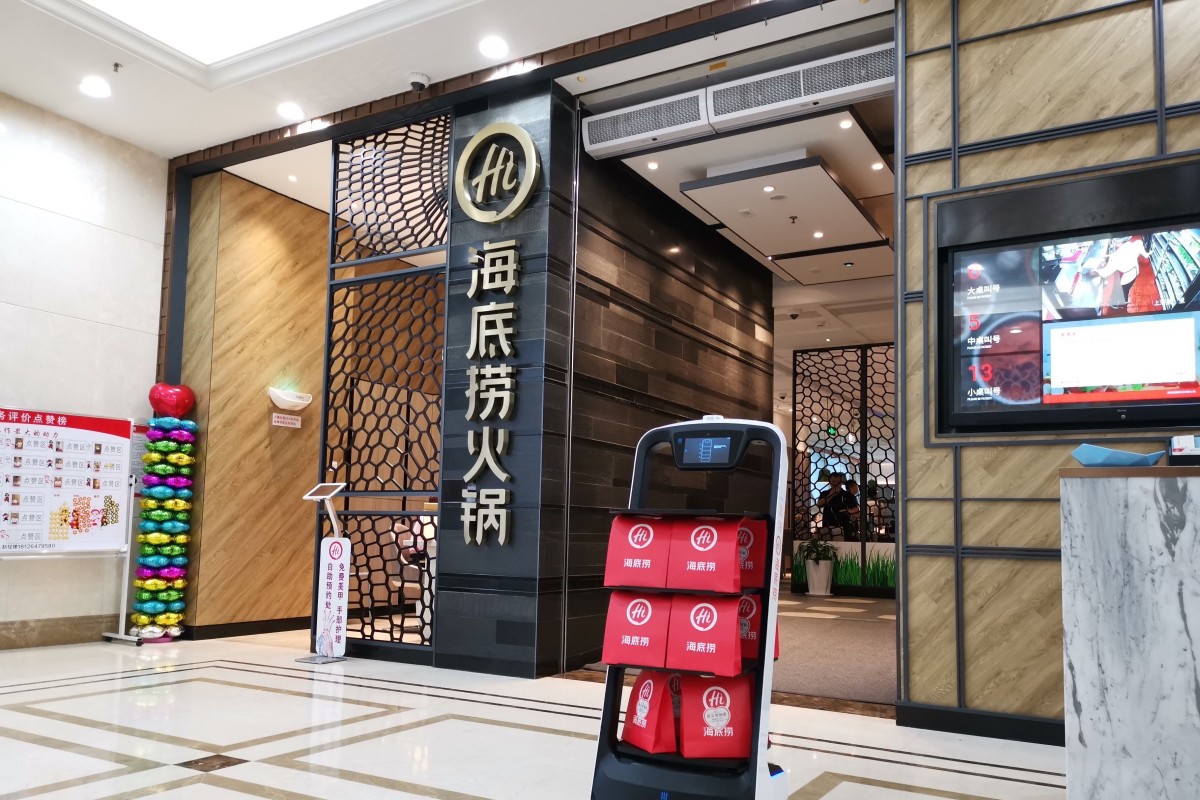
According to research firm Verified Market Research, the global robotics services market was valued at US$11.62 billion in 2018 and is projected to reach US$35.67 billion by 2026. Haidilao, China’s top hotpot restaurant, has not only adopted service robots but also introduced a smart restaurant with a mechanised kitchen in Beijing last year. And in China’s tech hub of Shenzhen, it is hard to pay without an app as most of the restaurants have deployed an online order service.
Can robots and virtual fruit help the elderly get well in China?
China’s labour force advantage has also shrank in recent years. The working-age population, people between 16 and 59 years’ old, has reduced by 40 million since 2012 to 897 million, accounting for 64 per cent of China’s roughly 1.4 billion people in 2018, according to the national bureau of statistics.
By comparison, those of working age accounted for 69 per cent of the total population in 2012.
Other Chinese robotic companies are also entering the market. SIASUN Robot & Automation Co, a hi-tech listed enterprise belonging to the Chinese Academy of Sciences, introduced their catering robots to China’s restaurants in 2017. Delivery robots developed by Shanghai-based Keenon Robotics Co., founded in 2010, are serving people in China and overseas markets such as the US, Italy and Spain.
Pudu projects it will turn a profit this year and it is in talks with venture capital firms to raise a new round of funding, which will be announced as early as October, according to Zhang. Last year it raised 50 million yuan in a round led by Shenzhen-based QC capital.
To be sure, the service industry is still the biggest employer in China, with 359 million workers and accounting for 46.3 per cent of a working population of 776 million people in 2018, according to the national bureau of statistics.
And new technology sometimes offers up new problems – in this case, service with a smile.
“When we go out for dinner, what we want is service. It is not as simple as just delivering meals,” said Wong Kam-Fai, a professor in engineering at the Chinese University of Hong Kong and a national expert appointed by the Chinese Association for Artificial Intelligence. “If they [robot makers] can add an emotional side in future, it might work better.”
Technology companies also face some practical issues like unusual restaurant layouts.
“Having a [catering robot] traffic jam on the way to the kitchen is normal. Some passageways are very narrow with many zigzags,” Zhang said. “But this can be improved in future with more standardised layouts.”
Multi-floor restaurants can also be a problem.
Dai Qi, a sales manager at the Lanlifang Hotel, said it is impossible for her restaurant to adopt the robot. “Our kitchen is on the third floor, and we have boxes on the second, third, and fourth floor. So the robots can’t work [to deliver meals to downstairs/upstairs],” Dai said.
But Bao says he has no plans to return to being a waiter, so the robots may have the edge.
“Why are human beings doing something robots can do? Let’s do something they [robots] can’t,” Bao said.
German Chancellor Angela Merkel visits Wuhan Yangtze River Bridge in Wuhan, capital city of central China’s Hubei Province, Sept. 7, 2019. German Chancellor Angela Merkel visited Wuhan on Saturday. (Xinhua/Xiao Yijiu)
WUHAN, Sept. 7 (Xinhua) — Angela Merkel Saturday visited central China’s Wuhan during her 12th trip to the country as German Chancellor since 2005.
Before Wuhan, capital city of Hubei province, Merkel had visited a number of cities besides Beijing during her China trips in the past.
When talking with students of Huazhong University of Science and Technology, Merkel highlighted the importance of international cooperation in the era of globalization, and called on the students to be participants.
Saying that a nation’s prosperity is part of the prosperity of the whole world, she voiced her hope that students should shoulder common responsibilities to combat global challenges.
In the speech, Merkel reviewed her past trips to China. In Shenyang, she witnessed economic upgrading. In Chengdu she learned about development of western China. In Shenzhen she saw remarkable progress brought by the reform and opening-up.
She said quite a few noted German companies including Siemens, and small and medium-sized innovation enterprises are operating business in Wuhan. Wuhan and Duisburg became the first pair of sister cities between China and Germany in 1982.
Merkel exchanged views with students on internet, artificial intelligence, intelligent manufacturing, and environmental protection.
Before wrapping up her trip, Merkel also visited a local hospital and a factory of the German company Webasto.
The airline’s data labs unit is using AI to improve customer service and better handle a flood of complaints
China Eastern Airlines planes are seen on the tarmac at Hongqiao International Airport in Shanghai. Photo: Reuters
In a business that receives around one million complaints a year, the ability to handle large amounts of information is critical.
That is why state-owned China Eastern Airlines is now using artificial intelligence (AI) to improve the customer experience, using the technology’s ability to handle huge amounts of data to tailor its services for individual consumers.
The airline’s data labs unit is even trying to solve problems before they happen by, for example, developing a pilot service that will allow customers to give better instructions and feedback on their in-flight meals.
“Using an analogy, if a good chef happens to leave a restaurant, then he or she takes an abundance of knowledge with them,” said Wang Xuewu, the founder and head of China Eastern Airlines’ data lab, in an interview at the AI summit in Hong Kong this month.
“Through AI, we can better ensure that the tastes and preferences of our customers are kept safe, analysed and applied in the future.”
Beijing thunderstorms return China Eastern’s flight MU5331 twice to Shanghai, taking 17 hours to get back to its origin
The idea for a pilot AI food service at China Eastern comes amid the country’s drive to develop AI technology, dubbed the fourth industrial revolution. In an ambitious three-step blueprint, China wants to catch up with the US in AI technology and applications by 2020, see major breakthroughs by 2025, and become a global leader in the field by 2030.
More broadly, the airline’s data lab now automatically classifies thousands of complaints and offers recommended solutions, to help front line customer relations staff. This shortens the customer response time and helps improve the overall quality of service, said Wang.
A Civil Aviation Administration of China (CAAC) report showed that China Eastern Airlines had 41.6 complaints per million passengers in May. This comes as the airline’s frequent flier members reached 39.6 million in 2019, an increase of 18.8 per cent from the year before, according to the company’s March annual report.
Beijing’s new Zaha Hadid-designed airport to showcase latest facial recognition technology
China’s Quora-like website Zhihu has several questions posted by angry fliers about what is the most effective way to get a satisfactory response from an airline to a complaint.
AI-related technologies have already been deployed at China’s airports. Beijing Capital International Airport launched a facial recognition system for security checks in April 2018 and now around 70 mainland China airports use the system, according to Xinhua reports.












 CHINDIA ALERT: You'll be living in their world, very soon