Archive for ‘BBC Hindi’

25/02/2020

Donald Trump in India: Seven killed in Delhi violence during visit

Seven people have been killed in Delhi in protests against India’s controversial new citizenship law, as US President Donald Trump made his first official visit to the country.

Violence has erupted again in parts of north-east Delhi, which saw deadly clashes between supporters and opponents of the law on Monday night.

Two journalists have been attacked and BBC reporters in the area say mobs are throwing stones and shouting slogans.

There are fears of further clashes.

Mobs in parts of north-east Delhi are throwing stones at each other, and the situation remains tense, according to BBC correspondents.

A policeman and six civilians have died in Delhi’s deadliest violence since the Citizenship Amendment Act (CAA) – which critics say is anti-Muslim – was passed last year.

Around 150 people, including 48 policemen, are reportedly injured.
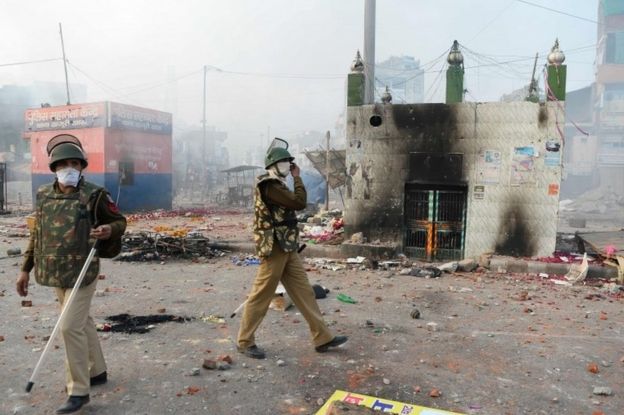
Policemen stand on a vandalised road following clashes between supporters and opponents of a new citizenship law, at Bhajanpura area of New Delhi on February 24, 2020, ahead of US President arrival in New Delhi.Image copyright AFP

“There are around 200 people, some are holding the Indian flag in their hands, others are holding saffron flags, generally associated with right-wing Hindu groups. They are chanting Jai Shri Ram [hail Lord Ram],” BBC Hindi reporter Faisal Mohammed said.

The crowd was also shouting “shoot the traitors”, our reporter added.

Correspondents say the timing of the unrest is an embarrassment to Prime Minister Narendra Modi as he hosts the US president and the violence has taken the spotlight away from Mr Trump’s visit.

Where is the violence?

It broke out in three Muslim-majority areas in north-east Delhi on Sunday and has continued since.

The violence in the area has seen protesters firmly split along religious lines, BBC reporters at the scene say.

Both sides have blamed each other for starting the clashes.
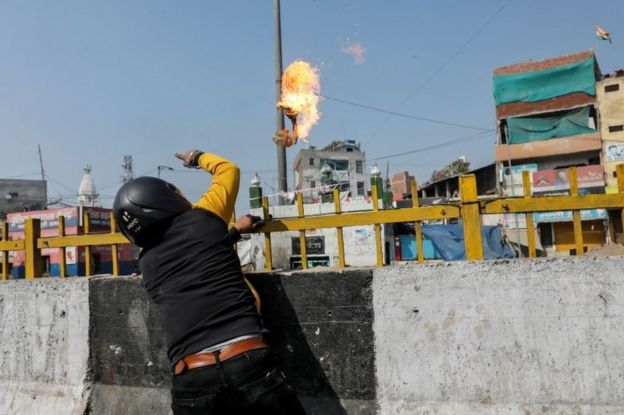
A man supporting a new citizenship law throws a petrol bomb at a Muslim shrine during a clash with those opposing the law in New Delhi India, February 24, 2020Image copyright REUTERS
Image caption The violence in the Muslim-majority areas in north-east Delhi began on Sunday

The violence has been linked to a BJP leader, Kapil Mishra, who had threatened a group of protesters staging a sit-in against the CAA over the weekend, telling them that they would be forcibly evicted once Donald Trump had left India.

The clashes spilled into Monday and police fired tear gas shells and led baton charges to disperse the stone-throwing crowds. TV footage showed flames and smoke billowing from buildings.

Eyewitnesses said they saw charred vehicles and streets full of stones in areas like Jaffrabad and Chand Bagh on Tuesday morning. Police were allowing people to enter only after checking their identity cards. Some Metro stations have also been shut.

Who are the dead and injured?

Six civilians and one policeman have been killed in the violence so far.

“One of the seriously injured is a senior police officer. He has now been moved to another hospital for specialised treatment,” an official said.

Two journalists belonging to the NDTV news channel were badly beaten while they were out reporting on Tuesday morning.

Shahid Alvi, an auto rickshaw driver, died because of a bullet injury he suffered during the protest. His brother Rashid told BBC Hindi that Shahid was married just a month ago.

“He was shot in the stomach and died while we were taking him to the hospital,” he said.

Another victim has been identified as Rahul Solanki.

His brother, Rohit Solanki, told BBC Hindi that he died after being shot as he tried to escape from a mob.

“He had gone out to buy groceries when he was suddenly surrounded. He was shot at point blank range. We tried taking him to four hospitals but we were turned away,” he said.

What are officials doing?

Delhi’s freshly re-elected Chief Minister Arvind Kejriwal, called on the federal government to restore law and order.

“There are not enough police on the streets [in the affected areas]. Local police are saying they are not getting orders from above to control the situation, and they are not able to take action,” he told reporters.

The capital’s police force reports directly to Mr Modi’s ruling Bharatiya Janata Party (BJP)-led government.

Home Minister Amit Shah, who is in-charge of Delhi’s police forces, is holding a meeting with Mr Kejriwal to discuss the situation.
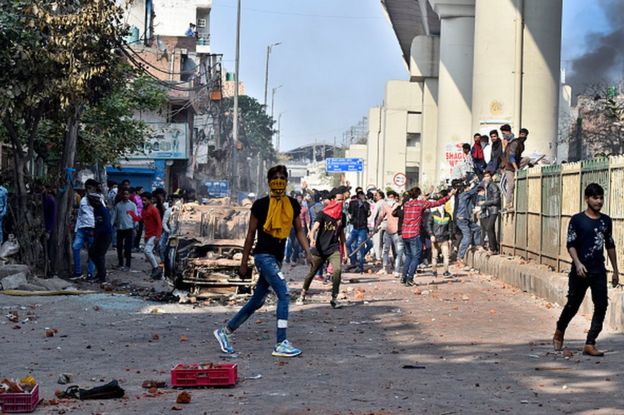
Protesters seen during clashes between a group of anti-CAA protestors and supporters of the new citizenship act, near Maujpur and Jaffrabad metro station on February 24, 2020 in New DelhiImage copyright GETTY IMAGES
Image caption The police and protesters fought pitched battles on the streets of Delhi

What is the citizenship act about?

The Citizenship Amendment Act (CAA) grants amnesty to non-Muslim immigrants from three nearby Muslim-majority countries.

The new law has raised fears that India’s secular status is at risk.

Critics say it discriminates against Muslims. But the government says the protests are unnecessary as it only seeks to give amnesty to persecuted minorities.

Protests so far have been largely led by Muslim women and men, but a lot of Hindus have also joined them.
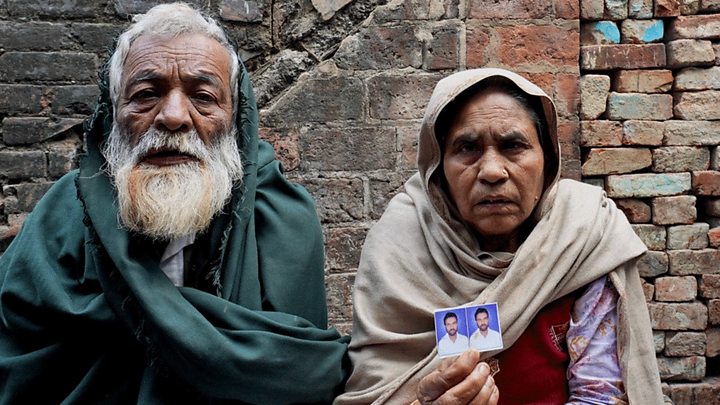
Media caption ‘Our son was shot dead by police’

Source: The BBC

21/02/2020

India woman held for chanting ‘long live Pakistan’ at citizenship protest

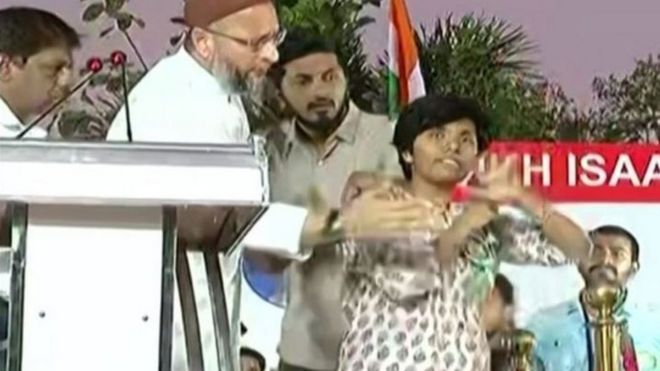
Amulya Leona at the protest event in BangaloreImage copyright ANI
Image caption Ms Leona was charged with sedition at a protest event in Bangalore city

An Indian woman has been arrested and charged with sedition for chanting “long live Pakistan” at a protest in the southern city of Bangalore.

Amulya Leona was participating in a demonstration against a controversial citizenship law, which critics say discriminates against Muslims.

Her comments were immediately condemned by a prominent local Muslim politician.

Asaduddin Owaisi, who was at the rally, said neither he nor his party supported India’s “enemy nation Pakistan”.

Muslim politicians in Hindu-majority India are often targeted as being “pro-Pakistan” by political rivals, particularly in the last few years. The neighbouring countries have a historically tense relationship, fighting three wars since Pakistan’s formation following the partition of India in 1947.

After the incident at the protest against the Citizenship Amendment Act (CAA) went viral, Ms Leona and her family were the target of massive outrage.

Clips of her comment were circulated widely, and her father has complained that a group of people came to his house and forced him to chant “hail mother India”. They also told him that he had not brought his daughter up properly and threatened him against getting bail for her.

Police in the district told BBC Hindi that they are investigating his complaint, adding that Ms Leona would be produced before a judicial magistrate in 14 days.

What is the CAA?

The law offers amnesty to non-Muslim illegal immigrants from three countries – Pakistan, Bangladesh and Afghanistan.

It amends India’s 64-year-old citizenship law, which currently prohibits illegal migrants from becoming Indian citizens.

Media caption Anti-citizenship law protests spread across Indian cities

It also expedites the path to Indian citizenship for members of six religious minority communities – Hindu, Sikh, Buddhist, Jain, Parsi and Christian – if they can prove that they are from Muslim-majority Pakistan, Afghanistan or Bangladesh. They will now only have to live or work in India for six years – instead of 11 years – before becoming eligible to apply for citizenship.

The government says this will give sanctuary to people fleeing religious persecution, but critics argue that it will marginalise India’s Muslim minority.

Source: The BBC

20/02/2020

Container slides off truck killing 19 in India freak accident

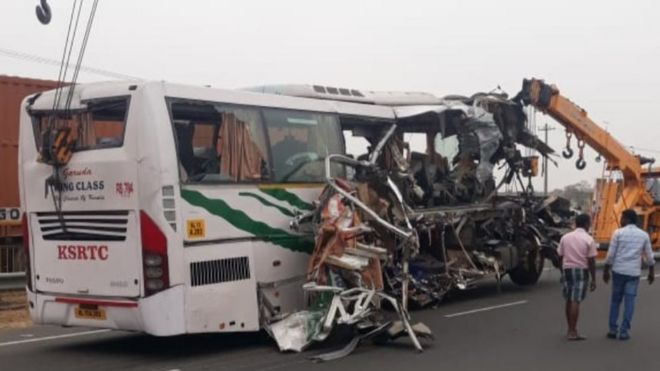
The bus after the accidentImage copyright TIRUPUR MANIKANDAN

At least 19 people have been killed in a freak accident in southern India, after a container slipped off a truck and rammed into a passenger bus.

Police are investigating the incident, but officials say the container came off its hinges after one of the wheels of the truck had a puncture.

“There were about 48 people in the bus, and several are in a critical condition,” an official told BBC Hindi.

The incident occurred around 3:30am local time (21:50 GMT), police said.

The bus was on a highway when the container slipped off the truck, which was in the opposite lane. It then rolled onto the other side, colliding with the bus.

The Volvo bus, owned by the Kerala state transport corporation, was travelling from Bangalore city in the neighbouring state of Karnataka to Ernakulam in Kerala.

The district collector, Dr Vijay Karthikeyan, told BBC Hindi that the cause of the accident was still being investigated.

The driver of the truck is reportedly absconding.

Source: The BBC

15/02/2020

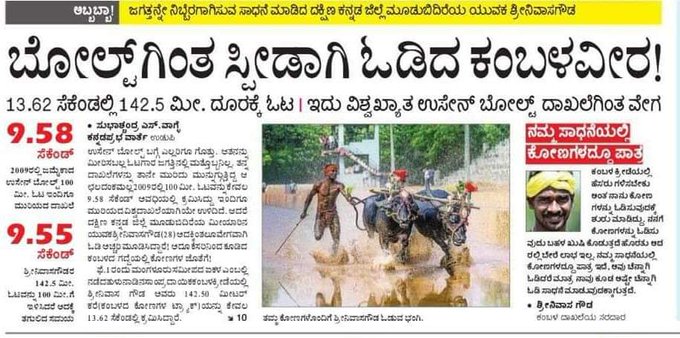
Srinivas Gowda: The Indian buffalo racer compared to Usain Bolt

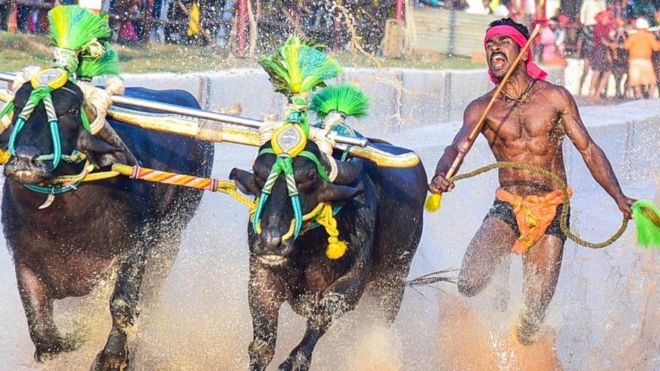
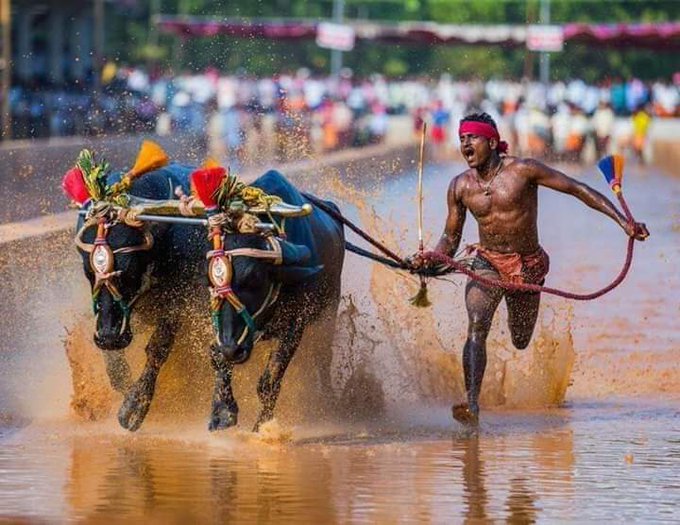
Srinivas Gowda in his winning Kambala raceImage copyright ANNU PAI
Image caption Srinivas Gowda also praised the efforts of his teammates, the two buffalo

A construction worker in south India is being compared to the Olympic gold medallist sprinter Usain Bolt after a record-breaking win in a buffalo race.

Srinivas Gowda, 28, was competing in Kambala, a sport from the southern state of Karnataka where people sprint 142m through paddy fields with buffalo.

Mr Gowda is said to have finished in 13.42 seconds. Bolt holds the world 100m record of 9.58 seconds.

But the governing body for Kambala has warned against comparing him to Bolt.

“We would not like to indulge in any comparison with others,” Prof K Gunapala Kadamba, president of the Kambala Academy, told BBC Hindi.

“They [Olympic event monitors] have more scientific methods and better electronic equipment to measure speed.”

Prof Kadamba’s response came after several local newspapers and journalists made the comparison between Mr Gowda’s performance and the Jamaican sprinter’s world record time.

Skip Twitter post by @dp_satish
But Mr Gowda, from Moodabidri in Karnataka’s coastal district of Dakshina Kannada, was excited about his record-breaking win and praised his teammates – the two buffalo he ran alongside – for doing so well.
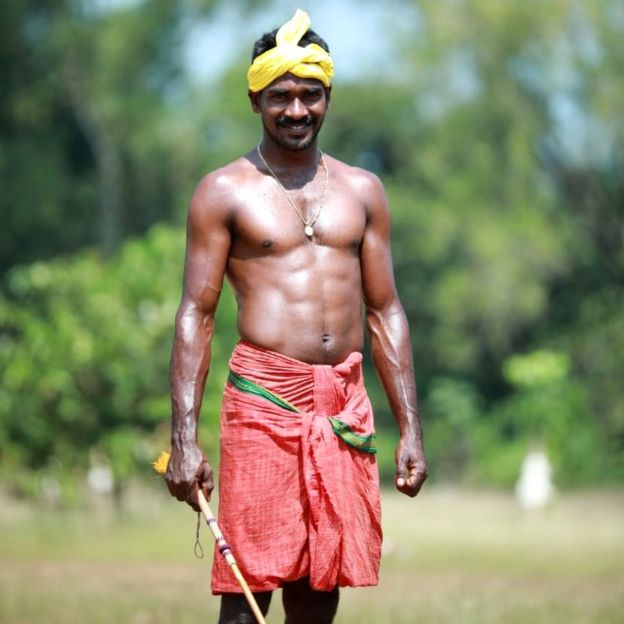
Srinivas GowdaImage copyright ANNU PAI
Image caption Srinivas Gowda, 28, has been taking part in Kambala for seven years

He told BBC Hindi he had taken part in Kambala for seven years, adding: “I got interested in it because I used to watch Kambala during my school days.”

What is Kambala?

Kambala, which roughly translates to “paddy-growing mud field” in the local language Tulu, is a traditional sport originating from part of Karnataka’s coast.

Participants sprint through a field, which is normally either 132m or 142m, with two buffalo that are tethered together.

It is controversial, and in the past the sport has attracted strong criticism from international animal rights groups.

In 2014, India’s Supreme Court issued a ban on races with bulls, prompted primarily by campaigns against the practice of Jallikattu, a form of bull-fighting from the neighbouring state of Tamil Nadu.

Two years later, Karnataka’s state court issued an interim order stopping all Kambala events.

Prof Kadamba said that the organising body had responded to this, updating the sport in order to make it more humane.

He said their current and former students – including Mr Gowda – are now taught how to deal with buffalo “in a humane manner without unnecessarily hurting the animal”.

In 2018, the state started allowing Kambala races to take part again, but issued several conditions – including a ban on the use of whips.

But the practice is still under threat. International animal rights group Peta has a petition pending in the Supreme Court, arguing that Karnataka’s reinstatement of Kambala was illegal.

“This Kambala is quite different from the traditional Kambala that used to be practised some decades ago,” Prof Kadamba added.

Source: The BBC

20/10/2019

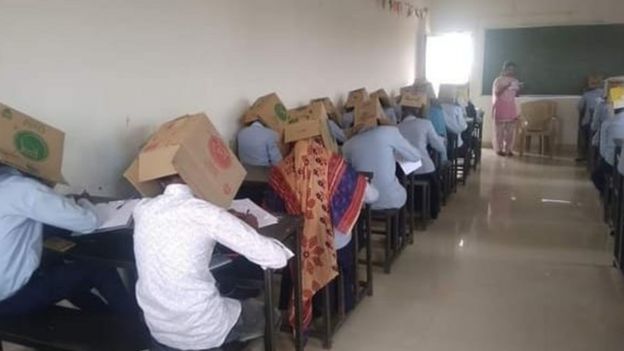
Apology after Indian students wear cardboard boxes for exams

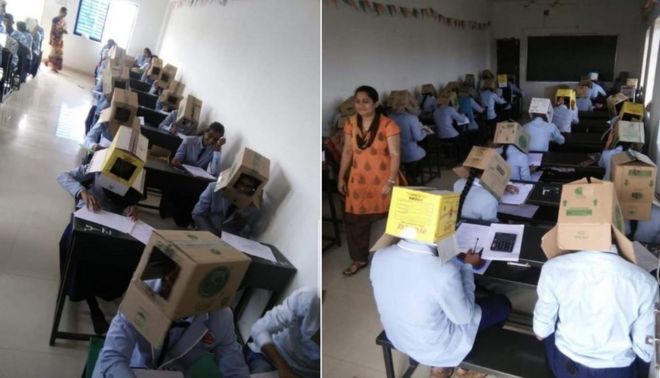
Collage images showing students sitting taking an exam with boxes on their headsImage copyright ANI
Image caption The photographs drew mockery and scorn on social media

An Indian school official has apologised after a bizarre set of images went viral showing students wearing cardboard boxes on their heads.

The images were taken during a chemistry exam at Bhagat Pre-University College in Haveri, Karnataka state.

They showed students wearing boxes, cut open on one side, to prevent them from being able to copy other people’s work.

A junior college administrator has spoken publicly and apologised to district officials for the incident.

MB Satish told BBC Hindi he was sorry for trying to use the unusual anti-cheating technique.

He said the school has only implemented the measure on an “experimental basis” after hearing of its use elsewhere.

Students wearing boxes on their heads in examImage copyright ANI
Image caption The school official said he had heard of the technique being used in Mumbai

He also insisted it had been done with the students’ consent – in fact they had brought in their own boxes.

“There was no compulsion of any kind. You can see in the photograph that some students were not wearing it,” he said. “Some who wore it removed it after 15 minutes, some after 20 minutes and we ourselves asked them to remove it after one hour.”

You may also like:

Regional officials reportedly rushed to the school to complain as soon as they were made aware of the images.

SC Peerjade, deputy director of the local pre-University Education Board, described the practice as “inhumane”.

“When I got a message on this, I immediately went to the college and ordered the management to stop the practice,” he was quoted by the Times of India as saying. “I also issued a notice to the college management and am contemplating disciplinary action against them for implementing this idea.”

School officials have said they have ceased the practice and are co-operating with the school board’s directive.

Source: The BBC

09/10/2019

Kashmir conflict: Woes deepen as lockdown stifles economy

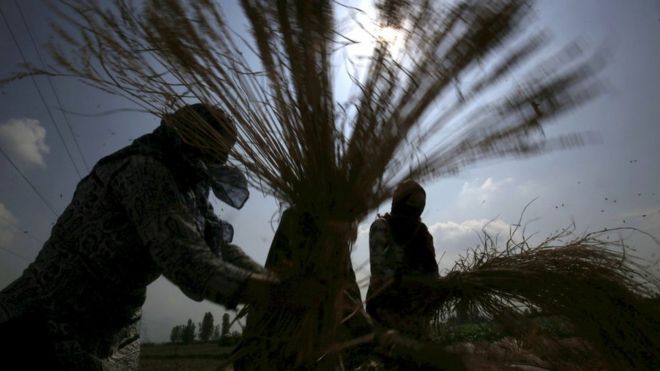
Farmers thresh paddy, separating grain from chaff, during the harvest season on October 2, 2019 on the outskirts of Srinagar, India.Image copyright GETTY IMAGES

The lockdown in Indian-administered Kashmir has cost the region’s economy more than $1bn in two months, according to industry experts. BBC Hindi’s Vineet Khare reports.

Mushtaq Chai recalls the afternoon of 2 August when he received a “security advisory” from the administration. A prominent local businessman, he owns several hotels across the Muslim-majority valley in Indian-administered Kashmir.

The note warned of “terror threats” and advised that tourists and Hindu pilgrims should “curtail their visit… and return as soon as possible”.

Mr Chai, like many others, took the advisory seriously. Two years before, seven Hindu pilgrims were killed in a militant attack while returning from the Amarnath cave, a major Hindu shrine in Kashmir’s Anantnag district.

“This was the first time in Kashmir’s history that tourists and pilgrims were asked to leave,” Mr Chai says.

Indian tourists seen leaving the City during the curfew in Srinagar on 16 August 2019.Image copyright GETTY IMAGES
Image caption Tourists left Kashmir amid a curfew in August

Soon officials arrived to enforce the order, and Mr Chai and his staff made arrangements for all of the guests to leave immediately.

Days later, on 5 August, the federal government stripped the region of its special status and placed it under a communications lockdown.

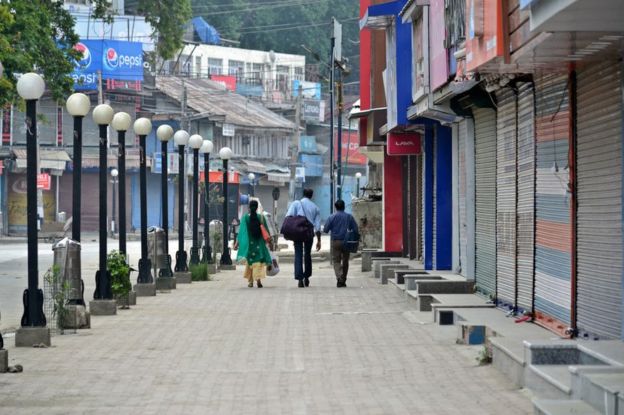
Two months on, the situation is far from normal. Internet and mobile phone connections remain suspended, public transport is not easily available, and most businesses are shut – some in protest against the government, and others for fear of reprisals from militants opposed to Indian rule.

There is also a shortage of skilled labour, as some 400,000 migrants have left since the lockdown began.

What’s more, the streets are deserted and devoid of the tourist business which had supported up to 700,000 people.

Presentational grey line

Read more about Kashmir

Presentational grey line

The lockdown has not come cheap.

A government official, who did not wish to be named, says they are “awaiting a financial package” from the federal government. But the Kashmir Chamber of Commerce and Industry estimates the shutdown has already cost the region more than $1.4bn (£1.13bn), and thousands of jobs have been lost.

“There are around 3,000 hotels in the valley and they are all empty. They have loans to pay off and daily expenses to bear,” says Mr Chai, sitting in his mostly empty hotel in the capital, Srinagar.

Only a handful of his 125 staff are at work. Many haven’t returned because of lack of transport – or fear. Tensions have been high in the region, and there have been a number of protests in the city.

But the situation may improve in the coming days as the government has announced that tourists will allowed in the state from Thursday.

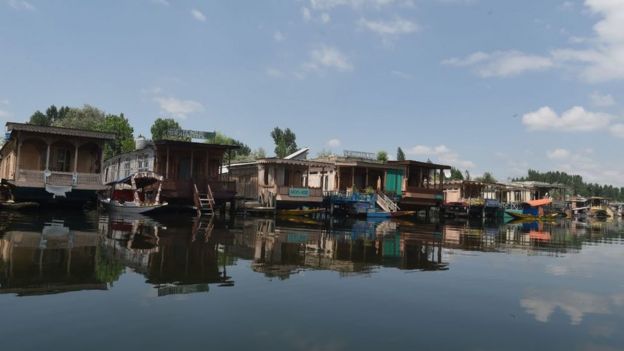
Empty houseboats on Srinagar's Dal lake.Image copyright GETTY IMAGES
Image caption Hundreds of houseboats have been lying vacant

But it isn’t just the hotels which have suffered.

“No internet has meant more than 5,000 travel agents have lost work,” says Javed Ahmed, a travel agent himself. “The government says give jobs to the youth. We are young but jobless. We have nothing to do with politics. We want jobs.”

Srinagar’s almost 1,000 iconic houseboats have also been running empty.

“Every houseboat needs up to $7,000 a year for maintenance,” says Hamid Wangnoo from the Kashmir Houseboats Owners Association. “For many, this is the only source of livelihood.”

And it isn’t just tourism.

“More than 50,000 jobs have been lost in the carpet industry alone,” according to Shiekh Ashiq, president of the chamber of industry.

He says July to September is when carpet makers usually receive orders for export – especially overseas, so they can deliver by Christmas.

But they are unable to contact importers, or even their own employees, because of the communications lockdown.

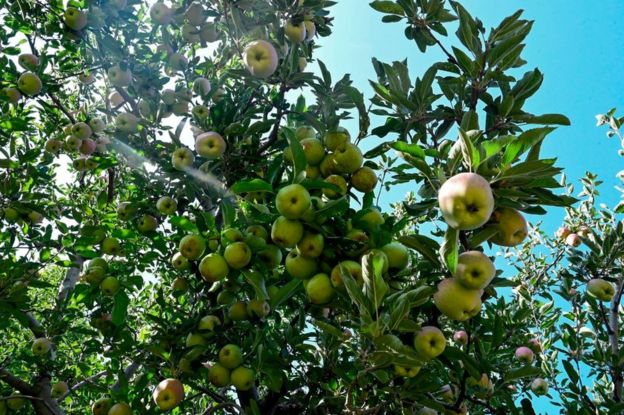
Apples are ready to be harvested in an orchard in Shopian district of southern Kashmir valley.Image copyright GETTY IMAGES
Image caption Kashmir’s famous apple orchards have also been hit hard

In southern Kashmir, the region’s famous apples are still waiting to be plucked from the trees. But shops and cold storage units are shut, and the main apple market is empty. Last year, it did business worth $197m, local farmers say.

“I feel so much pain seeing my apples hanging from the trees that I don’t go to the orchard anymore,” says a worried apple grower, who did not wish to be named.

“Apples account for 12–15% of Kashmir’s economy, but more than half of this year’s produce has not been plucked,” says economic journalist Masood Hussain. “If this continues through October, it will have devastating consequences.”

In Srinagar, some shop owners wait outside their stores and open them for a customer before closing them hurriedly – until the next customer arrives.

One such owner says he is unhappy with the government’s decision, but he is also scared of angry locals who want him to keep his business closed.

“But how do I survive without my daily earnings?” he asked.

Media caption Two wars, a 60-year dispute – a history of the Kashmir conflict

Source: The BBC

09/09/2019

Chandrayaan 2: What may have gone wrong with India’s Moon mission?

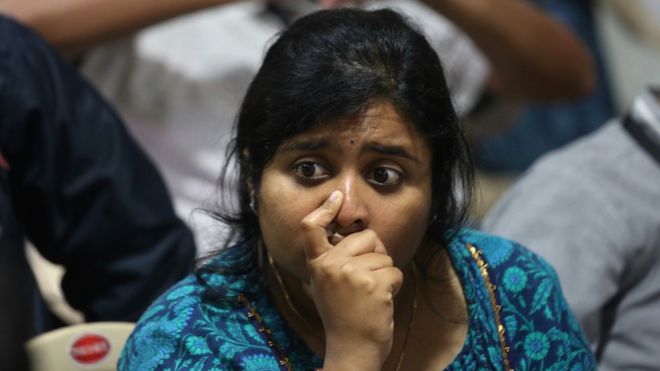
Isro employee reacts after the communication and data were lost from the vikram lander at ground station Indian Space Research Organization (ISRO) Telementry Tracking and Command Network (ISTRAC) Command Centre in Bangalore, India, 07 September 2019.Image copyright EPA
Image caption Indian scientists say contact with the lander was lost seconds before it was scheduled to touch down

India’s space agency, Isro, has not yet released information on how it lost contact with its Moon lander seconds before it was due to touch down on the lunar surface. But former members of the agency tell the BBC what may have gone wrong.

Chandrayaan-2 (Moon vehicle 2) entered the Moon’s orbit on 20 August and was due to land on the lunar surface a little after midnight India local time (1800 GMT) on 7 September – a month after it first shot into space.

But contact was lost moments before the lander (named Vikram, after Isro founder Vikram Sarabhai) was expected to touch down at the lunar south pole.

The orbiter has since spotted the lander on the surface of the Moon – unbroken, but tilted on its side. So far, scientists have not been able to establish contact with it.

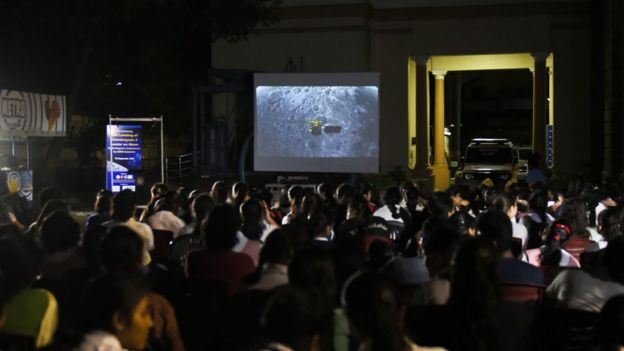
In Kolkata, India, 07 September, 2019, school students watch the live streaming screen of Chandrayaan2 landing on the lunar surface. According to ISRO (Indian Space Research Organisation), Vikram Lander was as planned and normal performance was observed upto an altitude of 2.1kmImage copyright GETTY IMAGES
Image caption The event was watched by millions across India

The lander’s final heart-stopping descent were monitored on screens, complete with readings which reflected the movement of the lander as it headed towards the surface of the Moon.

The screens carrying the readings also appeared on television and various social media accounts as the landing was broadcast live.

When the countdown began, the lander was moving at a velocity of 1,640 metres per second. Scientists say it appeared to be moving as planned during the first two phases of deceleration, known as the rough braking and fine braking operations.

It was during the final stage, known as the “hovering” stage, that the problem occurred.

The problem could well have been with the lander’s central engine, according to Prof Roddam Narasimha, a former member of Isro. He said that his theory was based on the readings on the screen.

Media caption Modi consoles scientists after India Moon-lander loses contact

“One plausible explanation was that the lander started falling more rapidly,” he told BBC Hindi’s Imran Qureshi. “It’s supposed to come down at a velocity of two metres per second when it hits the Moon’s surface. But the gravity on the moon would have made it fall somewhat more rapidly.”

He believes this could be because the central engine was not “producing the thrust that is required and, therefore, the deceleration was no longer what it was supposed to be”.

And this, in turn, may have led to eventually losing communication with the lander itself.

The head of India’s first Moon mission, Mylswamy Annadurai, also said the anomaly in the velocity profile was an indication that something had malfunctioned in the lander as it hurtled towards the Moon.

“Most likely the orientation [of the lander] could have been disrupted. Once we look at the data we will be able to say for sure what happened, but it is likely that either a sensor or a thruster could have malfunctioned,” he told BBC Tamil.

Members of the media cover the development as India's Prime Minister Narendra Modi is seen on a tv screen as he watches the live broadcast of the soft landing of spacecraft Vikram Lander of Chandrayaan-2 on the surface of the Moon at ISRO Telemetry, Tracking and Command Network (ISTRAC) centre in Bangalore early on September 7, 2019.Image copyright GETTY IMAGES
Image caption Prime Minister Narendra Modi also watched the event live

Dr Rajeswari Rajagopalan, the head of the Nuclear and Space Policy Initiative of the Observer Research Foundation (ORF), also said an engine malfunction was the likeliest reason.

“In the absence of data parameters, it is difficult to come to a conclusion, but the readings on the screen did show that something was wrong,” she told BBC Hindi.

“The other possibility is that when you do a landing at a higher speed, you cause a lot of dust to rise that also shakes up the spacecraft because of the gravitational pull. But it’s more likely the malfunctioning of one of the engines.”

Chandrayaan-2 was the most complex mission ever attempted by Isro.

The lander carried within its belly a 27kg Moon rover (called Pragyan, which translates as wisdom in Sanskrit), which included instruments to analyse the lunar soil.

The rover had the capacity to travel 500m from the lander in its 14-day life span, and would have sent data and images back to Earth for analysis.

The mission would have focused on the lunar surface, searching for water and minerals and measuring moonquakes, among other things.

Source: The BBC

Law of Unintended Consequences

continuously updated blog about China & India

ChiaHou's Book Reviews

continuously updated blog about China & India

What's wrong with the world; and its economy

continuously updated blog about China & India