Chindia Alert: You’ll be Living in their World Very Soon
aims to alert you to the threats and opportunities that China and India present. China and India require serious attention; case of ‘hidden dragon and crouching tiger’.
Without this attention, governments, businesses and, indeed, individuals may find themselves at a great disadvantage sooner rather than later.
The POSTs (front webpages) are mainly 'cuttings' from reliable sources, updated continuously.
The PAGEs (see Tabs, above) attempt to make the information more meaningful by putting some structure to the information we have researched and assembled since 2006.
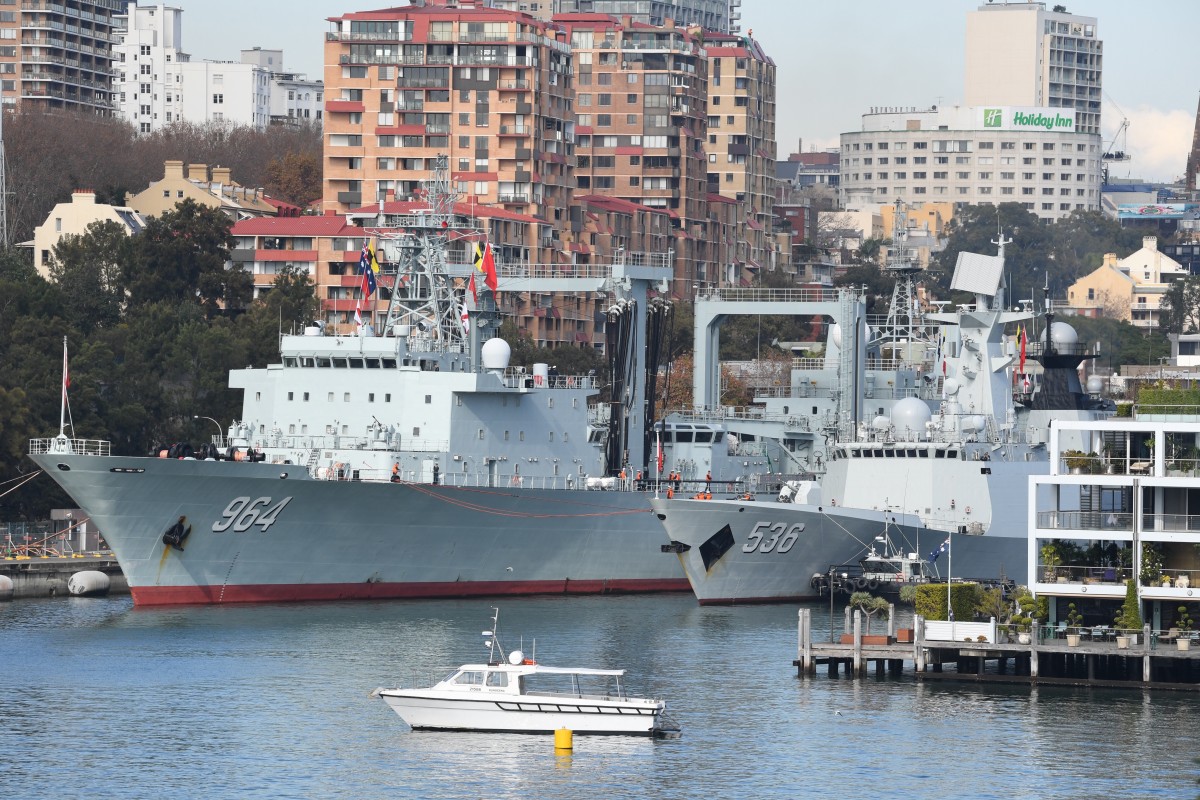
in Sydney for a publicly unannounced stopover on Monday set off a flurry of speculation about Beijing’s intentions amid rising anxiety about Chinese influence in the southern Pacific.
The visit by a Chinese frigate, auxiliary replenishment ship and amphibious vessel – with some 700 sailors in total – caught social media users and academics by surprise, with some questioning the visit’s timing and why the government had not given them advance notice.
It’s turning into a public relations disaster for ChinaJohn Fitzgerald, Swinburne University
“The People’s Liberation Army (PLA) Navy visit might have been intended as an act of diplomacy but it’s turning into a public relations disaster for China,” said John Fitzgerald, a China scholar at Swinburne University in Melbourne, noting that it followed
navy vessel in the South China Sea was tailed by the Chinese navy and Australian navy pilots had been targeted by lasers from Chinese fishing vessels.
Rory Medcalf, the head of Australian National University’s National Security College, said on Twitter that Beijing appeared to be making “a serious show of presence in the South Pacific”.
Medcalf said previous visits by Chinese navy ships typically involved a single vessel and that Sydney was not a convenient stopover for vessels returning from the Gulf of Aden, the body of water bordered by Yemen and Somalia.
Peter Jennings, executive director of the Australian Strategic Policy Institute think tank, told local media the government was remiss for not telling the public about the visit in advance.
Speaking to reporters from the Solomon Islands, Australian Prime Minister Scott Morrison said the government had “known about [the Chinese navy visit] for some time”.
“This was an arrangement, a reciprocal visit because Australian naval vessels have visited China,” said Morrison as he wrapped up a trip aimed at boosting Canberra’s standing among Pacific island nations and countering Chinese influence in the region.
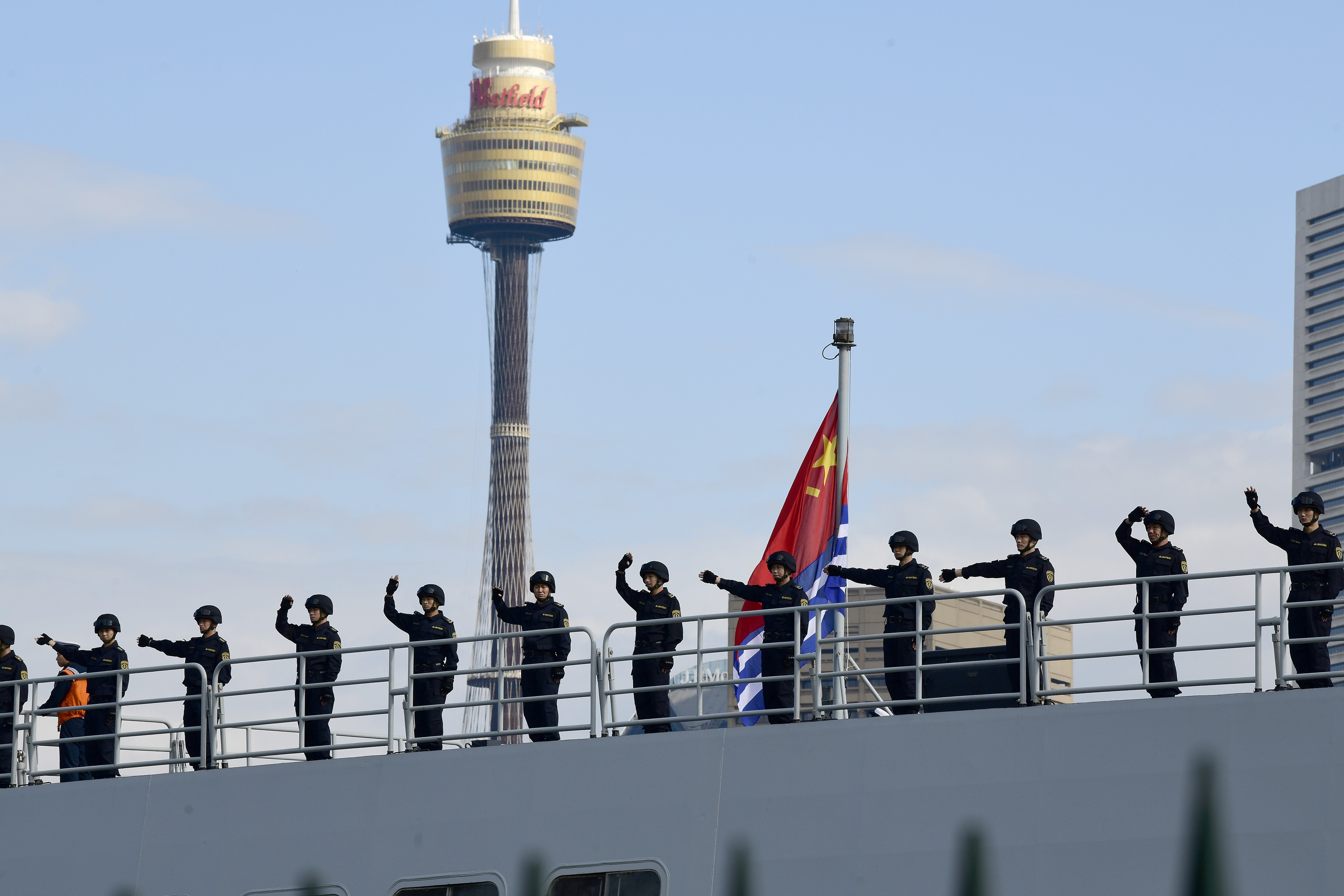
Chinese sailors wave from a PLA Navy ship after it arrives at Garden Island Naval Base in Sydney. Photo: EPA
Collin Koh, a research fellow at the S. Rajaratnam School of International Studies in Singapore, said it was not unusual for naval visits to not be announced in advance, depending on factors such as operational security requirements and expectations in the given country.
“Some visits are pre-announced and made public in the open domain, but some not,” Koh said.
Scholar points to Beijing’s ‘maritime militia’ in the South China Sea after lasers force Australian navy helicopter to land
“It’s not necessarily the case that foreign naval visits need to be publicised, though that, of course, depends on the sociopolitical circumstances of the host country which mandate a specific system of transparency and accountability.”
Morrison, who had earlier announced a A$250 million (US$173.36 million) grants programme for the Solomon Islands, said the Chinese ships were returning after a counter drug-trafficking operation in the Middle East.
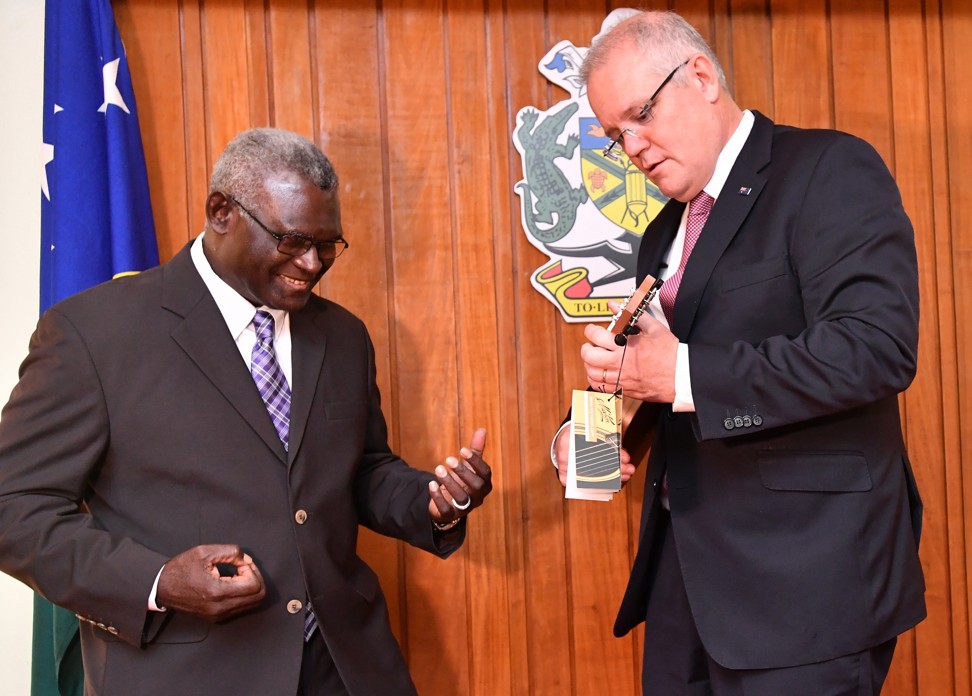
Solomon Islands Prime Minister Manasseh Sogavare (left) and Australian Prime Minister Scott Morrison. Morrison is visiting the Solomon Islands on his first post-election overseas trip. Photo: EPA
[The visit] is a further demonstration of the relationship that we have and this had been in train for some time,” he said. “It may have been a surprise to others but it certainly wasn’t a surprise to the government.”
The Australian Defence Force (ADF) said China had asked for the visit in April, and that the government was committed to fostering a “long-term constructive relationship with China”.
“Australia regularly hosts foreign navy vessels in its ports,” said an ADF spokesperson. “Notification to the public is not standard practice and is usually considered on a case-by-case basis.”
Since coming to power in 2012, China’s President Xi Jinping has invested heavily in the PLA Navy in a bid to project Chinese influence across the Pacific and beyond.
Singapore, China deepen defence ties, plan larger military exercises including joint navy drill
Beijing is locked in maritime disputes in the East and South China Seas with a number of countries including the Philippines, Japan, Vietnam and Brunei.
John Blaxland, a professor at the Strategic and Defence Studies Centre at the Australian National University, said it was interesting to consider what the PLA Navy flotilla would be doing after its Sydney port call.
“The Australian Government’s Pacific reset follows a period of some disengagement by Australia and has been, in part at least, triggered by China’s renewed interest in the Pacific – notably the remaining micro states that continue to support Taiwan,” Blaxland said.
The Kunlun Shan amphibious transport dock of the PLA Navy at Garden Island Naval Base in Sydney. Photo: EPA
Singapore-based research fellow Koh said the most significant takeaway from the visit was that it showed China’s emerging capability to carry out naval operations globally.
“The PLA Navy has since December 2008 been making long voyages across the globe – to the Baltic, Mediterranean, Caribbean and Latin America – and it’s been able to gain experience and exposure to such sustained long-duration missions,” he said.
What is the US Navy doing on Japan’s Iwo Jima, nearly 75 years after World War II?
“Hence, this visit to Australia – sailing from the Indian Ocean across to the far eastern end of Australia – represents no mean feat, and the coming of age of a blue-water-capable PLA Navy.”
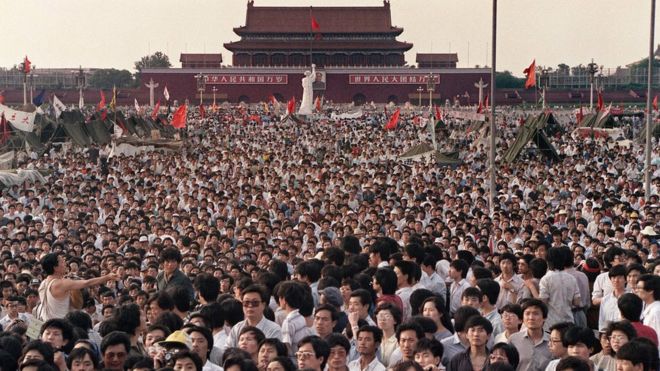
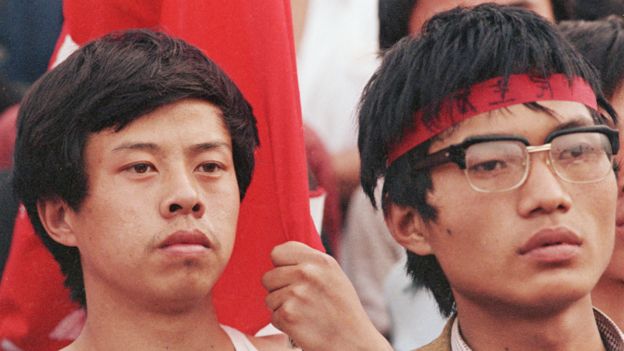
Asked by reporters whether the stopover was appropriate given that it came on the eve of the 30th anniversary of Beijing’s bloody crackdown in Tiananmen Square in 1989, Morrison said: “No, I think any reading into timing could be subject to a bit of overanalysis.”
Neil James, executive director of the independent watchdog Australia Defence Association, said the timing of the visit appeared to be an “accidental coincidence” and could be awkward for Beijing as it drew further attention to the Tiananmen anniversary.
US warships made 92 trips through the Taiwan Strait since 2007
“The timing is far more of a problem for the PLA Navy than Australia,” James said.
“The Tiananmen anniversary might have been known in China but they either ignored it, or it was a left-hand versus right-hand coordination glitch inside the People’s Republic of China government.”
Few signs of Eid celebrations after crackdown that has seen a reported million Uygurs and other minorities interned in camps
Muslims in far western Chinese region say they are now ‘too scared’ to practise their faith in public
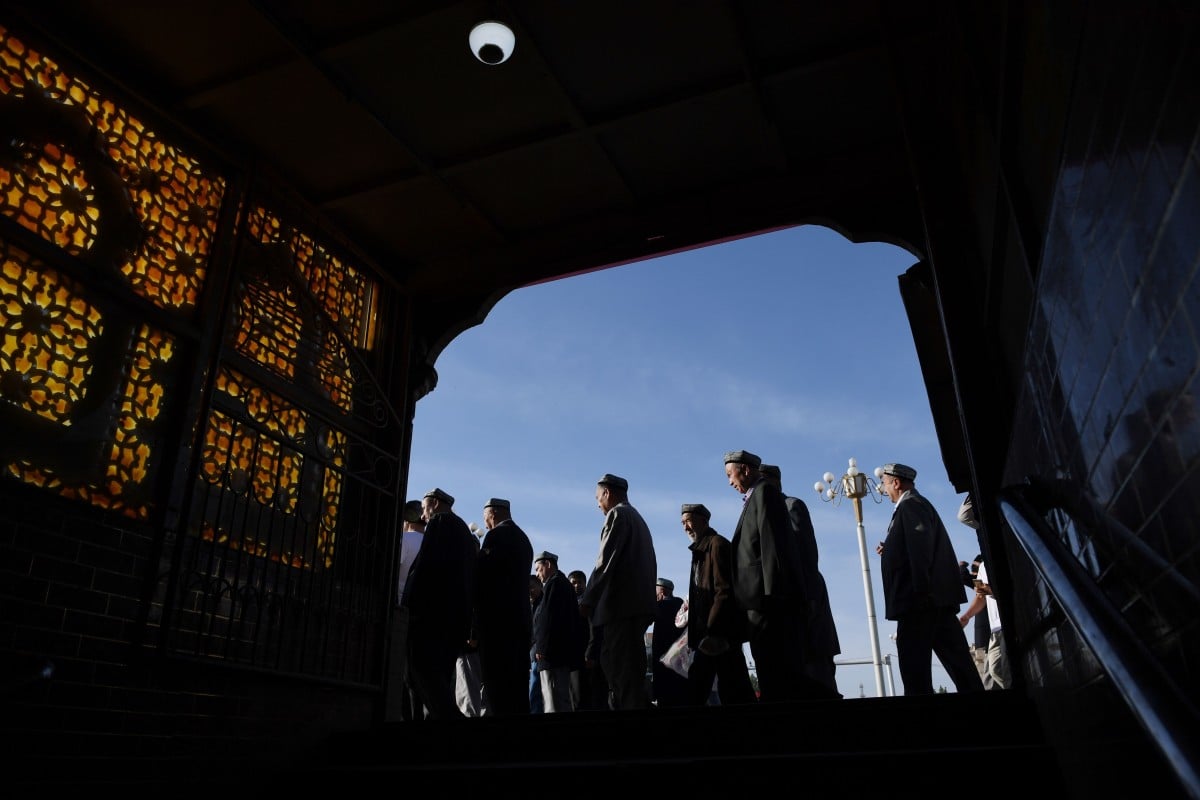
Worshippers leave a mosque in Kasghar after prayers on Wednesday. Photo: AFP
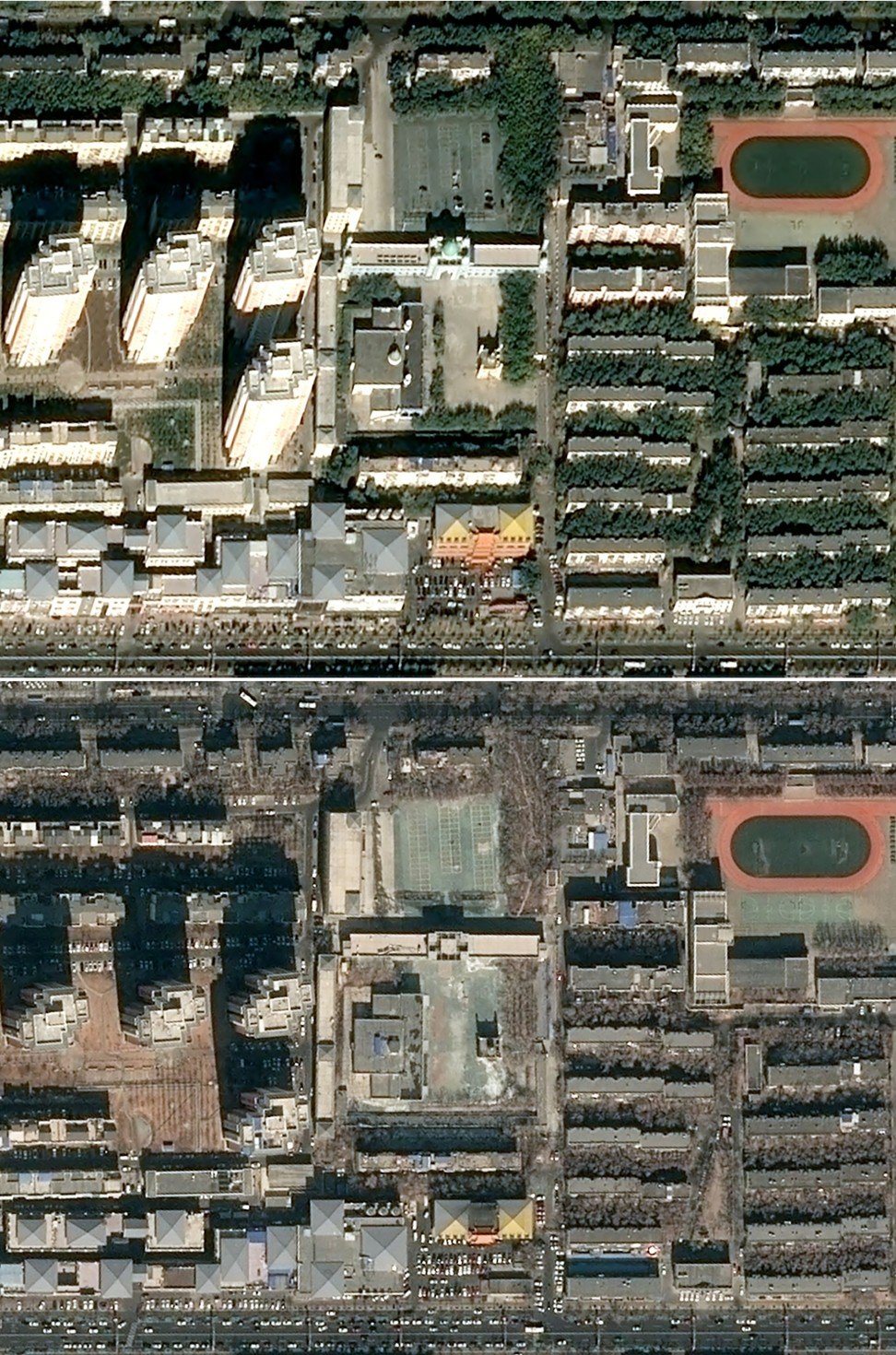
The corner where Heyitkah mosque in China’s far western region of Xinjiang once hummed with life is now a car park where all traces of the tall, domed building have been erased.
While Muslims around the world celebrated the end of Ramadan with prayers and festivities this week, the recent destruction of dozens of mosques in Xinjiang highlights the increasing pressure Uygurs and other ethnic minorities face in the heavily policed region.
Behind the car park in the city of Hotan, the slogan “Educate the people for the party” is emblazoned in red on the wall of a primary school where students must scan their faces upon entering the razor-wired gates.
The mosque “was beautiful,” recalled a vendor at a nearby bazaar. “There were a lot of people there.”
Satellite images reviewed by AFP and visual analysis non-profit Earthrise Alliance show that 36 mosques and religious sites have been torn down or had their domes and corner spires removed since 2017.
Satellite images from 2014 (top) and March this year show the disappearance of the dome of the Karamay West Mosque in Xinjiang. Photo: AFP/ Distribution Airbus Defence and Space/ CNES 2019/ Produced By Earthrise
In the mosques that are open, worshippers go through metal detectors while surveillance cameras monitor them inside.
“The situation here is very strict, it takes a toll on my heart,” said one Uygur, who requested anonymity for fear of reprisals. “I don’t go any more,” he added, referring to mosques. “I’m scared.”
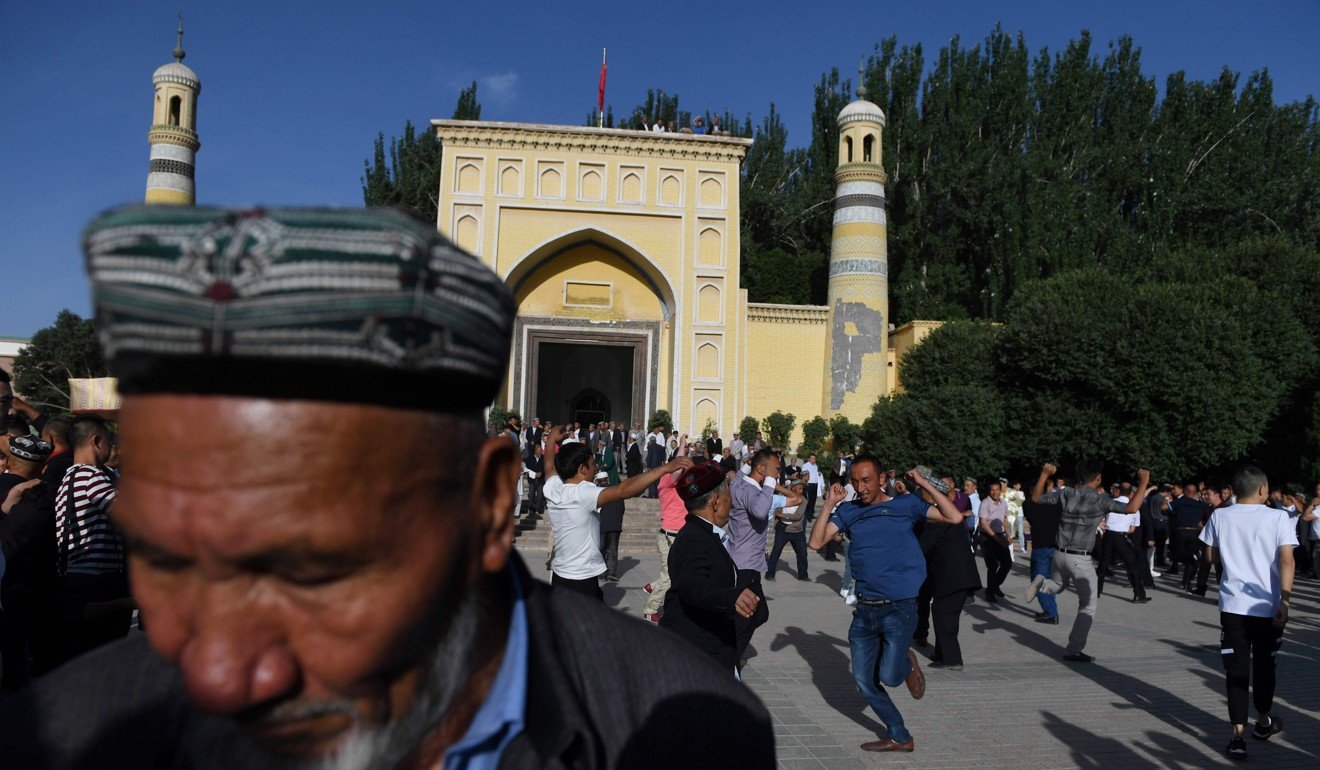
In the ancient Silk Road city of Kashgar, no longer does the sunrise call for prayer echo throughout the city – a ritual the manager of the city’s central mosque once proudly shared with touristsOn Wednesday, locals celebrating Eid al-Fitr quietly filed into the entrance of state-approved Idkah Mosque – one of the largest in China – as police and officials fenced off the wide square surrounding the building and plain clothes men monitored every person’s actions.
It was another low-key Ramadan for Muslims in Xinjiang, where restaurants were busy serving food to customers throughout the day, a time when practising Muslims fast.
In Hotan on Friday – a holy day for believers – the only mosque in the city was empty after sundown, an important prayer session when Muslim families typically break their daily Ramadan fast.
Earlier in the day, at least 100 people attended a midday session but the vast majority were elderly men.
Human Rights Watch decodes surveillance app used to classify people in China’s Xinjiang region
The ruling Communist Party “sees religion as this existential threat”, said James Leibold, an expert on ethnic relations and policy in China at La Trobe University.
Over the long term, the Chinese government wants to achieve “the secularisation of Chinese society,” he told AFP.
The Xinjiang government told AFP that it “protects religious freedoms” and citizens can celebrate Ramadan “within the scope permitted by law”, without elaborating.
The authorities have thrown a hi-tech security net across the region, installing cameras, mobile police stations and checkpoints in seemingly every street in response to a spate of deadly attacks blamed on Islamic extremists and separatists in recent years.
An estimated one million Uygurs and other Turkic-speaking ethnic groups are held in a vast network of internment camps.
After initially denying their existence, Chinese authorities last year acknowledged that they run “vocational education centres” aimed at steering people clear of religious extremism by teaching them Mandarin and China’s laws.
In those centres, it was a different Ramadan.
The Xinjiang government told AFP that people in the centres are not allowed to hold religious activities because Chinese law forbids it within education facilities, but they are free to do so “when they return home on weekends”.
Uygur men dance after Eid al-Fitr prayers in Kashgar. Photo: Greg Baker/ AFP
In recent years, Chinese authorities have ramped up controls on public displays of religion and Islamic traditions in Xinjiang.
AFP reporters did not see any veiled women and few men sporting long beards during a week-long visit to the region. Former internment camp inmates have said they were incarcerated for these outward signs of their religion.
Places of worship too have become targets of Beijing’s draconian security measures.
Human Rights Watch decodes surveillance app used to classify people in China’s Xinjiang region
In the satellite images analysed by AFP and Earthrise Alliance, 30 religious sites were completely demolished while six had their domes and corner spires removed.
AFP reporters visited about half a dozen sites, and found that some mosques had been repurposed into public spaces.
Police officers blocked journalists from entering Artux, just north of Kashgar, where the town’s grand mosque and dozens of other community mosques were destroyed.
The area is some 22 kilometres (14 miles) away from an enormous complex believed to be a re-education centre. Visible from a nearby village, the facility has razor-wired walls, watchtowers and imposing block buildings.In Kashgar, two cameras perched on the columns of a former mosque point at its entrance. There is no minaret or dome – instead, a shop selling dresses lies to its right alongside houses.
A demolished mosque in Hotan has been converted into a garden, paved with concrete walkways and sparsely planted trees.
On the outskirts of town, situated between a cemetery and sand dunes, two white flags and a pile of burned refuse and debris was all that was left of an old shrine named Imam Asim.
China’s top Xinjiang official Chen Quanguo should face sanctions over alleged abuses, US lawmakers say
Uygurs consider these mosques and shrines “their ancestral heritage,” said Omer Kanat, director of the Uygur Human Rights Project.
“The Chinese government just wants to erase everything … that is different from Han, everything which belongs to Uygur culture or Islamic culture in the region,” he said.
Juma Maimaiti, the official imam of Idkah Mosque, told AFP in an interview arranged by the propaganda department that the demolition of mosques “has never happened here”.
“But our government has proceeded to protect some key mosques,” he added, and said that the city of Kashgar has over 150 mosques.
A propaganda slogan and surveillance camera at a mosque in Yangisar, south of Kashgar. Photo: AFP
Though Beijing’s restrictions on religious piety, such as fasting, are not new, observers say conditions have deteriorated to the point where celebrations for the holy month in Xinjiang are reduced or largely invisible.
Islamic greetings and openly fasting in public are no longer permitted, said Darren Byler, a lecturer at the University of Washington who focuses on Uygur culture.
While there are Uygurs who continue to practise their faith, they are “internalising it at this moment – they’re not expressing it openly,” he said.
EU calls out Beijing on human rights but activists want harder line against China’s Xinjiang and Tibet policy
At state-backed mosques, religious activity is controlled as Beijing pursues a five-year plan to “Sinicise” Islam as the “only way for a healthy development of Islam” in the country, said Yang Faming, president.
163-million-year-old fossil represents something new in evolutionary history
Researchers say discovery is extraordinary
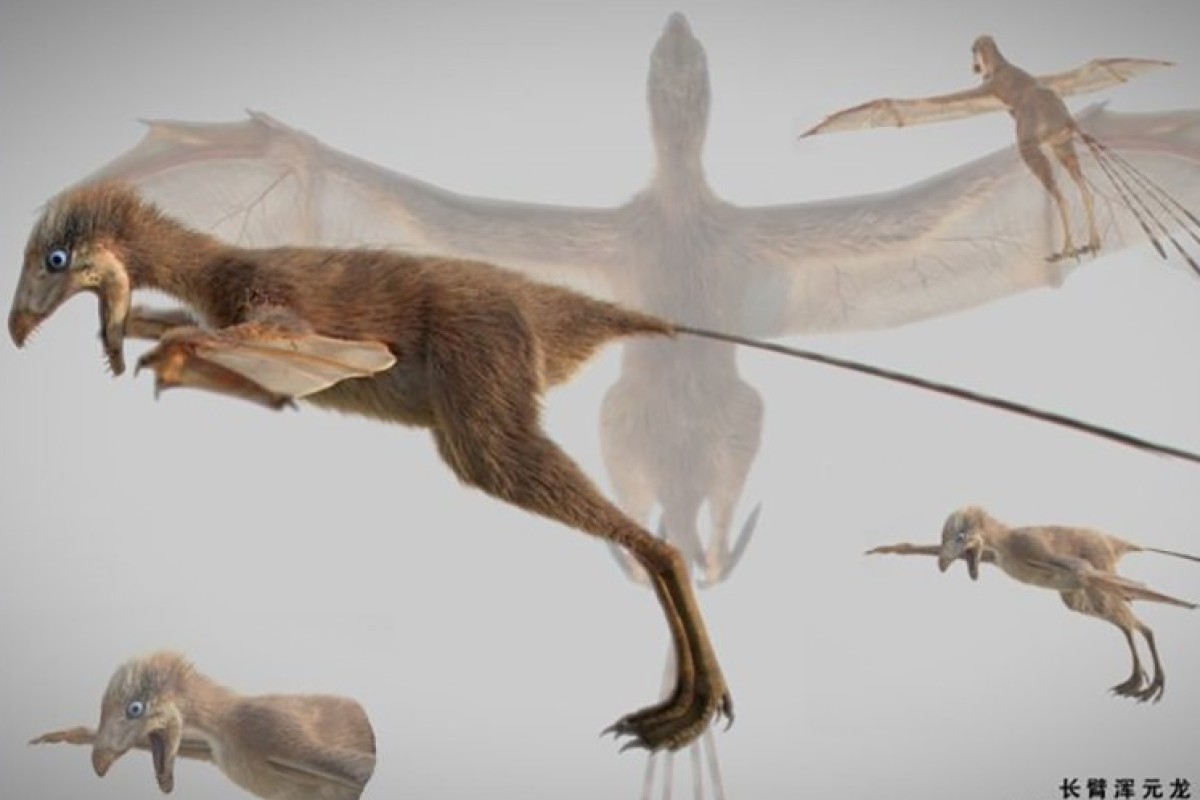
A small, tree-climbing dinosaur discovered in China has overturned evolutionary history with its cape-like membrane. Photo: Handout
Chinese scientists have discovered a new dinosaur species which appears to have been equipped – like Batman – with a cape that may have given it the ability to glide.
Researchers say the finding is extraordinary, representing something new in evolutionary history.
The little tree-climbing dinosaur – about the size of a magpie – was equipped with a soft, smooth membrane draped over its long, strong forearms that may have looked like the wings of a bat when spread.
The 163-million-year-old fossil has been named Ambopteryx longibrachium and was found at Wubaiding village, Liaoning province, northeast China, in 2017, according to a paper published in the journal Nature on Thursday.
The 163-million-year-old fossil found in eastern China showed long, strong forearms draped in a smooth cape-like membrane. Photo: Handout
Lead author Dr Wang Min, a researcher with the Chinese Academy of Sciences’ Institute of Vertebrate Palaeontology and Palaeoanthropology in Beijing, said quite a number of dinosaurs had birdlike feathers and some eventually evolved into birds.
“But bat-like wings? The idea has not been widely accepted,” he said.
The possibility was first raised a few years ago when a close relative of the newly discovered dinosaur was found, also in China, with a finger bone which had never before been seen in dinosaurs.
Scientists discover ‘nightmare’ crab with cartoon eyes
A small number of researchers suspected the bone could have been used to hold membrane, but the mainstream scientific community remained sceptical.
Why on earth, some critics argued, would a dinosaur need membrane when it already had feathers?
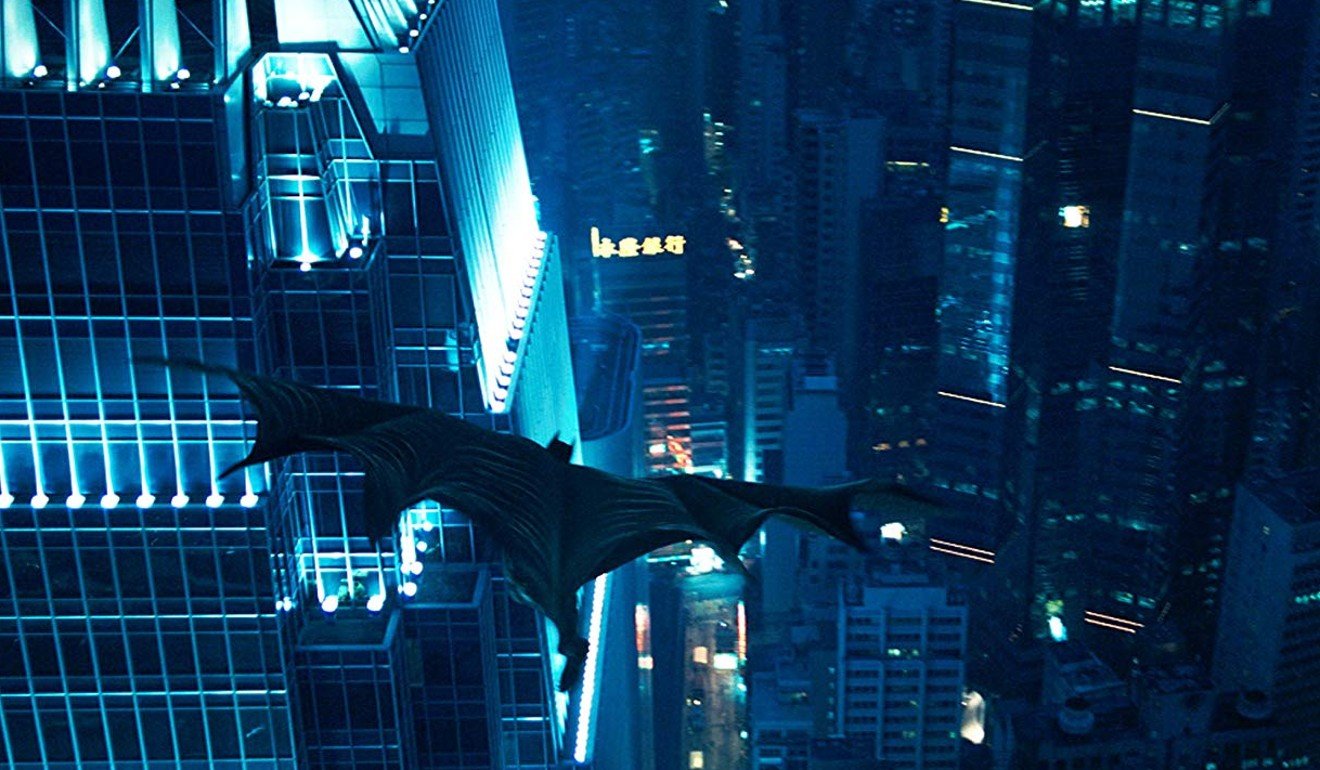
In the 2008 film “The Dark Knight”, Batman uses his cape to glide among the skyscrapers of Hong Kong. Researchers believe the new dinosaur may have used its cape-like membrane in a similar way. Photo: Handout
Ambopteryx longibrachium, nonetheless, had the same peculiar finger bone, only this time scientists were also able to observe a large membrane and a thick layer of hair over its head, neck and shoulders.
The hair and membrane was not an efficient combination for flight aerodynamics. But “in evolution, nothing is impossible”, Wang said.
The tiny T. rex cousin that humans could look down on
The dinosaur lived in thick forest and could have been easy prey to large predators. But its wings might have given it the ability to hop from tree to tree, and they could also have been useful when hunting.
The dinosaur had a slim body about the size of a magpie, with a soft, smooth membrane draped over its forearms like a cape. Photo: Handout
Wang and his colleagues found traces of small bones in the remnant of its stomach. While a tree-climbing dinosaur’s main diet should have been fruit, it could sometimes hunt as well, according to the researchers.
An absence of a large chest bone suggested the dinosaur could not fly at will, like a bird or bat. It remains unclear how long the species survived, but it eventually vanished, probably because of competition from better-equipped winged animals with all-feather or all-membrane wings.
China-Vietnam (Shenzhen-Haiphong) Economic and Trade Cooperation Zone is only Chinese state-owned industrial park in Vietnam
Venture has attracted increasing interest since start of US-China trade war, but operators say first duty is to support Xi Jinping’s trade initiative
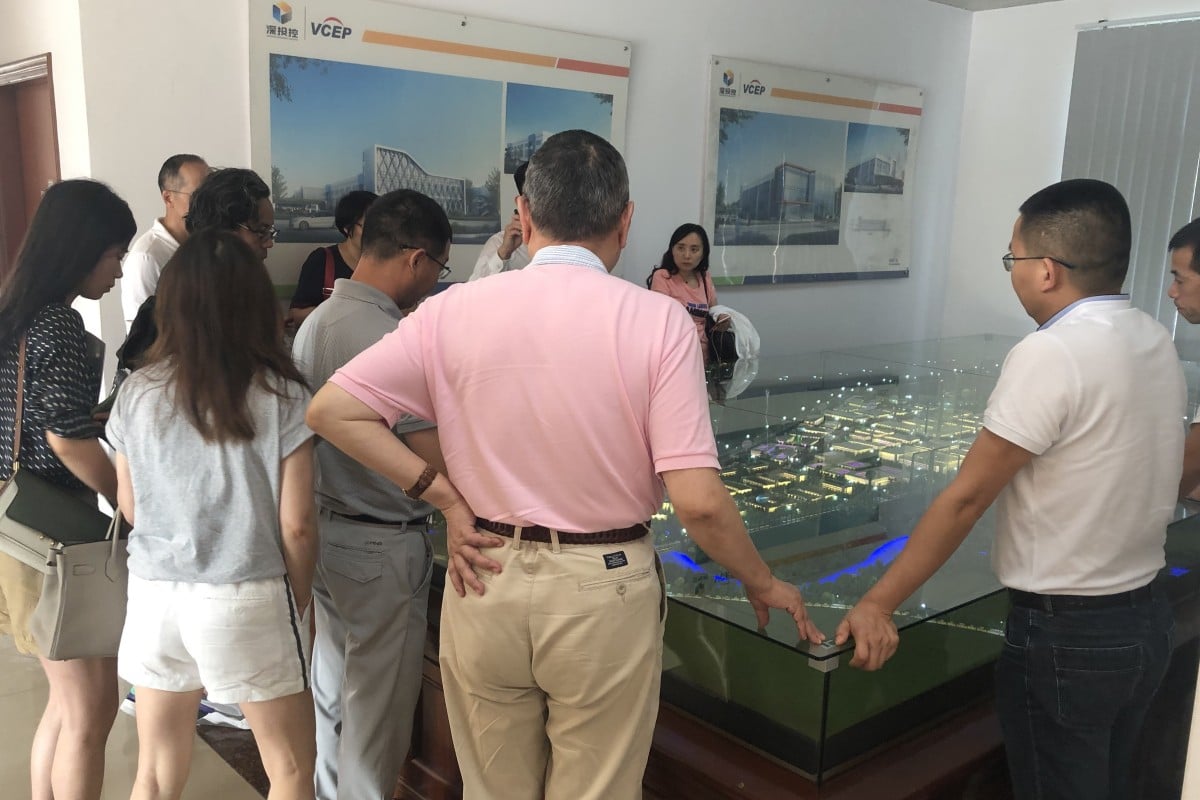
A total of 16 of the 21 Chinese companies that have relocated to the China-Vietnam (Shenzhen-Haiphong) Economic and Trade Cooperation Zone did so after the start of the US-China trade war. Photo: Cissy Zhou
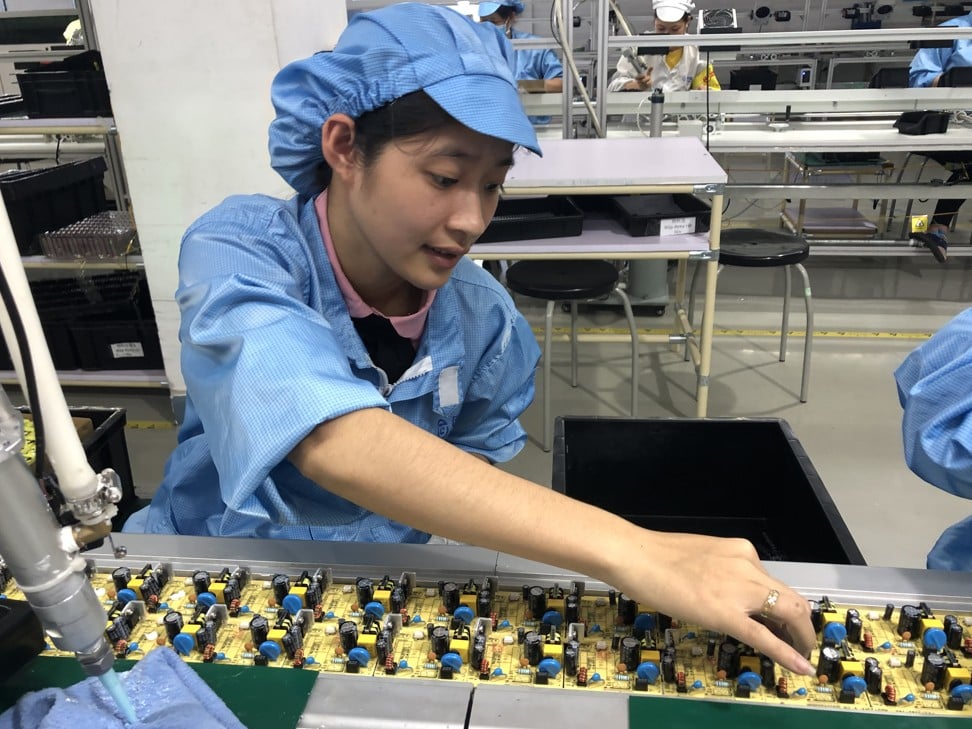
Until the middle of 2018, business was slow for the only Chinese state-owned industrial park in Vietnam, located in the northeastern manufacturing hub of Haiphong and wholly-owned by the Shenzhen city government.
US President Donald Trump’s tariffs on Chinese goods enacted last year changed that, with 16 of the 21 Chinese companies that have relocated to the China-Vietnam
(Shenzhen-Haiphong) Economic and Trade Cooperation Zone – many of them electronic device manufacturers – having done so since the start of the trade war.
However, profit-making was never the top priority for the park’s operators, which took over the reins from private investors after a series anti-Chinese riots raged through southern and central Vietnam in May 2014 forced the owners to abandon the project.
Protesters set fire to other industrial parks and factories and attacked Chinese workers, killing more than 20 people and injuring more than 100.
While any commercial organisation would be thrilled at the rush of manufacturing firms into Vietnam, for the park’s operators, the first duty is to showcase the Chinese government’s top international economic cooperation project, the Belt and Road Initiative.
[They] requested that we make this industrial park a showcase for the Belt and Road Initiative, so that when our top leaders pay state visits to Vietnam, they can come to our park Chen Xu
The Shenzhen arm of the State-owned Assets Control and Supervision Commission (SASAC), which oversees all city owned companies “has requested that we make this industrial park a showcase for the Belt and Road Initiative, so that when our top leaders pay state visits to Vietnam, they can come to our park”, Chen Xu, vice general manager at the Vietnam-China Economic and Trade Cooperation Park (VCEP), told the South China Morning Post.
The Chinese industrial enclave in Vietnam is part of a largely untold story of the trade war. The common narrative is that Chinese and international firms are fleeing China to avoid paying tariffs, setting up in low-cost hubs in Vietnam and elsewhere in Southeast Asia, but the picture is more nuanced than that.
In Haiphong, a part of the Chinese government is actively encouraging firms to come to Vietnam, armed with US$200 million in investment capital and with a vision of creating 30,000 jobs by the time the entire three-phase project is completed in 2022.
The then-private VCEP project was suspended after the 2014 riots, and after the local government in Vietnam said it would reclaim the land unless it resumed, the Shenzhen government “decided to fully take over the project”, according to VCEP general manager Zhang Xiaotao.
Newcomers must now buy land from the park and build their facilities themselves as the original buildings have already been rented out. Photo: Cissy Zhou
“Our evaluation then was that we could not make a profit out of this project. Then why did we still take it over? We have to serve the Belt and Road Initiative, as it is a national strategy,” Zhang added. “In fact, we surrender part of our profit [because] we sell the land [in the park] at a lower price and with better facilities than in neighbouring industrial parks. We are still in the red based upon the current land price. Our bosses understand the situation and ask us at least not to lose money.
“To make a profit is of course the priority of any company. But we are different, we are not a pure commercial project.”
Furthermore, it is a commonly held assumption that China is only open to losing low-end, labour intensive and high-polluting industry, as it looks to upgrade its manufacturing profile domestically. And while there is certainly truth to that as examples of low-value Chinese manufacturing plants litter Vietnam, VCEP is keen to avoid that persona.
Because of the need to maintain a relatively high-profile, the park does not welcome labour-intensive manufacturers such as shoes factories, because “it is bad for our image”, Chen said. Instead, it is focused on hi-tech engineering – exactly the kind of industry China is desperate to nurture on its own soil. In this sense, the Shenzhen-Haiphong facility represents something of a paradox.
With 1,500 people currently employed, it is some way from reaching its 30,000 goal, but the number of Chinese manufacturers wanting to set up factories in the park is now about eight times what it was before the trade war started last July, according to both Chen and Zhang. Newcomers must now buy land from the park and build their facilities themselves as the original buildings have already been rented out.
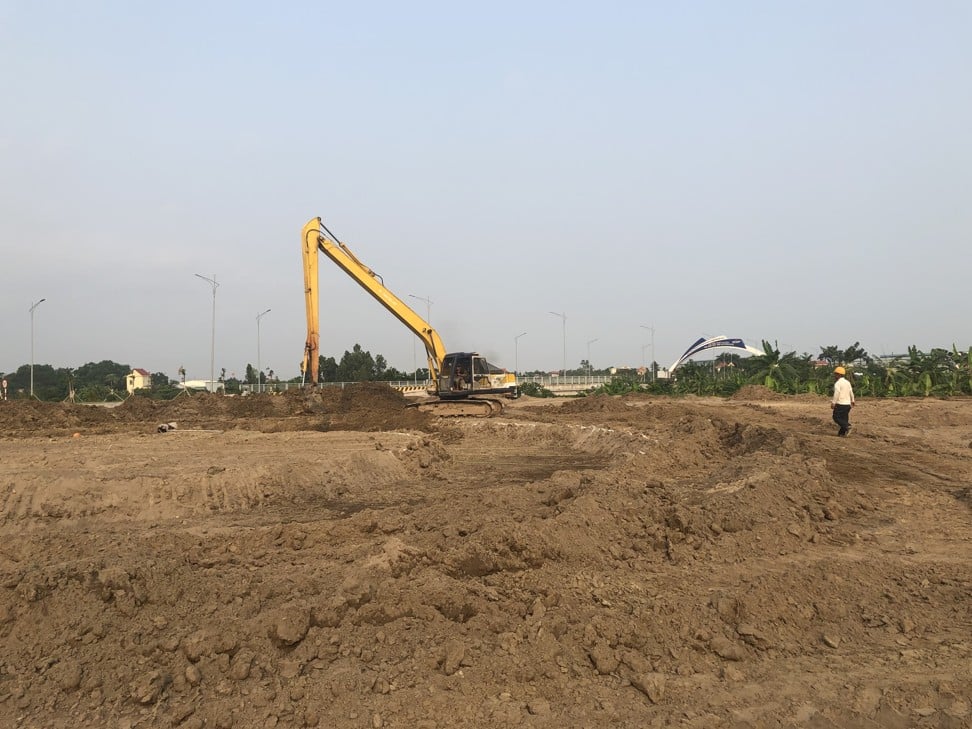
The relatively poor state of the surrounding infrastructure has also led VCEP to spend 30 million yuan (US$4.3 million) on a new road and bridge linking the park to the national highway in Haiphong.
“We could not wait for the Vietnamese government to build the infrastructure. They don’t have the money and their efficiency is low, so we built it ourselves,” said Li Meng, a member of VCEP’s Strategic Investment Department, who said it took less than nine months to finish the project.
The cost of the bridge was more than triple what it would have cost in China as “the efficiency is much lower here and we needed to import a lot of material from China due to lack of material in Vietnam”, Li added
“Every inch of the road and the bridge linking the national highway in Haiphong to VCEP is paved with renminbi.”
The Vietnam-China Economic and Trade Cooperation Park has a vision of creating 30,000 jobs by the time the entire three-phase project is completed in 2022. Photo: Cissy Zhou
TP-Link, the Shenzhen-based Chinese manufacturer of computer networking products, has rented a plant in the park and will start testing its equipment in July. The company, the world’s largest provider of consumer Wi-fi networking devices, has bought an additional 140,000 square metres of land in the park to expand production.
When TP-Link bought the land in late-2018, the price was between US$75 to US$80 per square metre, Chen said. Now, six months later, the price has risen to US$90 per square metre. This is indicative of the huge spike in interest in manufacturing in Vietnam caused by the trade war. Data from Vietnam’s Foreign Investment Agency shows that Vietnam attracted US$16.74 billion in foreign capital over the first five months of 2019, a year-on-year increase of 69.1 per cent. Of this, 72 per cent was invested in the processing and manufacturing sectors.
“Chinese local governments are, of course, unhappy with the increasing number of manufacturers who are relocating to Vietnam, but President Xi has clearly put forward the Belt and Road Initiative, which local governments cannot disturb. So local governments are not encouraging manufacturers to relocate, but they dare not try to stop them,” said vice-general manager Chen.
The Chinese inflow has also met with opposition in Vietnam, although far from the scale of the deadly riots of 2014.
“Some local [Vietnamese] media have been demonising China, with local prime time TV news talking about fake Chinese meat and poisoned food and hyping these cases. High-ranking Chinese officials have asked the Vietnamese government to guide public opinion in the right direction,” Chen added.
General manager Zhang added that the Vietnamese authorities have also become more sensitive to investment from China, a view reflected by Lam Thanh Ha, a senior lecturer at the Diplomatic Academy of Vietnam university which operates under the management of Vietnam’s Ministry of Foreign Affairs. “Overreliance on foreign cash in general and Chinese capital in particular may pose risks for Vietnam in terms of exchange rate fluctuations and external influences,” Ha warned.
“As production is generally dependent on transnational supply chains, foreign enterprises in Vietnam are often deeply engaged in both import and export processes, leaving the Vietnamese economy vulnerable to global economic conditions,” Ha added.
by the Post earlier in May, Ha warned that Vietnam should avoid “becoming China’s dirty industrial backyard”, although Zhang had the opposite view.
“We are not shifting all our low-end industries to Vietnam, which would be irresponsible. China is trying to help Vietnam with sincerity, even if we don’t make a profit, we still want to proceed with the project,” he said.
Cadres in Hebei village ordered to undergo self-criticism after photo of statue lying face down in the shrubbery was widely circulated online
Reinforced plastic structure had been leaning against the wall awaiting repair when it was blown into the bushes
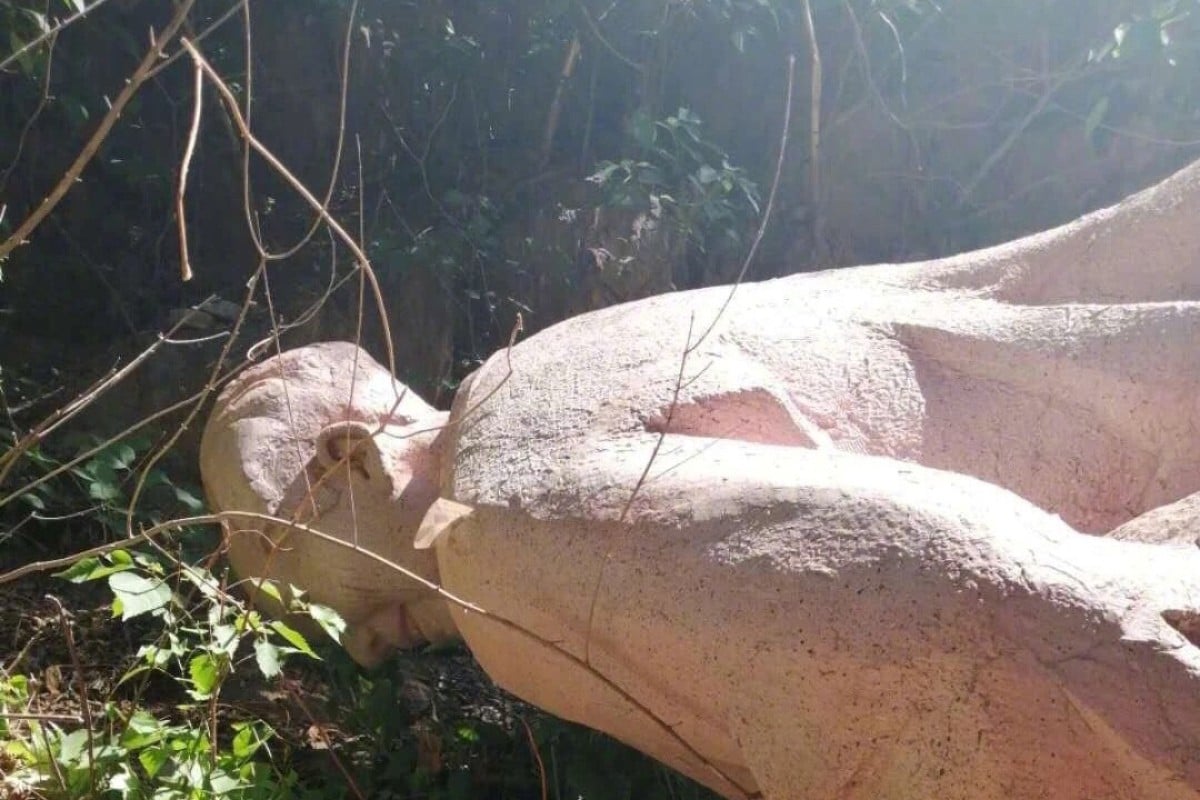
The photograph was widely circulated online, prompting a response from the local authorities. Photo: Weibo
A couple of grass-roots Communist Party members from northern China have been disciplined after a statue of Mao Zedong was photographed lying face down surrounded by overgrown bushes.
The government of Fuping county in Hebei province issued a statement late on Tuesday that the party chief of Huashan village, where the statue used to stand, had been given a “serious warning” for failing to protect the statue.
His immediate superior, the party head of Chengnanzhuang township, also received a warning.
The disciplinary action came after a picture of the statue lying amid the shrubbery was widely circulated online, triggering an angry response from Mao’s admirers.
The village has become a revolutionary tourist destination because the founding father of the People’s Republic spent some time there in 1948.
100 years on from China’s May Fourth Movement, its message is being co-opted by the Communist Party
The local government said on Sunday that the statue, showing Chairman Mao with a clenched right fist, had been erected in 2017.
It was removed from its plinth earlier this month after cracks appeared in the reinforced plastic model and its colour started to fade.
The government said it had been leaning against a wall after its removal on May 3, but was blown over by strong gusts of wind several days later.
It has now been sent to the manufacturer for repair.
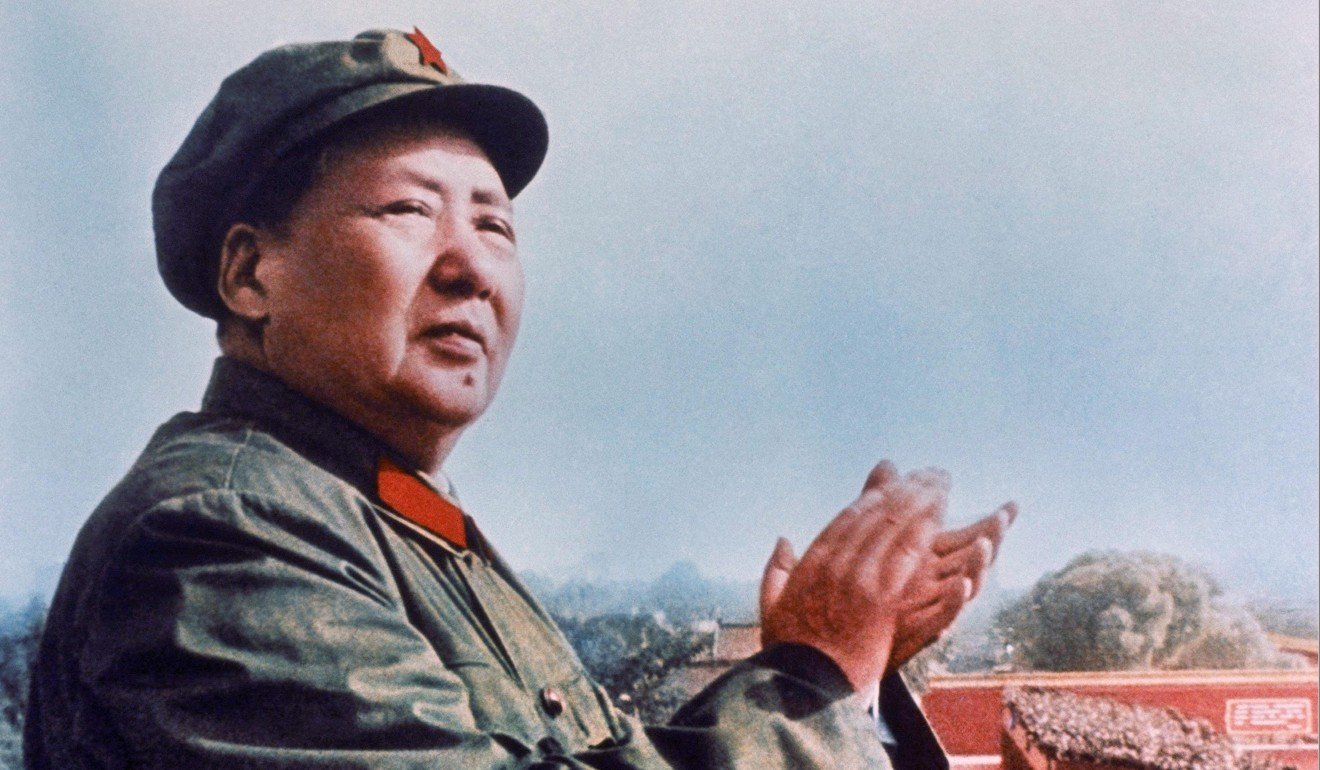
Mao’s image still adorns the banknotes and many public spaces in China. Photo: Alamy
The local officials were punished for “lacking ideological understanding” of the removal, failing to give enough protection to the statue and being careless in their daily work, the local government said.
Besides penalties for the individuals, the township party committee was also ordered to undertake self-criticism – a practice that began under Mao.
Statues of Chairman Mao used to be a common scene all across China, many of them built in the late 1960s at the height of the Cultural Revolution.
Shenzhen official kicked out of Chinese Communist Party for ‘trading power for personal gain and sex’.
Although many of them were removed after his death when the government began the process of reform and opening up, they can still be seen in spaces such as town squares and university campuses. Mao’s face also remains on the country’s banknotes and a large portrait of him hangs in Beijing overlooking Tiananmen Square.
Parents in Jiangsu province were shocked by a form that said a kindergarten class had been investigated and ‘no pupils were found to be involved in organised crime’
Officials fired or disciplined for ‘causing serious negative publicity’
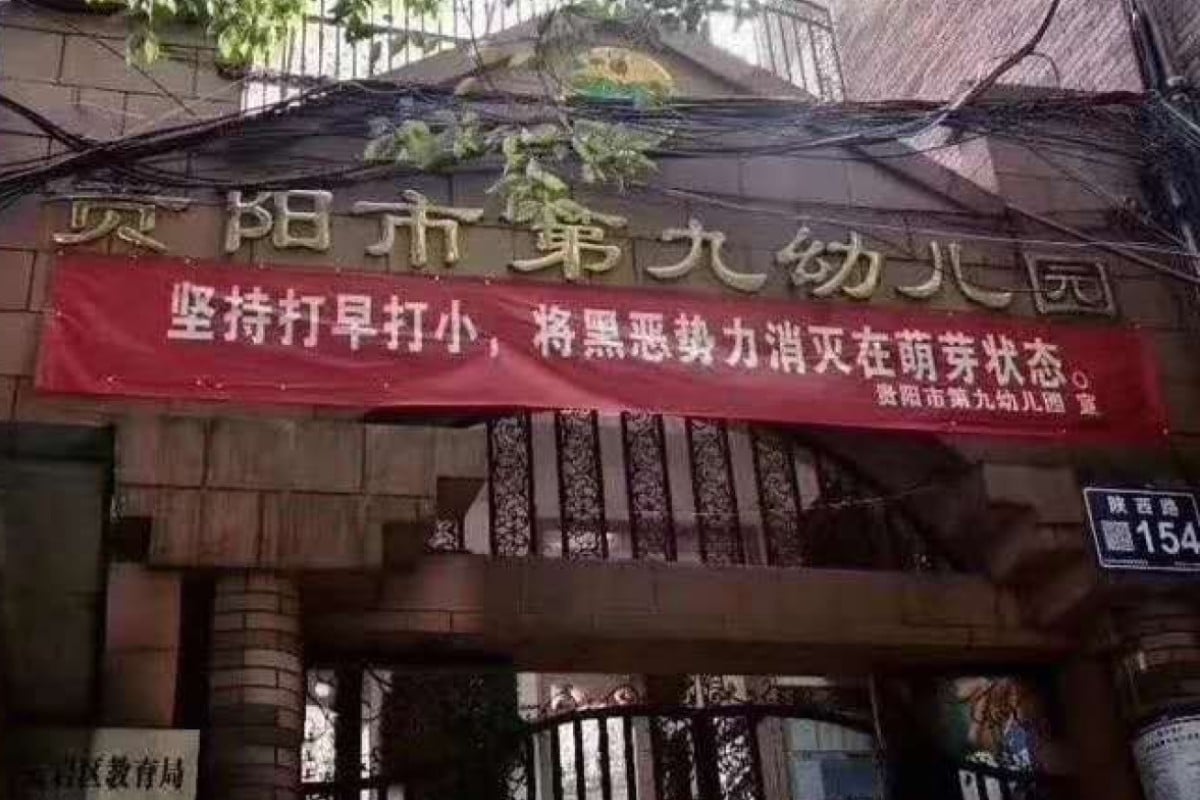
A kindergarten in Guiyang put up a banner on its entrance that read: “Crack down early and crack down young. Eliminate the dark and evil forces when they are still budding”. It was later removed. Photo: Weibo
Education officials in eastern China have been sacked or disciplined after targeting kindergarten pupils in a crackdown on organised crime.
Residents in Wuxi, a city in Jiangsu province, were shocked when a note saying that 35 pupils aged four and five at Xinguang Kindergarten had been investigated as part of the wider crackdown on mafia-style gangs was leaked online.
The form, signed by two teachers, concluded: “No pupils were found to be involved in organised crime”.
Copies of the document started circulating on social media, triggering a widespread backlash and ridicule.
Some social media users accused the kindergarten of box-ticking and questioned whether staff would have been capable of discovering whether any parents were involved in organised crime.
China’s war on organised crime, corrupt officials sees 79,000 people detained
One said that if officials really wanted to nip criminal tendencies in the bud, they were starting too late, adding: “Why not start when they are in the womb and crack down in the maternity hospital?”
But on Thursday the Wuxi government backed down and criticised education officials in Xishan district for misinterpreting the crackdown on organised crime and “putting on an unrealistic show”.
Three senior officials from the Xishan district authority were disciplined for their roles in “causing serious negative publicity”.
China’s fentanyl firms back crackdown on opioid
Feng Dongyan, the chief and party secretary of Xishan district education bureau, was given a party warning.
Wang Zhaoyu, director of the bureau’s general office, and Lu Zhongxian, the director in charge of education inspection of the bureau, lost their jobs and were given a serious party disciplinary warning.
Beijing started the campaign targeting grass-roots criminal organisations and their “protective umbrellas” last year.
More than 3,000 people have been punished so far, but the campaign has also been ridiculed for taking aim at the wrong targets.
Last month a kindergarten in Guiyang in Guizhou province put up a banner at its entrance reading: “Crack down early and crack down young. Eliminate the dark and evil forces when they are still budding”.
The kindergarten said the banner was “meant for the public” but took it down after an online backlash.
China’s housing market showing signs of bubble similar to that seen in Japan in 1980s, says Asian Development Bank Institute dean and CEO Naoyuki Yoshino
China’s loose policy following 2008 global financial crisis laid foundations for current housing bubble, with US-China trade war adding to concerns
The average price of a home in Beijing has soared from around 380 yuan (US$55) per square feet in the early 2000s to the current level of well above 5,610 yuan (US$813) per square foot, according to property data provider creprice.cn. Photo: Bloomberg
China must exercise extreme caution in handling its housing sector because it is showing signs similar to those witnessed during Japan’s bubble period of the 1980s that contributed to the collapse of Japanese asset prices and its subsequent “lost decades” of weak economic growth and deflation, a Japanese financial system expert warned.
The parallels between China’s current landscape and Japan’s three decades ago are readily apparent, stemming from a loose monetary policy that laid the foundation for the expansion of a housing bubble, said Naoyuki Yoshino, dean and CEO of the Asian Development Bank Institute.
China flooded its economy with credit in response to the 2008 global financial crisis, fuelling rapid growth in mortgages, real estate borrowings and investments over the past decade.
In the same vein, the Japanese government’s relaxed monetary policy in the 1980s triggered an economic bubble that eventually burst and sank the economy into a recession that
with the Bank of Japan continuing to still keep interest rates at or below zero per cent to this day in an attempt to spur inflation.
The Japanese government’s relaxed monetary policy in the 1980s triggered an economic bubble that eventually burst and sank the economy into a recession that lasted almost 25 years. Photo: Bloomberg
Japan’s experience could serve as a lesson on how to avoid a housing market collapse that would be especially detrimental to China’s financial sector and real economy, according to Yoshino.
“I’m very much concerned that if land prices keep on rising and if the population starts to shrink along with aggregate demand, then China will experience a similar situation to that of Japan,” Yoshino said.
There are already several strong signs of a housing bubble in China, according to Yoshino, firstly the astronomical surge in property prices in recent years.
I’m very much concerned that if land prices keep on rising and if the population starts to shrink along with aggregate demand, then China will experience a similar situation to that of Japan Naoyuki Yoshino
Home ownership is one of the few ways for Chinese families to generate wealth because of limited investment opportunities. The average price of a home in Beijing has soared from around 4,000 yuan (US$578) per square metre, or 380 yuan (US$55) per square feet, in the early 2000s to the current level of well above 60,000 yuan (US$8,677) per square metre, or 5,610 yuan (US$813) per square foot, according to property data provider creprice.cn.
The increase has also lifted the housing price to income ratio sharply from 5.6 in 1996 to 7.6 in 2013, well above the Japanese rate of 3.0 at its peak in 1988. The price to income ratio is the basic affordability measure for housing.
According to the Global Times, a reasonable home price should be three to six times the median household income. That means a family with an average income can buy a house with three to six years’ annual income. The house price to income ratio in China is above 50 in the first-tier cities and 30 to 40 in the third- and fourth-tier cities, the newspaper said in October. There are four levels of cities in China, defined by a number of factors including gross domestic product (GDP) and population, with Beijing, Shanghai and Shenzhen considered tier-one cities.
Another worrying sign, according to Yoshino, is that China’s financial sector has lent more heavily to the real estate sector than did Japanese banks during their bubble period.
Thirdly, the ratio of Chinese housing loans to the nation’s GDP has consistently been higher than Japan’s by about three times more.
Ever since US President Donald Trump started imposing tariffs on Chinese imports in July, worries have been mounting that China’s property bubble and its record debt level would make the economy vulnerable to the impact of rising trade tensions, leading to a sharper-than-expected economic slowdown.
Despite a government crackdown on debt and risky lending over the last several years, housing prices and bank lending to the sector have continued to rise, pushing homes beyond what the vast majority of people can afford, as well as putting many property developers deeply into debt.
The Chinese Academy of Social Sciences, a top government think tank, said in a report last week that the growth in housing prices in China’s bigger cities, caused by a relatively short supply of new homes, is likely to push up costs across the country.
“The government should closely monitor these cities to avoid overheating,” said Wang Yeqiang, a researcher at the Chinese Academy of Social Sciences who co-authored the report.
Property developers have begun a debt-fuelled land-buying spree just as urban housing demand is entering a long-running structural decline, said Julian Evans-Pritchard, senior China economist at Capital Economics. The potential supply of property that could be built on developers’ land reserves jumped last year to a record high, meaning the risk of a glut of new housing is real, Evans-Pritchard added, if developers were to convert all their land reserves into housing tracts.
“Since real estate drives around a fifth of GDP, a sharp downturn in this sector would be contagious, resulting in a jump in defaults across a wide swathe of the economy that could quickly erode bank capital buffers,” he warned.
China’s corporate debt stood at 155 per cent of GDP in the second quarter of 2018, much higher than other major economies, according to data from the Organisation for Economic Cooperation and Development. In comparison, Japan’s corporate debt level is 100 per cent of GDP and is 74 per cent in the US. China’s corporate debt includes issuances by its
vehicles which by extension is mostly credit with an implicit guarantee from the central government.
Since real estate drives around a fifth of GDP, a sharp downturn in this sector would be contagious, resulting in a jump in defaults across a wide swathe of the economy that could quickly erode bank capital buffersJulian Evans-Pritchard
China’s imbalance between housing supply and demand may worsen because it faces a similar economic transition that is already well underway in Japan – a
that led to Japan’s long-term deflation problem, said Yoshino, who is also the chief adviser to the Japan Financial Services Agency’s Financial Research Centre.
Even if rising housing demand due to urbanisation were to push China’s housing prices higher over the near term, the country faces risks from an oversupply of housing in the longer term due to its increasingly unbalanced demographic structure, he said.
The government has proposed that China’s retirement ages of 45 to 50 years for females and 55 to 60 years for males introduced in the 1980s be gradually increased to 65 years for both by 2045 due to a rapidly ageing population.
The rising population of retirees will consume fewer goods and services compared to younger families with children, and in turn, could dampen business investment given lower expected rates of return.
At the same time, more retirees means a bigger burden on the younger generation of taxpayers, which would reduce their wealth and change patterns of consumption. This is especially worrying on the back of China’s high debt level and pension funding gap, similar to the situation in Japan, Yoshino said.
In Japan, benefits from government pension schemes account for an increasing share of the country’s accumulated debt as spending on social protection programmes now represents more than a third of the government’s total budget.
China’s national pension fund is forecast to peak at 6.99 trillion yuan (US$1 trillion) in 2027 before it gradually runs out by 2035, according to the Chinese Academy of Social Sciences. Photo: AFP
forecast to peak at 6.99 trillion yuan (US$1 trillion) in 2027 before it gradually runs out by 2035, according to the Chinese Academy of Social Sciences, forcing the government to start to transfer assets from state-owned companies to fill the funding gap.
Against the broader economic slowdown, compounded by the trade war with the US, policymakers are also expected to carve out a highly expansionary fiscal budget for this year, with the broad deficit surging to 6.6 per cent of China’s GDP, up from 4.7 per cent last year, according to Larry Hu, head of China economics at Macquarie Capital.
Alicia Garcia Herrero, Asia-Pacific chief economist at Natixis, noted that the US criticisms of China’s unfair trade practises and currency manipulation were reminiscent of the US-Japan disputes in the 1980s and 1990s.
Because Japan was politically and economically dependent on the US at that time, it inevitably implemented economic policies to reduce its current account surplus. Subsequently, Japan suffered from the bursting of its asset price bubble, which led to deflation and the lost decades.
However, Herrero said that the modern China is less dependent on the US and so is in a better position to resist pressure to adjust its economic policies to create demand for American products.
Wang Yang, one of the seven members of China’s elite Politburo Standing Committee, said the US-China trade war could slash one percentage point off Beijing’s economic growth this year. Last year, growth expanded at its slowest pace since 1990, while corporate bond defaults hit a record high and banks’ non-performing loan ratio hit a 10-year high.
may be a dominant military force in Asia for now but short of going to war, it will be unable to stop its economic and diplomatic clout from declining relative to China’s power.
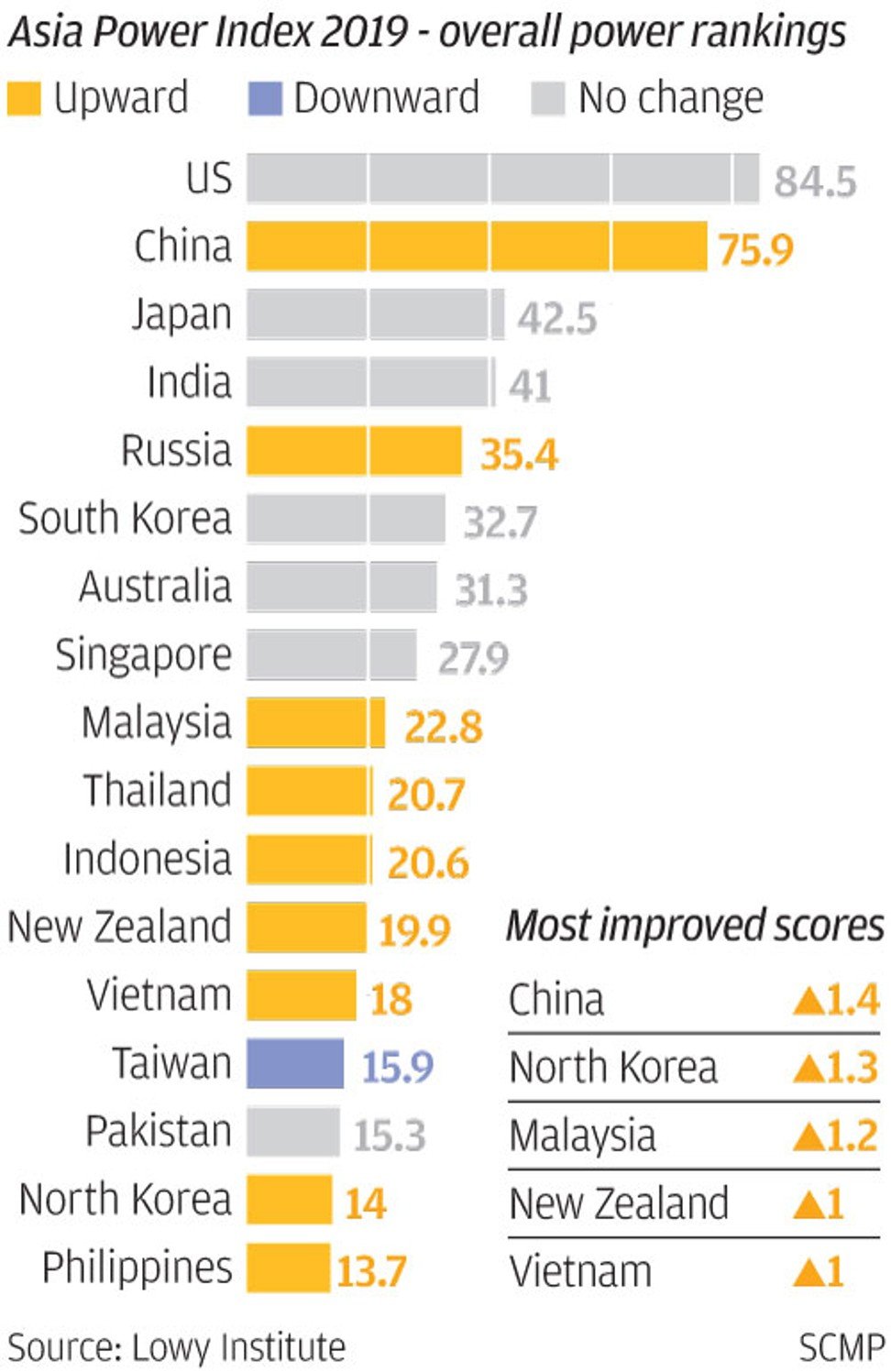
That’s the view of Australian think tank the Lowy Institute, which on Tuesday evening released its 2019 index on the distribution of power in Asia.
However, the institute also said China faced its own obstacles in the region, and that its ambitions would be constrained by a lack of trust from its neighbours.
The index scored China 75.9 out of 100, just behind the US, on 84.5. The gap was less than America’s 10 point lead last year, when the index was released for the first time.
“Current US foreign policy may be accelerating this trend,” said the institute, which contended that “under most scenarios, short of war, the United States is unlikely to halt the narrowing power differential between itself and China”.
The Lowy Institute’s Asia Power Index. Click to enlarge.
. He most recently hiked a 10 per cent levy on US$200 billion worth of Chinese goods to 25 per cent and has also threatened to impose tariffs on other trading partners such as the European Union and Japan.
Herve Lemahieu, the director of the Lowy Institute’s Asian Power and Diplomacy programme, said: “The Trump administration’s focus on trade wars and balancing trade flows one country at a time has done little to reverse the relative decline of the United States, and carries significant collateral risk for third countries, including key allies of the United States.”
The index rates a nation’s power – which it defines as the ability to direct or influence choices of both state and non-state actors – using eight criteria. These include a country’s defence networks, economic relationships, future resources and military capability.
It ranked Washington behind both Beijing and Tokyo in terms of diplomatic influence in Asia, due in part to “contradictions” between its recent economic agenda and its traditional role of offering consensus-based leadership.
The spoils of trade war: Asia’s winners and losers in US-China clash
Toshihiro Nakayama, a fellow at the Wilson Centre in Washington, said the US had become its own enemy in terms of influence.
“I don’t see the US being overwhelmed by China in terms of sheer power,” said Nakayama. “It’s whether America is willing to maintain its internationalist outlook.”
But John Lee, a senior fellow at the Hudson Institute, said the Trump administration’s willingness to challenge the status quo on issues like trade could ultimately boost US standing in Asia.
“The current administration is disruptive but has earned respect for taking on difficult challenges which are of high regional concern but were largely ignored by the Obama administration –
illegal weapons and China’s predatory economic policies to name two,” said Lee.
“One’s diplomatic standing is not just about being ‘liked’ or ‘uncontroversial’ but being seen as a constructive presence.”
CHINA’S RISE
China’s move up the index overall – from 74.5 last year to 75.9 this year – was partly due to it overtaking the US on the criteria of “economic resources”, which encompasses GDP size, international leverage and technology.
China’s economy grew by more than the size of Australia’s GDP in 2018, the report noted, arguing that its growing base of upper-middle class consumers would blunt the impact of US efforts to restrict Chinese tech firms in Western markets.
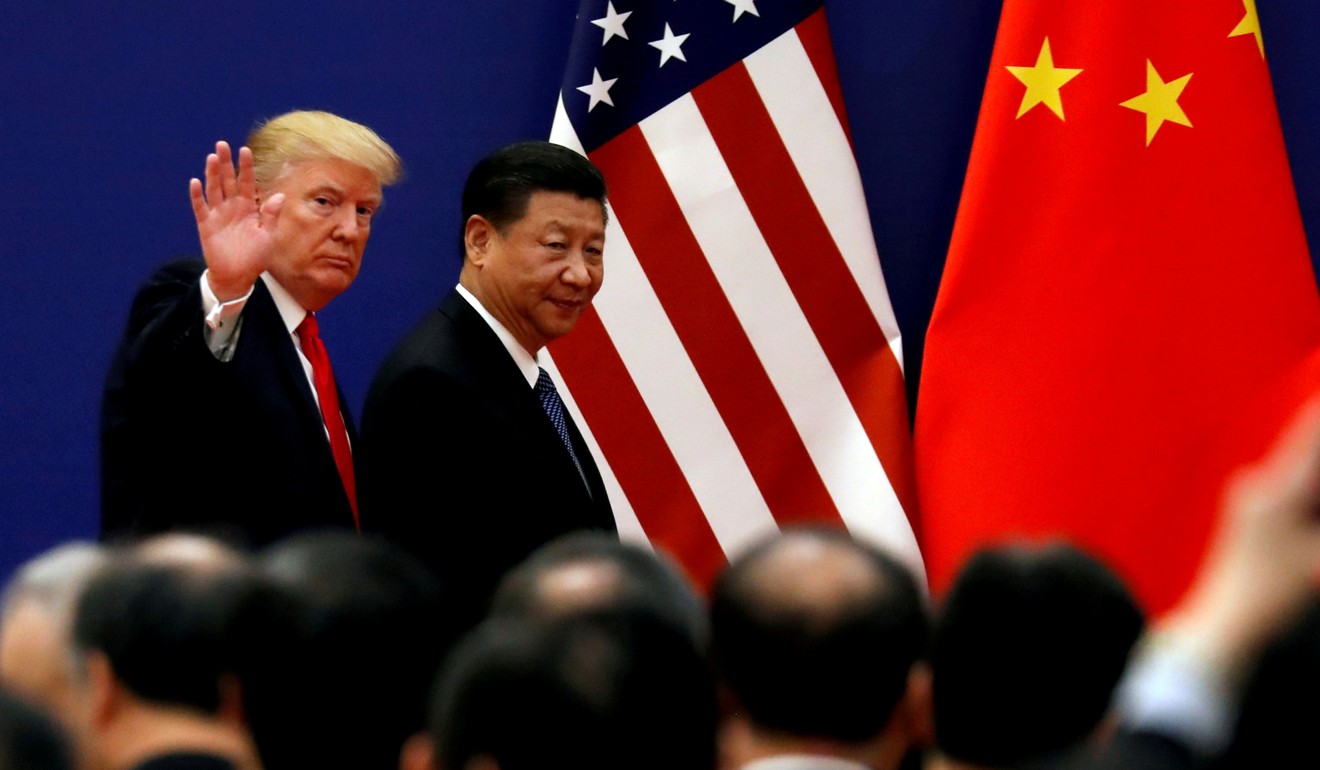
US President Donald Trump with Chinese counterpart Xi Jinping. Photo: Reuters
“In midstream products such as smartphones and with regard to developing country markets, Chinese tech companies can still be competitive and profitable due to their economies of scale and price competitiveness,” said Jingdong Yuan, an associate professor at the China Studies Centre at the University of Sydney.
“However, to become a true superpower in the tech sector and dominate the global market remains a steep climb for China, and the Trump administration is making it all the more difficult.”
The future competitiveness of Beijing’s military, currently a distant second to Washington’s, will depend on long-term political will, according to the report, which noted that China already spends over 50 per cent more on defence than the 10
stands in the way of its primacy in Asia, according to the index, which noted Beijing’s unresolved territorial and historical disputes with 11 neighbouring countries and “growing degrees of opposition” to its signature
and Myanmar due to concerns over feasibility and cost.
If Trump kills off Huawei, do Asia’s 5G dreams die?
Xin Qiang, a professor at the Centre for American Studies at Fudan University in Shanghai, said Beijing still needed to persuade its neighbours it could be a “constructive, instead of a detrimental, force for the region”.
“There are still many challenges for [China to increase its] power and influence in the Asia-Pacific,” Xin said.
Wu Xinbo, also at Fudan University’s Centre for American Studies, said Beijing was having mixed success in terms of winning regional friends and allies.
“For China, the key challenge is how to manage the maritime disputes with its neighbours,” said Wu. “I don’t think there is growing opposition to the Belt and Road Initiative from the region, actually more and more countries are jumping aboard. It is the US that is intensifying its opposition to the project as Washington worries it may promote China’s geopolitical influence.”
would persist and shape the global order into the distant future.
“They can still and do wish to cooperate where both find it mutually beneficial, but I think the more important task for now and for some time to come, is to manage their disputes in ways that do not escalate to a dangerous level,” Yuan said. “These differences probably cannot be resolved given their divergent interests, perspectives, etc, but they can and should be managed, simply because their issues are not confined to the bilateral [relationship] but have enormous regional and global implications.”
Elsewhere in Asia, the report spotlighted Japan, ranked third in the index, as the leader of the liberal order in Asia, and fourth-placed India as an “underachiever relative to both its size and potential”.
China’s wrong, the US can kill off Huawei. But here’s why it won’t
Lee said the index supported a growing perception that Tokyo had emerged as a “political and strategic leader among democracies in Asia” under
“This is important because Prime Minister Abe wants Japan to emerge as a constructive strategic player in the Indo-Pacific and high diplomatic standing is important to that end,” Lee said.
, Malaysia and Thailand rounded out the top-10 most powerful countries, in that order. Among the pack, Russia, Malaysia and Thailand stood out as nations that improved their standing from the previous year.
to address their growing diplomatic spat are receding.
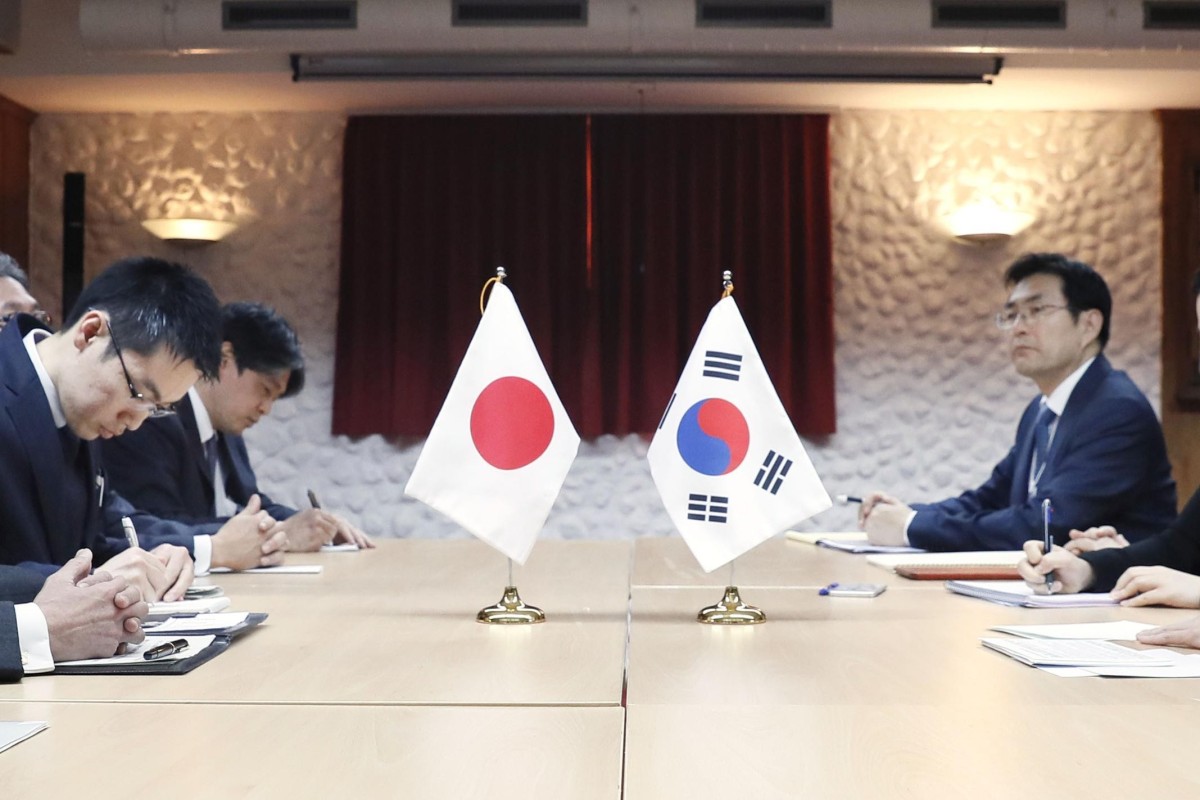
The three-day Asian security forum, which begins on Friday, had been seen as an ideal neutral venue for the two countries’ defence ministers to hold formal talks on issues including Tokyo’s claim that in January a
The issue is one of the biggest deviling the bilateral relationship, alongside Japan’s perception that Seoul has backtracked on a promise to draw a line under Japan’s use of
– euphemistically known as “comfort women” – in military-run brothels during World War Two.
However, Tokyo appears to have concluded that formal talks on the sidelines of the Shangri-La Dialogue would be premature. The Yomiuri newspaper has reported that a formal meeting will no longer take place and that Takeshi Iwaya and Jeong Kyeong-doo, his South Korean opposite number, will now be restricted to a brief, stand-up exchange of their positions.
Despite the report, South Korean officials were guarded when asked whether the meeting had been shelved. “A detailed plan [on the bilateral talks] has yet to be fixed. Consultations are still underway between authorities of the two countries,” said the South Korean defence ministry spokesperson Choi Hyun-soo on Tuesday.
Analysts suggested Japan had run out of patience with South Korea and that the biggest winner in the stand off between two US allies would be China.
Japanese Defence Minister Takeshi Iwaya. Photo: Kyodo
“My sense is that Japan sees South Korea as not engaging in negotiations on a number of issues and not adhering in good faith to agreements that it has already signed,” said Stephen Nagy, a senior associate professor of international relations at Tokyo’s International Christian University.
Tokyo has been incensed that the administration of
has gone back on a 2015 agreement that was meant to draw a final line under the “comfort women” issue. Its anger deepened when Seoul said it would not intervene in a South Korean Supreme Court ruling, which ordered Japanese companies to pay up to 120 million won (US$100,000) to each of a dozen
Like its stance on “comfort women”, Japan believed a line had been drawn under the issue, this time in a 1965 pact that normalised relations between the two countries. Seoul argues that the 1965 treaty, which it signed after receiving US$800 million in grants and soft loans from Tokyo as compensation, does not cover individual victims of colonial-era atrocities.
As rift between Japan, South Korea deepens, how hard can Seoul afford to push?
“Japan is not ready to get into any more agreements because it fears that Seoul will not follow through or that they will become politicised in the future,” Nagy said.
“Tokyo wants binding, long-lasting agreements rather than having to renegotiate something each time a new Korean government comes in,” he said.
“The biggest winner in this stand-off between the US’ two most important allies in the region is, of course, China,” he added. “They must be delighted to see this playing out because it means the US is not able to exert nearly as much pressure in areas such as the
A long-standing strategic aim in US foreign policy circles has been to form a trilateral alliance with South Korea and Japan to present a united front against common security concerns, including China’s growing influence. However, the seeming inability of the two countries to get along has long thwarted this ambition.
“If Japan, South Korea and the US could find a way to cooperate, imagine the influence they could exert over the South China Sea or over
,” Nagy said. “If Japan and Korea could find a way to put their differences aside and with their security capacity, it would be a powerful deterrent to Beijing and Pyongyang.”
South Korean protesters demonstrate against Japan’s use of sex slaves – euphemistically termed ‘comfort women’ in World War II. Photo: AFP
Toshimitsu Shigemura, a professor of international relations at Tokyo’s Waseda University, agreed that the schism between Seoul and Tokyo would be of serious concern to Washington, but he believed that US pressure had already been brought to bear on the two neighbours.
“By avoiding talks in Singapore, Japan is doing its best to avoid public problems between the two sides and I believe that talks are already taking place between the two governments on these issues,” he said.
US wants Japan and South Korea to tag team China. But history is in the way
“The US will have told Tokyo and Seoul that it does not want to see more disagreements and that it is very important that they cooperate and calm things down a bit,” he said.
“I am sure that Washington knows exactly what happened when the Korean warship locked onto the Japanese aircraft in January, but they’re not publicly taking sides and instead they’re telling both governments to put the dispute behind them and to move on,” he added.
Other analysts were more pessimistic.
“The dynamics in domestic politics in both countries are currently overwhelming any diplomatic motives to improve bilateral ties,” said Bong Young-sik, a researcher at the Asan Institute for Policy Studies in Seoul.
Japanese Prime Minister Shinzo Abe. Photo: AFP
“For President Moon Jae-in, Japan-bashing is a useful political card to appeal to his supporters while for
, giving the impression that South Korea is going too far in pressing Japan is also beneficial for his own political gains.”
Professor Ha Jong-moon at Hansin University said there were “no solutions in sight” to resolve the differences over forced labour and wartime sex slavery, but said there would be a chance to “smooth ruffled feathers” at the G20 summit in Osaka, which takes place at the end of June.
The last time the defence ministers of the two countries met was in October last year, when they held talks on the sidelines of the Asean Defence Ministers’ Meeting in Singapore.









 CHINDIA ALERT: You'll be living in their world, very soon