Chindia Alert: You’ll be Living in their World Very Soon
aims to alert you to the threats and opportunities that China and India present. China and India require serious attention; case of ‘hidden dragon and crouching tiger’.
Without this attention, governments, businesses and, indeed, individuals may find themselves at a great disadvantage sooner rather than later.
The POSTs (front webpages) are mainly 'cuttings' from reliable sources, updated continuously.
The PAGEs (see Tabs, above) attempt to make the information more meaningful by putting some structure to the information we have researched and assembled since 2006.
ANKARA (Reuters) – Turkey risks jeopardising economic ties with China if it keeps criticising Beijing’s treatment of Uighur Muslims, China’s envoy to Ankara warned, just as Chinese firms are looking to invest in Turkish energy and infrastructure mega-projects.
Last month Turkey broke a long silence over the fate of China’s Uighurs, saying more than one million people faced arbitrary arrest, torture and political brainwashing in Chinese internment camps in the country’s northwestern Xinjiang region.
Turkey’s Foreign Minister Mevlut Cavusoglu repeated Ankara’s concern at a United Nations meeting this week, calling on China to respect human rights and freedom of religion.
China has denied accusations of mistreatment and deems criticism at the United Nations to be interference in its sovereignty. Beijing says the camps are re-education and training facilities that have stopped attacks previously blamed on Islamist militants and separatists.
“There may be disagreements or misunderstandings between friends but we should solve them through dialogue. Criticising your friend publicly everywhere is not a constructive approach,” said Deng Li, Beijing’s top diplomat to Ankara.
“If you choose a non-constructive path, it will negatively affect mutual trust and understanding and will be reflected in commercial and economic relations,” Deng, speaking through a translator, told Reuters in interview.
For now, Deng said that many Chinese companies were looking for investment opportunities in Turkey including the third nuclear power plant Ankara wants to build.
Several Chinese firms including tech giant Alibaba, are actively looking at opportunities in Turkey after the lira’s sell-off has made local assets cheaper.
In addition to Alibaba, which last year purchased Turkish online retailer Trendyol, other companies holding talks included China Life Insurance and conglomerate China Merchants Group, Deng said.
GAPING DEFICIT
Deng said Chinese banks wanted to invest in Turkey, following the lead of Industrial and Commercial Bank of China (ICBC) which bought Tekstilbank in 2015.
Chinese investment in Turkey would help narrow Ankara’s gaping current account deficit, which stood at $27.6 billion last year. Turkey’s trade deficit with China alone stood at $17.8 billion last year, according to Trade Ministry data.
In January, Turkey’s Finance Minister Berat Albayrak said it was “impossible” for Turkey to maintain such a trade deficit with China and other Asian countries, saying the government was considering taking measures.
Deng said he did not expect Turkey to take protectionist steps. “Both countries are strictly against such policies, and both economies need an open world economy,” he said.
He also called on Turkey to adopt Chinese payment platforms such as WeChat and AliPay. “People don’t want to pay in cash and the population here is very young so they wouldn’t have trouble adapting to new technologies,” Deng said.
Good diplomatic and political ties, however, would remain crucial for developing economic ties and attracting more Chinese investment, he said, adding that he had raised the issue with Cavusoglu on Tuesday, a day after the foreign minister’s intervention at the United Nations.
“The most important issue between countries are mutual respect,” he said. “Would you stay friends if your friend criticized you publicly every day?
Teenager alleges man filmed his attacks and threatened her into silence
Victim’s mother says she never knew reason for daughter’s suicide attempts
Chinese girl accuses teacher of four years of beatings and sexual assault
28 Feb 2019
A 17-year-old girl alleges a teacher sexually assaulted her over four years and blackmailed her with video of the assaults. Photo: Weibo
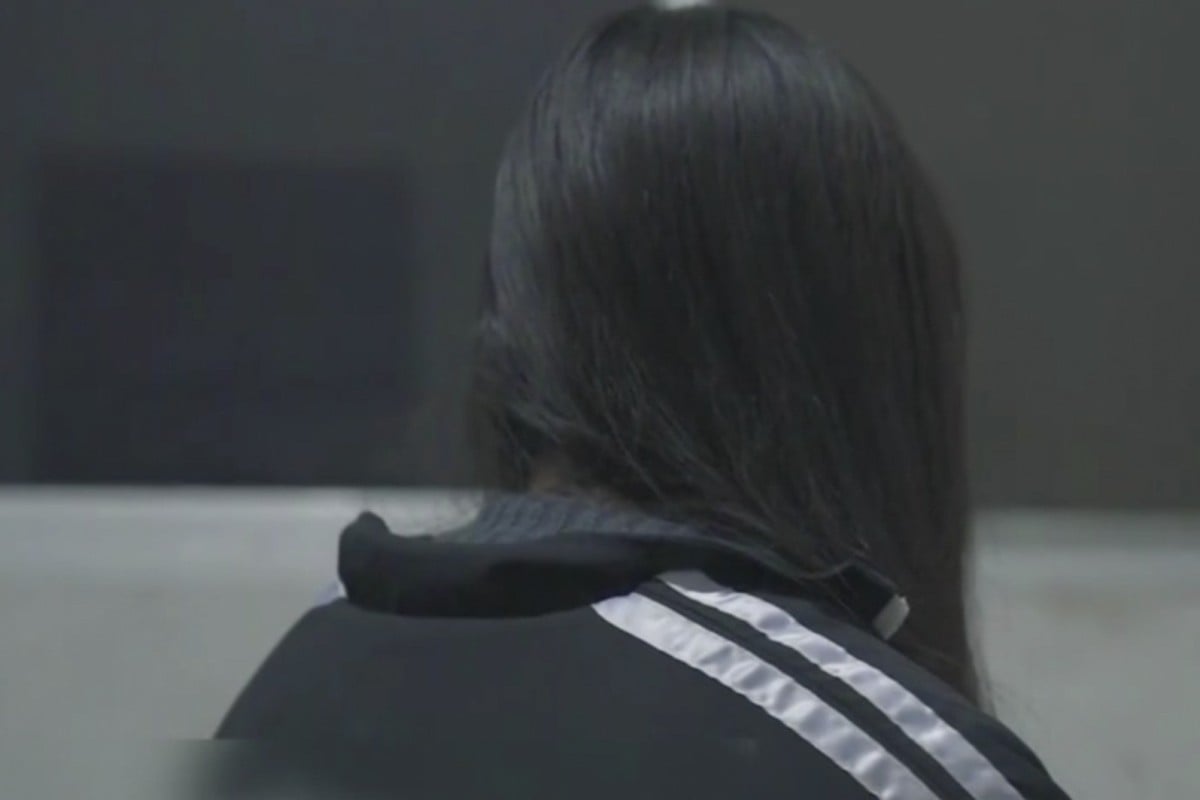
A teenage girl from northwestern China has created shock waves by publicly accusing a schoolteacher of four years of rape, physical abuse and blackmail.
The girl, now 17, told the City and Youth Channel of Shaanxi Television on Wednesday that the teacher at Chenggu County No 4 Middle School in Shaanxi province forced her into a sexual relationship and threatened her with violence if she spoke about the attacks.
Authorities began an investigation into allegations against a 42-year-old man about a week ago after the girl was found beaten up on a country road. A man identified by the surname Ni was taken into police custody in connection with the attacks. The county’s education bureau has also launched an inquiry, Shaanxi Television reported.
The interview with the girl was widely reported by Chinese newspapers and had been viewed more than 18 million times on Weibo by Thursday afternoon.
China’s #MeToo claim costs university professor his job
The student claimed she was first raped in 2015, when she was summoned by Ni to a classroom on the pretext of teaching her to draw.
“He grabbed me from behind after I entered the room,” she told Shaanxi Television. “I struggled and screamed, but he covered my mouth with his hand.”
Ni repeatedly raped her over the years, she claimed, and filmed the assaults. He would often hit her and threaten to make the videos public, she said.
The alleged assaults began when the girl, then 13, was summoned to an art class at school. Photo: Weibo
Share:
They last met on February 18, when the girl tried to persuade Ni to delete the videos but she was beaten again, she said. “He slapped my face and seized me by the throat in his car. He then held me down, sat on me and continued to hit me.”
The attacks stopped when passers-by witnessed the man beating the teenager and called police, the report said.
“The girl has suffered a trauma in the past couple of years. She has tried to kill herself several times, but I did not know the real reason,” the girl’s mother said in the report. “I thought it was the pressure at school.”
For some on social media, the story was an indictment of Chinese society’s treatment of sexual assault victims.
“Such an experience would be ‘humiliating’ in China,” one commenter said. “People around her would not really feel sorry for her. They would avoid her because she was ‘dirty’.”
Teenage sexual assault survivor demands right to be heard
“All girls who have come forward in an environment with such a patchy rule of law and pressure from the public are brave,” another said.
Students at schools and colleges began to speak out last year in the wake of the international #MeToo movement and a national campaign against sexual harassment that spread across schools and college campuses.
A year ago, Luo Qianqian, a former student at Beihang University in Beijing, alleged that she and at least five other women had been sexually harassed by one of their professors.
The professor was fired after an inquiry found his behaviour “was a breach of administrative discipline and the norms of being a teacher”.
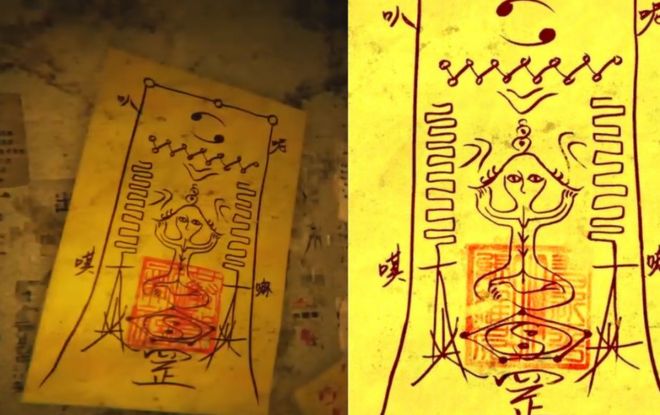
Image copyrightRED CANDLE GAMES/DEVOTIONImage captionWhen players interact with the poster (L), the poster (R) appears – with the words “Winnie the Pooh” and “Xi Jinping”
A Taiwanese games company has had its latest release pulled from mainland China, after players noticed subtle references mocking Chinese President Xi Jinping, including comparing him to Winnie the Pooh.
Red Candle Games released Devotion, a first-person horror game set in 1980s Taiwan, on games platform Steam on 19 February.
The game quickly went viral after players spotted so-called “easter eggs” and publicised them. However online discussion has since been censored.
An “easter egg” is a hidden message or joke in a computer game, normally only picked up by some players paying close attention.
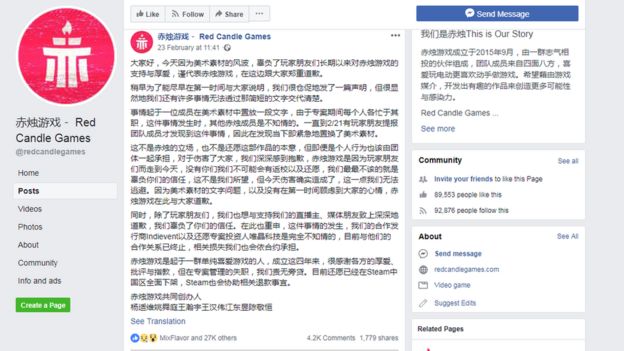
Red Candle Games has apologised, saying it will refund offended users.
Taiwan is an island that is for all practical purposes independent, but China sees it as a rebel region and insists that other countries should not have diplomatic relations with it.
Taiwan’s current president has sparred with Beijing over the island’s political future. In January, Xi Jinping said Taiwan “must and will be” reunited with China.
Hidden messages
One of the easter eggs in Devotion is a poster containing the words “Xi Jinping” next to “Winnie the Pooh”, in an ancient style of writing. Winnie the Pooh has been censored on Chinese search engines and social media since 2017, after bloggers began comparing Mr Xi to the children’s story book and film character.
Gamers have also spotted an old newspaper in Devotion that refers to an individual who has received a prison sentence, nicknamed “baozi” or “steamed bun”.
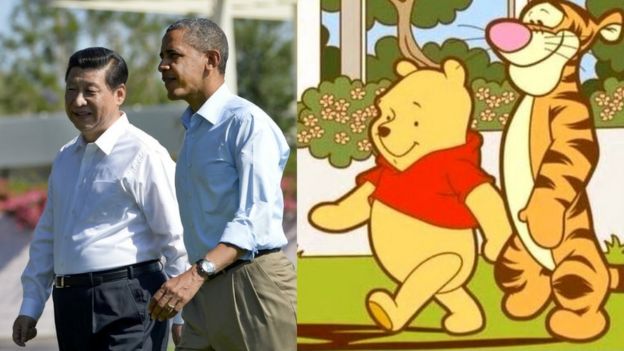
Image copyrightAFP/WEIBOImage captionThis meme showing Xi Jinping and former US President Barack Obama began circulating in 2013
“Steamed bun” is another sensitive term in China, as social media users have used it to refer to the president and evade government censors.
It said that it was aware some players may have been offended by the images, and said that it was in touch with Steam to ensure that such players could obtain a full refund.
“We sincerely hope that this ends with Red Candle, and please do not take it out on all of our innocent partners.”
Taiwanese Vice Premier Chen Chi-mai has praised the game, saying: “Only in countries with democracy and freedom can creation be free from restrictions.”
Image copyrightFACEBOOKImage captionRed Candle Games apologised and confirmed the game had been removed from Steam China
Chinese online censors, meanwhile, are trying to scrub references to the game and its hidden messages.
Searches for both “Red Candle Games” and “Devotion” in Chinese on Weibo are showing no results.
But on Monday, a search of the hashtag #Devotion showed only four posts, none of which refer to the game.
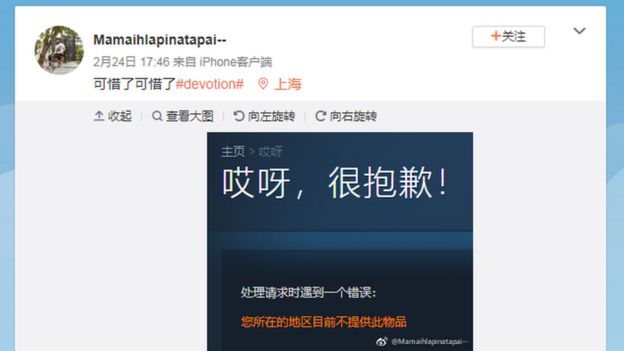
Posts that mention the game’s title in English, which the censors are often lax in censoring, show that China-based users are receiving messages on Steam saying that the game is “no longer available” to play in their country.
Meanwhile Red Candle’s account on China’s Twitter-like Sina Weibo service has been suspended, preventing the company from publicising its game in the mainland.
Image copyrightSINA WEIBOImage captionWeibo users shared posts saying they were no longer able to play the game
In Taiwan, where social media is not government-controlled, thousands of social media users are joking about the easter eggs.
Some on Facebook are posting pictures and gifs of Winnie the Pooh, and others are showing printouts of the offending poster.
Gaming in China
The episode has raised questions as to whether Steam will be the latest overseas online platform to be blocked in mainland China.
Technically, Steam has not gained official approval to operate in the country, but it remains accessible. Some 30m people are estimated to use it in China.
The platform allows China-based users to download and play games that have not received official authorisation.
Over the last decade, the government has banned games if their content is considered to be violent, or anti-Beijing. However many recent releases have never made it to China anyway because of a years-long backlog of games that regulators are yet to examine.
The top media regulator has also just announced that it will not be granting any new licences to gaming companies until the backlog is cleared.
The result is that wildly popular games such as PlayerUnknown’s Battlegrounds and Fortnite, both of which were released in 2017, remain neither banned, nor authorised in the country.
BEIJING, Feb. 26 (Xinhua) — A senior Communist Party of China (CPC) official met with the 11th Panchen Lama Bainqen Erdini Qoigyijabu in Beijing Tuesday.
You Quan, a member of the Secretariat of the CPC Central Committee and head of the United Front Work Department of the CPC Central Committee, congratulated the Panchen Lama for the progress he made last year.
You expressed the hope that the Panchen Lama could make new achievements in maintaining China’s reunification and ethnic unity as well as in promoting Tibetan Buddhism to be more adaptable to the socialist society.
The Panchen Lama said he will closely follow the CPC Central Committee in terms of thinking, political orientation and actions.
He said he will keep his responsibilities in mind, serve the believers and further contribute to national reunification, ethnic unity, religious harmony, and people’s well-being.
Different social systems should not be ‘a barrier to unification or an excuse for separation’, according to mainland’s cross-strait affairs office
After Quemoy began importing water from Fujian in August, preliminary research has been done to supply water to Matsu chain and electricity to both
News
Beijing says it can ease power and water shortages on Taiwan’s islands
27 Feb 2019
Taiwan-controlled Quemoy Island – which is just 2km from Xiamen – began importing water from the mainland in August. Photo: Weibo
Beijing says it is prepared to supply electricity and water to islands controlled by Taipei in the Taiwan Strait despite escalating tensions between the two sides.
An Fengshan, spokesman for the Taiwan Affairs Office in Beijing, also said their different social systems should not be “an excuse” to separate the country, and any deal between the mainland and Taipei should be struck in the interests of a “peaceful unification” agenda.
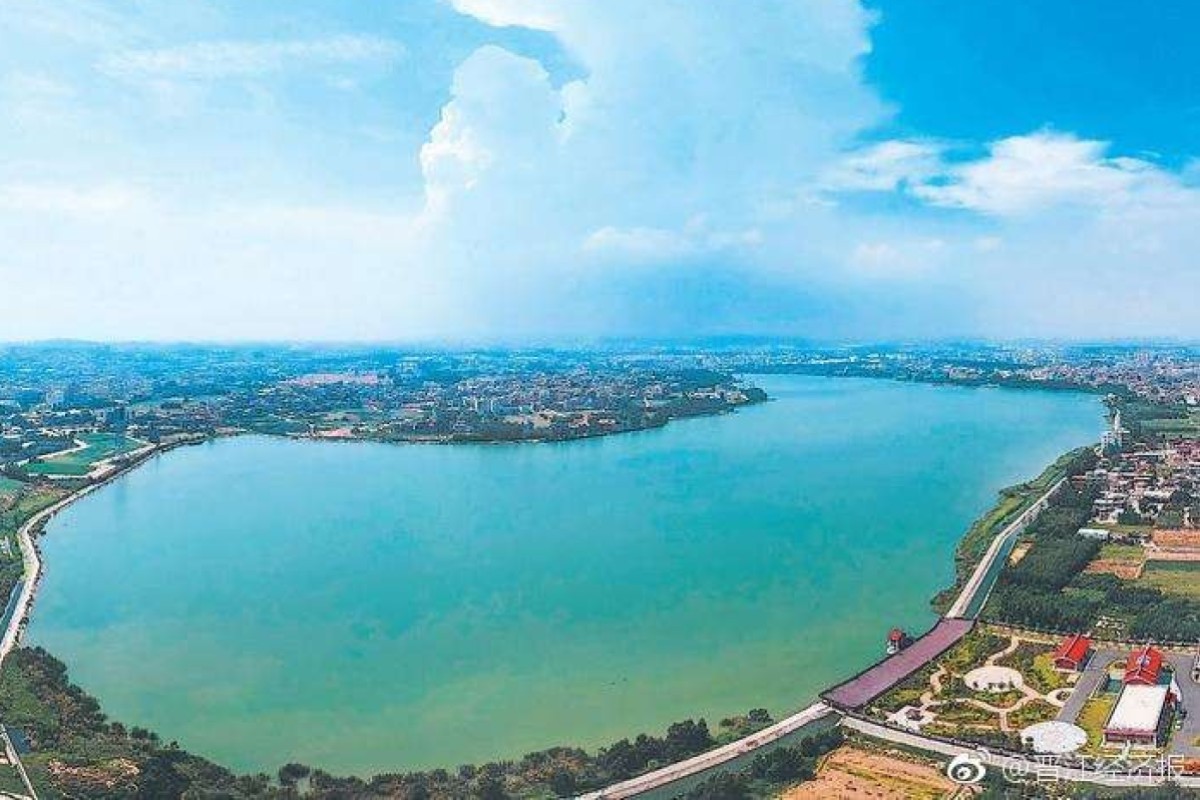
Speaking at a monthly press briefing on Wednesday, An said the mainland could supply power and water to meet the needs of residents on Quemoy, also known as Kinmen, and the Matsu island group. Controlled by Taipei, the islands are located off the mainland’s southeastern Fujian coast – Quemoy is just 2km from Xiamen – and have been on the front line of cross-strait tensions since 1949.
Taiwan’s cold war island begins to thaw
“The people of the Quemoy and Matsu islands have long hoped that the mainland could help to resolve the difficulties they face with power and water shortages, and they have made numerous appeals for gas and bridge connections [with the mainland],” An said.
“Our attitude is very clear – that in regards to these demands, the mainland will make every effort to provide opportunities and conditions to help them achieve bigger and better development.”
An said Fujian province authorities had completed preliminary research and planning to supply electricity to the Quemoy and Matsu islands, as well as water to the Matsu chain. Plans to supply gas and build bridges were expected in the future, he said, without elaborating.
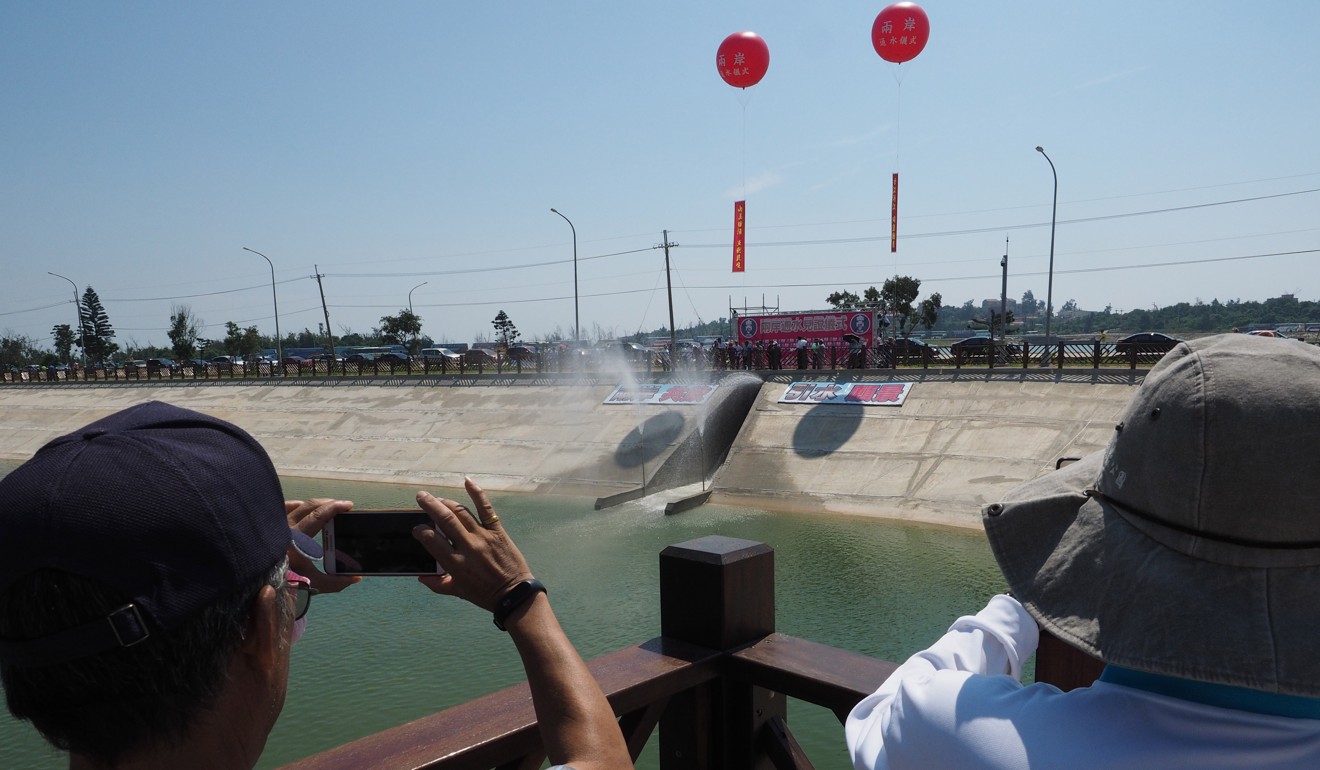
Water is released into the Tianbu Reservoir on Quemoy island in August when the mainland supply began. Photo: EPA-EFE
Quemoy began importing water from Fujian to ease its water shortage in August, three years after it signed a 30-year agreement with the mainland province to supply water via an undersea pipeline.
But Taiwan’s Mainland Affairs Council, which handles cross-strait ties, asked the Quemoy county government to downplay a ceremony marking the start of the supply
because of moves by Beijing to suppress Taipei.
Beijing sees Taiwan as a breakaway province subject to eventual reunification, by force if necessary. Relations across the strait soured after Tsai Ing-wen, of the independence-leaning Democratic Progressive Party, became president in 2016 and refused to accept the one-China principles.
Since then, mainland China has stepped up pressure on Taiwan, suspending official communications with the Tsai government, poaching its diplomatic allies and staging war games near the self-ruled island, which is edging closer to Washington.
In an interview with CNN last week, Tsai said she would seek re-election next year and there would be no peace deal with the mainland unless Beijing ruled out using force against Taiwan.
On Wednesday, An said the different social systems across the strait should not be a barrier to unification, which President Xi Jinping sees as part of his Chinese dream of national rejuvenation but has been rejected by Tsai.
“Peaceful unification and ‘one country, two systems’ are the basic policies for us to resolve the Taiwan issues, and the best way to realise the motherland’s unification,” An said.
He was referring to a speech by Xi in January calling for Beijing and Taipei to start talks on “one country, two systems” in Taiwan – first proposed by late paramount leader Deng Xiaoping in the 1980s – as the path to bring the island back into the China fold.
“The differences in the systems should not be a barrier to unification or an excuse for separation,” An said.
China protests against US ‘provocation’ after two American warships pass through Taiwan Straits.
Asked about Beijing-friendly Kuomintang chairman Wu Den-yih’s recent remarks that Taipei would sign a peace deal with the mainland if his party won the election in 2020, An said the two sides could explore a deal “as long as it benefits and safeguards the peace of the Taiwan Strait, increases the peaceful development of relations and pushes the peaceful unification process of the motherland”.
The IAF strike on Jaish camp in Balakot deep across LoC comes a day before the foreign ministers of Russia, India, and China (RIC) are expected to meet in the eastern China town of Wuzhen under the RIC mechanism.
China has urged India and [pakistan to exercise restrain after the Indian Air Force hit a Jaish camp in Balakot acro(AP file photo)
China on Tuesday urged India to fight terrorism through “international cooperation” hours after the Indian air force carried out a targeted strike on a Jaish-e-Mohammed (JeM) camplocated across the Line of Control (LoC).
India should create “favourable” conditions internationally to fight terrorism, China added possibly in an oblique reference to New Delhi’s failure to convince Beijing to allow Jaish-e-Mohammed chief, Azhar Masood to be designated as a terrorist at the UN Security Council.
The strike comes a day before the foreign ministers of Russia, India, and China (RIC) are expected to meet in the eastern China town of Wuzhen under the RIC mechanism.
Responding to a question on the air strike, the foreign ministry spokesperson, Lu Kang said both India and Pakistan — one of China’s closest allies — should maintain restraint.
“We have taken note of relevant reports. I want to say that India and Pakistan are both important countries. A sound relationship and cooperation serve the interests of peace and stability in South Asia. Both parties (should) remain restrained and do more to improve bilateral relations,” Lu Kang said.
“As for India’s claims on taking action against terrorism, fighting terrorism is a global practice. It needs to be dealt with international cooperation. And India needs to create a favourable condition internationally for the same,” Lu said.
The Chinese foreign ministry’s reaction came soon after foreign secretary, VK Gokhale confirmed that Indian forces carried out a strike on the biggest camp of the terror group Jaih e Mohammed in Balakot area early on Tuesday.
“Credible intelligence was received that JeM was attempting another suicide terror attack in various parts of the country, and the fidayeen jihadis were being trained for this purpose. In the face of imminent danger, a preemptive strike became absolutely necessary,” the foreign secretary said.
The Chinese foreign ministry reacted carefully, keeping in mind its close ties with Pakistan and the fact that India’s decision to carry out the strike was triggered by JeM-planned Pulwama attack that killed 40 CRPF personnel.
Interestingly, Chinese foreign minister, Wang Yi and his Pakistani counterpart, Shah Mehmood Qureshi spoke over phone about the Pulwama attack and its aftermath over the phone on Monday evening.
“Qureshi informed Wang of Pakistan’s stance on and measures to deal with the attack, reaffirming the country’s sincerity and resolution to communicate with India and find out the truth of the incident,” a report by China’s official news agency, Xinhua, said.
“Qureshi said Pakistan’s position on maintaining regional peace and fighting terrorism will remain unchanged and it is willing to join hands with other countries to cooperate in this area,” it added.
In the phone conversation, Wang said China supports Pakistan and India to resolve the issue through dialogue as soon as possible and avoid an escalation of the situation.
“He called on both sides to collaborate on fighting terrorism and jointly safeguard the security and stability of South Asia,” the report said.
Meanwhile, the Pulwama terrorist attack and the listing of Azhar as a global terrorist by the UN is expected to prominently figure at the 16th RIC foreign ministers’ meeting being held here on Wednesday.
Besides attending the annual trilateral meeting, external affairs minister Sushma Swaraj would also hold bilateral talks with Chinese FM Wang and Russian counterpart, Sergei Lavrov on the sidelines of the meeting.
Swaraj’s meeting with Wang assumes significance as it will be the first high-level interaction between the two countries after the Pulwama terror attack and Tuesday’s air strike.
China, a veto-wielding member of the UNSC, has consistently blocked India, the US, the UK and France’s efforts to list Azhar as a global terrorist since 2016 but endorsed a scathing statement issued by UN Security Council on February 21 on the Pulwama attack.
(This Feb. 24 story corrects paragraph 12 to show Huawei was world’s third-largest smartphone vendor last year, not second largest)
BARCELONA (Reuters) – China’s Huawei welcomed comments from President Donald Trump about the future of U.S. mobile communications on Sunday and asserted its position as a world-leading smartphone producer as Washington and Beijing seek a trade war ceasefire.
U.S. and Chinese negotiators are set to meet for a sixth straight day of negotiations on Sunday as they work to strike a deal ahead of a March 1 deadline on a trade dispute which has disrupted global commerce and slowed the world economy.
At the center of the imbroglio is Huawei Technologies, accused by Washington of sanctions busting, intellectual property theft and facilitating Chinese state espionage operations.
Speaking ahead of the mobile industry’s biggest global event which begins in Barcelona on Monday, Huawei Chairman Guo Ping reiterated his company’s position that it has never and would never allow any country to spy through its equipment.
Guo, who holds Huawei’s rotating chairmanship, said Trump’s recent assertion that the United States needed to get ahead in mobile communications through competition rather than seeking to block technology was “clear and correct”.
Trump’s tweets on Thursday did not specifically mention Huawei, the world’s largest producer of mobile network equipment, but appeared to soften earlier U.S. statements that it should be barred from Western networks on security grounds.
“I have noticed the president’s Twitter, he said that the U.S. needs faster and smarter 5G, or even 6G in the future, and he has realized that the U.S. is lagging behind in this respect, and I think his message is clear and correct,” Guo said, speaking through an interpreter.
He said the United States did not represent the whole world and called for equipment makers, network operators and governments to work together to devise trustworthy standards to manage cyber security risks.
The Huawei logo is displayed ahead of the Mobile World Congress (MWC 19) in Barcelona, Spain, February 24, 2019. REUTERS/Sergio Perez
“We need to have unified standard that should be verifiable. It should not be based on politics,” Guo said.
FOLDING PHONE, RIGID PRICE TAG
Huawei also sought to reaffirm its position as one of the world’s leading technology companies, unveiling a folding 5G smartphone to an audience of media and analysts in Barcelona.
Huawei, the world’s third-largest smartphone vendor after Samsung and Apple, said it had taken the lead in developing phones for 5G – which promises super-fast internet speeds – because it was also involved in developing the networks.
The new Huawei Mate X will have two back-to-back screens which unfold to become an eight-inch tablet display, and goes on sale later this year priced at 2,299 euros ($2,607), setting a new upper limit for consumer smartphones.
Samsung had unveiled its own folding smartphone last week, priced at nearly $2,000, as part of a bid to top the technology of Chinese rivals and Apple Inc.
Thomas Husson, principal analyst at Forrester Research, said the Mate X showed Huawei was an innovative technology company and no longer trailing American and Korean competitors.
“The fact that Huawei is not just a network equipment provider but also a smartphone manufacturer … gives them a competitive advantage for 5G. It is also a double-edge sword as some argue the security risks are higher,” Husson said.
China’s Xiaomi, the world’s fourth-largest smartphone maker, also unveiled a 5G handset on Sunday, but without the folding screen or high price tags touted by the Huawei and Samsung devices. Xiaomi’s offering will start at 599 euros ($679) when it hits the market in May.
Military watchers can expect ‘something new’ at this year’s National Day parade in October, Professor Jin Canrong tells forum in Hong Kong
As tensions rise over Taiwan, Beijing is building a naval and missile force as powerful as any in the world, he says
Beijing’s military build-up just starting – a lot more to come, expert warns
24 Feb 2019
Submarine arms race seen heating up in Indo-Pacific amid China ‘threat’
16 Feb 2019
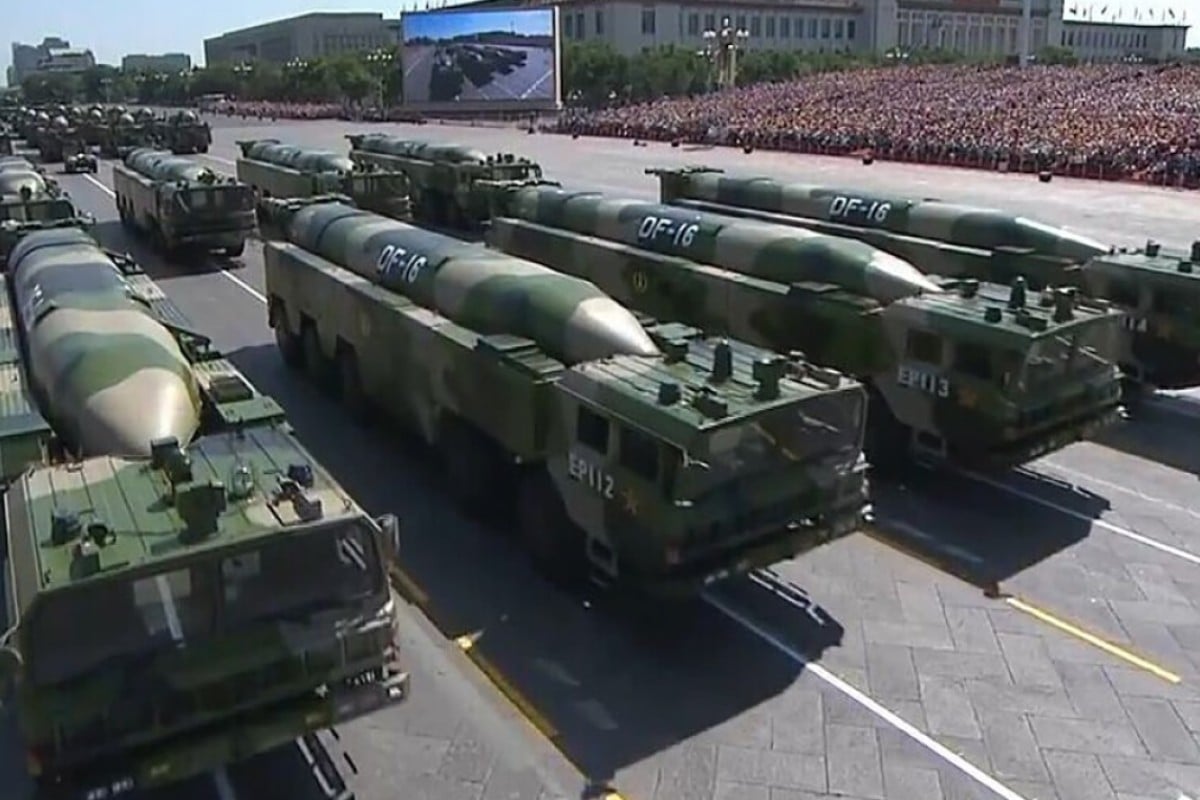
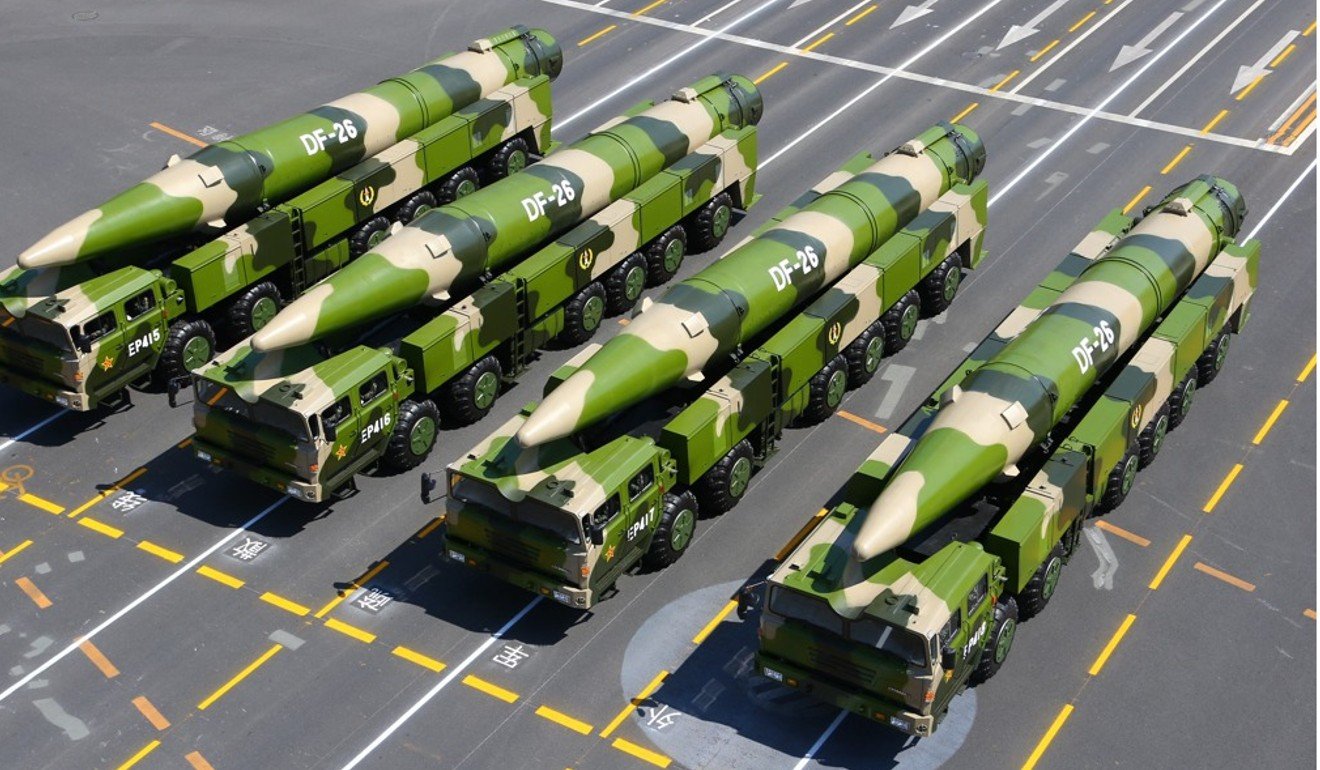
Military vehicles carrying DF-16 ballistic missiles take part in China’s National Day parade. Taiwan says Beijing has such missiles trained on the self-ruled island. Photo: Handout
Beijing will show the world “something new” when it rolls out its arsenal of short- to medium-range ballistic missiles at its National Day military parade in October, according to a Chinese expert on international relations.
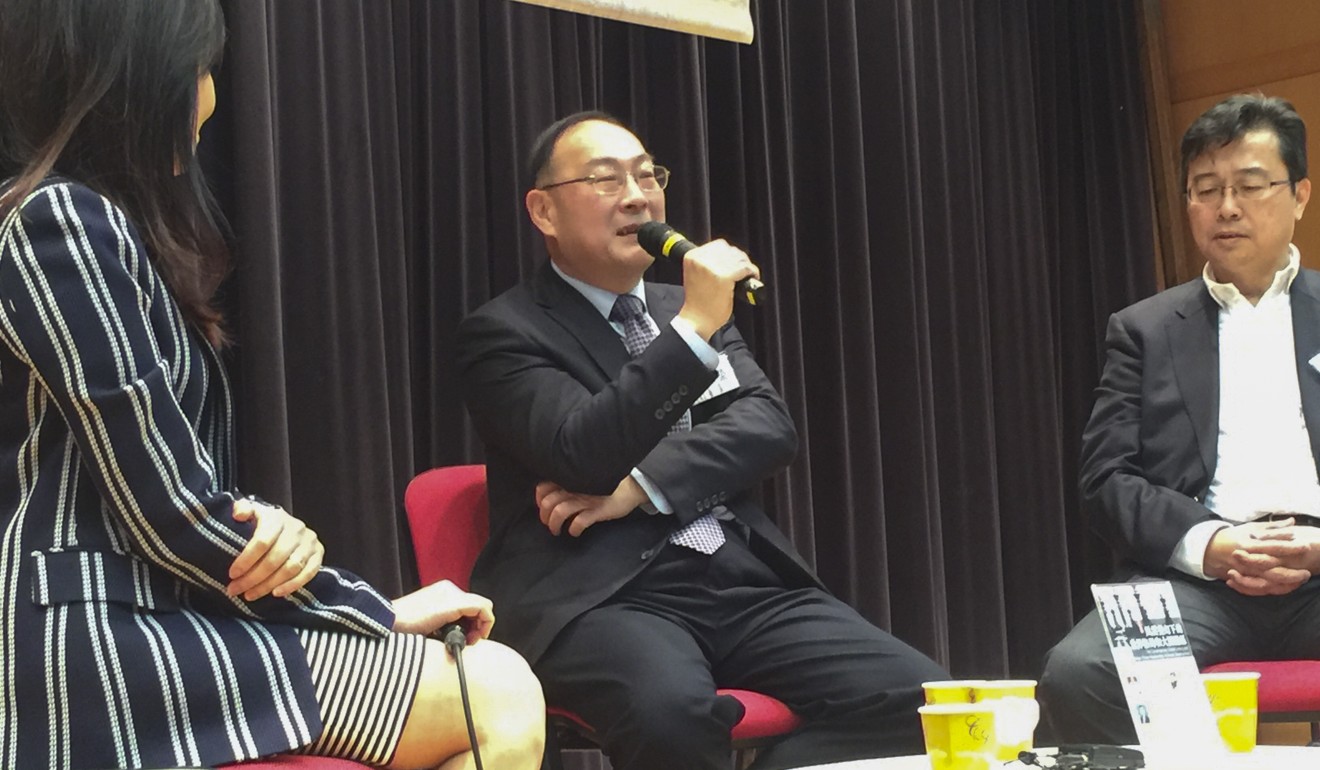
Speaking at a seminar at the University of Hong Kong on Saturday, Professor Jin Canrong, associate dean of the school of international studies at Renmin University in Beijing, said China had made great strides in expanding its military capability, but there was a lot more to come.
US commander pushes for more funding to counter China’s influence in Indo-Pacific
While he did not elaborate on what the “something new” might be, he said the country was gearing up for a possible conflict over Taiwan, the self-ruled island that Beijing regards as a wayward province awaiting reunification.
Over the next five or 10 years, Taiwan could provide the “biggest uncertainty” for Beijing, he said, especially if the United States decided to “ignite” the situation.
Known for being outspoken on sensitive issues, Jin said that while Beijing wanted a peaceful reunification, it was wary of “pro-independence factions [on the island] and right-wing American [politicians] creating trouble”.
By registering for these newsletters you agree to our T&C and Privacy Policy
In a speech on January 2 to mark the 40th anniversary of Beijing’s call to end military confrontation across the Taiwan Strait, Chinese President Xi Jinping said that “the political division across the strait … cannot be passed on from generation to generation”, apparently signalling his determination to bring it to an end.
Xi said China would not abandon the use of force in reunifying Taiwan, but stressed the military would target only external elements and those seeking independence for the island.
In 2017, Taipei said that it had detected the deployment of DF-16 ballistic missiles on the mainland that were aimed at Taiwan.
Jin said China was rapidly expanding its missile capabilities. The People’s Liberation Army had already stockpiled about 3,000 short- and medium-range missiles, he said, even though it had been using just 15 per cent of its production capacity.
“Just imagine if we were running at 100 per cent,” he said.
Beijing will show the world “something new” when it rolls out its ballistic missiles at its National Day military parade in October, an expert says. Photo: Xinhua
Share:
Under its plan for military modernisation China had achieved “great advancements in space, electronics and cyberwarfare”, the academic said, but its achievements to date were only the beginning.
As well as the expansion of its missile force, Beijing was investing heavily in its navy, he said.
Is China about to abandon its ‘no first use’ nuclear weapons policy?
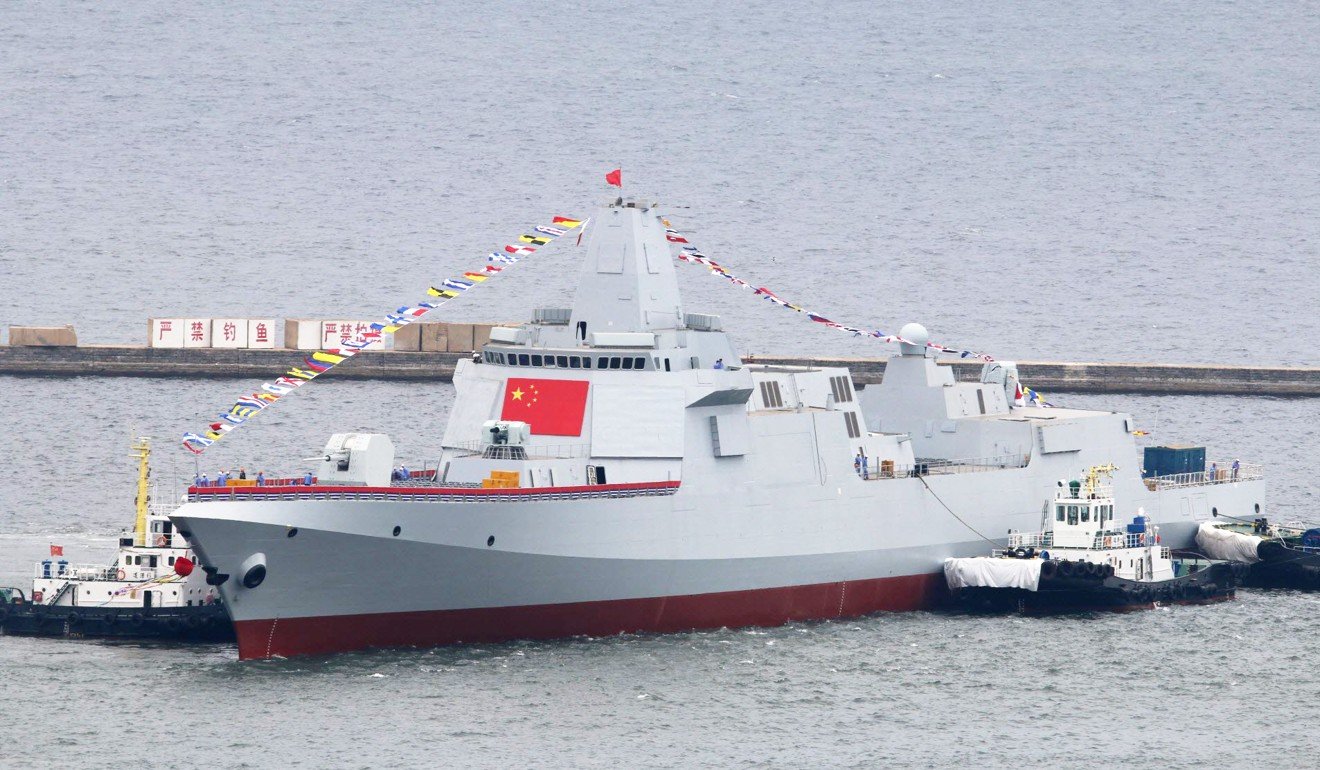
With the deployment of the new Type 055 guided-missile destroyer – which some Chinese military experts have said is as good as anything in the US Navy – the balance of power was shifting, he said.
“For the first time in 500 years, the East has combat equipment that is at least as good as the West’s.”
With the deployment of the new Type 055 guided-missile destroyer, the balance of power between China and the US is shifting, according to Jin Canrong. Photo: Handout
Share:
And as the navy continued to modernise and expand, the US might be forced to rethink its position in the region, he said.
“When we have dozens of destroyers and four or five [aircraft] carriers the US will not be able to meddle in Taiwan.”
China’s first aircraft carrier may become test bed for electromagnetic warplane launcher
Jin said that China would also soon have all the scientific, academic and research personnel it needed to achieve its military ambitions.
“China had nearly 30 million university students in 2018, which is twice as many as the US. More than half of them are studying science or engineering,” he said.
“Every year we produce about 4 million science and engineering graduates, while America produces just 440,000.”
Professor Jin Canrong speaks at a forum in Hong Kong. Photo: Handout
Share:
Beijing also had the money to support its plans, Jin said. Based on his own calculations, he said China allocated about 1.4 per cent of its gross domestic product to military spending, which was lower than “Germany’s 1.5 per cent”, and less than half the “3 per cent in Britain and France”.
“The tax paid by Chinese smokers is more than enough to cover [the country’s] military expenses,” Jin said.
According to figures from Nato, Britain spent 2.1 of its GDP on defence in 2017, France 1.8 per cent and Germany 1.2 per cent. Both the World Bank and the United Nations put China’s military spending in 2017 at 1.9 per cent of its GDP.
SEOUL/HANOI (Reuters) – North Korean leader Kim Jong Un made his way across China by train on Sunday, media reported, bound for a high-stakes second nuclear summit with U.S. President Donald Trump in Vietnam’s capital of Hanoi.
Few details of Kim’s trip have been announced but he left Pyongyang by train on Saturday afternoon for the Feb. 27-28 summit accompanied by senior North Korean officials as well as his influential sister, North Korea’s state media reported.
RELATED COVERAGE
Vietnam relishes role as peace maker as it seeks to balance ties
Vietnam’s Bamboo Airways to buy 10 Boeing planes during Trump-Kim summit
‘Chilling the atmosphere’ – North Korea media condemns U.S. Democrats ahead of summit
Trump and Kim will meet in Hanoi eight months after their historic summit in Singapore, the first between a sitting U.S. president and a North Korean leader, where they pledged to work towards the complete denuclearisation of the Korean peninsula.
With little progress since then, the two leaders are expected to focus on what elements of North Korea’s nuclear programme it might begin to give up, in exchange for U.S. concessions.
In rare, revealing coverage of Kim’s travel, while it is still going on, the North’s Rodong Sinmun newspaper featured photographs of him getting a red-carpet send-off in Pyongyang and waving from a train carriage door while holding a cigarette.
He was accompanied by top officials also involved in the Singapore summit, including Kim Yong Chol, a former spy chief and Kim’s top envoy in negotiations with the United States, as well as senior party aide Ri Su Yong, Foreign Minister Ri Yong Ho and defence chief No Kwang Chol.
The North Korean leader’s sister, Kim Yo Jong, who acted as a close aide in Singapore, is again part of the delegation, the North’s KCNA news agency reported. It made no mention of his wife, Ri Sol Ju.
The extensive coverage in the secretive North’s official media was a contrast to the limited reporting that has traditionally prevailed during his foreign trips.
Other senior officials, such as his de facto chief of staff Kim Chang Son and Kim Hyok Chol, negotiations counterpart to U.S. envoy Stephen Biegun, were already in Hanoi to prepare for the summit.
With scant progress since the June summit, the two leaders are likely to try to build on their personal connection to push things forward in Hanoi, even if only incrementally, analysts said.
Both sides are under pressure to forge more specific agreements than were reached in Singapore, which critics, especially in the United States, said lacked detail.
“They will not make an agreement which breaks up the current flow of diplomacy. (President Trump) has mentioned that they’ll meet again; even if there is a low-level agreement, they will seek to keep things moving,” said Shin Beom-chul, a senior fellow at the Asan Institute for Policy Studies.
LEARNING FROM VIETNAM
The Trump administration has pressed the North to give up its nuclear weapons programme, which, combined with its missile capabilities, poses a threat to the United States, before it can expect any concessions.
North Korea wants an easing of punishing U.S.-led sanctions, security guarantees and a formal end of the 1950-1953 Korean War, which ended in a truce, not a treaty.
Few details of summit arrangements have been released.
Some lamp posts on Hanoi’s tree-lined streets are decked with North Korean, U.S. and Vietnamese flags fluttering above a handshake design, and security has been stepped up at locations that could be the summit venue, or where the leaders might stay.
It could take Kim at least 2-1/2 days to travel to Vietnam by train.
Some carriages of a green train were spotted at Beijing’s station on Sunday, but it was not confirmed it was Kim’s.
South Korea’s Yonhap news agency said Kim’s train had passed through a station in China’s port city of Tianjin, southeast of Beijing, at around 1 p.m. (0500 GMT).
China has given no details of his trip. Its foreign ministry did not immediately respond to a request for comment.
Two top North Korean officials who were not in Singapore but will be in Hanoi are Kim Phyong Hae and O Su Yong, vice chairmen of the party’s Central Committee, respectively in charge of personnel management and industrial affairs, KCNA reported.
O is a former minister of electronics and vice minister of metals and machine building. He might try to learn about Vietnam’s development of manufacturing, analysts said.
Kim Jong Un may tour some economic facilities while in Vietnam.
Vietnam, like North Korea, fought a war against the United States and keeps tight control over its people and economy. It has been touted as a model for North Korea’s development.
Vietnamese media reported that a North Korean cargo plane arrived on Sunday carrying personnel who appeared to be Kim’s security guards and state media workers. They were driven under police escort to a downtown hotel.
Middle-aged man seen taking a nap mid-flight said to be senior pilot with the Taiwanese carrier
His co-pilot who took the video has also been reprimanded
China Airlines pilot punished after he’s filmed sleeping in cockpit
23 Feb 2019
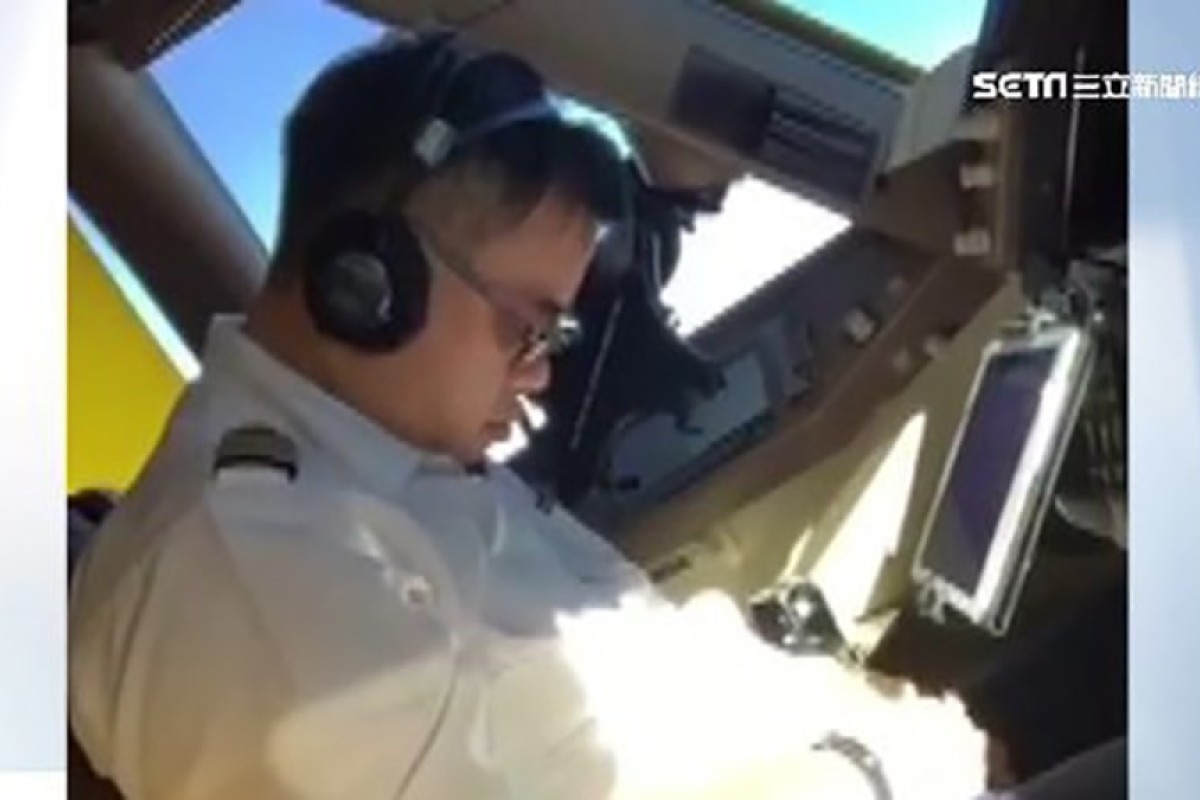
The video shows the pilot in the cockpit with his head down and eyes closed. Photo: setn.com
China Airlines, Taiwan’s biggest carrier, says it has punished a pilot after a video of him taking a nap in the cockpit mid-flight was posted online.
His co-pilot, who filmed the incident, has also been reprimanded, local television station SETN reported.
In the video, a middle-aged man in a pilot uniform and headphones appears to be asleep with his head down and eyes closed while in the cockpit of a Boeing 747.
The footage drew attention after it was shown in a report on Taiwanese TV network EBC on Wednesday. The man was identified as Weng Jiaqi, a senior pilot with almost 20 years of experience who was promoted to chief pilot last year.
Chinese airline Donghai suspends and fines pilot for allowing wife in cockpit
It was unclear when or on which flight the video was filmed, but the airline confirmed that Weng had reported his behaviour and been punished while his co-pilot had been reprimanded for “improper behaviour”, SETN reported.
Weng, who also supervises training, is a short-haul pilot to cities including Hong Kong, Shanghai, Beijing, Guangzhou, Tokyo, Okinawa and Seoul, according to the EBC report.
The China Airlines pilots went on strike on February 8, during the Lunar New Year holiday season. Photo: EPA-EFE
Share:
The incident comes after the airline last week reached a deal with the pilots’ union to
over working conditions and benefits that forced the cancellation of more than 200 flights.
But China Airlines told EBC that the video was filmed before the pilots walked off the job.
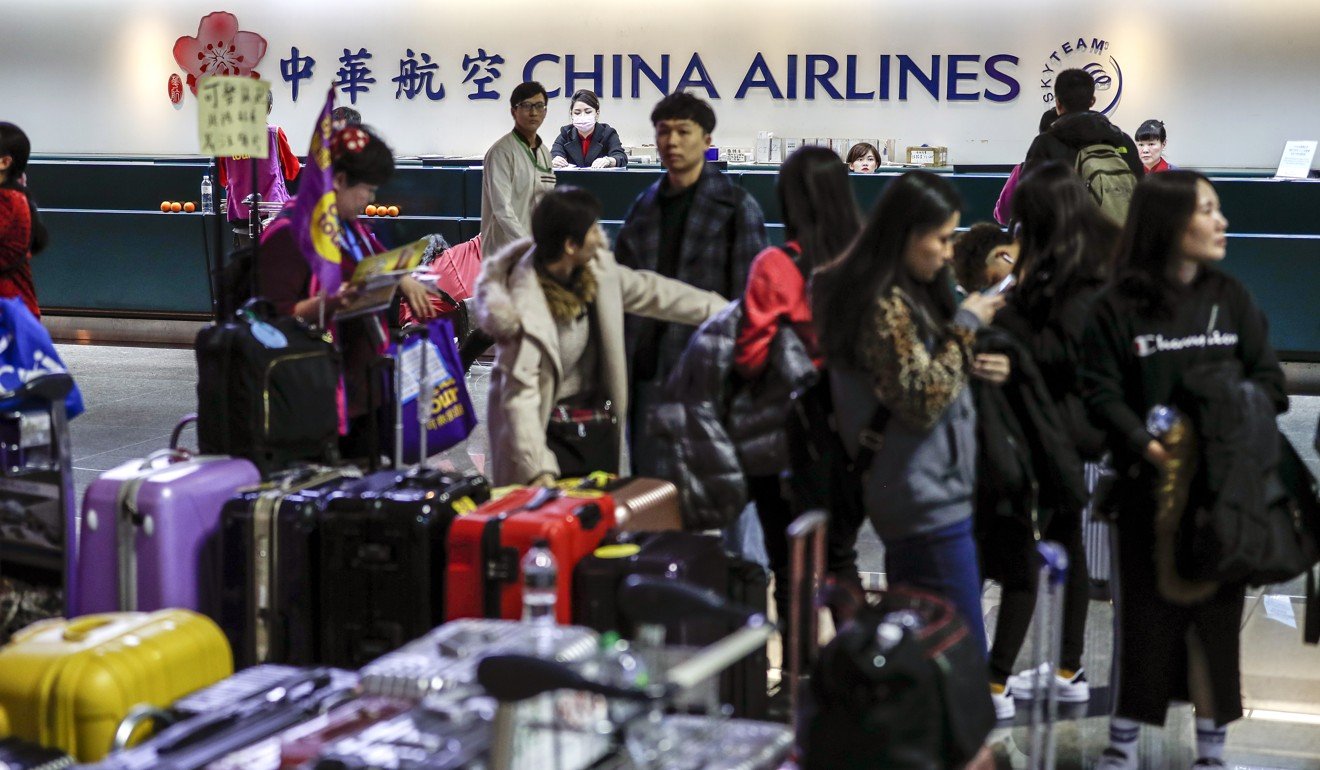
The Taoyuan Union of Pilots began the industrial action on February 8, stranding close to 50,000 passengers and inflicting over NT$500 million (US$16.2 million) in losses on the carrier.
Under a deal signed on February 14, the union agreed not to strike again in the next 3½ years. In return, China Airlines agreed to the union’s main demand to increase the number of pilots on various flights to combat fatigue and improve safety.
Chinese pilots, cabin crew told no more smoking in cockpits on domestic flights
The carrier will roster three pilots on flights of more than eight hours – up from the present two – and will have four pilots on flights over 12 hours, up from three.
China Airlines president Hsieh Shih-chien said the staffing increases were expected to sharply add to the cost of the company’s operations, but the carrier agreed to the terms in the interest of safety.