05/04/2020
- Pictures of packed trails over the weekend highlight difficulties in maintaining social distancing while trying to get back to normal
- Attraction in Anhui province said it would be forced to close on Sunday after exceeding its 20,000-visitor limits
== PICTURE CAPTURED FROM WEIBIO
Huangshan Mountains in China’s Anhui province was forced to close after tens of thousands of people flocked to the popular mountain range over the weekend, highlighting the difficulties in getting the country’s social life back to normal while keeping the coronavirus outbreak under control. Huangshan, or the Yellow Mountains, located in southern Anhui province in eastern China, said in a notice today that it had to close because the number of visitors had reached its limit of 20,000 for the day. Tourists are advised to visit the site on other days or try travelling to other sites. Since April 4, the Anhui government has been offering free access to 29 tourist sites in the Huangshan region, including the Yellow Mountains, to local residents for 2 weeks, in a bid to drum up more business since its reopening in late February as it seeks to get its economy back to normal. Photo: WEIBIO
A popular mountain range in southeast China was forced to close after tens of thousands of people flocked to its trails over the weekend.
The crowds flocking to the Huangshan, or Yellow Mountains, in Anhui province highlight the difficulties the country may face in future as it tries to get back to normal while keeping Covid-19 under control.
Starting from Saturday, the Anhui provincial government had been offering free entry to 29 sites, including Huangshan, to boost visitor numbers.
Visitors were asked to show their health status on an app, wear surgical masks and their body temperatures had to be checked before entering the site.
But on Sunday the park authorities said it would have to close because the number of visitors had reached its daily limit of 20,000 and urged people to visit other sites or come to the mountains at another time.
Coronavirus: China pulls the plug on wasteful, unnecessary research into Covid-19
Pictures and video circulated on the social media platform Weibo showing packs of visitors walking up the mountain range over the three-day Ching Ming festival.
“Tourism has been hit hard, and also its related industries,” said one Weibo comment. “But the epidemic isn’t over. If you must open the sites, you have to restrict the flow [of tourists], and those visitors from outside.”
As of Sunday, the number of confirmed cases being treated in the country had fallen to 2,382, according to the National Health Commission, but the total number of imported cases rose to 913.
Police try to hold back visitors to the mountain range. Photo: Weibo
“I think China is keeping a close eye on Covid-19 detections and may need to tune the social distancing measures that are needed to keep Covid-19 contained. For now, it may be OK to relax some measures, but those measures should be tightened if case numbers pick up,” said Benjamin Cowling, a professor of epidemiology and biostatistics at Hong Kong University.
“I would not be surprised if most countries continue to prohibit mass gatherings for the rest of 2020,” said Cowling, adding that temperature checks at entrances would be a good idea, but it might not be sufficient to protect visitors.
Coronavirus: Beijing’s ban on foreign travellers comes into force months after it criticised other countries for ‘isolating China’
Anhui, which shares its western border with Hubei province, the initial centre of the outbreak, last reported a new infection on Feb 27, according to official figures. The province reported a total of 990 cases of Covid-19, including six deaths.
China’s tourism and cultural sectors are among the worst hit as a result of the outbreak.
A number of Shanghai’s popular tourist spots, including the Shanghai Oriental Pearl Tower and Shanghai Jinmao Tower had to close again last week only two weeks after reopening.
Dai Bin, president of the China Tourism Academy, a research institute under the Ministry of Culture and Tourism, told a forum in February that he expected domestic tourism would contract as much as 56 per cent in the first quarter and 15.5 per cent for the whole year.
Dai also estimated that annual income loss from tourism could hit 1.2 trillion yuan (US$169 billion) this year.
Source: SCMP
Posted in Anhui province, Beijing’s, China Tourism Academy, China’s, coronavirus, coronavirus outbreak, Country, domestic tourism, epidemic, Hong Kong University, Huangshan mountains, lockdown, Ministry of Culture and Tourism, National Health Commission, Shanghai Jinmao Tower, Shanghai Oriental Pearl Tower, Shanghai’s, swamped, Tourism, tourism and cultural sectors, Uncategorized, visitors, Yellow Mountains |
Leave a Comment »
01/04/2020
TAIPEI (Reuters) – Anger at being confused with China amid the coronavirus outbreak and Beijing’s stepped-up efforts to assert sovereignty is stirring heated debate in Taiwan about how to further distance itself from its giant and often threatening neighbour
At its core is a debate about whether to drop “China” from the island’s official name, the Republic of China.
During the virus crisis, the World Health Organization (WHO), which considers the island part of China, has listed Taiwan’s far lower case number under China’s, and China has repeatedly insisted only it has the right to speak for Taiwan on the global stage, including about health issues.
Taipei says this has confused countries and led them to impose the same restrictions on Taiwanese travellers as on Chinese, and has minimised Taiwan’s own successful efforts to control the virus.
Taiwan has been debating for years who it is and what exactly its relationship should be with China – including the island’s name. But the pandemic has shot the issue back into the spotlight.
Lin I-chin, a legislator for the ruling Democratic Progressive Party (DPP), said in parliament last month that Taiwan should change its English name to “Republic of Chunghwa”, an English rendering of the word Taiwan uses for China in its name.
“Taiwan has been brought to grief by China,” she said.
On Sunday, the New Power Party, one of Taiwan’s smaller opposition groups, released the results of a survey in which almost three-quarters of respondents said Taiwan passports should only have the word “Taiwan” on them, removing any reference to China.
“During this epidemic period, our people have been misunderstood by other countries, highlighting the urgency of changing the English name,” it said in a statement.
Taiwan’s Foreign Ministry has given a cautious response to the passport idea, noting that according to the constitution, the official name is Republic of China and that the word Taiwan was already added to passport covers in 2003.
“In the future, if there is consensus between the ruling and opposition parties on this new name, the Foreign Ministry shall cooperate in handling it,” spokeswoman Joanne Ou said.
But the government is wary of a name change for Taiwan, saying there is no consensus for such a radical move.
Although the DPP supports the island’s independence – theoretically meaning the official formation of a Republic of Taiwan – President Tsai Ing-wen says there is no need to do so, as the island is already an independent country called the Republic of China. She often refers to the island as the Republic of China, Taiwan.
‘REPUBLIC OF TAIWAN’
Premier Su Tseng-chang has said changing the island’s name isn’t the most urgent issue facing Taiwan.
“If we want to change then it might as well be to ‘Republic of Taiwan’. Taiwan is more well known,” Su said in parliament. “But if there’s no national consensus, a name change isn’t the most important thing for now.”
Taiwan’s official name is a throwback to when the Kuomintang party fled to the island after losing the Chinese civil war to the Communists in 1949, and continued to claim to be China’s legitimate government.
“The Republic of China is a country, Taiwan is not,” Chen Yu-jen, a Kuomintang legislator from the island of Kinmen, which sits just offshore from the Chinese city of Xiamen, told parliament on Monday.
The statement drew a sharp rebuke from Su, who told reporters it meant Chen had no right to be a member of the legislature. Chen said she was simply stating the facts, and that Taiwan is a geographic name, not a national name.
China’s pressure on Taiwan diplomatically and militarily during the virus crisis has also reduced Beijing’s already low standing in the eyes of many Taiwanese.
A March poll commissioned by Taiwan’s China-policy making Mainland Affairs Council and carried out by Taipei’s National Chengchi University showed more than three-quarters of respondents believed China’s government was unfriendly to Taiwan’s, the highest level in a decade.
Any name change would infuriate China, which has a law mandating the use of force to stop Taiwan independence.
Source: Reuters
Posted in 1949, anger, ‘Republic of Taiwan’, “Republic of Chunghwa”, Beijing’s, China, civil war, Communists, confused, coronavirus outbreak, Foreign Ministry, identity debate, infuriate, Kuomintang Party, National Chengchi University, New Power Party, pandemics, parliament, Premier Su Tseng-chang, President Tsai Ing-wen, Republic of China, sovereignty, Taipei, Taipei’s, Taiwan, Taiwanese, travellers, Uncategorized, Virus, World Health Organization (WHO) |
Leave a Comment »
29/03/2020
- Chinese president is fighting ‘two tough battles’ to reboot industry and defeat Covid-19, Xinhua says
- Choice of industrial powerhouse for official visit shows the importance Xi gives to reviving the economy, observers say
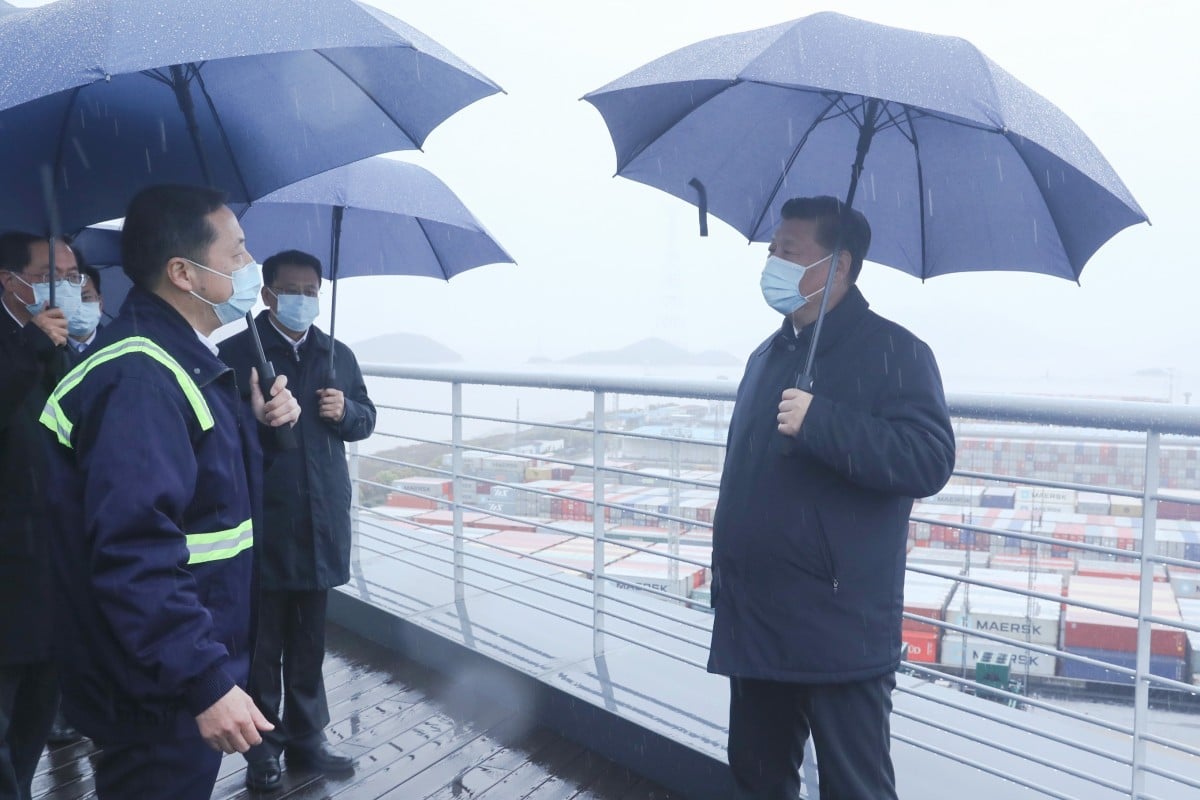
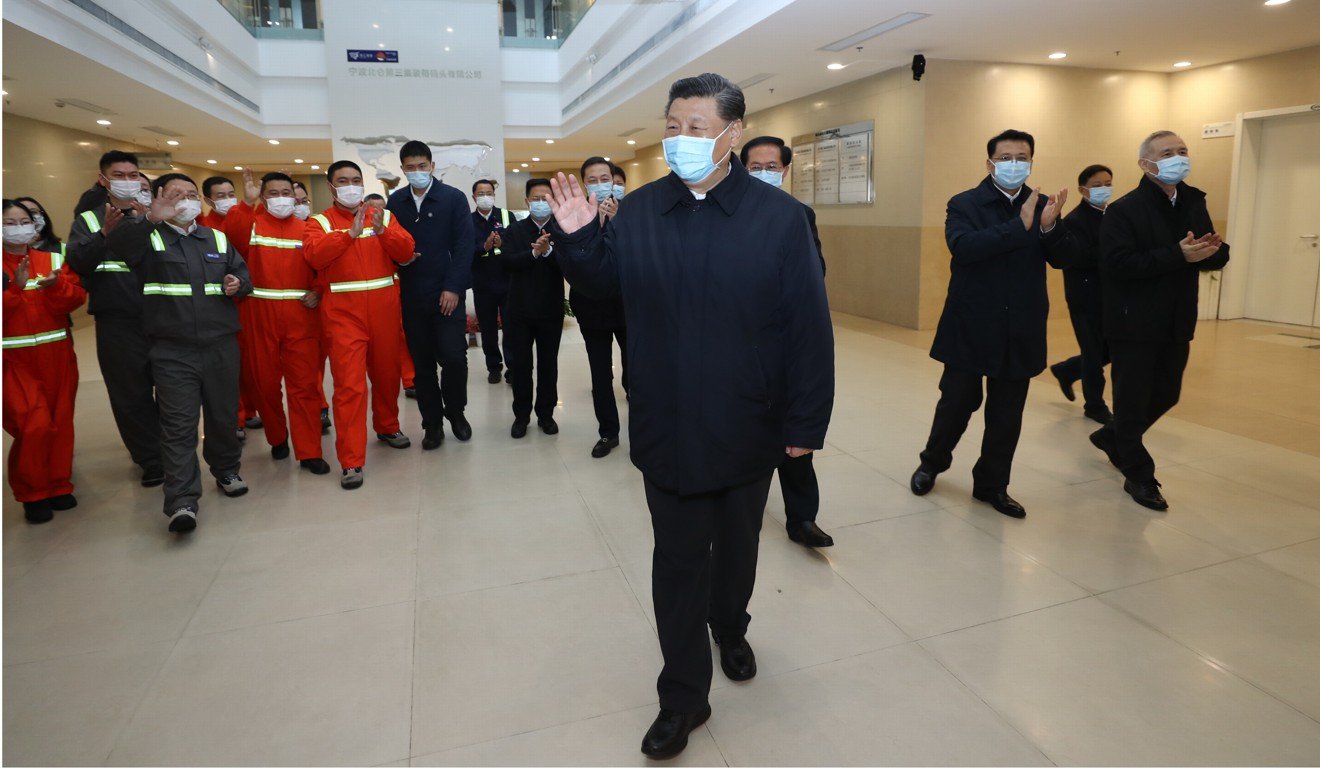
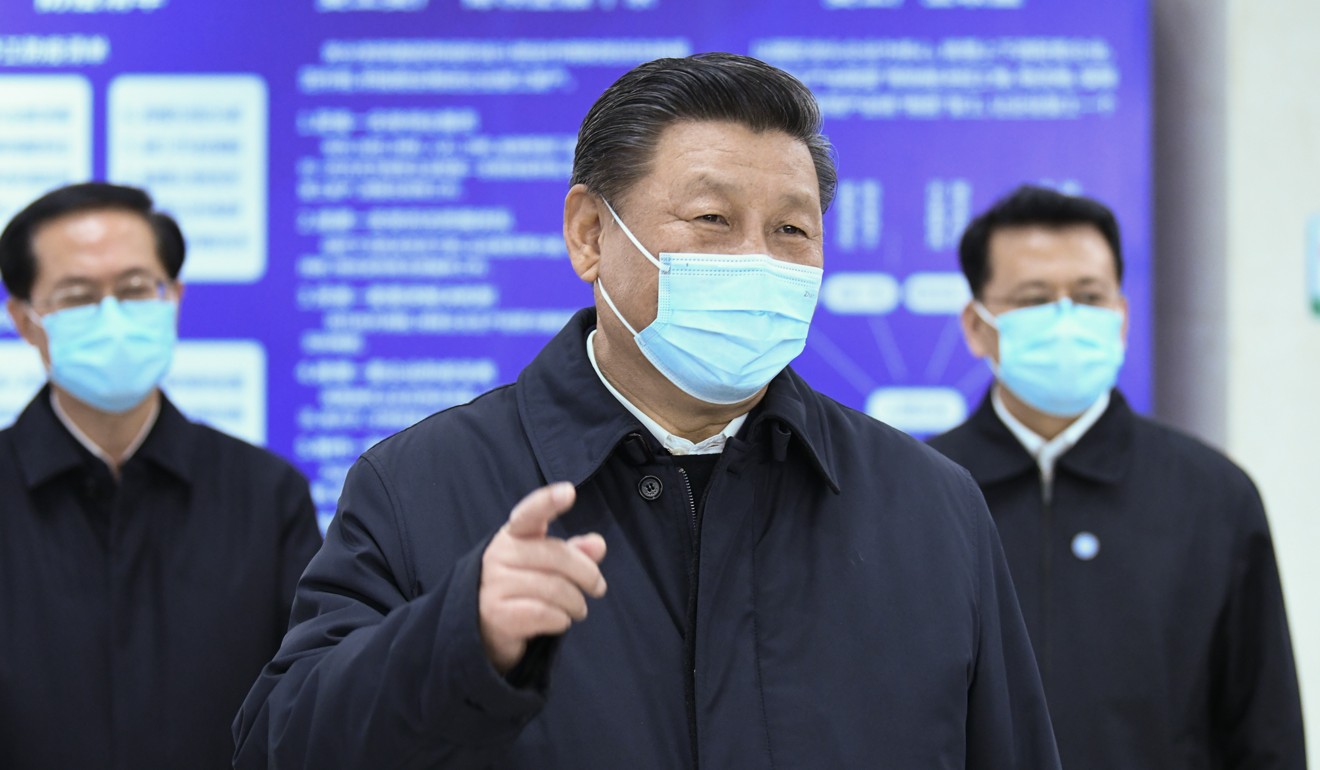
Chinese President Xi Jinping chats to workers and officials at Ningbo port in east China on Sunday. Photo: Xinhua
visited the industrial powerhouse of Zhejiang province on Sunday in a move state media described as a clear message the country was ready to get the economy back on track amid the “new normal” of dealing with the coronavirus.
The trip, to Ningbo – one of the world’s busiest ports and a trade hub for eastern China – was Xi’s first outside Beijing since he visited Wuhan, the initial epicentre of the Covid-19 outbreak, earlier in the month.
As well as a visiting the port, he spoke to workers at an industrial zone for car part manufacturers, where he learned about the latest efforts to restart production, Xinhua said in a brief report.
The visit came after two months of almost total lockdown in many parts of the country that disrupted businesses, transport and people’s daily lives, and ground the economy to a near standstill.
While local transmissions of the coronavirus in China appear to be under control, Beijing has implemented strict measures to prevent imported cases, including slashing international flights and banning most foreigners from entering the country.
In a separate report, Xinhua said Xi’s visit sent “a clear message” that China was resuming its industrial production and social activities, and described the fight against the coronavirus as the “new normal”.
Reviving the economy and battling a deadly disease were Xi’s “two tough battles”, it said.
Xi’s choice of destination was a clear message that restarting the economy is a top priority. Photo: Xinhua
Zhejiang is something of a power base for Xi, who spent nearly five years there during his climb through the ranks of the Communist Party.
One of the country’s biggest trading hubs, the province generated 3 trillion yuan (US$423.2 billion) in foreign trade last year, or more than 13 per cent of the national total, according to official figures.
“It’s a highly export-oriented economy … which has made it crucial not only to China’s development plan but also to safeguarding the stability of the global supply chain,” Xinhua said.
Observers said Xi’s visit was evidence of Beijing’s determination to get the economy back up and running as soon as possible.
Zhao Xijun, an economics professor at Renmin University, said Ningbo was a key part of the export economy and a base for many local and foreign entrepreneurs.
“It is a clear signal that China, after getting domestic infections under control, is now prioritising economic growth,” he said.
“It also shows the country will keep developing its economy and opening up its markets.”
But hopes of a quick recovery for the Chinese economy have been dashed by the spread of the coronavirus across Europe and the United States, causing a sharp decline in demand for Chinese goods.
Xi spent five years in Zhejiang while climbing the ranks of the Communist Party. Photo: Xinhua
In a meeting on Friday, the Communist Party’s Politburo said it would step up macroeconomic policy adjustments and pursue a more proactive fiscal policy while optimising measures to control the coronavirus to speed up the restoration of production, doing whatever it could to “minimise the losses caused by the epidemic”.
“China has successfully reopened much of its economy from the extremes of the coronavirus lockdown, but now faces a new problem: an impending collapse in demand for its exports as its customers go into lockdowns of their own,” Gavekal Dragnomics said in a research report.
“That shock to industry and manufacturing employment means that China will not enjoy the hoped-for V-shaped recovery in growth.”
Source: SCMP
Posted in 'total lockdown', ‘clear message’, ‘two tough battles’, back on its feet, banning, Beijing, Beijing’s, busiest ports, businesses, car part manufacturers, Chinese economy, Chinese goods, Communist Party, Communist Party’s Politburo, coronavirus, Country, COVID-19 outbreak, dashed, decline, defeat Covid-19, demand, determination, disrupted, economics professor, economy, employment, entering, epicentre, Europe, export-oriented, Foreigners, Gavekal Dragnomics, global, global supply chain, growth, industrial powerhouse, industrial zone, industry, international flights, it’s time, local transmissions, macroeconomic policy, Manufacturing, Ningbo, observers, optimising measures, people’s daily lives, power base, proactive fiscal policy, production, reboot industry, Renmin University, restart, Safeguarding, sends, stability, standstill, trade hub, Transport, Uncategorized, United States, V-shaped recovery, visit, workers, Wuhan, Xi, Xi Jinping’s, Xinhua, zhejiang province |
Leave a Comment »
19/03/2020
LONDON/BEIJING (Reuters) – The world’s wealthiest nations poured unprecedented aid into the traumatized global economy on Thursday as coronavirus cases ballooned in the current epicentre Europe even as they waned at the pandemic’s point of origin, China.
With almost 219,000 infections and more than 8,900 deaths so far, the epidemic has stunned the world and drawn comparisons with painful periods such as World War Two, the 2008 financial crisis and the 1918 Spanish flu.
“This is like an Egyptian plague,” said Argentinian hotelier Patricia Duran, who has seen bookings dry up for her two establishments near the famous Iguazu Falls.
“The hotels are empty – tourist activity has died.”
Tourism and airlines have been particularly battered, as the world’s citizens hunker down to minimize contact and curb the spread of the flu-like COVID-19. But few sectors have been spared by a crisis threatening lengthy global recession.
On markets, investors have dumped assets everywhere, many switching to U.S. dollars as a safe haven. Other currencies hit historic lows, with Britain’s pound near its weakest since 1985.
Policymakers in the United States, Europe and Asia have slashed interest rates and opened liquidity taps to try to stabilise economies hit by quarantined consumers, broken supply chains, disrupted transport and paralysed businesses.
The virus, thought to have originated from wildlife on mainland China late last year, has jumped to 172 other nations and territories with more than 20,000 new cases reported in the past 24 hours – a new daily record.
Cases in Germany, Iran and Spain rose to over 12,000 each. An official in Tehran tweeted that the coronavirus was killing one person every 10 minutes.
LONDON LOCKDOWN?
Britain, which had sought to take a gradual approach to containment, was closing dozens of underground stations in London and ordering schools shut from Friday.
Some 20,000 military personnel were on standby to help and Queen Elizabeth was due to leave Buckingham Palace in the capital for her ancient castle at Windsor. Britain has reported 104 deaths and 2,626 cases, but scientific advisers say the real number of infections may be more than 50,000.
Italian soldiers transported corpses overnight from an overwhelmed cemetery in Europe’s worst-hit nation where nearly 3,000 people have died. Germany’s military was also readying to help despite national sensitivities over its deployment dating back to the Nazi era.
Supermarkets in many countries were besieged with shoppers stocking up on food staples and hygiene products. Some rationed sales and fixed special hours for the elderly.
Solidarity projects were springing up in some of the world’s poorest corners. In Kenya’s Kibera slum, for example, volunteers with plastic drums and boxes of soap on motorbikes set up handwashing stations for people without clean water.
Russia reported its first coronavirus death on Thursday.
Amid the gloom, China provided a ray of hope, as it reported zero new local transmissions in a thumbs-up for its draconian containment policies since January. Imported cases, however, surged, accounting for all 34 new infections.
The United States, where President Donald Trump had initially played down the coronavirus threat, saw infections close in on 8,000 and deaths reach at least 151.
Trump has infuriated Beijing’s communist government by rebuking it for not acting faster and drawn accusations of racism by referring to the “Chinese virus”.
“EXTRAORDINARY TIMES”
In a bewildering raft of financial measures around the world, the European Central Bank launched new bond purchases worth 750 billion euros ($817 billion). That brought some relief to bond markets and also halted European shares’ slide, though equities remained shaky elsewhere.
“Extraordinary times require extraordinary action,” ECB President Christine Lagarde said, amid concerns that the strains could tear apart the euro zone as a single currency bloc.
The U.S. Federal Reserve rolled out its third emergency credit programme in two days, aimed at keeping the $3.8 trillion money market mutual fund industry functioning.
China was to unleash trillions of yuan of fiscal stimulus and South Korea pledged 50 trillion won ($39 billion).
The desperate state of industry was writ large in Detroit, where the big three automakers – Ford Motor Co (F.N), General Motors Co (GM.N) and Fiat Chrysler Automobiles NV (FCHA.MI) (FCAU.N) – were shutting U.S. plants, as well as factories in Canada and Mexico.
With some economists fearing prolonged pain akin to the 1930s Great Depression but others anticipating a post-virus bounceback, gloomy data and forecasts abounded.
In one of the most dire calls, J.P. Morgan economists forecast the Chinese economy to drop more than 40% this quarter and the U.S. economy to shrink 14% in the next.
There was a backlash against conspiracy theories and rumours circulating on social media, with Morocco arresting a woman who denied the disease existed.
And in Brazil, where President Jair Bolsonaro initially labelled the virus “a fantasy”, more members of the political elite fell ill. At night, housebound protesters banged pots and pans, shouting “Bolsonaro out!” from their windows.
Source: Reuters
Posted in 1918 Spanish flu, 1930s Great Depression, 2008 financial crisis, Aid, airlines, Asia, Beijing’s, Brazil, Britain’s pound, canada, Chinese economy, Chinese virus, communist government, coronavirus, COVID-19, Death, Egyptian plague, epicentre, Europe, European Central Bank, factories, Fiat Chrysler Automobiles NV (FCHA.MI) (FCAU.N), fight, Ford Motor Co (F.N), General Motors Co (GM.N), Germany, Iguazu Falls, interest rates, iran, Italian soldiers, J.P. Morgan, Kenya’s, London, LONDON LOCKDOWN, Mainland China, Mexico, Morocco, policymakers, post-virus bounceback, President Donald Trump, President Jair Bolsonaro, pumps, quarantined consumers, Queen Elizabeth, reeling, Rich world, Russia, slashed, Spain, supply chains, Tehran, Tourism, Transport, U.S. dollars, U.S. Federal Reserve, Uncategorized, underground stations, United States, Virus, wildlife, Windsor |
Leave a Comment »
16/03/2020
BEIJING (Reuters) – China tentatively plans to hold its delayed annual gathering of parliament in late April or early May, two people involved in preparations told Reuters, as new coronavirus cases in the country drop sharply even as they surge elsewhere.
The annual meetings of the National People’s Congress (NPC) and the Chinese People’s Political Consultative Conference (CPPCC), known as the “two sessions”, were scheduled for early March but were delayed due to the virus outbreak, with no new date announced.
Holding the events, which typically draw a combined 5,000 delegates to Beijing’s Great Hall of the People, would be a major indication that the Chinese leadership sees things as returning to normal.
The State Council Information Office and the media department of the Standing Committee of the NPC did not immediately respond to faxed requests for comment on Monday.
The outbreak that originated in the central city of Wuhan has infected more than 80,000 people in the country, killed 3,200 and wreaked economic havoc, causing factory output to plunge at the sharpest pace in three decades.
The NPC’s timing is not finalised, and one of the people said the number of attendees may be reduced, with those visiting from outside Beijing needing to undergo quarantine.
People now arriving in the capital from elsewhere in China must spend two weeks in quarantine.
“We still have to play it by ear, as the coronavirus rapidly spreads across the world,” said the person, declining to be identified given the sensitivity of the matter.
The NPC, China’s parliament, usually sits for at least 10 days. The CPPCC, a largely ceremonial advisory body, runs in parallel.
During parliament, legislators pass laws and unveil economic targets, defence spending projections and other important policy decisions. It is also an occasion for China’s ruling Communist Party to announce major policy and personnel changes.
This year, the NPC is expected to discuss the recent months of anti-government protests in Hong Kong, with China’s economy also expected to be a key item on the agenda.
Source: Reuters
Posted in Beijing’s, China, Chinese People’s Political Consultative Conference (CPPCC), Communist Party, economic havoc, eyes, Great Hall of the People, Hong Kong, National People’s Congress (NPC), outbreak, parliament, rescheduled, Standing Committee of the NPC, State Council Information Office, Uncategorized, Wuhan |
Leave a Comment »
28/02/2020
- Tennessee academic Hu was arrested on Thursday and charged with three counts of wire fraud and three counts of making false statements
- The Justice Department said Hu hid his link to the Peking University while taking funding from the US space agency
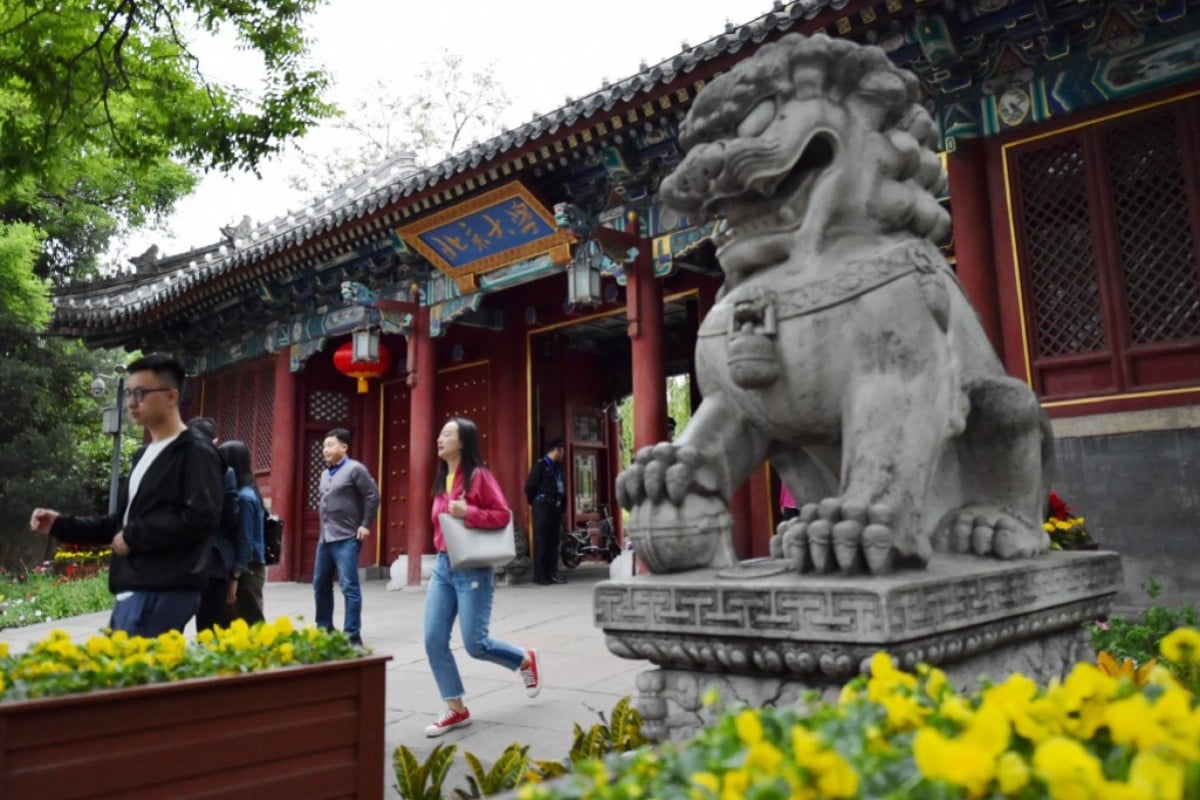
Peking University in Beijing. Photo: Xinhua
US authorities on Thursday charged a professor at a university in Tennessee with fraud and false statements, saying he hid his link to a Chinese institution while taking funding from Nasa.
In the latest case related to US efforts to halt alleged unauthorised technology transfers to China, the Justice Department said Anming Hu hid his ties to Peking University of Technology while he taught and did research at University of Tennessee, Knoxville.
The indictment said that from 2016, Hu “engaged in a scheme to defraud the National Aeronautics and Space Administration” (Nasa) by hiding his affiliation with the Peking University.
“Federal law prohibits Nasa from using appropriated funds on projects in collaboration with China or Chinese universities,” the Justice Department said in a statement.
Hu was arrested on Thursday and charged with three counts of wire fraud and three counts of making false statements.
The wire fraud charges bring up to 20 years in prison and a fine of up to $250,000 each; the false statement counts each bring a maximum five years in prison.
Chinese man pleads guilty to photographing US Navy base
The case was brought by the national security division of the Justice Department, which has taken aim over the past year at a number of Chinese nationals for allegedly stealing industrial and other secrets to boost China’s economy and defence sectors.
“This is just the latest case involving professors or researchers concealing their affiliations with China from their American employers and the US government. We will not tolerate it,” said John Demers, the assistant attorney general for national security.
US charges Harvard chemistry chair with lying about China ties
Washington says Beijing both pressures and incentivises its nationals to bring back proprietary technology from the US.
Among those arrested for allegedly supporting Beijing’s illicit technology acquisition efforts is the chairman of Harvard University’s chemistry and chemical biology department.
Charles Lieber allegedly hid from Harvard and US authorities payments of $50,000 a month for his personal needs and $1.5 million in lab funding from a Chinese university.
Source: SCMP
Posted in academic, acquisition, Anming Hu, Beijing’s, charged, China, Harvard, hiding, illicit, NASA, National Aeronautics and Space Administration” (Nasa), Peking University, Technology, Tennessee, ties, Uncategorized, US professor, US space agency |
Leave a Comment »
12/02/2020
- Excluded from the World Health Organisation on mainland China’s objections, Taipei said it dealt directly with organisation on outbreak
- Beijing and the WHO say they ensured Taiwan was kept up to date with virus developments
Taiwan says it dealt directly with the WHO over the virus outbreak and did not need mainland China’s permission to do so. Photo: Getty Images
Taiwan’s presence at a World Health Organisation (WHO) meeting this week on the coronavirus outbreak that started in mainland China was the result of direct talks between the island and the body, and did not require Beijing’s permission,
Taipei
said on Wednesday.
Its exclusion from WHO membership because of Chinese objections has been an increasingly sore point for Taiwan during the outbreak. It complained that it was unable to get timely information from the WHO and accused Beijing of passing incorrect information about Taiwan’s total virus case numbers, which stand at 18.
But in a small diplomatic breakthrough for the island – which mainland China regards as a wayward province – its health experts were this week allowed to attend an online technical meeting on the virus.
The Chinese foreign ministry said that was because Beijing gave approval for Taiwan’s participation. Taiwan foreign ministry spokeswoman Joanne Ou said China was trying to take credit for something it did not deserve.
Coronavirus: Taiwan restricts travellers from Hong Kong and Macau amid outbreak crisis
“The participation of our experts at this WHO forum was an arrangement made by our government and the WHO directly. It did not need China’s approval,” Ou said.
Taiwan’s experts took part in a personal capacity to avoid political disputes, and did not give their nationality when joining the online forum, she said.
Coronavirus: Everything you need to know in a visual explainer
Taiwan’s WHO exclusion became another point of contention between China and the United States last week, after the US ambassador to the UN in Geneva told the WHO’s executive board that the agency should deal directly with Taipei.
Mainland China, which said Beijing adequately represents Taiwan at the WHO, accused the US of a political “hype-up” about the issue.
Beijing and the WHO said they had ensured Taiwan was kept up to date with virus developments and that communication with the island was smooth.
Beijing insists that Taiwan cannot be part of the World Health Organisation as the island is part of “one China”. Photo: AFP
Taipei said that it alone had the right to represent the island’s 23 million people, that it has never been a part of the People’s Republic of China, and that it has no need to be represented by it.
Source: SCMP
Posted in “one China”, Beijing, Beijing’s, China’s objections, Chinese foreign ministry, coronavirus, developments, ensured, Excluded, Geneva, health experts, Hong Kong, island, Macau, Mainland China, meeting, online, organisation, outbreak, People’s Republic of China, permission, Taipei, Taiwan, take part, technical, Uncategorized, United States, US ambassador to the UN, WHO, WHO’s, World Health Organisation |
Leave a Comment »
20/01/2020
- Furious internet users have been digging for information on her background as they push for an explanation, while state media urges probe
- ‘Lu Xiaobao’, who posted pictures of her and a friend with her car at the site, claims to be the wealthy granddaughter-in-law of a revolutionary hero
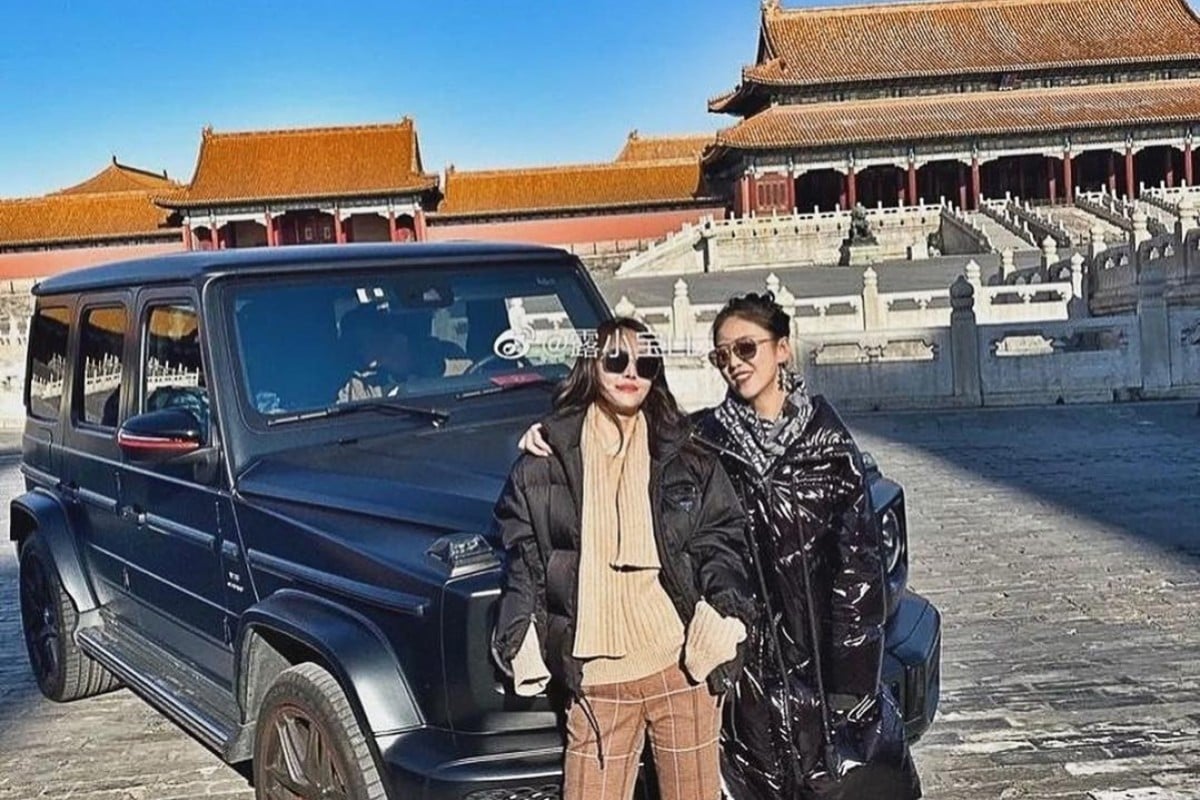
Pictures of the women posing in front of a car in the Forbidden City went viral. Photo: Weibo
A Chinese woman who
drove her luxury SUV into Beijing’s Forbidden City
and posted pictures online has prompted a public search for information about her, while state media called for the case to be investigated.
The photos – showing two women standing in front of a Mercedes-Benz G-Wagen parked in the World Heritage Site, which banned vehicles in 2013 – were posted on microblog site Weibo on Friday under the name “LuxiaobaoLL”. It was captioned: “As it is closed on Monday, [we] avoided tourists and enjoyed the palace.” The post went viral and drew tens of thousands of comments.
The Palace Museum, which runs the 600-year-old landmark, later apologised, confirming that a car had been allowed to enter the complex on Monday last week when it was closed to the public.
It did not identify the pair, but said it would “stop it from happening again”.
Lu Xiaobao claims she is married to the grandson of revolutionary hero He Changgong. Photo: Weibo
Social media user Lu Xiaobao, who posted the photos of herself and a friend, has claimed to be the wealthy granddaughter-in-law of a Chinese revolutionary hero, and that her fortune includes a house in Los Angeles worth more than US$11 million.
Lu herself and the family she says she married into have so far remained silent, and the claims could not be independently verified. But irate social media users have been digging online for information on her background as they push for an official explanation.
Some are concerned that flouting the car ban risked damaging the Ming dynasty complex, and the incident has also reinforced a widespread perception that certain people are granted privileges denied to ordinary Chinese because of their family connections.
Lucky Air passenger who threw ‘good luck’ coins at plane ordered to pay airline US$17,200
Social media users seized on one of Lu’s Instagram posts featuring a house she claims to have bought in 2018. The property is apparently owned by Wang Zhijie, wife of Liu Zhongtian, the billionaire founder of aluminium products maker China Zhongwang, raising suspicion that Lu could be connected to the family.
But the company denied there was any link with the woman in a statement issued on Sunday. “Mr Liu himself doesn’t know Luxiaobao LL or her relatives directly,” it said.
State media has also weighed in on the case, with People’s Daily, the Communist Party mouthpiece, running a scathing commentary on Saturday calling for a thorough investigation by the Palace Museum.
“People are distressed because our national heritage and culture – which we treasure – has been damaged,” the commentary read. “People are furious because there are still people trying to challenge the consensus that the 600-year-old Forbidden City is no longer a private property for feudal privilege.”
The history of the Forbidden City: a visual explainer Hu Xijin, editor-in-chief of state-run tabloid Global Times, also called for a better explanation of the incident.
The woman has claimed that she is married to He Gang, the grandson of He Changgong, who joined the party in 1922, a year after it was established, and played an important role in its early development.
But Hu wrote on Weibo that if the woman’s claim was true, her background was “not so eminent” since He Changgong had not taken any important positions after the founding of the People’s Republic in 1949.
The Palace Museum banned vehicles from the Forbidden City in 2013 to protect the complex. The ban has been strictly enforced, including when former French president Francois Hollande visited that year and had to leave his car outside and walk into the palace.
Posted in 1949, Beijing’s, Chinese revolutionary hero, Communist Party, drove, Francois Hollande, French president, Global Times, Mercedes-Benz G-Wagen, mouthpiece, People’s Daily, The Palace Museum, Uncategorized, Weibo, Woman, World Heritage Site |
Leave a Comment »
17/12/2019
- This is the third instalment in a four-part series examining the brewing US-China tech war over the development and deployment of artificial intelligence tech
- The US is home to five of the world’s top 10 universities in the AI field, which includes computer vision and machine learning, while China has three
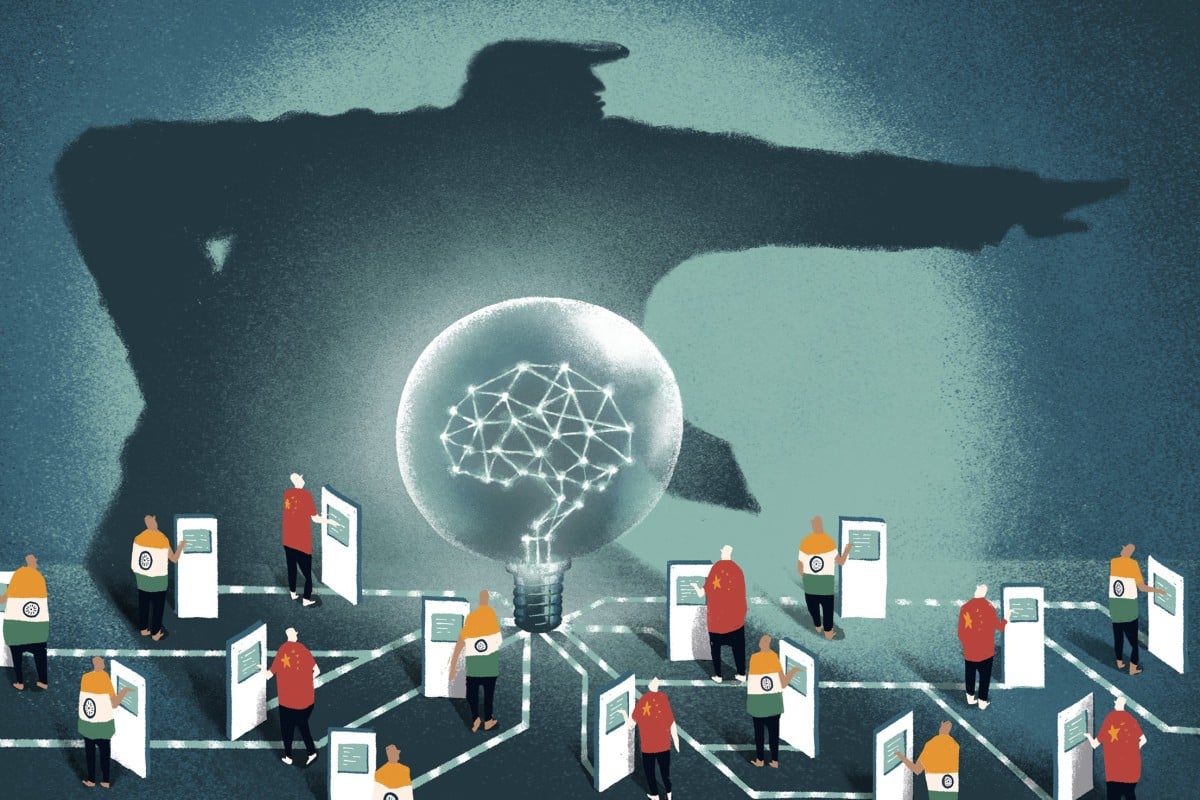
For those Chinese with long-term plans to stay in the US, a major obstacle lies in getting work visas, especially in the current trade war environment. Illustration: Perry Tse
After working in the United States for more than a decade, Zheng Yefeng felt he had hit a glass ceiling. He also saw that the gap in artificial intelligence between China and the US was narrowing.
Last year Zheng, who worked as a researcher at Siemens Healthcare in New Jersey, made a decision that addressed both problems. He accepted an offer to head up the medical research and development team at Tencent’s YouTu artificial intelligence lab in Shenzhen, known as China’s Silicon Valley.
“There was almost no room for promotion if I stayed in the US,” he said, expressing a common dilemma faced by experienced Chinese tech workers in America.
With the US-China trade war leading to tighter scrutiny of Chinese nationals working in the US tech industry, people like Zheng are moving back to China to work in the burgeoning AI sector, especially after Beijing designated AI a national priority. The technology’s varied applications have attracted billions of dollars of venture capital investment, created highly valued start-ups like SenseTime and ByteDance, and sparked a talent war among companies.
That has created an odd symbiotic relationship between the two countries vying for AI supremacy. The US, with its superior higher education system, is the training ground for Chinese AI scientists like Zheng, who obtained a PhD from the University of Maryland after earning bachelor’s and master’s degrees at China’s premier Tsinghua University.
“Many professors in China have great academic ability, but in terms of the number [of top professors], the US is ahead,” said Luo Guojie, who himself accepted an offer from Peking University to become an assistant professor after studying computer science in the US.
Among international students majoring in computer science and maths in US universities, Chinese nationals were the third largest group behind Indians and Nepalese in the 2018-2019 academic year, representing 19.9 per cent, according to the Institute of International Education.
[To build] the best universities is not easy. The university is a free speech space, whereas in China, this is not the case Gunther Marten, a senior official with the European Union delegation to China
The South China Morning Post spoke with several Chinese AI engineers who decided to stay and work in the US after their studies. They only agreed to give their surnames because of the sensitivity of the issues being discussed.
A 25-year-old Beijinger surnamed Lin graduated from one of China’s best engineering schools in the capital before heading to a US university for a master’s degree in computer science in 2017. Like some of his peers, he found the teaching methods in China to be outdated.
“It’s hard to imagine that a final exam of a coding course still asked you to hand write code, instead of running and testing it on a computer,” said Lin, who now works as a software engineer for Google in Silicon Valley.
“Although we still had to take writing tests [in the US], we had many practical opportunities in the lab and could do our own projects,” he added.
A Facebook software engineer surnamed Zhuang had a similar experience at his university in Shanghai.
“Many engineering students [in China] still get old-school textbooks and insufficient laboratory training,” he said. “Engineering practices for AI have been through a fast iteration over the past few decades, which means many Chinese students are not exposed to the most updated knowledge in the field, at least not in the classroom.”
Zhuang also noted out that many classes in China are taught in Chinese, meaning engineering graduates are not fluent in English, the preferred language of the global AI research community.
The US is home to five of the world’s top 10 universities in the AI field, which includes computer vision and machine learning, while China has three. Carnegie Mellon University (CMU) in Pennsylvania ranks No 1 while China’s Tsinghua University is No 2, according to CSrankings, which bases the list on papers published since 2009.
US tech chief: China is threatening US’ lead in global AI race
With its top institutions and an open culture that encourages freedom of speech, including unfettered internet access, the US has become a magnet for the brightest AI students the world over.
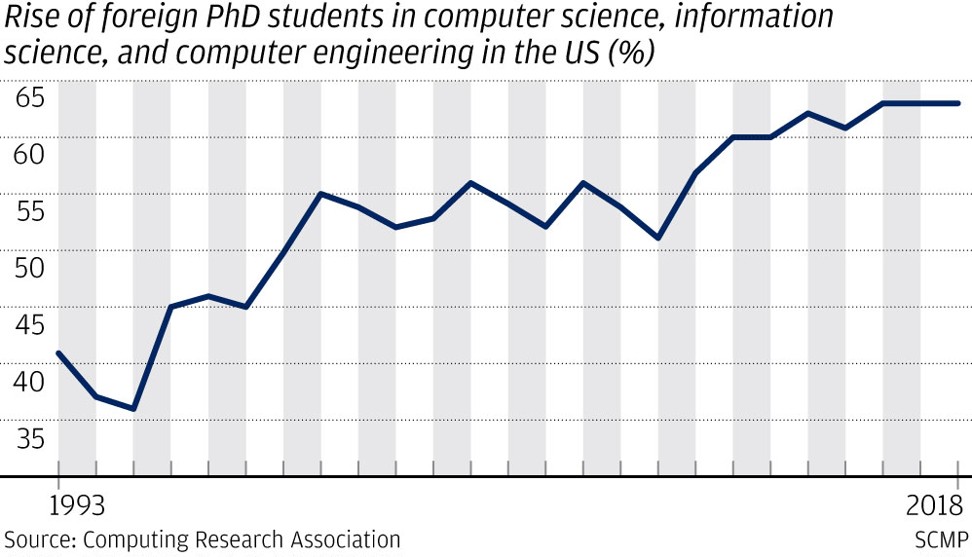
In 2018, 62.8 per cent of PhD degrees and 65.4 per cent of master’s degrees in computer science, information science and computer engineering programmes in the US were granted to “non-resident aliens”, according to a survey by the Computing Research Association.
“[To build] the best universities is not easy,” Gunther Marten, a senior official with the European Union delegation to China, said on the sidelines of the World Internet Conference in Wuzhen in October. “The university is a free speech space, whereas in China, this is not the case.”
When these US-educated AI scientists finish studying, most take advantage of a rule allowing them to stay in the country for three years to gain work experience.
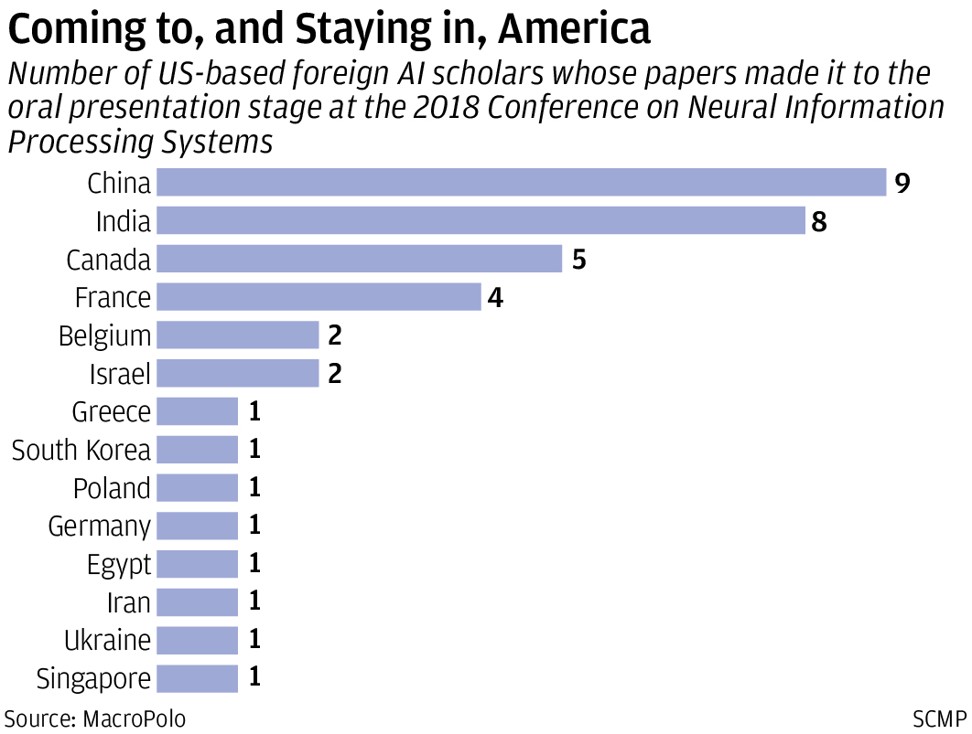
Of the foreign nationals taking part in last year’s Conference on Neural Information Processing Systems (NIPS), a major machine learning event for AI professionals, 87 per cent of those whose papers made it to the oral presentation stage went to work for American universities or research institutes after earning their PhD, according to MacroPolo, a think tank under the Paulson Institute.
“China has many great universities and companies, especially in certain subfields of AI such as computer vision, but many people remain hesitant to move to China due to the political environment, quality of life concerns and workplace issues,” said Remco Zwetsloot, a research fellow at Georgetown University’s Center for Security and Emerging Technology (CSET).
China’s PhD students miserable, yet hopeful: survey
Some of the US-trained Chinese AI engineers told the Post they were scared off by China’s “996” working culture: 9am to 9pm, six days a week. Tech firms in China typically expect their employees to work long hours to prove their dedication.
Lin, the Beijinger who now works for Google, used to be an intern at one of China’s largest internet giants. “I worked from the time I woke up until going to bed,” he said, “At Google, I’ve been confused because many people here only work till 5pm but Google is still a global leader.” Lin said he would be happy to return to China if the 996 work culture eases.
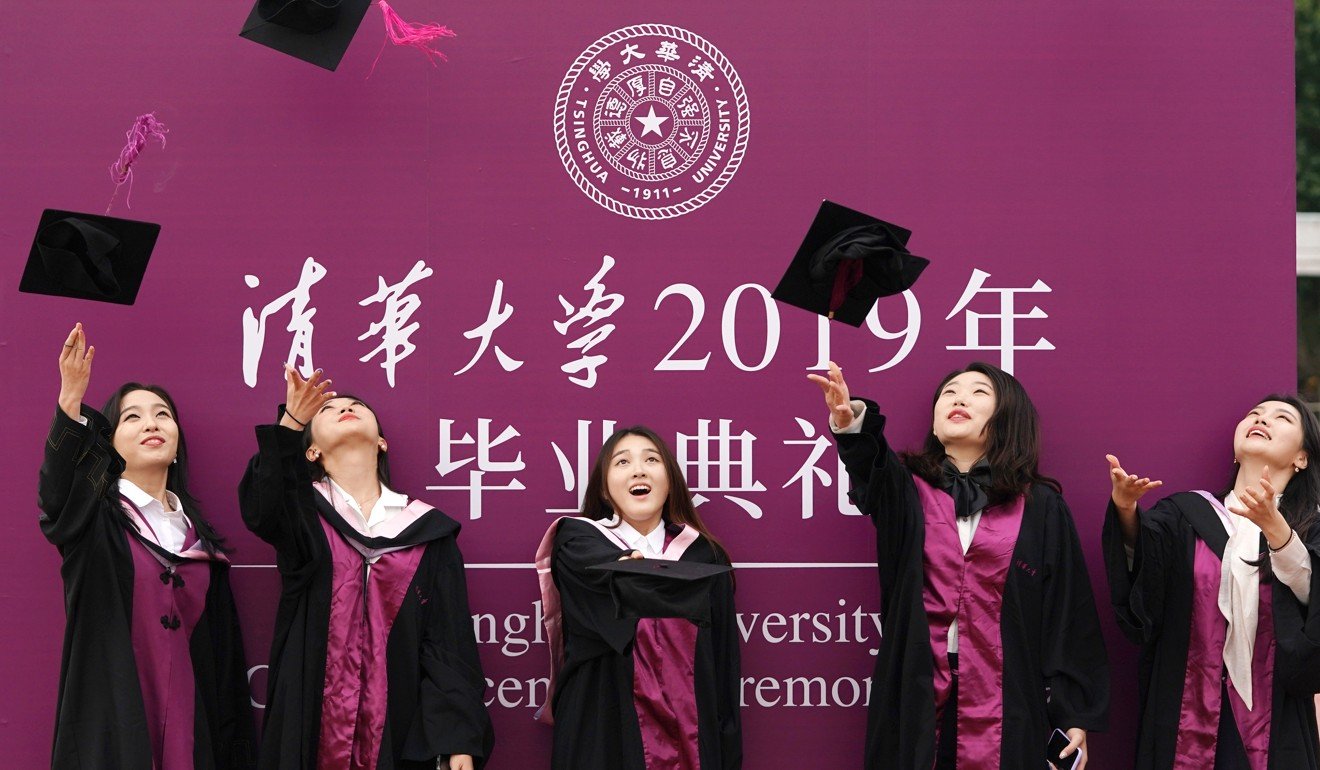
Graduates throw their caps in the air as they pose for a group photo during the 2019 commencement ceremony of Tsinghua University in Beijing. Tsinghua ranks as China’s top university for AI. Photo: Xinhua
Chen, a female postgraduate student at Carnegie Mellon, who recently accepted a job offer from Google, once interned at Beijing-based AI unicorn SenseTime, where she worked from 10am to between 8pm and 10pm most days.
A SenseTime spokesperson said the company has adopted flexible working hours for its employees.
Besides a better work-life balance, Chinese graduates look for jobs in Silicon Valley because of the higher pay.
“If you include pre-tax income, many of us get offers that pay more than 1 million yuan (US$142,000) a year but in China the salaries offered to the best batch of fresh undergraduates are about 200,000 to 300,000 yuan (US$28,000 to US$43,000),” Chen said.
Still, for those Chinese with long-term plans to stay in the US, a major obstacle lies in getting work visas, especially in the current trade war environment. Most AI-related workers are on H-1B visas that allow US companies to employ non-US nationals with expertise in specialised fields such as IT, finance and engineering.
However, the number of non-immigrant H-1B visas granted has started to fall since 2016, when it peaked at 180,000, according to the US Department of State, and US tech companies have complained that a policy shift by the Trump administration has made the approval process longer and more complicated.
In 2017, President Donald Trump requested an overhaul of the H-1B visa programme, saying he did not want it to enable US tech companies to hire cheaper foreign workers at the expense of American jobs. He also wants to give priority to highly skilled people and restrict those wanting to move to the US because of family connections.
Science graduates from overseas countries can stay in the US with their student visas for up to three years while competing for the hard to get work visas, which are granted based on undisclosed mechanisms. Overseas students already working in the US can apply for so-called green cards, which offer permanent residency.
After working for a major US tech company for almost three years on a student visa, one Chinese software engineer, who spoke to the Post on condition of anonymity, said she was relocated to the US firm’s Beijing office last year after failing to obtain a H-1B work visa.
“While there might be individual cases, it seems like the current tensions have not – at least as of a few months ago – led to noticeable changes in the overall number of Chinese students staying in the US after graduating,” said CSET’s Zwetsloot.
Some Chinese AI scientists use Twitter to announce their decision to stay. Chen Tianqi, who just obtained a PhD at the University of Washington in Seattle, and Jun-Yan Zhu, a CMU and UC Berkeley alumnus currently working at Adobe, each tweeted that they would join Carnegie Mellon as assistant professors next year.
To achieve the goal of turning China into “the world’s primary AI innovation centre” by 2030, according to a 2017 blueprint issued the State Council, the central government has stepped up efforts to attract US-educated talent.
The Thousand Talents Plan has seen more than 6,000 overseas Chinese students and academics return since its was established in 2008, but because of escalating tensions with the US, Beijing has played down the initiative.
Longer term, Beijing’s willingness to invest significant sums into the AI sector could see more Chinese return for the better employment opportunities. Between 2013 and the first quarter of 2018, China attracted 60 per cent of global investment in AI, according to a Tsinghua University report.
China’s spending on AI may be far lower than people think
Chinese authorities are investing heavily in the sector, with the city of Shanghai setting up a 10 billion yuan (US$142 million) AI fund in August and Beijing city government announcing in April it would provide a 340 million yuan (US$48 million) grant to the Beijing Academy of Artificial Intelligence.
“More and more senior people like me have come back, and some start their own businesses,” said Zheng, the Siemens Healthcare researcher who joined Tencent. “It’s easier for Chinese to seek venture capital in China than in other countries.”
Source: SCMP
Posted in Adobe, AI, Artificial intelligence, artificial intelligence (AI), artificial intelligence lab, Beijing Academy of Artificial Intelligence, Beijing’s, Beijinger, Carnegie Mellon, Carnegie Mellon University (CMU), China’s Silicon Valley, Chinese, computer vision, Computing Research Association, Conference on Neural Information Processing Systems (NIPS), countries, dominance, European Union, Facebook, Georgetown University’s Center for Security and Emerging Technology (CSET), Google, H-1B visa programme, Home, hopes, machine learning, MacroPolo, New Jersey, overseas, Paulson Institute, Pennsylvania, return, Science graduates, Seattle, SenseTime, Shanghai, Shenzhen, Siemens Healthcare, Silicon Valley, south china morning post, TENCENT, Tencent’s YouTu, Thousand Talents Plan, Tsinghua University, Twitter, UC Berkeley, Uncategorized, University of Maryland, University of Washington, US Department of State, US-China trade war, US-educated |
Leave a Comment »
12/12/2019
BEIJING/SYDNEY (Reuters) – China has raised “important concerns” with Boeing Co (BA.N) regarding design changes proposed to end the grounding of the Boeing 737 MAX airliner, Beijing’s aviation regulator said on Thursday, declining to say when it might fly in China again.
The remarks broke months of public silence from China, the first country to ground the 737 MAX in March following the second deadly crash involving the model in less than five months.
“Boeing is currently upgrading its software to the 737 MAX, and it is still a work in progress. The CAAC has raised our important concerns on areas such as system reliability and safety assessment,” Civil Aviation Administration of China (CAAC) spokesman Liu Lusong told reporters at a monthly briefing.
The 737 MAX would need to be re-certified and pilots given comprehensive and effective training before it could fly in China, he reiterated.
He said the causes of two crashes that killed 346 people needed to be investigated with effective measures put in place to prevent another one.
China in April said it had set up a task force to review design changes submitted by Boeing.
The U.S. Federal Aviation Administration (FAA) will not allow the 737 MAX to resume flying before the end of 2019, its chief, Steve Dickson, said on Wednesday.
“We continue to work with the FAA, CAAC and global regulators on addressing their concerns in order to safely return the MAX to service,” Boeing said in a statement on Thursday.
FAA approval would allow the 737 MAX to resume flights in the United States, but individual national regulators could keep the planes grounded pending completion of their own reviews.
“Due to the trade war, the jury is still out on when China would reintroduce the aircraft,” said Rob Morris, global head of consultancy at Ascend by Cirium.
Source: Reuters
Posted in 'important concerns', aviation regulator, Beijing’s, Boeing 737 MAX, Boeing Co (BA.N), CAAC, China alert, Civil Aviation Authority of China (CAAC), design changes, regulator, U.S. Federal Aviation Administration (FAA), Uncategorized |
Leave a Comment »







 CHINDIA ALERT: You'll be living in their world, very soon