Chindia Alert: You’ll be Living in their World Very Soon
aims to alert you to the threats and opportunities that China and India present. China and India require serious attention; case of ‘hidden dragon and crouching tiger’.
Without this attention, governments, businesses and, indeed, individuals may find themselves at a great disadvantage sooner rather than later.
The POSTs (front webpages) are mainly 'cuttings' from reliable sources, updated continuously.
The PAGEs (see Tabs, above) attempt to make the information more meaningful by putting some structure to the information we have researched and assembled since 2006.
NEW DELHI (Reuters) – U.S. President Donald Trump said on Tuesday that India will buy $3 billion worth of military equipment, including attack helicopters, as the two countries deepen defence and commercial ties in an attempt to balance the weight of China in the region.
India and the United States were also making progress on a big trade deal, Trump said. Negotiators from the two sides have wrangled for months to narrow differences on farm goods, medical devices, digital trade and new tariffs.
Trump was accorded a massive reception in Indian Prime Minister Narendra Modi’s home state on Monday, with more than 100,000 people filling into a cricket stadium for a “Namaste Trump” rally.
On Tuesday, Trump sat down for one-on-one talks with Modi followed by delegation-level meetings to try and move forward on issues that have divided them, mainly the festering trade dispute.
RELATED COVERAGE
U.S. first lady Melania Trump visits ‘happiness’ class at Delhi school
After those meetings, Trump said his visit had been productive with the conclusion of deals to buy helicopters for the Indian military. India is buying 24 SeaHawk helicopters from Lockheed Martin equipped with Hellfire missiles worth $2.6 billion and also plans a follow-on order for six Apache helicopters.
India is modernising its military to narrow the gap with China and has increasingly turned to the United States over traditional supplier, Russia.
Trump said the two countries were also making progress on a trade deal, which had been an area of growing friction between them.
“Our teams have made tremendous progress on a comprehensive trade agreement and I’m optimistic we can reach a deal that will be of great importance to both countries,” said Trump in remarks made alongside Modi.
The two countries had initially planned to produce a “mini deal”, but that proved elusive.
Instead both sides are now aiming for a bigger package, including possibly a free trade agreement.
Trump said he also discussed with Modi, whom he called his “dear friend”, the importance of a secure 5G telecoms network in India, ahead of a planned airwaves auction by the country.
The United States has banned Huawei, arguing the use of its kit creates the potential for espionage by China – a claim denied by Huawei and Beijing – but India, where telecoms companies have long used network gear from the Chinese firm, is yet to make a call.
Trump described Monday’s rally in Ahmedabad and again praised Modi and spoke of the size of the crowd, claiming there were “thousands of people outside trying to get in..
“I would even imagine they were there more for you than for me, I would hope so,” he told Modi. “The people love you…every time I mentioned your name, they would cheer.”
In New Delhi, Trump was given a formal state welcome on Tuesday at the red sandstone presidential palace with a 21-cannon gun salute and a red coated honour guard on horseback on a smoggy day.
HUG GETS TIGHTER
India is one of the few big countries in the world where Trump’s personal approval rating is above 50% and Trump’s trip has got wall-to-wall coverage with commentators saying he had hit all the right notes on his first official visit to the world’s biggest democracy.
They were also effusive in their praise for Modi for pulling off a spectacular reception for Trump.
“Modi-Trump hug gets tighter,” ran a headline in the Times of India.
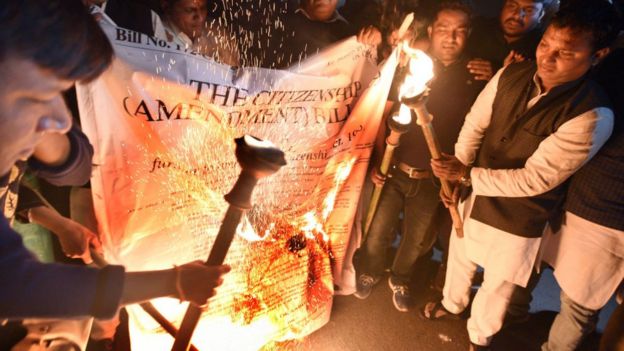
But in a sign of the underlying political tensions in India, violent protests broke out in Delhi on Monday over a new citizenship law that critics say discriminates against Muslims and is a further attempt to undermine the secular foundations of India’s democracy. They say the law is part of a pattern of divisiveness being followed by Modi’s Hindu nationalist Bharatiya Janata Party.
At least 7 people were killed and about 150 injured in the clashes that took place in another part of the capital, away from the centre of the city where Modi is hosting Trump.
In his speech on Monday, Trump extolled India’s rise as a stable and prosperous democracy as one of the achievements of the century. “You have done it as a tolerant country. And you have done it as a great, free country,” he said.
Delhi has also been struggling with high air pollution and on Tuesday the air quality was moderately poor at 193 on a government index that measures pollution up to a scale of 500. The WHO considers anything above 60 as unhealthy.
NEW DELHI (Reuters) – Violent clashes erupted in Delhi between police and hundreds of university students on Friday over the enactment of a new citizenship law that critics say undermines India’s secular foundations.
The unrest has already led Japanese Prime Minister Shinzo Abe to cancel a planned visit to India from Sunday.
The new law offers a way to Indian citizenship for six minority religious groups from neighbouring Bangladesh, Pakistan and Afghanistan including Hindus and Christians, but not Muslims.
RELATED COVERAGE
Explainer: What does India’s new citizenship law mean?
Clashes erupt in New Delhi between students, police over citizenship law
See more stories
Police fired tear gas and used baton charges to disperse scores of students demonstrating at Jamia Millia Islamia university in the heart of Delhi over the law.
Protesters attacked cars in the capital, and several people were injured and taken to hospital.
Zakir Riyaz, a PhD student in social work, said the new law made a mockery of India’s religious openness.
“It goes against the whole idea of a secular India,” he said, speaking by phone from the Holy Family Hospital in New Delhi where 15 of his fellow students were admitted after being injured in a police baton charge.
Police barricades were knocked down and streets were strewn with shoes and broken bricks. An official at the university dispensary said that more than 100 students had been brought in with injuries but all had been discharged.
Parvez Hashmi, a local politician who went to the protest site to speak to police, said about 50 students had been detained.
Students said it was meant to be a peaceful protest, with them trying to go from Jamia University to Parliament Street to show their opposition to the legislation. But police pushed them back, leading to clashes.
Critics of Prime Minister Narendra Modi’s government say it is promoting a Hindu-first agenda for India and that the citizenship law excluding Muslims showed a deep-seated bias against India’s 170 million Muslims.
Imran Chowdhury, a researcher, said “either give citizenship to refugees of all religions or none at all. The constitution is being tampered with in the name of religion.”
Modi’s ruling Bharatiya Janata Party denies any religious bias but says it is opposed to the appeasement of one community. It says the new law is meant to help minority groups facing persecution in the three nearby Muslim countries.
ABE CANCELS
The United Nations human rights office voiced concern that the new law is “fundamentally discriminatory in nature”, and called for it to be reviewed.
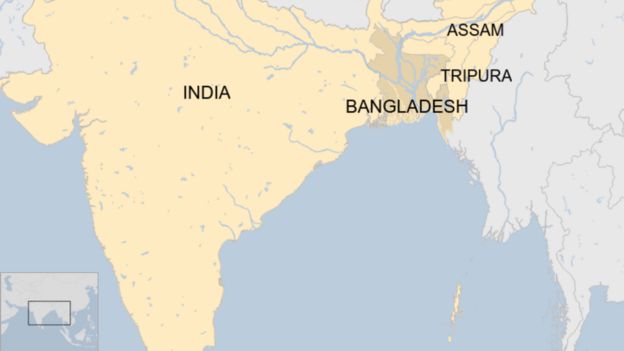
Two people were killed in India’s Assam state on Thursday when police opened fire on mobs torching buildings and attacking railway stations in protest at the new citizenship rules signed into law on Thursday.
Japan’s Prime Minister Shinzo Abe cancelled a trip to Assam for a summit with his Indian counterpart Narendra Modi that had been due to begin on Sunday.
Japan has stepped up infrastructure development work in Assam in recent years, which the two sides were expected to highlight during the summit. Abe had also planned to visit a memorial in the nearby state of Manipur where Japanese soldiers were killed in World War Two.
“With reference to the proposed visit of Japanese PM Abe Shinzo to India, both sides have decided to defer the visit to a mutually convenient date in the near future,” Indian foreign ministry spokesman Raveesh Kumar said in a tweet.
Japan’s Chief Cabinet Secretary Yoshihide Suga said both countries would decide on the appropriate timing for the visit although nothing has been decided yet.
A movement against immigrants from Bangladesh has raged in Assam for decades. Protesters there say granting Indian nationality to more people will further strain the state’s resources and lead to the marginalisation of indigenous communities.
“The central government and I are totally committed to constitutionally safeguard the political, linguistic, cultural and land rights of the Assamese people,” he tweeted.
However, with internet and mobile services shut down, it is unlikely residents would have been able to read the message.
The chief minister of Assam was stranded at the airport for several hours on Wednesday because roads were blocked by protests.
What do protesters want?
They want the bill to be repealed, as they say their ethnic and cultural identity is under threat from illegal migration.
Essentially, they do not want any migrants – regardless of religion – to be allowed into the state.
The National Register of Citizens (NRC) is a list of people who can prove they came to the state by 24 March 1971, a day before neighbouring Bangladesh became an independent country.
In the run-up to its publication, the BJP had supported the NRC, but changed tack days before the final list was published, saying it was error-ridden.
The reason for that was a lot of Bengali Hindus – a strong voter base for the BJP – were left off the list, and would possibly become illegal immigrants.
The CAB is seen as being linked to the register, although it is not the same thing.
It will help protect non-Muslims who are excluded from the register and face the threat of deportation or internment.
Has the bill been challenged?
The Indian Union Muslim League, a political party, has petitioned the country’s top court to declare the bill illegal.
In their petition to the Supreme Court, the Indian Union Muslim League argued that the bill violated articles of equality, fundamental rights and the right to life.
HYDERABAD, India (Reuters) – Indian police shot dead four men on Friday who were suspected of raping and killing a 27-year-old veterinarian near Hyderabad city, an action applauded by her family and many citizens outraged over sexual violence against women.
However, some rights groups and politicians criticised the killings, saying they were concerned the judicial process had been sidestepped.
The men had been in police custody and were shot dead near the scene of last week’s crime after they snatched weapons from two of the 10 policemen accompanying them, said police commissioner V.C. Sajjanar.
Thousands of Indians have protested in several cities over the past week following the veterinarian’s death, the latest in a series of horrific cases of sexual assault in the country.
RELATED COVERAGE
Factbox: Reactions, comments on killing of four men accused of rape in India
Why many Indians cheered police for killing gang rape accused
See more stories
The woman had left home for an appointment on her motor-scooter and later called her sister to say she had a flat tyre. She said a lorry driver had offered to help and that she was waiting near a toll plaza.
Police said she was abducted, raped and asphyxiated and her body was then set alight on the outskirts of Hyderabad. Four men were arrested.
Sajjanar, the police officer, said the men – two truck drivers and two truck cleaners, aged between 20 and 26 years – had been taken to the spot to help recover the victim’s mobile phone and other personal belongings on Friday morning.
“As the party approached this area today (during the) early hours, all the four accused got together. They started attacking the police party with stones, sticks and other materials,” he told reporters near the site of the shootings.
The men, who were not handcuffed, then snatched weapons away from the police and started firing at them, but were killed after the police retaliated. He did not say how the accused were able to overpower their escorts.
“Law has done its duty, that’s all I can say,” Sajjanar said.
The National Human Rights Commission, a government-funded watchdog, said it had ordered an investigation. “Death of four persons in alleged encounter with the police personnel when they were in their custody, is a matter of concern for the Commission,” it said in a statement.
Indian police have frequently been accused of extra-judicial killings, called “encounters”, especially in gangland wars in Mumbai and insurrections in the state of Punjab and in disputed Kashmir. Police officers involved in such killings were called “encounter specialists” and were the subject of several movies.
People shout slogans as they celebrate after police shot dead four men suspected of raping and killing a 27-year-old veterinarian in Telangana, in a residential area in Ahmedabad, India, December 6, 2019. REUTERS/Amit Dave
‘LONG LIVE POLICE’
The victim’s family welcomed the news the alleged perpetrators had been killed.
“I express my gratitude towards the police & govt for this. My daughter’s soul must be at peace now,” Reuters partner ANI quoted her father as saying.
A Reuters reporter saw the four men’s bodies lying in an open field, all of them face up and barefoot, with their clothes stained with blood, surrounded by policemen.
A large crowd gathered at the site and threw flower petals at police vans in support of the action. Some shouted “Long live police”, while others hoisted police officials onto their shoulders and burst firecrackers.
There was no immediate word from Prime Minister Narendra Modi’s government on the incident, but Maneka Gandhi, a lawmaker from his ruling Bharatiya Janata Party, said the police appeared to have over-reached.
“You can’t take the law in your own hands. The courts would’ve ordered them (the accused) to be hanged anyway. If you’re going to shoot them with guns before due process is followed, then what’s the point of having courts, police and law?” she said.
Tough laws were enacted after the 2012 gang rape and murder of a woman in a bus in New Delhi that led to an outpouring of anger across the country, but crimes against women have continued unabated.
Fast track courts have been set up but cases have moved slowly, for lack of witnesses and the inability of many families to go through the long legal process. Some victims and their families have ended up being attacked for pursuing cases against powerful men, often local politicians.
Many Indians applauded the killings.
“Great work #hyderabadpolice ..we salute u,” badminton star Saina Nehwal wrote on Twitter.
In Uttar Pradesh state, where a rape victim was set ablaze on Thursday while she was on her way to court, opposition politician Mayawati said the police there should take “inspiration” from what happened in Hyderabad.
“Culprits should be punished, and if they are not punished then whatever happened in Hyderabad should happen,” the victim’s brother said in hospital.
She was on life support, hospital authorities said, news that could further inflame passions in a country where public anger over crimes against women has grown in recent weeks.
Indian police registered more than 32,500 cases of rape in 2017, according to the most recent government data. But courts completed only about 18,300 cases related to rape that year, leaving more than 127,800 cases pending at the end of 2017.
But some people said the lack of progress in the courts did not mean the police had a free hand to dispense justice.
“We now have to trust that a police force that managed to let unarmed suspects escape their custody, and needed to shoot them dead because they could not catch them alive, is somehow competent enough to have identified and arrested the real culprits?,” Meenakshi Ganguly, South Asia Director at Human Rights Watch, told Reuters from London.
MUMBAI (Reuters) – India’s richest state is set to be ruled by parties opposed to Prime Minister Narendra Modi’s nationalist Bharatiya Janata Party, jeopardising a Japanese-backed bullet-train project opposed by farmers.
The BJP’s inability to pull together voters in the westerly state of Maharashtra, of which Mumbai is capital, has meant that three parties, including a former BJP ally, will form the government. That is a major setback for Modi after his landslide victory in general elections this year.
It could also hinder the bullet train project, a $17 billion investment largely financed by a long-term, low-cost loan from Japan. The BJP was in power in both Maharashtra and Gujarat states when work began on project in 2017.
“We have always opposed the bullet train,” said Manisha Kayande, a spokesperson for the Shiv Sena, a former BJP ally whose leader is now set to head Maharashtra. “Our state is giving a major chunk of money for the project, when most of the track is in another state. This will definitely be re-framed,” .
The train will run from Mumbai to Ahmedabad, the main city in Gujarat state, a distance of 508 kilometres (315 miles). But it has run into obstacles acquiring land amid opposition from fruit farmers.
Any delay of the project is likely to undermine investor confidence, at a time when growth has slowed to its weakest pace in years.
Critics say India does not need the high-speed train and investment should go instead to improve the existing network.
“We are not against development or infrastructure projects, but at the same time farmers’ interests can’t be ignored. We will rethink about projects that farmers are opposing,” said a senior leader of Nationalist Congress Party, which is a part of the coalition government.
National High Speed Rail Corporation (NHSRCL), the government agency overseeing the project, had no immediate comment.
The authorities have acquired 548 hectares land out of the total requirement 1,380 hectares and the project was targeted to be operational by 2023 , the government told parliament in July.
Protests against land acquisitions are common in India, where tens of millions of farmers till small holdings. A planned $44 billion refinery to be run by a consortium including Saudi Aramco, the world’s biggest oil producer, is also struggling to secure land in Maharashtra.
India has formally divided the state of Jammu and Kashmir into two new federally-administered territories.
In the new arrangement, Jammu and Kashmir is one territory, and Ladakh, which borders China, is separate.
The two new union territories are now ruled directly from the capital Delhi.
It’s part of a controversial move announced in August to tighten the Indian government’s control over the part of Kashmir it administers.
R K Mathur and Girish Chandra Murmu were sworn in as lieutenant governors of Ladakh and Jammu and Kashmir respectively on Thursday.
“Now the real participation of co-operative federalism will be seen. New highways, new railway lines, new schools, new hospitals will take the development of the people of Jammu and Kashmir to new heights,” Prime Minister Narendra Modi said at a public rally in the western state of Gujarat.
Union territories have far less autonomy from the federal government than states do.
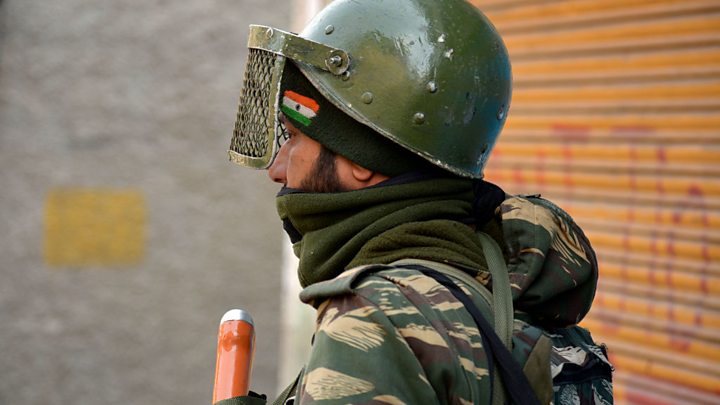
The former state has long been one of the world’s most dangerous flashpoints and is a highly militarised area.
India and Pakistan both claim Kashmir in full, but control only parts of it.
How does this affect the people there?
Almost 98% of the state’s population will be in the union territory of Jammu and Kashmir, comprising two regions – the Muslim-majority Kashmir valley, which has about eight million people, and the Hindu-majority Jammu, which has about six million.
The third region, the newly created union territory of Ladakh, is a high-altitude desert inhabited by 300,000 people, with almost equal numbers of Muslims and Buddhists.
Workers from the previous state government will continue to retain their jobs in the new territories, the government said.
What’s the background?
On 5 August, the government revoked Kashmir’s special status, sparking protests in the Muslim-majority valley.
Article 370, as the constitutional provision guaranteeing special status was known, allowed the region a certain amount of autonomy, including special privileges in property ownership, education and jobs. This provision had underpinned India’s often fraught relationship with Kashmir.
Before the Bharatiya Janata Party-led government announced its decision to scrap the special status, it put the region under lockdown – mobile phone networks, landlines and the internet were cut off; and regional political leaders were placed under house arrest.
Media caption The children being ‘tortured’ in Kashmir
The region also witnessed protests where security forces often clashed with civilians. Thousands of activists and others were believed to have been picked up from their homes in the days that followed the surprise move.
Almost three months later, the situation is still far from normal.
On Tuesday, militants killed five migrant labourers in Kulgam district. Just a day before, a truck driver from outside the region was killed in Anantnag district.
Earlier this month, the Indian government restored mobile services 72 days after they were suspended.
But internet services continue to be suspended and most businesses remain closed – some in protest against the government, and others for fear of reprisals from militants opposed to Indian rule.
ENJERLA/NEW DELHI, India (Reuters) – It was supposed to be Johnson & Johnson’s biggest manufacturing plant in India. It was to eventually employ at least 1,500 people and help bring development to a rural area near Hyderabad in southern India.
Yet, three years after the U.S. healthcare company completed construction of production facilities for cosmetics and baby products on the 47-acre site, they stand idle.
Two sources familiar with J&J’s operations in India and one state government official told Reuters production at the plant, at Penjerla in Telangana state, never began because of a slowing in the growth in demand for the products.
One of them said that demand didn’t rise as expected because of two shock policy moves by Prime Minister Narendra Modi: a late 2016 ban on then circulating high-value currency notes, and the nationwide introduction of a goods and services tax (GST) in 2017.
J&J spokespeople in its Mumbai operations in India and at its global headquarters in New Brunswick, New Jersey, declined to respond to a list of questions from Reuters.
Modi’s office did not respond to a call and an email with questions.
Aimed at rooting out corruption and streamlining the tax system, the double whammy of ‘demonetization’ and GST – were two of Modi’s signature policy moves. But instead of encouraging economic activity as intended, they did the opposite, at least in 2016-2018, by sapping consumer demand, according to some economists.
Many businesses, especially small and medium-sized enterprises, complained publicly – some in their financial statements – that they suffered a drop off in orders. The suspended J&J project stands as one of the most vivid examples of the impact on the broader investment picture.
In the first month after demonetization, some business surveys showed that sales of products such as shampoos and soap fell more than 20 percent.
Lack of jobs growth and a farm-income crisis because of low crop prices have hurt Modi in the current general election, according to several political strategists.
Still, Modi and his ruling Hindu nationalist Bharatiya Janata Party are expected by many of the strategists to be in a position to get a second term – probably with support of some other parties – when votes are counted on Thursday, partly because of his strong stance on national security issues.
BIG INVESTMENTS, GREAT EXPECTATIONS
A range of Modi’s business policies, such as capping prices of medical devices, forcing tech companies to store more data locally and stricter e-commerce regulations have in the past two years hurt plans of American multinationals such as J&J, Mastercard, Amazon and Walmart-owned Flipkart.
The groundbreaking of the J&J facility in Penjerla, its third in the country, was carried out with much fanfare in 2014, attended by Telangana state’s Chief Minister Chandrashekar Rao, who hailed the foreign investment as a big win for local communities. A document dated April 2017 that lists products the company planned to make at the facility, submitted to the Telangana government and reviewed by Reuters, names baby oil, baby shampoo, baby lotion, baby hair oil, face wash and creams.
Shaukat Ali, running a tea shop under a bamboo stall on barren land outside the plant, said local workers check in routinely for possible vacancies at the J&J site, but nothing has come up in years.
At the local pollution control board office, the member secretary Satyanarayana Reddy said the J&J plant had all the required approvals and he was not sure why it hadn’t started production.
“It is unusual for such a big plant to stay idle for so long,” he said. “But there is no problem from our side.”
Chandrasekhar Babu, an additional director at the Telangana industries department, said a J&J company official told him the plant hadn’t started due to lack of demand.
GST and demonetization were two key reasons the plan didn’t kick off, one of the sources said, adding that lack of consumer demand since then dented company’s plans.
The second source familiar with J&J’s plans said the company miscalculated Indian market demand.
On a recent visit by a Reuters reporter to the J&J plant, plush, furnished conference rooms and cubicles sat inactive; M. Sairam, who said he was the site manager, told Reuters production areas with machines were idle too.
PLANNED FURTHER EXPANSION
Local officials had hoped the initial J&J plant would be only the beginning. After the groundbreaking in 2014, Pradeep Chandra, who was Telangana’s special chief secretary of industries, told Business Today magazine that “based on the extent of land (J&J) have acquired we believe that they are looking at much larger expansion here.”
Local media reports at the time said the J&J facility would employ some 1,500 people.
A J&J official, who was not identified by name, was reported subsequently in December 2016 in India’s Business Standard assaying that the $85 million plant would be operational by 2018 after it had overcome procedural delays. The official was quoted as saying the company had earmarked an additional $100 million for expansion.
Vikas Srivastava, the managing director of J&J Consumer(India), who was at the 2014 groundbreaking, did not respond to calls for comment.
Reuters also talked to two workers outside a sprawling Procter & Gamble facility making detergents and diapers, which is next to the J&J plant. They said they were part of the P&G plant’s production team and the plant had been running below capacity.
A P&G spokesperson denied that, saying the plant was “operating at full capacity in line with our business plans”. “India is a priority market for P&G globally and in recent quarters, P&G’s business in India has registered strong double-digit growth consistently,” the company said.
The weak rural economy, where most Indians work, has also hurt growth in sales of basic items such as detergents and shampoo in the past year.
Hindustan Unilever Ltd, an industry bellwether that would compete with the likes of J&J and P&G in some categories, said its volume growth shrank to 7 percent in the quarter ended March 31, down from double-digit growth in the previous five quarters.
The company warned that the daily consumer goods segment in India was “recession resistant … not recession proof.”
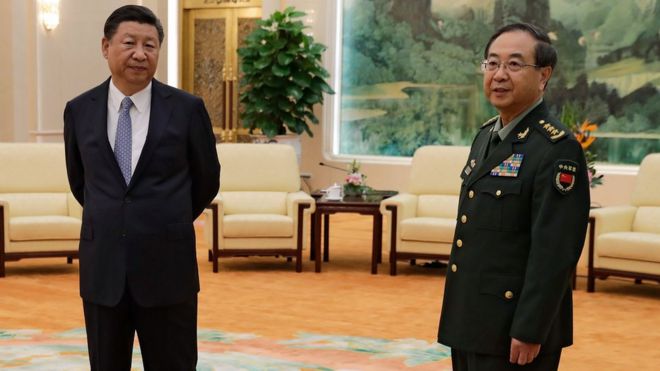
Image copyrightAFPImage captionFang Fenghui with President Xi Jinping in 2017
A former high-ranking Chinese general has been sentenced to life in jail for corruption, state media reports.
Fang Fenghui, ex-chief of joint staff of the People’s Liberation Army, was found guilty of bribery and having huge wealth that he had been unable to account for, according to Xinhua.
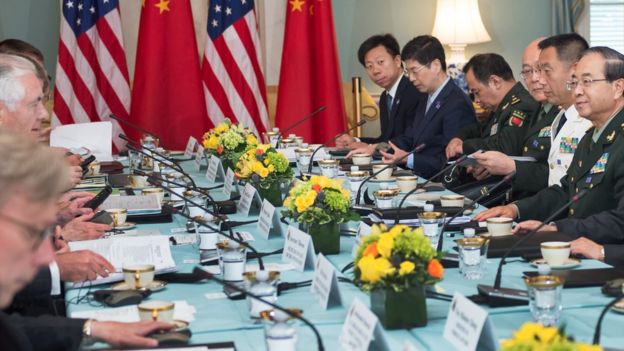
The 67-year-old accompanied President Xi Jinping in his first meeting with US President Donald Trump in 2017.
Many officials have been jailed in what Mr Xi says is an anti-corruption drive.
The efforts have had a particular focus on the country’s military, which is the world’s largest and is undergoing a modernisation campaign.
Fang Fenghui lost his post with no explanation in 2017 and disappeared from public view. The government later confirmed he was under investigation for alleged corruption.
Image copyrightAFPImage captionFang Fenghui in a meeting with US officials, including former Secretary of State Rex Tillerson, in Washington in 2017
He was also a member of the powerful Central Military Commission, China’s supreme military body, and was close to Zhang Yang, who also served on the commission and was found dead in 2017 while being investigated for corruption.
Fang was expelled from the Communist Party last year ahead of his trial at a military court.
All his assets have been confiscated, Xinhua adds, without mentioning how much money was involved.
It is unclear whether he was allowed to retain a lawyer, Reuters news agency reports.
More than one million officials have been punished in the anti-corruption drive started by Mr Xi when he took power in 2012, the government says.
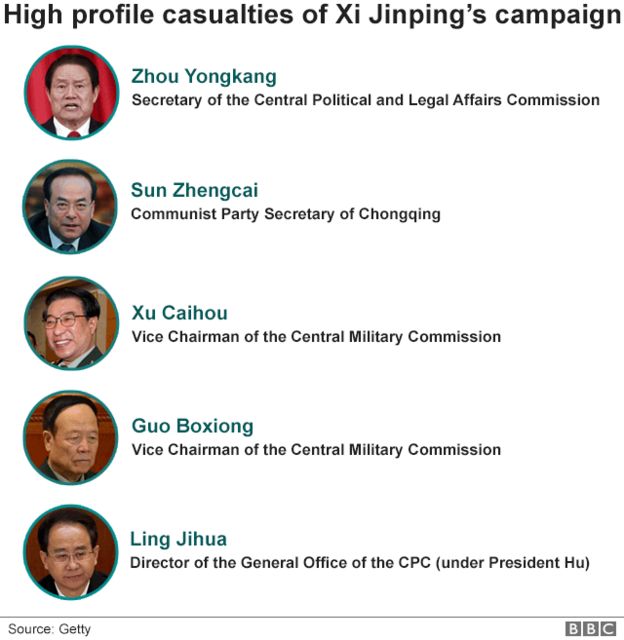
They include Xu Caihou and Guo Boxiong, both former vice chairman of the Central Military Commission. Xu died of cancer in 2015 before he could face trial while Guo was sentenced to life in prison for bribery in 2016.
The anti-corruption campaign has been described by some as a massive internal purge of opponents, on a scale not seen since the days of Mao Zedong, in whose Cultural Revolution many top officials were purged.
GUWAHATI, India (Reuters) – At least 84 people have died from drinking toxic bootleg liquor in the northeastern Indian state of C, and around 200 others have been hospitalised, a state government minister said on Saturday.
The deaths come less than two weeks after more than 100 people died from drinking tainted alcohol in two northern Indian states, Uttarkhand and Uttar Pradesh.
Police have arrested twelve people in connection with making bootleg alcohol in Assam, a practice local politicians say is rampant in the area’s tea estates, where its is drunk by poorly-paid labourers after a tough day’s work in the plantations.
“Every 10 minutes we are getting reports of casualties from different places. So far about 200 people are in hospital with many of them critical,” Assam Health Minister Himanta Biswa Sarma told Reuters via telephone.
“Doctors from nearby districts and other medical colleges have been rushed in to deal with the crisis,” said Sarma, after visiting patients at Jorhat, located some 300 kilometres east of the state’s financial hub, Guwahati.
Deaths from illegally produced alcohol, known locally as hooch or country liquor, are common in India, where many cannot afford branded spirits.
The death tolls from the two recent incidents, however, are believed to be the deadliest since a similar case killed 172 in West Bengal in 2011.
Dilip Rajbnonshi, a doctor at the government hospital in Golaghat, located some 40 kilometres southwest of Jorhat said the deaths were due to “spurious country liquor”.
A number of women are among the casualties. Many of those that drank the liquor were tea plantation workers who had just received their weekly wages, according to another state government official.
“I asked some of the patients why they consume liquor almost everyday and they said after a hard day’s work in the plantations they drink to relieve stress and tiredness,” health minister Sarma said.
Mrinal Saikia, a local lawmaker from the Bharatiya Janata Party – which is in control of the federal and Assam state governments – said alcohol, often laced with cattle feed and battery acid, is being supplied “in gallons” to tea plantation workers.
“This is a big business in areas surrounding tea gardens where people set up illegal distilleries to make country liquor,” he said.
NEW DELHI (Reuters) – India’s Jammu and Kashmir state withdrew the security details for 18 separatist leaders and 155 other opposition figures on Wednesday after an Islamist suicide bomber killed 40 paramilitary troopers last week.
The restive mountain state is currently administered by India’s federal government after Prime Minister Narendra Modi’s Bharatiya Janata Party walked out a coalition with a major Kashmiri party.
The separatist leaders had been allocated security personnel to protect them from militants after they entered talks with the federal government.
In a statement, the Jammu and Kashmir state government said it “felt that providing security to these separatist leaders is a wastage of scarce state resources which could be better utilized elsewhere”.
Besides the separatist leaders, the security of 155 political figures and activists – some from mainstream opposition parties – was also withdrawn, the statement said.
“Through this (step), over 1,000 police personnel and over 100 vehicles are freed to do regular police work,” it said.
Both India and Pakistan lay claim to Kashmir and have twice gone to war over it since independence from Britain in 1947. India accuses Pakistan of fomenting decades of sporadic insurgency in its only Muslim-majority state.
Pakistan denies that, saying it only offers political support to the Kashmiri people.






 CHINDIA ALERT: You'll be living in their world, very soon