25/04/2020
- But trade with partner countries might not be as badly affected as with countries elsewhere in the world, observers say
- China’s trade with belt and road countries rose by 3.2 per cent in the January-March period, but second-quarter results will depend on how well they manage to contain the pathogen, academic says
China’s investment in foreign infrastructure as part of its Belt and Road Initiative has been curtailed because of the coronavirus pandemic. Photo: Xinhua
The
coronavirus pandemic is set to cause a slump in Chinese investment in its signature
and a dip in trade with partner countries that could take a year to overcome, analysts say.
But the impact of the health crisis on China’s economic relations with nations involved in the ambitious infrastructure development programme might not be as great as on those that are not.
China’s total foreign trade in the first quarter of 2020 fell by 6.4 per cent year on year, according to official figures from Beijing.
Trade with the United States, Europe and Japan all dropped in the period, by 18.3, 10.4 and 8.1 per cent, respectively, the commerce ministry said.
By comparison, China’s trade with belt and road countries increased by 3.2 per cent in the first quarter, although the growth figure was lower than the 10.8 per cent reported for the whole of 2019.
China’s trade with 56 belt and road countries – located across Africa, Asia,
Europe and South America – accounts for about 30 per cent of its total annual volume, according to the commerce ministry.
Despite the first-quarter growth, Tong Jiadong, a professor of international trade at Nankai University in Tianjin, said he expected China’s trade with belt and road countries to fall by between 2 and 5 per cent this year.
His predictions are less gloomy than the 13 to 32 per cent contraction in global trade forecast for this year by the
World Trade Organisation.
“A drop in [China’s total] first-quarter trade was inevitable but it slowly started to recover as it resumed production, especially with Southeast Asian, Eastern European and Arab countries,” Tong said.
“The second quarter will really depend on how the epidemic is contained in belt and road countries.”
Nick Marro, Hong Kong-based head of global trade at the Economist Intelligence Unit, said he expected China’s total overseas direct investment to fall by about 30 per cent this year, which would be bad news for the belt and road plan.
“This will derive from a combination of growing domestic stress in China, enhanced regulatory scrutiny over Chinese investment in major international markets, and weakened global economic prospects that will naturally depress investment demand,” he said.
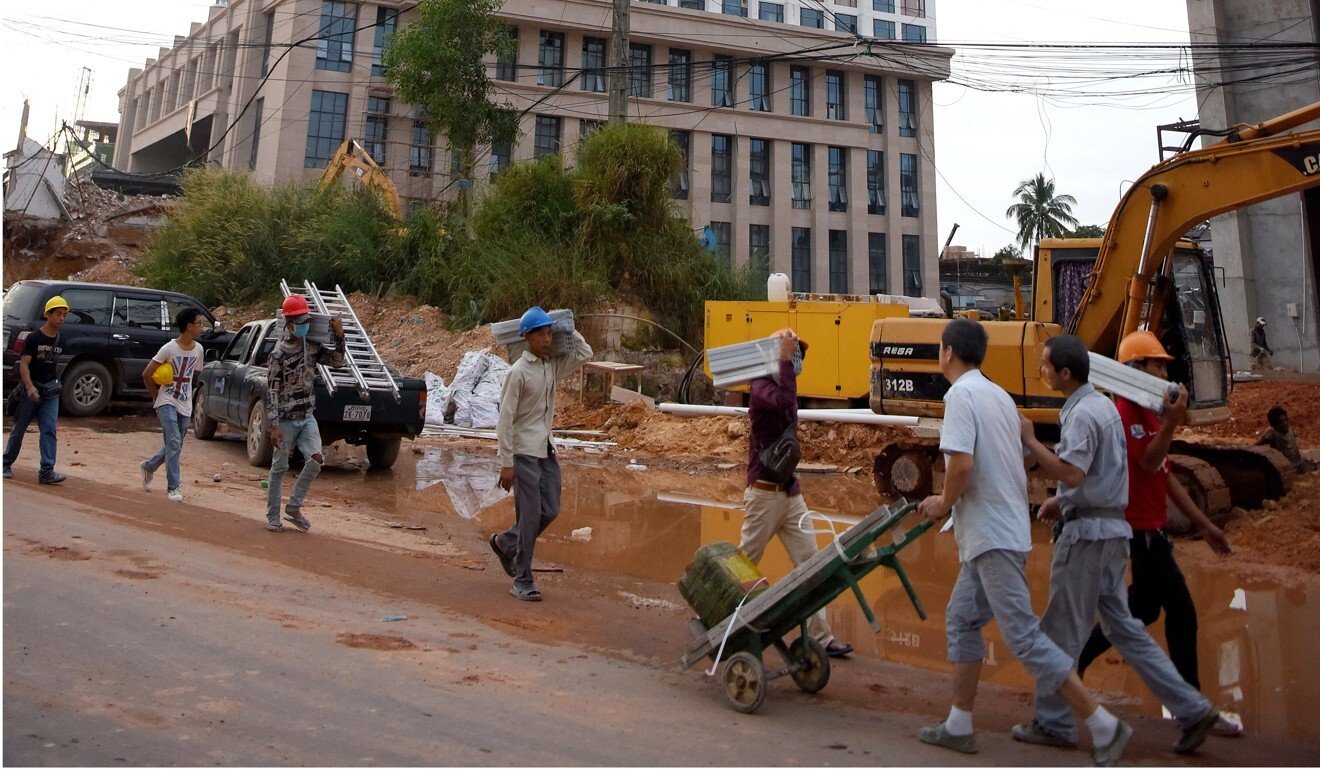
The development of the Chinese built and operated special economic zone in the Cambodian town of Sihanoukville is reported to have slowed, while infrastructure projects in Bangladesh, including the Payra coal-fired power plant, have been put on hold.
The development of the Chinese built and operated special economic zone in the Cambodian town of Sihanoukville is reported to have slowed. Photo: AFP
Marro said the reduction of capital and labour from China might complicate other projects for key belt and road partner, like Pakistan, which is home to infrastructure projects worth tens of billions of US dollars, and funded and built in large part by China.
“Pakistan looks concerning, particularly in terms of how we’ve assessed its sovereign and currency risk,” Marro said.
“Public debt is high compared to other emerging markets, while the coronavirus will push the budget deficit to expand to 10 per cent of GDP [gross domestic product] this year.”
Last week, Pakistan asked China for a 10-year extension to the repayment period on US$30 billion worth of loans used to fund the development of infrastructure projects, according to a report by local newspaper Dawn.
China’s overseas investment has been falling steadily from its peak in 2016, mostly as a result of Beijing’s curbs on capital outflows.
Last year, the direct investment by Chinese companies and organisations other than banks in belt and road countries fell 3.8 per cent from 2018 to US$15 billion, with most of the money going to South and Southeast Asian countries, including Singapore, Vietnam, Indonesia and Pakistan.
Tong said the pandemic had made Chinese investors nervous about putting their money in countries where disease control measures were becoming increasingly stringent, but added that the pause in activity would give all parties time to regroup.
“Investment in the second quarter will decline and allow time for the questions to be answered,” he said.
“Past experience along the belt and road has taught many lessons to both China and its partners, and forced them to think calmly about their own interests. The epidemic provides both parties with a good time for this.”
Dr Frans-Paul van der Putten, a senior research fellow at Clingendael Institute in the Netherlands, said China’s post-pandemic strategy for the
belt and road in Europe
might include a shift away from investing in high-profile infrastructure projects like ports and airports.
Investors might instead cooperate with transport and logistics providers rather than invest directly, he said.
“Even though in the coming years the amount of money China loans and invests abroad may be lower than in the peak years around 2015-16, I expect it to maintain the belt and road plan as its overall strategic framework for its foreign economic relations,” he said.
Source: SCMP
Posted in 10-year, 2018, 2019, 2020, 30, academic, according, accounts, across, activity, africa, airports, allow, ambitious, analysts, annual volume, answered, Arab countries, Asia, bad news, Bangladesh, because, Beijing, Belt and Road Initiative, belt and road plan, billion, billions, budget deficit, Cambodian, capital, capital outflows, cause, China, China’s, Chinese, Clingendael Institute, combination, Commerce Ministry, compared, comparison, complicate, contained, contraction, cooperate, coronavirus, Coronavirus pandemic, countries, curbs, Currency, curtailed, Dawn, decline, demand, depend, depress, derive, development, dip, direct investment, disease control measures, domestic stress, dropped, Eastern European, economic prospects, economic relations, Economist Intelligence Unit, elsewhere, Emerging markets, enhanced, epidemic, especially, Europe, extension, fall, falling, Fell, figure, first-quarter, forecast, foreign, foreign trade, GDP [gross domestic product], global trade, gloomy, great, growth, health crisis, high, impact, increased, increasingly, Indonesia, inevitable, Infrastructure, infrastructure projects, international markets, International trade, Investment, investors, involved, January, Japan, Labour, last week, loans, local newspaper, located, logistics, lower, Major, manage, March, might not, nations, naturally, nervous, Netherlands, observers, official figures, on hold, other, overall strategic framework, overcome, overseas, Pakistan, pandemic, parties, partner, pathogen, pause, Payra coal-fired power plant,, per cent, Period, ports, predictions, production, professor, programme, providers, Public debt, put, questions, recover, reduction, regroup, regulatory scrutiny, repayment, reported, results, resumed, Risk, second-quarter, signature, Singapore, slowed, slower, slump, South, South America, Southeast Asian, sovereign, special economic zone, stringent, take, this year, Tianjin, time, Total, town, Trade, Transport, Uncategorized, United States, US dollars, US$30, Vietnam, weakened, while, World, world trade organisation, worth, year, year-on-year |
Leave a Comment »
23/04/2020
- Travel restrictions and continued uncertainty about when campuses will reopen has reduced enrolments from America’s biggest group of international students
- Demand was already softening due to worsening US-China relations before Covid-19 pandemic struck
The coronavirus is making many Chinese youngsters think twice about pursuing a higher education in the US. Photo: Xinhua
The
Covid-19 pandemic has upended the appetite for prestigious US degrees among Chinese students, jeopardising US$15 billion in revenue for American colleges.
The disease – which has spread to more than 185 countries, infected more than 2.6 million people and claimed more than 180,000 lives worldwide – has caused unprecedented disruption. Borders are closed and travel has been significantly limited to contain the spread.
For American schools, it has meant reduced Chinese demand for higher education in the 2020-21 academic year, according to a Congressional report into the cascading economic impacts of the pandemic published on Tuesday by the US China Economic and Security Review Commission.
The report identified a host of issues, from delays or cancellations of US entrance exams in China, through to indefinite travel restrictions and continued uncertainty about when US college campuses will reopen. The consequences could be severe, with nearly a third of all tuition payments to US public universities coming from international students.
Amid outbreak, universities contend with dependence on Chinese students
China has remained the largest source of international students for the US in the past decade, with 369,548 Chinese students enrolled in US higher education programmes in 2018, more than three times the count from nine years earlier, according to the Institute of International Education. The group together contributed US$15 billion in tuition payments.
University administrators told the authors of the report that cancelled recruitment events in China and an inability to work with local recruitment agencies could further depress Chinese student enrolment in US university programmes.
The blow will be severe as international students typically pay full tuition, with only 17 per cent receiving grants or scholarships from their institution, according to a report published by World Education News & Reviews in December.
Wuhan, Los Angeles officials talk about getting back to work after lockdown
The sudden decrease in enrolments added to a softening trend in Chinese student numbers in recent years as US-China relations have become more hostile. Tensions between China and the US over tariffs and trade disputes put more strain on academic exchanges between the two countries.
Before the coronavirus disrupted international travel and school terms,
US schools had already seen a decline in enrolments from Chinese students. Last June, Beijing warned its students about the risks of studying in the US and China’s education ministry said some were encountering problems with the duration of their visas limited and an increase in visa refusals.
“This has affected Chinese students going to study in the United States or smoothly completing their studies,” it said.
“The education ministry reminds students and academics of the need to strengthen risk assessment before studying abroad, enhance prevention awareness and make corresponding preparations.”
Chinese students battle rising tide of prejudice in US
Chinese students and scholars have attracted scrutiny from the Trump administration, with claims some could be helping Beijing to obtain trade and technological secrets. US lawmakers are also concerned about China’s growing ambition through effort to influence through its own narratives globally.
, for example, which are based on college campuses and funded by Beijing to promote Chinese language and culture, have been investigated over espionage allegations. Two dozen US schools closed the cultural centres on their campuses in the past two years. The most recent closure, in January, was also the oldest Confucius Institute in the country – at the University of Maryland – which had been operating since 1985.
Tuesday’s report said that as well as the decline in Chinese enrolments, tourism from China would also suffer. Together, higher education and tourism make up the US’ top services exports to China, which will lead to a narrowing in its services trade surplus with China, it said.
Source: SCMP
Posted in Beijing, billion, Chinese students, Confucius Institute, coronavirus, Covid-19 pandemic, faces, hit, Los Angeles, prestigious, stay away, Tuesday, Uncategorized, US China Economic and Security Review Commission, US education, World Education News & Reviews, Wuhan |
Leave a Comment »
22/04/2020
SEOUL/BEIJING (Reuters) – China has allowed 200 employees from South Korea’s Samsung Electronics Co Ltd (005930.KS) to enter the country to work on an expansion of the firm’s NAND memory chip factory, the company said on Wednesday.
The move came after China said on Tuesday that it was in talks with some countries to establish fast-track procedures to allow travel by business and technical personnel to ensure the smooth operation of global supply chains.
China said it has reached a consensus on such an arrangement with South Korea, without elaborating on the terms, including whether individuals entering China will be subject to quarantine.
China, where the virus first emerged late last year, blocked entry last month for nearly all foreigners in an effort to curb risks of coronavirus infections posed by travellers from overseas. After bringing the local spread under control with tough containment measures, it is trying to restart its economic engines after weeks of near paralysis.
A chartered China Air Ltd (601111.SS) plane flew in the Samsung Electronics employees on Wednesday, a company spokeswoman said.
Samsung said its employees will follow the local government’s policy upon arrival, without elaborating.
Shaanxi province, where Samsung’s NAND memory chip plant is located, requires people travelling from overseas to undergo a 14-day quarantine, according to South Korea’s foreign ministry.
“Samsung employees will not be exempted from the 14-day quarantine rule imposed by the Shaanxi province. They will get coronavirus tests at the airport upon arrival and will be transported to a local hotel designated by Chinese authorities,” an official at the Consulate General of South Korea in Xi’an told Reuters.
Samsung Electronics in December increased investment at its chip factory in China by $8 billion to boost production of NAND flash memory chips.
Source: Reuters
Posted in $8 billion, 14-day quarantine, 200, according, after, Airport, allow, allowed, allows, Arrangement, arrival, Beijing, billion, blocked, boost, bringing, Business, came, chartered, China, China Air Ltd, chinese authorities, chip factory, Company, consensus, Consulate General, containment, control, coronavirus infections, coronavirus tests, countries, Country, curb, December, designated, economic engines, effort, elaborating, emerged, employees, ensure, enter, entering, entry, establish, exempted, expansion, Factory, fast-track, firms, flash memory chips, flew, Foreign Ministry, Foreigners, from, from overseas, global supply chains, including, increased, individuals, Investment, last month, late last year, local governments, local hotel, local spread, located, measures, memory chip, move, NAND, near, nearly, Official, operation, overseas, paralysis, People, personnel, plane, Plant, policy, posed, procedures, production, quarantine, reached, requires, restart, Reuters, Risks, rule, Samsung Elec, Seoul, shaanxi province, smooth, South Korea, South Korea’s, spokeswoman, staff, subject, talks, technical, terms, tough, transported, travel, travellers, travelling, trying, Tuesday, Uncategorized, undergo, upon, Virus, Wednesday, weeks, whether, without, work, Xi'an |
Leave a Comment »
20/04/2020
BEIJING, April 20 (Xinhua) — China has resumed construction of major water conservancy projects amid its further containment of the novel coronavirus disease (COVID-19) epidemic.
Construction has resumed so far on 143 of the 172 major water conservancy projects, with the scale of investment under construction reaching over 1 trillion yuan (around 141 billion U.S. dollars), according to the Ministry of Water Resources.
The ministry said 30 conservancy projects have completed construction and produced benefits.
As the situation of epidemic control and prevention continues to improve, China is speeding up construction on major infrastructure projects to mitigate the economic impact of the novel coronavirus epidemic.
Construction has resumed on about 85 percent of the housing and urban infrastructure projects in China as of April 1, with about 158,700 housing and urban infrastructure projects across the country cranking up work, according to the Ministry of Housing and Urban-Rural Development.
Source: Xinhua
Posted in according, amid, Beijing, benefits, billion, China, completed, Construction, containment, continues, COVID-19, economic impact, epidemic, epidemic control and prevention, further, housing, improve, infrastructure projects, Investment, Major, ministry, Ministry of Housing and Urban-Rural Development, Ministry of Water Resources, mitigate, novel coronavirus disease, novel coronavirus epidemic, percent, produced, projects, reaching, resumes, scale, situation, speeding up, trillion yuan, U.S. dollars, Uncategorized, urban, water conservancy |
Leave a Comment »
20/04/2020
BRUSSELS (Reuters) – The euro zone’s trade surplus with the rest of the world grew in February, with a decline in imports from China as well as sharply lower energy needs because of mild winter weather.
The unadjusted goods trade surplus grew to 23.0 billion euros ($25.1 billion) in February, compared with 18.5 billion euros a year earlier. Exports rose by 1.6%, while imports fell by 1.0%.
For China, which already had widespread coronavirus restrictions in place in February, exports from the European Union as a whole were slightly lower than in February 2019. However, imports were down by 8.1%, according to data on Eurostat’s website.
Energy imports as a whole also declined by 9.6% in February, when comparing Jan-Feb data issued on Monday and January data from a month ago. That translated into 10.1% lower imports from Russia and 5.9% less from Norway.
The trade surplus with the United States, by contrast, grew by 21% in the month as exports increased and imports declined. The persistent surplus in goods has been a source of transatlantic tension.
On a seasonally adjusted basis the euro zone trade surplus also rose to 25.8 billion euros in February from 18.2 billion euros in January. Exports were 1.8% higher month-on-month and imports 2.3% lower.
Source: Reuters
Posted in 2019, according, adjusted, already, basis, because, billion, Brussels, by contrast, China, compared, comparing, Data, decline, declined, earlier, energy, Euro Zone, European Union, euros, Eurostat’s, exports, February, Fell, from, goods, grew, grows, has been, higher, However, imports, in place, increased, January, lower, mild, Monday, month, month-on-month, needs, Norway, persistent, rest of the world, restrictions, Russia, seasonally, sharply, slightly, source, surplus, tension, trade surplus, transatlantic, translated, unadjusted, Uncategorized, United States, weather, website, while, whole, widespread, winter, year |
Leave a Comment »
20/04/2020
BEIJING, April 19 (Xinhua) — China’s National Equities Exchange and Quotations, also known as the “new third board,” saw transactions exceed 26.4 billion yuan (3.67 billion U.S. dollars) so far this year.
From April 13 to 17, turnover on the board reached 1.8 billion yuan. As of Friday, the board had 8,718 listed firms.
Saidian, operator of Bestdo.com, a Chinese online sport service provider, recorded the highest weekly transaction on the board, raising 127 million yuan.
The exchange was launched in early 2013 to supplement the Shanghai and Shenzhen stock exchanges to serve small- and medium-sized enterprises.
It is seen as an easier financing channel for small businesses, with low costs and simple listing procedures.
Source: Xinhua
Posted in "new third board", 2013, amid, April, Beijing, Bestdo.com, billion, board, China's, Chinese, easier, epidemic, exceed, exchange, financing channel, Friday, fund, helps, highest, launched, listed firms, low costs, National Equities Exchange and Quotations, online, operator, raise, reached, recorded, Saidian, seen, serve, Shanghai, Shenzhen, simple listing procedures, small businesses, small- and medium-sized enterprises, SMEs, so far, sport service provider, stock exchanges, supplement, this year, transaction, transactions, turnover, U.S. dollars, Uncategorized, weekly, yuan |
Leave a Comment »





 CHINDIA ALERT: You'll be living in their world, very soon