Chindia Alert: You’ll be Living in their World Very Soon
aims to alert you to the threats and opportunities that China and India present. China and India require serious attention; case of ‘hidden dragon and crouching tiger’.
Without this attention, governments, businesses and, indeed, individuals may find themselves at a great disadvantage sooner rather than later.
The POSTs (front webpages) are mainly 'cuttings' from reliable sources, updated continuously.
The PAGEs (see Tabs, above) attempt to make the information more meaningful by putting some structure to the information we have researched and assembled since 2006.
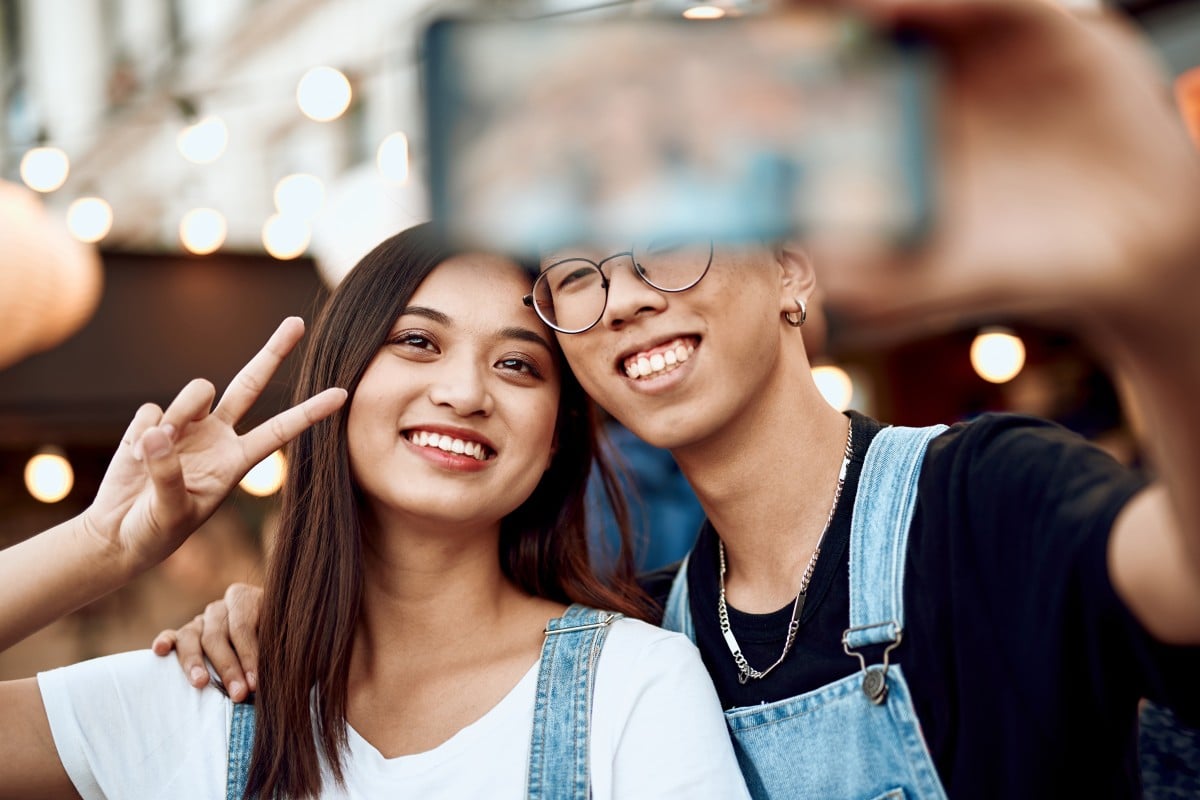
Powerful zoom functions can reveal fingerprint details which may be copied by criminals
A cybersecurity awareness campaign in China has prompted a warning about criminals harvesting fingerprint information from a popular pose in pictures uploaded to the internet. Photo: Shutterstock
A popular hand gesture adopted by China’s online community in uploaded pictures could be used by criminals to steal people’s fingerprints, Chinese cybersecurity experts have warned.
The “scissor hand” pose – similar to the peace sign or “V” for victory– could reveal a perfect fingerprint if held close enough to the camera, according to Zhang Wei, vice-director of the Shanghai Information Security Trade Association.
Speaking at an event promoting a national cybersecurity awareness campaign in Shanghai on Sunday, Zhang said photo magnifying and artificial intelligence-enhancing technologies meant it was possible to extract enough detail to make a perfect copy of the sensitive information.
According to a report by online news portal Thepaper.cn, Zhang’s advice was that scissor-hand pictures taken closer than three metres (10 feet) could be vulnerable and should not be published on the internet.
Chinese face-swapping app sparks privacy concerns soon after its release
“A scissor-hand picture taken within 1.5 metres (four feet 11 inches) can be used to restore 100 per cent of people’s fingerprints, while pictures taken about 1.5-3 metres away can turn out 50 per cent of the fingerprints,” he said.
Based on the information extracted from the pictures, criminals could make models of the prints which could then be used to register at fingerprint-based identity recognition checks, such as door access and payment systems, Zhang said.
Feng Jianjiang, a professor on fingerprint identification from the Department of Automation at Tsinghua University, told the South China Morning Post that, theoretically, pictures could show fingerprints clearly enough to be copied, but said he was unsure of what distance would be safe.
“Some people’s fingerprints could not be captured [at any distance] because of skin problems [for example],” Feng said. “But the fingerprint images would be fairly clear if the distance, angle, focus and lighting were all ideal.”
Feng suggested people check the clarity of detail by zooming in on their fingerprints in pictures before uploading them to social media.
Zang Yali, a researcher from the Institute of Automation at the Chinese Academy of Sciences, agreed that the conditions required to be able to harvest sufficiently detailed fingerprint information were “very demanding”, according to a report in China Science and Technology Daily.
The warning had been viewed on China’s Twitter-like platform Weibo 390 million times within 24 hours of Zhang’s address on Sunday, with 49,000 comments left on the website by Monday afternoon.
“It’s horrifying. I always present a scissor hand in photos,” one Weibo user wrote.
“Advanced technology has brought us convenience but meanwhile has also brought us risk and danger. What can we do now?” another commenter wrote.
One social media user had the perfect solution, writing: “No worries. just show the back of your hand to the camera if you are concerned.”
Top law enforcement body starts campaign to rally mainland support for officers amid anti-government protests
Maxim’s described as ‘company that loves the country and loves Hong Kong’ after condemnation of unrest by daughter of founder
Officer Lau (third from left) and police colleagues receive a delivery of mooncakes. Photo: Weibo
China’s top law enforcement agency has shown its support for Hong Kong’s embattled police by delivering 650 boxes of mooncakes to the force’s dormitories and stations ahead of Friday’s Mid-Autumn Festival.
The festive gifts were sent after an online campaign titled “I want to send hometown delicacies to Hong Kong Police”, launched last Friday by Chang An Jian, an official social media account of the Central Political and Legal Affairs Commission, Beijing’s top political body responsible for law and order.
The commission – a Communist Party organ, rather than a government body that police report to – said in a blog post that seven people had donated about 150,000 yuan (US$21,000) between them.
The campaign represents the latest display of mainland support for the force, with no end in sight to mass protests in Hong Kong triggered in June by opposition to an
that would have allowed the transfer of criminal suspects to mainland China. Hong Kong police have faced numerous accusations of excessive use of force during the unrest.
But the mooncake delivery was complicated by customs regulations, with most major Chinese courier services unwilling to take deliveries containing processed meat and egg yolk across the border with Hong Kong.
“[We] were panicking because a lot of enthusiastic netizens had their salted duck and mooncake deliveries to Hong Kong rejected by couriers!” a Chang An Jian blog post said on Wednesday night.
In the end, 650 boxes of mooncakes that were bought from Hong Kong were sent to police dormitories and stations on Wednesday evening.
Mid-Autumn Festival is the second most important traditional Chinese holiday after Lunar New Year.
“[The mooncakes] were from Maxim’s, a company that loves the country and loves Hong Kong!” the blog post also said.
Annie Wu Suk-ching, whose father co-founded the Maxim’s chain, last week
She was lauded by Communist Party mouthpiece People’s Daily for “clearly adhering to the one country principle” – referring to “one country, two systems”, the principle under which Hong Kong was guaranteed a high degree of autonomy after it was handed over from British to Chinese rule in 1997.
One of Maxim’s biggest rival mooncake manufacturers in Hong Kong, Taipan Bread and Cake, had its products removed from shops across the Chinese mainland and from its biggest e-commerce sites, Tmall.com and JD.com, after the son of its founder was vilified by People’s Daily for a Facebook post that the newspaper said showed he backed the protests.
Recipients of the mooncakes included a police officer who in July was hailed as a hero by Chinese state media and nicknamed “bald sergeant Lau Sir” after pointing a shotgun at protesters who had besieged a police station. Lau has since been invited by Beijing to attend a grand celebration on October 1 for the 70th anniversary of the founding of the People’s Republic of China.
Mooncake importer says stock will be destroyed after mainland backlash
Beijing has focused attention on the violent elements of the Hong Kong protests in its social media posts and media coverage, while businesses have been carefully monitored and expected to toe Beijing’s line on condemning violence and supporting one country, two systems.
“Hong Kong Police have been having a very difficult time,” said one mainlander, surnamed Lu, in a video posted by Chang An Jian. “We want to cheer them up.”
Students lay flowers to pay tribute to revolutionary martyrs during a campaign at the Museum of the War of Chinese People’s Resistance Against Japanese Aggression in Beijing, capital of China, April 4, 2019. China has kicked off a campaign to promote paying tribute to revolutionary martyrs as Tomb-sweeping Day draws near. The campaign is aimed at combining educational activities with paying tribute. Tomb-sweeping Day, also known as Qingming Festival, falls on April 5 this year. It is a traditional Chinese holiday where people pay tribute to deceased family and friends. (Xinhua/Zhang Chenlin)
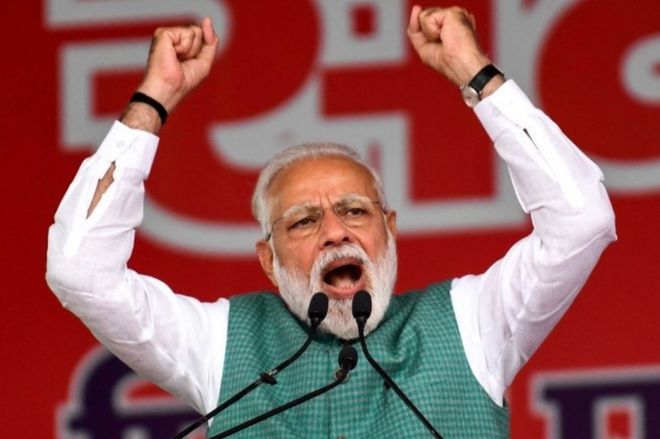
Image copyrightAFPImage captionMr Modi is accused of exploiting India-Pakistan hostilities for political gain
A gaffe is when a politician tells the truth, American political journalist Michael Kinsley said.
Last week, a prominent leader of India’s ruling Hindu nationalist Bharatiya Janata Party (BJP) appeared to have done exactly that. BS Yeddyurappa said the armed aerial hostilities between India and Pakistan would help his party win some two dozen seats in the upcoming general election.
The remark by Mr Yeddyurappa, former chief minister of Karnataka, was remarkable in its candour. Not surprisingly, it was immediately seized upon by opposition parties. They said it was a brazen admission of the fact that Prime Minister Narendra Modi’s party was mining the tensions between the nuclear-armed rivals ahead of general elections, which are barely a month away. Mr Modi’s party is looking at a second term in power.
Mr Yeddyurappa’s plain-spokenness appeared to have embarrassed even the BJP. Federal minister VK Singh issued a statement, saying the government’s decision to carry out air strikes in Pakistan last week was to “safeguard our nation and ensure safety of our citizens, not to win a few seats”. No political party can afford to concede that it was exploiting a near war for electoral gains.
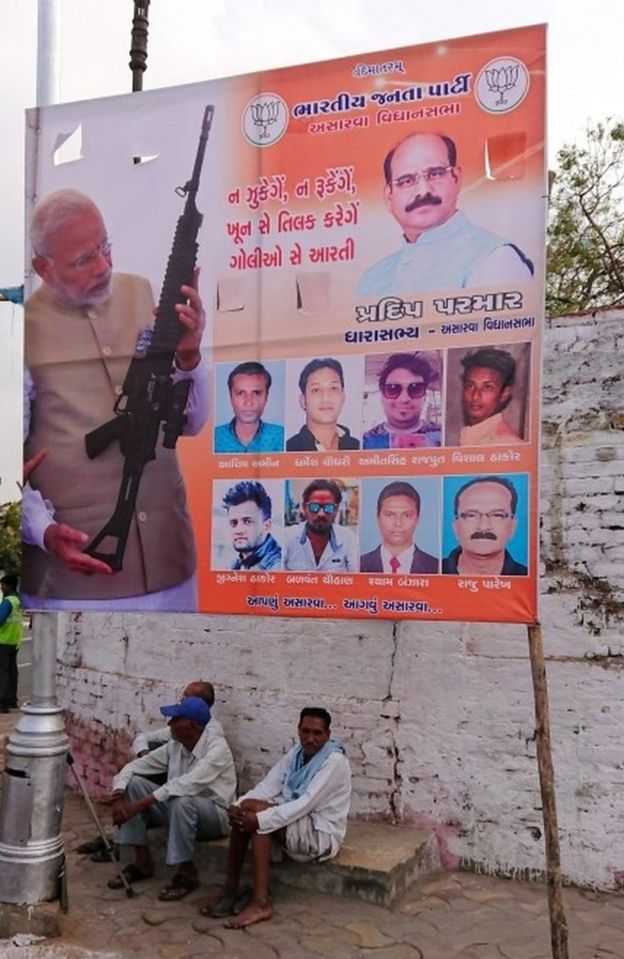
Image copyrightAFPImage captionThe BJP has put up election posters of Mr Modi posing with guns
Even as tensions between India and Pakistan ratcheted up last week, Mr Modi went on with business as usual. Hours after the Indian attack in Pakistan’s Balakot region, he told a packed election meeting that the country was in safe hands and would “no longer be helpless in the face of terror”. Next morning, Pakistan retaliated and captured an Indian pilot who ejected from a downed fighter jet. Two days later, Pakistan returned the pilot to India.
Mr Modi then told a gathering of scientists that India’s aerial strikes were merely a “pilot project” and hinted there was more to come. Elsewhere, his party chief Amit Shah said India had killed more than 250 militants in the Balakot attack even as senior defence officials said they didn’t know how many had died. Gaudy BJP posters showing Mr Modi holding guns and flanked by soldiers, fighter jets and orange explosions have been put up in parts of the country. “Really uncomfortable with pictures of soldiers on election posters and podiums. This should be banned. Surely the uniform is sullied by vote gathering in its name,” tweeted Barkha Dutt, an Indian television journalist and author.
Mr Modi has appealed to the opposition to refrain from politicising the hostilities. The opposition parties are peeved because they believe Mr Modi has not kept his word. Last week, they issued a statement saying “national security must transcend narrow political considerations”.
‘Petty political gain’
But can the recent conflict fetch more votes for Mr Modi? In other words, can national security become a campaign plank?
Many believe Mr Modi is likely to make national security the pivot of his campaign. Before last month’s suicide attack – claimed by Pakistan-based militants – killed more than 40 Indian paramilitaries in Kashmir, Mr Modi was looking a little vulnerable. His party had lost three state elections on the trot to the Congress party. Looming farm and jobs crises were threatening to hurt the BJP’s prospects.
Now, many believe, Mr Modi’s chances look brighter as he positions himself as a “muscular” protector of the country’s borders. “This is one of the worst attempts to use war to win [an] election, and to use national security as petty political gain. But I don’t know whether it will succeed or not,” says Yogendra Yadav, a politician and psephologist.
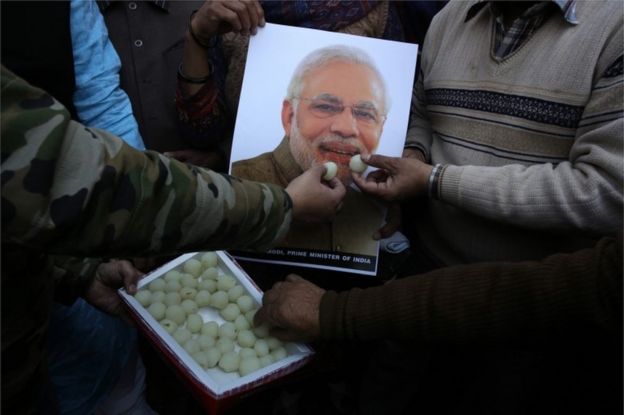
Image copyrightEPAImage captionMany Indians have celebrated India’s strike in Pakistani territory
Evidence is mixed on whether national security helps ruling parties win elections in India. Ashutosh Varshney, a professor of political science at Brown University in the US, says previous national security disruptions in India were “distant from the national elections”.
The wars in 1962 (against China) and 1971 (against Pakistan) broke out after general elections. Elections were still two years away when India and Pakistan fought a war in 1965. The 2001 attack on the Indian parliament that brought the two countries to the brink of war happened two years after a general election. The Mumbai attacks in 2008 took place five months before the elections in 2009 – and the then ruling Congress party won without making national security a campaign plank.
For one, he says, it comes just weeks ahead of a general election in a highly polarised country. The vast expansion of the urban middle class means that national security has a larger constituency. And most importantly, according to Dr Varshney, “the nature of the regime in Delhi” is an important variable. “Hindu nationalists have always been tougher on national security than the Congress. And with rare exceptions, national security does not dominate the horizons of regional parties, governed as they are by caste and regional identities.”
Bhanu Joshi, a political scientist also at Brown University, believes Mr Modi’s adoption of a muscular and robust foreign policy and his frequent international trips to meet foreign leaders may have touched a chord with a section of voters. “During my work in northern India, people would continuously invoke the improvement in India’s stature in the international arena. These perceptions get reinforced with an event like [the] Balakot strikes and form impressions which I think voters, particularly on a bipolar contest of India and Pakistan, care about,” says Mr Joshi.
Others like Milan Vaishnav, senior fellow and director of the South Asia Program at the Carnegie Endowment for International Peace, echo a similar sentiment. He told me that although foreign policy has never been a “mass” issue in India’s domestic politics, “given the proximity of the conflict to the elections, the salience of Pakistan, and the ability of the Modi government to claim credit for striking back hard, I expect it will become an important part of the campaign”.
But Dr Vaishnav believes it will not displace the economy and farm distress as an issue, especially in village communities. “Where it will help the BJP most is among swing voters, especially in urban constituencies. If there were fence-sitters unsure of how to vote in 2019, this emotive issue might compel them to stick with the incumbent.”
How the opposition counters Mr Modi’s agenda-setting on national security will be interesting to watch. Even if the hostilities end up giving a slight bump to BJP prospects in the crucial bellwether states in the north, it could help take the party over the winning line. But then even a week is a long time in politics.
The author, Zhang Qianfan, a professor at Peking University known for his advocacy of constitutionalism and judicial reform, dismissed any suggestion his writing excessively promoted Western ideas as “utter nonsense”, and said the academic world should not be politicised.
Since taking office in 2012, President Xi Jinping has tightened the Communist Party’s control over society including the legal system and education.
While authorities have not confirmed they ordered the book withdrawn, and no reason for its disappearance has been given, it comes after the government began a sweeping review of teaching materials.
The Ministry of Education in early January launched a nationwide check on the content of all university constitutional law textbooks, according to posts on the Jiangxi and Zhejiang province education ministry websites.
Universities were told the “fact-finding” sweep was of great importance and they must accurately fill in a chart detailing titles and authors of the books they used, with “no omissions”, according to the ministry’s posts.
The campaign drew criticism from some legal academics, which was amplified by a rumour that the sweep was sparked by an accusation from a professor that certain texts were “promoting Western thinking and agitating for a Western system”.
The education ministry did not respond to a faxed request for comment.
China’s constitution promises freedom of speech, religion and assembly, but it is trumped in practice by legislation and regulations, and it is rarely invoked in legal cases.
The constitution has long been a focus for political reformers, who argue that its status should be elevated within the legal system.
Zhang’s book could not be found on China’s main online bookstores when searched by Reuters on Friday.
Zhang, in an interview published on the WeChat social media platform, rejected any suggestion his texts promoted a “Western” system over alternatives.
“To criticise purely for the sake of it and to shut our nation off to the outside world is closed-minded thinking,” Zhang said.
“Constitutional law, as an academic discipline, should not be politicised,” he said. “Any academic discipline should retain a certain political neutrality.”
“At this time, constitutional law is a ‘sensitive’ topic. As far as I can see there is basically no public discussion. It seems that everyone is scared,” he said.
Zhang’s interview disappeared soon after it was posted, to be replaced by a notice saying the content had broken “relevant laws and regulations”.
Zhang did not respond to an email seeking comment.
Many legal scholars took to social media to voice support for Zhang.
Some posted the foreword from his book, in which he stresses the importance of giving people who have suffered injustices the chance to defend themselves using the constitution.
Some voiced concern that some academics might accuse others of failing to toe the party line.
“The worst part about this incident is that in the current environment, not only are these people not inhibited, but rather they are given a channel, or even rewards,” Zhang Taisu, an associate professor of law at Yale University in the United States, wrote on Weibo, referring to the accusers.
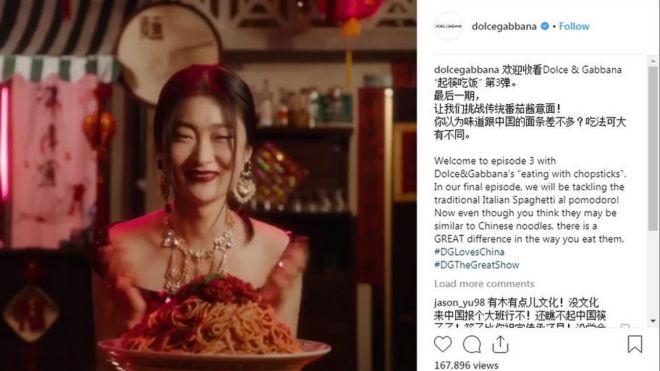
Image copyrightDOLCE AND GABBANA/INSTAGRAMImage captionThe ad was supposed to show that ‘#DGLovesChina’
The Chinese model featured in a Dolce & Gabbana ad campaign accused of racism has said the controversy almost ruined her career.
Three videos, released in November, showed Zuo Ye struggling to eat Italian food including cannoli and pizza with chopsticks.
Widely seen as offensive it led to a severe backlash in China with several retailers pulling the brand’s products.
Ms Zuo said she felt “guilty and ashamed” but asked for understanding.
Following her statement on Chinese social media network Weibo, the debate has flared up again with some people saying they hope that she can continue her career as a model and that they understand her hands were tied working with D&G.
‘It nearly killed my career’
In a long post on Monday, Ms Zuo said that usually working for an international brand like D&G would be an exciting career step but that in this case “it nearly killed off my modelling career”.
She explains she understands that “it’s about representing the national image of China and Chinese culture” and that she “therefore feels even more guilty and ashamed”.
She also vowed to “improve my behaviour” in the future.
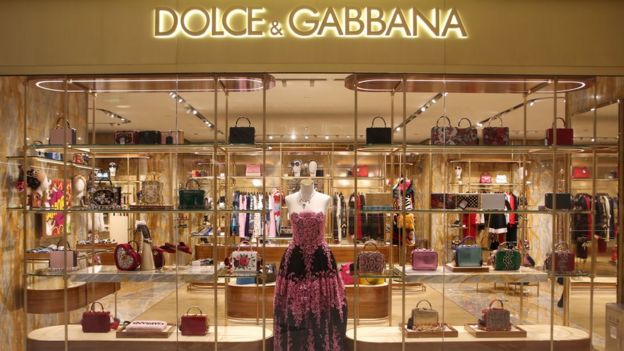
Image copyrightGETTY IMAGESImage captionConsumers called for a boycott of D&G products in China
According to her statement, she knew the shoot was about trying Italian delicacies but that she felt very awkward when she was asked to eat food like pizza and pasta with chopsticks.
The director told her to show first shock and disbelief, then roll her eyes, and eventually delight and satisfaction at the presumed tastiness of said Italian dishes, she said.
The model explains that she didn’t see the final clip before it was released.
She also writes she didn’t receive any support during the backlash, even when she, her family and agent were all targeted in widespread attacks on social media.
Support and condemnation
Since Ms Zuo’s post, opinion has been divided on Chinese social media.
While some see her as a victim of the Italian brand and sympathise with her experience, others remain critical saying she only had herself to blame.
Others again point out the problem with the powerlessness of models in the industry as a whole where they are often made to do things they might not necessarily want to do.
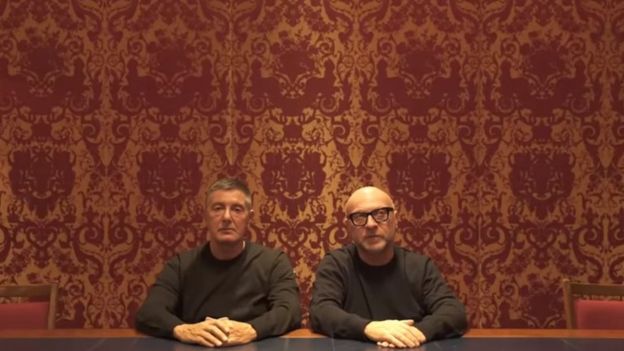
Image copyrightDOLCE AND GABBANAImage captionDomenico Dolce and Stefano Gabbana asked for forgiveness
In November last year, D&G released the videos on social media ahead of a fashion show in Shanghai.
The entire campaign was accused of trivialising Chinese culture and promoting unflattering stereotypes.
“Chinese consumers are not naïve; they will spot insincerity and tokenism a mile off, and respond accordingly,” Dr Julie Bilby of the department of media and communication at RMIT University in Melbourne told the BBC.
The controversy escalated further when screenshots were circulated showing designer Stefano Gabbana allegedly insulting China in an Instagram chat.
D&G insisted the account had been hacked and apologised publicly for the controversial ad campaign.
The Italian luxury company was forced to cancel the fashion show in Shanghai and their products were removed from several Chinese online retailers.
Consumers in China also called for a boycott of the brand.







 CHINDIA ALERT: You'll be living in their world, very soon
COMMENTS: