Archive for ‘Capital city’

13/05/2020

Xi Focus-Quotable Quotes: Xi Jinping on eco-protection

Chinese President Xi Jinping, also general secretary of the Communist Party of China Central Committee and chairman of the Central Military Commission, checks the ecological protection work of the Fenhe River in Taiyuan, capital city of north China’s Shanxi Province, May 12, 2020. (Xinhua/Li Xueren)

BEIJING, May 13 (Xinhua) — Chinese President Xi Jinping attaches great importance to ecological conservation and environmental protection. He has spoken of the issue on many occasions. The following are some highlights of his quotes.

— Lucid waters and lush mountains are invaluable assets.

— Ecological conservation and environmental protection are contemporary causes that will benefit many generations to come.

— A sound ecological environment is the basic foundation for the sustainable development of humanity and society.

— We should adhere to the integrated protection and restoration of mountains, rivers, forests, farmlands, lakes and grasslands, and coordinate efforts to strengthen ecological and environmental protection in river basins with efforts to promote an energy revolution, green production and lifestyle, and economic transformation and development.

— A good ecological environment is the fairest public product and the most accessible welfare for the people.

— The quality of the eco-environment is the key to building a moderately prosperous society in all respects.

— Economic development should not be achieved at the cost of the ecology. The ecological environment itself is the economy. Protecting the environment is developing productivity.

— We shall protect ecosystems as preciously as we protect our eyes, and cherish them as dearly as we cherish our lives.

— The history of civilizations shows that the rise or fall of a civilization is closely tied to the quality of the ecological environment.

Source: Xinhua

07/05/2020

Xinhua Headlines: Archaeological findings provide key proof of Chinese civilization origin

— Chinese archaeologists announced significant achievements at the Shuanghuaishu site in central China’s Henan Province, providing key proof of the origin of the over 5,000-year-long Chinese civilization.

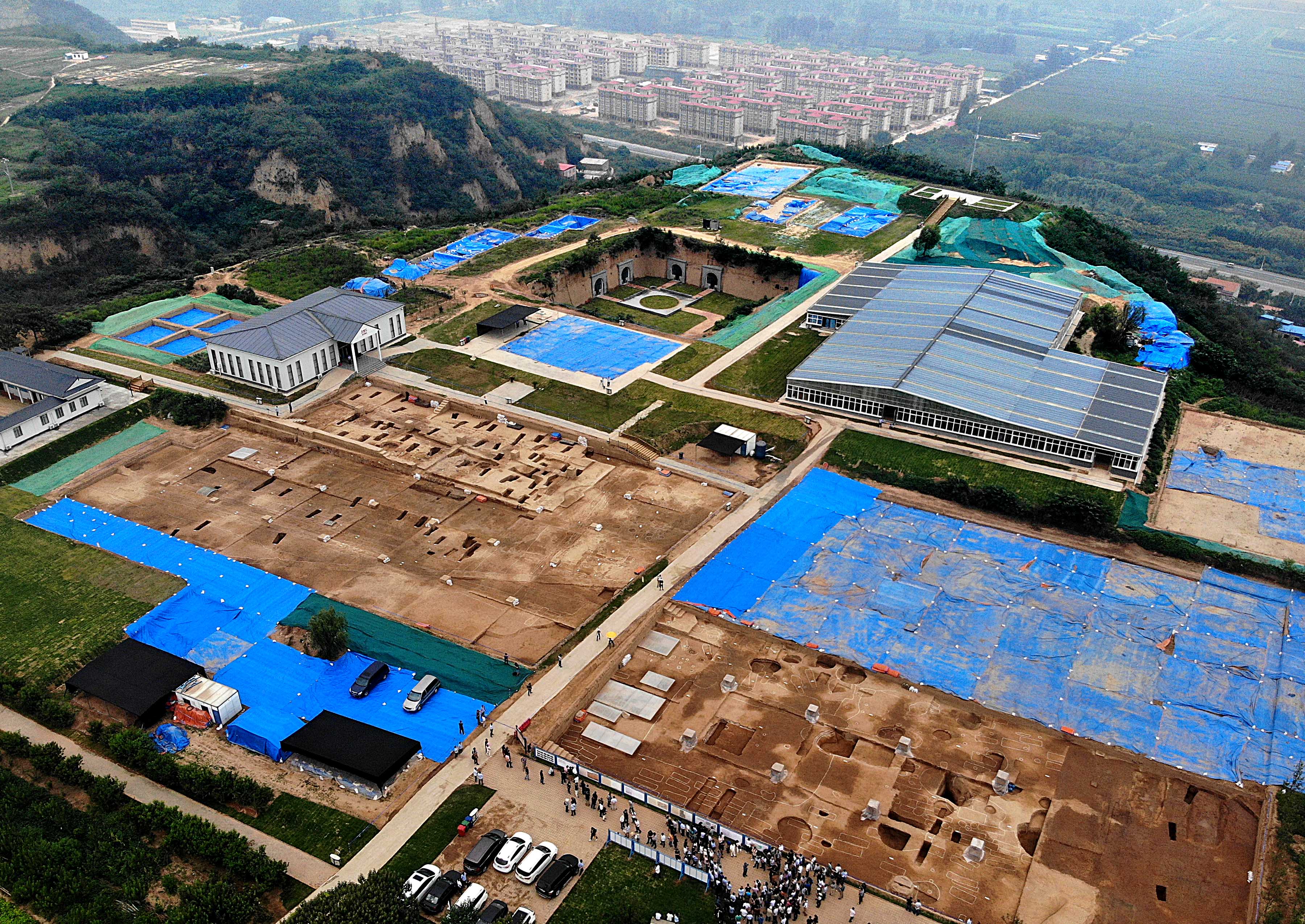
— With an area of 1.17 million square meters, the Shuanghuaishu site, dating back to around 5,300 years, is located on the south bank of the Yellow River in the township of Heluo, Gongyi City, and was proposed to be named “Heluo kingdom.”

— A large number of relics of the Yangshao Culture dating back 5,000 to 7,000 years have been discovered at the site.

by Xinhua writers Xu Ruiqing, Wang Ding, Gui Juan, Shuang Rui

ZHENGZHOU, May 7 (Xinhua) — Chinese archaeologists announced Thursday significant achievements at the Shuanghuaishu site in central China’s Henan Province, providing key proof of the origin of the over 5,000-year-long Chinese civilization.

With an area of 1.17 million square meters, the Shuanghuaishu site is located on the south bank of the Yellow River in the township of Heluo, Gongyi City.

The ancient city relic dating back to around 5,300 years ago was proposed by Chinese archaeologists to be named “Heluo kingdom” after its location in the center of the Heluo area, where the Yellow River (known as He in ancient China) and the Luohe River meet.

“The Shuanghuaishu site is the highest-standard cluster with the nature of a capital city discovered so far in the Yellow River basin in the middle and late stage of Yangshao Culture, the early stage of the formation of Chinese civilization,” said Li Boqian, a professor at Peking University, at a press conference on major archaeological discoveries at Shuanghuaishu site held Thursday in Zhengzhou, the provincial capital.

Aerial photo taken on Aug. 27, 2019 shows the Shuanghuaishu site in central China’s Henan Province. (Xinhua/Li An)

A large number of relics of the Yangshao Culture dating back 5,000 to 7,000 years have been discovered at the site, said Gu Wanfa, director of the Zhengzhou Municipal Research Institute of Cultural Relics and Archaeology, at the press conference.

“The important archaeological findings provide key proof of the origin of Chinese civilization, and also prove the representativeness and influence of the Heluo area in the golden stage of the origin of Chinese civilization around 5,300 years ago,” said Wang Wei, a member of the Chinese Academy of Social Sciences.

Since 2013, the Zhengzhou Municipal Research Institute of Cultural Relics and Archaeology and the Institute of Archaeology of the Chinese Academy of Social Sciences have conducted continuous archaeological excavations on the site.

According to archaeologists, the Shuanghuaishu site was about 1,500 meters long from east to west and 780 meters wide from north to south. It was surrounded by three ring trenches with each found to have external access, forming a strict defense system.

Aerial photo taken on Aug. 27, 2019 shows the Shuanghuaishu site in central China’s Henan Province. (Xinhua/Li An)

The central residential area with four rows of houses was found in the northern part of the inner ring moat. Meanwhile, three public cemeteries with more than 1,700 tombs, three sacrificial remains, an astronomical relic, a pottery workshop area, a water storage area, a road system, and other facilities were also discovered at the city ruins.

“The Shuanghuaishu site was a well-selected and scientifically planned settlement site,” said Wang.

“Based on the geographical location and scale, it’s also the only large-scale city settlement discovered so far in the Yellow River basin from the middle and late stage of Yangshao Culture,” Wang added.

Archaeologists believe that the Heluo kingdom was the source of many typical characteristics of Chinese civilization.

Silk originated in China and later became one of the country’s major trade items. “The mulberry-growing and silkworm-raising culture was an important component of Chinese civilization,” said Li.

Among the unearthed relics at Shuanghuaishu, a boar tusk carving of a silkworm, 6.4 cm long, nearly 1 cm wide and 0.1 cm thick, was believed to be China’s earliest carving depicting silkworms.

Undated photo shows a boar tusk carving of a silkworm unearthed at the Shuanghuaishu site in central China’s Henan Province. (Xinhua)

Experts say that the carving depicts a spinning silkworm which is quite similar to modern silkworms in appearance. “The spinning shape of the carving suggests that ancient Chinese people were familiar with the habits of silkworms,” said Gu.

Along with silk fabrics unearthed at the surrounding Wanggou site and Qingtai site, archaeologists said they are solid evidence to prove that the ancient Chinese in the Yellow River basin began raising silkworms and silk production around 5,300 years ago.

“Except Shuanghuaishu and its surrounding settlement sites, there were no definite discoveries from around 5,300 years ago related to the silk textile industry in other parts of the country,” said Li. “In that sense, they are the earliest representatives in the development history of Chinese mulberry cultivation and silkworm-rearing culture.”

Meanwhile, at the astronomical relic at Shuanghuaishu, nine pottery pots were arranged in the pattern of the nine stars of the Big Dipper, which shows that the ancestors of Heluo had relatively mature astronomical knowledge.

Photo taken on April 28, 2020 shows one of nine pottery pots arranged in the pattern of the nine stars of the Big Dipper, at an astronomical relic at the Shuanghuaishu site in central China’s Henan Province. (Xinhua/Li An)

“The relic also indicates the worship of the celestial body may have formed a grand sacrificial ceremony for observing the solar terms and praying for a good harvest,” said Gu.

Experts also believe the astronomical relic and the surrounding sacrificial remains constitute a whole, which is consistent with the records of winter solstice sacrifices in ancient Chinese documents. “It is of great significance to the study of early Chinese astronomy and the origin of Chinese civilization,” added Gu.

Source: Xinhua

01/05/2020

No asymptomatic cases turn into confirmed cases after Wuhan lifts lockdown

WUHAN, April 30 (Xinhua) — No asymptomatic cases of COVID-19 in the hard-hit Wuhan turned into confirmed cases in the three weeks after the city lifted its 76-day lockdown, local health authorities said Thursday.

From April 8 to 29, more than 1.03 million nucleic acid tests were conducted in the capital city of central China’s Hubei Province, with 499 asymptomatic cases reported, said the Wuhan municipal health commission.

Meanwhile, none of the 2,250 close contacts of the asymptomatic cases had developed into confirmed or asymptomatic cases, it said.

To avoid crowding and guard against risks of potential infection, the provincial culture and tourism bureau said Thursday that tourists should make bookings before visiting local scenic sites, and tourist flow should be limited to no more than 30 percent of the maximum tourist capacity.

Source: Xinhua

28/04/2020

Coronavirus: China’s capital city struggles to get back to normal amid continued outbreak worries

  • Beijing’s Chaoyang district remains the last high-risk area in China, with virus preventive measures continuing to impact on travel and shopping plans
  • China faces the dilemma of preventing a re-emerge of the pandemic, while also pushing to get its economy back to normal
China’s continued pandemic prevention measures, coupled with still hesitant consumer demand, will inevitably lead to persistent limitations on the nation’s economic recovery, analysts said. Photo: Bloomberg

After nearly three months of being quarantined by herself in Beijing, Mary Zhao was looking forward to the upcoming long weekend at the start of May to be able to finally reunite with her parents.

But Zhao was forced to abandon her plan for the Labour Day holidays as Beijing’s upmarket Chaoyang district, where she lives, remains the only high-risk zone for coronavirus in the entire country.

If she travelled the five hours by car, or two hours via bullet train, to the neighbouring Hebei province, she would first have to undergo a 14-day quarantine before seeing her parents. Her parents would also have the same two week quarantine to look forward to once they returned home if they came to visit their daughter in Beijing.

These strict controls to prevent a re-emergence of the coronavirus outbreak are making a return to normal life impossible for many, and mean the final economic and social cost

 from China’s draconian preventive measures could be much larger than expected.
Wuhan declares ‘victory’ as central Chinese city’s last Covid-19 patients leave hospital
It underscores the dilemma facing China’s leaders on how to balance the need to

restart the economy

and to avoid a fresh outbreak. On the surface, China may be able to declare victory as even Wuhan, the city where the virus was first detected, announced that the last Covid-19 patient had left hospital on Sunday. But fears of a renewed outbreak have kept the country’s cinemas and most schools closed, with travel between provinces discouraged.

China’s national borders also remain largely closed, with flights being cut to a minimum, and a mandatory 14-day quarantine for every arrival. In the number of places where new cases have been reported, quarantine requirements have been tightened, including Harbin and a few other cities near the border with Russia.
Chaoyang, the home to one of Beijing’s main business districts and most foreign embassies, changed its risk rating to high from low in the middle of April after three new cases were reported, dealing a fresh blow to the district’s

struggling businesses,

and forcing many of the 3.5 million residents to cancel their travel plans.

On the outskirts of Beijing, near Beijing Capital International Airport, returning migrant workers to Picun village were ordered to stop at entrance and could only be escorted inside by their landlord, with many villages and residential compounds remaining closed to outsiders.

In the high-end shopping district of Guomao, some shops also remain closed as there are few potential customers, while over in the popular Sanlitun area, metal barriers restrict access and temperature checkpoints are still required.

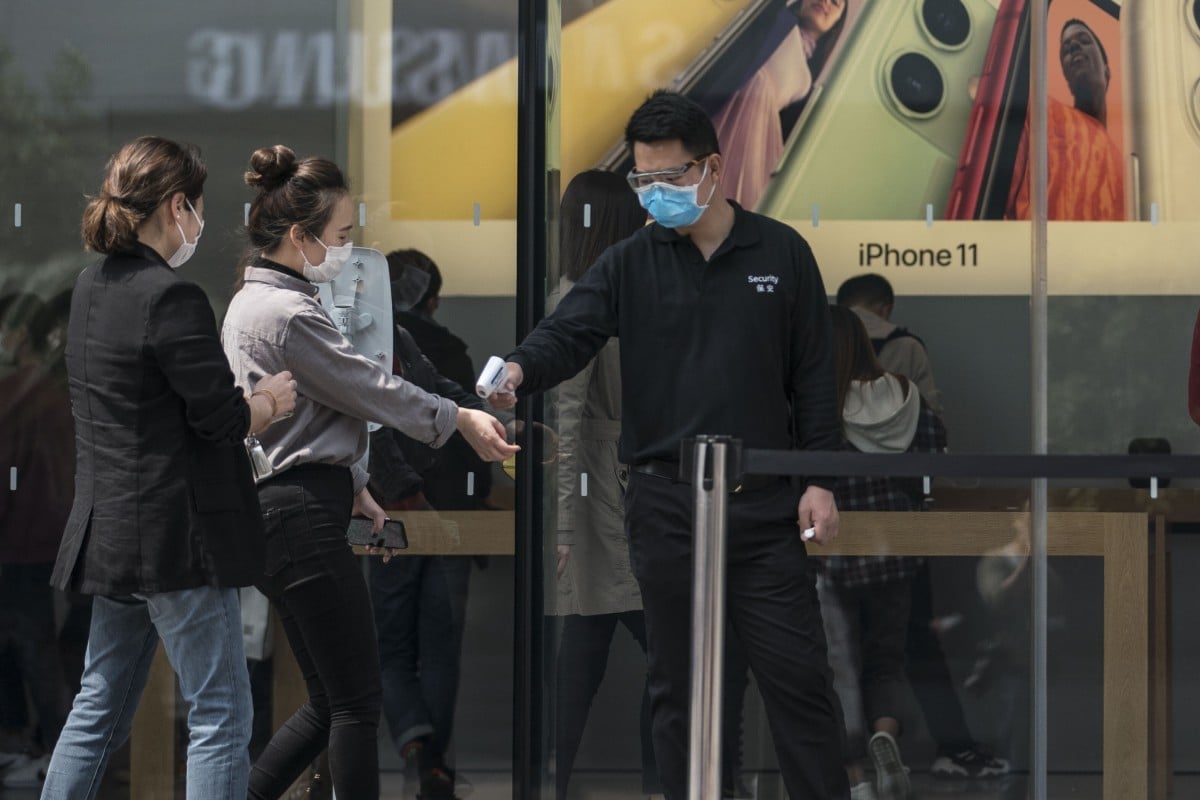
The landmark Apple Store in the popular Taikoo shopping centre is open, but with limited customers allowed inside, there are long queues outside. Customers are required to scan a QR code to check their movements over the last few days before entering.

Coronavirus: More schools reopen in China for students preparing for university entrance exams
“Why do I have to spend 20 minutes just to get into the Apple Store? The sun has almost melted me down,” one visitor complained to the security guards at the front of the shop.

China’s continued pandemic prevention measures, coupled with still hesitant consumer demand, will inevitably lead to persistent limitations on the nation’s economic recovery, analysts said.

Ernai Cui, an economist at research firm Gavekal Dragonomics, said on Monday that China’s cautious approach to lifting restrictions “points to a weak second quarter for consumer services”, adding additional pressure to the economic recovery.Mao Zhenhua, a researcher at the China Institute of Economics at Renmin University, said China’s preventive measures will inevitably be a drag on production, employment and exports.

Source: SCMP

17/04/2020

Spring yet to come: Small businesses at Beijing’s tourist hot-spots struggle

BEIJING (Reuters) – For Zhang Yu, who runs a cafe in one of Beijing’s top tourist spots, business has never been so bad.

To contain the spread of the coronavirus, bars and cafes in the Wudaoying hutong – a top Lonely Planet destination built around a narrow lane – are permitted to provide take-away services only. Non-residents must show proof they have an appointment to enter the area.

Added to which, tourism has plummeted.

“Don’t mention it! This is supposed to be the peak season,” said Zhang, who has run her cafe for five years. “But there are almost no customers as they (authorities) don’t want to have people hanging around here.”

While China’s manufacturing and retail sectors are starting to get back to work as the pace of new infections slows sharply, tourism sites in Beijing remain a shadow of their former and bustling self.

China’s capital city has maintained the highest level of emergency response to the outbreak, so tourist attractions like the Forbidden City remain closed. A 14-day quarantine for new arrivals has stifled travel.

As a result, small business owners running restaurants, souvenir shops and tourism agencies are struggling.

Only a little over 20% of tourism-related businesses in Beijing had resumed operation as of the three-day Qingming national holiday in early April, a survey by on-demand delivery service giant Meituan Dianping showed.

HANGING ON

The only people present in Wudaoying on a recent afternoon were a few elderly residents sitting outside to enjoy the spring sunshine. A cat made its way lazily through empty rooftop bars.

“We used to see more customers in one hour in pre-virus days than we see in a whole day right now,” said a worker at a sandwich restaurant in Wudaoying.

In another popular area, Khazzy, a 32-year-old doctoral student who opened a restaurant last October, has had only four customers all day.

“There are almost no tourists coming to Beijing and the remaining locals have concerns about eating out,” Khazzy said as sunset approached.

Khazzy said he has let five of his 13 staff go and has no idea how long he can stay afloat financially even though his landlord has agreed to waive one month’s rent on the property in Qianmen, near Beijing’s Tiananmen Square.

More than half of the shops in Qianmen remain closed. The manager of a state-backed noodle restaurant said most of the closed stores are privately owned small businesses that can’t secure enough business to support their daily operations.

She said revenues at the noodle restaurant have plunged more than 80%, but staff salaries have not been cut.

Zhang, the cafe owner in Wudaoying, reckoned small businesses could hold on for the next three months.

“But after that, I just don’t know,” she said.

Source: Reuters

06/03/2020

In Beijing, you will soon be able to order books with your lunch on Chinese food delivery app Meituan

  • A first batch of 72 bookstores are launching on food delivery platform Meituan “as soon as next week”
  • Booksellers in China’s capital city have been struggling to stay afloat due to reduced footfall during the epidemic
For illustration: coffee and cake in front of a shelf of books at a bookstore. Photo: SCMP / Dickson Lee

Bookstores in Beijing, struggling to survive amid the coronavirus epidemic, are teaming up with a popular food delivery app to help get books into the hands of readers.

The initiative, co-launched by food delivery company Meituan Dianping and the municipal government of Beijing, will feature a first batch of 72 bookstores.

“Due to the epidemic, 80 per cent of physical bookstores are closed,” the publicity department of the Communist Party of China’s Beijing Municipal Committee told local media. “Although many of them try to launch online programmes to keep customers, it doesn’t make a substantial income for stores … companies want the government to coordinate more resources and platforms to help them.”

The bookstores will not have to pay a fee to join the programme, according to the Beijing publicity department.

Users will be able to purchase books on Meituan “as soon as next week”, the food delivery company said in a statement. “After the launch, we will support bookstores by charging them lower service fees, providing subsidies and launching reward plans to help them get on board quickly,” the company added.
China’s smartphone brands adapt to life under coronavirus restrictions
17 Feb 2020

Bookstores in China’s capital city have been hit hard by the coronavirus outbreak. About 60 per cent of 248 stores in Beijing said they expected their revenues to drop more than 50 per cent year-on-year, while only 48 per cent said their cash flows were sufficient to support operations for another one to three months, according to a report by the Beijing Institute of Culture Innovation and Communication.

With fewer customers patronising physical stores and pressure from rent and employee salaries, more bookstores are looking toward online channels to increase sales. Among those interviewed by the Beijing Institute of Culture Innovation and Communication, 21.8 per cent said they were now selling books only via online channels, 48 per cent had tried advertising on social media platforms like WeChat and Weibo, while 16.9 per cent are promoting books on video-sharing platforms like Douyin and Kuaishou.

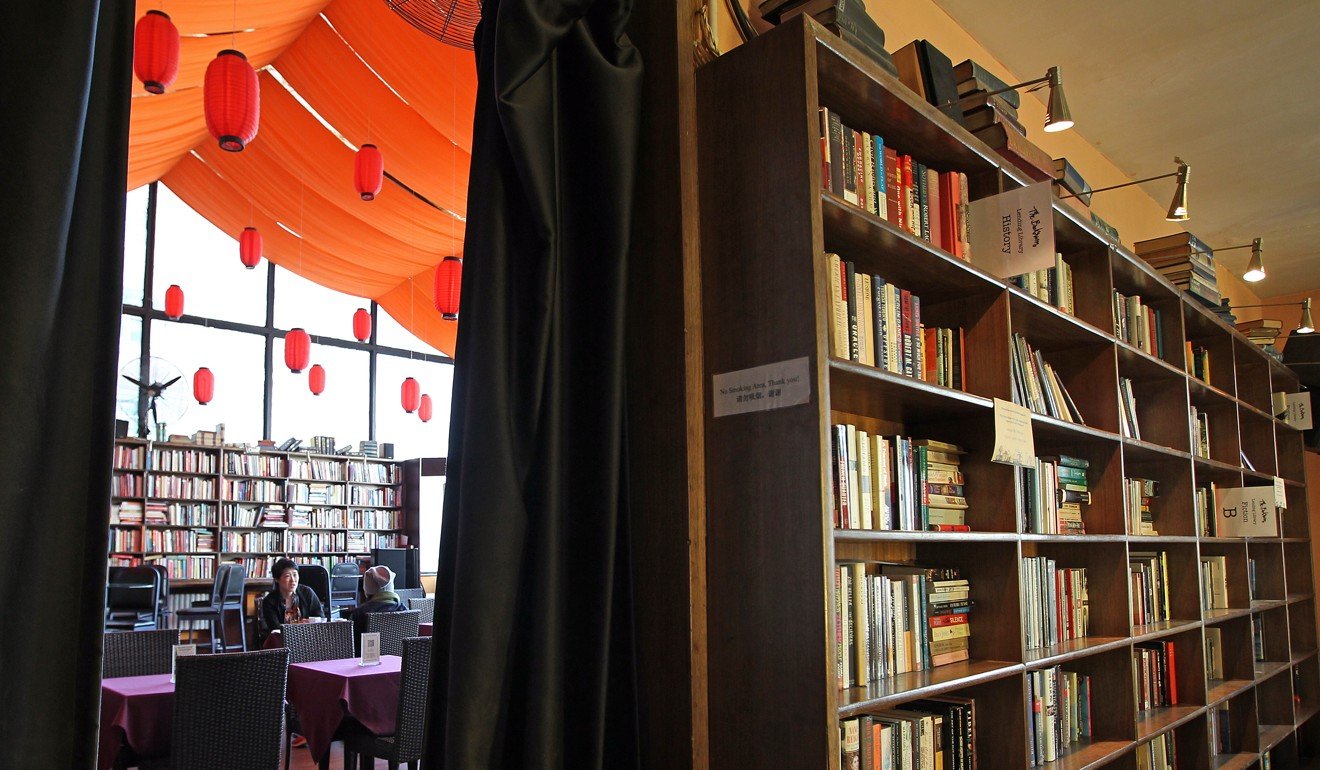
An interior view of a bookstore, Bookworm, at Sanlitun, Beijing. File photo: SCMP
Last week, Beijing-based bookstore chain OWSpace, which has 15 year history selling books and drinks, posted an appeal on its WeChat account for loyal customers to pay a 50 yuan to 8,000 yuan membership fee to help with its cash flow.

Among their four physical stores in China, only one in Beijing remains open and traffic is a tenth of what it was before the outbreak, it said.

“The store can only sell 15 books a day on average, and more than half are bought by our own staff. We expect our revenue in February to drop 80 per cent compared to other years,” OWSpace said in the post.

Wu Yanping, the general manager of OWSpace’s offline stores, said one of the chain’s stores in Beijing is joining Meituan’s book delivery platform. The store remains physically closed because it is located in an office park that prohibits anyone who travelled out of Beijing from entering before they complete the mandatory 14-day quarantine period.

“Our Dongfeng store is closed for now but even if it opens later, it will not have much traffic [because of the travel restrictions]. So we hope to sell books along with our coffee and drinks on the delivery platform even with the store closed,” Wu said.

Beijing has initiated a range of measures to help keep bookstores afloat, including subsidising their rent, rewarding stores that stay open during the epidemic and encouraging bookstores to expand their sales channels online.

Wu said that since OWSpace posted its appeal letter, it managed to reopen another store in Hangzhou, in the eastern province of Zhejiang, and traffic to both stores has been “gradually recovering to just under 50 per cent of a normal day [before the outbreak]”.

OWSpace also conducts live streams on Taobao three times a week to introduce books, encourage viewers to appreciate literature and sell the store’s peripheral products.

“Readers are quite enthusiastic about it. There were almost 10,000 people watching our last live stream” Wu said.

Taobao is an e-commerce platform operated by Alibaba Group Holding, which is the parent company of the Post.

Source: SCMP

07/10/2019

Xinhua Headlines: China achieves best world championships results in 20 years over National Day holiday

The Chinese legion at the World Athletics Championships celebrated the 70th anniversary of the founding of the People’s Republic of China in style — staging their best performance at the world championships in 20 years in Doha.

By Sportswriters Ma Xiangfei, Wu Junkuan and Liu Ning

DOHA, Oct. 6 (Xinhua) — For the first time in history, the World Athletics Championships spanned almost the entirety of China’s National Day holiday.

More coincidentally, the year 2019 is the 70th anniversary of the founding of the People’s Republic of China, which gave added meaning to the Chinese delegation’s quest in Doha.

And the Chinese legion celebrated the holiday in style — staging the country’s best performance at the 10-day world championships in 20 years with three gold, three silver and three bronze medals.

“The race had a special meaning for me because it was held just before China’s National Day,” said former world record holder Liang Rui, who led a one-two finish for China in the women’s 50-kilometer race walk.

“This victory is a birthday gift from me for my homeland,” she said after finishing the race at dawn on September 29.

Liang Rui of China celebrates after the women’s 50km race walk at the 2019 IAAF World Championships in Doha, Qatar, Sept. 29, 2019. (Xinhua/Jia Yuchen)

At the same time, many Chinese back home were busy preparing for a huge nationwide celebration on October 1 in a festival atmosphere similar to that of the traditional Chinese Lunar New Year.

One day later, when China was counting down to a grand military parade and mass pageantry at Beijing’s iconic Tian’anmen square, Olympic gold medalist Liu Hong and her teammates Qieyang Shijie and Yang Liujing swept the 20km race walk podium in Doha.

“Even before we came here, the team was confident of retaining the 20km title before the National Day, and the only question was who would win it. Every one of us wanted to win the gold medal, to pay tribute to our country,” said 32-year old Liu, who returned to action in early 2019 after more than two years of maternity leave.

“This is the third time I have won at the World Championships. I am very pleased that I won this time because tomorrow will be the 70th anniversary of the founding of the People’s Republic of China. Winning all three medals, this achievement is our gift to our motherland,” she said.

China’s Liu Hong (2nd L), Qieyang Shenjie (2nd R) and Yang Liujing (1st R) compete during the women’s 20km race walk final at the 2019 IAAF World Championships in Doha, Qatar, Sept. 29, 2019. (Xinhua/Wang Jingqiang)

Hours before first light was shed on a sleepless Beijing on October 1, Xie Zhenye had written a piece of athletics history when he became the first Chinese man ever to qualify for the 200m final at the world championships.

“Yes, I created some history. I did my best today and I am proud of myself, especially on this day,” said the 26-year-old, who qualified as the third fastest runner in the 200m semifinals.

Xie eventually finished seventh in the final on Tuesday night, when 6,000km away China was deep in sleep after the National Day culminated in spectacular firework displays in the heart of the capital city.

The Asian record holder said he took valuable experience from Doha, and already has his sights set on next year’s Tokyo Olympic Games.

“I believe I have gone through the most difficult process, running in the strongest heat group and in the inside lane in the final. I took this as a test and a learning opportunity for next year’s Olympics,” he said.

“Everyone in the team was trying to keep it steady this year because our bigger goal is Tokyo.”

China’s Xie Zhenye (R) competes during the men’s 200m final at the 2019 IAAF World Athletics Championships in Doha, Qatar, on Oct. 1, 2019. (Xinhua/Xu Suhui)

As the National Day celebrations drew to a close, many Chinese people began to enjoy their holiday by traveling around the country. In the first four days of the seven-day holiday, the country received a total of 542 million domestic tourists and recorded 452.63 billion yuan (63.6 billion U.S. dollars) in domestic tourism revenue.

Many people also elected to stay at home and relax, allowing them to watch the world championships and hear more good news from Doha.

Defending champion Gong Lijiao, competing in her seventh world championships, retained her shot put title on October 3. The 30-year-old held off a strong challenge from Jamaica’s Danniel Thomas-Dodd and produced four throws over 19m, grabbing the gold with a throw of 19.55m in the fourth round.

Despite her win, Gong was unsatisfied with her performance and promised to do better in Tokyo.

“I’m so happy to win but the result was well below my expectations,” said Gong, whose personal best is 20.43m.

“I worked out too much in the warm-up before the final and was dripping with sweat. So when the competition started, I felt like I was losing all my momentum, and the air conditioning in the stadium worked against me too,” she explained.

“This is a lesson for me and I will pay more attention to these details in Tokyo. My dream is obviously to win the title then,” said Gong, who already has a silver and a bronze from the Olympic Games.

China’s Gong Lijiao celebrates after winning the title of the women’s shot put final at the 2019 IAAF World Athletics Championships in Doha, Qatar, Oct. 3, 2019. (Xinhua/Wang Lili)

Liu Shiying and Lyu Huihui also brought home a silver and a bronze medal respectively in women’s javelin, although the color of the medal was not the right one for Lyu, a clear favorite before the world championships with a four-month winning streak across 12 competitions.

“I have already competed at two world championships before, winning a silver and a bronze, and I really wanted a gold this time,” she said.

Little did she know that the Chinese team’s achievements in Doha had already made their compatriots proud.

When the women’s 20km walk race medal ceremony was held on China’s National Day on October 1, 2014 Winter Olympic gold medalist Zhang Hong watched three Chinese flags fluttering on the big screen at the Khalifa International Stadium.

The scene could well have reminded her of her days as an athlete, when she raced to the 1,000m speed skating title in Sochi in 2014, becoming the first Chinese Olympic champion in this event.

“I was so proud when I heard the national anthem on October 1. Those athletes who saw the national flags raised in the competition are the best,” said the current International Olympic Committee (IOC) member.

Gold medalist Liu Hong (C) of China, silver medalist Qieyang Shenjie (L) of China and bronze medalist Yang Liujing of China pose for photos at the awarding ceremony of women’s 20km race walk during the 2019 IAAF World Athletics Championships in Doha, Qatar, Sept. 30, 2019. (Xinhua/Wang Jingqiang)

Zhang retired after the 2018 Winter Olympics and was elected to the Athlete’s Commission of the IOC. During her visit to Doha as a representative of the IOC, Zhang was informed that she was appointed to the Future Host Commission, which will explore, monitor and encourage interest in future Olympic Games, Olympic Winter Games and Youth Olympic Games.

After joining the IOC, Zhang said she could see her country from another perspective.

“After I became an IOC member, I came to know more about athletes from other countries and regions. I didn’t know how well we Chinese athletes are taken care of until I spoke to others,” she said.

Zhang’s career path could set an example for other Chinese athletes, as China’s top sprinter Su Bingtian was nominated as one of the 15 candidates for the six available seats in the IAAF Athletes’ Commission.

“I met him in Doha the other day and gave him my encouragement. I hope he can be elected,” Zhang said.

Source: Xinhua

Law of Unintended Consequences

continuously updated blog about China & India

ChiaHou's Book Reviews

continuously updated blog about China & India

What's wrong with the world; and its economy

continuously updated blog about China & India