Archive for ‘China’s sovereignty’

20/05/2020

Taiwan president rejects Beijing rule; China says ‘reunification’ inevitable

TAIPEI (Reuters) – Taiwan cannot accept becoming part of China under its “one country, two systems” offer of autonomy , President Tsai Ing-wen said on Wednesday, strongly rejecting China’s sovereignty claims and likely setting the stage for an ever worsening of ties.

China responded that “reunification” was inevitable and that it would never tolerate Taiwan’s independence.

In a speech after being sworn in for her second and final term in office, Tsai said relations between Taiwan and China had reached an historical turning point.

“Both sides have a duty to find a way to coexist over the long term and prevent the intensification of antagonism and differences,” she said.

Tsai and her Democratic Progressive Party won January’s presidential and parliamentary elections by a landslide, vowing to stand up to China, which claims Taiwan as its own and says it would be brought under Beijing’s control by force if needed.

“Here, I want to reiterate the words ‘peace, parity, democracy, and dialogue’. We will not accept the Beijing authorities’ use of ‘one country, two systems’ to downgrade Taiwan and undermine the cross-strait status quo. We stand fast by this principle,” Tsai said.

China uses the “one country, two systems” policy, which is supposed to guarantee a high degree of autonomy, to run the former British colony of Hong Kong, which returned to Chinese rule in 1997. It has offered it to Taiwan, though all major Taiwanese parties have rejected it.

China’s Taiwan Affairs Office, responding to Tsai, said Beijing would stick to “one country, two systems” – a central tenet of Chinese President Xi Jinping’s Taiwan policy – and “not leave any space for Taiwan independence separatist activities”.

“Reunification is a historical inevitability of the great rejuvenation of the Chinese nation,” it said. “We have the firm will, full confidence, and sufficient ability to defend national sovereignty and territorial integrity.”

China views Tsai as a separatist bent on formal independence for Taiwan. Tsai says Taiwan is an independent state called the Republic of China, its official name, and does not want to be part of the People’s Republic of China governed by Beijing.

TAIWAN OPEN TO DIALOGUE

China has stepped up its military drills near Taiwan since Tsai’s re-election, flying fighter jets into the island’s air space and sailing warships around Taiwan.

Tsai said Taiwan has made the greatest effort to maintain peace and stability in the narrow Taiwan Strait that separates the democratic island from its autocratic neighbour China.

“We will continue these efforts, and we are willing to engage in dialogue with China and make more concrete contributions to regional security,” she added, speaking in the garden of the old Japanese governor’s house in Taipei, in front of a socially-distanced audience of officials and diplomats.

Taiwan has become a rising source of friction between China and the United States, with the Trump administration strongly backing Taiwan even in the absence of formal diplomatic ties.

U.S. Secretary of State Mike Pompeo sent his congratulations to Tsai on Tuesday, praising her “courage and vision in leading Taiwan’s vibrant democracy”, in a rare high-level message from Washington direct to Taiwan’s government.

China’s Foreign Ministry condemned Pompeo’s remarks, and said the government would take “necessary countermeasures”, though did not elaborate.

China cut off a formal talks mechanism with Taiwan in 2016 after Tsai first won election.

Yao Chia-wen, a senior adviser to Tsai, told Reuters the chance of talks with China were small given ongoing tensions.

“We are ready to engage with them any time, but China is unlikely to make concessions to Taiwan,” he said. “In the next four years there’s little chance for the cross-strait relationship to improve.”

Source: Reuters
20/04/2020

Educational situation in China’s Xinjiang much improved: scholar

KATHMANDU, April 19 (Xinhua) — A German scholar has recently found that the right to education for Uygurs and people of other ethnic groups is well protected in China’s Xinjiang region, as young people there enjoy increasingly better opportunities.

Michael Heinrich, who has been teaching German in Minzu University of China for more than five years, said in an article published on Online Khabar news website in March that he has “paid close attention to the development of Chinese education in recent years, especially the education situation in ethnic minority areas.”

Heinrich said he has taught a Xinjiang Uygur student, who often talks with him about the education situation in her hometown and appreciates government policies on education.

The Uygur student has told Heinrich that she lives in a place where she receives Islamic religious education and China’s nine-year compulsory education, and the Uygur students in Xinjiang can enjoy preferential policies, such as extra points in college entrance examination, special policies for college admissions, and employment policy support.

In recent years, the Chinese government has intensified policy support on education in Xinjiang Uygur Autonomous Region, and increased investment in educational resources, especially those on vocational education, the article read.

“Through vocational education, more Uyghur Muslim students can enhance their survival skills and work harder by themselves and improve their living standards with these hands,” it said.

For some time, Xinjiang has been plagued by terrorism, religious extremism and separatism, according to the passage, and carrying out vocational education and training in Xinjiang is an effective measure to promote the rule of law and a practical action to protect the vital interests of people of all ethnic groups there.

It is also a just move in fighting extremism and terrorism to contribute to the stability in Xinjiang, it added.

Some Western media outlets as well as some U.S. politicians often slander the Chinese government under the guise of “human rights,” which does not only disregard the facts but also interferes with China’s sovereignty, Heinrich pointed out.

The situation in Xinjiang that they saw was completely different from the stories told by some Western politicians and media, Heinrich quoted some people who have visited Xinjiang and witnessed its development as saying.

The rights to life and development of people of all ethnic groups in Xinjiang are protected to the largest extent, Heinrich added.

Source: Xinhua

19/08/2019

Beijing warns US of ‘consequences’ after Donald Trump approves US$8 billion sale of fighter jets to Taiwan

  • President says sale of Lockheed Martin F-16Vs will go ahead if ratified by Senate
  • Military experts have said the jets would bolster Taiwan’s ability to counter the threat of air strikes from mainland China
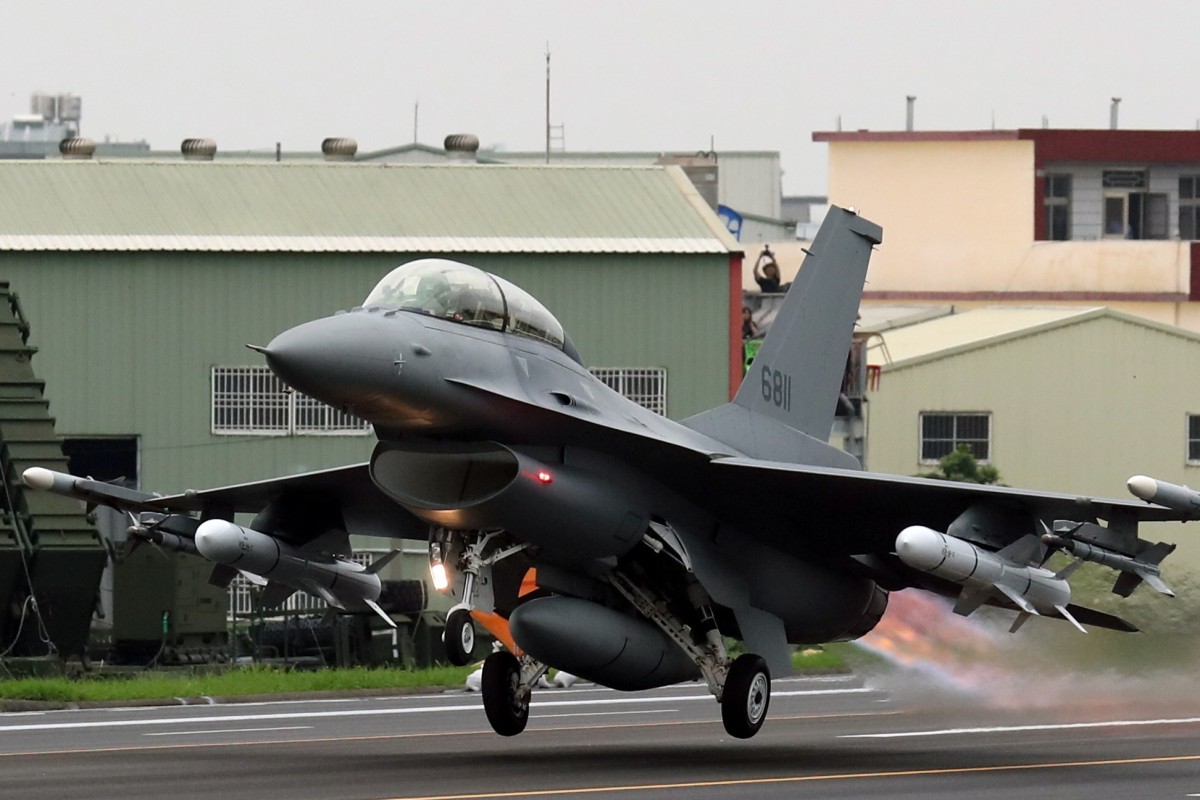
A Taiwan Air Force F-16V takes off during a drill in May. Photo: EPA-EFE
Beijing warned it would take countermeasures against Washington for selling 66 fighter jets to Taiwan after US President Donald Trump said he had approved the US$8 billion deal.
Chinese foreign ministry spokesman Geng Shuang on Monday said the sale of Lockheed Martin F-16V jets was a serious violation of the one-China principle.
“China has made numerous solemn representations to the US on the sale of F-16V jets to Taiwan,” Geng said in a press conference, adding that the United States should halt the sale.
“The US has to bear all the consequences triggered by the sale,” Geng said. “China will take necessary measures to defend its self-interest based on the development of the situation.”

Geng gave no details of the action China would take. In July, Beijing said it would impose sanctions on US firms involved in a deal to sell US$2.2 billion worth of tanks, missiles and related equipment to Taiwan, describing it as harmful to China’s sovereignty and national security.

Liang Yunxiang, an international relations expert from Peking University, said one countermeasure Beijing might use was to suspend military-to-military exchanges with the United States.

“And Beijing might also try to increase pressure on the island, including by conducting more military drills near or in the Taiwan Strait,” Liang saiOn Sunday, Trump said he had approved the proposed deal for the jets – a move set to significantly boost the self-ruled island’s defences against mainland China.

‘Fighter jets trump battle tanks’ in Taiwan’s US arms priorities

Speaking to reporters in New Jersey on Sunday, Trump said that the sale would need to be ratified by the US Senate but that he had approved it.

“It’s US$8 billion. It’s a lot of money. That’s a lot of jobs. And we know they’re going to use these F-16s responsibly,” he said.

If the deal is approved by Congress, it will be the first time since 1992 that the United States has sold F-16s to Taiwan. Previous requests were rejected by the Barack Obama administration, which instead offered to upgrade Taiwan’s existing fleet of about 140 F-16A/B Block 20 aircraft.

During months of slow progress since  the sale  was outlined earlier this year, some lawmakers and defence experts had suggested that Trump was using the proposed deal as leverage to secure a better agreement for the US in talks to resolve its year-long

trade war with China.
Taiwan’s presidential office and foreign ministry lauded Trump’s announcement, calling it a strong sign of the US’ commitment to its security and saying the deal would help to maintain regional stability.
“The new warplanes will greatly strengthen our anti-air defence capability and we will continue to be devoted to safeguarding peace and stability across the Taiwan Strait and in the region, thereby maintaining freedom and democracy in Taiwan,” presidential office spokesman Alex Huang said.
‘Fighter jets trump battle tanks’ in Taiwan’s US arms priorities
In a statement, Taiwan’s foreign ministry said persistent war games by the mainland around the island and in the East and South China Sea had not only sabotaged peace and stability in the region but also triggered grave concern from China’s neighbours.
It described Trump’s approval of the deal as a “strong indicator of the close and growing security partnership between the US and Taiwan”.
Opinion: Care needed over Taiwan arms deal
Military experts have said the new variant of the F-16, the Viper – which can carry a wide range of short and medium-range air-to-air missiles – is more able to counter the threat of an air strike from mainland China’s fourth-generation aircraft, such as the Su-35 and J-10.
Last week, Republican Senator Marco Rubio said the US administration had  made progress in advancing the deal, which he called “an important step in support of Taiwan’s self-defence efforts”.
In July, the US  also approved arms sales to Taiwan worth US$2.2 billion, including 108 M1A2T Abrams tanks and 250 Stinger portable surface-to-air missiles.
Beijing strongly opposes arms deals with Taiwan, which it considers a renegade province, but the US is obliged to help defend the self-governing island under the terms of its Taiwan Relations Act, effective since 1979.
Source: SCMP
Law of Unintended Consequences

continuously updated blog about China & India

ChiaHou's Book Reviews

continuously updated blog about China & India

What's wrong with the world; and its economy

continuously updated blog about China & India