Archive for ‘China alert’

13/01/2017

China posts worst export fall since 2009 as fears of U.S. trade war loom | Reuters

China’s massive export engine sputtered for the second year in a row in 2016, with shipments falling in the face of persistently weak global demand and officials voicing fears of a trade war with the United States that is clouding the outlook for 2017.

In one week, China’s leaders will see if President-elect Donald Trump makes good on a campaign pledge to brand Beijing a currency manipulator on his first day in office, and starts to follow up on a threat to slap high tariffs on Chinese goods.

Even if the Trump administration takes no concrete action immediately, analysts say the specter of deteriorating U.S.-China trade and political ties is likely to weigh on the confidence of exporters and investors worldwide.

The world’s largest trading nation posted gloomy data on Friday, with 2016 exports falling 7.7 percent and imports down 5.5 percent. The export drop was the second annual decline in a row and the worst since the depths of the global crisis in 2009.

It will be tough for foreign trade to improve this year, especially if the inauguration of Trump and other major political changes limit the growth of China’s exports due to greater protectionist measures, the country’s customs agency said on Friday.

“The trend of anti-globalization is becoming increasingly evident, and China is the biggest victim of this trend,” customs spokesman Huang Songping told reporters.

“We will pay close attention to foreign trade policy after Trump is inaugurated president,” Huang said. Trump will be sworn in on Jan. 20.

China’s trade surplus with the United States was $366 billion in 2015, according to U.S. customs data, which Trump could seize on in a bid to bring Beijing to the negotiating table to press for concessions, economists at Bank of America Merrill Lynch said in a recent research note.

A sustained trade surplus of more than $20 billion against the United States is one of three criteria used by the U.S. Treasury to designate another country as a currency manipulator.

China is likely to point out that its own data showed the surplus fell to $250.

79 billion in 2016 from $260.91 billion in 2015, but that may get short shrift in Washington.

“Our worry is that Trump’s stance towards China’s trade could bring about long-term structural weakness in China’s exports,” economists at ANZ said in a note.

“Trump’s trade policy will likely motivate U.S. businesses to move their manufacturing facilities away from China, although the latter’s efforts in promoting high-end manufacturing may offset part of the loss.”

On Wednesday, China may have set off a warning shot to the Trump administration. Beijing announced even higher anti-dumping duties on imports of certain animal feed from the United States than it proposed last year.

“Instead of caving in and trying to prepare voluntary export restraints like Japan did with their auto exports back in the 1980s, we believe China would start by strongly protesting against the labeling with the IMF, but not to initiate more aggressive retaliation … immediately,” the BofA Merrill Lynch Global Research report said.

“That said, even a ‘war of words’ could weaken investor confidence not only in the U.S. and China, but globally.”

CHINA’S DECEMBER EXPORTS FALL

China’s December exports fell by a more-than-expected 6.1 percent on-year, while imports beat forecasts slightly, growing 3.1 percent on its strong demand for commodities which has helped buoy global resources prices.

An unexpected 0.1 percent rise in shipments in November, while scant, had raised hopes that China was catching up to an export improvement being seen in some other Asian economies.

China reported a trade surplus of $40.82 billion for December, versus November’s $44.61 billion.

While the export picture has been grim all year, with shipments rising in only two months out of 12, import trends have been more encouraging of late, pointing to a pick-up in domestic demand as companies brought in more raw materials from iron ore to copper to help feed a construction boom.

China imported record amounts of crude oil, iron ore, copper and soybeans in 2016, plus large volumes of coal used for heating and in steelmaking.

“Trade protectionism is on the rise but China is relying more on domestic demand,” said Wen Bin, an economist at Minsheng Bank in Beijing.

Prolonged weakness in exports has forced China’s government to rely on higher spending and massive bank lending to boost the economy, at the risk of adding to a huge pile of debt which some analysts warn is nearing danger levels.

Data next Friday is expected to almost certainly show that 2016 economic growth hit Beijing’s target of 6.5-7 percent thanks to that flurry of stimulus.

But signs are mounting that the red-hot property market may have peaked, meaning China may have less appetite this year for imports of building-related materials.

“It is hard to see what could drive a more substantial recovery in Chinese trade,” Julian Evans-Pritchard, China Economist at Capital Economics, wrote in a note.

“Further upside to economic activity, both in China and abroad, is probably now limited given declines in trend growth. Instead, the risks to trade lie to the downside…,” he said, saying the chance of a damaging China-U.S. trade spat has risen since Trump’s appointment of hardliners to lead trade policy.

A decline in China’s trade surplus in 2016, to just under $510 billion from $594 billion in 2015, may also reduce authorities’ ability to offset capital outflow pressures, which have helped drive its yuan currency to more than eight-year lows, ANZ economists said.

Source: China posts worst export fall since 2009 as fears of U.S. trade war loom | Reuters

Tags:
12/01/2017

Pen power: China closer to ballpoint success – BBC News

It has sent rockets into space, produced millions of the world’s smartphones and built high-speed trains. But until now, one bit of manufacturing had perhaps unexpectedly eluded China: the ballpoint pen.

A year ago Premier Li Keqiang went on national television and bemoaned the failure of his country to produce a good quality version of this seemingly-simple implement.

Locally-made versions felt “rough” compared to those from Germany, Switzerland and Japan, Mr Li complained.

High precisionThe problem was not the body of the pen, but the tip – the tiny ball that dispenses ink as you write.It might be something we take for granted, but making them requires high-precision machinery and very hard, ultra-thin steel plates.

Put simply, China’s steel has not been good enough. And it has struggled to shape its pen tips accurately.

Li Keqiang has held a few pens in his time as Chinese Premier

Without that ability, China’s 3,000 penmakers have had to import this crucial component from abroad, costing the industry a reported 120m yuan ($17.3m; £14.3m) a year.

But according to People’s Daily, the state-owned Taiyuan Iron and Steel Co thinks it has cracked the problem, after five years of research.

The first batch of 2.3-millimetre ballpoint pen tips has recently rolled off its production lines, the paper says.

And once lab tests are completed, it’s expected China could phase out pen tip imports completely within two years.

Symbolic

On one level, whether China can make a great pen is not hugely important in the scheme of things.

High-tech and innovative manufacturing lie at the heart of the central government’s Made in China 2025 programme – designed to help domestic growth.

Relatively low-value items, like ballpoint pens, have not been a priority.

But the pen-conundrum is a symbolic one.

European firms have dominated the ballpoint pen industry at both the top and lower ends of the market

Despite producing more than half of the world’s crude iron and steel, China has still heavily relied on imports for high-grade steel.

It was a failing that Mr Li said highlighted the need to upgrade China’s manufacturing capabilities.

Different culture

“Historically, China has never been able to do precision engineering very well and the ballpoint pen is an example of that,” says Professor George Huang, head of the University of Hong Kong’s department of industrial and mechanical engineering.

“Its parts are so small and very precise, and it’s not easy to solve this problem”

Precision engineering is thriving only in certain sectors such as aerospace and defence where the government has placed a high priority, says Prof Huang.

Even when it comes to smartphones and computers, the high end computer chips are usually imported from Japan and Taiwan.

Prof Huang says that China lacks a culture of excellence in precision engineering.

He uses the Mandarin term “fuzao” which describes something that is not 100% solid or reliable.

“The culture is different from the Japanese and Germans,” he says, who are known for innovation in engineering.”We Chinese are supposed to be craftsmen, but somehow the spirit is not as good.”

Source: Pen power: China closer to ballpoint success – BBC News

12/01/2017

Service With a Smile in Xi’an – China Real Time Report – WSJ

In China’s ancient capital Xi’an, police are taking charm lessons from high-end innkeepers.

The Public Security Bureau in the city’s Chang’an district sent more than 20 officers to a nearby luxury hotel to study “Smiling Services” on Sunday, a few days after a local TV news program aired footage criticizing police and other local bureaucrats for poor customer service.

It’s a rare case of public agencies turning to private companies for working advice in a country where officialdom has long enjoyed the superior status.

The news report focused on difficulties people have in getting a Hukou, an essential local residence certificate in China, and the service they received from desk officers at the local police station.

The report came on the heels of a pledge by new Xi’an’s municipal party secretary, Wang Yongkang, that he would serve as a “five-star waiter” for local residents, and drew a sharp response from local Communist Party officials.

“We are all the waiters for the people. We should not only serve people well, but also should serve them better than five-star hotels and try to devote wholeheartedly to become people’s ‘Five-star Waiters,’” an article posted on the website of the Xi’an Communist Party’s municipal committee said.Chinese people have long complained about poor service from bureaucrats, with many saying their sole focus is on pleasing their superiors, not the people they are paid to help.

Mr. Wang’s “five-star pledge” has resonated throughout Xi’an and appears to have inspired the undercover news report on police services. The same news program aired a similar report targeting bureaucrats in the city’s business registration offices two days before it took on the police.In the wake of the latest news story, Public Security Bureau officials said they held emergency meetings to watch the program and criticize involved officials before coming up with a plan to seek advice from a local five-star hotel, which wasn’t identified.

The police officers received a PowerPoint presentation on the hotel staff’s serving standards and observed their work on site, according to sanqin.com, a local media site which was allowed to tag along at the sessions. Public Security Bureau officials declined to comment to The Wall Street Journal.

A photo posted on Chang’an Public Security’s social-media account showed police officers smiling behind the hotel desk counters, attending to “guests” played by hotel employees. Another photo showed police officers listening attentively to lectures and carefully taking notes.

The effort didn’t impress everyone, judging by responses in social and traditional media.“The timely response of local authorities toward local media exposure is worthy of praise,” Nanfang Daily commented, but it went on to question the value of the charm lessons. “Smiling shouldn’t be a fake smile. It’s better to come from the heart.”

One commentator on social media said people would simply be happy if bureaucrats did their jobs correctly.

“Citizens don’t ask you to extend warm welcome and farewell or deliver some star-level service,” this person said. “What we ask for is only that you answer questions and solve problems according to the rules.”

Source: Service With a Smile in Xi’an – China Real Time Report – WSJ

12/01/2017

Edifice Complex: China Is the World’s Largest Skyscraper Factory, Again – China Real Time Report – WSJ

China’s love for megatowers has hit another high.

For the ninth year running, China topped the world last year for the largest number of new skyscrapers 656 feet tall (200 meters) or taller.

A record 84 high-rises were completed in the country out of 128 globally, according to a report by the U.S.-based Council on Tall Buildings and Urban Habitat, which conferred the top ranking on China. Hundreds more are in China’s pipeline for the coming years, with the 1,965-foot Ping An Finance Centre in Shenzhen poised to become the second tallest in the country if finished as planned this year (Shanghai Tower in China’s business capital is the tallest.).

By comparison, seven skyscrapers of comparable height were built last year in the U.S.

Once seen as a sign of China’s progress, the soaring supply of skyscrapers is becoming a symbol of the slowing Chinese economy. Overall office vacancy rates are inching higher as demand wanes from domestic companies facing higher costs and multinational firms cutting back expansion plans.

In China, companies have generally been slow to lease, renting 25% less overall office space over the first three quarters of 2016 compared with a year earlier, due to worries about economic growth and the flight of peer-to-peer lending firms after a regulatory crackdown, according to real-estate broker CBRE Group. The 121-story Shanghai Tower is a prominent example of struggles with leasing.

So why hasn’t momentum slowed?

Partly, it is because local governments in China, hoping to meet economic-growth targets, have a strong incentive to sell long-term leases to developers, who in turn may seek quick returns by building as much rentable space as possible per land parcel, says Daniel Safarik, China director for the Council on Tall Buildings.

“There is also a strong incentive for leaders of large cities to show economic progress in even more tangible ways, such as building the skyline,” Mr. Safarik said.

Developers were particularly aggressive in Shenzhen, a tech hub where 11 high-rises 656 feet or taller were built last year, more than in any country besides China. Four towers of similar height were built in New York City last year.

Office-leasing troubles are starting to surface in the city, according to a third-quarter report from real estate broker Savills. The huge supply delayed some office-project launches, the broker said. Meanwhile, the overall amount of available space that was leased in the third quarter fell 35% from the previous quarter.

The city-wide vacancy rose to 9.9%, compared with the 9.2% average for China’s four first-tier cities, which include Shenzhen. CBRE said in a report that the rate may climb further with more buildings being completed over the next six months.

Office demand has been even more slack in second-tier cities, typically including provincial capitals and other large municipalities. The office vacancy rate for them collectively was 28.3% in the third quarter, CBRE said. In Chongqing, a fast-growing city in central China, the city-wide office vacancy rate was 43% at the end of the third quarter.

Source: Edifice Complex: China Is the World’s Largest Skyscraper Factory, Again – China Real Time Report – WSJ

Tags:
10/01/2017

Donald Trump has ‘great meeting’ with Alibaba boss Jack Ma – BBC News

US President-elect Donald Trump has held what he said was a “great meeting” in New York with Jack Ma, chairman of the e-commerce site Alibaba.

After the meeting Mr Ma said that both had agreed that US-China relations “should be strengthened, should be more friendly and do better”.

Mr Ma said he would help US businesses create a million new jobs by using his website to sell to China.

During his campaign Mr Trump threatened to place tariffs on Chinese imports.

“Jack and I are going to do some great things,” Mr Trump told reporters gathering in the Trump Tower lobby as the two emerged from the lift together.

What exactly does Alibaba do?

The man behind Alibaba: Jack MaUS vs China – Trump tools upTrump hints ‘One China’ policy could end

Calling the future US president “smart” and “open-minded”, Mr Ma described his company’s plan to attract one million small US businesses to its platform in order to sell goods to Chinese consumers.

The Alibaba Group tweeted about their job-creation plan after the meeting

Company spokesman Bob Christie said that one million new jobs will be created over the next five years as small American businesses hire new employees who will be tasked with interacting with Alibaba.

Mr Ma, who is one of the richest people in China, specifically said that farmers and small clothing makers in the US Midwest should use the Alibaba online marketplace to reach Chinese consumers.

It is estimated that up to 80% of Chinese online purchases are made on the Alibaba platform.

The New York real estate mogul has said that 45% import taxes could be placed on Chinese goods and would come in response to currency manipulation and illegal subsidies by the world’s second largest economy.

He has been highly critical of Chinese trade practices, and has appointed noted China critics to key economic cabinet positions in the White House.

Market researchers fear that punitive tariffs would lead to a retaliatory response from China, triggering a trade war.

Source: Donald Trump has ‘great meeting’ with Alibaba boss Jack Ma – BBC News

06/01/2017

Xi Jinping is busy arranging a huge reshuffle | The Economist

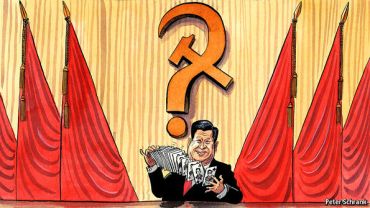
EVERY four years the United States holds an election that can change national policy and unseat many decision-makers. Every five years China holds a selection process that can do the same thing. Communist Party officials tout it as evidence of a well-ordered rhythm in their country’s politics. This year it may turn out as unpredictable as America’s election in 2016.

The people up for re-selection are the 350-odd members of the party’s Central Committee, the political elite, along with its decision-taking subsets: the Politburo, the Politburo’s Standing Committee (a sort of inner cabinet) and the army’s ruling council. The choice of new leaders will be made at a party congress—the 19th since the founding one in 1921—which is expected to be held in Beijing in October or November, and at a meeting of the newly selected Central Committee which will be held directly afterwards.

Party congresses, which are attended by more than 2,000 hand-picked delegates, and the Central Committee meetings that follow them, are little more than rubber-stamp affairs. But they are of huge symbolic importance to Chinese leaders. They matter for three reasons.

First, they endorse a sweeping reshuffle of the leadership that is decided in advance during secretive horsetrading among the elite. The coming congress will be Mr Xi’s first opportunity to pack the Central Committee with his own allies; the outgoing one was picked in 2012, when he took over, not by him but by the people then running the country, including his two predecessors. After previous congresses held five years into a leader’s normally ten-year term—that is, those convened in 2007 and 1997—it became clear who that leader’s successor was likely to be. If the coming meetings are like those earlier ones—a big if—they will give a strong clue to Mr Xi’s choice of successor and start the transition from one generation of leaders to another.

Second, congresses can amend the party’s constitution. China’s leaders like the document to give credit to their favourite ideological themes (and Mr Xi is particularly keen on ideology). When Jiang Zemin stepped down as party chief in 2002 his buzzwords were duly incorporated; so too were those of his successor, Hu Jintao, five years later. Mr Xi’s contribution to party-thought—such as on the need to purge it of corruption while strengthening its grip—is likely to gain similar recognition.

Third, congresses are the setting for a kind of state-of-the-union speech by the party leader, reflecting an elite consensus hammered out during the circulation of numerous drafts. In the coming months, Mr Xi will be devoting most of his political energy to ensuring that his will prevails in all three of these aspects. His authority in the coming years will hugely depend on the degree to which he succeeds. Preparations for the gatherings are under way. They involve a massive operation for the selection of congress delegates. On paper, this is a bottom-up exercise. Party committees down to village level are choosing people who will then choose other representatives who, by mid-summer, will make the final pick. Thousands of party members are also scrutinising the party’s charter, looking for bits that might need changing.It may sound like a vast exercise in democratic consultation, but Mr Xi is leaving little to chance. Provincial party bosses are required to make sure that all goes to (his) plan. Over the past year, Mr Xi has appointed several new provincial leaders, all allies, who will doubtless comply.

Hands up who likes XiT

hose chosen to attend the congress will follow orders, too, especially when it comes to casting their votes for members of the new Central Committee. And the newly selected committee will stick even closer to script. The processes that lead to its selection of the party’s and army’s most senior leaders are obscure—a bit like the picking of cardinals in the Vatican. But an account in the official media of what happened in 2007 suggests that at some point in the summer, Mr Xi will convene a secret meeting of the current Central Committee and other grandees for a straw poll to rank about 200 potential members of the new Politburo (which now has 25 members). This is called “democratic recommendation”, although those taking part will be mindful of who Mr Xi’s favourites are.

Candidates for the Politburo must fulfil certain criteria, such as holding ministerial rank. For the coming reshuffle, Mr Xi has added a new stipulation: faithful implementation of his policies. For all his power, Mr Xi has struggled with widespread passive resistance to his economic reforms. To ram home the importance of obedience, Mr Xi recently held what he called a “democratic life session” at which Politburo members read out Mao-era-style self-criticisms as well as professions of loyalty to Mr Xi as the “core” leader (as the party decided last October to call him).

By August, when Mr Xi and his colleagues hold an annual retreat at a beach resort near Beijing, the initial lists of leaders will be ready. Probably in October, the Central Committee will hold its last meeting before the congress to approve its documents. The “19th Big” will start soon after, and will last for about a week. The first meeting of the new Central Committee will take place the next day, followed immediately by the unveiling before the press of Mr Xi’s new lineup (no questions allowed, if officials stick to precedent).

The process is cumbersome and elaborate, but over the past 20 years it has produced remarkably stable transfers of power for a party previously prone to turbulent ones. This has been helped by the introduction of unwritten rules: a limit of two terms for the post of general secretary, and compulsory retirement for Politburo members if they are 68 or over at the time of a congress. Mr Xi, however, is widely believed to be impatient with these restrictions. He has ignored the party’s hallowed notion of “collective leadership”, by accruing more power to himself than his post-Mao predecessors did.

If precedent is adhered to, five of the seven members of the Politburo’s Standing Committee, six of its other members and four of the 11 members of the party’s Central Military Commission (as the army council is known) will all start drawing their pensions. In addition, roughly half the 200-odd full members of the Central Committee (its other members, known as alternates, do not have voting rights) will retire, or will have been arrested during Mr Xi’s anti-corruption campaign. This would make the political turnover at this year’s gatherings the biggest for decades, akin to changing half the members of the House of Representatives and three-quarters of the cabinet.

Until late in 2016 there was little to suggest any deviation from the informal rules. But in October Deng Maosheng, a director of the party’s Central Policy Research Office, dropped a bombshell by calling the party’s system of retirement ages “folklore”—a custom, not a regulation.

The deliberate raising of doubts about retirement ages has triggered a round of rumour and concern in Beijing that Mr Xi may be considering going further. The main focus is his own role. Mr Xi is in the middle of his assumed-to-be ten-year term. By institutional tradition, any party leader must have served at least five years in the Standing Committee before getting the top job. So if Mr Xi is to abide by the ten-year rule, his successor will be someone who joins the Standing Committee right after the coming congress.

But there is widespread speculation that Mr Xi might seek to stay on in some capacity when his term ends in 2022. He might, for instance, retire as state president (for which post there is a clear two-term limit) but continue as party general-secretary. He faces a trade-off. The more he breaks with precedent, the longer he will retain power—but the more personalised and therefore more unstable the political system itself may become. Trying to square that circle will be Mr Xi’s biggest challenge in the politicking of the year ahead.

Source: Xi Jinping is busy arranging a huge reshuffle | The Economist

06/01/2017

How China uses Shakespeare to promote its own bard | The Economist

LIKE many countries, China had a busy schedule of Shakespeare-themed celebrations in 2016, 400 years after his death. There were plays, lectures and even plans announced for the rebuilding of his hometown, Stratford-upon-Avon, at Sanweng-upon-Min in Jiangxi province. But as many organisers saw it, Shakespeare was just an excuse.

Their main aim was to use the English bard to promote one of their own: Tang Xianzu. Whatever the West can do, their message was, China can do at least as well.Tang is well known in China, though even in his home country he does not enjoy anything like the literary status of his English counterpart—he wrote far fewer works (four plays, compared with Shakespeare’s 37), and is not as quotable. But no matter. The timing was perfect. Tang died in 1616, the same year as Shashibiya, as Shakespeare is called in Chinese. President Xi Jinping described Tang as the “Shakespeare of the East” during a state visit to Britain in 2015. The Ministry of Culture later organised a Tang-themed exhibition, comparing his life and works to those of Shakespeare. It has shown this in more than 20 countries, from Mexico to France.

The two playwrights would not have heard of each other: contacts between China and Europe were rare at the time. But that has not deterred China’s cultural commissars from trying to weave a common narrative. A Chinese opera company created “Coriolanus and Du Liniang”, in which Shakespeare’s Roman general encounters an aristocratic lady from Tang’s best-known play, “The Peony Pavilion”. The musical debuted in London, then travelled to Paris and Frankfurt. Last month Xinhua, an official news agency, released an animated music-video, “When Shakespeare meets Tang Xianzu”. Its lines, set bizarrely to a rap tune, include: “You tell love with English letters, I use Chinese ink to depict Eastern romance.”

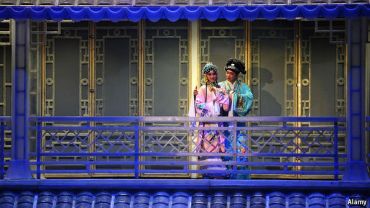
The anniversary of Shakespeare’s death is now over, but officially inspired adulation of Tang carries on (a musical about him premiered in September in Fuzhou, his birthplace—see picture). Chinese media say that a recent hit song, “The New Peony Pavilion”, is likely to be performed at the end of this month on state television’s annual gala which is broadcast on the eve of the lunar new year. It is often described as the world’s most-watched television programme. Officials want to cultivate pride in Chinese literature, and boost foreign awareness of it. It is part of what they like to call China’s “soft power”.

Shakespeare’s works only began to take root in China after Britain defeated the Qing empire in the first Opium War of 1839-42. They were slow to spread. After the dynasty’s collapse in the early 20th century, Chinese reformers viewed the lack of a complete translation of his works as humiliating. Mao was less keen on him. During his rule, Shakespeare’s works were banned as “capitalist poisonous weeds”. Since then, however, his popularity has surged in tandem with the country’s growing engagement with the West.

Cong Cong, co-director of a recently opened Shakespeare Centre at Nanjing University, worries that without a push by the government, Tang might slip back into relative obscurity. But Ms Cong says the “Shakespeare of the East” label does Tang a disservice by implying that Shakespeare is the gold standard for literature. Tang worked in a very different cultural environment. That makes it difficult to compare the two directly, she says. Officials, however, will surely keep trying.

Source: How China uses Shakespeare to promote its own bard | The Economist

Tags:
06/01/2017

‘Yeti’ Prints Suggest Humans Settled in Tibet More Than 7,000 Years Ago – China Real Time Report – WSJ

A cluster of ghostly hand- and footprints on a mountain north of Lhasa offers evidence that humans scratched out a permanent existence in the thin air of Tibet much earlier than commonly thought, according to a new study.

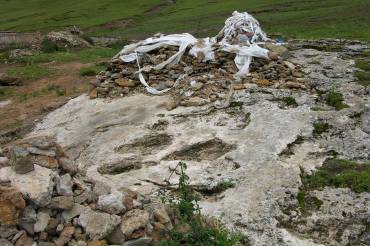
Some locals believe the prints, pressed into an ancient slab of limestone located 14,000 feet above sea level near the present-day village of Chusang, were left behind by mythical beasts. A team of researchers say that the impressions were left by people and that they offer intriguing clues to the puzzle of Tibetans’ ethnic origins.The researchers, whose latest findings are published in the latest issue of Science, say they’ve now developed a clearer picture of the site’s significance. According to their calculations, Chusang was very likely used by inhabitants of a nearby year-round settlement between 7,400 and 12,700 years ago — at least 2,200 years before permanent villages are believed to have been established elsewhere on the Tibetan Plateau.The researchers used radiocarbon dating and other, more advanced tests to determine the age of rock and dirt samples taken near the prints, according to the report.

There are no other reliably dated sites on the central, high-elevation part of the plateau,” said Mark Aldenderfer, a University of California, Merced who lead the study along with geologist Michael Meyer, from the University of Innsbruck.

By positing an earlier date of settlement on the Tibetan plateau, the study is likely to be controversial in Chinese archaeological circles. It could also irk Communist Party officials, for whom the question of where Tibetans came from is freighted with political significance.

Pushing back against advocates for Tibetan independence, the Chinese government recently began arguing that Tibet has been a part of China, not just during the imperial era, but “since ancient times.” The effort to prove that claim has led state-affiliated scholars to reach past China’s first, and some say largely mythical, dynasty, the 4,000-year-old Xia, to a neolithic culture called the Yangshao that existed in China’s Yellow River basin between 7,000 and 5,000 years ago.

Some pottery shards and other artefacts found on the Tibetan Plateau appear similar to remnants of the late Yangshao — proof, these government-backed scholars say, that China and Tibet are branches of the same civilization.“Early history has abruptly become of far greater importance to the issue, and specifically to the Chinese side,” said Robert Barnett, director of the modern Tibet studies program at Columbia University. Previously, Mr. Barnett said, the government had dated its claims over Tibet to the Yuan Dynasty, established by Mongolian leader Kublai Khan in 1271.

A 2015 paper on human settlement of the Tibetan Plateau written by Chinese archaeologists, also published in Science, supports the Yangshao timeline. It says that people didn’t start living in year-round settlements on the plateau until the development of agriculture and herding in what is now Qinghai province around 3,000 B.C.The new paper, however, suggests that migrants bearing pottery and other elements of Yangshao culture into the Tibetan regions would have encountered indigenous inhabitants, according to Mr. Aldenderfer.

“Our argument is fairly simple: There were people on the Tibetan Plateau before these ceramics and other influences came in from lower elevation locations,” he said.

There are 19 handprints and footprints of various sizes pressed into the Chusang limestone, which is believed to have formed by deposits from a now extinguished hot spring. The site was discovered in 1996 by University of Hong Kong geographer David Zhang, who was not part of the Aldenderfer team.

An image of one of the hand prints, taken in 2006. PHOTO: MARK ALDENDERFER“

Locals took me there and said [the prints] were left by a yeti,” Mr. Zhang told China Real Time, referring to the mythical creature better known in the west as the Abominable Snowman.

Mr. Zhang, who said he had seen a copy of the report but not its supplementary material,  disagreed with the conclusions of the new study. He cited tests he conducted that measured when quartz crystals from an ancient hearth found near the prints were last exposed to light. From that, he concluded that the evidence of settlement is closer to 20,000 years old.

Chusang was most likely one of several seasonal sites that people traveled to from primary settlements at lower elevations, he said.

Mr. Aldenderfer said Mr. Zhang’s measurements, taken in 2002, came from a different part of the Chusang site and that his testing methods were outdated. He said it would have taken an improbably long time to travel on foot from Chusang to a base camp at a low elevation.

The existence of smaller handprints suggests children also spent time at the site, he said.

Life would have been hard, with people forced to survive by hunting and foraging wild barley in temperatures only slightly warmer than they are now, but the area also would have had its advantages, Mr. Aldenderfer said.

A view to the north of the valley below the hot springs.
A view to the north of the valley below the hot springs. PHOTO: MARK ALDENDERFER

“It’s a really cool place. It’s perched on a mountainside, and when you’re sitting at the hot spring that has the hand- and footprints, it has an absolutely fabulous view of the valley below,” he said. The hot spring would have offered warmth, and possibly even a chance to bathe, he said.

Source: ‘Yeti’ Prints Suggest Humans Settled in Tibet More Than 7,000 Years Ago – China Real Time Report – WSJ

Tags: ,
04/01/2017

‘China freight train’ in first trip to Barking – BBC News

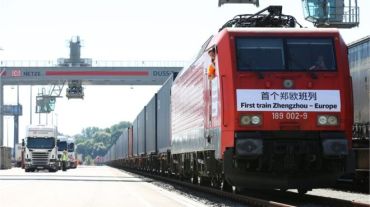
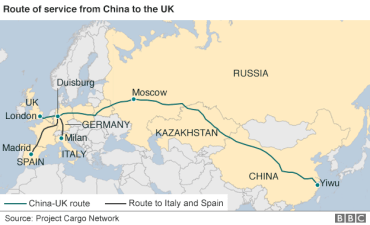
China has launched a direct rail freight service to London, as part of its drive to develop trade and investment ties with Europe.China Railway already runs services between China and other European cities, including Madrid and Hamburg.

The train will take about two weeks to cover the 12,000 mile journey and is carrying a cargo of clothes, bags and other household items.

It has the advantage of being cheaper than air freight and faster than sea.

The first China-Europe Block Train for Madrid left Yiwu Railway Freight Station in November 2014The proliferation of routes linking China and Europe is part of a strategy launched in 2013 aimed at boosting infrastructure links with Europe along the former Silk Road trading routes.London will become the 15th European city to join what the Chinese government calls the New Silk Route.

The service will pass through Kazakhstan, Russia, Belarus, Poland, Germany Belgium and France before arriving at Barking Rail Freight Terminal in East London, which is directly connected to the High Speed 1 rail line to the European mainland.

Because of the different railway gauges involved, a single train cannot travel the whole route and the containers need to be reloaded at various points.

The Chinese government is keen to boost its economy in the face of slowing export and economic growth.

Source: ‘China freight train’ in first trip to Barking – BBC News

22/12/2016

China Sends Carbon Fight Into Orbit – China Real Time Report – WSJ

As the climate-change community watches whether President-elect Donald Trump will retreat from U.S. greenhouse-gas commitments, China signaled it is charging ahead, launching a satellite to monitor rising levels of carbon in the atmosphere.

The move comes after a week when a thick blanket of smog hung over much of northern China, forcing the government to shut schools and businesses.

The launch of the satellite known as TanSat, reported early Thursday by state media, marks a renewed effort by the world’s biggest emitter to better understand and track the effects of greenhouse gas emissions. It also reflects the bigger role China aims to play in shaping the global response to climate change at a time the incoming U.S. administration voices skepticism about the Paris accord enacted this year to control and reduce carbon emissions.

“It’s a significant step in terms of being an indicator of China investing large amounts of resources and energy to understand the science behind climate change and carbon emissions,” said Ranping Song, a climate expert at the World Resources Institute in Washington.

The 1,400 pound satellite will orbit more than 400 miles above the earth for the next three years, said Yin Zengshan, the TanSat project’s chief designer, according to Xinhua News Agency, and follows similar projects by the U.S. and Japan to track global carbon levels from monitoring in space.

The satellite—in development for nearly six years—collects independent carbon data. Loaded with sensitive equipment that reads changes in atmospheric CO2 levels to within 1%, TanSat will take carbon readings every 16 days.

As a result, it could help “double check” emissions data reported by countries world-wide, said Mr. Song. Emissions accounting today still largely relies on estimates from energy-consumption statistics. The satellite readings would be a source of independent data for Chinese policy makers.

China has been trying to raise its image in the global climate-change debate, wanting to appear active in aiding global efforts to reduce greenhouse gas emissions, rather than serving as an obstacle. It has already pledged to peak and begin reducing its carbon emissions by 2030 as part of a deal reached with the U.S. in 2014. Yet it also comes against a more complicated backdrop today, with Mr. Trump’s incoming administration promising to boost production of polluting fossil fuels including coal.

Mr. Trump’s pledge ahead of the election to “cancel” the U.S. commitment to the global climate pact that entered force this year has worried Chinese officials. Xie Zhenhua, China’s special representative for climate-change affairs, has urged Mr. Trump to adhere to what China views as a global trend toward cutting emissions.

Under Mr. Trump, many in the U.S. environmental community fear funding for climate-change research could be hacked. In California, Gov. Jerry Brown has even vowed to launch the state’s own monitoring satellite if budgets get chopped.

“If Trump turns off the satellite,” Mr. Brown said this month, “California will launch its own damn satellite. We’re going to collect the data.”

In effect, the Chinese satellite could help add more “eyes in the sky” for monitoring carbon levels in the atmosphere, and serve as a complement to the existing data already being collected by the U.S. and Japan. Xinhua quoted officials as saying China was prepared to share its new data with researchers world-wide.

“Since only the United States and Japan have carbon-monitoring satellites, it is hard for us to see firsthand data,” Xinhua quoted Zhang Peng, vice director of China’s National Satellite Meteorological Center, as saying. “The satellite has world-wide scope and will improve data collection.”

Source: China Sends Carbon Fight Into Orbit – China Real Time Report – WSJ

Law of Unintended Consequences

continuously updated blog about China & India

ChiaHou's Book Reviews

continuously updated blog about China & India

What's wrong with the world; and its economy

continuously updated blog about China & India