Archive for ‘China alert’

15/08/2019

Cameroon official hails higher education cooperation with China

YAOUNDE, Aug. 14 (Xinhua) — Wilfred Gabsa Nyongbet, Secretary General of Cameroon’s Ministry of Higher Education, on Wednesday hailed as “excellent” the cooperation with China in higher education.

Nyongbet made the remarks during a ceremony to bid farewell to 128 Cameroonian students who will study in China with scholarships. “This is a true demonstration of the excellent bilateral friendship between our two countries,” he said.

“They are going to learn the type of technology that we need for the emergence of Cameroon… We are willing to continue the collaboration in the higher education sector,” Nyongbet added.

Among the 128 students, 45 benefit from the Chinese government scholarship, 83 from the Confucius Institute scholarship.

Speaking at the ceremony, Chinese ambassador Wang Yingwu said the number of Chinese scholarships awarded to Cameroon students in 2019 hit a record high since 2006. “China is ready to work with Cameroon to enhance cooperation in education to a higher level,” he said.

“China is advanced in technological sectors, and there is a transfer of know-how in its cooperation with Cameroon. The scholarship is an opportunity for me to study in China, and apply what I have learned back home,” a scholarship winner Francis Yonkeu Nya told Xinhua.

More than 3,000 Cameroonian students are now studying in China, among them about 300 are beneficiaries of Chinese government scholarship, according to the Chinese embassy to Cameroon.

Source: Xinhua

15/08/2019

Pakistan observes ‘Black Day’ for Kashmir as India celebrates independence

ISLAMABAD (Reuters) – Pakistan observed a ‘Black Day’ on Thursday to coincide with India’s Independence Day celebrations, in protest at New Delhi’s decision to revoke special status for its portion of the contested Kashmir region.

India’s decision this month, along with a communications blackout and curbs on the movement of those in Indian-administered Kashmir, caused fury in Pakistan, which cut trade and transport links and expelled India’s envoy in retaliation.

Newspapers in Pakistan printed editions with black borders on Thursday and politicians, including Prime Minister Imran Khan, replaced their social media pictures with black squares.

Protests are due to be held across the country, including Azad Kashmir, the wedge of territory in the west of the region that Pakistan controls.

The largely symbolic move comes amid growing frustration in Islamabad at the lack of international response over the Kashmir dispute.

Pakistan was isolated diplomatically and faced “a world in denial” over the situation in Kashmir, Dawn, the country’s most influential English language newspaper, said in an editorial.

The 15-member United Nations Security Council could discuss the dispute as soon as Thursday, but Pakistan says it only has guaranteed support from China, which also claims part of India’s Jammu and Kashmir state.

Permanent security council member Russia said on Wednesday it supported India’s stance that the dispute should be resolved through bilateral means, while the United States has called India’s decision an internal matter for New Delhi.

In his Independence Day speech in the Indian capital, Prime Minister Narendra Modi highlighted the decision to remove the special rights of the Muslim-majority region among the bold moves of his second term, following an election victory in May.

“Today every Indian can proudly say ‘One Nation, One Constitution’,” Modi, speaking from the ramparts of the historic Red Fort, said of the decision.

Source: Reuters

14/08/2019

How China could use bio-waste to mass-produce cheap super-fuel for missiles

  • Scientists’ large-scale conversion of agricultural waste into fuel offers savings up to 60 per cent, they say
  • Discovery could slash military costs and bring civilian applications of hypersonic flight technology closer
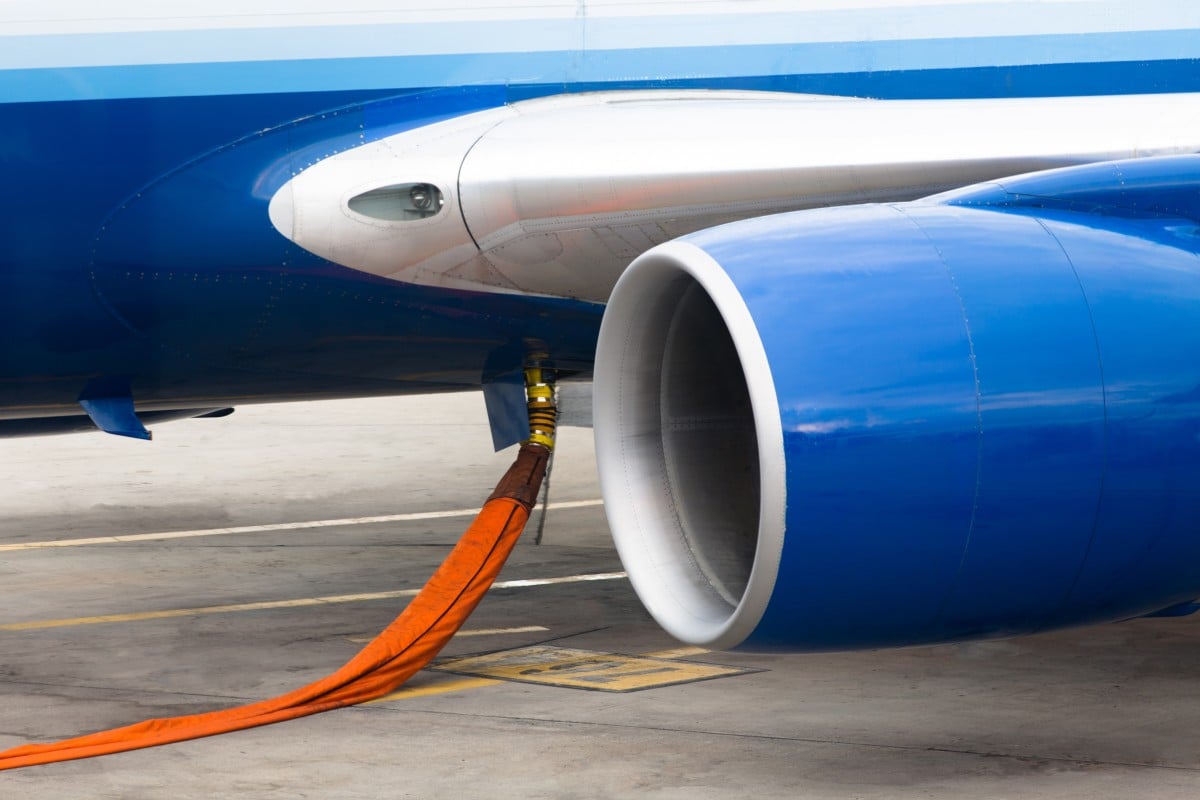
Super-fuel for military aircraft costs nearly 10 times as much as ordinary jet fuel for commercial planes. Photo: Shutterstock
Chinese scientists say they have developed a technology to convert bio-waste into fuel for missiles and hypersonic planes, reducing fuel costs by as much as 60 per cent.
The existing JP-10 super-fuel for military aircraft has numerous advantages including high energy density, good thermal stability and low freezing point, but it costs more than US$7,000 per tonne – nearly 10 times as much as ordinary jet fuel for commercial aircraft.
It is used mainly in cruise missiles and ramjet or scramjet engines on new-generation aircraft travelling at hypersonic speed, or five times faster than sound.
Scientists from the Dalian Institute of Chemical Physics, at the Chinese Academy of Sciences in the northeastern province of Liaoning, predicted using the new technology in the near future could reduce the cost to as low as US$2,547 per tonne.
The secret, according to their paper, published in the latest issue of German chemistry journal Angewandte Chemie, lies in cheap bio-waste.
Using agricultural and forestry residues including bran, chaff and mill dust, Professor Zhang Tao, Li Ning and colleagues discovered new chemical processes that can turn the waste to JP-10 fuel on a large scale with unprecedented efficiency.

At present, the super-fuel comes from coal tar or naphtha, and the synthesis is extremely costly and unfriendly to the environment.

The bio-JP-10 fuel can be produced by two different methods, one involving six steps of chemical reactions and the other only four, according to the paper.

China’s plan to make jet fuel from restaurant leftovers

Combining these methods with the latest technology in biomass conversion, the researchers said, the super-fuel can be mass-produced at a price equivalent to that of some of the bio-jet fuels already in commercial use, thanks to government subsidies provided for their environmental benefits.

“We believe that the future commercialisation of bio-JP-10 fuel is very promising, especially taking policy support and exemption from CO2 emission tax into consideration,” the authors wrote in the paper.

Liu Huoxing, professor at the school of energy and power engineering at Beijing University of Aeronautics and Astronautics, said civilian applications of hypersonic flight technology faced many challenges that remained to be solved, with the problem of high fuel prices being one of the headaches.

“No airline will buy a plane if the fuel costs too much, however fast it can fly,” he said.

Liu, who conducts research on engine technology for hypersonic vehicles but was not involved in the Dalian study, said the reduction of production costs for jet fuel was usually incremental and it was quite rare to see a significant drop.
“This can be an important development,” he said of the Dalian findings.
China is developing various models of hypersonic speed aircraft for military and civilian use. Some are aimed at flying distances such as Shanghai to Los Angeles in a couple of hours.

Source: SCMP

14/08/2019

China is building world’s most powerful laser radar to study Earth’s solar shield

  • New facility is designed to help scientists study particles that help deflect cosmic rays in the high atmosphere
  • Despite scepticism among some scientists, those familiar with the project insist radar will have a range about 10 times greater than existing ones
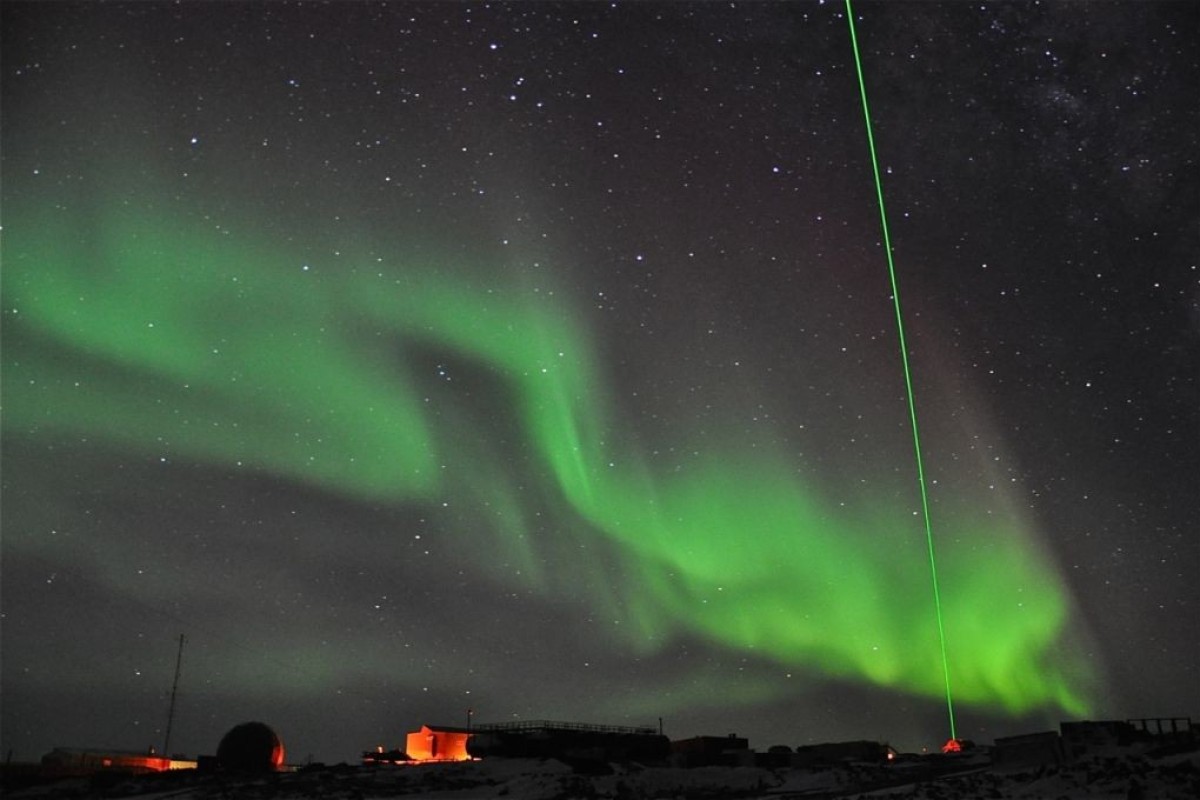
When completed the new laser radar will be used to study the high atmosphere. Photo: Handout
China has started building the world’s most powerful laser radar designed to study the physics of the Earth’s high atmosphere, according to state media reports and scientists informed of the project.
It is described as having a detection range of 1,000km (600 miles) – 10 times that of existing lasers – and will be used to study atmospheric particles that form the planet’s first line of defence against hostile elements from outer space such as cosmic rays and solar winds.
The facility, to be built on a site that remains classified, is expected to be up and running within four years and will form part of an ambitious project to reduce the risk from abnormal solar activities.
The radar will use a high-energy laser beam that can pierce through clouds, bypass the International Space Station and reach the outskirts of the atmosphere, beyond the orbiting height of most Earth observation satellites.
Lasers help tell ghostly story of doomed Nazi submarine U-576 and its entombed crew

There, the air becomes so thin that scientists will be able to count the number of gas atoms found within a radius of several metres.

These high-altitude observations could greatly expand our knowledge of a part of the atmosphere that has been little studied because the distances involved mean no one has been able to make direct observations from the ground.

“The large-calibre laser radar array will achieve the first detection of atmospheric density of up to 1,000km in human history,” said a statement posted on the website of the Chinese Academy of Sciences on Tuesday, a day after the launch of the project.

But the claim has been greeted with some scepticism in the scientific world.

“I think the 1,000km is a misprint!” professor Geraint Vaughan, director of observations at the National Centre for Atmospheric Science in the UK, replied when asked about the project.

Vaughan, who is also a Fellow of the Royal Meteorological Society, said that while he thought the Chinese announcement was “very interesting”, it did not seem possible with existing technology.

At present, the effective range of atmospheric lasers is about 100 kilometres.

Some other senior scientists in China and overseas also expressed doubt about the project, although they requested anonymity due to the sensitivity of the issue.

US warns airmen to beware of laser attacks near China’s military base in Djibouti
“There are other approaches, such as launching a satellite. Building such a huge, expensive machine on the ground does not make sense,” said a Beijing-based laser scientist.
But several researchers told the South China Morning Post that the project did exist, and insisted that 1,000km range was not a mistake.
Hua Dengxin, a professor at Xian University of Technology and a lead scientist in China’s laser radar development programmes, said: “I have heard of the project, yes. But I cannot speak about it.”
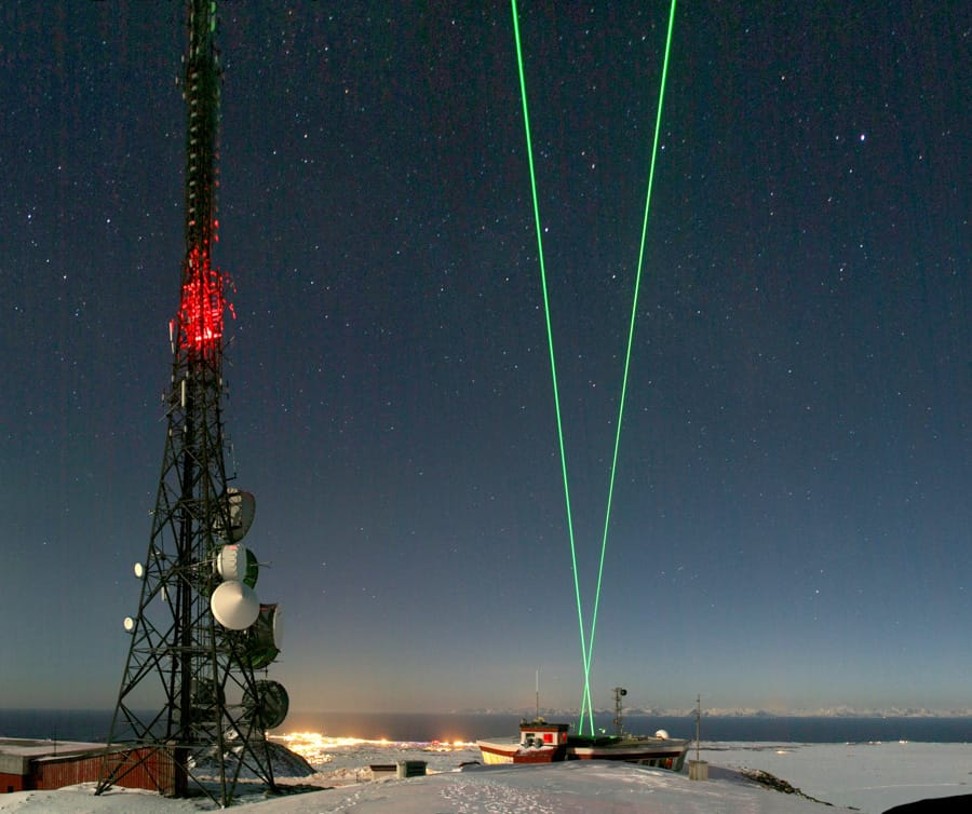
Powerful telescopes will pick up the signals reflected back to earth. Photo: Handout

According to publicly available information, the facility will use several large optical telescopes to pick up the faint signals reflected by the high-altitude atoms when the laser is fired at them.

The project is part of the Meridian Space Weather Monitoring Project, an ambitious programme that started in 2008 to build one of the largest, most advanced observation networks on Earth to monitor and forecast solar activities.

By 2025 Meridian stations containing some of the world’s most powerful radar systems will be established across the world – with facilities in Arctic and Antarctic, South China Sea, the Gobi desert, the Middle East, Central Asia and South America.

China in race for counter-drone tech and laser weapons as it tries to catch up with US

The purpose of the Meridian project, according to the Chinese government, is to reduce the risk abnormal solar activities pose to a wide range of Chinese assets including super-high voltage power grids, wireless communication, satellite constellations, space stations or even a future base on the Moon.

Chinese laser scientists have developed some of the world’s most sophisticated systems in recent years, including ranging stations that can track the movement of satellites and space debris, which the Pentagon has claimed have temporarily blinded some American scientists.

Last year researchers based in Xian, the capital of Shaanxi province, announced that they had developed a “ laser AK-47” that could set fire to target from a distance of 800 metres.

The Chinese government is also funding the development of a laser satellite that can penetrate seawater to a depth of 500 metres from space to detect the waves generated by submarines.

The use of such a powerful laser raises concerns that passing objects such as planes, satellites or spacecraft – to say nothing of birds – may be at risk from its beams.

But Professor Qiao Yanli, engineer in chief at the Anhui Institute of Optics and Fine Mechanics, part of the Chinese Academy of Sciences, said there was an “extremely low” risk of this happening.

“The sky is enormous. Getting hit by a tiny beam is almost impossible,” he said.

Some much smaller laser radars, such as those installed in auto-driving test vehicles, have reportedly damaged digital cameras by burning a few pixels on sensor.

But spacecraft such as earth observation satellites, according to Qiao, usually have some protection mechanisms, such as a warning system, to avoid permanent damage caused by an accidental laser hit.

‘Laser AK-47’? Chinese developer answers sceptics with videos of gun being tested

Professor Li Yuqiang, a researcher at the Yunnan Observatories in Kunming, whose team has measured the distance between the Earth and the Moon by shooting lasers at a reflector placed on the lunar surface during the US Apollo 15 mission, said detecting atom-sized targets on the fringes of the atmosphere posed many technical challenges.

“The number of photons [particles of light] reflected by the sparse gas particles will be very small. Even if they can be picked up by large telescopes on the ground, the analysis will require some very good algorithms to separate the useful signals from the noise,” Li said.

“How that can be achieved is beyond the scope of my knowledge.”

Source: SCMP

10/08/2019

Collapse of intelligence pact between US, South Korea and Japan ‘will be symbolic victory for China’

  • Three-year-old security treaty between US and two key allies under threat as tensions between Seoul and Tokyo continue to escalate
  • End of General Security of Military Information Agreement risks undermining Washington’s influence in the region
South Korean protesters hold signs saying “No Abe” during a rally demanding the abolition of the General Security of Military Information Agreement. Photo: AP
The possible termination of a military information-sharing pact between South Korea and Japan would be a symbolic victory for China, a security analyst has warned.
Recent tension between the two countries recently threatened to spill over into the sphere of intelligence after Seoul signalled that it may pull out of the General Security of Military Information Agreement (GSOMIA) pact.

The agreement signed in 2016 enables three-way intelligence gathering between the US and its two allies and provides a crucial framework for coping with North Korea’s nuclear and missile threats.

But the escalating trade dispute between Seoul and Tokyo, prompted by a dispute about Japan’s colonial legacy, has left the future of the deal in jeopardy as the annual deadline for its renewal looms.

Japan approves first hi-tech exports to South Korea since start of ‘trade war’ – but with a warning

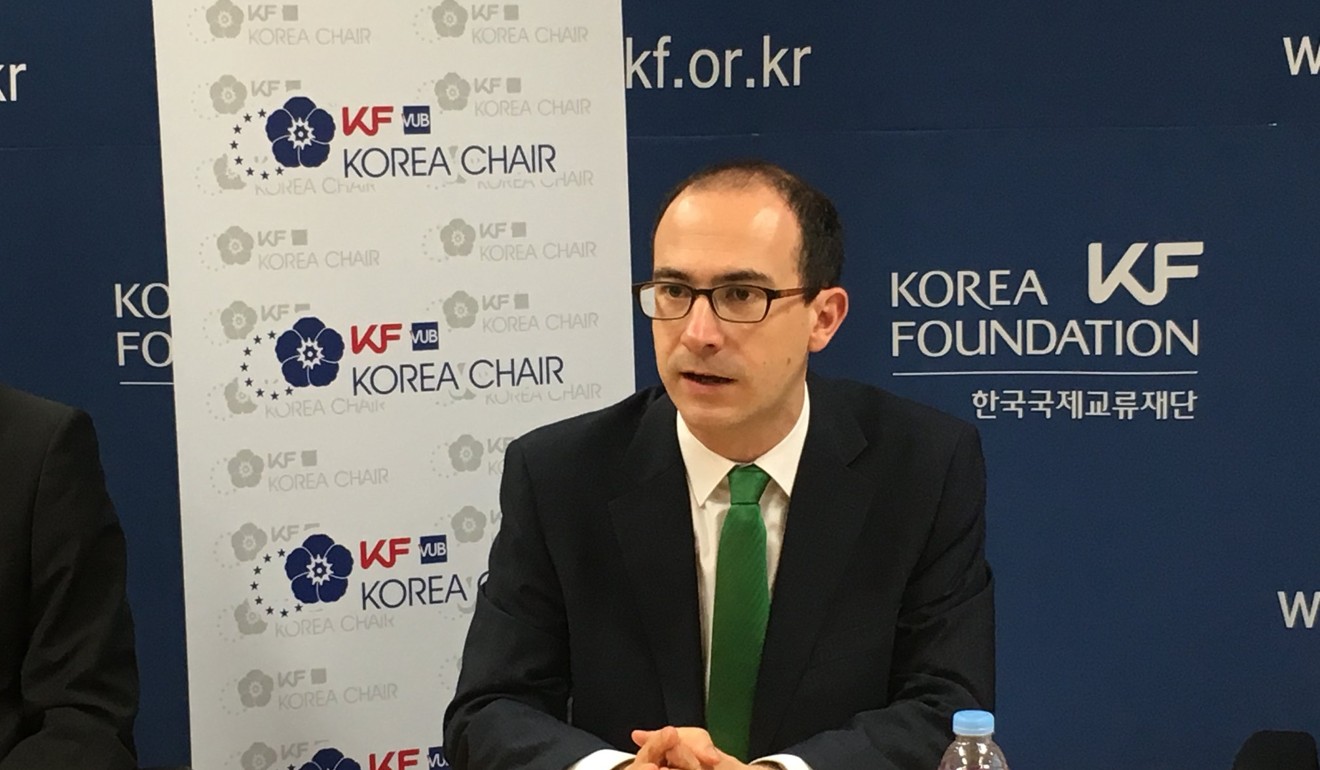
Ramon Pacheco Pardo, the first Korea chair at the Institute for European Studies at Vrije Universiteit Brussel in Belgium, said scrapping the pact would help strengthen China’s influence in the Asia-Pacific region at the expense of the US.

“It is undeniable that termination of GSOMIA would dent the US-South Korea-Japan alliance. The alliance system in northeast Asia will be weaker, strengthening China in relative terms in the process. “This could embolden China and Russia to strengthen their military cooperation in northeast Asia, said Pardo, a member of the non-governmental EU Council for Security Cooperation in the Asia-Pacific.

“Ending GSOMIA would signal that South Korea and Japan are not ready to follow Washington’s lead in the way the latter would like, given the political capital that successive US administrations spent in convincing both countries to share intelligence.”

Ramon Pacheco Pardo said the collapse of the pact would have a largely symbolic impact on China. Photo: Facebook

But Pardo also stressed that the intelligence alliance was not directly targeting China.

“While it is true that GSOMIA serves to connect the weakest link of the US-South Korea-Japan security triangle, ultimately South Korea’s security posture and the capabilities of each country independently mean that it is difficult to argue that the agreement is a concerted effort to contain China.”

“After all, Beijing does not share any significant information on North Korea’s nuclear and missile programmes with South Korea, Japan or the US.

“This is not going to change any time soon. So the good news for China would be symbolic rather than substantial.”

US missiles, jittery neighbours and South Korea’s big security dilemma

Beijing warned on Tuesday that it would take “countermeasures” if the US deployed ground-based missiles in either Japan or South Korea, and Pardo argued that scrapping the intelligence-sharing pact would expose the weaknesses in their co-ordinated approach towards China.

The security deal is automatically renewed every year unless one party decides to pull out. To do so, it must notify the others 90 days before its expiry – a deadline that falls on August 23.

The trade row was sparked by a recent South Korean court ruling that Japanese should compensate individual victims of wartime forced labour. Tokyo believes it settled all necessary compensation under a treaty signed in 1965, but Seoul believes that individual victims’ right to file a claim has not expired.

Relations between South Korea and Japan have deteriorated following a court ruling over forced labour in the wartime era. Photo: Shutterstock

Last week Japan said it would remove South Korea from its “white list” of countries with preferential trade status. Seoul has threatened to respond in kind, but also warned that it may reconsider whether to renew the intelligence-sharing pact.

Both the US and Japan have said they want the arrangement to continue, but Pardo said the effect of the termination would remain largely symbolic.

South Korea has already been investing in its own satellite and anti-submarine programmes to monitor the North’s activities, while Japan has also been developing its own intelligence programmes.

“This shows that neither South Korea nor Japan wants to rely on each other or third parties, namely the US, when it comes to monitoring North Korea’s military activities,” Pardo said.

But he argued that this behaviour already indicated that the alliance was weakening and suggested that terminating the treaty would increase China’s room for manoeuvre.

South Korea buys helicopters worth US$800 million after Trump seeks contribution for US presence

Since the 1990s successive US administrations have pushed for intelligence-sharing arrangements with Japan and South Korea to help build a framework to check Chinese and Russian military expansion in the Pacific.

“Beijing and Moscow are clearly moving in the direction of closer cooperation anyway. GSOMIA or not, military cooperation will continue … as long as Xi Jinping and Vladimir Putin lead each country and most probably even beyond then,” Pardo said.

China and Russia flexed their muscles in the region last month as the trade dispute between the two key allies intensified.

Russian and Chinese long-range military aircraft conducted their first-ever joint air patrol over the Sea of Japan – also known as the East Sea – and the East China Sea.

“The East Asian security landscape would be reshaped insofar that China, North Korea and Russia would see that their main opponent in the region – the US – is unable to convince its two key allies, South Korea and Japan, to cooperate on a key issue,” Pardo said.

“The current dispute between South Korea and Japan will need a negotiated solution … In any case, Japan will have to learn to live with the fact that former colonisers will, from time to time, receive criticism by many of their former colonies, criticism that sometimes will escalate.

“It happens to former European colonial powers, for example, and it is only logical because the interpretation of the past is always in flux.”

Source: SCMP

10/08/2019

Typhoon Lekima: 13 dead and a million evacuated in China

At least 13 people have been killed and more than a million forced from their homes as Typhoon Lekima hit China.

Sixteen people were also missing after a landslide was triggered by the storm, state media reported.

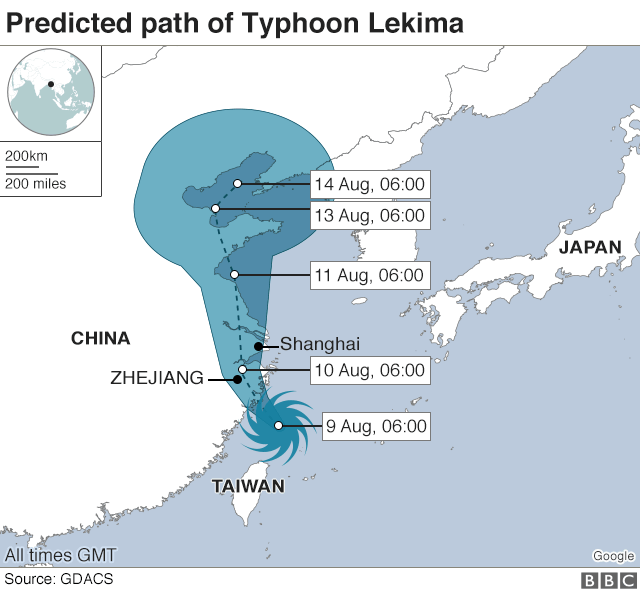
Lekima made landfall in the early hours of Saturday in Wenling, between Taiwan and China’s financial capital Shanghai.

The storm was initially designated a “super typhoon”, but weakened slightly before landfall – when it still had winds of 187km/h (116mph).

The fatal landslide happened when a dam broke in Wenzhou, near where the storm made landfall, state media said.

Lekima is now slowly winding its way north through the Zhejiang province, and is expected to hit Shanghai, which has a population of more than 20 million.

Emergency crews have battled to save stranded motorists from floods. Fallen trees and power cuts are widespread.

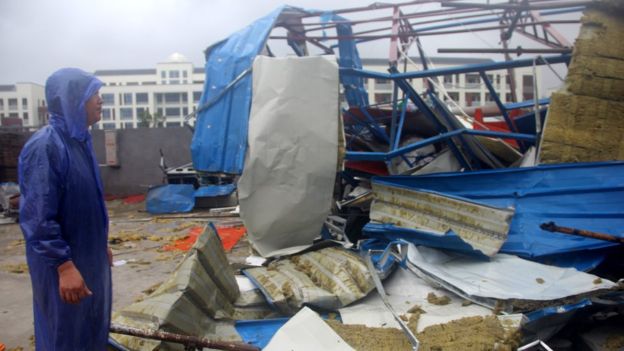
A worker searches for his belongings in a shelter brought down by Typhoon Lekima at a construction site in Wenling, Zhejiang province, China, 10 August 201Image copyright EPA
Image caption A worker looks for his belongings at a construction site shelter collapsed by the storm

Authorities have cancelled more than a thousand flights and cancelled train services as the city prepares for the storm.

It is expected to weaken further by the time it reaches Shanghai, but will still bring a high risk of dangerous flooding.

Predicted path of Typhoon Lekima
The city evacuated some 250,000 residents, with another 800,000 in the Zhejiang province also being taken from their homes.

An estimated 2.7 million homes in the region lost power as power lines toppled in the high winds, Chinese state media said.

It is the ninth typhoon of the year, Xinhua news said – but the strongest storm seen in years. It was initially given China’s highest level of weather warning but was later downgraded to an “orange” level.

Media caption Typhoon Lekima inches towards China

Chinese weather forecasters said the storm was moving north at just 15km/h (9mph).

It earlier passed Taiwan, skirting its northern tip and causing a handful of injuries and some property damage.

Coming just a day after a magnitude six earthquake, experts warned that the combination of earth movement and heavy rain increased the risk of landslides.

Lekima is one of two typhoons in the western Pacific at the moment.

Further east, Typhoon Krosa is spreading heavy rain across the Northern Mariana Islands and Guam. It is moving north-west and could strike Japan some time next week, forecasters said.

Source: The BBC

09/08/2019

China sees rapid income, consumption growth in rural areas over past 70 years

CHINA-RURAL RESIDENTS-INCOME GROWTH (CN)

A villager shops at a mart in Wangzhuanggou Village of Wuxiang County, north China’s Shanxi Province, Feb. 17, 2019.

China has seen rapid income and consumption growth in rural areas over the past 70 years, according to a report from the National Bureau of Statistics (NBS). In 2018, rural per capita disposable income had increased 40 times from 1949 to stand at 14,617 yuan (about 2,088 U.S. dollars) in real terms after deducting price factors, up 5.5 percent on average annually, the NBS said. The country’s urban-rural income gap narrowed remarkably, with the ratio of per capita disposable income for urban residents to that of rural residents hitting 2.69 in 2018, 0.64 lower than 1956. The rural consumption level continued to rise in the last 70 years, as indicated by its expanding size and improving quality. Per capita rural consumption grew by an average annual rate of 5.2 percent to reach 12,124 yuan in real terms in 2018 after deducting price factors, up 32.7 times from 1949, while the Engel coefficient for rural residents dropped 38.5 percentage points from 1954 to reach 30.1 percent. Per capita living space in rural areas reached 47.3 square meters, posing a sharp contrast to 8.1 square meters in 1978, according to the report.

Household consumption in rural areas also increased, with the average ownership of cars, computers and cell phones per 100 households reaching 22.3, 26.9 and 257, respectively in 2018. (Xinhua/Zhan Yan)

Source: Xinhua

09/08/2019

China on red alert as Typhoon Lekima bears down on east coast

A woman shields herself with an umbrella as she walks in New Taipei City in rain brought by Typhoon Lekima as it passes northeastern Taiwan on August 9, 2019Image copyright AFP
Image caption Lekima has brought heavy rain to Taiwan

Chinese authorities have declared a red alert as a powerful typhoon heads towards the eastern coast.

Typhoon Lekima is currently battering Taiwan with winds of more than 190km/h (120mph) and is due to make landfall in China’s Zhejiang province on Saturday.

Emergency teams have been deployed to the region to guide relief work, China’s emergency ministry said.

Thousands of people further up the coast in Shanghai have been warned to prepare to evacuate.

Lekima, which is the ninth typhoon so far this year, strengthened into a super typhoon late on Wednesday, but Taiwanese authorities have since downgraded it to a regular typhoon.

Flood warnings have been issued for eastern sections of China’s Yangtze River and the Yellow River until Wednesday. The provinces of Jiangsu and Shandong are also on alert.

Cruise liners have been told to delay their arrival in Shanghai and some train services have been suspended over the weekend.

Beijing has also cancelled some trains heading to and from the Yangtze delta region.

Lekima is one of two typhoons in the western Pacific at the moment. Further east, Typhoon Krosa is spreading heavy rain across the Northern Mariana Islands and Guam. It is moving north-west and could strike Japan some time next week, forecasters said.

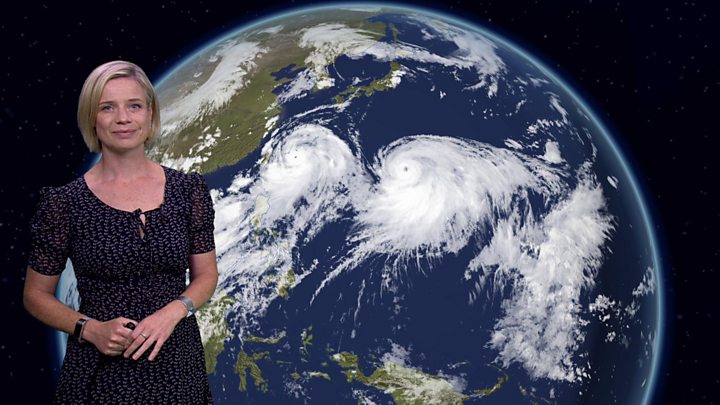
Media caption BBC Weather’s Sarah Keith-Lucas on typhoons Lekima and Krosa

Lekima was passing the north of Taiwan on Friday, causing flight cancellations and the closures of schools and offices.

Power was cut to more than 40,000 homes and the island’s high speed rail service was suspended north of the city of Taichung, local media reported.

The huge storm came a day after eastern Taiwan was rattled by a 6.0 magnitude earthquake. Experts said the risks of landslides triggered by the tremor were made more likely by the typhoon dumping up to 900mm (35 inches) of rain on Taiwan’s northern mountains.

Media caption The 6.0 earthquake in Taiwan was caught on cat cam

Lekima also brought heavy rain and high winds to south-west Japan on Friday, cutting power to about 14,000 homes, broadcaster NHK reported.

China’s weather bureau said Lekima was expected to have weakened further by the time it made landfall. The country has a four-stage colour-coded warning system, with red representing the most severe weather.

Source: The BBC

08/08/2019

Nestle starts selling Starbucks-branded coffee in China

SHANGHAI (Reuters) – Food giant Nestle (NESN.S) on Thursday started selling Starbucks-branded (SBUX.O) coffee in mainland China, seeking to tap growth in a market where it says coffee consumption per capita remains low compared to global standards.
Nestle last year paid $7.15 billion for exclusive rights to sell the U.S. chain’s coffees and teas globally, and began selling Starbucks-labelled products in Europe, Asia and Latin America in February.
The world’s largest food company will start selling 21 Starbucks-branded capsule and instant coffee products on Chinese e-commerce platforms like Alibaba’s (BABA.N) Tmall and JD.com (JD.O), as well as to offices and hotels in tier-1 cities, both companies said.
“We believe China is the most exciting market in general but especially for coffee because… per capita cup consumption is quite low as compared to Asia,” said Rashid Aleem Qureshi, Nestle’s chief executive officer for the Greater China region.
“Right now the overall soluble coffee in China is growing between 3-5% (a year) and we believe that by bringing this exciting new business opportunity we should be able to grow faster than that,” he said, referring to a category that includes capsule and instant coffee.
Nestle’s move comes as the Swiss company experienced a slower first-half growth in China, its second-largest market, where other categories like mainstream baby foods have struggled compared to pricier options.
China’s per capita coffee consumption is about 6 cups a year, compared to 400 in Japan and 300 in South Korea, Nestle said.
The partnership with Starbucks would help Nestle add a premium coffee option to the range of products it already sells in China, such as Nescafe instant coffee range and Nespresso capsule coffees, Qureshi said.
Starbucks China CEO Belinda Wong said the Nestle deal would open two new avenues to sell its products in China, where it has been investing heavily in its store network and delivery amid tougher competition from local startups.
Source: Reuters
07/08/2019

Xinhua Headlines: China expands Shanghai FTZ for further opening-up, globalization

BEIJING, Aug. 6 (Xinhua) — China on Tuesday announced the expanding of its Shanghai free trade zone (FTZ) in its latest major strategic move for further opening-up.

The addition of the Lingang area is a major strategic decision made by the Communist Party of China Central Committee to further opening up, Vice Commerce Minister Wang Shouwen told a press conference Tuesday.

It also demonstrates China’s clear stand to adhere to all-round opening up in the new era and an important measure taken to actively lead the healthy development of economic globalization, Wang said.

The new Lingang section will match the standard of the most competitive free trade zones worldwide and implement opening-up policies and systems with strong global market competitiveness, according to an overall plan for the new Lingang area of the China (Shanghai) Pilot Free Trade Zone issued by the State Council, or the cabinet.

Lingang, with a start-up area of 119.5 square kilometers, will facilitate overseas investment and capital flows and realize the free flow of goods, according to the plan.

Aerial photo taken on June 27, 2019 shows the Lingang area in Shanghai, east China. (Xinhua/Fang Zhe)

“The new area is not just a simple expansion of the existing free trade zone and a copy of existing policies. It is comprehensive, profound and fundamental institutional innovation and reform,” Chen Yin, executive vice mayor of Shanghai, told the press briefing.

The Shanghai FTZ had an area of 28.78 square kilometers when it was established in September 2013 and expanded to 120.72 square kilometers in December 2014.

Over the past years, the Shanghai FTZ has made remarkable progress in its bold exploration in sectors like investment, trade and finance and contributed precious experience to the all-around deepening of reforms and high-level opening-up, said Wang.

SPECIAL ZONE

The area will be built into a special economic function zone with global influence and competitiveness, to better serve the country’s overall opening-up strategy, the plan says.

“The status as a special economic function zone means that it is not adding more facilitation but moving toward real investment and trade liberalization,” said Shen Yuliang, a researcher with the Institute of World Economics under the Shanghai Academy of Social Sciences.

By 2025, the Lingang area will have a relatively mature institutional system of investment and trade liberalization and facilitation. By 2035, it will be built into a special economic function zone with strong global market influence and competitiveness, becoming an important platform for the country to integrate into economic globalization.

The area, administered like a special economic zone, will establish an institutional system with its focus on investment and trade liberalization and set up an open industrial system with global competitiveness, according to the plan.

Aerial photo taken on June 27, 2019 shows new cars wating for shipment at a port in the Lingang area in Shanghai, east China. (Xinhua/Fang Zhe)

It will strive to become a business cluster for international business, cross-border financial services, frontier technology research and development and cross-border services trade, and speed up the industrial upgrading of existing companies.

The Yangshan comprehensive bonded area will be set up there, and the area will also pilot free capital inflows and outflows and free capital conversion.

Income tax shall be levied at a reduced rate of 15 percent within five years from its establishment for qualified enterprises engaged in manufacturing and R&D in key fields including integrated circuits, artificial intelligence, biomedicine and civil aviation, says the plan.

Shanghai will also set up a fund of 100 billion yuan (14.2 billion U.S. dollars) in five years to support the development of the new area, said Chen.

OPENING-UP, INNOVATION LEADER

The plan says the new area will be granted greater administration power for self-development, self-reform and self-innovation, and regularly promote its experience to spearhead a new round of reform and opening-up of the Yangtze River Delta.

Apart from serving the Belt and Road Initiative and the Yangtze River Economic Belt, the new area is also designed to promote the coordinated development, reform and opening-up of the Yangtze River Delta, said Wang.

The Lingang area, home to Tesla’s gigafactory, has become a cluster of high-end industries after more than a decade of development, and it now emphasizes the development of key industries like integrated circuits, AI, biomedicine and civil aviation.

Aerial photo taken on July 25, 2018 shows Phase IV of the Yangshan Deep Water Port of east China’s Shanghai. (Xinhua/Ding Ting)

China’s economy faces complicated external situations and to improve industrial competitiveness and move up the value chain, the boost of scientific and technological innovation capacity is the only way, said Yin Chen, secretary general of the Shanghai Free Trade Zone Comprehensive Research Institute with Fudan University.

With more openness, the new area can boost Shanghai’s high-end resources allocation ability and better represent the country to take part in global cooperation and competition, said Yin.

BOON FOR BUSINESSES

The addition of the new area to the FTZ is a boon for both domestic and foreign businesses.

“The new tax policy support will help speed up the commercialization of autonomous driving,”said Xue Jiancong, vice president of TuSimple, an AI company registered in Lingang that received the country’s first open road testing license for trucks.

“We hope that the new policies will help promote the free flow of auto parts,”said Song Feng, president of Caterpillar Remanufacturing Services (Shanghai) Co., Ltd., citing current restrictions on imports of old machinery parts.

Yu Bo, a tax partner at accounting firm PwC, said China has been rolling out institutional reforms over the past years to allow domestic institutions in alignment with international standards.

China, among the top three investment destinations with the biggest development potential for business executives worldwide in an PwC survey, should continue to improve the business environment for foreign investment and conduct more institutional reforms to promote the higher-level opening-up, said Yu.

Source: Xinhua

Law of Unintended Consequences

continuously updated blog about China & India

ChiaHou's Book Reviews

continuously updated blog about China & India

What's wrong with the world; and its economy

continuously updated blog about China & India