Chindia Alert: You’ll be Living in their World Very Soon
aims to alert you to the threats and opportunities that China and India present. China and India require serious attention; case of ‘hidden dragon and crouching tiger’.
Without this attention, governments, businesses and, indeed, individuals may find themselves at a great disadvantage sooner rather than later.
The POSTs (front webpages) are mainly 'cuttings' from reliable sources, updated continuously.
The PAGEs (see Tabs, above) attempt to make the information more meaningful by putting some structure to the information we have researched and assembled since 2006.
Chinese President Xi Jinping (R) holds talks with Nepalese President Bidhya Devi Bhandari in Beijing, capital of China, April 29, 2019. (Xinhua/Huang Jingwen)
BEIJING, April 29 (Xinhua) — Chinese President Xi Jinping held talks with Nepalese President Bidhya Devi Bhandari in Beijing on Monday.
China highly values the development of bilateral relations, and supports Nepal’s efforts in safeguarding national independence, sovereign and territorial integrity, and in exploring a development path suited to Nepal’s own conditions, Xi said.
He expressed appreciation for Nepal’s long-time firm support on issues related to China’s core interests and major concerns, and Nepal’s active participation in the Belt and Road Initiative.
China and Nepal should strengthen cooperation in infrastructure construction, and continue to advance the construction of cross-border economic cooperation zone, Xi said, adding that China is willing to continue to support Nepal’s economic and social development.
Xi called on the two countries to intensify exchanges among legislative institutions, political parties, youth, think tanks and media, consolidate public support for China-Nepal friendship, and advance the friendly cooperative relations to a new level.
Bhandari said that China’s prosperity and stability present opportunities to Nepal, and her country is willing to deepen mutually beneficial cooperation with China in various fields.
She said that Nepal adheres to the one-China policy, and that Nepal will not allow any forces to engage in anti-China activities by using the territory of Nepal.
The two heads of state attended a ceremony for the signing of bilateral cooperation documents after the talks.
Notice says holidaymaker found his wallet and mobile phone missing after being asked for directions by an attractive woman on the Champs-Élysées
Warnings come just days after Beijing withdraws invitation to join navy’s anniversary parade for French frigate that sailed through Taiwan Strait
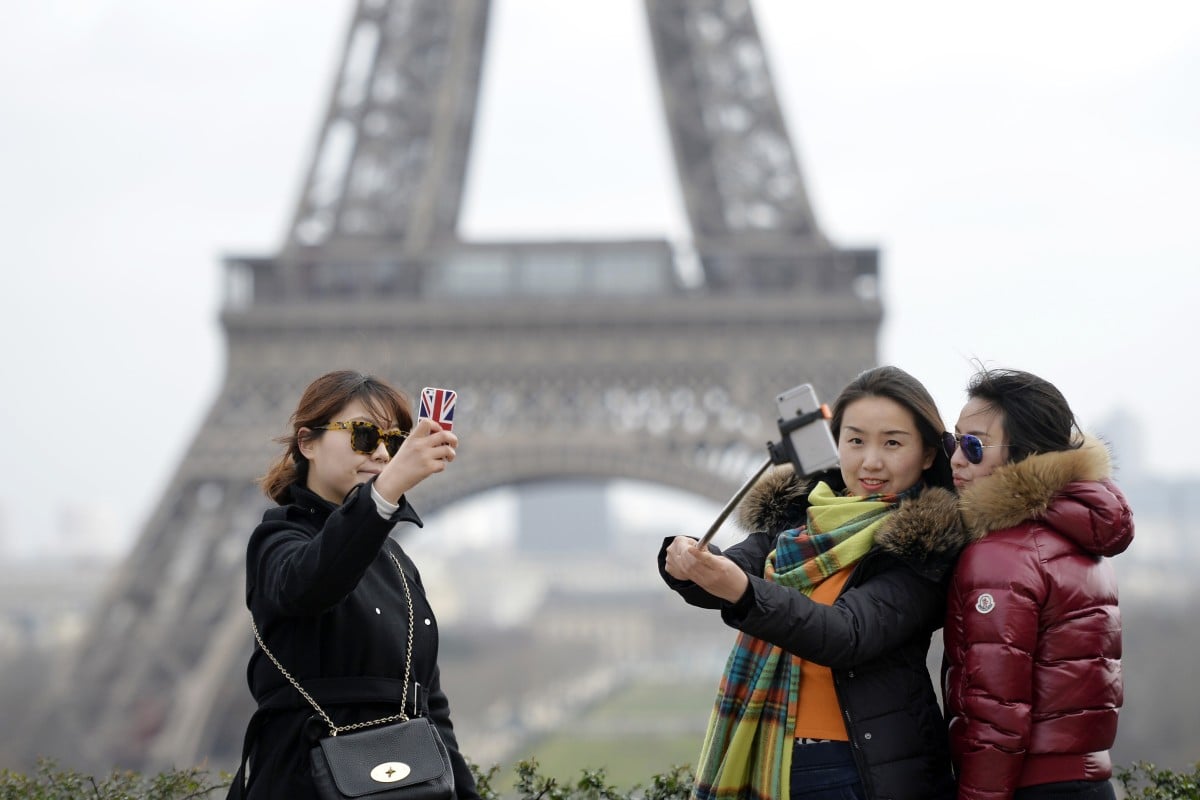
Chinese tourists have been warned to be on their guard when visiting France. Photo: AFP
Chinese visitors to Paris have been warned to be on the look out for a bewitching blonde who preys on the good nature and naivety of tourists to relieve them of their valuables.
According to a series of notices posted on the website of the Chinese embassy in the French capital, the alluring larcenist is just one of a number of con artists and crooks that prowl the city in search of easy targets.
Holidaymaker “Shen” became their latest victim earlier this month, the mission said.
“On April 1, a Chinese citizen surnamed Shen was appreciating the beautiful scenery at Avenue des Champs-Élysées, when a blonde approached him and asked for directions,” according to one of the notices posted on the site on Thursday.
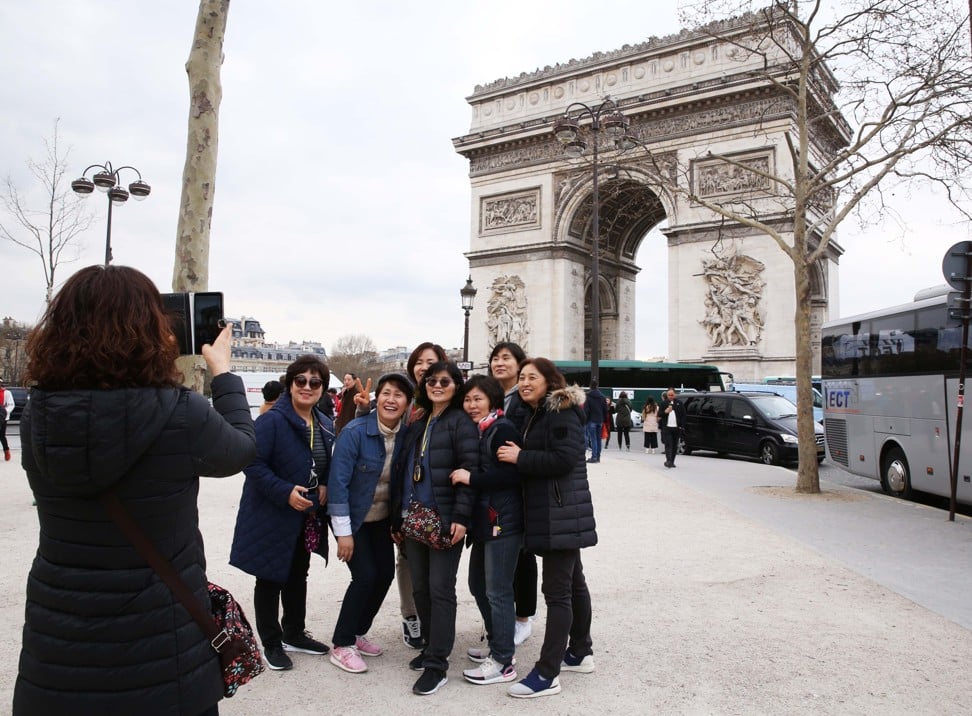
The Arc de Triomphe stands at the western end of the Champs-Élysées, where a Chinese tourist identified only as “Shen” was allegedly robbed on April 1. Photo: Xinhua
“Although Shen was curious why the blonde would chose a foreigner like him for directions, he still replied as he had made some travel preparations.”
It was only after the woman had walked away that Shen realised his mobile phone and wallet were missing, it said.
Cherish the love: China and France should disrupting ties, Beijing says
Pickpockets and sneak thieves are a threat to all visitors to France, but the Chinese are often regarded as prime targets because of the belief they carry lots of cash and valuables, the embassy said.
As well as the Champs-Élysées, tourists were warned to take extra care when visiting attractions like the Palace of Versailles and Sacré-Coeur, and when travelling on the subway.
“Be aware of strangers in public places and on public transport, and always pay attention to your belongings,” the embassy said.
The notice about Shen did not say if he had reported the suspected theft to the local police.
Pickpockets and sneak thieves are a threat to all visitors to France, but the Chinese are often regarded as prime targets, the embassy said. Photo: AFP
According to the Paris Region Tourism Board, China accounts for the third largest number of visitors to France after the United States and Britain. Chinese tourists made 1.1 million trips to the country in 2017 and the figure is forecast to grow to 2 million by 2022.
While most experience trouble-free trips, there have been reports of Chinese visitors to France being robbed or even assaulted in recent years.
in the car park of their hotel in the Val-de-Marne suburb of Paris after returning from a shopping trip. Their four assailants made off with nine bags filled with luxury goods.
A year earlier, 27 Chinese tourists were attacked by a group of six Frenchmen as they boarded a bus that was about to take them to the airport.
Two men detained and a third wanted over destruction of formation at scenic spot that took millions of years to take shape
The men took turns to batter off the stalactite with a rock. Photo: Weibo
Police in eastern China arrested two men and are looking for a third who allegedly broke off a 4 million-year-old stalactite in 30 seconds before taking it from the cave where it had been on display.
Surveillance camera footage taken in the Natural Underground Gallery in Yishui county, Shandong province, on April 21 showed three men taking turns to hit the stalactite with a rock to break it off, news site Iqilu.com reported on Tuesday.
“We call that part of the stalactite the Lovebird, and Geography of China, a programme on China Central Television, came last year specially to report on the Lovebird,” Yang Feng, an executive at the gallery, told Shandong Business Daily.
“[The men] took a large rock to break the stalactite and caused serious damage. Now the tail of the Lovebird is gone.”
China, too, has lessons to learn from US terracotta warrior vandalism case, experts say
Yang said he could not put a monetary value on the stalactite because it took millions of years to form.
The vandals also damaged other parts of the gallery, surveillance footage showed.
The damage to the Lovebird was not discovered until the next day, when a tour guide reported that its tail was missing.
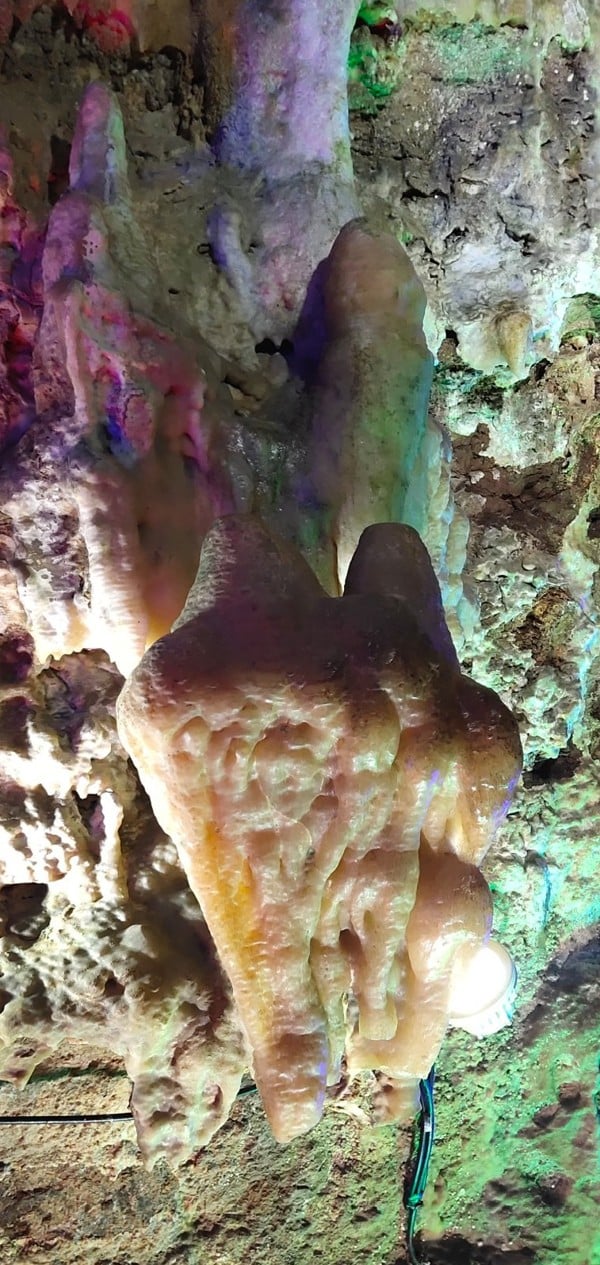
The stalactite took millions of years to form. Photo: Weibo
Yang said the damaged stalactite was less than 20cm long and 10cm wide. The gallery did not call the police until Saturday, after a geologist they consulted told them it would take millions of years for the missing section to grow back.
“We are outraged. The stalactite is precious for geological study but worth nothing to most people because the part that has been broken off will darken and become an ordinary stone,” Yang said.
In 2017, a man was caught on camera destroying a 50cm stalagmite in a cave in Songtao county, Guizhou province.
The man made three attempts to kick the stalagmite on the side of the main path in the cave and eventually knocked off a 30cm tip. He then walked away without taking it, the footage showed.
The scenic attraction’s administrators contacted police, who found the man and fined him 500 yuan (US$74).
Beijing has retaliated with duties on $110bn worth of American products.
Tariffs on $200bn worth of Chinese goods were due to more than double at the start of the year, rising from 10% to 25%.
But both countries agreed to suspend tit-for-tat tariffs after they struck a truce in December, and began negotiations to work towards a deal.
US President Donald Trump recently said the US and China had agreed on “a lot of the most difficult points” but that “we have some ways to go”.
What are the sticking points?
Sticking points in negotiations in recent months have included how a deal would be enforced, issues around intellectual property protection, and how fast to roll back tariffs.
Gary Hufbauer from the Peterson Institute for International Economics in Washington said enforcement was a crucial issue, but remained optimistic about the prospect of a deal.
“China will make lots of promises, the US remains sceptical on implementation,” he said.
Still, he expects a deal to be announced by mid-May. The latest round of talks are expected to be followed by further negotiations in Washington on 8 May.
The US accuses China of stealing intellectual property and wants Beijing to make changes to its economic policies, which it says unfairly favour domestic companies through subsidies. It also wants China to buy more US goods to rein in a lofty trade deficit.
He said China would boost efforts to secure intellectual property protection, increase imports of goods and services and ensure a fair trading environment for firms.
But what makes trade negotiations particularly difficult to resolve is the fact they are part of a broader power struggle between the world’s two largest economies.
China’s growing influence has put many Western governments – and particularly the US on the defensive. Some in China see the trade war as part of US efforts to curb its rise.
The trade war is already having an impact on the world economy.
International Monetary Fund chief economist Gita Gopinath said the escalation of US-China trade tensions was one factor that had contributed to a “significantly weakened global expansion, especially in the second half of 2018.” The IMF cut its growth forecast for this year by 0.2 percentage points to 3.3%.
SINGAPORE (Reuters) – Some 20 million barrels of Iranian oil sitting on China’s shores in the northeast port of Dalian for the past six months now appears stranded as the United States hardens its stance on importing crude from Tehran.
Iran sent the oil to China, its biggest customer, ahead of the reintroduction of U.S. sanctions last November, as it looked for alternative storage for a backlog of crude at home.
The oil is being held in so-called bonded storage tanks at the port, which means it has yet to clear Chinese customs. Despite a six-month waiver to the start of May that allowed China to continue some Iranian imports, shipping data shows little of this oil has been moved.
Traders and refinery sources pointed to uncertainty over the terms of the waiver and said independent refiners had been unable to secure payment or insurance channels, while state refiners struggled to find vessels.
The future of the crude, worth well over $1 billion at current prices, has become even more unclear after Washington last week increased its pressure on Iran, saying it would end all sanction exemptions at the start of May.
“No responsible Chinese company with any international exposure will have anything to do with Iran oil unless they are specifically told by the Chinese government to do so,” said Tilak Doshi of oil and gas consultancy Muse, Stancil & Co in Singapore.
Iran previously stored oil in 2014 at Dalian during the last round of sanctions that was later sold to buyers in South Korea and India. reut.rs/2yo9Se6
China last week formally complained to the United States over the unilateral Iran sanctions, but U.S. officials have said Washington is not considering a further short-term waiver or a wind-down period.
The 20 million barrels is equal to about a month’s worth of China’s imports from Iran over the past six months, or about two days of the country’s total imports.
Iran says it will continue to export oil in defiance of U.S. sanctions.
A senior official with the National Iranian Tanker Company (NITC), who spoke on condition of anonymity, told Reuters: “We will continue to sell our oil.”
“Iran is now desperate and will deal with anyone with steep discounts as long as they get paid somehow,” said Doshi.
SOME OIL TAKEN
Some Iranian oil sent to Dalian has moved, according to a ship tracking analyst at Refinitiv.
Dan, a supertanker owned by NITC moved 2 million barrels of oil from Dalian more than 1,000 km (620 miles) to the south to the Ningbo Shi Hua crude oil terminal in March, according to Refinitiv data.
Ningbo is home to Sinopec’s Zhenhai refinery, one of the country’s largest oil plants with a capacity of 500,000 barrels a day and a top processor of Iranian oil.
Sinopec declined to comment.
The Iranian tanker was chartered by state-run Chinese trader Zhuhai Zhenrong Corp, according to Refinitiv analyst Emma Li. The NITC official confirmed the oil was taken by Zhuhai Zhenrong.
Zhenrong was started in the 1990s and brokered the first oil supply deals between Iran and China. At that time, Iran was supplying oil to China to pay for arms supplied by Beijing during the 1980-88 Iran-Iraq war. Zhuhai Zhenrong still specializes mainly in buying Iranian oil.(reut.rs/2IHlvEx)
An official at the general manager’s office with Zhuhai Zhenrong’s office in Beijing said he could not immediately comment. The company did not reply to a fax seeking comment.
For now, more Iranian oil is heading to China, with the supertankers Stream and Dream II due to arrive in eastern China from Iran on May 5 and May 7, respectively, Refinitiv data showed.
Some of this crude may be from Chinese investments into Iranian oilfields, a sanctions grey area.
Whether China will keep buying oil from Iran remains unclear, but analysts at Fitch Solutions said in a note “there may be scope for imports via barter or non-compliance from … China.”
Muse, Stancil & Co’s Doshi said the only way to get the Iranian oil out of Dalian now was by cheating.
“Only rogue parties might try to cheat the system and try to pass the Iranian oil at Dalian as something else via fraudulent docs. But I doubt this is easy or can amount to much in terms of volume.”
(MAP: Iranian supertanker frees some oil from China storage in March, tmsnrt.rs/2W1FJvK)
BEIJING, April 28 (Xinhua) — China will work to build a sound system of health services for the country’s senior citizens, according to the country’s top health official Sunday.
Ma Xiaowei, head of the National Health Commission, said at a national conference on elderly affairs that the system that covers health education, disease prevention and fitness, disease treatment and rehabilitation, as well as daily care, long-term services and hospice care for the elderly in both urban and rural areas, will be improved.
The system needs to properly define the target groups and providers of such services as well as the contents of the services, Ma said.
The financial issue should also be considered, the official said.
As of the end of 2018, China has a population of 249 million aged 60 or above, and the number is expected to exceed 300 million in 2025, according to Ma.
BEIJING, April 28 (Xinhua) — China will hold a gathering to mark the centenary of the May Fourth Movement at 10:30 a.m. on Tuesday at the Great Hall of the People in Beijing.
President Xi Jinping, also general secretary of the Communist Party of China Central Committee and chairman of the Central Military Commission, will attend the event and deliver an important speech.
The event will be broadcast live by China Media Group and on http://www.xinhuanet.com. It will also be rebroadcast simultaneously on major news websites including people.com.cn, cctv.com and china.com.cn as well as on news apps run by People’s Daily, Xinhua News Agency and China Central Television.
Chinese President Xi Jinping delivers a speech at the opening ceremony of the International Horticultural Exhibition 2019 Beijing in Yanqing District of Beijing, capital of China, April 28, 2019. (Xinhua/Ju Peng)
BEIJING, April 28 (Xinhua) — Chinese President Xi Jinping delivered a speech at the opening ceremony of the International Horticultural Exhibition 2019 Beijing on Sunday.
Themed on “Live Green, Live Better,” the Beijing expo is participated by 110 countries and international organizations, the largest of its kind in history.
Dangerous midnight speed drive fuelled by drinking and karaoke session
High-performance cars seen switching lanes, driving on the wrong side of the road and running a red light
Two men have been detained in eastern China for racing their rented Porsche sports cars on city streets. Photo: Handout
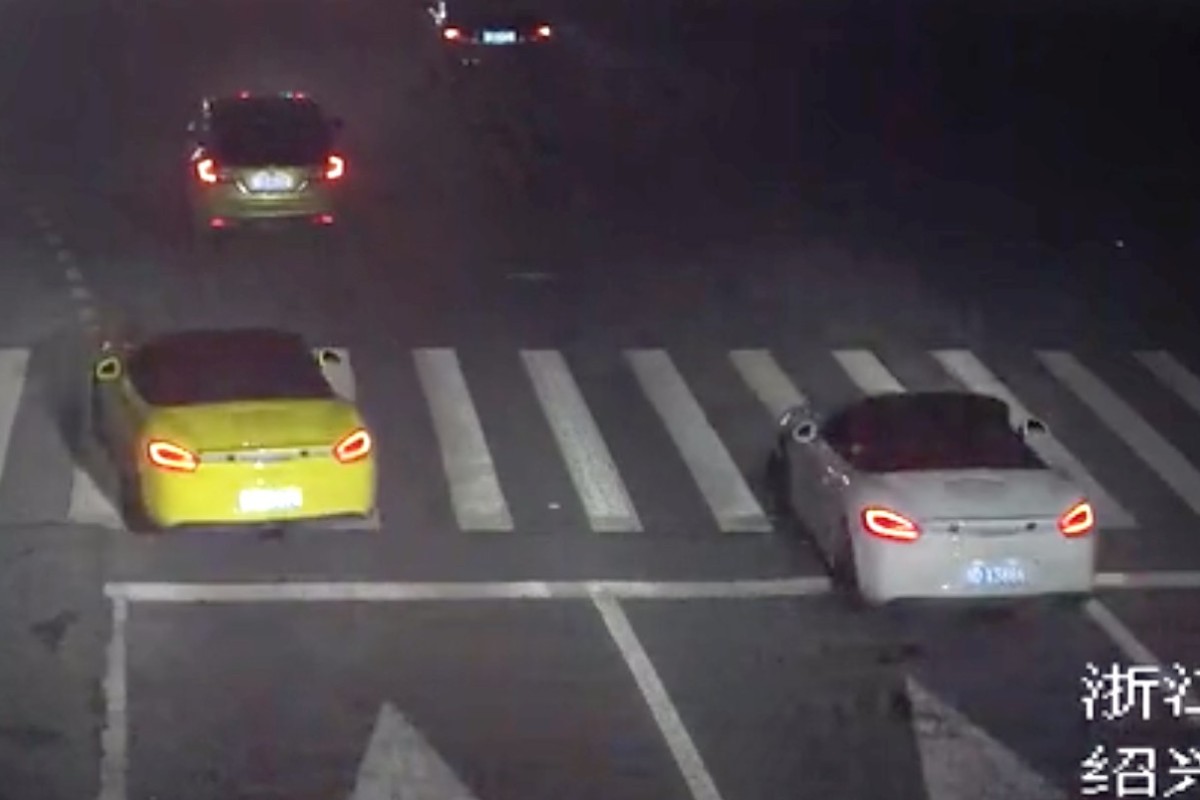
An alcohol-fuelled midnight street race between two high-powered sports cars in an eastern Chinese city has landed two men in detention.
At one point, according to police in Zhuji, Zhejiang province, the rented Porsche cars hit 170km/h (105mph) as they tore through the city, randomly switching lanes, running a red light and even driving on the wrong side of the road.
A police investigation found the culprits had been drinking alcohol at a karaoke singing session before deciding to test their driving skills.
One of them, a 21-year-old university student surnamed Ying, had rented the yellow Porsche for a month for 20,000 yuan (US$3,000). The other man, a 24-year-old surnamed Jiang, had rented the white Porsche for a day at 800 yuan because he wanted to race his friend.
Chinese are buying more used cars online — without kicking a tyre
Ying was arrested two days after the illegal race and confessed, the police statement said.
Local police started receiving calls from residents at around midnight on April 22, complaining at the loud racing going on through the streets.
In a statement on the WeChat social messaging app, police said footage from more than 10 security cameras showed a yellow Porsche and a white one chasing each other in a dangerous manner down a main road past a hospital and numerous residential compounds.
Speeding has been a criminal offence in China since 2011. According to Chinese law, “whoever races a motor vehicle on a road with execrable circumstances or drives a motor vehicle on a road while intoxicated shall be sentenced to criminal detention and a fine.”
Are increasing diplomatic tensions behind tighter inspections and cancelled orders?
Farmers switch to other crops in bid to beat barriers
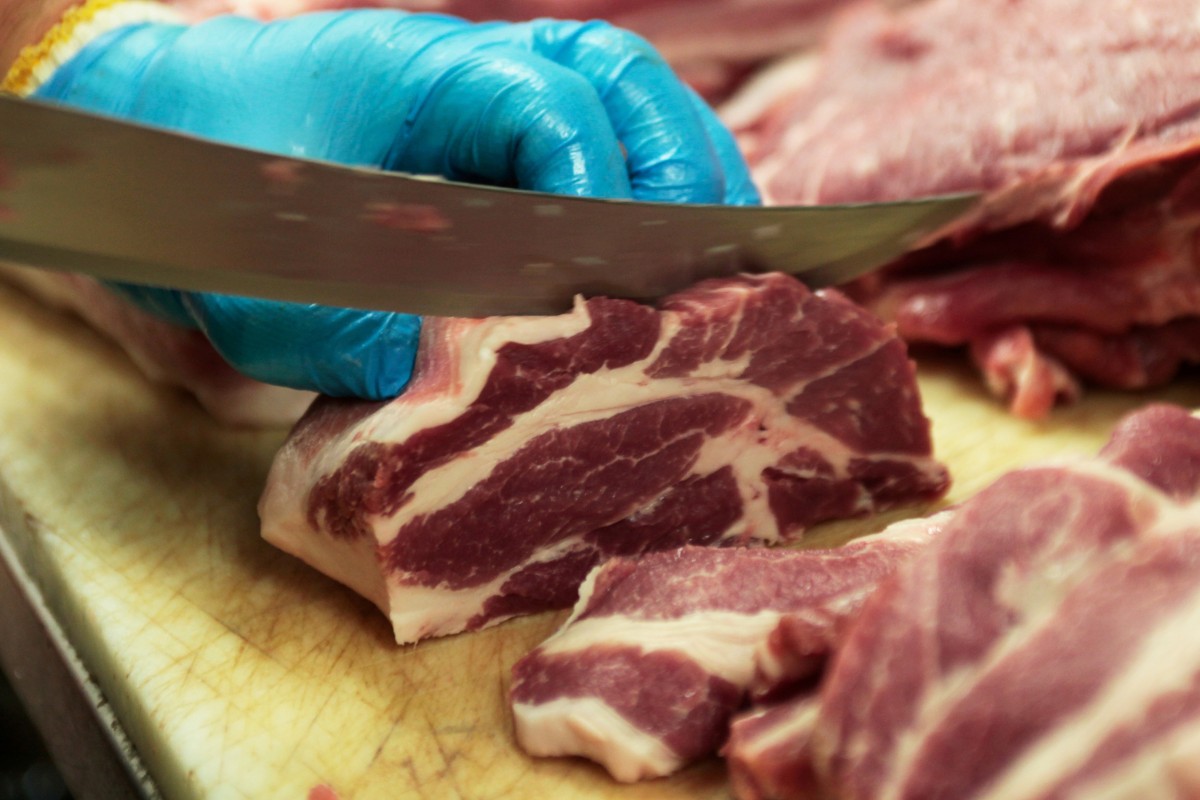
Canadian exporters of pork, soybeans and peas say they are facing delays and increased inspections at Chinese ports. Photo: Reuters
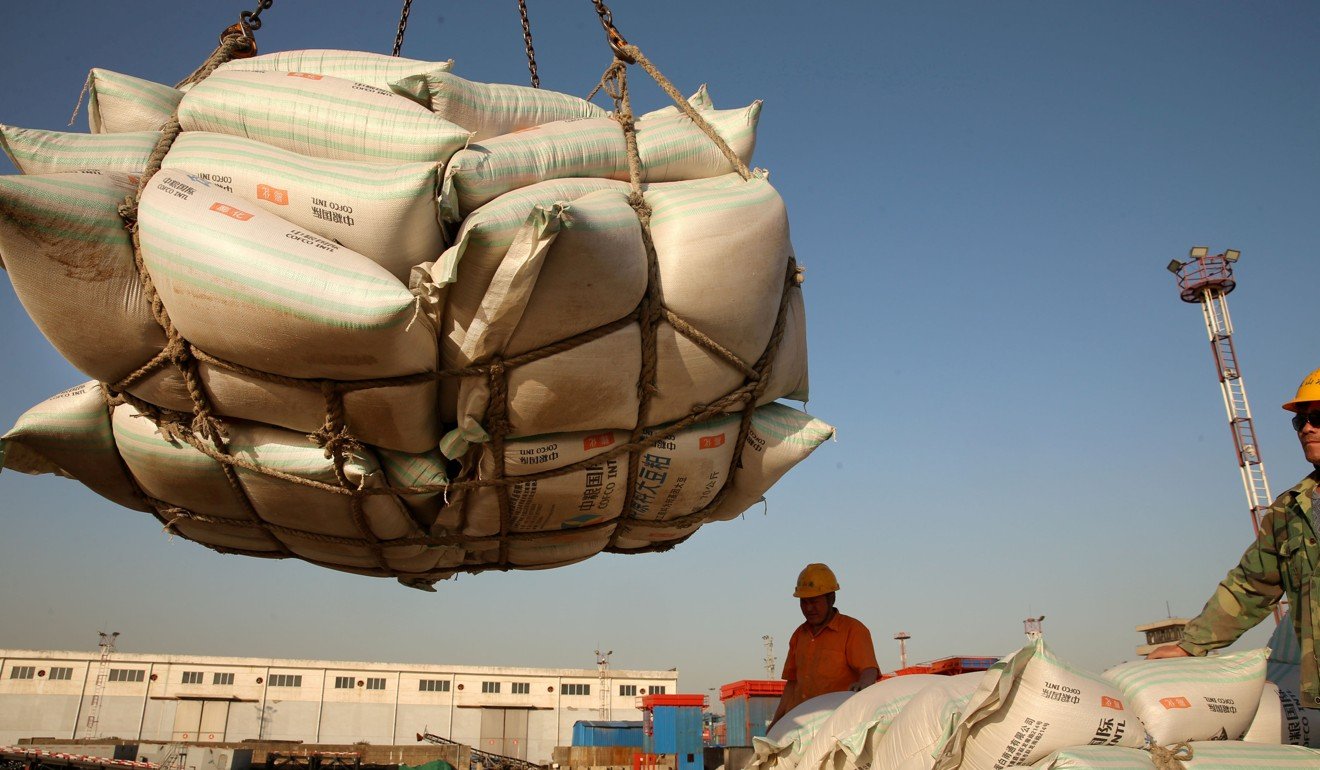
A growing list of Canadian farm exports is facing obstacles at Chinese ports, raising concerns that a bitter diplomatic dispute between the two countries may be to blame.
Sellers of Canadian soybeans and peas say they are experiencing unusual obstacles and Ottawa also warned last week that China was holding up pork shipments over paperwork issues.
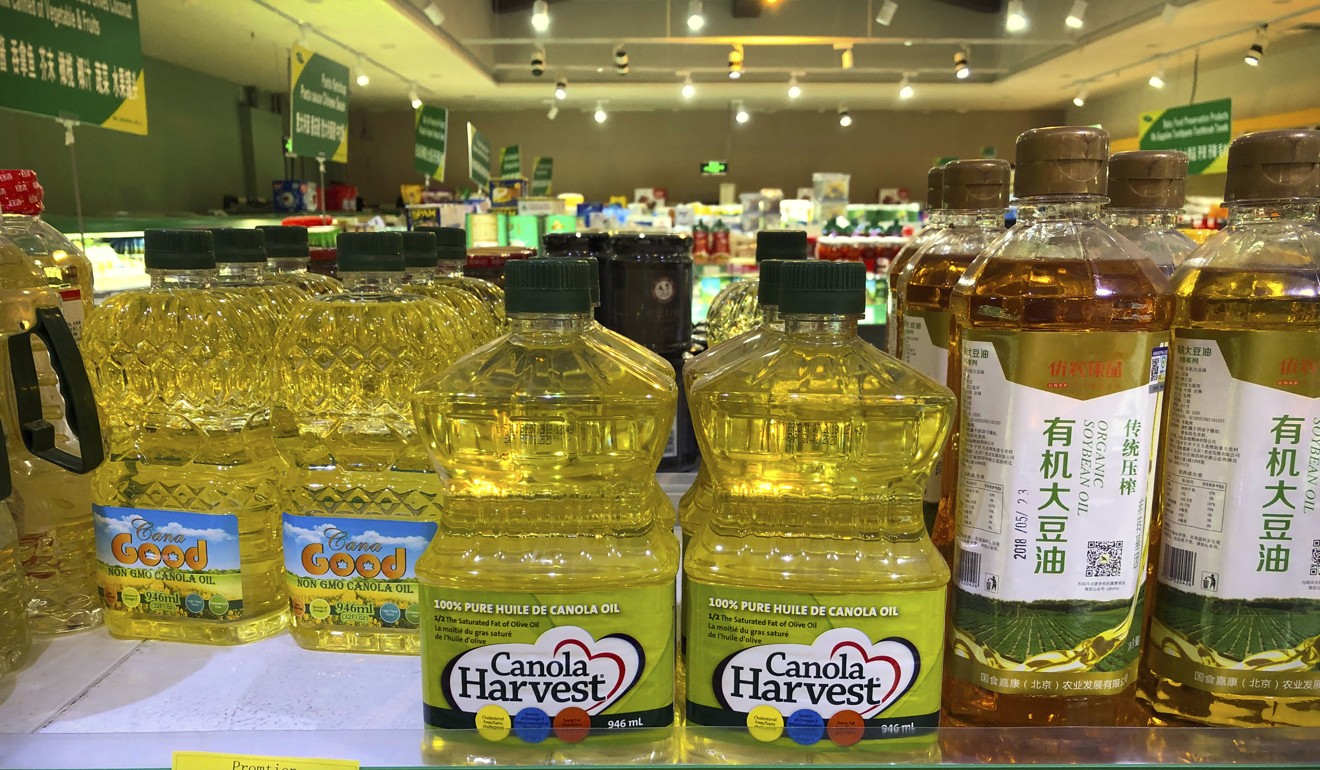
China has already blocked Canadian canola from Richardson International and Viterra, two of Canada’s biggest farm exporters, saying that shipments had pests. Other China-bound canola cargoes have been cancelled, forcing exporters to re-sell elsewhere at discount.
Canadian politicians have said the concerns are baseless, and noted that China detained two Canadians after Canada arrested an executive of Chinese telecom company Huawei Technologies Co Ltd in December at the United States’ request. China has used non-tariff barriers before during diplomatic tensions, most recently against Australian coal.
China has already blocked canola from two of Canada’s biggest farm exporters, while other China-bound canola cargoes have been cancelled. Photo: AP
Increasing tensions with China, a top buyer for most Canadian farm commodities, have forced farmers to plant other crops, such as wheat, that they hope will not face barriers.
China bought US$2.01 billion worth of Canada’s canola and $381 million worth of its pork last year.
The spread of African swine fever through China’s pig herd has reduced China’s need for canola and soybeans to process into feed ingredients but, since January, port soybean inspections that routinely take a few days now require three weeks, causing Chinese buyers to avoid Canadian products, according to Dwight Gerling, president of Canadian exporter DG Global.
“They’re basically sending out the signal, ‘You buy from Canada, we’re going to make your life difficult,’” Gerling said.
Earlier this year, a Chinese buyer told Gerling that a government inspector had found ants in 34 containers (roughly 680 tonnes) of the Canadian soybeans he shipped there.
Such a finding would be rare, since the soybeans were stored in concrete silos in Canada and shipped in sealed containers in late autumn, said Gerling, who concluded the buyer was trying to avoid the new hassles of buying from Canada.
“It’s just them playing games. (Beijing) is just going to keep putting the screws to us,” he said.
China’s General Administration of Customs did not reply to a request for comment. Government officials have said their canola ban is a regular inspection and quarantine measure to protect China’s farm production and ecological safety.
In a statement, the Canadian agriculture department said it could not confirm that China had imposed stricter measures against farm goods other than canola. Ottawa said this month it hoped to send a delegation to China to discuss the issue.
Gerling’s company has halted soybean sales to China and found other buyers in Southeast Asia.
An official at a state-owned crusher in southern China confirmed that port inspections had tightened on Canadian soybean cargoes.
“We don’t have Canadian cargoes coming in as we can’t blatantly commit such wrongdoing when the atmosphere is so intense,” the official said on condition of anonymity.
Soybeans from Canada are facing delays when they reach Chinese ports, according to traders. Photo: Reuters
Another official in northern China said his crushing plant scrapped plans to buy Canadian soybeans when the trade dispute flared.
Canada shipped $1.2 billion worth of soybeans to China in 2018, up sharply year over year, according to the Soy Canada industry group, as China and the United States fought a trade war. But sales have now slowed to a trickle.
Canola has taken the brunt of China’s measures.
Chinese buyers have cancelled at least 10 cargoes of Canadian canola in the past few weeks, according to a Singapore-based trader at a company that runs crushing facilities in China. Some cargoes, around 60,000 tonnes each, have been resold to buyers in Pakistan and Bangladesh at deep discounts, the trader said.
“It is devastating for exporters,” the trader said.
Canada gets tough with China on canola ban, demands contamination proof
Intercontinental Exchange (ICE) canola futures fell to a more than four-year low on Tuesday as supplies piled up. Growers intend to sow the smallest crop in three years.
On Monday last week, Ottawa said some Canadian pork exporters used an outdated form to certify shipments to China, causing delays. Such issues arise regularly in commodity trading, but rarely with damaging consequences, said Canadian Pork Council spokesman Gary Stordy.
Canadian pea exporters fear they could be next. China imported C$533 million worth of Canadian peas in 2018, according to industry group Pulse Canada, but the pace has slowed.
Chinese authorities have begun scrutinising import documents and product samples more closely, according to Taimy Cruz, director of logistics at Toronto-based BroadGrain Commodities.
China Inspection and Quarantine Authorities now tests samples of each pea shipment before authorising it for import. They also restrict in some cases the number of soybean shipments allowed under one licence, slowing the flow, she said.
Similarly, import authorities now require soybean shipments that change vessels in Singapore and Shanghai – a routine practice called trans-shipping – to reach their destination on a single ship, she said.
While BroadGrain has not seen its cargoes turned back, it has reduced sales to China to avoid risk, concentrating on the Indian subcontinent and South America, she said.
“We have to be extra careful,” Cruz said. “They are very strict now.”





 CHINDIA ALERT: You'll be living in their world, very soon