Archive for ‘China alert’

06/04/2019

China’s leading anti-poverty foundation helps over 30 mln people

BEIJING, April 6 (Xinhua) — The China Foundation for Poverty Alleviation (CFPA) has helped over 30 million people since its establishment 30 years ago.

The foundation has raised over 5.85 billion yuan (871 million U.S. dollars) in cash and in kind as of the end of 2018, according to sources with the foundation.

The CFPA has leveraged the development of local industries to help improve people’s income.

It has spent 11.67 million yuan using e-commerce to help about 16,000 farmers sell their produce since 2015. About 59,000 people have benefited from local tourism development, while over 40.7 billion yuan has been offered as credit to finance farmers.

The “Love Package,” the most popular CFPA program, allows donors to mail care packages to help students in poor areas. The program has received 3.706 million pieces of individual donations and raised 677 million yuan as of the end of the end of 2018.

Source: Xinhua

06/04/2019

People mourn for martyrs who died while fighting forest fire in Sichuan

#CHINA-MARTYRS-FOREST FIRE-HOMETOWN (CN)

A ceremony is held to receive the bone ashes of fireman Zhang Chengpeng, who died while fighting a forest fire in southwest China’s Sichuan Province, at Jinan international airport in Jinan, east China’s Shandong Province, April 5, 2019. The ashes of fireman Zhang Chengpeng returned to his hometown of Zouping in Shandong Province on Friday. (Xinhua/Dong Naide)

Source: Xinhua

06/04/2019

China’s aviation regulator asked to join FAA safety review of Boeing 737 MAX

  • Civil Aviation Administration of China has not decided whether to take up invitation to be part of task force looking into automated flight control system, according to state media
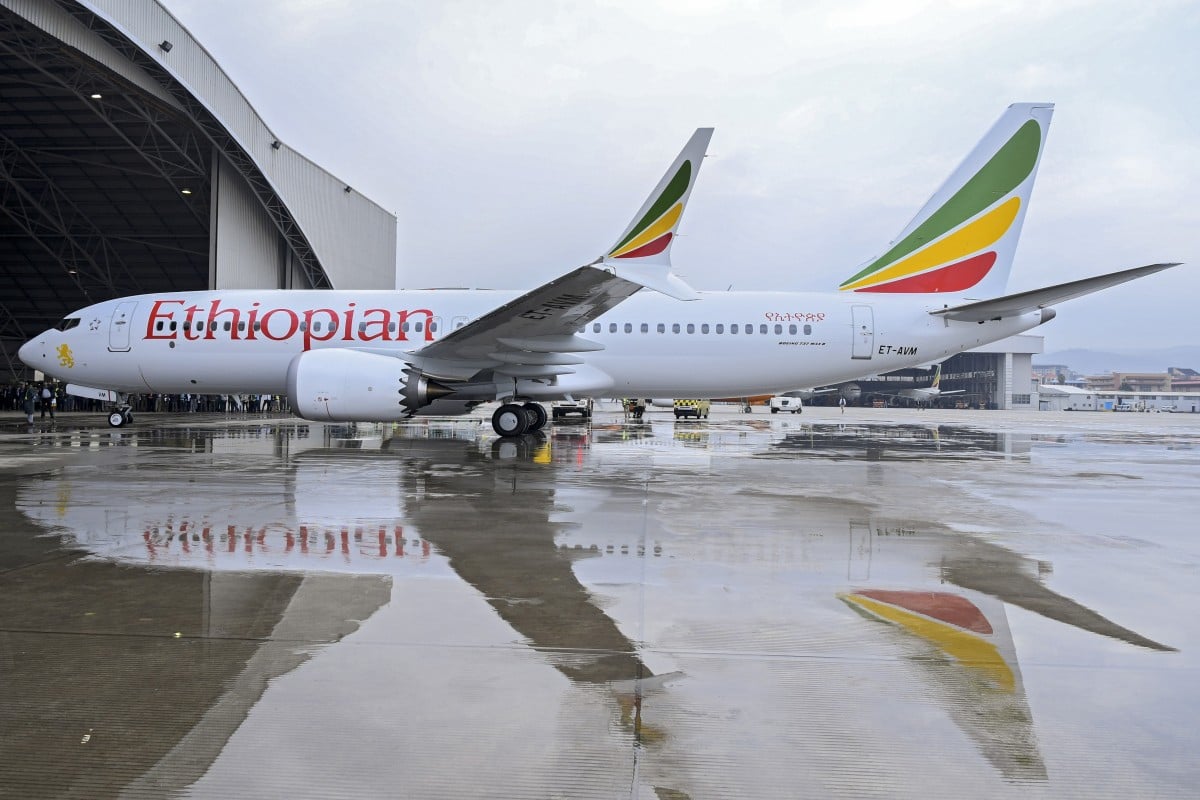
The FAA is putting together an international team of experts to review the safety of the Boeing 737 MAX after two fatal crashes. Photo: EPA-EFE
China’s aviation regulator has been invited to join the US Federal Aviation Administration’s (FAA) task force to review the automated flight control system of Boeing’s 737 MAX jets, state media reported on Saturday.
The Civil Aviation Administration of China has not decided whether to accept the invitation, state broadcaster CCTV reported, citing an administration official.
But the official said the regulator would closely follow the investigation into two fatal crashes involving Boeing 737 MAX planes.
The FAA on Wednesday said it was forming an international team to review the safety of the Boeing 737 MAX following the accidents.
China was the first country to ground all Boeing 737 MAX 8 jets after an Ethiopian Airlines plane crashed outside Addis Ababa on March 10, killing all 157 people on board.

It was the second crash involving Boeing’s newest model, after 189 people were killed when a Lion Air plane crashed into the Java Sea off Indonesia on October 29.

Noting the similarities between the two accidents, China’s civil aviation regulator ordered domestic airlines to ground all 737 MAX 8 aircraft. It stopped taking applications for Boeing’s 737 MAX 8 airworthiness certification on March 21.After China ordered a dozen carriers to ground their 96 planes – about a quarter of all 737 MAX aircraft in operation globally – authorities in Ethiopia, Indonesia, Mongolia, Morocco and Singapore followed suit, along with airlines in Latin America and South Korea, before it was grounded worldwide.

How every Boeing 737 MAX was grounded in five days

China’s civil aviation regulator has said the plane would only be allowed to resume flights after it is satisfied measures to effectively ensure safety have been taken.

On Wednesday, the FAA said it would set up a Joint Authorities Technical Review (JATR) team to evaluate the safety of the Boeing 737 MAX. Experts from the FAA, Nasa and international aviation authorities would “conduct a comprehensive review of the certification of the automated flight control system on the Boeing 737 MAX aircraft”, the FAA said in a statement

“The JATR team will evaluate aspects of the 737 MAX automated flight control system, including its design and pilots’ interaction with the system, to determine its compliance with all applicable regulations and to identify future enhancements that might be needed,” the statement said.

Source: SCMP

05/04/2019

China sees progress in online medical care service

BEIJING, April 5 (Xinhua) — China has made headway in promoting the initiative of Internet plus medical and health care, according to the national health authority.

An array of supporting policies have been introduced in areas such as online diagnosis and treatment, Internet hospitals and telemedical services, with 30 measures rolled out to benefit people under the initiative, the National Health Commission said in a statement.

Noting the progress in building a national platform for people’s health information, the commission said 1,273 tertiary hospitals, the highest in China’s three-tier hospital grading system, are able to share their medical service information with each other.

E-health cards, which offer access to personal health information and medical services through a QR code, have been piloted in 28 provincial-level regions, it added.

A specialized network for medical services spanning across the country and online platforms for cloud telemedical services have been established, which enables hospitals to provide telemedical services.

Source: Xinhua

05/04/2019

China Focus: Funeral reform fosters new trends in China

BEIJING, April 5 (Xinhua) — “The air and environment in the cemetery have been notably improved, with less people burning joss paper,” said Wang Fang, a tomb sweeper from Yinchuan, Ningxia Hui Autonomous Region.

This year’s Tomb Sweeping Day, which falls on Friday, witnesses more changes, as China has made various efforts to reform funeral traditions in recent years, and ecological burial and environmentally friendly tomb sweeping practices are increasingly popular.

GREENER BURIAL

In a tea garden in Hangzhou in east China’s Zhejiang Province, there stands a hidden cemetery where burial plots are built under tea trees in a bid to enlarge its green area as well as conserve land.

“It would be good to return to nature here after I pass away,” said a local resident surnamed Wu.

China has seen progress in ecological burials in recent years, especially in developed cities. The first model ecological cemetery of Beijing has been built in Babaoshan Revolutionary Cemetery, with a green coverage rate of nearly 90 percent.

Currently, ecological burials in first-tier cities, including Beijing, Shanghai and Guangzhou, takes up more than 20 percent of the total. It is expected that by 2020, the share of ecological burial across the country reach over 50 percent.

In addition, tomb sweeping practices have become greener. Most tomb sweepers would rather present flowers at tombstones than burn joss paper to pay tribute to their deceased families and friends.

On Tomb Sweeping Day, some cemeteries hold cultural activities, such as calligraphy and painting exhibitions as well as poetry recitals as an alternative to tomb sweeping.

LAND CONSERVATIVE

Besides the “tea garden burial,” other ecological burial methods in China include tree, flower, wall and sea burials.

Replacing traditional tombstones with trees and flower beds, putting urns on shelves in walls or just dropping ashes into the sea requires less or even no land.

“At first people said it was for those in financial difficulties to save money, but as time changes, the popularity of ecological burials have increased,” said Zhao Quansheng, manager of a Yinchuan-based cemetery.

“A customer told us that his father voluntarily asked for an ecological burial to conserve land,” Zhao said.

Non-profit cemeteries are also thriving in places of separate burial traditions. In Yishui County, east China’s Shandong Province, 110 non-profit cemeteries have been built, leading to conservation of large areas of land that otherwise would be utilized for burial sites.

Xue Feng, Party secretary of Yishui, said it used to take about 20 to 27 hectares of land to accommodate all the private tombs in the county, but now it only needs 10 percent of that.

LESS MONEY

China has beefed up funeral infrastructure and public services, with the number of funeral parlours and cemeteries reaching 1,760 and 1,420, respectively.

Since 2009, the Ministry of Civil Affairs has pushed forward fee reduction in basic public funeral services as well as other preferential policies, benefiting low-income groups. For example, commercial cemeteries in Chongqing, Gansu and Ningxia were required to set aside part of their burial sites as non-profits for those with financial difficulties.

“Now the whole funeral is free, including the urn and burial site, which is a great help for households with low incomes like us,” said Yuan Li, a rural resident from Yishui, where funeral services have been free of charge since 2017.

Xue said the fee-reduction policy could save the public nearly 200 million yuan (about 30 million U.S. dollars) annually.

The Ministry of Civil Affairs issued a pilot plan for funeral reform in 2017, and released guidelines with another 14 authorities on further reform in 2018.

“The funeral reforms help encourage fine and up-to-date practices and trends, and make contributions to land and ecological conservation,” said Ma Guanghai, sociology professor of Shandong University. “It is an important aspect of social progress.”

Source: Xinhua

05/04/2019

Campaign to promote paying tribute to revolutionary martyrs kicks off in China

CHINA-BEIJING-QINGMING FESTIVAL-CAMPAIGN (CN)

Students lay flowers to pay tribute to revolutionary martyrs during a campaign at the Museum of the War of Chinese People’s Resistance Against Japanese Aggression in Beijing, capital of China, April 4, 2019. China has kicked off a campaign to promote paying tribute to revolutionary martyrs as Tomb-sweeping Day draws near. The campaign is aimed at combining educational activities with paying tribute. Tomb-sweeping Day, also known as Qingming Festival, falls on April 5 this year. It is a traditional Chinese holiday where people pay tribute to deceased family and friends. (Xinhua/Zhang Chenlin)

Source: Xinhua

05/04/2019

Decade on from failed Chinese well-digging project, poor farmers wait for water

  • Poverty busting project in northern China was meant to increase cultivation of green vegetables
  • Instead, more than 100 inadequate wells have been abandoned
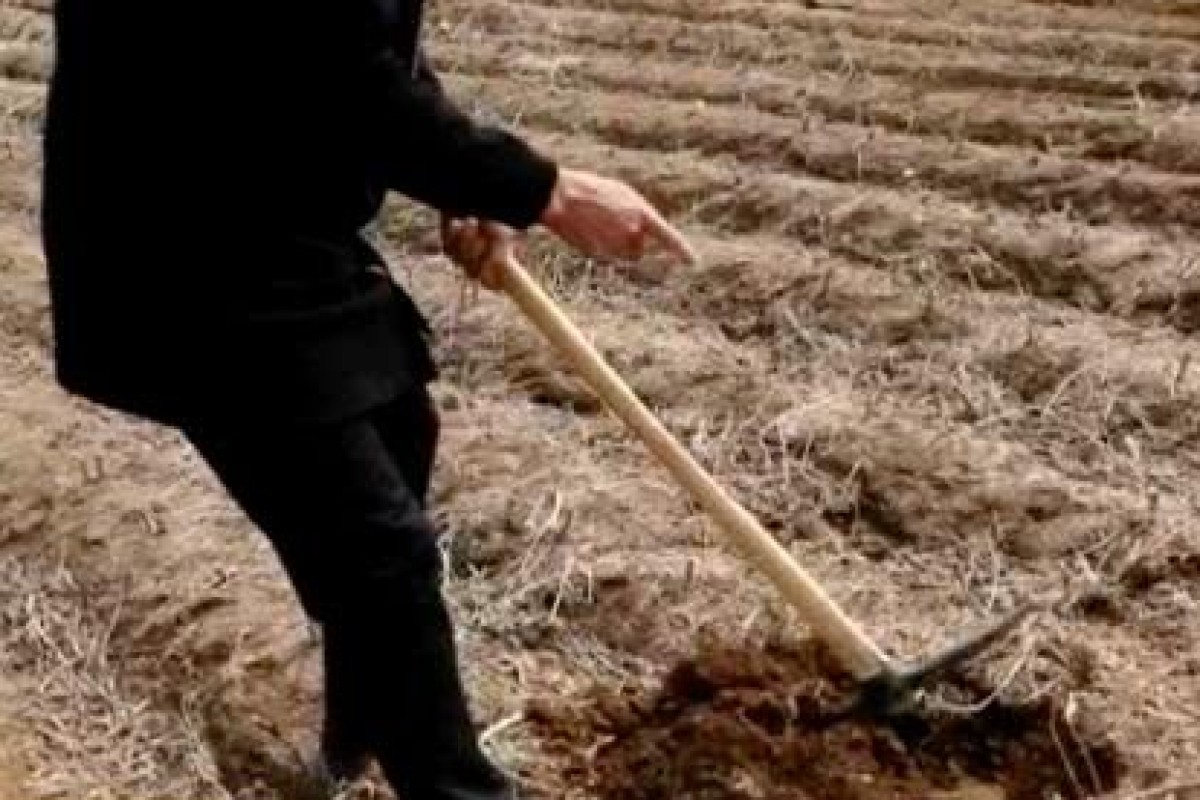
More than 100 wells dug by a local government in northern China have been abandoned and covered over because they failed to produce any water. Photo: Weibo
More than 100 wells dug by a local government in northern China have been abandoned and covered over because they failed to produce any water.
Built in 2000, the wells were part of a poverty alleviation programme in Xiuyan county, Liaoning province, looking to spur cultivation of green vegetables, CCTV’s Half-hour Economy programme reported on Thursday.
The problem was first exposed in 2015 by the same programme, and most of the wells have now been filled in to prevent people from tripping into or over them.
“This well does not have any water, it’s just for show. All of the ones here are like that,” Li Guoyi, a county resident told CCTV.
One of the abandoned wells dug as part of a poverty busting programme in China’s northern Liaoning province. Photo: Weibo

Li’s farmland is next to one of the abandoned wells. He said he cannot grow as many square metres of vegetables as he would like as they require more water.

Instead, he cultivates hardy crops that fetch lower prices, like potatoes and corn. He has had to buy a pump and transport water from a source 200 metres away for irrigation, according to the report.

“I still hope we can have working wells,” Li, 71, said. “If I can live for another 10 years and make 18,000 yuan (US$2,680) a year, I can reduce my children’s burden a lot.”

A villager who helped dig the wells said the project had failed to follow protocols that would have produced wells fit for irrigation.

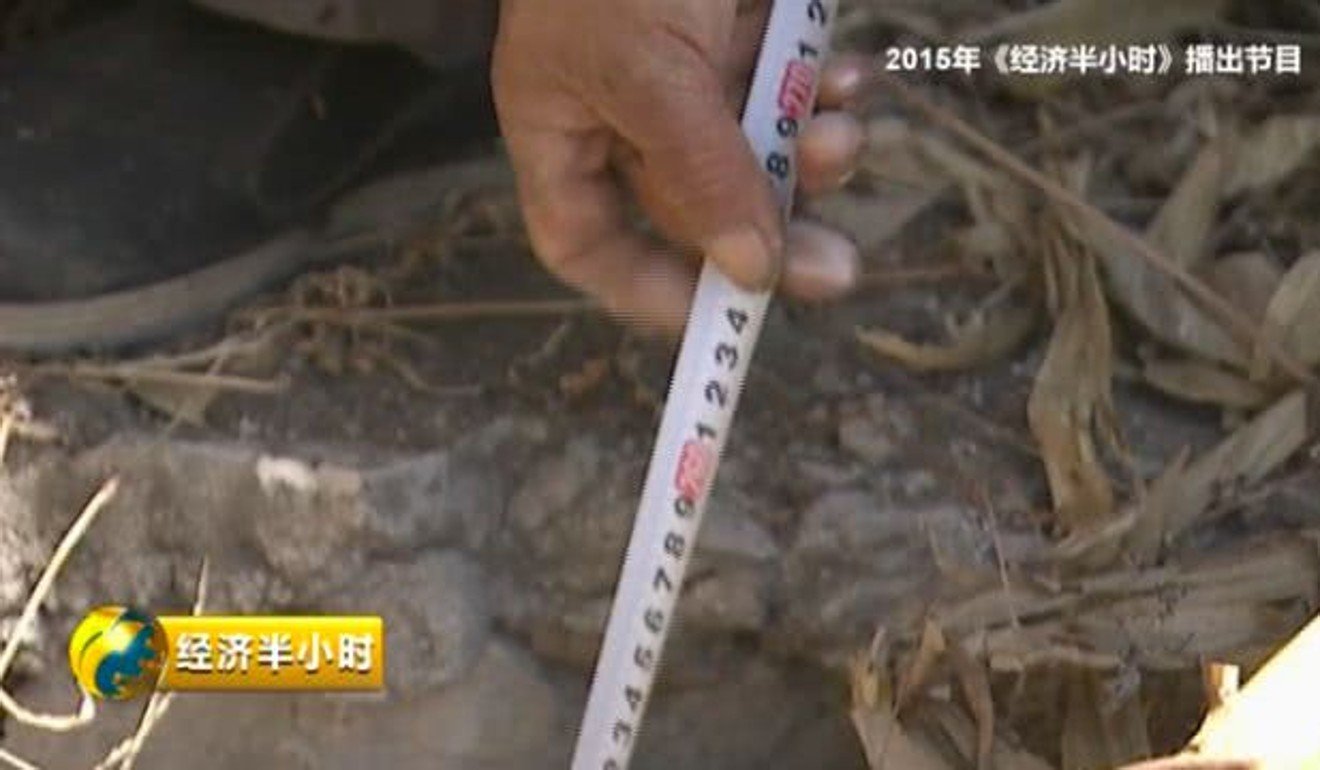
Dong Ensheng, who also wrote a 2015 report into the failed project, said the wells were only required to be dug to a depth where water was visible. In addition, some of the wells had openings as small as 40cm in diameter – not even big enough to fit a water pump.

A 2015 report found some of the wells had openings too small to fit a water pump. Photo: Weibo

In his report Dong said the wells fell way below established standards. “At the very least, they should be able to sustain several hours of water pumping. The well we dug was pumped dry in minutes,” he wrote.

When confronted with the issue of the failed wells this year, county officials refused to take responsibility and declined to provide records of the 2015 investigation, launched in response to the previous exposé, according to CCTV.

“This happened more than 10 years ago. You want to follow up on this now, you won’t be able to find it,” Wei Tianhui, the deputy director of Xiuyan county’s economy bureau, was quoted as saying.

“The staff has changed a lot. The structure of the county government has changed a lot. Where do we start looking?”

The programme drew angry reactions from internet users on China’s Twitter-like Weibo, who criticised the local government.

“They just keep passing the ball, thinking it’s not my fault so why should I bear the responsibility?” a user from Shandong province, eastern China, wrote. “Are these the civil servants of the new era? These are the so-called civil servants in service of the people?”

Source: SCMP

05/04/2019

US and China edge closer to ‘epic’ trade deal, says Trump

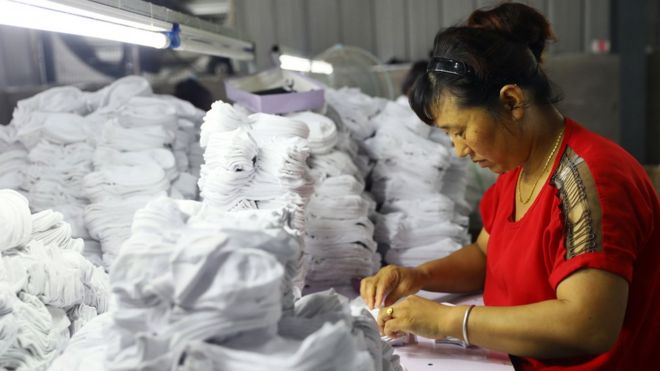
A woman works on socks that will be exported to the US at a factory in Huaibei in China's eastern Anhui province on August 7, 2018Image copyrightGETTY IMAGES

President Donald Trump says the US has found agreement on some of the toughest points in trade talks with China.

He said a deal could come in the next four weeks, but added some sticking points remained.

The Chinese echoed the optimism, with President Xi Jinping touting substantial progress, according to the Chinese state news agency Xinhua.

The US and China have been in talks since December trying to end a trade war that is hurting the global economy.

Mr Trump said the US and China had agreed on “a lot of the most difficult points” but that “we have some ways to go”.

He was speaking from the White House, before a meeting with Chinese Vice Premier Liu He.

The US president said if there was a deal, he would hold a summit with President Xi.

“This is an epic deal, historic – if it happens,” said Mr Trump.

“This is the Grand Daddy of them all and we’ll see if it happens. It’s got a very good chance of happening.”

Sticking points in negotiations in recent weeks have included how fast to roll back tariffs and how a deal would be enforced.

Mr Trump suggested at the press conference that some of these persisted.

He said it would be tough for the US to allow trade to continue with China in the same way as in the past, if a deal did not materialise.

‘Conflicting signals’

The world’s two largest economies imposed tariffs on billions of dollars worth of one another’s goods over the past year.

Negotiations between them have continued since a trade truce was agreed in December, but have at times been rocky.

The BBC’s China correspondent Robin Brant said that both sides were – yet again – giving conflicting signals.

Mr Liu said the US and China had reached a new consensus on important issues like the text of the economic and trade agreement, Xinhua reported.

While that echoed Mr Trump’s comments, US Trade Representative Robert Lighthizer sounded more cautious. He said there were still some major issues left in trade talks, according to reports.

Mr Brant said there was clearly still significant distance between the two sides on the crucial issue of enforcement.

What’s being discussed?

The US accuses China of stealing intellectual property from American firms, forcing them to transfer technology to China.

Washington wants Beijing to make changes to its economic policies, which it says unfairly favour domestic companies through subsidies and other support, and wants China to buy more US goods to rein in a lofty trade deficit.

China accuses the US of launching the largest trade war in economic history, and is unlikely to embrace broader structural changes to its economy.

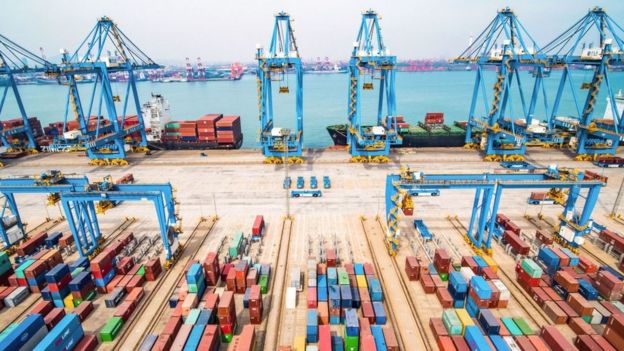
An aerial view of a port in Qingdao in China's eastern Shandong province on March 8, 2019Image copyrightGETTY IMAGES

What’s at stake?

Failure to achieve a deal may see the US more than double the 10% tariffs on $200bn (£153bn) of Chinese goods and impose fresh tariffs.

Mr Trump has in the past threatened to tax all Chinese goods going into the US.

The US has already imposed tariffs on $250bn worth of Chinese goods, and China has retaliated with duties on $110bn of US products.

The damaging trade war has already cast a shadow over global trade and the world economy.

Source: The BBC

04/04/2019

China to keep increasing assistance to needy people

BEIJING, April 3 (Xinhua) — The Chinese government will not reduce financial assistance to needy people but keep it increasing, said Minister of Civil Affairs Huang Shuxian at a national civil affairs conference that closed Wednesday.

The priority in the near future is to increase the civil affairs service at the primary level and increase personnel at county, township and village levels, Huang said at the two-day meeting.

China has allocated more than 840 billion yuan (about 125 billion U.S. dollars) from the central budget for minimum living allowances, medical aid and financial assistance to people in special difficulties, and for emergency aid from 2013 to 2018, according the ministry.

The standard minimum living allowance in urban areas increased by 9.2 percent annually from 2013 to 2018, and 14.7 percent for rural areas.

Source: Xinhua

04/04/2019

China Focus: Premier Li’s Europe visit to inject impetus to China-EU ties

BEIJING, April 3 (Xinhua) — Chinese Premier Li Keqiang’s upcoming visit to Europe will intensify cooperation between China and European countries and provide new impetus to the China-EU comprehensive strategic partnership, a Foreign Ministry official said Wednesday.

Li’s visit, scheduled for April 8 to 12, will take him to Brussels for the 21st China-EU leaders’ meeting, and Croatia for an official visit and the eighth leaders’ meeting of China and Central and Eastern European countries (CEEC), Vice Foreign Minister Wang Chao said at a press briefing.

This is the first overseas trip to be made by Li this year as well as another significant high-level exchange between China and Europe after Chinese President Xi Jinping’s successful state visits to Italy, Monaco and France in March, demonstrating the importance that China attaches to its relations with Europe, Wang noted.

A SIGNIFICANT MEETING FOR CHINA AND EUROPE

“The China-EU leaders’ meeting, a high-level platform for strategic communication between the two sides, has played a leading role in deepening China-EU relations and promoting dialogue and cooperation,” Wang said.

He stressed that this year’s meeting, the fifth co-chaired by Premier Li, European Council President Donald Tusk and European Commission President Jean-Claude Juncker, will be the last China-EU leaders’ meeting during the tenure of the current EU institutions, thus bearing transitional significance.

China and the EU are enjoying sound development of ties, close high-level connections, deepening cooperation and robust people-to-people exchanges, he added.

“We share broad common interests in deepening win-win practical cooperation, common positions on upholding multilateralism and free trade, and common goals in improving global governance and maintaining world peace and stability.”

Leaders of the two sides will exchange views on bilateral ties and major international and regional issues of common concerns, and witness the signing of cooperation documents on energy, competition policies and other areas, Wang said.

“We believe that this meeting will inject new impetus to the China-EU comprehensive strategic partnership, take our dialogue and cooperation across the board to a new level, and strengthen the stability, reciprocity and strategic significance of our relations,” Wang said.

A BOOST FOR 16+1 COOPERATION

Wang Chao said China-CEEC cooperation (16+1 cooperation) was a beneficial mechanism of regional cooperation between China and Central and Eastern European (CEE) countries, and has provided a platform for China and CEE countries to deepen traditional friendship and enhance mutually beneficial cooperation.

Initiated in 2012, the 16+1 cooperation has gained broad support and active participation from 16 CEE countries, and has built up an all-round and multi-tiered cooperation framework, said Wang, adding that the 16+1 cooperation has played a positive role in promoting trade and expanding pragmatic cooperation across-the-board between China and other countries.

This year marks the 70th anniversary of the founding of the People’s Republic of China. Some CEE countries also established diplomatic relations with China 70 years ago.

Wang said this year’s meeting, to be held in Croatian city Dubrovnik, was of important significance to the promotion of the steady, long term development of 16+1 cooperation as well as China-Europe relations.

Noting the theme of this year’s meeting of building new bridges of openness, innovation and partnership, Wang said leaders attending the meeting would review new progress of 16+1 cooperation, have insightful discussions on key future work directions, and announce a series of new measures on pragmatic cooperation.

China hopes that the 16+1 cooperation will become a bridge of openness, innovation and partnership through enhancing exchanges and cooperation of mutual benefit and win-win results, he said.

According to the vice minister, outcome documents charting 16+1 cooperation will be released after the meeting and related parties will ink cooperation agreements on infrastructure construction, trade, finance, education, quality inspection, personnel exchanges, and mutual recognition of driving licenses.

China believes this year’s meeting will inject new impetus to relations between China and the CEE countries and the development of the China-Europe comprehensive strategic partnership, he said.

CHINESE PREMIER’S FIRST VISIT TO CROATIA

“Li’s visit will be the first ever by a Chinese premier to Croatia since the establishment of diplomatic ties. Therefore, it is significant in consolidating traditional friendship and advancing our comprehensive cooperative partnership as well as China-EU relations,” Wang Chao said.

Hailing Croatia as an important member of CEE countries and a key stop on the ancient Silk Road, Wang said relations between China and Croatia had been growing rapidly with the development of the Belt and Road Initiative and 16+1 cooperation.

In addition to close top-level exchanges, fruitful cooperation in trade, investment and infrastructure construction, and ever-deepening friendship between the two peoples, China-Croatia relations face a broad space for future development, he added.

During Li’s visit, the two sides will issue a joint statement summarizing any important consensus reached by their leaders and mapping out future cooperation. The prime ministers of the two countries will witness the signing of government cooperation documents and commercial contracts covering multiple sectors.

China hopes the visit will help synergize both countries’ development strategies, enhance mutual understanding and political trust, deepen cooperation and bring bilateral ties to a higher level, Wang said.

Law of Unintended Consequences

continuously updated blog about China & India

ChiaHou's Book Reviews

continuously updated blog about China & India

What's wrong with the world; and its economy

continuously updated blog about China & India