Chindia Alert: You’ll be Living in their World Very Soon
aims to alert you to the threats and opportunities that China and India present. China and India require serious attention; case of ‘hidden dragon and crouching tiger’.
Without this attention, governments, businesses and, indeed, individuals may find themselves at a great disadvantage sooner rather than later.
The POSTs (front webpages) are mainly 'cuttings' from reliable sources, updated continuously.
The PAGEs (see Tabs, above) attempt to make the information more meaningful by putting some structure to the information we have researched and assembled since 2006.
BEIJING, March 5 (Xinhua) — China announced Tuesday that the country’s new solid rocket booster, with 200-tonne thrust engine, completed hot firing tests, proving its readiness for commercial launches.
With a diameter of 2.65 meters, the booster engine is expected to be used on the modified version of the Long March-11 rocket. The rocket is the only series in the Long March family that uses solid propellants, and it can be launched within 24 hours.
Developed by the Academy of Aerospace Solid Propulsion Technology under the China Aerospace Science and Technology Corporation, it will be China’s most powerful rocket booster engine, delivering a maximum thrust of 200 tonnes and the ability to carry as much as 71 tonnes of fuel.
It will have a carrying capacity of 1.5 tonnes for sun-synchronous orbit.
In 2009, the academy took the lead in China in developing a rocket booster engine for the Long March-11. The previous-generation, covered with a steel shell, was 2 meters in diameter, capable of 120 tonnes of thrust and could carry 35 tonnes of fuel.
To increase its carrying capacity and market competitiveness, the new booster is made using filament winding composite material, which is better and can be applied more widely than a metal shell, said Wang Jianru, chief designer of the booster.
The successful tests mark a milestone in developing a more efficient booster engine with cost advantage for China’s new-generation rocket, according to the design team.
China’s first seaborne rocket launch is scheduled for mid-2019, with a Long March-11 carrier rocket set to blast off in the Yellow Sea.
BEIJING, March 5 (Xinhua) — Despite increasing downward pressure on its economy, China is assuring the world of its firm resolution in the pursuit of green development with concrete and self-motivated efforts.
For China, green development is a critical element of modernizing its economy. The country sticks to a new development vision that features innovative, coordinated, green and open development for the benefit of all.
It is not at the request of others, but on the country’s own initiative.
With a large population, China is facing increasing resource constraints, severe environmental pollution and a deteriorating ecosystem. People are becoming increasingly aware of environmental problems.
The country’s leadership has made it clear that China must win the battle to ensure blue skies and clean water and soil.
The battle will not be won easily.
Facing a complicated and challenging domestic and international environment of a kind rarely seen in many years, China has two options: lowering standards of environmental protection in launching new projects to stimulate growth; finding fundamental solutions to address pollution and build an ecological civilization that will benefit generations to come.
China’s choice and actions reassure those who may doubt its seriousness about green development.
When China says it “puts ecological protection first,” it is not just lip service.
This year, China will cut the energy consumption per unit of GDP by around 3 percent. Sulfur dioxide and nitrogen oxide emissions will be cut by 3 percent, and there will be a continuous decline in PM2.5 density in key areas.
The central government will allocate 25 billion yuan (3.73 billion U.S. dollars) to prevent and control air pollution, an increase of 25 percent year on year, an evidence of the advantage of China’s governance system which can “concentrate resources to accomplish major undertakings.”
China will also strengthen green and environmental protection industries, and press ahead to conserve and restore the ecosystems of mountains, rivers, lakes, forests, farmland, and grassland.
Simple, moderate, green, and low-carbon ways of life are increasingly popular in China. It has become common sense among the public that “lucid waters and lush mountains are invaluable assets themselves.”
As a matter of fact, the country’s yearning for green growth, instead of dragging down the economy, will be a boon to the economy, for China and the rest of the world.
Chinese and foreign investors are embracing a new wave of opportunities in the market for environment-related products and services, such as thermal power and steel industry upgrading, the development of sewer networks and treatment facilities and the construction of eco-friendly buildings.
China is one of the first countries to sign the Paris Agreement on climate change. China has pledged to halt the rise in carbon dioxide emissions by around 2030.
Among the essence of traditional Chinese thinking is the concept that man and nature form a community of life. Only by observing the laws of nature can mankind avoid costly blunders in its exploitation.
China has embarked on this bumpy but promising road. Marching toward an era of green development, there will be no turning back.
BEIJING (Reuters) – China’s exports likely contracted in February after a surprise bounce in January, while imports fell for a third straight month, a Reuters poll showed, heightening anxiety over whether Washington and Beijing can resolve deep differences over trade.
China’s exports in February are expected to have fallen 4.8 percent from a year earlier, according to the median estimate of 32 economists in a Reuters poll, following a 9.1 percent rise in January.
Such a drop would be the biggest since December 2016, and suggest a further weakening in global demand.
Imports in February are expected to have fallen 1.4 percent from a year earlier, compared with the previous month’s 1.5 percent decline.Stronger-than-expected imports could prompt some China watchers to say the economy is showing signs of bottoming out in response to a string of stimulus measures in 2018.
But most analysts typically caution that China’s data early in the year can be highly distorted by the timing of the Lunar New Year holidays, when some business rush out shipments or scale back output before shutting for a extended break. As such, analysts’ estimates for February varied widely.
TRADE DEAL NOT A SILVER BULLET
In recent weeks, the United States and China appear to have moved closer to a trade deal that would roll back tit-for-tat tariffs on each others’ goods, with Beijing making pledges on structural economic changes, a source briefed on negotiations said on Sunday.
But President Donald Trump will reject any pact that is not perfect, Secretary of State Mike Pompeo said this week.
Even if concrete steps such as dismantling tariffs are agreed, it would not be a panacea for all of China’s economic woes. Its exporters would have to piece supply chains back together, win back market share and contend with slowing demand globally.
Factory surveys have suggested exports and imports will remain weak in coming months, with February’s official gauge showing export orders fell to their weakest level since the global financial crisis.
China’s overall trade surplus is seen to have shrunk sharply to $26.38 billion in February from $39.16 billion the previous month, according to the Reuters poll.
In response to growing domestic and global pressure, China’s government this week unveiled a 2019 economic growth target of 6.0-6.5 percent, down from an actual 6.6 percent in 2018, the slowest pace in nearly 30 years.
China to slash taxes, boost lending to prop up slowing economy
Premier Li Keqiang told parliament on Tuesday that China will shore up the economy through billions of dollars in additional tax cuts and infrastructure spending, and will lower real interest rates.
“A set of pro-growth measures are planned despite positive progress in U.S.-China trade talks, which makes us think that either China doesn’t have full confidence in a trade truce or that the damages from the trade conflict cannot easily be undone,” said Iris Pang, Greater China economist at ING.
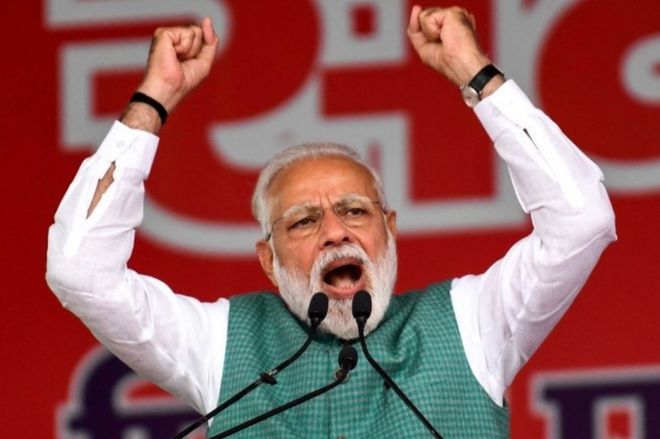
Image copyrightAFPImage captionMr Modi is accused of exploiting India-Pakistan hostilities for political gain
A gaffe is when a politician tells the truth, American political journalist Michael Kinsley said.
Last week, a prominent leader of India’s ruling Hindu nationalist Bharatiya Janata Party (BJP) appeared to have done exactly that. BS Yeddyurappa said the armed aerial hostilities between India and Pakistan would help his party win some two dozen seats in the upcoming general election.
The remark by Mr Yeddyurappa, former chief minister of Karnataka, was remarkable in its candour. Not surprisingly, it was immediately seized upon by opposition parties. They said it was a brazen admission of the fact that Prime Minister Narendra Modi’s party was mining the tensions between the nuclear-armed rivals ahead of general elections, which are barely a month away. Mr Modi’s party is looking at a second term in power.
Mr Yeddyurappa’s plain-spokenness appeared to have embarrassed even the BJP. Federal minister VK Singh issued a statement, saying the government’s decision to carry out air strikes in Pakistan last week was to “safeguard our nation and ensure safety of our citizens, not to win a few seats”. No political party can afford to concede that it was exploiting a near war for electoral gains.
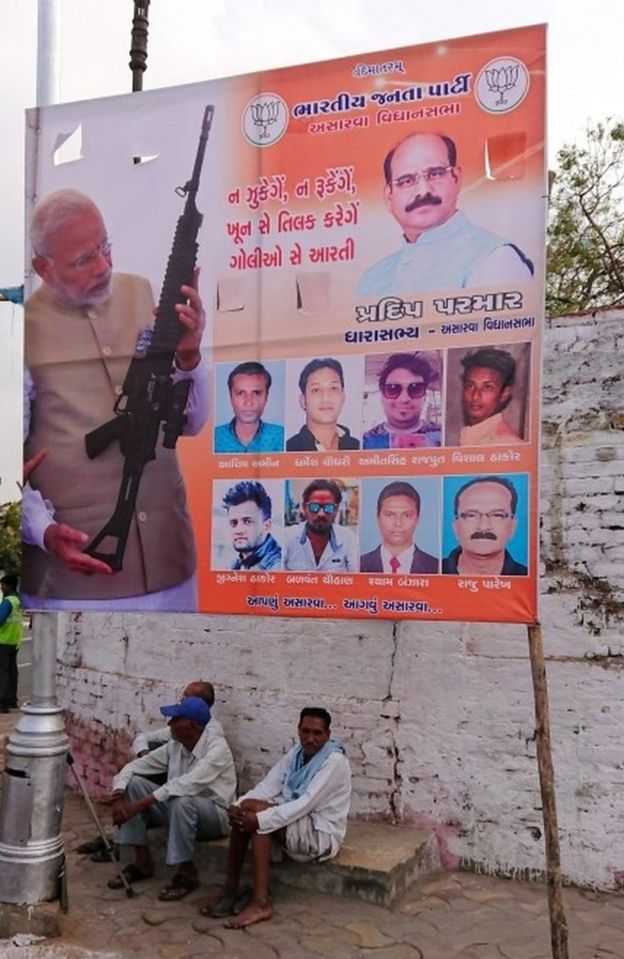
Image copyrightAFPImage captionThe BJP has put up election posters of Mr Modi posing with guns
Even as tensions between India and Pakistan ratcheted up last week, Mr Modi went on with business as usual. Hours after the Indian attack in Pakistan’s Balakot region, he told a packed election meeting that the country was in safe hands and would “no longer be helpless in the face of terror”. Next morning, Pakistan retaliated and captured an Indian pilot who ejected from a downed fighter jet. Two days later, Pakistan returned the pilot to India.
Mr Modi then told a gathering of scientists that India’s aerial strikes were merely a “pilot project” and hinted there was more to come. Elsewhere, his party chief Amit Shah said India had killed more than 250 militants in the Balakot attack even as senior defence officials said they didn’t know how many had died. Gaudy BJP posters showing Mr Modi holding guns and flanked by soldiers, fighter jets and orange explosions have been put up in parts of the country. “Really uncomfortable with pictures of soldiers on election posters and podiums. This should be banned. Surely the uniform is sullied by vote gathering in its name,” tweeted Barkha Dutt, an Indian television journalist and author.
Mr Modi has appealed to the opposition to refrain from politicising the hostilities. The opposition parties are peeved because they believe Mr Modi has not kept his word. Last week, they issued a statement saying “national security must transcend narrow political considerations”.
‘Petty political gain’
But can the recent conflict fetch more votes for Mr Modi? In other words, can national security become a campaign plank?
Many believe Mr Modi is likely to make national security the pivot of his campaign. Before last month’s suicide attack – claimed by Pakistan-based militants – killed more than 40 Indian paramilitaries in Kashmir, Mr Modi was looking a little vulnerable. His party had lost three state elections on the trot to the Congress party. Looming farm and jobs crises were threatening to hurt the BJP’s prospects.
Now, many believe, Mr Modi’s chances look brighter as he positions himself as a “muscular” protector of the country’s borders. “This is one of the worst attempts to use war to win [an] election, and to use national security as petty political gain. But I don’t know whether it will succeed or not,” says Yogendra Yadav, a politician and psephologist.
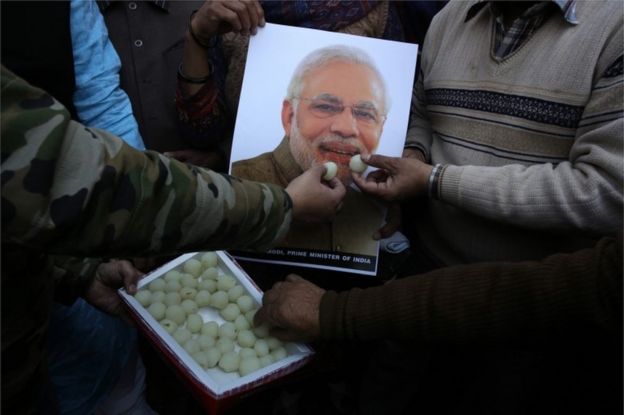
Image copyrightEPAImage captionMany Indians have celebrated India’s strike in Pakistani territory
Evidence is mixed on whether national security helps ruling parties win elections in India. Ashutosh Varshney, a professor of political science at Brown University in the US, says previous national security disruptions in India were “distant from the national elections”.
The wars in 1962 (against China) and 1971 (against Pakistan) broke out after general elections. Elections were still two years away when India and Pakistan fought a war in 1965. The 2001 attack on the Indian parliament that brought the two countries to the brink of war happened two years after a general election. The Mumbai attacks in 2008 took place five months before the elections in 2009 – and the then ruling Congress party won without making national security a campaign plank.
For one, he says, it comes just weeks ahead of a general election in a highly polarised country. The vast expansion of the urban middle class means that national security has a larger constituency. And most importantly, according to Dr Varshney, “the nature of the regime in Delhi” is an important variable. “Hindu nationalists have always been tougher on national security than the Congress. And with rare exceptions, national security does not dominate the horizons of regional parties, governed as they are by caste and regional identities.”
Bhanu Joshi, a political scientist also at Brown University, believes Mr Modi’s adoption of a muscular and robust foreign policy and his frequent international trips to meet foreign leaders may have touched a chord with a section of voters. “During my work in northern India, people would continuously invoke the improvement in India’s stature in the international arena. These perceptions get reinforced with an event like [the] Balakot strikes and form impressions which I think voters, particularly on a bipolar contest of India and Pakistan, care about,” says Mr Joshi.
Others like Milan Vaishnav, senior fellow and director of the South Asia Program at the Carnegie Endowment for International Peace, echo a similar sentiment. He told me that although foreign policy has never been a “mass” issue in India’s domestic politics, “given the proximity of the conflict to the elections, the salience of Pakistan, and the ability of the Modi government to claim credit for striking back hard, I expect it will become an important part of the campaign”.
But Dr Vaishnav believes it will not displace the economy and farm distress as an issue, especially in village communities. “Where it will help the BJP most is among swing voters, especially in urban constituencies. If there were fence-sitters unsure of how to vote in 2019, this emotive issue might compel them to stick with the incumbent.”
How the opposition counters Mr Modi’s agenda-setting on national security will be interesting to watch. Even if the hostilities end up giving a slight bump to BJP prospects in the crucial bellwether states in the north, it could help take the party over the winning line. But then even a week is a long time in politics.
Chinese Premier Li Keqiang delivers a government work report at the opening meeting of the second session of the 13th National People’s Congress at the Great Hall of the People in Beijing, capital of China, March 5, 2019. (Xinhua/Pang Xinglei)
BEIJING, March 5 (Xinhua) — China will strengthen intellectual property (IP) protection across the board, improve the system of punitive compensation for IP infringements, and promote invention and creation and their industrial application, says a government work report.
The report was delivered by Premier Li Keqiang at the second annual session of the 13th National People’s Congress that opened in Beijing Tuesday.
SHANGHAI, March 4 (Xinhua) — Authorities in Shanghai will begin recruiting volunteers for the second China International Import Expo (CIIE) next month.
Currently, around 1.28 million people have registered as volunteers via an online application, according to the Shanghai municipal committee of the Communist Youth League.
During the first expo, more than 34,000 volunteers took part in voluntary services in Shanghai, latest figures showed. Those born in the 1990s made up a majority of the volunteers. A total of 338 volunteers from Shanghai International Studies University provided interpretation, translation and concierge services during last year’s expo.
Last year, the first CIIE was held in Shanghai from Nov. 5 to 10 and concluded with deals worth about 57.83 billion U.S. dollars. The expo attracted 3,600 overseas companies.
BEIJING, March 5 (Xinhua) — A sculpture exhibition commemorating the 70th anniversary of the founding of the People’s Republic of China is being held at the National Art Museum of China (NAMOC).
The exhibition, featuring unity of the Chinese nation, showcases history, heroes, lives and culture of ethnicities in China, demonstrating new achievements of China’s modern sculptural arts.
Over 220 sculptures were selected out of 600.
Art featuring national characteristics can have lasting vitality and stand firm in the world of art, said Wu Weishan, the NAMOC director.
KUNMING, March 3 (Xinhua) — China’s social endowment insurance for rural and urban residents has covered over 523 million people by the end of 2018, according to the Ministry of Human Resources and Social Security (MOHRSS).
Over 49 million people in poverty have benefited from the insurance program directly, MOHRSS data showed.
The unemployment insurance premium has allocated 1.82 billion yuan (about 272 million U.S. dollars) of living subsidies to 402,000 migrant workers who had lost their jobs, the ministry said.
The social endowment insurance program covers groups including the self-employed, rural migrant workers and farmers, providing pensions for their retirement.
China faces the challenge of building a more sustainable pension system as its population ages.
By 2018, China had 249 million people aged 60 and above, accounting for 17.9 percent of its total population, becoming a country with the largest and fastest-growing aged population in the world.
NEW YORK, March 3 (Xinhua) — The new stock-trading venue in Shanghai Stock Exchange is a “very good attempt” to optimizing the multi-tiered capital market system and enhancing the capital market’s capability to serve the real economy in China, American experts said.
The science and technology innovation board, which pilots registration-based initial public offering (IPO) system, is “a very good attempt,” and “it may be adopted by A-share markets in the future,” said Henry Huang, professor with Sy Syms School of Business, Yeshiva University.
“If high-tech companies grow and expand in the sci-tech innovation board, maybe they will get listed in the A-share markets later to attract more qualified investors, which makes the sci-tech innovation board an incubator of quality enterprises,” Huang said.
Kevin Chen, chief economist with U.S. wealth management firm Horizon Financial, agreed.
The new board will “largely improve” financing environment for high-tech companies, thereby accelerating the progress of sci-tech innovation in China as a whole, he said.
The adoption of registration-based IPO system will “make shell companies meaningless, while real values of listed companies will be shown in their share prices through more appropriate supervision mechanism,” Chen said.
In addition, the new major reform will facilitate Shanghai’s transformation into an international financial center as well as a science and technology innovation hub, said Allen Tjiong, president and CEO of BOC International (USA) Inc.
“These reforms are essential in making Shanghai a more competitive and attractive capital market for technology companies to raise capital,” said Tjiong.
China’s top securities regulator on Friday released regulations on the science and technology innovation board, which pilots registration-based IPO system. The regulations took effect on March 1 on a trial basis, according to the China Securities Regulatory Commission (CSRC).
The new stock-trading venue focuses on companies in high-tech and strategically emerging sectors such as new generation information technology, advanced equipment, new materials and energy, environmental protection, and biomedicine, according to the CSRC.
Under the pilot registration system, eligible companies can become listed by filing required documents. Currently, new shares of the A-share markets are subject to approval from the securities watchdog.
BEIJING, March 3 (Xinhua) — China will roll off a new generation of self-developed driverless maglev trains with a designed speed of 200 km per hour in early 2020, according to its lead developer.
Once put into operation, they will be the fastest maglev trains for commercial use in China. CRRC Zhuzhou Locomotive Co.,Ltd. leads the efforts to develop the trains.
Zhou Qinghe, chairman of the company, told reporters Sunday prior to the annual session of the national legislature that new technologies are being used to enable the trains to travel faster and have greater hill climbing power. The latest maglev trains are also equipped with a “powerful brain” to realize safe and reliable autonomous operation.
Zhou, who is also a deputy to the National People’s Congress, said the new trains are suitable for inter-city or urban transit between 50 and 200 km in distance. They will also be the world’s first maglev trains to run at 200 km per hour, he added.





 CHINDIA ALERT: You'll be living in their world, very soon