Chindia Alert: You’ll be Living in their World Very Soon
aims to alert you to the threats and opportunities that China and India present. China and India require serious attention; case of ‘hidden dragon and crouching tiger’.
Without this attention, governments, businesses and, indeed, individuals may find themselves at a great disadvantage sooner rather than later.
The POSTs (front webpages) are mainly 'cuttings' from reliable sources, updated continuously.
The PAGEs (see Tabs, above) attempt to make the information more meaningful by putting some structure to the information we have researched and assembled since 2006.
Chinese Permanent Representative to the United Nations Ma Zhaoxu (C, Front) addresses a Security Council meeting on the situation in Yemen, at the UN headquarters in New York, on Feb. 19, 2019. The first redeployment of forces in Hodeidah of Yemen could possibly begin later Tuesday, UN Special Envoy to Yemen Martin Griffiths told the Security Council via video link from Amman on Tuesday. (Xinhua/Li Muzi)
UNITED NATIONS, Feb. 19 (Xinhua) — A Chinese envoy on Tuesday urged the international community to push the Yemeni parties to sustain effective political dialogue.
“We should push the Yemeni parties to sustain effective political dialogue and negotiation,” Ma Zhaoxu, China’s permanent representative to the United Nations, said at a Security Council meeting on the situation in Yemen.
“We need to insist on the role of the United Nations as the main channel,” he said.
“Under the leadership of the Redeployment Coordination Committee, political will is to be turned into real action,” the Chinese ambassador said.
“We hope to see an early launch of the next round of peace talks under the leadership of special envoy (Martin) Griffiths, so as to reach a settlement that balances and takes into account of the interests of all parties and help resume peace, stability, and normal order in Yemen,” he said.
Noting that the international community “is paying close attention to” the issue of Yemen and is having a lot of expectations for the resumption of peace and stability in Yemen, Ma said that the Stockholm Agreement “has brought about hope of peace for the Yemeni people.”
“The Security Council should have a timely understanding of the implementation of the agreement by all parties and the challenges they are facing, and continue to play a positive role on the issue of Yemen,” the Chinese envoy added.
Ma told the Security Council that all Yemeni parties “are abiding by the ceasefire agreement in general,” adding that the Redeployment Coordination Committee under the auspices of the United Nations and with the participation of all Yemeni parties, is conducting its work “in an orderly fashion and has arrived at a consensus” on the first phase arrangement on Sunday.
Speaking of the challenges, the Chinese envoy said that the practical difficulties in implementing the agreement cannot be underestimated.
“Fighting is going on in Hodeidah and its surrounding areas. The two parties still have differences on the list of prisoners and the issue of task,” he said.
“The humanitarian situation in Yemen is dire,” Ma noted.
The envoy urged parties concerned to continue with the implementation of the Stockholm Agreement.
“The Yemeni parties should effectively implement the agreement, address their differences through dialogue, and increase their consensus,” he said.
“Efforts should be made to accelerate the deployment of the UN mission in Yemen to assist and monitor the implementation of the agreement,” said the ambassador.
Noting that the Security Council should take full account of, and respect the opinions of the country in question and the countries in the region, Ma said that the council should “continue to stay united.”
He also called for vigorous effort to ease the humanitarian situation in Yemen, stressing that the international community should provide food, medicine and funds “in a targeted fashion” to support the economic improvement and price stabilization in Yemen to satisfy the basic needs of livelihood for the Yemeni people.
UN Special Envoy to Yemen Griffiths told the Security Council via video link from Amman that Yemen’s government and Houthi rebels had agreed to pull back from the rebel-held ports of Saleef and Ras Issa followed by a redeployment from Hodeidah port, also held by the Houthis, and critical parts of the city.
Li Zhanshu (R), chairman of the National People’s Congress (NPC) Standing Committee, holds talks with Iranian Parliament Speaker Ali Larijani at the Great Hall of the People in Beijing, capital of China, Feb. 19, 2019. (Xinhua/Pang Xinglei)
BEIJING, Feb. 19 (Xinhua) — China’s top legislator Li Zhanshu on Tuesday held talks with visiting Iranian Parliament Speaker Ali Larijani, calling for stronger cooperation to boost ties.
Li, chairman of the National People’s Congress (NPC) Standing Committee, urged the two sides to take a strategic and long-term view in bilateral ties, constantly deepen political mutual trust, strengthen communication and coordination, and provide mutual support on issues concerning each others’ core interests.
He also called for more anti-terrorism security cooperation and more mutually beneficial cooperation within the framework of the Belt and Road Initiative.
Despite profound changes in the international situation and increasing instabilities and uncertainties, China’s position in safeguarding the Iranian nuclear deal has not changed, neither has its commitment to developing China-Iran relations, Li said.
During Chinese President Xi Jinping’s state visit to Iran in 2016, the two countries established a comprehensive strategic partnership, ushering in a new chapter in bilateral ties, said Li.
Hailing the smooth progress in all-round cooperation in recent years, Li said that exchanges between the countries’ legislative institutions are an important component in the comprehensive strategic partnership.
“The NPC is willing to carry out friendly exchanges with Iranian parliament at different levels and in different forms, strengthen communication on experiences in legislation, supervision, and state governance, so as to provide sound legal guarantee for the two countries’ mutually beneficial cooperation,” he said.
Larijani said the ancient trade routes of the Silk Road witnessed the long history of exchanges between the two countries, and the Belt and Road Initiative proposed by President Xi Jinping gives new meanings to the Silk Road.
He said the Iranian side highly values and actively participates in the Belt and Road Initiative. The Iranian Parliament would like to carry out more exchanges with the NPC and support mutually beneficial cooperation in various fields.
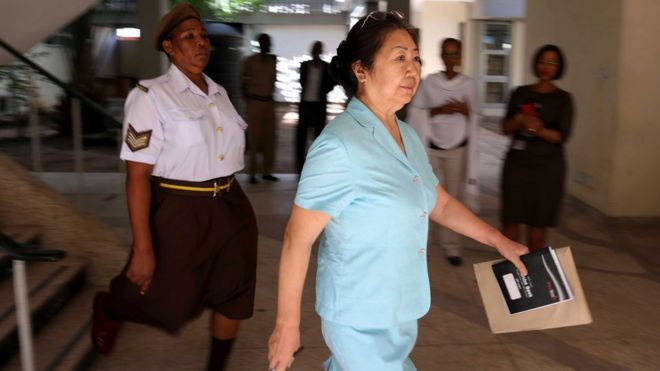
Image copyrightAFPImage captionYang Fenglan was a leading figure in business circles at the time of her arrest
Tanzania has sentenced Yang Fenglan, a Chinese businesswoman nicknamed the “Ivory Queen”, to 15 years in jail for smuggling hundreds of elephant tusks.
Yang was accused of operating one of Africa’s biggest ivory-smuggling rings, responsible for smuggling $2.5m (£1.9m) worth of tusks from some 400 elephants.
Two Tanzanian men were also found guilty of involvement in the ring.
Ivory poaching is said to have caused a 20% decline in the population of African elephants in the last decade.
The International Union for Conservation of Nature (IUCN), a global environmental body, says the population of African elephants has fallen to 415,000 – a drop of 110,000 over the last 10 years – as a result of poaching.
The illicit trade is fuelled by demand from China and east Asia, where ivory is used to make jewellery and ornaments.
Yang was convicted on charges relating to the smuggling of around 800 pieces of ivory between 2000 and 2014 from Tanzania to the Far East.
The Tanzanian men were also jailed for 15 years on similar charges.
The court in Dar es Salaam, Tanzania’s main city, has ordered Yang’s property to be repossessed.
She had been under investigation for more than a year when she was arrested in 2015, following a high-speed car chase.
At the time of her arrest, Yang was a prominent businesswoman, operating a Chinese restaurant as well as an investment company in Dar es Salaam.
Fluent in Swahili, she had lived and worked in Tanzania since the 1970s, and had served as vice-president of the China-Africa Business Council of Tanzania.
Environmental campaigners welcomed the arrest because she was seen as playing a pivotal role in the illegal ivory trade. Most arrests tend to involve minor players.
Policy statement outlines broad goals including plan to revive domestic soybean production
A farmer picks tea leaves in Mianxian county, Shaanxi province. Beijing’s policy document reiterated a strategy to improve income levels and living standards in China’s countryside. Photo: Xinhua
China will deepen reforms of its agriculture sector to promote its rural economy, the government said in its first policy statement of 2019, as it seeks to bolster growth and offset trade challenges.
Beijing’s statement, released late on Tuesday, comes after the world’s second-largest economy saw its weakest growth in 28 years in 2018 and remains entangled in a trade war with Washington.
“Under the complicated situation of increasing downward pressure on the economy and profound changes in the external environment, it is of special importance to do a good job in agriculture and rural areas,” the government said in the document issued by the State Council and published by official news agency Xinhua.
The biggest winners in Shenzhen, ‘China’s Silicon Valley’? Pig and chicken farmers
Known as the “No 1 document”, this year’s policy reiterated a rural rejuvenation strategy first laid out in 2017 to improve income levels and living standards in China’s countryside.
It also highlighted a plan to boost domestic soybean production but did not offer further details.
Chinese President Xi Jinping visits a farm in northeastern Heilongjiang province during an inspection tour in September. Photo: Xinhua via AP
Industry analysts said on Wednesday they were eagerly awaiting further details to assess the impact of the plan, which had already been flagged by Agriculture Minister Han Changfu earlier this month.
China has been overhauling its crop structure in recent years, reducing support for corn after stocks ballooned, and seeking to promote more planting of oilseeds that it mostly imports.
That goal has become increasingly important since a trade war with the United States, which led China to slap tariffs on soybean imports, tightening domestic supplies.
Han has previously urged authorities in China’s northeast to support soybean production through subsidies and called for rotating of soybeans with other crops including corn and wheat.
Beijing also aims to support the production of rapeseed in the Yangtze River Basin, according to the document.
The garlic case that foreshadowed the US-China trade war
As in previous years, it also called for stable grain production, but also an increase in imports of agriculture products where there are shortages in the domestic market.
“The focus now is on retaining production capacity, in the form of high quality farmland, and using the international market to make up production shortfalls,” said Even Rogers Pay, an agriculture analyst at China Policy, a Beijing-based consultancy.
The reference to imports is positive for trade partners like the United States, said Cherry Zhang, analyst with Shanghai JC Intelligence, who said it raised the likelihood that China will buy more US agriculture products.
China’s DJI turns its eye to enterprise uses like agriculture after conquering global commercial drone market
Shares of Chinese livestock companies, along with pig and poultry breeders, rose on Wednesday following the release of the policy paper.
The document also outlines plans to accelerate development of a new farm subsidy policy system and further crack down on the smuggling of agriculture products.
Additionally, the government said it plans to strengthen the monitoring and control of African swine fever outbreaks, after more than 100 cases were reported in China since August.
Other plans include continuing to tackle rural pollution and promoting recycling of agricultural waste such as manure and agricultural film.
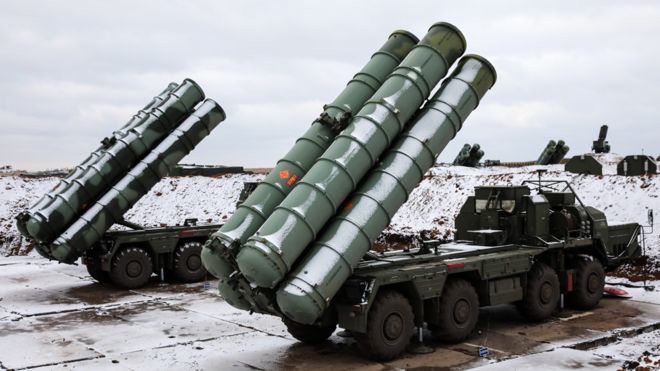
China is getting two regimental units, which amounts to at least 128 missiles.
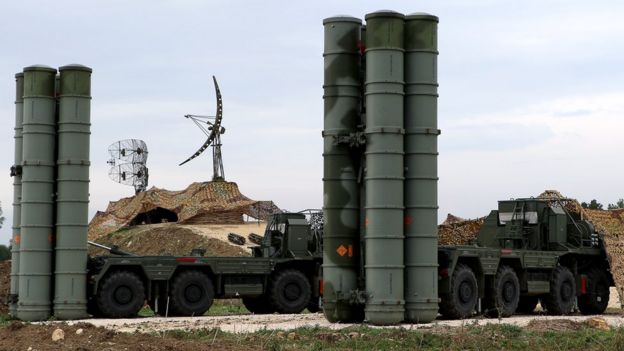
Image copyrightAFPImage captionThe S-400 missile system is deployed at Russia’s Hmeimim airbase in Syria
The S-400 “Triumf” is one of the most sophisticated surface-to-air missile systems in the world. It has a range of 400km (248 miles) and one S-400 integrated system can shoot down up to 80 targets simultaneously.
Russia says it can hit aerial targets ranging from low-flying drones to aircraft flying at various altitudes and long-range missiles.
The US sanctions are aimed at putting pressure on the Russian government over its annexation of Crimea and intervention in eastern Ukraine in 2014.
In October, India signed a $5bn (£3.9bn) deal to buy five S-400 regimental units. That amounts to at least 320 missiles. Each S-400 launch vehicle – a heavy lorry – carries four missiles.
Russia has deployed S-400s to protect its military airbase at Hmeimim in Syria.
Turkey, a Nato member, is buying S-400s despite US warnings. The US wants to sell Patriot missiles, made by Raytheon Co, to Turkey instead. The US argues that S-400s are incompatible with Nato systems.
“We made the S-400 deal with Russia, so it’s out of the question for us to turn back. That’s done,” Turkish President Recep Tayyip Erdogan said.
Neither Turkey nor India are yet under US sanctions over the purchases.
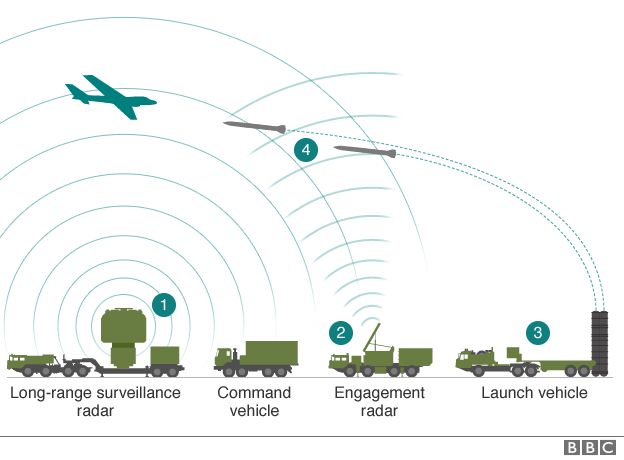
How the S-400 system works
Long-range surveillance radar tracks objects and relays information to command vehicle, which assesses potential targets
Target is identified and command vehicle orders missile launch
Launch data are sent to the best placed launch vehicle and it releases surface-to-air missiles
Engagement radar helps guide missiles towards target.
MoUs on tourism, cooperation in the field of housing, International Solar Alliance among others were exchanged between the two countries.
SNS Web | New Delhi | February 20, 2019 2:52 pm
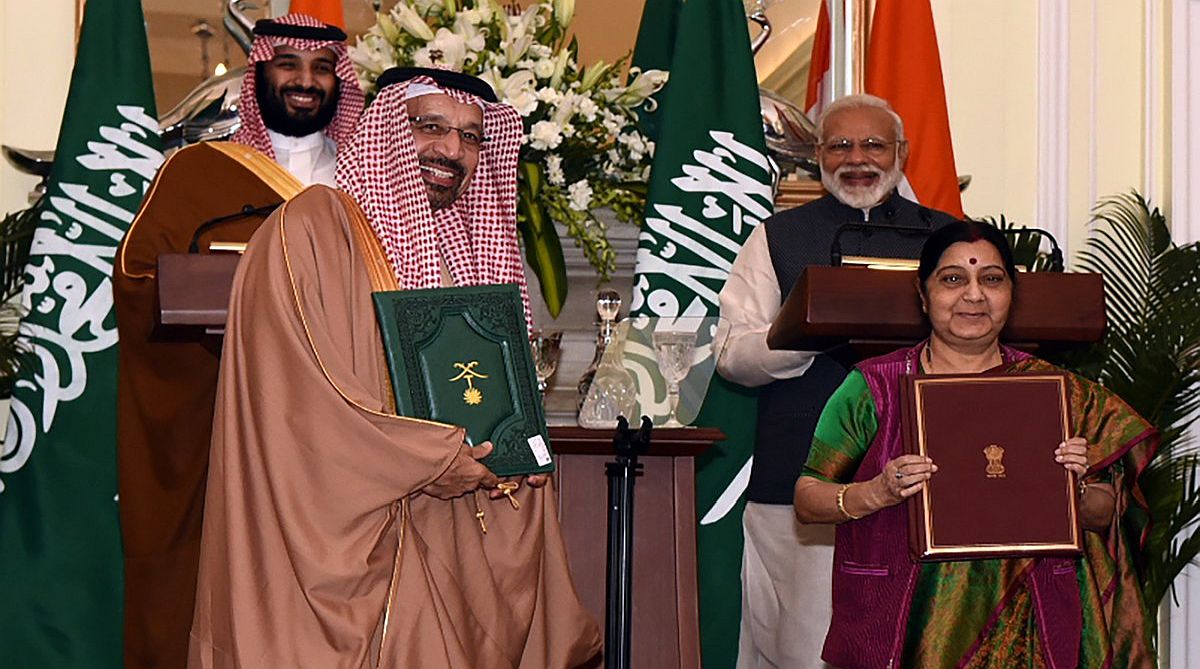
Prime Minister Narendra Modi and Saudi Arabia Crown Prince Mohammed bin Salman witnessing the Exchange of Agreements between India and Saudi Arabia at Hyderabad House, New Delhi. (Photo: Twitter | PIB India)
MoUs on tourism, cooperation in the field of housing, International Solar Alliance among others were exchanged between the two countries.
On his first state visit to the country, Prime Minister Narendra Modi welcomed the Saudi Crown Prince saying that Saudi Arabia was India’s “close friend”.
India and Saudi Arabia have a longstanding relationship, PM Modi said adding that in the 21st century, Saudi Arabia was among India’s most important strategic partners.
The Prime Minister, in a joint press conference with Crown Prince Mohammed bin Salman, also welcomed Saudi investment in Indian infrastructure.
In a major development, Saudi Arabia also joined the International Solar Alliance, informed PM Modi adding that the two leaders also discussed how to further strengthen the defence cooperation between the two nations.
“We have agreed to strengthen their cooperation in the areas of renewable energy. We welcome Saudi Arabia to the International Solar Alliance. The peaceful use of nuclear energy, especially water desalination and health, will be another dimension of our cooperation,” PM Modi said.
Speaking on the Pulwama terror attack that killed at least 44 CRPF personnel, the Prime Minister said the two leaders agreed on the need to destroy the infrastructure of terror and clamp down on countries supporting terror.
“We have also vowed to increase pressure on any country that promotes terror activities,” the Prime Minister said.
This comes after Salman’s high-profile tour of Pakistan on January 17 where he said dialogue was the only way to resolve “outstanding issues” between India and Pakistan.
Addressing the joint press conference, Saudi Arabia Crown Prince Mohammed bin Salman said his country shares India’s concerns over terror.
“Terrorism is a common concern. We will cooperate with India in every way, like intelligence sharing. India has played a positive role,” he said.
He also thanked the people of India and the Government for the warm welcome.
“The relationship between India and Saudi Arabia is over thousands of years old. It is even older than history, and this relationship has grown stronger in the last 50 years. Our objectives are similar be it in energy, agriculture or technology,” he added.
Salman also called for common planning between the two nations to tackle various issues and said that “Saudi Arabia has invested $44 billion in India”.
Earlier in the day, PM Modi and Salman held delegation-level talks on key areas of mutual interest such as trade and investment, energy, defence and security, nuclear and space, civil aviation, renewables, counter-terrorism, community welfare and regional challenges.
External Affairs Minister Sushma Swaraj also met Salman and discussed ways to add further momentum to the strategic ties between the two nations besides deepening engagement in areas of trade and investment.
Earlier on Wednesday, the Saudi Crown Prince was accorded a ceremonial reception at the Rashtrapati Bhawan by President Ram Nath Kovind.
After meeting President Ram Nath Kovind, the Saudi Arabia Crown Prince said, “Today we want to be sure that this relation is maintained and improved for the sake of both countries. With the leadership of the President and the Prime Minister, I am sure we can create good things for Saudi Arabia and India”.
Earlier on Tuesday, in a special gesture, Prime Minister Narendra Modi broke the protocol to personally receive the Saudi prince and welcomed him with a warm hug at the Palam airport.
External Affairs Ministry spokesperson Raveesh Kumar had said that the first state visit of the Saudi Crown Prince marks a “new chapter in bilateral relations between the two countries”.
Salman’s visit comes in the backdrop of the escalating tension between India and Pakistan following the Pulwama terror attack carried out by Pakistan-based Jaish-e-Mohammad (JeM) terror group in which at least 44 CRPF personnel were killed.
Saudi Arabia had on Friday said it stood with India’s fight against terrorism and extremism and denounced as “cowardly” the attack.
India’s bilateral trade with Saudi Arabia was USD 27.48 billion in 2017-18, making Saudi Arabia its fourth largest trading partner.
Saudi Arabia is also a key pillar of India’s energy security, being a source of 17 per cent or more of crude oil and 32 per cent of LPG requirements of India.
The Crown Prince is expected to travel to China from India.
BEIJING, Feb. 18 (Xinhua) — The development plan of the Greater Bay Area in southern China has presented new opportunities for the deepening of cooperation within the region, said a commentary to be published Tuesday on People’s Daily.
The Outline Development Plan for the Guangdong-Hong Kong-Macao Greater Bay Area was released on Monday, which includes the strategic positioning, development objectives, the spatial layout and other aspects of the project.
Following the programmatic plan, the building of a dynamic and internationally competitive bay area and a world-class city cluster will be realized through hard work, said the commentary.
The plan was designed to facilitate overall and long-term development.
The development of the Greater Bay Area will facilitate the implementation of the new concept of development, the further deepening of reform and opening up, the building of a new system of open economy in line with international standards, and the development of a new platform for high-level international cooperation, said the article.
Developing the Greater Bay Area is also a major decision to maintain the long-term prosperity and stability of the Hong Kong and Macao special administrative regions (SARs).
The project will facilitate the enrichment of the implementation of the “one country, two systems,” create more opportunities for the socio-economic development of the two SARs and for Hong Kong and Macao compatriots wishing to develop careers on the mainland, said the commentary.
It called for innovation in building the Greater Bay Area, as it will be carried out under “one country, two systems,” involving three customs territories using three different currencies, without any precedent to follow.
We must “free our minds, make active explorations and bold trials, and strive to play a pioneering role,” said the article.
BEIJING, Feb. 18 (Xinhua) — China has urged pork food firms to enhance their management of pork to guard against African swine fever after media reports of suspected contaminated dumplings.
Samples from three batches of pork-filled dumplings from Sanquan Foods tested positive for the nucleic acid associated with African swine fever, according to media reports.
The State Administration for Market Regulation and the Ministry of Agriculture and Rural Affairs urged the company to trace the source of the pork and dispose of related products.
The two ministries required local governments to beef up risk control measures, regulate information disclosure and crack down upon unscrupulous firms.
The African pig plague is a highly contagious viral disease that is believed to only infect pigs. No humans or other species have thus far been infected.
BEIJING, Feb. 18 (Xinhua) — Emergency air rescue has played a key role in relieving southern China from frequent forest fires during the Spring Festival, according to the emergency management authorities Monday.
During the week-long Spring Festival holidays from Feb. 4 to 10, helicopters were dispatched 91 times to fight forest fires in southern China, according to the Ministry of Emergency Management.
In a total of 170 flight hours, they carried a 735 tonnes of water with hanging buckets to fight eight forest fires with a total range of 25,000 kilometers.
The Spring Festival has been a key time for forest fire control in southern China due to the warmer weather and more frequent outdoor fire use during the holiday, especially during tomb sweeping and when setting off fireworks.
Emergency air rescue is playing a more important role in fighting forest fires in China, especially in southern regions with high-altitude mountains or rough terrain.
Aerial extinguishing teams take firefighters, equipment and water closer to the sites with fire fighting helicopters, allowing them to control the fire more quickly.
China is making efforts to strengthen emergency air emergency rescue capabilities by introducing new equipment, cultivating professionals and improving infrastructure, according to Ministry of Emergency Management.
CHONGLI, Hebei Province, Feb. 18 (Xinhua) — Chinese vice premier Sun Chunlan spoke of the need for solid training, a sense of honor and above all for confidence from China’s winter sport athletes during her inspection in the Beijing 2022 snow events zone here on Monday.
The athletes are currently undergoing training here in the mountains of Chongli, north of Beijing. Sun observed the construction of venues, listened to a report of the current state of Beijing 2022 competition preparations, inspected the training of national skiing teams and talked with athletes in this district of Zhangjiakou in Hebei province, situated 200 kilometers northwest of Beijing, which will stage most of the skiing events of the 2022 Winter Olympic Games.
“To organize the Beijing 2022 Olympic Games successfully is one of the priorities for China. I hope everyone can promote a positive sporting spirit and the Olympic spirit, aim for our target and work hard,” said Sun.
“Everyone needs to try hard to improve our competition skills, make efforts for better results, display the outstanding morals, win glory for the motherland and add lustre to life.”
Sun called for tightly-knit, painstaking work in the competition preparations.
“You need to find the weak links and mend them, stick to scientific training, and strengthen research on rules for various events,” said Sun, stressing the importance of accumulating and analyzing past experience in competitions, training management, on-site commanding, Games organization, sporting science and new technologies.
Sun also called to continue the fight against doping.
“Zero tolerance for doping in the national teams is a basic requirement. Our goal is to safeguard the cleanness of Beijing 2022 and ensure that ice and snow sports can be as pure as ice and snow,” said Sun.
Sun also called on relevant departments to take full advantage of the opportunities provided by Beijing 2022 to promote ice and snow sports among the public, to improve sport fitness facilities, to push forward the coordinated development of mass sports, competitive sports and the wider sports industry.





 CHINDIA ALERT: You'll be living in their world, very soon