Chindia Alert: You’ll be Living in their World Very Soon
aims to alert you to the threats and opportunities that China and India present. China and India require serious attention; case of ‘hidden dragon and crouching tiger’.
Without this attention, governments, businesses and, indeed, individuals may find themselves at a great disadvantage sooner rather than later.
The POSTs (front webpages) are mainly 'cuttings' from reliable sources, updated continuously.
The PAGEs (see Tabs, above) attempt to make the information more meaningful by putting some structure to the information we have researched and assembled since 2006.
Li Zhanshu (R), chairman of the National People’s Congress (NPC) Standing Committee, shakes hands with Ninoyu Satoshi, a member of Japan’s House of Councillors who heads a delegation consisting of several members of Japan’s House of Councillors, at the Great Hall of the People in Beijing, capital of China, Feb. 18, 2019. The delegation was in Beijng to attend the eighth meeting of the mechanism for regular exchanges between China’s top legislature and the upper house of the National Diet of Japan. (Xinhua/Li Tao)
BEIJING, Feb. 18 (Xinhua) — China’s top legislator Li Zhanshu on Monday met with a delegation consisting of several members of Japan’s House of Councillors, pledging to enhance the exchanges and cooperation with the National Diet of Japan, so as to promote Sino-Japanese relationship.
Li, chairman of the National People’s Congress Standing Committee, said there are important opportunities facing the two countries this year for further improvement and development of bilateral ties, as China-Japan relations were led back to the right track of development after Chinese President Xi Jinping and Japanese Prime Minister Shinzo Abe met three times last year and reached important consensus.
“The two sides should implement the consensus of the leaders of the two countries, enhance mutual trust over strategic security, expand pragmatic cooperation in such areas as the economy, culture and exchanges between the young people,” said Li.
Ninoyu Satoshi, head of the delegation and a member of Japan’s House of Councillors, said the National Diet of Japan would like to reinforce contacts and mutual understanding with the National People’s Congress of China and make more contributions to the two countries’ neighborly friendliness.
The delegation was in Beijing to attend the eighth meeting of the mechanism for regular exchanges between China’s top legislature and the upper house of the National Diet of Japan.
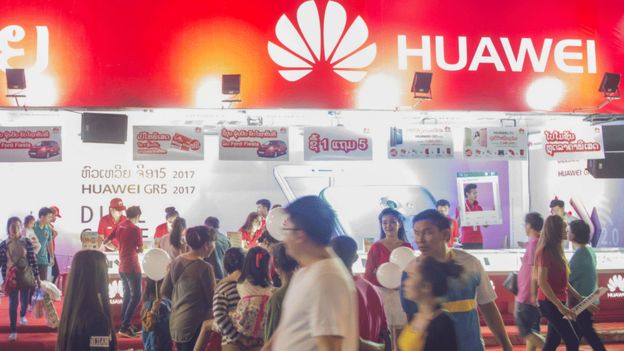
The founder of Huawei has said there is “no way the US can crush” the company, in an exclusive interview with the BBC.
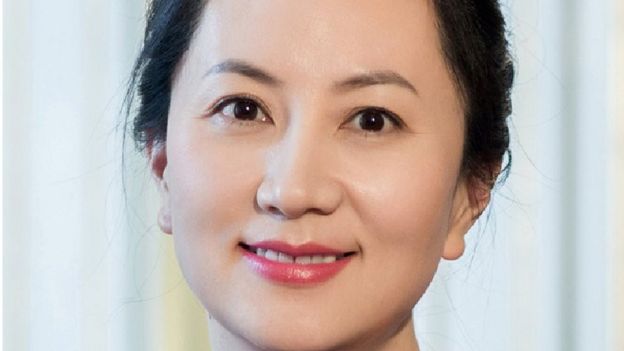
Ren Zhengfei described the arrest of his daughter Meng Wanzhou, the company’s chief financial officer, as politically motivated.
The US is pursuing criminal charges against Huawei and Ms Meng, including money laundering, bank fraud and stealing trade secrets.
Huawei denies any wrongdoing.
Mr Ren spoke to the BBC’s Karishma Vaswani in his first international broadcast interview since Ms Meng was arrested – and dismissed the pressure from the US.
“There’s no way the US can crush us,” he said. “The world cannot leave us because we are more advanced. Even if they persuade more countries not to use us temporarily, we can always scale things down a bit.”
However, he acknowledged that the potential loss of custom could have a significant impact.
Last week, US Secretary of State Mike Pompeo warned the country’s allies against using Huawei technology, saying it would make it more difficult for Washington to “partner alongside them”.
Australia, New Zealand, and the US have already banned or blocked Huawei from supplying equipment for their future 5G mobile broadband networks, while Canada is reviewing whether the company’s products present a serious security threat.
Mr Ren warned that “the world cannot leave us because we are more advanced”.
“If the lights go out in the West, the East will still shine. And if the North goes dark, there is still the South. America doesn’t represent the world. America only represents a portion of the world.”
Many of the UK’s mobile companies, including Vodafone, EE and Three, are working with Huawei to develop their 5G networks.
They are awaiting a government review, due in March or April, that will decide whether they can use Huawei technology.
Commenting on the possibility of a UK ban, Mr Ren said Huawei “won’t withdraw our investment because of this. We will continue to invest in the UK.
“We still trust in the UK, and we hope that the UK will trust us even more.
“We will invest even more in the UK. Because if the US doesn’t trust us, then we will shift our investment from the US to the UK on an even bigger scale.”
Image copyrightGETTY IMAGESImage captionHuawei has denied that it poses any risk to the UK or any other country
What does Mr Ren think about his daughter’s arrest?
Mr Ren’s daughter Meng Wanzhou, Huawei’s chief financial officer, was arrested on 1 December in Vancouver at the request of the US, and is expected to be the subject of a formal extradition request.
The first covers claims Huawei hid business links to Iran – which is subject to US trade sanctions. The second includes the charge of attempted theft of trade secrets.
Mr Ren was clear in his opposition to the US accusations.
“Firstly, I object to what the US has done. This kind of politically motivated act is not acceptable.
“The US likes to sanction others, whenever there’s an issue, they’ll use such combative methods.
“We object to this. But now that we’ve gone down this path, we’ll let the courts settle it.”
Image copyrightREUTERSImage captionMeng Wanzhou was arrested in Vancouver last December
What did Mr Ren say about Chinese government spying?
Huawei, which is China’s largest private company, has been under scrutiny for its links to the Chinese government – with the US and others expressing concern its technology could be used by China’s security services to spy.
Under Chinese law, firms are compelled to “support, co-operate with and collaborate in national intelligence work”.
But Mr Ren said that allowing spying was a risk he wouldn’t take.
“The Chinese government has already clearly said that it won’t install any backdoors. And we won’t install backdoors either.
“We’re not going to risk the disgust of our country and of our customers all over the world, because of something like this.
“Our company will never undertake any spying activities. If we have any such actions, then I’ll shut the company down.”
Is Huawei part of the Chinese state?
Analysis – Karishma Vaswani, BBC Asia business correspondent – Shenzhen
For a man known as reclusive and secretive, Ren Zhengfei seemed confident in the conviction that the business he’s built for the last 30 years can withstand the scrutiny from Western governments.
Mr Ren is right: the US makes up only a fraction of his overall business.
But where I saw his mood change was when I asked him about his links to the Chinese military and the government.
He refused to be drawn into a conversation, saying only that these were not facts, simply allegations.
Still, some signs of close links between Mr Ren and the government were revealed during the course of our interview.
He also confirmed that there is a Communist Party committee in Huawei, but he said this is what all companies – foreign or domestic – operating in China must have in order to abide by the law.
HONG KONG/LONDON (Reuters) – HSBC Holdings turned in a disappointing annual profit as higher costs and a stocks rout chipped away at its trading businesses, while warning that an economic slowdown in China and Britain would throw up further hurdles this year.
Chief Executive John Flint, rounding off his first year at the helm of the company, said the bank may have to scale back investment plans in order to avoid missing a key target known as ‘positive jaws’ – which tracks whether it is growing revenues faster than costs – for a second straight year.
HSBC remains alert to the downside risks of the current economic environment, economic environment and the future path of interest rates, Flint said, adding the bank was “committed” to the growth targets announced in June.
“We will be proactive in managing costs and investment to meet the risks to revenue growth where necessary, but we will not take short-term decisions that harm the long-term interests of the business,” Flint said on Tuesday, after HSBC reported a lower-than-expected 16 percent rise in 2018 profit before tax.
In June, Flint had said HSBC would invest $15-$17 billion in three years in areas including technology and China, while keeping profitability and dividend targets little changed.
ADVERTISEMENT
“The key thing is just to moderate the pace of investments … not to cancel it or change the shape of the investments,” Flint told Reuters.
The bank said it failed to achieve positive jaws in 2018 due to the negative market environment in the fourth quarter.
A combination of U.S.-China trade tensions, central banks turning off the money taps and cooling growth in former hot spots wiped 10 percent off MSCI’s 47-country world stocks index last year, its first double-digit loss in any year since the 2008 global financial crisis.
GROWING BUT SLOWLY
Flint’s comments come as an economic slowdown in China, exacerbated by a bitter Sino-U.S. trade war, challenges HSBC’s strategy of pouring more resources into Asia where it already makes more than three quarters of its profits.
China’s economic growth slowed to 6.6 percent in 2018, the weakest in 28 years, weighed down by rising borrowing costs and a clampdown on riskier lending that starved smaller, private companies of capital and stifled investment.
Pressure on the world’s second-largest economy could increase if Beijing and Washington do not reach a deal soon to end their year-long trade dispute, which is taking a growing toll on export-reliant economies from Asia to Europe.
HSBC’s profits in Asia grew by 16 percent to $17.8 billion last year, accounting for 89 percent of the group profit.
“Clearly our customers are really more cautious and are more thoughtful around this trade war with the U.S.,” Flint said.
“It’s possible that we’ll see slightly lower growth rate this year but we are still going to see a growth rate.”
Since taking over from Stuart Gulliver last February, Flint has largely stuck to the same China-focused strategy as his predecessor while attempting to revive HSBC’s ailing U.S. franchise and putting less emphasis on its investment bank.
Europe’s biggest bank by market value is also being buffeted by headwinds from Britain, which grew at its slowest in half a year in the three months to November as factories suffered from tough global trade conditions and the approach of Brexit.
HSBC joined its London-based peer Royal Bank of Scotland in warning that uncertainties related to Brexit could drive businesses under.
“The longer we have the uncertainty the worse it’s going to be for the customers. Customers are absolutely postponing investment decisions … and that’s been the part of this slowdown that we have seen in the U.K.,” Flint said.
DISAPPOINTING PROFIT
Earlier in the day, HSBC reported a profit before tax of $19.9 billion for 2018, versus $17.2 billion the year before, but below an average estimate of $22 billion, according to Refinitiv data based on forecasts from 17 analysts.
HSBC’s Hong Kong shares dropped as much as 2.7 percent after the earnings announcement.
The stock was down 1.4 percent at 0732 GMT, while the Hong Kong market index was 0.3 percent lower.
HSBC said it would pay a full-year dividend of $0.51 per share, roughly in line with analysts’ expectations. The bank was confident of maintaining the dividend at this level, it said.
The bank’s core capital ratio, a key measure of financial strength, fell to 14 percent at end-December from 14.5 percent at end-2017, mainly due to adverse foreign exchange movements.
Pakistan Prime Minister Imran Khan on Tuesday said if there is any evidence of involvement of any Pakistani national in Pulwama terror attack, his government will act against the culprits. (AP)
Pakistan Prime Minister Imran Khan has denied his country’s role behind the Pulwama terror attack, the worst in Jammu and Kashmir in decades. He claimed that India does not have any evidence to prove Pakistan’s role in terror attacks in Kashmir.
“You (India) have blamed the Pakistan government without any evidence…If you have any evidence, we will act,” Imran Khan said.
He said, “It is in our interest that nobody from our soil spreads violence. I want to tell Indian government that we will take action if evidence is found against anyone from Pakistan.”
“What has Pakistan to gain from this? Why will Pakistan do this at a stage when it is moving towards stability,” said Imran Khan adding that “this is a Naya Pakistan with a new mindset.”
Calling for a dialogue with India, he said, “If you thinks you will attack us and we will not think of retaliating…We will retaliate. We all know starting a war is in the hands of humans, where it will lead us only God knows. This issue should be solved through dialogue.”
Imran Khan’s reaction comes days after at least 40 CRPF jawans were killed in a terror attack in Jammu and Kashmir. Pakistan-backed terror outfit Jaish-e-Mohammad claimed responsibility for the attack.
Earlier, Pakistan sought an urgent intervention of UN Secretary-General in defusing tensions with India and help facilitate dialogue between the two countries.
Following the terror attack, India launched a diplomatic offensive against Pakistan with the ministry of external affairs reaching out to more than two dozen countries including P5 – the US, the UK, France, Russia and China, which has repeatedly blocked India’s bid to get Jaish-e-Mohammad chief Masood Azhar declared as global terrorist by the United Nations.
China has used veto to shield Masood Azhar. Pakistan has also denied its support to the terror group. On Monday, in a joint statement Imran Khan and Saudi Arabia’s prince Mohammed bin Sultan “underlined the need for avoiding politicisation of UN listing regime.” This is being viewed as a snub to India’s renewed efforts to isolate Pakistan over its continued support to terror outfits and corner Masood Azhar’s JeM.
India withdrew the most favoured nation (MFN) status accorded to Pakistan in 1996. The MFN status had not been revoked even during the 1999 Kargil War and in the aftermath of 2008 Mumbai terror attack that killed more than 160 people.
BEIJING, Feb. 18 (Xinhua) — The widely used new media has become an efficient tool for China’s anti-graft body to promote information transparency.
Commentary in a newspaper administrated by the Communist Party of China Central Commission for Discipline Inspection and the National Supervisory Commission said Monday netizens can find the latest information released by the top anti-graft watchdog on its website and post suggestions there.
People can report corrupt practices and other violations of disciplines and laws online, such as posting on the micro-blogging site Weibo, sending a message to anti-graft authorities’ accounts on the instant messaging tool WeChat or reporting through an app run by the top anti-graft authority.
Varied reporting channels have helped expose more officials violating disciplines and laws that were hard to be found out by anti-graft authorities in the past, the commentary said.
Improved information transparency has also helped ensure more objective and fair investigations, it added.
Anti-graft authorities can post online information of corrupt officials, including those fleeing overseas, meaning there will be more chances to capture them, said the commentary.
It also said as anti-graft authorities’ articles and video clips are reaching more people online through Weibo, Wechat and their apps, people are now able to learn about the ongoing crackdown on corruption, which also benefits the anti-graft work.
Aerial photo shows members of a rural female dancing team performing wooden-bench dragon dance to celebrate the upcoming Chinese Lantern Festival, which falls on Feb. 19 this year, at Yaokou Village of Huyuan Township in Hangzhou, capital city of east China’s Zhejiang Province, on Feb. 17, 2019.
Yaokou Village is famous for its wooden-bench dragon dance, which is originated from the Qing Dynasty (1644-1911). The wooden-bench dragon is 130 meters long with 58 wooden benches linked together, on which various lantern decorations are installed. People dressed in traditional costumes would dance the wooden-bench dragon at major festival events to pray for good luck in a new year. (Xinhua/Xu Yu)
Opinion piece in major state media outlets is seen to be part of Beijing’s efforts to reassure its citizens that the tariff war with the United States will soon be over
A Chinese delegation led by Vice-Premier Liu He is expected to leave on Tuesday for the American capital after last week’s trade talks in Beijing produced ‘progress’
China applauds ‘positive’ Donald Trump tweet ahead of Washington talks
18 Feb 2019
China and US make ‘progress’ but talks to head to Washington next week
16 Feb 2019
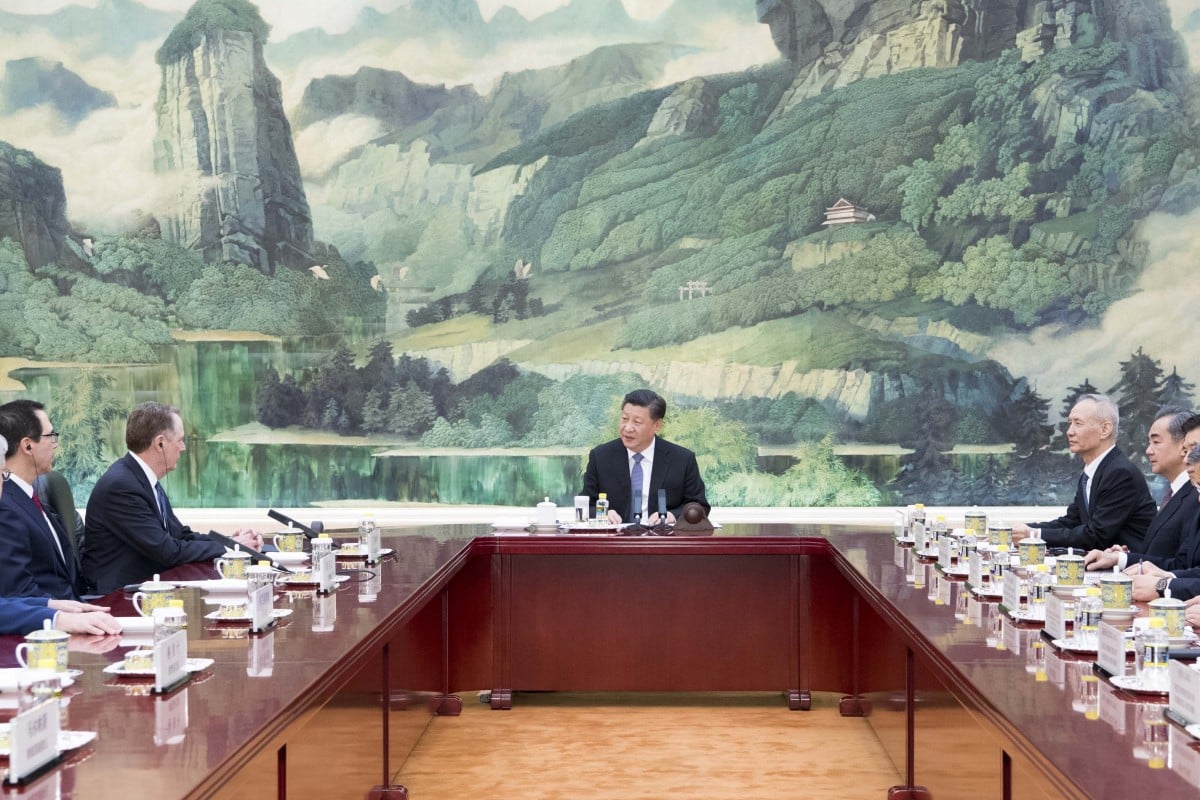
Chinese President Xi Jinping urged for a “mutually beneficial” trade deal in this week’s talks when he met US trade representative Robert Lighthizer and US Treasury Secretary Steven Mnuchin in Beijing on Friday, according to Xinhua. Photo: Xinhua
A tweet by US President Donald Trump on the ongoing trade war is a “positive” signal, brightening prospects of a deal from this week’s talks in Washington, according to an opinion piece published by China’s major state media outlets on Monday.
Monday’s opinion piece was published the day before a Chinese delegation led by Vice-Premier Liu He is expected to leave for talks in Washington.
In the tweet on Sunday, Trump said: “Important meetings and calls on China trade deal, and more, today with my staff. Big progress being made on soooo many different fronts! Our country has such fantastic potential for future growth and greatness on an even higher level!”
The opinion piece, which was published by the official Xinhua news agency, the People’s Daily and the Global Times under the pseudonym Niu Tanqin, is seen to be part of Beijing’s efforts to reassure its citizens that the trade war with the United States will soon be over.
It did contrast previous columns on Trump by the same author, who in March last year argued that China dislikes the American president for his “insatiable demands, greediness and lack of trust worthiness”.
Last week’s trade talks in Beijing produced “progress” ahead of the March 1 deadline, which could see tariffs on US$200 billion worth of Chinese products increased from 10 per cent to 25 per cent if the world’s two largest economies fail to reach a deal.
The outcome of the talks in Washington, which are likely to be the last before March 1, will largely decide whether China and the United States can reach a pact, likely in the form of a memorandum of understanding, to suspend the tariff battle that has been roiling global markets and clouding growth prospects since last year.
According to the opinion piece, Trump’s use of “soooo” instead of “so” indicated that the US president was excited when he heard reports from his trade envoys following the talks in Beijing, which Chinese President Xi Jinping attend on Friday.
Donald J. Trump
✔@realDonaldTrump
Important meetings and calls on China Trade Deal, and more, today with my staff. Big progress being made on soooo many different fronts! Our Country has such fantastic potential for future growth and greatness on an even higher level!
“The US side is attaching great importance [to the trade talks]. Although Trump is on vacation, he listened to relevant reports and he definitely will make specific instructions,” it added.
Trump has been upbeat about the prospects of reaching a trade deal with China, and said on Friday at the White House: “It’s going extremely well.”
Chinese President Xi urged for a “mutually beneficial” trade deal in this week’s talks when he met US trade representative Robert Lighthizer and US Treasury Secretary Steven Mnuchin in Beijing on Friday, according to Xinhua.
Stocks in China and Hong Kong surged on Monday, partly bolstered by the increased likelihood of a trade deal between China and the United States.
Monday’s opinion piece fits into the latest official line that an agreement is very likely to end the tariff war after the Global Times said over the weekend that the bilateral trade talks are “sprinting” towards a positive end.
Donald Trump’s demands ‘good for China’, says economist Jin Keyu
Meanwhile, reports in China suggest differences between Beijing and Washington still remain over forced technology transfer, intellectual property rights, cyber theft as well as a verification system to ensure China keeps its promises.
Xi told the US trade envoys that China is willing to “cooperate” but “cooperation has principals”, a statement showing that Beijing will not entertain US demands if it finds such demands violate China’s principals.
A White House statement on Friday said that “much work remains”, showing gaps still exist.
MUNICH, Germany, Feb. 16 (Xinhua) — People-to-people and cultural exchanges are thriving, making China and Europe a great example of cultural dialogue and engagement, a senior Chinese official said here Saturday.
Yang Jiechi, a member of the Political Bureau of the Communist Party of China (CPC) Central Committee, said this in his keynote speech themed “Working for a Community with a Shared Future for Mankind by Promoting International Cooperation and Multilateralism” at the 55th Munich Security Conference.
Fifteen years since the establishment of the China-EU comprehensive strategic partnership, the two sides have developed an all-dimensional and multi-tiered framework of exchanges and cooperation covering wide-ranging areas, said Yang, who is also director of the Office of the Foreign Affairs Commission of the CPC Central Committee.
Efforts to build China-EU partnerships for peace, growth, reform and civilization have made substantial progress, Yang noted.
“It is essential that our two sides continue to draw on each other’s strengths, focus on shared interests, remove obstacles and work together to seize the opportunities presented by the Fourth Industrial Revolution and meet our people’s aspirations for a better life,” said the official.
This year marks the 70th anniversary of the founding of the People’s Republic of China. Under the leadership of the Communist Party of China, Yang said, the country has embarked on the right path, one that is suited to its national conditions and follows the trend of the times.
The Chinese economy has entered a new phase of transitioning from high-speed growth to high quality development, operating within a proper range and maintaining overall stability and continued progress, he added.
“Facing lackluster new drivers and mounting downward pressure in the global economic context, China has enough resilience and huge potential to keep the economy on a sound track for a long time to come,” Yang said.
The enormous effective demand being generated by the 1.4 billion Chinese people who are moving up the income ladder will provide the world with even more opportunities in terms of market, investment and cooperation, he reassured.
German Chancellor Angela Merkel makes appeal to Beijing at Munich Security Conference as Washington prepares to leave INF treaty
But China’s top diplomat Yang Jiechi says nation’s missiles are defensive, do not pose a threat
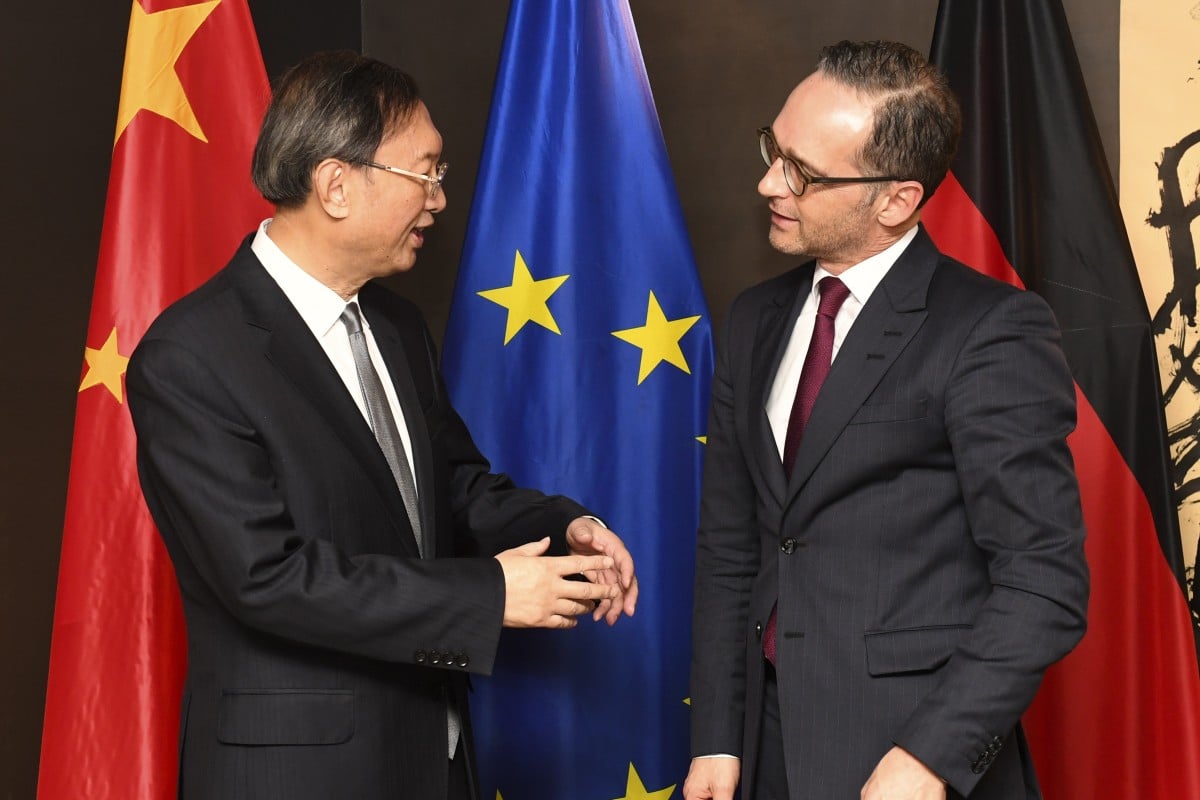
Chinea’s top envoy Yang Jiechi chats to German Foreign Minister Heiko Maas at the Munich Security Conference. Photo: AP
China on Saturday rejected German Chancellor Angela Merkel’s appeal to join a cold war-era arms control treaty that the United States accuses Russia of breaching, saying it would place unfair limits on its military.
Fearing a nuclear arms race between China, Russia and the US after the collapse of the Intermediate-Range Nuclear Forces (INF) treaty, which the US is withdrawing from, Merkel made her call for a global treaty.
“Disarmament is something that concerns us all and we would of course be glad if such talks were held not just between the United States, Europe and Russia but also with China,” she told the Munich Security Conference.
Is China about to abandon its ‘no first use’ nuclear weapons policy?
Russia and the United States are the signatories to the 1987 INF treaty that bans land-based missiles with a range between 500km (310 miles) and 5,500km, and which US President Donald Trump started the six-month withdrawal from this month, blaming Russian violations.
Moscow denies any wrongdoing, but the US and its Nato allies want Russia to destroy its 9M729 nuclear-capable cruise missile system, which Washington says could allow Russia to strike Europe with almost no warning.
Merkel’s suggestion of involving China in a negotiation is seen by European Nato diplomats as a potential way out of the impasse because a new treaty could address American concerns about a growing military threat from China and Russia.
But China’s top diplomat Yang Jiechi, who spoke on a panel in Munich, said that Chinese missiles were defensive.
“China develops its capabilities strictly according to its defensive needs and doesn’t pose a threat to anybody else. So we are opposed to the multilateralisation of the INF,” he said.
China’s stated ambition is to modernise its People’s Liberation Army by 2035, improve its air force and push into new technologies including very high speed cruise missiles and artificial intelligence.
Its defence budget grew nearly 6 per cent between 2017 and 2018, according to the London-based International Institute for Security Studies.
Chinese scientists make progress on nuclear submarine communication
Retired Chinese general Yao Yunzhu told delegates a new arms control agreement would only work if it included sea- and air-launched missiles, as well as land, because most of China’s military technology was ground-based and the country would not want to put itself at a disadvantage.
Cheaper to build, more mobile and easier to hide, ground-based rocket launchers are an attractive option for China as it develops its armed forces, experts said, whereas the United States operates more costly sea-based systems to comply with the INF.
“China is traditionally a land power and the Chinese military is a ground force,” Yao said.
“If China is to enter into these kinds of negotiations, I think it ought to be more comprehensive to include not only land-based but also air and sea-based strike capabilities … and that would be hugely complicated,” she said.
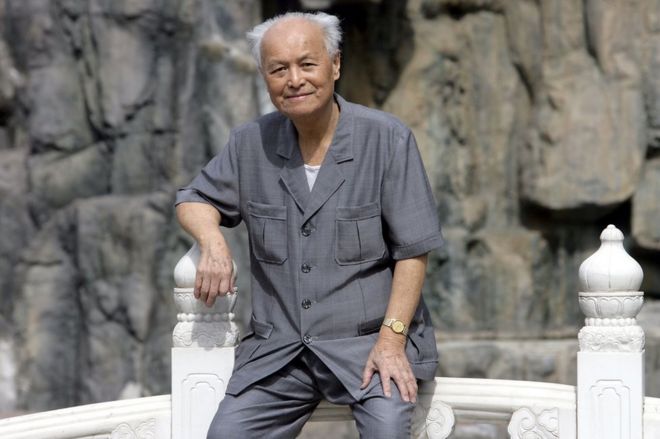
Image copyrightAFPImage captionLi Rui remained an activist and idealist until his death
“We are not allowed to talk about past mistakes.”
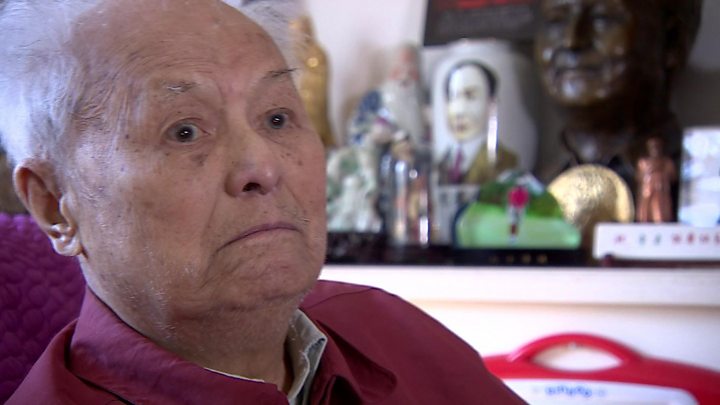
Li Rui said this in 2013, while reflecting on the similarities between China’s then-new leader Xi Jinping and the founding father of Communist China, Mao Zedong.
Mr Xi, he warned, was echoing Mao’s suppression of individual thought, and was trying to build a similar cult of personality – both things he had experienced at first hand.
Li Rui joined the Communist Party in 1937, at the start of the brutal Sino-Japanese war, and 12 years before the party won the civil war that established the People’s Republic. He was hand-picked by Mao to become his personal secretary in 1958.
Despite this turbulent history with the party, the fact that Mr Li was one of the original revolutionaries meant that he occupied a special place in contemporary China – one that allowed him a degree of freedom to talk about the ruling party’s many issues, and how he felt things should be done differently.
People may not be allowed to talk about past mistakes, but Mr Li did it anyway – and his work has helped historians understand the truth and scale of Mao’s atrocities.
Li Rui died in Beiijng on Saturday, aged 101.
An underground revolutionary
As a university student, Mr Li joined a group of idealistic Communist activists protesting against Japanese occupation. Shortly afterwards, at the age of 20, he officially joined the party. He was tortured for his communist activism.
But things changed when the party came into power in 1949, and by 1958 Mr Li had become the youngest vice minister in China.
It was also that year that he had a meeting with Mao that would change the course of his life. Mao, having seen Mr Li argue passionately against building the Three Gorges Dam on the Yangtze River, chose him to be his personal secretary.
Their relationship didn’t last long.
‘Mao put no value on human life’
In 1959, Mr Li openly criticised Mao’s Great Leap Forward – a policy that was supposed to boost China’s economic output, but instead unleashed widespread famine across the country.
For this transgression Mr Li was expelled from the Communist Party, and he was imprisoned for eight years in Qincheng, maximum security prison built for the detention of disgraced senior party officials.
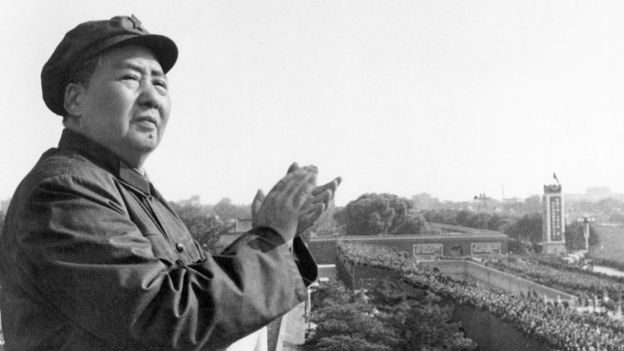
Image copyrightGETTY IMAGESImage captionLi Rui said Mao Zedong, pictured, “put no value on human life”
Following Mao’s death, the more pragmatic Deng Xiaoping came to power in 1978 and Mr Li was rehabilitated and allowed back into the party. He then became a strong advocate for political reform, and in his later years, threw himself into calling for China to move further towards a European socialist-style system.
He wrote five books on Mao, all of which were published overseas and banned in mainland China. His last book, published in 2013, called for the current “one-party, one-leader and one-ideology regime” to be overhauled. His daughter, Li Nanyang, has spoken of having her copies of his memoir confiscated at Beijing’s airport.
Aside from writing books, he worked right into his 90s as a patron of the reformist magazine Yanhuang Chunqiu – roughly translated as “China through the ages”.
The magazine was taken over in 2016. Its editor Wu Si was forced out, and its former staff released a statement warning that “anybody who publishes any periodicals with the title of Yanhuang Chunqiu will be nothing to do with [them]”.
Professor Steve Tsang, director of SOAS’s China Institute, tells BBC News that this affected Li Rui deeply.
“The single most important thing that Li Rui had, was the patronage that he gave to the magazine Yanhuang Chunqiu,” Professor Tsang says. “It does still exist, but it’s been completely changed it terms of management and focus. It’s practically a different magazine.”
The last idealist
But even though his writing was censored, Mr Li was not a dissident – he remained a party member until his death. And the fact that he was left to compose his memoirs from a prestigious apartment block in Beijing shows how, despite his outspoken criticism of the current leadership, he continued to be revered for his role as one of the country’s original revolutionaries.
But with Mr Li dies the idealism of the activist who joined his party eight decades ago, and spent the years since vigorously rebelling against leaders who abused their power.
“He was among the last of that generation of idealists who joined the Communist Party at the beginning, and who tried to hold the Communist Party to the rhetoric [they heard] when they were being recruited,” Prof Tsang says.
“There is probably nobody else who will hold the party now to what the party had originally said it was meant to do.”








 CHINDIA ALERT: You'll be living in their world, very soon