Chindia Alert: You’ll be Living in their World Very Soon
aims to alert you to the threats and opportunities that China and India present. China and India require serious attention; case of ‘hidden dragon and crouching tiger’.
Without this attention, governments, businesses and, indeed, individuals may find themselves at a great disadvantage sooner rather than later.
The POSTs (front webpages) are mainly 'cuttings' from reliable sources, updated continuously.
The PAGEs (see Tabs, above) attempt to make the information more meaningful by putting some structure to the information we have researched and assembled since 2006.
NEW DELHI (Reuters) – In a putdown rare even for India’s sometimes dramatic court proceedings, the country’s Supreme Court told the former chief of federal police on Tuesday to “sit in one corner” and fined him 100,000 rupees for disobeying the court.
M Nageswara Rao, former chief of the Central Bureau of Investigation (CBI), was given the instruction after being found guilty of violating an earlier order that mandated seeking court permission before taking an investigating officer off a case.
“Please go and sit in one corner till the rising of the court. Fine to be deposited in one week,” Ranjan Gogoi, the court’s chief justice, told him after the court found him guilty of contempt of court.
Rao proceeded to sit in a corner and appeared to be avoiding eye contact with anyone, a Reuters witness said.
Bizarre orders and courtroom drama are fairly common in Indian courts, but lawyers and court officials said such a direction towards a senior CBI official in the Supreme Court was unprecedented.
Rao, now an additional director in the CBI, had ordered the transfer of a CBI officer investigating a sexual exploitation case at a shelter home in the eastern state of Bihar.
One of the injured students at the hospital in Pulwama on February 13.(ANI/Twitter Photo)
Twelve students were injured in an explosion at a private school in south Kashmir’s Pulwama on Wednesday. The blast took place around 2.30pm.
The injured are students of class 10 of the Falah-i-Millat school in Pulwama’s Narbal town. Seven of them have been referred to Srinagar Hospital for further treatment.
They have been rushed to the government district hospital in Pulwama for treatment.
“I was teaching and then suddenly an explosion occurred. I can’t say how many students are injured,” Jawed Ahmed, a teacher at the school where the blast took place told news agency ANI.
The police have lodged a case and are investigating the nature of the blast.
The CAG report said India has managed to save 17.08 per cent money for the India Specific Enhancements in the 36 Rafale contract, compared to the 126 aircraft deal.
SNS Web | New Delhi | February 13, 2019 12:54 pm
The report of the Comptroller and Auditor General (CAG) on the 2015 Rafale jet deal tabled in the Parliament on Wednesday, said the Rafale deal sealed by the Modi government is 2.8 per cent cheaper than the one negotiated by the previous UPA government.
The CAG report tabled before Rajya Sabha said India has managed to save 17.08 per cent money for the India Specific Enhancements in the 36 Rafale contract, compared to the 126 aircraft deal.
It further said the delivery schedule of the first 18 Rafale aircraft is better than the one proposed in the 126 aircraft deal, by five months.
The auditor report noted that the Indian Air Force did not define the ASQRs (Air Staff Qualitative Requirements) properly. As a result of which none of the vendors could fully meet the ASQRs. ASQRs were changed repeatedly during the procurement process, the report said.
This created difficulties during technical and price evaluation and affected the integrity of competitive tendering which was one of the main reasons for the delay in the acquisition process, the report said.
Objectivity, equity and consistency of technical evaluation process was not evident in the Technical Evaluation Report.
Finding issues with the UPA-era deal, the audit further said a Defence Ministry team in March 2015 had recommended the scrapping of the 126 Rafale deal saying that the Dassault Aviation was not the lowest bidder and EADS (European Aeronautic Defence & Space Company) was not fully compliant with the tender requirements.
The Defence Ministry team had said that the proposal of Dassault Aviation Rafale should have been rejected in technical evaluation stage itself as it was non-compliant with RFP requirements.
The report comes as a major victory for the Narendra Modi-led BJP government which had been cornered by the Opposition parties in the matter.
Reacting to the report, Union Minister Arun Jaitley in a series of tweets slammed the opposition Congress saying “the lies of ‘Mahajhootbandhan’ stand exposed by the CAG Report”.
Comparing the 2007 and 2016 terms of the deal, Jaitley said the NDA contract involved lower price of jets, faster delivery, better maintenance and lower escalation.
He said “the CAG Report on Rafale reaffirms the dictum” adding that “the truth shall prevail”.
The Congress and other opposition parties have dismissed the report as biased as auditor Rajiv Mehrishi was the Finance Secretary when the deal for 36 Rafale fighter jets was inked in 2016.
The Congress had on Sunday demanded that CAG Rajiv Mehrishi recuse himself from the audit citing conflict of interest.
“Finance ministry plays an important role in negotiations. How will CAG investigate himself?” said Congress leader Kapil Sibal.
The Congress has been accusing massive irregularities in the deal, alleging that the government was procuring each aircraft at a cost of over Rs 1,670 crore as against Rs 526 crore finalised by the UPA government when it was negotiating procurement of 126 Rafale jets.
It has also demanded a Joint Parliamentary Committee (JPC) probe into the deal.
The Supreme Court had earlier in December given a clean chit to the Centre on the procurement of 36 Rafale fighter jets from France.
A three-Judge bench headed by Chief Justice Ranjan Gogoi had dismissed all the petitions and said no Rafale probe was required.
India has signed an agreement with France to buy 36 Rafale fighter aircraft, costing approximately Rs 58,000-crore (about USD 8 billion), in a fly-away condition for Indian Air Force equipment upgrade.
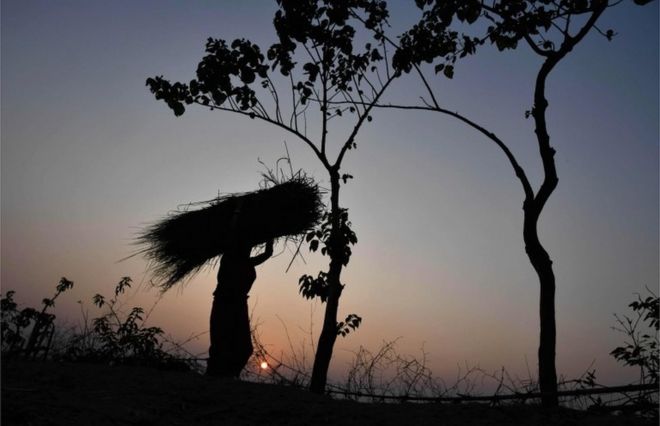
Image copyrightAFPImage captionThe sun rises nearly two hours earlier in the east of India than in the far west
India’s single time zone is a legacy of British rule, and is thought of as a symbol of unity. But not everyone thinks the Indian Standard Time (IST) is a good idea.
Here’s why.
India stretches 3,000km (1,864 miles) from east to west, spanning roughly 30 degrees longitude. This corresponds with a two-hour difference in mean solar times – the passage of time based on the position of the sun in the sky.
The US equivalent would be New York and Utah sharing one time zone. Except that in this case, it also affects more than a billion people – hundreds of millions of whom live in poverty.
The sun rises nearly two hours earlier in the east of India than in the far west. Critics of the single time zone have argued that India should move to two different standard times to make the best use of daylight in eastern India, where the sun rises and sets much earlier than the west. People in the east need to start using their lights earlier in the day and hence use more electricity.
The rising and setting of the sun impacts our body clocks or circadian rhythm. As it gets darker in the evening, the body starts to produce the sleep hormone melatonin – which helps people nod off.
This is how it happens. The school day starts at more or less the same time everywhere in India but children go to bed later and have reduced sleep in areas where the sun sets later. An hour’s delay in sunset time reduces children’s sleep by 30 minutes.
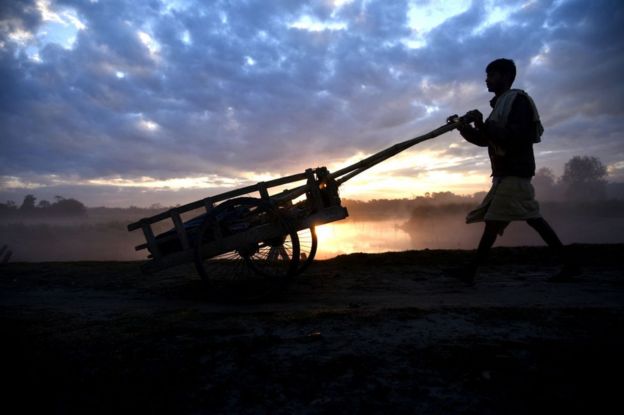
Image copyrightAFPImage captionScientists suggest Manipur, a hilly north-eastern state, should have a different time zone
Using data from the India Time Survey and the national Demographic and Health Survey, Mr Jagnani found that school-going children exposed to later sunsets get fewer years of education, and are less likely to complete primary and middle school.
He found evidence that suggested that sunset-induced sleep deprivation is more pronounced among the poor, especially in periods when households face severe financial constraints.
“This might be because sleep environments among poor households are associated with noise, heat, mosquitoes, overcrowding, and overall uncomfortable physical conditions. The poor may lack the financial resources to invest in sleep-inducing goods like window shades, separate rooms, indoor beds and adjust their sleep schedules,” he told me.
“In addition, poverty may have psychological consequences like stress, negative affective states, and an increase in cognitive load that can affect decision-making.”
Mr Jagnani also found that children’s education outcomes vary with the annual average sunset time across eastern and western locations even within a single district. An hour’s delay in annual average sunset time reduces education by 0.8 years, and children living in locations with later sunsets are less likely to complete primary and middle school, the research showed.
Mr Jagnani says that back of the envelope estimates suggested that India would accrue annual human capital gains of over $4.2bn (0.2% of GDP) if the country switched from the existing single time zone to the proposed two time zone policy: UTC+5 hours for western India and UTC+6 hours for eastern India. (UTC is essentially the same as Greenwich Mean Time or GMT but is measured by an atomic clock and is thus more accurate.)
Image copyrightAFPImage captionThe sun can rise nearly two hours earlier in the east of India than in the far west
India has long debated whether it should move to two time zones. (In fact tea gardens in the north-eastern state of Assam have long set their clocks one hour ahead of IST in what functions as an informal time zone of their own.)
During the late 1980s, a team of researchers at a leading energy institute suggested a system of time zones to save electricity. In 2002, a government panel shot down a similar proposal, citing complexities. There was the risk, some experts felt, of railway accidents as there would be a need to reset times at every crossing from one time zone to another.
Researchers at the National Physical Laboratory said the single time zone was “badly affecting lives” as the sun rises and sets much earlier than official working hours allow for.
Early sunrise, they said, was leading to the loss of many daylight hours as offices, schools and colleges opened too “late” to take full advantage of the sunlight. In winters, the problem was said to be worse as the sun set so early that more electricity was consumed “to keep life active”.
Moral of the story: Sleep is linked to productivity, and a messy time zone can play havoc with the lives of people, especially poor children.
NEW DELHI (Reuters) – Thousands of candidates, hundreds of parties, endless combinations of possible coalitions – spare a thought for India’s pollsters, tasked with making sense of the country’s fiendishly complicated politics ahead of a general election due by May.
The ruling Bharatiya Janata Party led by Prime Minister Narendra Modi won a surprise majority in 2014. Until last year, many predicted a similar result. But amid rising anger over unemployment and a fall in rural incomes, the BJP lost key state elections in December, making this contest more closely fought than first expected.
That means surveys conducted on behalf of newspapers and TV channels will be closely scrutinised. Some of India’s top pollsters however, told Reuters current surveys could be wide of the mark until the parties finalise alliances, which could be as late as April – and even then, there are challenges.
“In India there are certain relationships between caste, religion and allegiance,” said VK Bajaj, chief executive of Today’s Chanakya, the only polling firm to predict the BJP would win an outright majority in 2014. “We have to do checks and counter-checks when collecting our samples.”
CHEQUERED PAST
Opinion polls grew in popularity in India in the 1990s, after economic liberalisation saw a boom in privately-owned newspapers and TV channels, all demanding their own surveys.
In 1998 and 1999, the polls closely predicted the share of seats for the winning BJP-led coalition, according to data collected by Praveen Rai, an analyst who has tracked opinion polls in India for more than 15 years at the Centre for the Study of Developing Societies, which also runs its own surveys.
But in the last three elections, polls have been significantly wide of the mark. In 2004 and 2009 the victorious Congress alliance was completely underestimated, while in 2014 only Bajaj’s firm predicted the BJP would win an outright majority.
Elections in India have become “increasingly multi-varied”, Rai said, with the emergence of regional parties complicating pollsters’ efforts.
REALITY ON THE GROUND
Many polls are conducted face-to-face, and collecting representative samples can be hard in a country that still has several armed separatist movements and tribal communities unused to opinion polling.
When CNX, one of India’s largest polling companies, conducts fieldwork in rural Chhattisgarh and Jharkhand – two states with large tribal populations – it often finds many are unfamiliar with the concept of opinion polls.
“In areas where people are not so educated it is difficult for them to understand,” said Bhawesh Jha, CNX’s founder.
Elsewhere, a lack of trust in why polls are conducted and how the data is used means respondents are also less truthful than other countries, pollsters said.
“Dubious opinion polls conducted by some media houses to sway the elections for political parties … has definitely created a bad name for the polling industry in India,” Rai said.
India lacks strong data protections laws like those in North America and Europe, and many people still believe their details will be passed on to political parties, Rai and Jha said, meaning answers were often those they think the pollster wants to hear.
“We have to convince people we are not going to reveal their identity,” Jha said.
COMPLEX ARITHMETIC
Current polls are making large assumptions, no more so than in Uttar Pradesh, India’s largest state with a population of more than 200 million that accounts for nearly a fifth of the seats in India’s lower house.
Results there have been so difficult to predict that the state has earned the nickname “Ulta Pradesh” – a play on the Hindi word meaning “reverse” – for its ability to confound experts.
A recent poll there found that if two regional parties already in alliance joined forced with the main opposition Congress, the BJP would be wiped out in the state, almost certainly losing power nationally.
But like other states in India, much depends on who contests from where – and to what extent Congress stands its candidates down to allow regional parties a run.
Until the final seats sharing agreements and candidate lists are announced – which may not be until April – current polls are little more than guesswork, said Today’s Chanakya chief Bajaj.
“We have to wait until the final alliances come out,” he said. “It is not possible to do anything until that.”
The Congress has been repeatedly alleging a scam in the multi-crore Rafale fighter jet deal with France.
SNS Web | New Delhi | February 12, 2019 1:33 pm
Congress president Rahul Gandhi on Tuesday accused Prime Minister Narendra Modi of compromising on national security and called him a “middleman for Anil Ambani”.
Addressing a press conference on Tuesday in New Delhi, Gandhi, whose party has been repeatedly alleging a scam in the multi-crore Rafale fighter jet deal with France, cited a media report which said that Ambani met the French Defence Minister just days before the inking of the fighter jet deal.
“An email has come into light that states ‘A. Ambani visited the Minister’s office… Mentioned MoU in preparation and intention to sign during PM visit’. How is Anil Ambani meeting the French Defence Minister prior to PM’s visit?” Gandhi said while showing the email to media persons.
“Modi is under oath to protect secrets. He has given these secrets to Anil Ambani, who knew about the biggest defence deal in the world 10 days before. This in itself is criminal. This in itself will put the Prime Minister in jail,” Gandhi said.
Alleging that the PM has compromised with national security, Gandhi said, “Defence Minister says he doesn’t know about the new deal, whereas Anil Ambani is sitting in the French Defence Minister’s office saying PM will sign an MoU with him involved.”
“This is the breach of the Official Secrets Act. PM was working as the middleman for Anil Ambani,” he added.
“First, it (the deal) was a matter of corruption, now it is a matter of official secrets act. Investigation should begin immediately,” Gandhi demanded, reiterating that the new development is serious.
Rejecting the Comptroller and Auditor General (CAG) report on the Rafale deal, Gandhi even went on raising a finger at the Supreme Court’s judgement based on that report.
“Supreme Court judgement is open to question. It does not have jurisdiction and has quoted the CAG report which does not exist,” he said.
A three-Judge bench headed by Chief Justice Ranjan Gogoi had dismissed all the petitions calling for a probe in the procurement of 36 Rafale fighter jets from France.
According to a report published by The Indian Express on Tuesday, Anil Ambani visited then French Defence Minister Jean-Yves Le Drian’s office in Paris and had a meeting with his top advisers in March 2015. NDTV reported that Anil Ambani’s Reliance Defence stated that the visit had nothing to do with Rafale but to discuss a Naval Utility Helicopter deal for which the government of India had issued a Request for Information in 2015.
Gandhi had on Monday slammed the PM for “facilitating loot” in the deal by removing the anti-corruption clause, as was reported by a daily.
“Every defence deal has an anti-corruption clause. The Hindu has reported that the PM removed the anti-corruption clause. It is clear that the PM facilitated loot,” Gandhi told reporters outside the Andhra Bhawan in New Delhi where he came to support Andhra Pradesh Chief Minister N Chandrababu Naidu’s protest against the Centre.
“NoMo anti corruption clause. The Chowkidar himself opened the door to allow Anil Ambani to steal 30,000 crore from the IAF,” Gandhi tweeted from his official handle using his “chowkidaar chor hai” jibe at the PM.
Congress members have been raising the matter since the start of the Winter Session of Parliament on 11 December, demanding a Joint Parliamentary Committee (JPC) probe into the Rafale deal.
LUCKNOW, India (Reuters) – Priyanka Gandhi Vadra, the latest entrant into politics from India’s Nehru-Gandhi dynasty, made her debut on Monday with a roadshow drawing thousands to see her in the most populous state, months before a general election due to be held by May.
Congress President Rahul Gandhi pulled a surprise last month by appointing his younger sister a party general secretary. She will also be its face in Uttar Pradesh, the state that sends the highest number of lawmakers to the lower house of parliament and is currently dominated by Prime Minister Narendra Modi’s ruling Bharatiya Janata Party (BJP).
But a string of BJP defeats in state elections late last year and rising discontent over a weak farm economy and lacklustre jobs growth have weakened Modi’s position, which an increasingly aggressive Congress is looking to capitalize on.
The 47-year-old Priyanka – she is usually referred to by just her first name – bears a striking resemblance to her grandmother, former Prime Minister Indira Gandhi, and is known for her gifts as a speaker able to connect with voters.
Congress hopes that the eyeballs she’s able to generate will turn into votes.
“It’s like Indira Gandhi has come back,” said Fuzail Ahmed Khan, 45, a Congress supporter. “The state’s farmers want Rahul Gandhi to be prime minister, Priyanka to be chief minister.”
Indira Gandhi, India’s only woman prime minister and known as the “Iron Lady”, was criticised for suspending civil liberties for nearly two years starting in 1975. The Hindu nationalist BJP calls Priyanka’s appointment an extension of Congress’s “dynastic politics”.
Posters of Priyanka lined the streets of the state capital, Lucknow, and hundreds of Congress supporters, accompanied by drummers, chanted her name as she emerged from the airport with her brother.
The siblings continuously waved at supporters from atop a bus and then later from an SUV during the drive from the airport to their state office.
At a stopover, Rahul Gandhi grabbed a microphone and said the appointments of Priyanka and lawmaker Jyotiraditya Scindia as state party leaders were aimed at beyond the general election and bringing Congress into power in Uttar Pradesh.
“If there is a heart of the country, it is Uttar Pradesh,” he said to loud cheers, Priyanka standing by his side. “They’re definitely focused on the parliamentary election but the aim also is to form a government in the state. We’ll bring a government of youth, poor and peasants.”
But it won’t be easy for the brother-sister combination in Uttar Pradesh, a poor state of 220 million people where two regional caste-based parties now compete for power with the BJP and Congress is only a marginal player.
The BJP won 73 of the 80 seats in the state in the last general election. BJP President Amit Shah said last week the party would win 74 seats there this year.
Although Priyanka has helped manage elections for her brother and her mother, former Congress chief Sonia Gandhi, she has never held an official party post until now.
“I hope that we can together start a new kind of politics,” she said in an audio message shared by Congress, but she did not make a speech in Lucknow amid fears, political analysts say, she could overshadow her brother.
Since the announcement of Priyanka’s entry into politics, India’s financial crime-fighting agency Enforcement Directorate has questioned her husband, Robert Vadra, in a case relating to alleged ownership of 1.9 million pounds of undisclosed assets abroad. His lawyer and Congress have dismissed the charges as politically motivated.
Priyanka, who drew more 78,000 followers soon after joining Twitter on Monday and even before sending a single tweet, will spend three days in Lucknow meeting workers from more than 40 constituencies.
From 21 seats in the 2009 general election in Uttar Pradesh, Congress’ tally fell to just two in 2014.
Congress president Rahul Gandhi, party general secretary (incharge of east UP) Priyanka Gandhi Vadra during a roadshow from the Chaudhary Charan Singh airport to the UPCC headquarters in Lucknow, Uttar Pradesh.(Subhankar Chakraborty/HT PHOTO)
Congress president Rahul Gandhi on Monday underlined his party’s ambitions in Uttar Pradesh saying the party cannot afford to be weak in the state.
‘Congress started in UP and it cannot stay weak here. Priyanka Gandhi and Jyotiarditya Scindia will make Congress strong in UP again,’ Rahul said at headquarters in UP unit of the Congress in Lucknow at the end of a mammoth road show that his sister Priyanka launchedin her first visit to .the state sicne her appointment as c general secretary in charge of eastern U.P.
While the roadshow marked Priyanka’s formal entry into active politics, Rahul set his sight beyond the upcoming general elections to regain power in U.P.
‘Congress party has to form government in Uttar Pradesh.’
The Congress president reiterated that the party will fight the elections on its own in India’s most populous state which sends 80 lawmakers to the Lok Sabha. The Samajwadi Party and the Bahujan Samaj Party which announced an alliance last month, left the Congress put of it but said they would not contest from Rae Bareilly and Amethi – the Lok Sabha seats of Sonia Gandhi and Rahul Gandhi.
‘I respect Mayawati and Akhilesh Yadav, but Congress will fight with all its might in Uttar Pradesh,’ Rahul said.
The Congress won two Lok Sabha seats in U.P. in 2014.
Rahul Gandhi also brought up the Rafale aircraft deal to attack Prime Minister Narendra Modi , accusing him once again of manipulating the contract to benefit Anil Ambani.
“In every defence deal there is a clause against corruption.Narendra Modi scrapped the corruption clause to benefit Anil Ambani,” he said.
He also accused the Prime Minister of ignoring farmers and favouring industrialists.
“Modi’s empty slogans are there before the people to see Chowkidar waived Rs 3.5 lakh crore of loans for industrialists but not farmers.”
The Congress has consistently attacked the Modi government for not addressing farm distress in the country and the issue was one of the main election planks for the grand old party in the recent assembly elections in five states.
Urging Congress workers to “transform UP”, Rahul Gandhi said that PM Modi’s “hollow promises of have come to light”.
SNS Web | New Delhi | February 11, 2019 7:04 pm
With an appeal to the people of Uttar Pradesh to bring the Congress to power at the Centre in the upcoming Lok Sabha elections, party president Rahul Gandhi presented his party as the one that can bring a progressive government for farmers, Dalits, youth and the poor.
Addressing Congress supporters in Lucknow on Monday at the conclusion of a massive roadshow with Priyanka Gandhi and Jyotiraditya Scindia, the 48-year-old Gandhi said that there is need to empower grassroot leaders to help bring the party to power and fulfil the aspirations of the people.
Slamming the BJP-RSS, Gandhi said, “This is an ideological battle. On one hand there is the Congress ideology of love, harmony and brotherhood. On the other, there is BJP-RSS ideology of dividing and weakening the nation.”
Urging Congress workers to “transform UP”, Gandhi said that PM Modi’s “hollow promises of have come to light”.
“Congress workers must fight this battle with issues that concern the youth, farmers. There is no dearth of issues. Congress party will fight to transform UP and the nation,” he added, while assuring the supporters that the party will “play on the front foot”.
Criticising Narendra Modi over the promises he made, Gandhi said that the youth of the country believe that the Prime Minister has failed to fulfil them.
“Uttar Pradesh has witnessed what Narendra Modi did for the last 5 years in the country. Youth are saying that Modi failed his promise to provide employment and benefited only people like Anil Ambani,” he said.
Attacking the NDA government and PM Modi over the Rafale deal, in which the Congress smells a scam, Gandhi cited a series of media reports stating that the Defence Ministry expressed its strong reservations to the “parallel negotiations” conducted by the Prime Minister’s Office (PMO) with France on the multi-billion dollar fighter jet deal and that the government removed the anti-corruption clause from the Rafale fighter jet defence deal.
“Modi had said that he has a 56-inch chest. He wants to be a ‘Chowkidar’. The truth has now surfaced that he conducted parallel negotiations in the Rafale deal. The clause that enabled investigation in case of corruption, was waived off by Mr. Modi,” he said.
Earlier today, Gandhi had accused PM Modi of “facilitating loot” in the Rafale fighter jet deal with France.
“Every defence deal has an anti-corruption clause. The Hindu has reported that the PM removed the anti-corruption clause. It is clear that the PM facilitated loot,” Gandhi told reporters outside the Andhra Bhawan in New Delhi where he came to support Andhra Pradesh Chief Minister N Chandrababu Naidu’s protest against the Centre.
“NoMo anti corruption clause. The Chowkidar himself opened the door to allow Anil Ambani to steal 30,000 crore from the IAF,” Gandhi tweeted from his official handle using his “chowkidaar chor hai” jibe at the PM while attaching a report.
The report, published by The Hindu, stated that just days before it signed the Inter-governmental Agreement (IGA) for 36 Rafale fighter jets, the Centre had waived off critical provisions for anti-corruption penalties as well as overruled financial advisers’ recommendations for making payments through an escrow account.
Mega roadshow
Monday’s roadshow, which was witnessed by thousands in the city, marked the official entry of Priyanka Gandhi Vadra into active politics.
Appointed Congress general secretary of Uttar Pradesh East last month by her brother, Priyanka Gandhi Vadra is being seen by Congress loyalists as a fortune changer for the grand old party in electorally powerful Uttar Pradesh.
From onboard an open top bus, Priyanka Gandhi, her brother Rahul, Scindia and Uttar Pradesh Congress Committee chief Raj Babbar were seen waving to a sea of supporters who had gathered to catch a glimpse of the leaders.
The approximately 20-km long roadshow started from Amausi airport to the Nehru Bhawan office of the Uttar Pradesh Congress Committee located a Mall Avenue near Hazratganj.
Ahead of her visit to the state, a group of party workers geared up to work as her “army”, complete with a pink uniform that has her photo and a message. They call themselves the ‘Priyanka Sena’.
Earlier on Sunday, in a message to party supporters and voters, Priyanka Gandhi said she hopes to start a “new kind of politics” in which “everyone will be a stakeholder”.
“… I have hope in my heart that together we will start a new kind of politics, a politics in which all of you will be stakeholders — my young friends, my sisters and even the weakest person, all their voices will be heard,” said Gandhi through the Congress’s Shakti App.
While Priyanka will concentrate on 42 seats of eastern UP, Scindia will focus on 38 seats of western UP.
Priyanka’s first meeting is scheduled with the workers of the Mohanlalganj (reserved) constituency while the last interaction slated for Thursday will be with the workers of the Misrikh (reserved) Lok Sabha seat.
UP East also has Varanasi, the parliamentary constituency of Prime Minister Modi, and Gorakhpur, a stronghold of UP Chief Minister Yogi Adityanath.
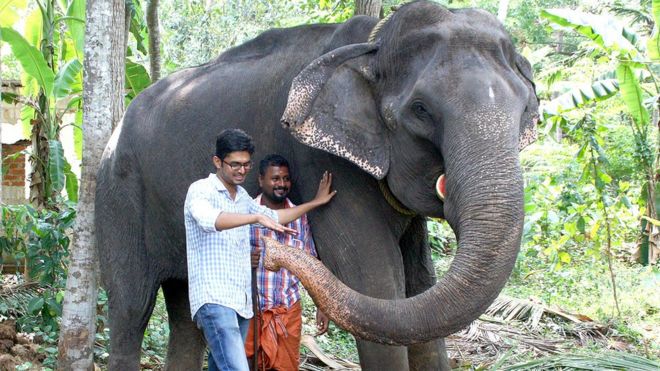
Image copyrightSTR/AFP/GETTYImage captionDakshayani, pictured here in 2016, lived at the Chengalloor Mahadeva Temple in southern Kerala state
Dakshayani, thought to be the world’s oldest elephant in captivity, has died at the age of 88 in India.
Given the title Gaja Muthassi or elephant granny, Dakshayani took part in temple rituals and processions at the Chengalloor Mahadeva Temple in the southern state of Kerala.
But her vet said the elephant stopped taking food and died on Tuesday.
Keepers started feeding her pineapples and carrots in recent years after she began to have trouble moving around.
She had not taken part in any public event for several years.
The Travancore Devaswom Board, which runs the temple where she lived, says she was the oldest elephant in captivity and estimated her age at 88.
However, the current Guinness World Record holder for oldest elephant in captivity is Lin Wang.





 CHINDIA ALERT: You'll be living in their world, very soon