Archive for ‘India alert’

19/12/2018

British businesses lured by India’s ‘golden opportunities’

India’s large workforce and improving infrastructure have made it an enticing place to invest
FRANCIS MASCARENHAS/REUTERS

Britain is the largest western investor in India, with businesses channelling $26 billion into the country in the past 18 years.

Companies based in the UK contributed 7 per cent of all foreign direct investment into India last year as their expenditure grew by $847 million, according to research by the CBI, the lobby group, and Grant Thornton, the accounting firm.

British businesses, particularly manufacturers, services providers and retailers, have been increasing their presence in India over recent years. This is partly because of the country’s large workforce, improving infrastructure and the business-friendly policies implemented under Narendra Modi, its prime minister since 2014.

Foreign direct investment is when companies buy capital, such as factories or machines, in a foreign country or purchase assets or shares that give investors control in a foreign business.

Increasing corporate investment is welcome news for Britain’s trade relations with India as it looks to its trading partners outside of the European Union before Brexit in March. Both the UK and EU have said that they want to increase trade flows with India.

British investment in India is ahead of that of the United States and the Netherlands, which contribute 6 per cent to the total. In the EU, the UK invests more than Germany, which contributes 3 per cent, and France, which represents 2 per cent. Worldwide, Britain is behind only Mauritius, Singapore and Japan.

The report, Sterling Assets: Britain Meets India, said that about 40 per cent of British companies had made new investments in India last year, creating more than 50,000 new jobs. British firms are believed to have created about 423,000 jobs in India since 2000.

“There’s no question that India will be a vital trading partner as the UK charts a new future out the EU,” Shehla Hasan, CBI director for India, said. She said that there was a “golden opportunity” for UK companies thanks to economic reforms that she said made India more attractive to entrepreneurs and established businesses.

More than half of British companies operating in India are in the services sector, such as restaurants and hotels, while about a third are manufacturers, which include factories. The chemicals industry has received the lion’s share of British investment in India since 2000 at $12 billion, followed by the drugs and pharmaceuticals sector, at $8.8 billion, and services, at $7 billion.

Since 2000, the state of Maharashtra, where Mumbai is located, has attracted the largest share of British investment.

Central bank chief quits
Urjit Patel resigned as government of India’s central bank on Monday (Callum Jones writes). Mr Patel, who has been grappling with ministerial criticism of the bank’s policies, cited “personal reasons” for his departure.

Raghuram Rajan, a former reserve bank governor, raised concerns over the “impasse” that had pushed his successor to quit. He said: “I think this is something all Indians should be concerned about because strength of our institution is really important.”
17/12/2018

Three-year-old assaulted on Delhi bus rape anniversary

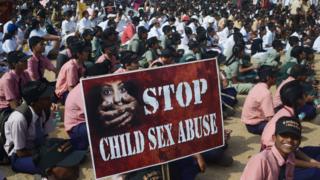
A protest in India against child sex abuseImage copyrightAFP

A three-year-old Indian girl is in critical condition after she was allegedly raped by her neighbour in the capital Delhi.

The accused, a 40-year-old security guard who worked in the building the child lived in, has been arrested.

Police found the girl unconscious and rushed her to hospital where she is undergoing surgery.

The incident occurred on Sunday, which was the sixth anniversary of the brutal gang rape of a student on a Delhi bus.

Delhi Women’s Commissioner Swati Maliwal said the incident “let down” the bus rape victim, whose attack saw country-wide protests and a tightening of rape laws.

There is still no clarity on the condition of the girl or whether she will survive the attack, which local media have described as “brutal”.

Locals in the area found the accused and attacked him after the incident came to light, the Times of India newspaper said. It also quoted police as saying that the accused was treated for injuries before they arrested him.

The girl’s parents, who are daily wage labourers, were away when the incident occurred. The accused allegedly lured the girl with sweets and picked her up from outside her house.

Police have registered a case for rape under the Protection of Children from Sexual Offences (POSCO) Act, which could see the death penalty handed out to the accused.

The incident, which has prompted a fresh wave of anger and outrage in India, comes after a series of high-profile cases against children this year. In April, the brutal gang-rape and murder of an eight-year-old in Indian-administered Kashmir dominated headlines. In June, hundreds took to the streets in the central state of Madhya Pradesh over the rape of a seven-year-old girl.


The scale of abuse in India

  • A child under 16 is raped every 155 minutes, a child under 10 every 13 hours
  • The number of reported rapes of children increased from 8,541 in 2012 to 19,765 in 2016
  • More than 10,000 children were raped in 2015
  • 240 million women living in India were married before they turned 18
  • 53.22% of children who participated in a government study reported some form of sexual abuse
  • 50% of abusers are known to the child or are “persons in trust and care-givers”
17/12/2018

Narendra Modi: Is hardline Hindu politics failing India’s PM?

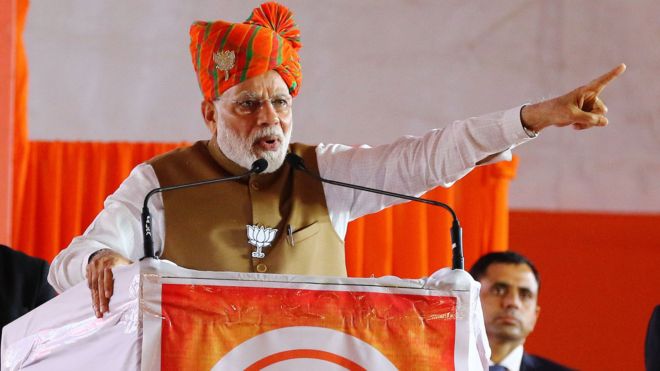
Prime Minister Narendra Modi addressing the election campaign rally ahead the state assembly polls , in Jaipur , Rajasthan, India , Dec 04,2018.Image copyrightGETTY IMAGES

Last week’s electoral losses in five states for India’s ruling party has led to speculation that its agenda of promoting hardline Hindu politics has backfired. The BBC’s Priyanka Pathak reports.

Prime Minister Narendra Modi’s Bharatiya Janata Party (BJP) lost to the main opposition Congress party in the Hindi-speaking heartland states of Madhya Pradesh, Rajasthan and Chhattisgarh, all of which they previously governed. Local parties swept up the other two states – Telangana and Mizoram – putting the BJP in a tough place ahead of general elections next year.

It appears that after winning no less than 13 state elections since coming to power in 2014, the BJP’s seemingly invincible electoral juggernaut is losing steam.

There is a great deal of introspection within and outside the party. And the main question is: has the BJP’s recent pursuit of a hardline Hindu agenda – known locally as Hindutva – backfired? Will a departure from an inclusive, development agenda to a polarising, communal one cost the BJP general election too?

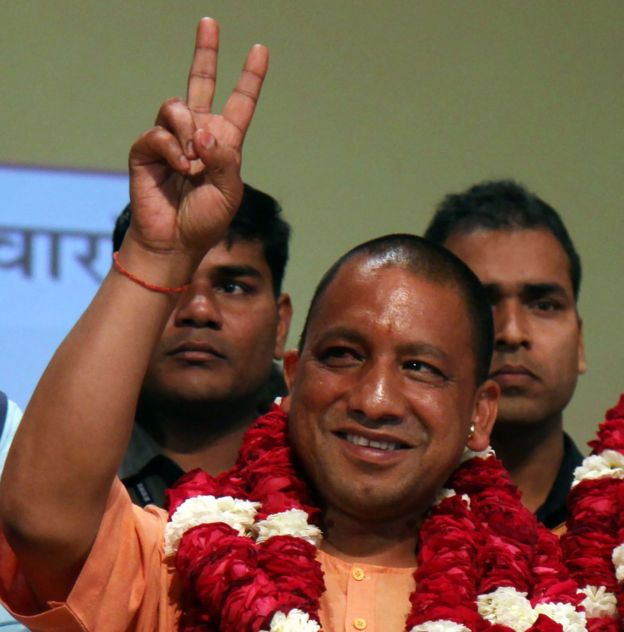
These are legitimate questions because the party deployed the chief minister of the northern state of Uttar Pradesh, Yogi Adityanath, as its star campaigner in the five states that went to polls.

Mr Adityanath is widely considered a controversial figure because of his well-publicised anti-Muslim comments.

He addressed 74 election rallies while Mr Modi, who is usually his party’s star campaigner, addressed just 31.

Adityanath victoryImage copyrightAFP
Image captionYogi Adityanath is seen as a “poster child” for a hardline Hindu agenda

Mr Adityanath also spent the past few months courting the Sangh Parivar – a “family” of Hindu nationalist organisations including the Rashtriya Swayamsevak Sangh (RSS), a hardline Hindu organisation with umbilical ties to the BJP.

The Sangh Parivar also includes the Vishwa Hindu Parishad (VHP), which has been at the forefront of a movement demanding the construction of a Hindu temple on the site of a 16th Century mosque that was torn down by Hindu mobs in 1992, provoking widespread riots that left thousands dead.

Hindus believe Ayodhya, situated in Mr Adityanath’s Uttar Pradesh state, is the birthplace of their revered deity Lord Ram, and say an older temple existed at the site before the mosque was constructed.

Mr Adityanath has announced the construction of a giant statue of Ram in the state, and changed the name of the historical city of Allahabad to the more “Hindu” sounding Prayagraj ahead of the forthcoming Ardh Kumbh Mela, one of the world’s largest religious gatherings.

But if Mr Adityanath was hoping to prove to the VHP leadership that he is a more willing pursuer of the Hindutva agenda and, therefore, a potential alternative to Mr Modi, the recent electoral defeats do not advance his case.

Many observers believe that the BJP’s defeats are because the party deviated from the development agenda that swept them to power in 2014. The pursuit of Hindutva has backfired, they say.

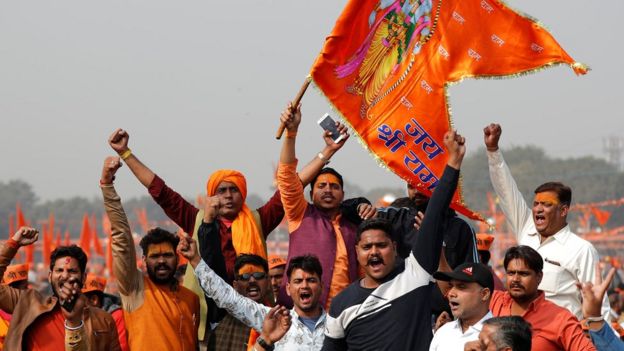
Supporters of the Vishva Hindu Parishad (VHP), a Hindu nationalist organisation, shout religious slogansImage copyrightREUTERS
Image captionHindus believe the disputed religious site of Ayodhya is the birthplace of one of their most revered deities

But some in the Sangh Parivar disagree, insisting that it is actually the opposite that is true. “Just the way people feel disenchanted with the economic policies of the government, the people have also lost faith in this government’s commitment to build the Ram temple. If the VHP and RSS have to come to the street to warn the government about it, what does it tell you? What does it tell the electorate?” one of them said.

Last week, tens of thousands of Hindus gathered in the capital, Delhi, to demand the expedited construction of the temple and criticised the government for failing to do so.

They chanted a striking slogan directly targeting Mr Modi’s stated development-first agenda: “Pehle Ram ko aasan do, phir humko sushasan do (First give Ram a throne, then give us good governance)”.

But it must be noted that while Mr Modi has never openly supported these hardline elements, his silence on issues such as an increasing number of attacks on Muslims over various issues like eating beef – cows are considered sacred in Hinduism and their slaughter is banned in many Indian states – is interpreted as a tacit approval for muscular Hindu politics.

But he now faces pressure to do more.

His government already leads a lacklustre economy. And this renewed pressure to recommit to Hindutva, despite its apparent failure as an electoral agenda, puts Mr Modi’s government in a difficult place.

There is also the fact that the RSS played a vital role in the BJP’s 2014 election victory by mobilising and galvanising voters. They are also credited for Mr Modi’s rise from state chief minister to a national figure. Apart from spearheading a sophisticated online and digital campaign in his favour, cadres also held 600 district-level meetings across the country to make Mr Modi a familiar name among the rural population.

Clearly, they cannot be ignored or offended.

So even as the liberals suggest that Hindutva has backfired and demand that the government refocus on the economy, there are voices within the BJP which are demanding a more strident return to the party’s “core” agenda – including the construction of the Ram temple and renewed focus on efforts to protect cows – to reassure their base that the BJP has not abandoned them.

The less-than-satisfactory economic performance will also make the Hindutva agenda more important, they say.

17/12/2018

Indian forces lock down Kashmir city, hold leaders to stifle protests

SRINAGAR, India (Reuters) – Indian police detained separatist leaders in the disputed Kashmir region on Monday and sealed off roads in an effort to stifle protests against the killing of civilians on the weekend.

An Indian policeman stands guard behind concertina wire laid across a road leading to the Indian army headquarters in Srinagar December 17, 2018. REUTERS/Danish Ismail

Unrest has intensified over recent weeks in the Muslim-majority region at the heart of decades of hostility between India and Pakistan, and seven civilians were killed on Saturday when security forces opened fire at a protest over the killing of three militants.

Separatists leaders Mohammad Yasin Malik and Mirwaiz Umar Farooq said they were detained as they marched towards an army headquarters in Kashmir’s main city of Srinagar. Another leader, Syed Ali Shah Geelani, was under house arrest, police said.

“Indian troops are killing Kashmiris,” Malik told reporters as police in riot gear took him away in a white vehicle. “For the last many years they are on a killing spree.”

A senior police official, who declined to be identified, said Malik and Farooq would be released “once the situation stabilises”.

A spokesman for India’s Ministry of Home Affairs in New Delhi said he had no comment.

Police and para-military forces put up barricades in various parts of Srinagar, including on roads leading to the army headquarters, and were patrolling in force.

The army warned the population against being used to make trouble.

“Army advises people not to fall prey to such designs of anti-national forces,” the army said in a statement late on Sunday.

“It’s an attempt to pit the civilian population against the security forces”.

One soldier was killed in the Saturday violence.

‘DIALOGUE, NOT VIOLENCE’

Shops, government offices and banks were closed in Srinagar and a nearby district and traffic was off the roads. Authorities have also shut down mobile internet and train services.

Slideshow (3 Images)

Pakistan, which like India, claims Kashmir in full but rules it in part, condemned the Saturday killings.

“Only dialogue and not violence and killings will resolve this conflict,” Pakistan Prime Minister Imran Khan said, adding that his country would raise India’s “human rights violations” at the United Nations.

Hindu-majority India accuses Pakistan of training and arming separatist militants operating in Kashmir.

Pakistan denies that saying it only offers political support to the people of the Muslim region who are being denied their rights by India’s security forces.

Indian forces say they have killed 242 militants this year in the region, while 101 civilians and 82 members of the security forces have been killed, making it the bloodiest year in more than a decade.

Meenakshi Ganguly, South Asia director at Human Rights Watch, said Indian authorities should investigate and prosecute those responsible for “indiscriminate use of force”.

“Security forces are aware that villagers gather, protest during gunfights with Kashmir militants and have responsibility to ensure civilians are not at risk,” she said in a tweet.

17/12/2018

‘Carnage of unbelievable proportions’: Delhi High Court convicts Sajjan Kumar for 1984 riots

Sajjan Kumar,anti-Sikh riots case,1984 anti-sikh riots case
Congress’ Sajjan Kumar was convicted today by Delhi High Court in 1984 riots case(PTI)

The Delhi High Court on Monday called the anti-Sikh riots case of 1984 “communal frenzy” after the then prime minister Indira Gandhi was assassinated by her bodyguards as it sentenced Congress leader Sajjan Kumar to life imprisonment in one of the cases.

As it reversed the trial court’s order acquitting Kumar, the court also directed him to surrender by December 31, 2018, and slapped a fine of Rs 5 lakh on him and Rs 1 lakh on all other accused in the case.

The case relates to the murder of five members of a family during the anti-Sikh riots in the Raj Nagar area in the Delhi Cantonment on November 1, 1984.

“What happened in the aftermath of the assassination of the then Prime Minister was carnage of unbelievable proportions in which over 2,700 Sikhs were murdered in Delhi alone. The law and order machinery clearly broke down and it was literally a ‘free for all’ situation which persisted. The aftershocks of those atrocities are still being felt,” justice S Muralidhar and justice Vinod Goel said while handing the 203-page judgement.

Also watch | Congress’ Sajjan Kumar convicted in 1984 Sikh riots case, gets life term 

The judges also quoted a poem by Amrita Pritam on the violence after the Partition in 1947 in India and Pakistan. She escaped to India with her two children from Pakistan’s Lahore.

“She was moved to pen an “Ode to Waris Shah” in which she spoke of the fertile land of Punjab having “sprouted poisonous weeds far and near” and where “Seeds of hatred have grown high, bloodshed is everywhere/Poisoned breeze in forest turned bamboo flutes into snakes/Their venom has turned the bright and rosy Punjab all blue,” they said.

Also read | Congress’ Sajjan Kumar convicted in 1984 Sikh riots, gets life term

“The killings would continue in the streets of Delhi. Thirty-seven years later, the country was again witness to another enormous human tragedy. Following the assassination of Smt. Indira Gandhi, the then Prime Minister of India, on the morning of 31st October 1984 by two of her Sikh bodyguards, a communal frenzy was unleashed.”

‘Political patronage’

The judges recalled the violence in which thousands of Sikhs were killed, some burnt alive, as their houses were destroyed in Delhi and across the country.

“A majority of the perpetrators of these horrific mass crimes, enjoyed political patronage and were aided by an indifferent law enforcement agency … The criminals escaped prosecution and punishment for over two decades.”

“There was an abject failure by the police to investigate the violence which broke out in the aftermath of the assassination of the then Prime Minister Smt. Indira Gandhi is apparent from the several circumstances highlighted hereinabove.”

There was an “utter failure” to register separate first report information in the case of five deaths in which Congress leader Kumar and others were sentenced.

“The failure to record any incident whatsoever in the DDR and the lack of mention of PW-1’s statement therein, amongst other circumstances, established the apathy of the Delhi Police and their active connivance in the brutal murders being perpetrated.

Here is what they also said in the summary of their judgement:

1. This was an extraordinary case where it was going to be impossible to proceed against A-1 in the normal scheme of things because there appeared to be ongoing large-scale efforts to suppress the cases against him by not even recording or registering them. Even if they were registered they were not investigated properly and even the investigations which saw any progress were not carried to the logical end of a charge sheet actually being filed. Even the defence does not dispute that as far as FIR No.416/1984 is concerned, a closure report had been prepared and filed but was yet to be considered by the learned MM.

2. The trial Court completely omitted to address the charge of conspiracy despite detailed arguments submitted by the CBI in that regard. There was a two-pronged strategy adopted by the attackers. First was to liquidate all Sikh males and the other was to destroy their Crl.A. 1099/2013 & Connected Matters Page 200 of 203 residential houses leaving the women and children utterly destitute. The attack on the Raj Nagar Gurudwara was clearly a part of the communal agenda of the perpetrators.

Read | ‘Will pay for sins’: Arun Jaitley targets Congress after Sajjan Kumar conviction

3. The mass killings of Sikhs between 1st and 4th November 1984 in Delhi and the rest of the country, engineered by political actors with the assistance of the law enforcement agencies, answer the description of “crimes against humanity”. Cases like the present are to be viewed in the larger context of mass crimes that require a different approach and much can be learnt from similar experiences elsewhere.

4. Common to the instances of mass crimes are the targeting of minorities and the attacks spearheaded by the dominant political actors facilitated by the law enforcement agencies. The criminals responsible for the mass crimes have enjoyed political patronage and managed to evade prosecution and punishment. Bringing such criminals to justice poses a serious challenge to our legal system. Decades pass by before they can be made answerable. This calls for strengthening the legal system. Neither “crimes against humanity‟ nor genocide‟ is part of our domestic law of crime. This loophole needs to be addressed urgently.

5. The acquittal of A-1 by the trial Court is set aside. He is convicted of the offence of criminal conspiracy punishable under Section 120B read with Sections 302, 436, 295, and 153A (1) (a) and (b) IPC; for the offence punishable under Section 109 IPC of abetting the commission of the aforementioned offences; and for the offence of delivering provocative speeches instigating violence against Sikhs Crl.A. 1099/2013 & Connected Matters Page 201 of 203 punishable under Section 153A (1) (a) and (b) IPC.

15/12/2018

The women in India building a road to a new life

Three years ago, many journeys through villages in India’s Sundarbans Delta were treacherous. Women suffered miscarriages and children’s education was suffering because it was hard for them to get to hospitals and schools.

But then, a group of women decided to take matters into their own hands, by building their own road.

15/12/2018

Is Delhi’s air causing lung cancer?

Air pollution levels in the Indian capital have been rising alarmingly in recent years. Today, in some parts of the city, breathing in the open air equals smoking 20 cigarettes a day.

Go to next video: Hair-raising drive through Delhi smog

15/12/2018

India boy travels 280km to meet cricket idol Navjot Singh Sidhu

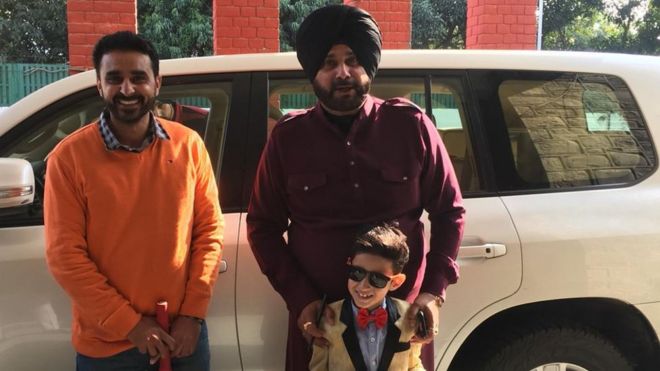
Waris Dhillon's father, Waris Dhillon and Navjot Singh Sidhu
Image captionNavjot Singh Sidhu (R) with Waris Dhillon and his father

A seven-year-old boy in the northern Indian state of Punjab travelled 280km (124 miles) from his home to get an autograph from cricketer turned politician Navjot Singh Sidhu.

Waris Dhillon had begged his father to drive him to Chandigarh city so that he could meet his idol.

Dressed in a gold jacket and red bow tie, Waris waited for six hours before Mr Sidhu signed his cricket bat.

“He is my favourite cricketer,” the boy told BBC Punjabi’s Arvind Chhabra.

Waris waited patiently for his turn on Friday amid the many journalists who had gathered outside the home of Mr Sidhu, who is in charge of three ministries in Punjab.

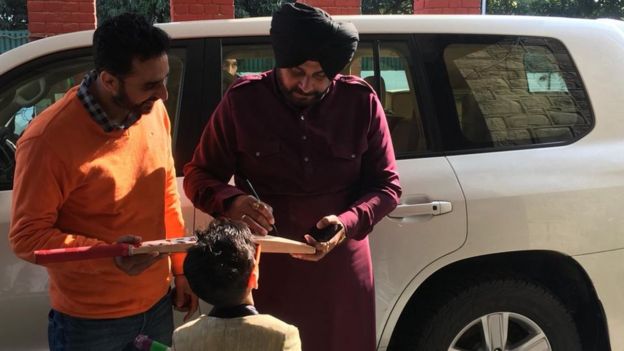
After the crowd dispersed, someone told Mr Sidhu that a “little fan” had been waiting for hours to get an autograph. The politician called him in and hugged him before signing two cricket bats that Waris had brought along.

Waris Dhillon gets his cricket bats signed by Mr Sidhu
Image captionWaris, 7, said he was inspired by Mr Sidhu

“I have been asking my father to take me to meet him for months now,” said Waris, adding that he loves to play cricket and was inspired by Mr Sidhu.

His father said they drove from Bathinda to Chandigarh, which took about six hours, so that Waris could finally meet his cricket idol.

Mr Sidhu played cricket for more than 19 years and rose to fame for his hard-hitting and flamboyant batting skills. After retirement, he became a popular sports commentator, gaining attention for his wisecracks, which are often referred to as Sidhuisms.

He joined politics in 2004 and quickly became known for being outspoken and controversial.

He was convicted in 2006 for manslaughter by a high court in Punjab for beating up a man during a parking dispute. The man later died.

In May 2018, his conviction was overturned by the Supreme Court on appeal.

15/12/2018

Thirteen miners trapped in coal mine in northern India after flooding

GUWAHATI, India (Reuters) – Rescue workers were trying on Friday to reach 13 miners trapped underground in a coal mine in India’s remote northeastern Meghalaya state since the previous day, authorities said.

The mine is an old, illegal so-called rat-hole mine, they said. Rat-hole mines are common in Meghalaya as they are dug by villagers but are very dangerous as the coal is pulled out from narrow, horizontal seams.

Meghalaya Chief Minister Conrad Sangma said authorities had no information on the condition of the miners.

“We are praying that they come out alive,” he told Reuters by telephone from the state capital Shillong.

A flash flood from a nearby river on Thursday raced through the mine, which is located near a dense forest, said Sylvester Nongtngr, police chief of the East Jaintia Hills district of Meghalaya.

Nearly all mines in Meghalaya, which borders Bangladesh, use the rat-hole mining method, even though they are not legal and authorities try to crack down on them.

Workers, often children, descend hundreds of feet on bamboo ladders to dig out the coal from small holes, often leading to accidents.

15/12/2018

Seven dead as Indian police fire on Kashmir protesters

SRINAGAR, India (Reuters) – Seven civilians died and dozens were injured when Indian security forces opened fire at people protesting the killing of three militants in a gun battle in restive Kashmir on Saturday, police said.

People offer the funeral prayers of Zahoor Ahmad, a suspected militant, who according to local media reports was killed during a gun battle with Indian soldiers, in Sirnoo village in south Kashmir’s Pulwama district

December 15, 2018. REUTERS/Danish Ismail


Defence spokesman Colonel Rajesh Kalia said an operation was launched in the morning in response to intelligence reports about the presence of militants in a village in Pulwama district, south of the state’s summer capital Srinagar.

“During the operation militants fired upon troops, leading to a gun battle in which three militants were killed,” he said.

A senior police officer, who was not authorised to speak to the media, said large numbers of local people then gathered at the site, leading to clashes between them and security forces in which seven people were killed and about 50 injured.

An eyewitness, Mohammad Ayuob, told Reuters Indian troops fired at the locals when they tried to retrieve the body of a militant.

Jammu and Kashmir is mainly Hindu India’s only Muslim-majority state. India and Pakistan both rule the region in part but claim in full. India accuses Pakistan of fomenting trouble in its part of Kashmir, a charge Islamabad denies.

The Himalayan state has been particularly tense over the past few months as Prime Minister Narendra Modi’s Hindu nationalist party pulled out of local government, leaving a power void.

Widespread protests have broken out in Srinagar and other parts of Kashmir over the killings. Security has been tightened and troops rushed to potential hotspots. A curfew was imposed in Pulwama town and surrounding areas, according to media reports.

The separatist group Hurriyat Conference called for a three-day strike and protests across Kashmir.

“Bullets and pellets rain!” its Chairman Mirwaiz Omar tweeted, adding that their supporters would march towards an army cantonment on Monday so that the Indian government can “kill all of us at one time rather than killing us daily”.

Authorities have suspended train services in the Kashmir Valley and shut down mobile internet services to try and prevent the unrest from spreading.

Indian security forces say they have killed 242 militants this year. In addition, 101 civilians and 82 security officials have also died, according to officials. The total death toll in violence is the highest in more than a decade.

Law of Unintended Consequences

continuously updated blog about China & India

ChiaHou's Book Reviews

continuously updated blog about China & India

What's wrong with the world; and its economy

continuously updated blog about China & India