Archive for ‘India alert’

23/06/2016

Foreign Direct Investment Into India Jumps 26%, U.N. Says – India Real Time – WSJ

India’s fast-growing economy attracted $44 billion in foreign direct investment in 2015, making it the 10th largest destination globally for such investment last year, according to United Nations figures released this week.

That represents a 26% increase in foreign investment in India over the year before, according to the U.N. Conference on Trade and Development, which published the data in its latest World Investment Report. Prime Minister Narendra Modi has touted the growing stream of overseas money entering India as a signal accomplishment of his two years in office.

The latest U.N. figures suggest in particular that the Modi government’s efforts to encourage more global companies to “Make in India” are reaping some success. Foreign investments worth $28.7 billion in so-called “greenfield” manufacturing projects, or those that start from scratch, were announced in India last year—more than double the $11 billion in investments that were announced in 2014. Electronics manufacturing saw an especially big boost, with $13.5 billion invested in such projects in 2015, compared with $1.1 billion the year before.

The Modi administration has made changes to keep the money coming. Last year it began allowing foreigners to own larger stakes in Indian companies in insurance, construction, mining, manufacturing and others. This week the government announced increases in foreign-investment limits in defense, retail, civil aviation, pharmaceuticals and grocery businesses. The changes, the official press release declared, make India “the most open economy in the world” for foreign direct investment.

Some experts doubt the latest rule changes will cause more money to flood in right away, though, given the degree to which Indian regulations remain vague and regulatory decision-making remains opaque.

India has risen steadily as a host of overseas investment since 2000, when the entirety of foreigners’ stakes in the economy was valued at $16 billion. The same figure last year was $282 billion.

In terms of yearly inflows, the country still ranks far behind mainland China, which lured $136 billion in foreign direct investment in 2015; Hong Kong, which attracted $175 billion; and Singapore, $65 billion. The U.S. was 2015’s top host of investment from abroad: $380 billion of it flowed into the world’s largest economy last year.

Among executives surveyed by the UNCTAD, 19% picked India as the most promising host country for investment over the next few years. Nearly half picked the U.S.; 21% chose China. But world-wide, the U.N. body expects foreign investment flows to dip by 10% to 15% this year. Its surveys indicate that multinational companies are skittish about volatile exchange rates, geopolitical uncertainty and mounting debt in developing countries.

Source: Foreign Direct Investment Into India Jumps 26%, U.N. Says – India Real Time – WSJ

22/06/2016

Cabinet approves auction of mobile phone airwaves – govt source | Reuters

The cabinet approved on Wednesday an auction of mobile phone airwaves, a government source told Reuters.

Earlier this year India’s telecoms ministry had proposed sale of airwaves in the 700 Mhz, 800 Mhz, 900 Mhz, 1800 Mhz, 2100 Mhz, 2300 Mhz and 2500 MHz bands.

India is the world’s second largest mobile phone market by users after China, and a rapid expansion of high-speed 4G services is expected to create demand for additional airwaves.The government is expected to announce details of the auction at a press conference later in the day, the official who did not want to be named, said.

Source: Cabinet approves auction of mobile phone airwaves – govt source | Reuters

22/06/2016

India’s Space Agency Sends 20 Satellites Into Orbit – India Real Time – WSJ

India on Wednesday put 20 satellites into the Earth’s orbit, including 17 from foreign countries, a record number for its space agency as it seeks to become a low-cost and reliable choice for launches.

The successful mission by the Indian Space Research Organisation puts it right after Russia and the U.S. for the number of satellites launched from a single rocket so far, said an ISRO official. In 2014, a single Russian space launch vehicle deployed 33 satellites. A National Aeronautics and Space Administration rocket carried 29 satellites in 2013.

ISRO’s rocket, the Polar Satellite Launch Vehicle, carried its own Cartosat-2 series satellite for earth observation along with 13 satellites from the U.S., two from Canada, one each from Germany and Indonesia and two from Indian academic institutions.

“ISRO continues to break new barriers,” Indian Prime Minister Narendra Modi said on his Twitter account. He said the country’s space program “has time and again shown the transformative potential of science and technology in people’s lives.”

The launch comes as global space agencies face competition from private companies who are aiming to bring down the cost and time for manufacturing and launching satellites by automating their production and using unmanned reusable rockets.

U.S. businessman Greg Wyler has joined hands with Airbus Group SE to build an automated manufacturing facility in Florida that can churn out hundreds of satellites each year. Traditional satellites are built using touch labor. SpaceX, an aerospace startup founded by Elon Musk, successfully landed a rocket on an ocean platform in early May after launching a communications satellite.

India has been fast achieving recognition as a budget option for launching satellites. In 2014, ISRO put a satellite into the orbit of Mars, becoming the first Asian country to reach the red planet, and at fraction of the cost of a similar launch in U.S. and Europe.

In May ISRO launched the test model of its planned reusable space shuttle.  In April, it launched the seventh satellite needed to create its own navigation system, joining a small group of nations with their own versions of GPS.

The global space industry was estimated to be worth $330 billion in 2014, the latest year for which data are available, according to the Space Foundation, a U.S.-based research group. Commercial space activities comprised as much as 76% of the industry, it said.

There were 92 rocket launches in 2014, and Russia continues to hold its leadership in this area with 32 rocket launches, followed by U.S. with 32 and 11 by Europe, the Space Foundation said. It didn’t provide figures for India.Ajay Lele, a senior fellow at New Delhi-based Institute for Defense Studies and Analyses estimates the U.S. has about a 40% share of the global satellite-launching market, while Europe has 25% and Russia 20%. Countries such as China and India have a much smaller share of the market of about 3% percent or less, Mr. Lele said.

ISRO officials said after the launch they want to accelerate the pace of sending satellites into space by extending partnerships with private Indian companies. The space organization has launched more than 57 satellites from about 20 countries on board the PSLV over about two decades.

Source: India’s Space Agency Sends 20 Satellites Into Orbit – India Real Time – WSJ

21/06/2016

India’s suicide farmers’ widows face living death | Reuters

At the age of 24, Joshna Wandile and her two children were thrown out of the house she shared with her in-laws after her farmer husband hanged himself. He left a pile of debts after years of drought laid waste to his land.Wandile is not alone. More than 300,000 farmers have killed themselves in India over the last two decades, leaving their widows battling with the state, moneylenders, in-laws and their communities.

While widows in rural India are often ostracised and abused, farmer widows have it particularly tough, activists said ahead of International Widows’ Day on Thursday.”I had nothing when my husband died – he sold everything in the house, even the cooking vessels, to pay the creditors,” said Wandile who lives in Vidarbha in Maharashtra, among the worst affected by farmers’ suicides.

“I couldn’t even feel sad. I could only think: where will we live? How will I earn enough money? How will I keep us safe?” said Wandile, who was married at 17.

Maharashtra, which is struggling with its worst drought in four decades, accounted for more than half the 5,650 farmer suicides in India in 2014, according to official data. Some estimate last year’s toll exceeded 3,000.

“Bankruptcy or indebtedness” was the most common reason cited. Most were small farmers, with holdings of under two hectares.

There is little information on the families left behind who struggle to claim their right to the land they till and the house they live in, while battling archaic stigmas that dog their every step.

Source: India’s suicide farmers’ widows face living death | Reuters

21/06/2016

Yoga Takes Over the World on Second International Day of Yoga – India Real Time – WSJ

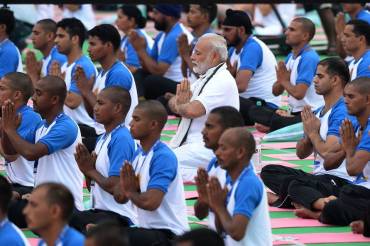
A year after the first International Day of Yoga was celebrated the world over, yoga enthusiasts were back again Tuesday morning lunging forward, raising and stretching their arms, and slowly inhaling and exhaling.

The day was introduced when Indian Prime Minister Narendra Modi successfully lobbied the United Nations to dedicate 24 hours to the ancient discipline in September 2013.This year, Mr. Modi joined thousands of people in the northern Indian city of Chandigarh as they pulled their mats out for a massive demonstration. World over, 173 countries will celebrate the discipline Tuesday.

“We are disconnected from ourselves in today’s times. Yoga helps us reconnect with ourselves,” Mr. Modi said, addressing participants at his event.

On Monday, Mr. Modi also released a set of commermorative postal stamps showing the various steps of the “surya namaskar,” or sun salutation.In India’s capital city, President Pranab Mukherjee conducted a Yoga class at the Rashtrapati Bhavan, his residence-cum-office located in the heart of Delhi.

Images of different Yoga postures were displayed at the headquarters of the United Nations in New York in the build up to Yoga Day.

“Practicing yoga can help raise awareness of our role as consumers of the planet’s resources and as individuals with a duty to respect and live in peace with our neighbours,” said Ban Ki-moon, the UN Secretary-General.

Source: In Pictures: Yoga Takes Over the World on Second International Day of Yoga – India Real Time – WSJ

18/06/2016

India looks to China’s technology for making clouds rain|Government|chinadaily.com.cn

China is in talks with India on the transfer of cloud-seeding technology.In the first such engagement between the Asian giants, a team of scientists and officials from Beijing, Shanghai and East China’s Anhui province, were recently in Maharashtra to discuss weather conditions with the government of the western Indian state, parts of which have experienced severe droughts over the past two years.

line art drawing of cloud seeding.

line art drawing of cloud seeding. (Photo credit: Wikipedia)

The Chinese team’s days-long tour concluded on June 2.If the discussions are successful, Chinese experts would provide training to officials of the Indian Meteorological Department on their latest cloud-seeding technology, according to two sources with knowledge of the matter.

One of the sources had earlier described it as an “exploratory visit by the Chinese side to discuss with relevant Indian authorities how to go about it”.

The training is expected to be given on procedures to seed clouds successfully, the source said.

The training is aimed at inducing rain over Maharashtra’s Marathwada region in the summer of 2017 if needed, the source said.

While summer rains have arrived this year in India, the region has been traditionally vulnerable to drought.

The sources spoke to China Daily on condition of anonymity.

An official in the China Meteorological Administration said that arrangements are still in progress.

The development follows a meeting between Han Zheng, Shanghai’s top official, and Maharashtra chief minister Devendra Fadnavis, in the Indian state’s capital of Mumbai in early May.

Han, who is also a Communist Party of China Politburo member, had asked Fadnavis if China could do anything for drought relief in Maharashtra, one of the sources said.

Monsoons and temperatures nearing 50 C have triggered many agrarian crises in India, with poor farmers being hit the hardest.

Indian media said in April that the Maharashtra government would begin cloud-seeding experiments in June and continue through August – the period of summer monsoons.

China started to use cloud-seeding technology in 1958, and today has one of the most advanced systems in the world.

Source: India looks to China’s technology for making clouds rain|Government|chinadaily.com.cn

18/06/2016

New App Promises to Tell Indian Farmers When to Sow Crops – India Real Time – WSJ

Monsoon season in India has just begun, but farmers in Andhra Pradesh, a southeastern coastal state of India, won’t need to look to the skies to know when to sow their crops.

A new mobile application launched earlier this month and developed by a local agriculture research institute, Microsoft India and the state government tells farmers in the state which week is perfect for sowing seeds, the health of their soil and other indicators.

The app uses rainfall data collected from farms in 13 districts in Andhra Pradesh over 45 years to give farmers a sense of when to start planting, Suhas P. Wani, director of Asia research at the International Crops Research Institute for Semi-Arid Tropics or ICRISAT, a research organization in Hyderabad said.Farmers are asked to register a mobile number with the state government, choose a language–currently limited to the regional Telugu and English–and enter details of the village, district or sub-district.

The advice received could vary from farmer to farmer and from village to village, Mr. Wani said. “The app has crop-specific information such as 10 years of groundnut sowing progress data” to guide farmers who grow specific crops, he added.

He said that constant data on crop yield was being collected on a monthly basis by field officers and sent for evaluation to provide regular forecasts to farmers.

A weather button shows the temperature and rainfall as well as fertilizer recommendations for the day and projection for the next seven days. Additionally, a farmer can get weather alerts for extreme conditions like hailstorms or unseasonal rains that impact crop yields.

Andhra Pradesh logged the highest number of farmer suicides in the country last year. At least 58 farmers took their own lives in the state, according to an agriculture ministry report.

But not every farmer can afford to invest in expensive smartphone technology.

So far, most of the farmers have requested to be sent the information via SMS message. Mr. Wani said once registered, farmers can get the predicted sowing date through SMS. “The main idea behind the application is to help farmers reduce losses by telling when to sow seeds or spray the plants,” he said.

The application will be rolled out in other Indian states next year, based on feedback from farmers in the state, he added.

Source: New App Promises to Tell Indian Farmers When to Sow Crops – India Real Time – WSJ

16/06/2016

Why an Indian Hindu Group Wants a Ministry of Cows – India Real Time – WSJ

Cows have long held a sacred place in India’s society, revered as holy by the country’s predominantly Hindu population. If one group gets its way they might soon have a government department devoted to their interests too.

The cow-protection unit of the right-wing Hindu group Vishva Hindu Parishad (World Hindu Council) is urging Prime Minister Narendra Modi to form a dedicated ministry for the preservation and protection of cows.

“Gou mata (mother cow) is the symbol of life, soul of our culture. She is not being given enough importance,” an official at the Bharatiya Govansh Rakshan Samvardhan Parishad (Indian Cattle Protection and Promotion Council), who didn’t wish to be named, said.

He said the “whole idea is to save the cows from getting killed.” Rearing cows will also increase milk production in the country, he added.

Slaughter of bovines has long been a fraught issue in India, but a renewed push to protect the animals came after a Hindu mob killed a Muslim man in the town of Dadri, 31 miles from New Delhi last September over rumors that he butchered a cow. The murder unleashed a wave of violence and sparked a debate over religious intolerance in the country.

There is no central law on cattle slaughter in India, though various states have introduced their own rules since Mr. Modi took power. A number of states have also tightened restrictions on the consumption of beef.

Minority groups, including around 170 million Muslims, have expressed concern over the clampdown.

The official from the Indian Cattle Protection and Promotion Council said members of his organization plan to meet ministers and members of Mr. Modi’s ruling Bharatiya Janata Party to ask them to take up the issue of a separate cow ministry in the upcoming monsoon session of Parliament, which begins in July.

“Our goal is to restore cows of bharatiya (Hindu) breed back to the country’s economy,” he added.Despite the various bans, India is the world’s largest exporter of beef, according to the U.S. Department of Agriculture. India exported 2.4 million tons of beef last year, compared with 2 million tons by Brazil. India alone accounts for nearly 24% of global beef exports.

India has also ranked first among the world’s milk-producing nations since 1998, according to India’s department of animal husbandry, dairying and fisheries. Milk production in India during the period has gone up from 17 million tons in 1950 to 146.3 million tons till last year, it said.

Source: Why an Indian Hindu Group Wants a Ministry of Cows – India Real Time – WSJ

16/06/2016

India Is Making Progress on Reducing Malnutrition But Now Has a Diabetes Problem – India Real Time – WSJ

While India has dramatically reduced its rate of child malnutrition, a new report points to the increasing burden of diabetes in the world’s second most populous country.

According to the 2016 Global Nutrition Report released Tuesday, India is reducing childhood stunting at double the rate it was a decade ago. Stunting, or low height for age, is caused by insufficient nutrient intake and frequent infections.

“That is highly significant given that India is home to more than one-third of the world’s stunting children,” the study said.

However, the country is facing a new health issue. India has a 9.5% prevalence of diabetes, putting it ahead of the U.K., with 7.8%, and the U.S., with 8.4%, the report showed.

Experts say the high sugar and trans-fat diet Indians consume are a key cause of the growing occurrence of diabetes, which is caused by a deficiency or inability of the body to effectively use insulin. Genetic factors and environmental influences exacerbate the issue.

In April, the WHO said that in India, more men die from diabetes than in any other country. The condition accounted for 2% of all deaths across age groups in India.

As a region, Asia has the highest prevalence of the condition, according to the Global Nutrition Report. Globally, one in 12 people have type 2 diabetes, the report said.“We must stem and tide,” Corinna Hawkes, co-chair of the Global Nutrition Report’s independent expert group said in a statement.

India also has a way to go to reduce stunting. India has the 18th highest prevalence, 38.7% among children under five, of 137 countries included in the Global Nutrition Report. That rate is down from 47.9% recorded a year earlier.

Indian states must set specific targets to help them meet global nutrition goals, while the federal government should devote $6 billion a year to combat nutrition, 13% more than it currently does, the report said.“At current rates of decline, India will achieve the current stunting rates of Ghana or Togo by 2030 and that of China by 2055,” the report said.

Source: India Is Making Progress on Reducing Malnutrition But Now Has a Diabetes Problem – India Real Time – WSJ

16/06/2016

U.S., India and Japan Begin to Shape a New Order on Asia’s High Seas – India Real Time – WSJ

From the waters of the Philippine Sea this week emerged a partial outline of Washington’s vision for a new Asian maritime-security order that unites democratic powers to contend with a more-assertive and well-armed China.

A U.S. Navy aircraft-carrier strike group along with warships from India and Japan jointly practiced anti-submarine warfare and air-defense and search-and-rescue drills in one of the largest and most complex exercises held by the three countries.

The maneuvers were being tracked by a Chinese surveillance vessel, a U.S. Navy officer aboard the carrier USS John C. Stennis said on Wednesday. Last week, China’s Foreign Ministry spokesman Hong Lei said Beijing hoped the training “will be conducive to regional peace, security and stability.

”Washington and Tokyo have long cooperated closely on defense. And the U.S. has been working to deepen strategic ties with India and to encourage New Delhi to play a more active role, not just in the Indian Ocean but also in the Pacific, as China’s rise shifts the regional balance of power.

Americans are looking for those who can share the burden,” said C. Raja Mohan, director of the Carnegie Endowment for International Peace’s India center. A strengthened three-way partnership among the U.S., Japan and India is “an important strategic shift.”

Source: U.S., India and Japan Begin to Shape a New Order on Asia’s High Seas – India Real Time – WSJ

Law of Unintended Consequences

continuously updated blog about China & India

ChiaHou's Book Reviews

continuously updated blog about China & India

What's wrong with the world; and its economy

continuously updated blog about China & India