Archive for ‘India alert’

01/05/2019

Why is a 2,500-year-old epic dominating polls in modern India?

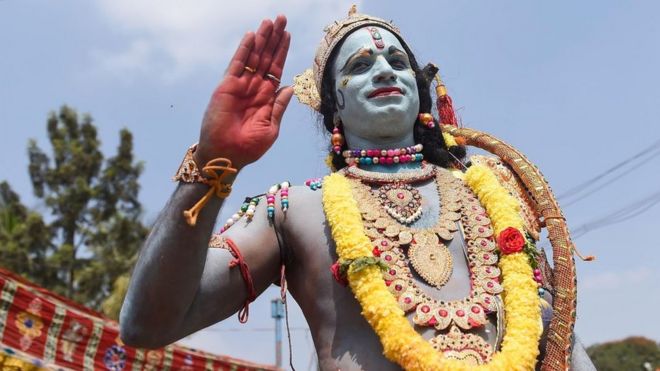
An Indian artist dressed as Lord Rama, a character from a Hindu mythological epic poem entitled Ramayana, gestures during Hanuman Jayanti festival in Bangalore on December 20, 2018.Image copyrightGETTY IMAGES
Image captionMany Hindus see the Ramayana’s protagonist, Ram, as a hero

With the Indian general election under way, the Ramayana, a 2,500-year-old Hindu mythological epic, is back in the spotlight. The BBC’s religious affairs reporter Priyanka Pathak explains why.

This year, like in previous elections, the conversation among many hardline Hindus has returned to the epic Ramayana and its protagonist, Ram.

A longstanding demand to construct a temple in the northern city of Ayodhya – a key point of tension between Hindus and Muslims – which Hindus believe is Ram’s birthplace, has become louder in recent months.

Hardline Hindus want the temple built on the same spot where a 16th Century mosque was demolished by Hindu mobs in 1992. They believe the Babri mosque was built after the destruction of a Hindu temple by a Muslim invader.

India’s Ayodhya site: Masses gather as Hindu-Muslim dispute simmers

The governing Bharatiya Janata Party (BJP) has promised, once again, to reconstruct the Ram Mandir (temple) in its election manifesto.

Like in previous elections, they hope that this pledge will draw in more Hindu voters. They also organised Hindu religious festivals on a grand scale in the lead-up to the polls.

On 12 April, a large gathering of right-wing organisations was held at the iconic Ram Lila Maidan, a sprawling ground named after the god in the centre of the capital, Delhi, to celebrate “Ram’s birthday”.

People dressed in saffron robes wielded swords as they chanted “Jai Shree Ram”, which translates from the Hindi to “Hail Lord Ram”. They shouted slogans, reiterating their promise to Ram that they would reconstruct the temple.

Presentational grey line

What is the story of the Ramayana?

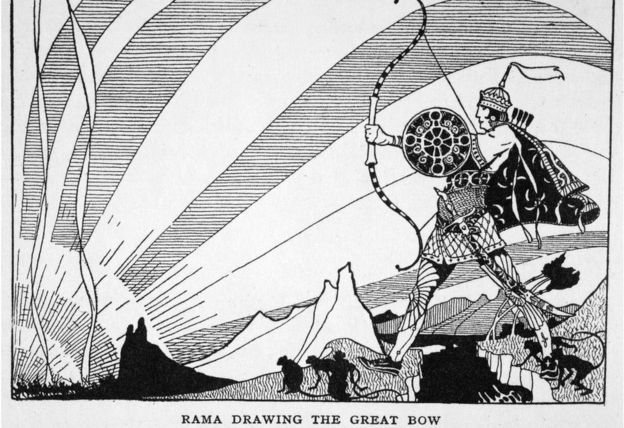
Rama Drawing the Great Bow', 1925. A scene form the Hindu epic poem the Ramayana. Rama preparing to fire the Brahmastra in his final victorious battle with the demon-king Ravana.Image copyrightHERITAGE IMAGES/GETTY
  • The epic tells the story of Ram, a beloved prince who is unaware of his own divinity
  • On the eve of his coronation, he is banished from his kingdom for 14 years by his father at the behest of his stepmother
  • With his wife, Sita, and brother, Lakshman, he wanders through India’s forests – until the 10-headed demon king Ravana abducts Sita
  • Ram then fights and defeats Ravana to rescue Sita after which he establishes a just kingdom
  • The story of Ram’s pursuit of righteousness has made him a symbol of self-sacrifice and heroism for many Hindus
  • He is why this epic remains potent and has dominated India’s political discourse
Presentational grey line

Experts believe that the movement to build the temple, spearheaded by a powerful Hindu nationalist organisation called the Rashtriya Swayamsevak Sangh (RSS), has helped craft some sort of a collective Hindu identity in India.

This idea is something that the RSS, the ideological fountainhead of the BJP, has cultivated since the early 20th Century.

However, the movement found its zeitgeist moment only a century later.
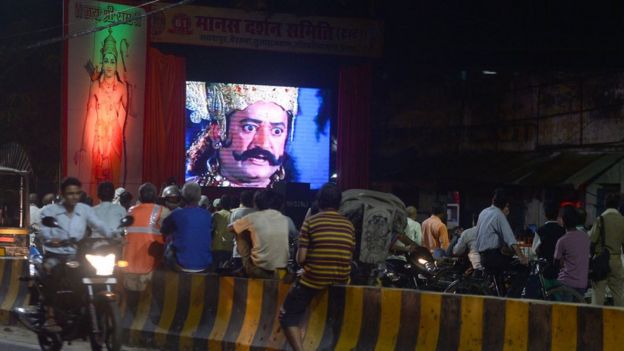
People sit along the road side watching an Indian epic television series of Ramayana, the story of the battle of Hindu god Rama over the demon king Ravana, as they celebrate Navratri (Nine Nights) culminating on the tenth night with the Dusshhra festival depicting the victory of Good over Evil, in Allahabad on September 25, 2017Image copyrightGETTY IMAGES
Image caption People in Ahmedabad city sitting along the road and watching a television series on the Ramayana

Several things happened almost concurrently during the late 1980s. First, a television show on the epic reminded 80 million viewers of the story and rekindled a love for its hero.

The serial broadcast a standardised story of the Ramayana, pulled together from many versions and variants. There is no official version of this sprawling epic although historical scholars consider the version by Valmiki, a sage and Sanskrit poet, to be the most authentic.

But really there are as many as 3,000 retellings of the story in around 22 languages, including some that eulogise Ravana while others say it was actually Ram’s brother Lakshman who killed the demon king.

Presentational grey line

India votes 2019

Presentational grey line

But what the television show did was give India a single narrative of the Ramayana. It also gave a single religion to a country “that was diverse and plural and included many different ways to be Indian”, says Arshia Sattar, a doctorate in south Asian languages, who has translated Valmiki’s Ramayana from Sanskrit into English.

The second big moment came in the late 1980s, when the Congress party led by Rajiv Gandhi – which has always styled itself as secular – decided to lay the foundation stone of the temple in Ayodhya with the help of Vishwa Hindu Parishad (VHP), a right-wing outfit, to woo Hindu votes in a close election.

The plan didn’t work – instead, it paved the way for the BJP, still a young party at the time, to seize what they saw as an opportunity to galvanise Hindu voters.

In September 1989, the party’s then president LK Advani launched a nationwide march for the temple. Bricks began to move from around India for the construction of the temple. The campaign was successful in mobilising communal sentiments and set in motion a series of events that would result in the demolition of the mosque. This, in turn, triggered nationwide riots.
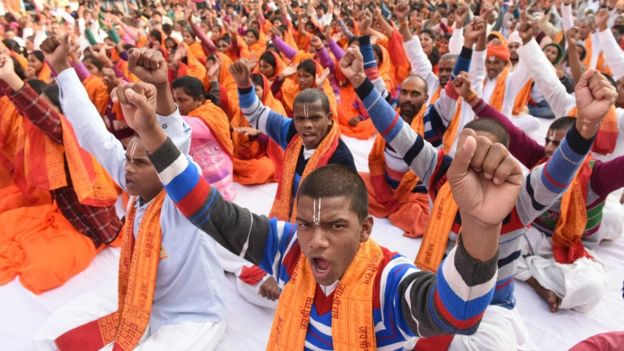
VHP saints at Karsevak Puram taking park in Hindu Swabhiman Sammelan organized by the VHP to mark 25th anniversary Babri Masjid demolition, on December 6, 2017 in AyodhyaImage copyrightGETTY IMAGES
Image captionHindu activists are demanding the construction of the Ram Temple

But in the next elections, the BJP swept the polls. From that moment forward, the party – which was 12 years old at the time – became a national heavyweight.

It took its place as either the party leading the ruling government alliance or as the leading opposition party. For the BJP, the Ayodhya issue became a way to consolidate Hindu votes – something that used to be fragmented along caste lines.

This now well-known version of the epic, championing Ram, also became a convenient point for other Hindu organisations to rally around. This meant that other versions of the epic began to be stamped out.

For instance, in 2011, a Hindu nationalist student union and other affiliated right-wing groups succeeded in forcing Delhi University to drop an essay by the late poet and Ramayana scholar AK Ramanujan, which questioned how many versions of the epic existed, from its history curriculum.

“This may have been part of the general climate of intolerance and the battle over who had the right to tell the country’s history and its myths that was part of the Indian landscape between the 1980s and the 2000s,” literary critic and author Nilanjana Roy wrote of the incident in her blog in 2011.
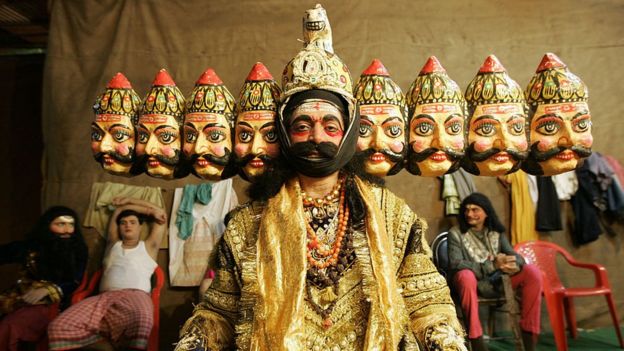
An artist dressed up as th 10 faced Ravana from the mythological Ramayana at Shivaji Park for a Ram Lila show on the occasion of Dassera.Image copyrightGETTY IMAGES
Image captionRam fights and defeats the ten-headed demon Ravana in the Hindu epic

But for hardline Hindus, the cultural loss of other versions is simply collateral damage.

They believe that a sort of Hindu renaissance can be built around the epic, allowing Hindus to band together and revive their religion as a way of life that they believe was lost and can be re-established.

For instance, in September 2017, the Uttarakhand state minister for alternative medicine, proposed spending $3.6m (£2.8m) to find Sanjeevani – a mythical, glow-in-the-dark herb, described in the epic as having saved Ram and Lakshman from certain death.

The deputy chief minister of Uttar Pradesh has also suggested that science was so advanced during the time of the Ramayana that Sita was actually a test-tube baby. And the vice chancellor of an Indian university has claimed that Ravana, had a fleet of airplanes.

A series of such examples from Indian politicians and scholars can be seen as an attempt to bolster pride in the mythological epic. But they also evoke a nostalgia for a grand past, reawakening hope for a future that repeats the great feats of distance ancestors.

Source: The BBC

01/05/2019

India’s Nayara Energy closes $750 million pre-pay with Trafigura, BP

LONDON (Reuters) – Russian-backed Indian refiner Nayara Energy has completed a long-term pre-payment deal with BP and global commodities trader Trafigura for $750 million (£573 million), Nayara’s chief executive said on Wednesday.

The deal, backed by a consortium of international banks, will see the two firms repaid with future gasoline and gasoil over the next four years.

Pre-payments are one the financing mechanisms frequently used in the oil industry.

The total is half the amount originally targeted but is key for asserting the firm’s independence after being previously owned by the debt-laden Essar Group which was wholly dependent on local lenders.

“Nayara Energy is continually looking for innovative opportunities to develop a robust financing framework to strengthen its balance sheet,” CEO B. Anand said in a statement.

“This is truly a benchmark transaction and yet another milestone in our journey towards achieving financial excellence.”
Trafigura and BP closed two similar deals over shorter periods worth $1.45 billion last year.
Nayara, formerly Essar Oil, was taken over by a consortium led by Russian oil major Rosneft in 2017. Rosneft owns 49.13 percent of Nayara, while Russian fund UCP and Geneva-based Trafigura together own a similar share.
The consortium acquired a 400,000 barrel-per-day refinery in Vadinar as well as a port, power plant and 3,500 fuel stations for nearly $13 billion.
Earlier this year, the refiner said it would invest $850 million to build a new refinery and petrochemical plant.
Source: Reuters
01/05/2019

15 commandos, driver killed in blast by Maoists in Maharashtra’s Gadchiroli

Just when the two vehicles of the security forces were passing through the Dadapur Road in Gadchiroli, Maoists triggered the explosion.

INDIA Updated: May 01, 2019 15:36 IST

Pradip Kumar Maitra
Pradip Kumar Maitra
Hindustan Times, Nagpur
Maoists,Gadchiroli,maoists
The improvised explosive device (IED) blast in Gadchiroli targeted a vehicle carrying security personnel.(HT Photo)
Fifteen jawans of C-60, an anti-Maoist squad of Gadchiroli police, and a driver were killed in a powerful landmine blast on Wednesday on Dadapur Road in Gadchiroli district, Maharashtra.
The explosion occurred this afternoon when the jawans were out on an operation. Just when the two vehicles of the security forces were passing through the Dadapur Road towards Korchi, located about 250 km from Nagpur, the Maoists triggered the blast.
Many jawans were also injured in the incident. The improvised explosive device (IED) blast is believed to be a retaliation after 40 Maoists were gunned down by security forces on April 22 last year near Bhamragarh in the district.
Officials said reinforcements have been rushed to the spot and the injured have been shifted to a civil hospital in Gadchiroli.
Prime Minister Narendra Modi condemned the attack on security personnel. “Strongly condemn the despicable attack on our security personnel in Gadchiroli, Maharashtra. I salute all the brave personnel. Their sacrifices will never be forgotten. My thoughts & solidarity are with the bereaved families. The perpetrators of such violence will not be spared,” PM Modi tweeted.

Also read: BJP legislator, 4 security personnel killed in Maoist attack in Dantewada

Earlier in the day, Maoists torched at least three dozen vehicles belonging to private contractors in Kurkheda, Gadchiroli.

The incidents took place on a day the state is celebrating its foundation day, Maharashtra Day. The Maoists were in the final stages of observing a week-long protest to mark the first anniversary of 40 of their men who were gunned down by security forces on April 22, 2018.

The targeted vehicles were engaged in construction works for the Purada-Yerkad sector of National Highway 136 near Dadapur village.

Last month, a BJP legislator and four others were killed when Maoists attacked their convoy in Chhattisgarh’s Bastar. The incident happened on April 9, just two days before the region votes in the first phase of the 2019 general election.

Source: Hindustan Times

29/04/2019

China’s quest for clean energy heats up with groundbreaking ‘artificial sun’ project

    • Fusion reactor built by Chinese scientists in eastern Anhui province has notched up a series of research firsts
    • There are plans to build a separate facility that could start generating commercially viable fusion power by 2050, official says
    The Experimental Advanced Superconducting Tokamak (EAST) device – or “artificial sun” – in Hefei, Anhui province. Photo: AFP/Chinese Academy of Sciences
    The Experimental Advanced Superconducting Tokamak (EAST) device – or “artificial sun” – in Hefei, Anhui province. Photo: AFP/Chinese Academy of Sciences
    A groundbreaking fusion reactor built by Chinese scientists is underscoring Beijing’s determination to be at the core of clean energy technology, as it eyes a fully functioning plant by 2050.
    Sometimes called an “artificial sun” for the sheer heat and power it produces, the doughnut-shaped Experimental Advanced Superconducting Tokamak (EAST) that juts out on a spit of land into a lake in eastern Anhui province, has notched up a succession of research firsts.
    In 2017 it became the world’s first such facility to sustain certain conditions necessary for nuclear fusion for 
    longer than 100 seconds

    , and last November hit a

    personal-best temperature

    of 100 million degrees Celsius (212 million Fahrenheit) – six times as hot as the sun’s core.

    Such mind-boggling temperatures are crucial to achieving fusion reactions, which promise an inexhaustible energy source.

    EAST’s main reactor stands within a concrete structure, with pipes and cables spread outward like spokes connecting to a jumble of censors and other equipment encircling the core. A red Chinese flag stands on top of the reactor.

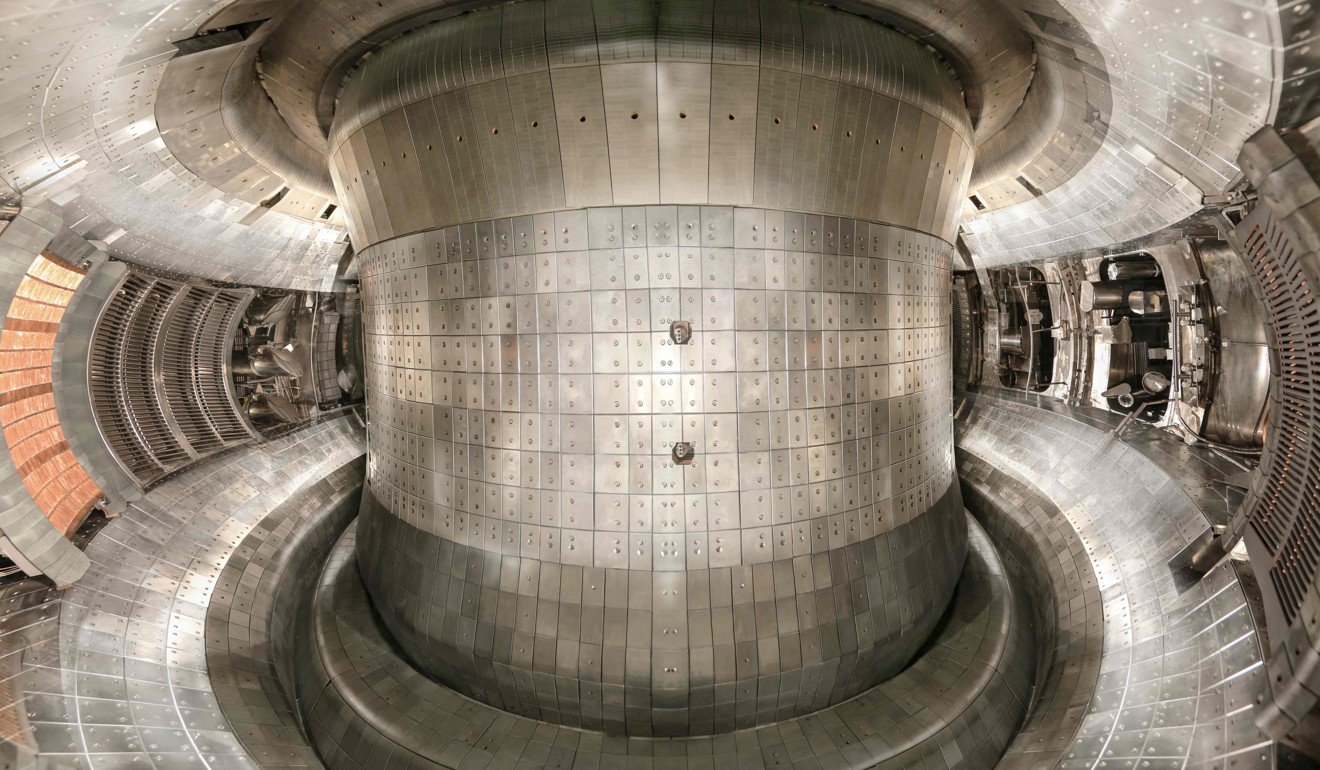
    A vacuum vessel inside the fusion reactor, which has achieved a temperature of 100 million degrees Celsius – six times as hot as the sun’s core. Photo: AFP/Chinese Academy of Sciences
    A vacuum vessel inside the fusion reactor, which has achieved a temperature of 100 million degrees Celsius – six times as hot as the sun’s core. Photo: AFP/Chinese Academy of Sciences

    “We are hoping to expand international cooperation through this device [EAST] and make Chinese contributions to mankind’s future use of nuclear fusion,” said Song Yuntao, a top official involved in the project, on a recent tour of the facility.

    China is also aiming to build a separate fusion reactor that could begin generating commercially viable fusion power by mid-century, he added.

    Some 6 billion yuan (US$891.5 million) has been promised for the ambitious project.

    EAST is part of the International Thermonuclear Experimental Reactor (ITER) project, which seeks to prove the feasibility of fusion power.

    Funded and run by the European Union, India, Japan, China, Russia, South Korea and the United States, the multibillion-dollar project’s centrepiece will be a giant cylindrical fusion device, called a tokamak.

    Now under construction in Provence in southern France, it will incorporate parts developed at the EAST and other sites, and draw on their research findings.

    China is “hoping to expand international cooperation” through EAST. Photo: Reuters
    China is “hoping to expand international cooperation” through EAST. Photo: Reuters

    Fusion is considered the Holy Grail of energy and is what powers our sun.

    It merges atomic nuclei to create massive amounts of energy – the opposite of the fission process used in atomic weapons and nuclear power plants, which splits them into fragments.

    Unlike fission, fusion emits no greenhouse gases and carries less risk of accidents or the theft of atomic material.

    But achieving fusion is both extremely difficult and prohibitively expensive – the total cost of ITER is estimated at 20 billion (US$22.3 billion).

    Wu Songtao, a top Chinese engineer with ITER, conceded that China’s technical capabilities on fusion still lag behind more developed countries, and that US and

    Japanese tokamaks have achieved more valuable overall results.

    But the Anhui test reactor underlines China’s fast-improving scientific advancement and its commitment to achieve yet more.

    China’s capabilities “have developed rapidly in the past 20 years, especially after catching the ITER express train”, Wu said.

    In an interview with state-run Xinhua news agency in 2017, ITER’s director general Bernard Bigot lauded China’s government as “highly motivated” on fusion.

    “Fusion is not something that one country can accomplish alone,” Song said.

    “As with ITER, people all over the world need to work together on this.”

Source: SCMP

29/04/2019

Police break up clashes in West Bengal, Mumbai votes in fourth phase of massive poll

MUMBAI/NEW DELHI (Reuters) – Police broke up clashes between rival groups of voters in West Bengal on Monday as some of India’s richest families and Bollywood stars also cast their ballots in Mumbai during the fourth phase of a massive, staggered general election.

In West Bengal, a populous eastern state crucial for Prime Minister Narendra Modi’s re-election bid, supporters of his Hindu nationalist Bharatiya Janata Party (BJP) clashed with others from the regional Trinamool Congress, police said.

TV footage showed armed security forces chasing away people wielding sticks, although it was initially difficult to determine the scale of the clashes.

There were no immediate reports of any poll-related injuries in West Bengal, where at least one person was killed and three injured during the third phase of voting last week.

The BJP is in a direct, and sometimes bloody, fight in West Bengal with Trinamool, whose chief Mamata Banerjee is one of Modi’s biggest critics and a potential prime ministerial candidate.

More than 127 million people are eligible to vote in this round of the seven-phase election held across 71 seats in nine states. Modi’s coalition won more than 75 percent of the seats in the previous election in 2014.

Many of the constituencies are in Uttar Pradesh in the north and western India’s Maharashtra, where the financial capital Mumbai is located. Uttar Pradesh elects the most lawmakers, with Maharashtra next. Both states are ruled by the BJP and its allies.
However, political analysts say the BJP may struggle to repeat its strong showing this time due mainly to a jobs shortage and weak farm prices, issues upon which the main opposition Congress party has seized.

‘SOME PROGRESS’

First-time voter Ankita Bhavke, a college student in Mumbai, said she voted for economic development.

“I want the country to be at par with the best in the world,” she said. “There’s been some progress in the last five years.”

India’s financial markets were closed on Monday for the election.

Mumbai is home to the massive Hindi film industry, as well as Asia’s wealthiest man, Mukesh Ambani, and India’s richest banker, Uday Kotak.
Ambani, who heads Reliance Industries, and Kotak, managing director of Kotak Mahindra Bank, created a stir this month by publicly endorsing an opposition Congress party candidate from their upscale South Mumbai constituency.
Mumbai, which has six seats, is India’s wealthiest city but ageing and insufficient infrastructure is a major concern. Six people were killed last month when part of a pedestrian bridge collapsed, recalling memories of a 2017 rush-hour stampede that killed at least 22 people on a narrow pedestrian bridge.
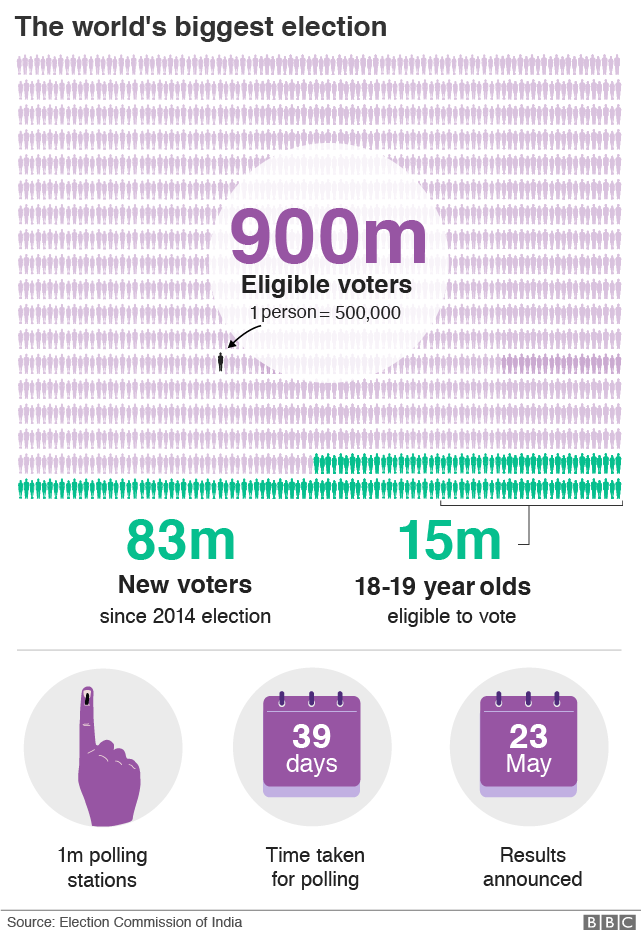
The election, the world’s biggest democratic exercise with about 900 million voters, started on April 11 with Modi in the lead amid heightened tension with long-time enemy Pakistan.
The last phase of voting is on May 19, with results released four days later.
There are a total of 545 seats in the Lok Sabha.
Modi sent warplanes into Pakistan in late February in response to a suicide attack by an Islamist militant group based there that killed 40 Indian police in the disputed Kashmir region.
Modi has sought votes on his tough response towards militancy and in recent days has evoked the deadly Easter Sunday bombings in nearby Sri Lanka.
Maidul Islam, a professor of political science at Kolkata’s Centre for Studies in Social Sciences, said long queues outside polling stations would indicate whether Modi’s national security pitch was working.
“Whenever there is a BJP kind of a wave, you see a higher voter turnout,” he said.
Source: Reuters
29/04/2019

Cyclone Fani may be headed to Odisha; NDRF, Coast Guard on alert

The NDRF and the Indian Coast Guard have been put on high alert and placed at the disposal of the state governments concerned.

INDIA Updated: Apr 29, 2019 14:37 IST

HT Correspondent
HT Correspondent
New Delhi
Cyclone fani,NDRF,Coast Guard
Representational Image(REUTERS File)

The NDRF and the Indian Coast Guard have been put on high alert and fishermen asked not to venture into the sea, the Home Ministry said Monday.

According to the India Meteorological Department (IMD), its landfall over Tamil Nadu and Andhra Pradesh is ruled out. However, the possibility of landfall in Odisha is under continuous watch.

On Monday morning, it was located at 880 km of South-East of Chennai and it will continue to move North-West and change its path to North-East from Wednesday.

The National Disaster Response Force (NDRF) and the Indian Coast Guard have been put on high alert and placed at the disposal of the state governments concerned. Regular warnings have been issued since April 25 to fishermen not to venture into the sea and asking those at sea to return to coast, it said.

The IMD has been issuing three hourly bulletins with latest forecast to all the states concerned and the home ministry is also in continuous touch with the state governments and the central agencies concerned, the statement said.
Source: Hindustan Times
28/04/2019

A really simple guide to India’s general election

Indian electionsImage copyright GETTY IMAGES

It is an election like no other. Those eligible to vote in India’s upcoming polls represent more than 10% of the world’s population and they will take part in the largest democratic exercise in history.

Voters will choose representatives for the Indian parliament, and in turn decide if Hindu nationalist Prime Minister Narendra Modi will run the country for another five years.

What is at stake?

Whoever wins these elections and forms a government will control the destiny of the world’s largest democracy.

While they are in charge,  is likely to overtake the UK’s and become the world’s fifth-largest.

Its population meanwhile – at more than 1.34bn people – is predicted to soon surpass China’s 1.39bn.

Hundreds of millions of Indians have escaped  since the turn of the millennium but huge challenges remain.

 is a major concern and is especially high among young people.

Millions of  about low crop prices.

How the nuclear-armed country engages with the outside world – and manages a tricky  – is also of immense importance to international security.

Graphic: The immense scale of India's elections

Who is being elected?

Indians are voting for members of parliament and the job of prime minister tends to go to the leader of the party or coalition with most seats. The current PM is .

His main rival is opposition leader .

Parliament has two houses: the Lok Sabha and the .

The lower house –  – is the one to watch.

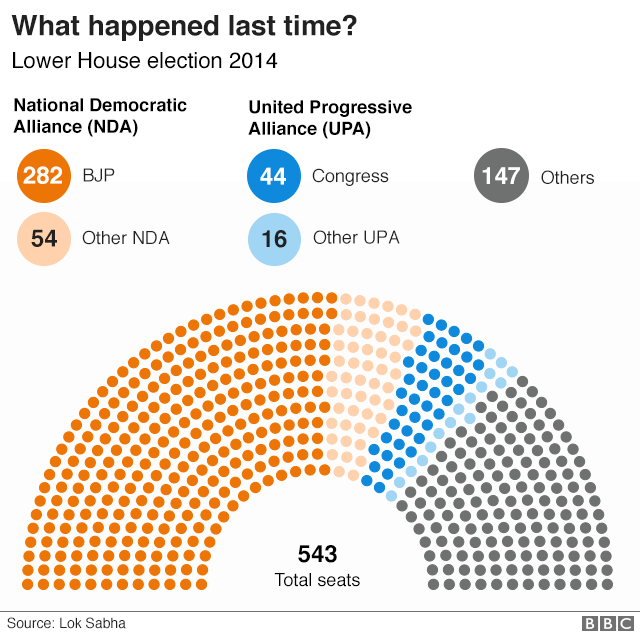
It has 543 elected seats and any party or coalition needs a minimum of 272 MPs to form a government.

At the last election in 2014, Mr Modi’s  won 282 seats.

Mr Gandhi’s  only took 44 seats in 2014 – down from 206 in 2009.

Graphic: The battle for the Lower House of the Indian Parliament

Why does voting take so long?

Because of the enormous number of election officials and security personnel involved, voting will take place in seven stages between 11 April and 19 May.

Different states will vote at different times.

Votes will be counted on 23 May and results are expected on the same day.

Who will win?

This election is being seen as a referendum on Mr Modi, a polarising figure adored by many but also accused of stoking divisions between  and the country’s 200 million Muslims.

Until a few months ago, Mr Modi and his BJP party were seen as the overwhelming favourites. But the  in December’s regional elections injected a sense of serious competition into the national vote.

Analysts are divided on whether Mr Modi will be able to win a simple majority again.

A recent escalation of tensions with Pakistan has given the BJP a new and popular issue to campaign on.

It will be hoping that a focus on patriotism will help the party to get past the serious challenge mounted by powerful regional parties and Congress.

Source: The BBC

27/04/2019

PepsiCo sues four Indian farmers for using its patented Lay’s potatoes

AHMEDABAD/NEW DELHI (Reuters) – PepsiCo Inc has sued four Indian farmers for cultivating a potato variety that the snack food and drinks maker claims infringes its patent, the company and the growers said on Friday.

Pepsi has sued the farmers for cultivating the FC5 potato variety, grown exclusively for its popular Lay’s potato chips. The FC5 variety has a lower moisture content required to make snacks such as potato chips.

The company is seeking more than 10 million rupees (£110,669) each for alleged patent infringement.

The farmers grow potatoes in the western state of Gujarat, a leading producer of India’s most consumed vegetable.

“We have been growing potatoes for a long time and we didn’t face this problem ever, as we’ve mostly been using the seeds saved from one harvest to plant the next year’s crop,” said Bipin Patel, one of the four farmers sued by Pepsi.

Patel did not say how he came by the PepsiCo variety.

A court in Ahmedabad, the business hub of Gujarat, on Friday agreed to hear the case on June 12, said Anand Yagnik, the farmers’ lawyer.

“In this instance, we took judicial recourse against people who were illegally dealing in our registered variety,” a PepsiCo India spokesman said.

“This was done to protect our rights and safeguard the larger interest of farmers that are engaged with us and who are using and benefiting from seeds of our registered variety.”

PepsiCo, which set up its first potato chips plant in India in 1989, supplies the FC5 potato variety to a group of farmers who in turn sell their produce to the company at a fixed price.

The company said the four farmers could join the group of growers who exclusively grow the FC5 variety for its Lay’s potato chips.

“PepsiCo India has proposed to amicably settle with the people who were unlawfully using the seeds of its registered variety. PepsiCo has also proposed that they may become part of its collaborative potato farming programme,” the company spokesman said in a statement.

If the farmers do not wish to grow the FC5 potato variety for PepsiCo, they can simply sign an agreement with the company to cultivate other available varieties, he added.

The All India Kisan Sabha, or All India Farmers’ Forum, has asked the Indian government to protect the farmers.

The forum has also called for a boycott of Lay’s chips and PepsiCo’s other products.

The Ministry of Agriculture & Farmers’ Welfare did not immediately respond to an email seeking comment.

PepsiCo is the second large U.S. company to face patent infringement issues in India.
Stung by a long-standing intellectual property dispute, seed maker Monsanto, now owned by German drugmaker Bayer AG, withdrew from some businesses in India over a cotton-seed dispute with farmers, Reuters reported in 2017. (reut.rs/2ncBknn)
Source: Reuters
25/04/2019

Indian officials travel deep into jungle to allow one temple priest to vote

NEW DELHI (Reuters) – Indian officials travelled nearly 70 km (45 miles) through lion-infested jungle this week to ensure a 69-year-old holy man got his chance to take part in the world’s biggest democratic exercise.

A four-member team of election officials, accompanied by a policeman, set up a special polling station deep in the Gir wildlife sanctuary in Gujarat state so a sole voter – Bharatdas Darshandas – could vote in the general election.

A priest who has lived at his remote forest temple for two decades, Darshandas has not missed an election since 2002, and cast his vote on Tuesday by walking nearly a kilometre to the special polling station.

Darshandas looks after a Shiva Temple in the 350 square kilometre (850-square-mile) wildlife sanctuary, home to some 600 of the last remaining Asiatic lions.

India has more than 900 million eligible voters who can cast their ballots at 1 million polling stations.

Officials often have to travel to remote regions over days to get to voters. But an arduous trip for just one voter is not so common.

“The fact that the government is taking so much effort to ensure the casting of one vote speaks to the importance of each and every vote,” Darshandas told Reuters partner ANI in an interview.

“Just the way voting is 100 percent in Banej, there should be 100 percent voting everywhere,” Darshandas said, referring to the place he lives.

The staggered general election has seven phases. It began on April 11 and will end on May 19. Votes will be counted on May 23.

Sourabh Pardhi, an election official from the area, said the Election Commission had worked hard to ensure everyone got a chance to vote.

“We want to make sure that no voter is left behind,” he told ANI.
Source: Reuters
25/04/2019

Exclusive: In rare move, French warship passes through Taiwan Strait

WASHINGTON (Reuters) – A French warship passed through the strategic Taiwan Strait this month, U.S. officials told Reuters, a rare voyage by a vessel of a European country that is likely to be welcomed by Washington but increase tension with Beijing.

The passage, which was confirmed by China, is a sign that U.S. allies are increasingly asserting freedom of navigation in international waterways near China. It could open the door for other allies, such as Japan and Australia, to consider similar operations.

The French operation comes amid increasing tensions between the United States and China. Taiwan is one of a growing number of flashpoints in the U.S.-China relationship, which also include a trade war, U.S. sanctions and China’s increasingly muscular military posture in the South China Sea, where the United States also conducts freedom of navigation patrols.

Two officials, speaking on condition of anonymity, said a French military vessel carried out the transit in the narrow waterway between China and Taiwan on April 6.

One of the officials identified the warship as the French frigate Vendemiaire and said it was shadowed by the Chinese military. The official was not aware of any previous French military passage through the Taiwan Strait.

The officials said that as a result of the passage, China notified France it was no longer invited to a naval parade to mark the 70 years since the founding of China’s Navy. Warships from India, Australia and several other nations participated.

China said on Thursday it had lodged “stern representations” with France for what it called an “illegal” passage.

“China’s military sent navy ships in accordance with the law and the rules to identify the French ship and warn it to leave,” defence ministry spokesman Ren Guoqiang told a regularly scheduled media briefing, while declining to say if the sailing had led to the withdrawal of France’s invitation to the parade of ships this week.

“China’s military will stay alert to firmly safeguard China’s sovereignty and security,” he said.

Colonel Patrik Steiger, the spokesman for France’s military chief of staff, declined to comment on an operational mission.

The U.S. officials did not speculate on the purpose of the passage or whether it was designed to assert freedom of navigation.

MOUNTING TENSIONS

The French strait passage comes against the backdrop of increasingly regular passages by U.S. warships through the strategic waterway. Last month, the United States sent Navy and Coast Guard ships through the Taiwan Strait.

The passages upset China, which claims self-ruled Taiwan as part of its territory. Beijing has been ramping up pressure to assert its sovereignty over the island.

Chen Chung-chi, spokesman for Taiwan’s defence ministry, told Reuters by phone the strait is part of busy international waters and it is “a necessity” for vessels from all countries to transit through it. He said Taiwan’s defence ministry will continue to monitor movement of foreign vessels in the region.

“This is an important development both because of the transit itself but also because it reflects a more geopolitical approach by France towards China and the broader Asia-Pacific,” said Abraham Denmark, a former U.S. deputy assistant secretary of defence for East Asia.

The transit is a sign that countries like France are not only looking at China through the lens of trade but from a military standpoint as well, Denmark said.

Last month, France and China signed deals worth billions of euros during a visit to Paris by Chinese President Xi Jinping. French President Emmanuel Macron wants to forge a united European front to confront Chinese advances in trade and technology.

Source: Reuters

Law of Unintended Consequences

continuously updated blog about China & India

ChiaHou's Book Reviews

continuously updated blog about China & India

What's wrong with the world; and its economy

continuously updated blog about China & India