Chindia Alert: You’ll be Living in their World Very Soon
aims to alert you to the threats and opportunities that China and India present. China and India require serious attention; case of ‘hidden dragon and crouching tiger’.
Without this attention, governments, businesses and, indeed, individuals may find themselves at a great disadvantage sooner rather than later.
The POSTs (front webpages) are mainly 'cuttings' from reliable sources, updated continuously.
The PAGEs (see Tabs, above) attempt to make the information more meaningful by putting some structure to the information we have researched and assembled since 2006.
Image copyrightREUTERSImage caption This year marks the 30th anniversary of the pro-democracy protests
A promotional video for camera company Leica has sparked backlash in China for featuring a famous Tiananmen Square image.
The video depicts photographers working in conflicts around the world, including a photographer covering the 1989 protests.
People on Chinese social media site Weibo have called for a boycott of the camera brand.
Leica has distanced itself from the video.
“Tank Man” was a lone protester who brought a column of tanks to a standstill during a crackdown on pro-democracy protesters in Beijing in 1989.
He refused to move out of the way and climbed onto the leading tank to speak to the driver. He was later pulled away from the scene by two men. What happened to him remains unknown.
Users on Chinese social media site Weibo have been forbidden from commenting on recent official posts by Leica. However some people are managing to post carefully worded comments on earlier official Leica posts, BBC Monitoring has found.
A search of the hashtag Leica shows that 42,000 users have left posts on Weibo but only 10 are available to view.
Some comments urge users to “boycott the camera” and joke about the company being linked to “patriotic Huawei”.
Chinese technology giant Huawei has been restricted by the US and other countries over security concerns in telecommunications networks. Consumers in China have rallied around the company, which uses Leica technology in its latest mobile phones.
A spokeswoman for Leica told the South China Morning Post that the film was not an officially sanctioned marketing film commissioned by the company. However it features Leica cameras and the company’s logo at the end of the footage.
They added that the company “must therefore distance itself from the content shown in the video and regrets any misunderstandings of false conclusions that may have been drawn”.
The BBC has contacted Leica for additional comment.
How China keeps Tiananmen off the internet
By Kerry Allen, BBC Monitoring China analyst
China has banned all activists’ commemorations of the 1989 Tiananmen incident for years and has strictly regulated online discussion of it.
If users search for “Tiananmen” on domestic search engines like Baidu or social media platforms like Sina Weibo, they only see sunny pictures of the Forbidden City in Beijing. If any pictures of tanks running along Chang’an Avenue are visible in image searches, they are only from Victory Day parades.
Hundreds of references to 4 June 1989 are banned all-year round by thousands of cyber police, and Weibo steps up censorship of even seemingly innocuous references to the incident on its anniversary.
Simple candle emojis, and number sequences that reference the date, such as “46” and “64” (4 June) and “1989” (the year of the protests), are instantly deleted. Small businesses also struggle to market items on 4 June every year, if their sale price is 46 or 64 yuan. Such advertising posts are swiftly removed by nervous censors.
But creative users always find ways of circumventing the censors. For example in 2014, when Taylor Swift released her 1989 album, the album cover featuring the words “T.S.” and “1989” was seen as an effective metaphor by users to talk about the incident – as T.S. could be taken to mean “Tiananmen Square”.
More than one million Chinese students and workers occupied Tiananmen Square in 1989, beginning the largest political protest in communist China’s history. Six weeks of protests ended with the bloody crackdown on protesters of 3-4 June.
Estimates of the death toll range from several hundred to more than 1,000.
China’s statement at the end of June 1989 said that 200 civilians and several dozen security personnel had died in Beijing following the suppression of “counter-revolutionary riots” on 4 June 1989.
SHANGHAI (Reuters) – Hundreds of people have added their names to an online petition in support of a University of Minnesota student who said she was raped last August by Richard Liu, the chief executive officer of China’s e-commerce retailer JD.com Inc.
The student, Liu Jingyao, from China, filed a civil lawsuit against JD’s CEO in a Minneapolis court on Tuesday, nearly four months after prosecutors declined to press criminal charges against him.
The law suit identified the student for the first time. The two Lius are not related.
Richard Liu, through his lawyers, maintained his innocence throughout the law enforcement investigation, which ended in December. The company did not immediately respond to an email request for comment.
It was unclear who launched the petition, which carried the hashtag #HereForJingyao, although signatories included Chinese students at foreign universities as well as in China. On Saturday, it was gathering momentum on the social media platform WeChat, with more than 500 names attached.
“To Liu Jingyao: You are not alone. We believe in survivors, we believe in your bravery and honesty, we will always stand with you. We must join hands and march together in the face of the challenge of a culture of blaming the victims of rape,” the petition said.
A Chinese-language translation of the indictment was also circulating online.
Liu Jingyao first accused Richard Liu of rape in August when he was visiting the University of Minnesota to attend a program directed at executives from China.
Liu, 46, who started JD.com as a humble electronics stall and expanded it into an e-commerce company with 2018 net revenues of $67 billion, was arrested on Aug. 31 but released without charge about 17 hours later.
A fledgling #MeToo-style movement in support of women’s rights has been slow to gain wide traction in China, where issues like sexual assault have traditionally been brushed under the carpet.
China’s ruling Communist Party, wary about grassroots organizing, has also in recent months put pressure on activists focused on issues like sexual assault on campuses and workers’ rights.
Chinese President Xi Jinping, also general secretary of the Communist Party of China Central Committee and chairman of the Central Military Commission, talks with villagers, primary-level officials, cadres in charge of poverty alleviation work and village doctors in Huaxi Village of Shizhu Tujia Autonomous County, southwest China’s Chongqing, April 15, 2019. From April 15 to 17, Xi made an inspection tour to Chongqing. He also presided over and delivered a speech at a symposium to address the problems concerning the basic living needs of rural poor populations and their access to compulsory education, basic medical services, and safe housing. (Xinhua/Ju Peng)
CHONGQING, April 18 (Xinhua) — Eliminating absolute poverty in China has been an aspiration of the Communist Party of China (CPC) throughout its 98-year history and a goal for the 70-year-old People’s Republic of China and the 40 years of reform and opening-up.
It is a major concern for Xi Jinping, general secretary of the CPC Central Committee. During an inspection tour to southwest China’s Chongqing Municipality from Monday to Wednesday, he pledged to address this issue like “a hammer driving a nail.”
Since the 18th CPC National Congress held in late 2012, China has made incredible progress in fighting poverty. The number of rural residents living below the current poverty line has been reduced from 98.99 million in 2012 to 16.6 million in 2018.
“The battle against poverty has entered a decisive and critical stage. We must press ahead with our full strength and strongest resolve and never stop until securing a complete victory,” he said.
CONFIDENCE
When Xi walked into the home of Ma Peiqing, a resident of Huaxi Village, located deep in the mountains of Chongqing, it was around 6 p.m. Monday.
After flying from Beijing in the morning to Chongqing, he spent another three hours, first by train and then by road, to reach Huaxi Village, home to 85 households and 302 villagers who were registered as living below the current poverty line. Today, only eight households and 19 villagers remain on the list.
Huaxi Village is a typical case of China’s impoverished regions. The basic needs for food and clothing have been met, but more efforts are needed for compulsory education, basic medical care and safe housing.
“I was diagnosed with nasopharynx cancer in 2017,” said Zhang Jianfeng, an impoverished villager. “About 80,000 yuan (11,900 U.S. dollars) of my medical expenses were reimbursed by medical insurance. It was indeed a timely help.”
“After visiting the village, I feel reassured,” said Xi. “We may have about 6 million impoverished people and 60 impoverished counties left at the beginning of 2020. If we make sure this year’s work is well-implemented and push ahead next year, we will eliminate poverty.”
“We are confident about accomplishing the mission,” he added.
NO LAXITY
“Less than two years are left before fulfilling the objective of poverty alleviation. This year is particularly crucial,” Xi said at a symposium held Tuesday afternoon in Chongqing. “The most important thing at this stage is to prevent laxity and backsliding.”
Xi stressed that people need to be aware of the difficulties and problems and clearly define priorities.
What needs to be solved and can be solved must be tackled urgently, he said, adding that as for the long-term problems, plans should be made and solutions developed step by step.
Of the country’s 832 poverty-stricken counties, 153 have been removed from the state list while another 284 are under assessment.
“To get rid of poverty, we must consider both quantity and quality. We must strictly enforce the standards and procedures for evaluating whether people are poor or not, so as to ensure that genuinely poor people really get rid of poverty.”
SOLIDARITY
Tan Xuefeng, Party chief of the Zhongyi Township, shared with Xi his seven-year experience in the forefront of the fight against poverty.
“Last year, my colleagues and I only took three full weekends off, spending the rest on household surveys and implementing the policies,” said Tan.
Throughout the years, more than three million officials from governments above the county level, state-owned enterprises and public institutions have stayed in impoverished villages to offer assistance.
Reaffirming the Party’s commitment to poverty reduction, Xi said that no one should be left behind as the country marches toward building a moderately prosperous society in all respects, and the assistance must be offered to everyone in need because “that makes a Communist party.”
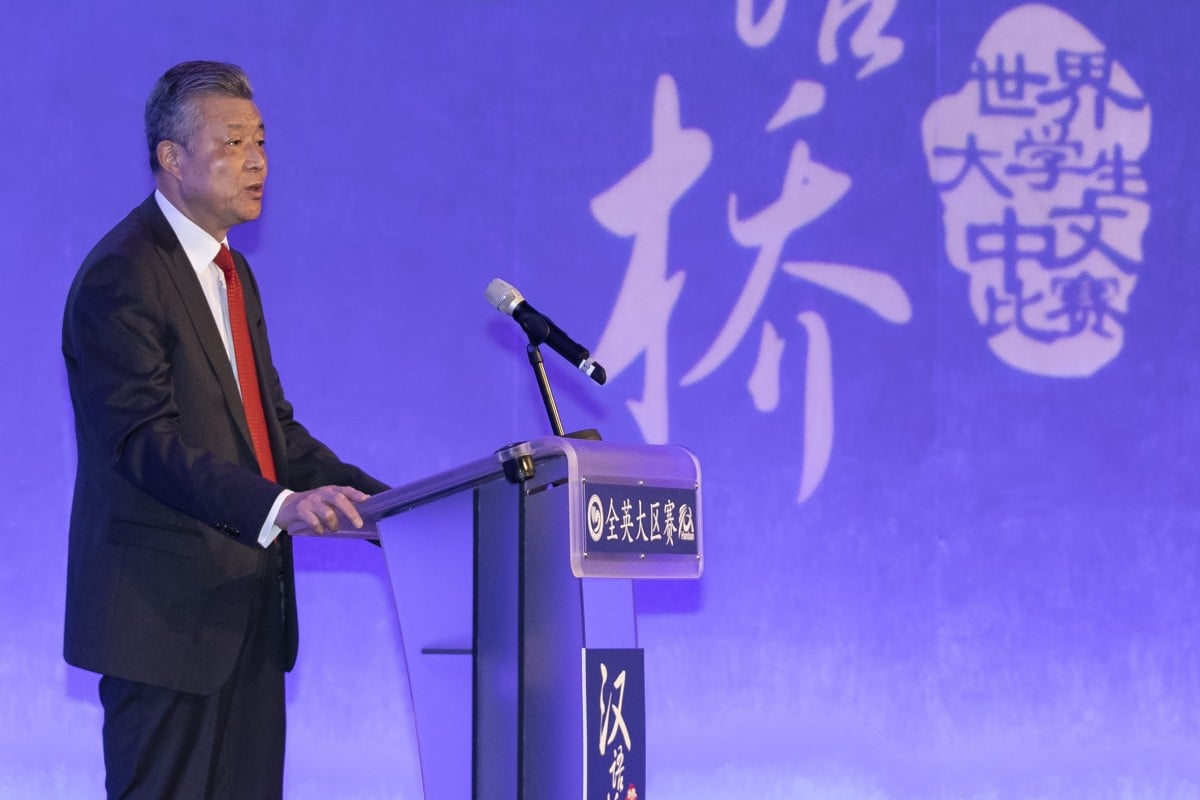
China’s Ambassador to the UK Liu Xiaoming cites ‘rule-making’ as an area for bilateral cooperation with the UK
Chinese Ambassador to the UK Liu Xiaoming gives a keynote speech during the ‘Chinese Bridge’ Chinese Proficiency Competition for Foreign College Students UK Regional Final in London. Photo: Xinhua
China has asked Britain for help to offset claims its “Belt and Road Initiative” investments are opaque and justify its overseas spending to critics.
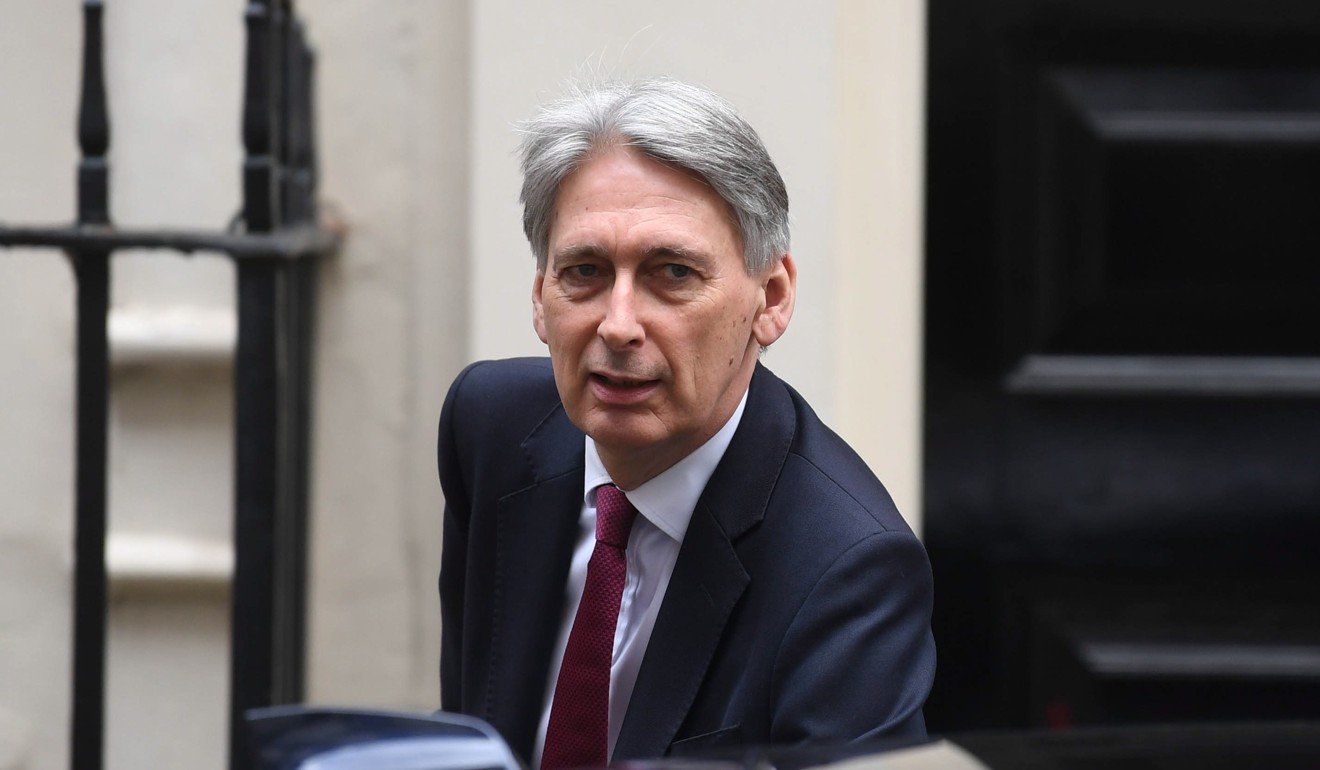
It made the move days before UK Chancellor Phillip Hammond was expected to head to the belt and road forum in Beijing.
In an article in London’s Evening Standard on Wednesday, China’s Ambassador to the UK Liu Xiaoming cited “rule-making” as an area for bilateral cooperation.
“Britain has played a leading role in the establishment and management of the Asian Infrastructure Investment Bank,” Liu said. “In [belt and road] development, Britain could have a big role to play in ensuring that the projects are of higher quality, at a higher standard, with higher return.”
Four years ago the UK defied the US and joined the AIIB.
Liu’s comments followed news the UK’s Department for International Development (DFID) was asked to join a new initiative aimed at improving China’s international accounting and transparency standards.
China is thought to see DFID as a model for its new aid outfit, China International Development Cooperation Agency (CIDCA), which was established last year to oversee Beijing’s foreign aid.
Britain’s Chancellor of the Exchequer Phillip Hammond. Photo: EPA-EFE
Share:
The DFID was the third most transparent donor in the world after the Asian Development Bank and UNDP, according to the aid data-crunching website Publish What You Find. China was the least.
Critics say part of the problem is Beijing prefers to deliver loans and other investments through local elites. There are also often several government departments involved, each directed by their own rules and priorities, making financial reporting more complex.
“I think the Chinese are instead playing by a different set of rules, not all of them in conflict with the West’s … but most definitely not fully aligned with what the West wants or expects”, said Eric Olander, managing editor of Shanghai-based The China Africa Project. “Therefore, I would not expect to see the kind of meaningful change in its accounting and financial standards in the near term.”
‘Cooperate or stop criticising’, China’s foreign minister Wang Yi says as belt and road summit nears
The MOU proposed by China is more a statement of intent than a plan of action but the UK welcomed it as a positive sign
“China’s proposal to set up a ‘Multilateral Cooperation Centre for Development Finance’ has real potential to ensure its huge investments in developing countries meet the key international standards that matter to all of us – on debt, transparency, environment and social safeguards,” UK International Development Secretary Penny Mordaunt said at the World Bank Spring Meeting recently.
A source at DFID told the SCMP that the UK has not signed the MOU yet but said while other countries are aware of the proposal, it is the only country so far to be formally invited to participate by China.
France and Germany were two possible future signatories, and MCCDF has been discussed in EU member state meetings in Beijing.
“[China] is clearly frustrated that it feels misunderstood by the international community,” said Olander.
“I have attended one seminar after another where African stakeholders ask the Chinese for more transparency and the Chinese respond with a sympathetic smile that says ‘I’d love to but I’m not sure how we can do that given our political culture and the current political realities’.”
With the Chinese economy slowing at home and the losses abroad in places like Venezuela starting to mount, there are indications that the Chinese policy banks are becoming far more risk-averse in places like Africa and the Americas.
Even so according to figures released on Thursday, the Export Import Bank of China provided more than a trillion yuan (US$149 billion) to more than 1,800 Belt and Road projects since 2013. China Development Bank (CDB) said in March it had provided US$190 billion in the same period.
“The UK is very concerned by rising debt levels, particularly in emerging market economies and in low-income countries,” Mordaut told the World Bank.
“Unsustainable debt levels are a real risk that can undermine or reverse development gains.”
The IMF said recently 24 out of 60 of the poorest countries are either in debt distress or at a high risk of falling into it.
China is also looking to the UK to help manage the BRI projects and organise part of the financing, something the City of London and the government are keen to do, Liu said.
Describing it as “third-party involvement in BRI development” he said: “The UK, with its unique strengths in professional services, project-management and financing, could tap into this potential.”
China is keen for the UK to sign a BRI MOU like Italy, and soon Switzerland, but so far it has resisted. A report released earlier this month by the parliament’s Foreign Affairs Committee called for a rebranding of the “golden era” started by the former chancellor George Osborne, now the editor of the London Evening Standard.
Britain is keen to cement closer ties with Beijing as the world’s fifth largest economy looks to reinvent itself as a global trading nation if and when it leaves the European Union.
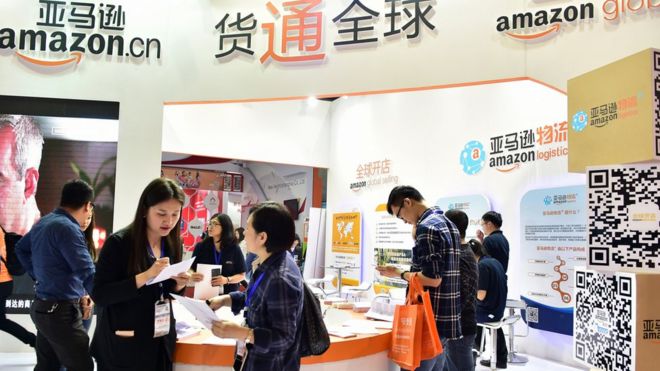
Amazon plans to shut its online store in China that allows shoppers to buy from local sellers as it downsizes operations in the country.
The firm said it would no longer run the domestic marketplace from July, but Chinese shoppers will still be able to order goods from Amazon’s global store.
It will also continue to operate its cloud business in China.
The retail retreat comes as Amazon faces tough competition from local rivals Alibaba and JD.com.
Reuters first reported Amazon’s plans to close its domestic marketplace in China by mid-July to focus on more lucrative businesses selling overseas goods and cloud services. Amazon’s profitable cloud computing division hosts huge swathes of the corporate world on its data servers.
A spokesperson for the company said in a statement that it was “working closely with our sellers to ensure a smooth transition and to continue to deliver the best customer experience possible”.
Consumers accessing Amazon Chinese web portal, Amazon.cn, after 18 July will see a selection of goods from its global store, Bloomberg reported.
Amazon bought Joyo.com, a Chinese books, music and video retailer, for $75m (£57.4m) in 2004. It rebranded the company as Amazon.cn in 2007.
But it has struggled to compete with dominant players JD.com and Alibaba’s Tmall marketplace in China.
PHNOM PENH, April 18 (Xinhua) — A Cambodian and Chinese entrepreneurs meeting was held here on Thursday, aiming at exploring opportunities for trade and investment, officials said.
The meeting brought together nearly 20 entrepreneurs from southwest China’s Sichuan province and about 20 Cambodian business executives.
Ek Sam Ol, president of the Cambodia-China Friendship Association, said that currently, many enterprises from Sichuan have been doing businesses in various sectors in Cambodia.
“The forum is a good opportunity for the entrepreneurs from both sides to exchange experiences and to explore opportunities for investments or business partnerships,” he said.
Sam Ol said China is currently the top foreign investor in Cambodia and Chinese investments have importantly contributed to socio-economic development in the country.
He said Chinese investments have focused on a variety of sectors including transport infrastructure, hydropower plants, industrial zones, garment and footwear factories, banking and finance, real estate and construction, agriculture, tourism, and airlines.
BEIJING, April 18 (Xinhua) — Chinese citizens could access more than 100,000 government services via online platforms run by provincial-level governments as of the end of 2018, according to an official report.
The assessment report on China’s online government services was made by the e-government research center of the Party School of the Communist Party of China Central Committee (National Academy of Governance), commissioned by the e-government office of the State Council General Office.
The government services accessible online are provided by 1,418 departments at the provincial level, regarding various issues such as administrative permission, the report said.
In October 2018, the government of the southwestern Tibet Autonomous Region put its service website on a trial run, meaning China’s 32 provinces, municipalities and autonomous regions all have their own government service e-platforms.
The report also said the e-platforms should improve the user experience and that relative governments and departments should enhance their efficiency when providing services online.
Health watchdog warns that tobacco products are widely available on both social media and online retailers
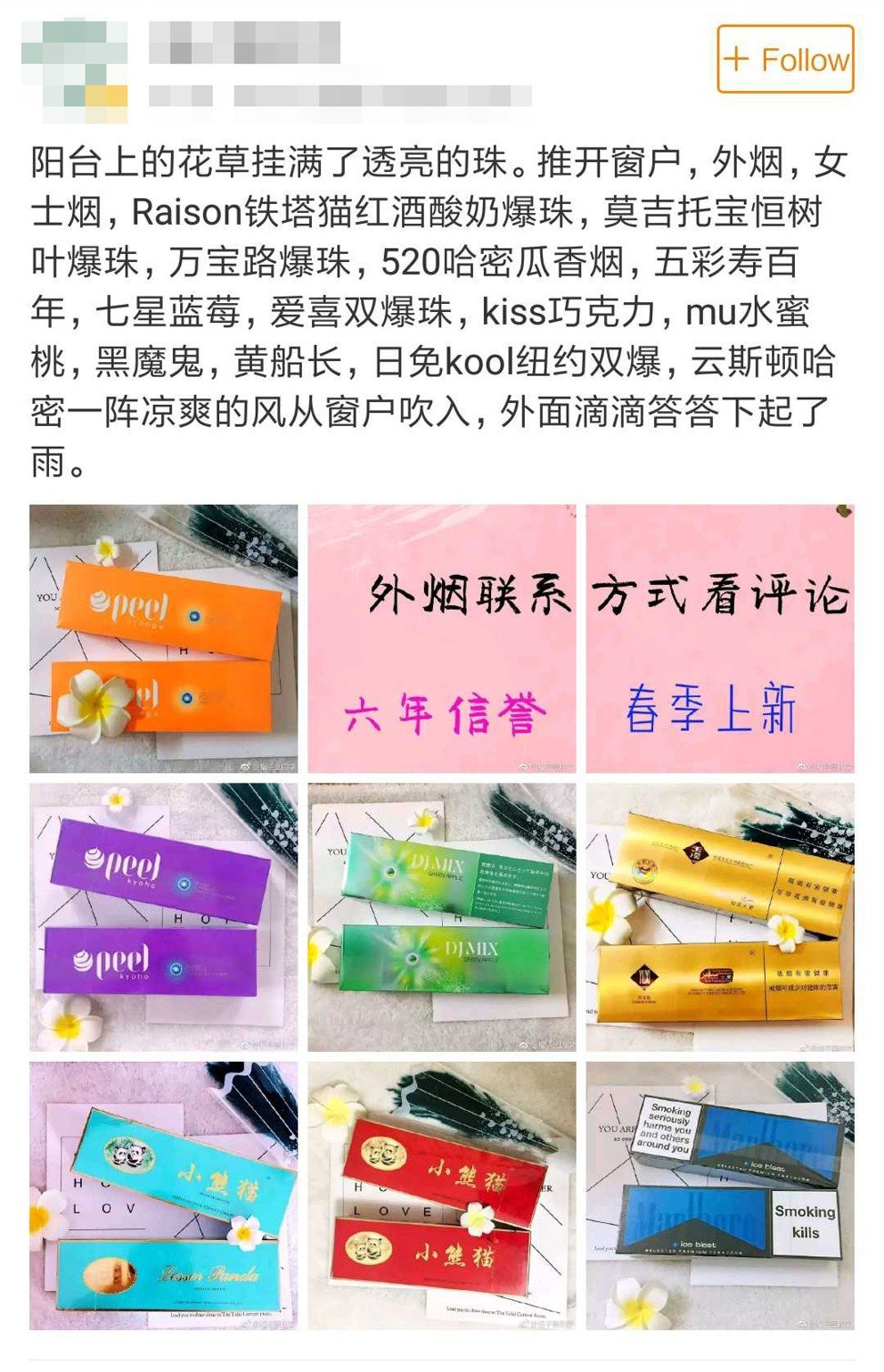
A tobacco seller’s advert posted on WeChat. Photo: Handout
Illegal tobacco trading is rife online in China both via social media and e-commerce platforms, a health watchdog has warned.
The Beijing Centre for Disease Prevention and Control released a report on Monday that said almost 52,000 advertisements and listings for tobacco products had been found on 14 social media and e-commerce platforms in the first half of last year.
“Compared with traditional advertising, tobacco promotion on the internet uses methods such as sponsored content, which is more discreet,” the report said.
China’s internet advertising regulations prohibit the online promotion of tobacco products.
Selling cigarettes online is illegal as the State Tobacco Monopoly Administration bans the sale of tobacco across provinces and strictly controls the production, sale and import of the product.
Screenshot from Weibo of an advertisement for imported cigarettes. Photo: Handout
The social network Weibo, China’s equivalent of Twitter, was highlighted as the platform where most of the banned promotion and selling were found, with nearly 43,000 adverts and listings, or 82 per cent of the total.
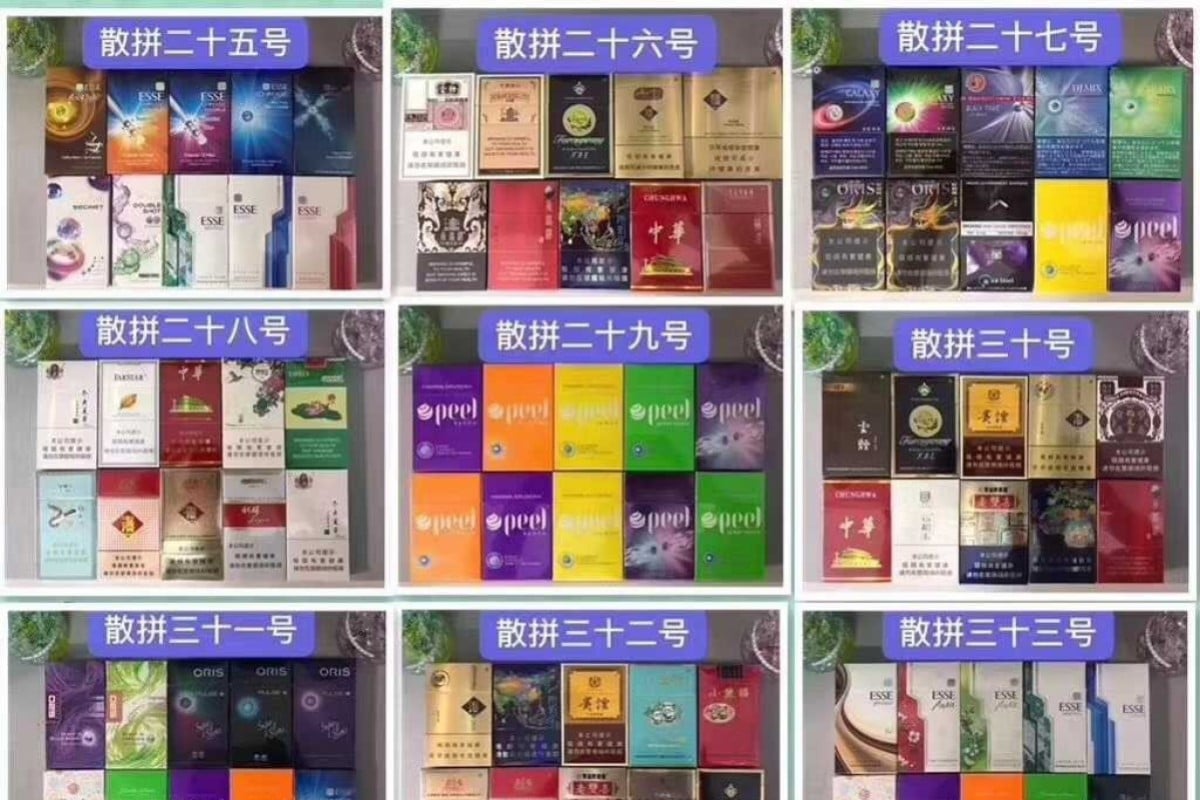
The South China Morning Post found that tobacco advertising and direct selling proliferates on Weibo, where searching for terms such as “cigarettes” and “women’s cigarettes” yielded almost 1,300 results, many of them offering WeChat and QQ contact information.
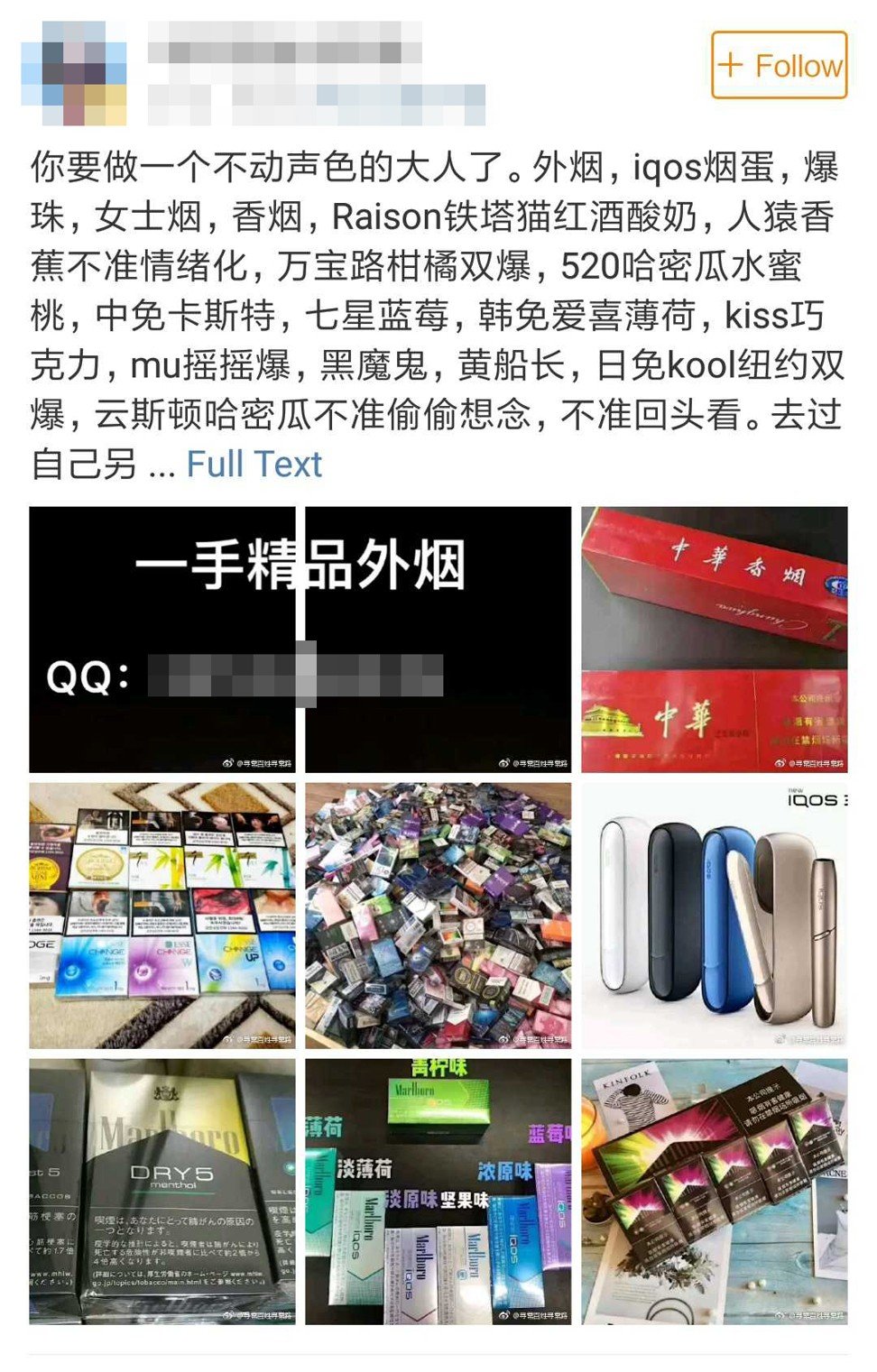
Five vendors found through Weibo offered various imported cigarettes such as Marlboro and South Korean brand Esse.
One seller claimed his wares were smuggled into China from places like the US. Another offered refunds for products that were confiscated, but only if they were bought for delivery within the same province.
A 10-packet carton of Kent cigarettes, an American brand, was selling for around 30 per cent less than the retail price in Beijing.
An extraordinary man’: China’s tobacco and orange king, entrepreneur Chu Shijian, dies aged 91
“A few days ago, cigarette sellers on Little Red Book began trending. People in different places have stopped. I’m still going, one step at a time,” a vendor calling herself “24 hours online cigarette hawker” wrote on her WeChat timeline on Wednesday.
She was referring to media coverage of Little Red Book the e-commerce platform popular with influencers selling lifestyle products.
Little Red Book, whose investors include Alibaba, the owner of the South China Morning Post, has pledged to remove as many as 95,000 adverts and listings for tobacco products found on the app on Tuesday in response to a report by newspaper Beijing Youth Daily.
Searches for “cigarettes” or “women’s cigarettes” no longer yielded results on Thursday.
“We are working hard to remove related content. We ask users to promptly report cases and work together to maintain order on the platform,” Weibo’s PR director Mao Taotao said.
Imported cigarettes on sale on Weibo. Photo: Handout
While advertising and online selling of tobacco are prohibited, e-cigarettes fall in a grey area. China’s tobacco agency has banned the sale of IQOS, a type of battery heated cigarette that delivers nicotine. However, regulations for non-nicotine vaporisers are less clear. These continue to be widely available online.
“In China, even toilet paper has standards. There are none for e-cigarettes,” Li Enze, the industrial law committee secretary for the Chinese Association on Tobacco Control, said.
“I think there needs to be a total ban on the sale of e-cigarettes until standards and regulations are set.”
E-cigarettes and vaporisers come in a variety of flavours and shapes to target women and young people, which poses a serious problem according to Li.
Under-18s can easily purchase vaporisers online and can be induced to smoking the real thing, he said.
Two sets of standards for e-cigarettes have been considered by the Standardisation Administration of China since 2017.
However, both were proposed by organisations associated with the state tobacco monopoly, which Li deemed a conflict of interest.
Women make up nearly half of India’s 900 million voters, but they are still poorly represented in the country’s law-making bodies. One political party is trying to correct the balance by nominating 41% female candidates. The BBC’s Geeta Pandey travelled to the state of West Bengal to see how they are faring.
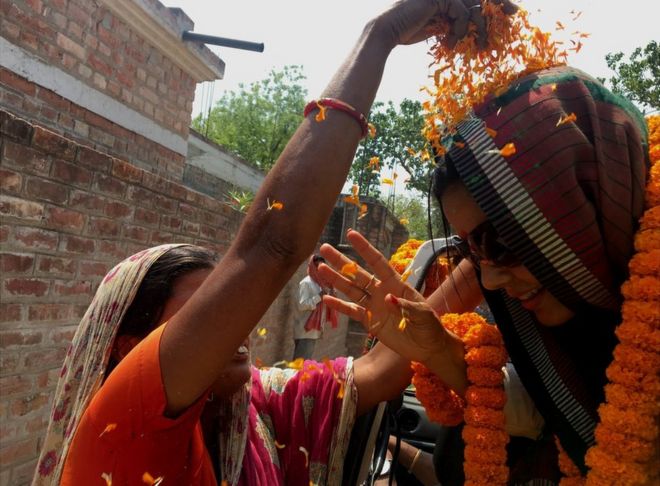
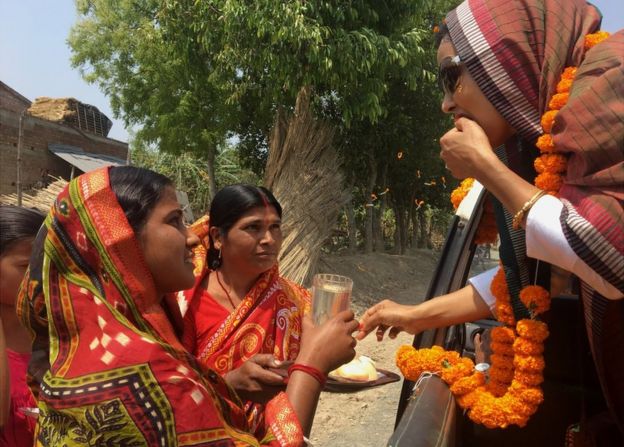
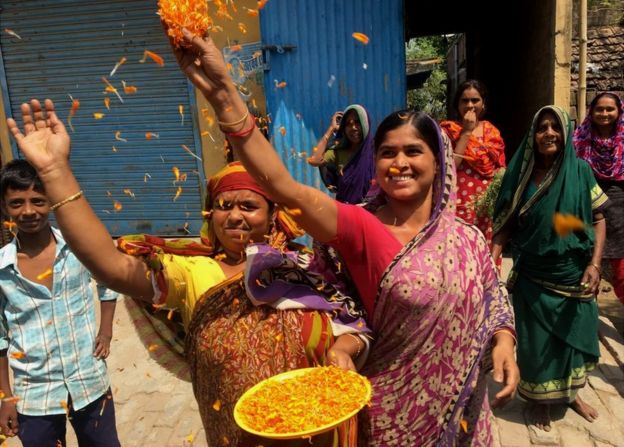
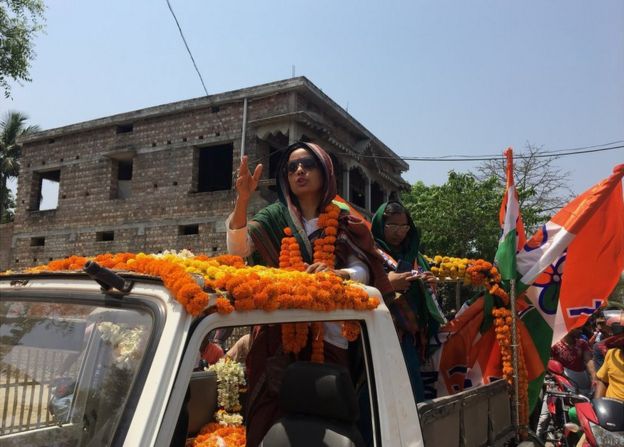
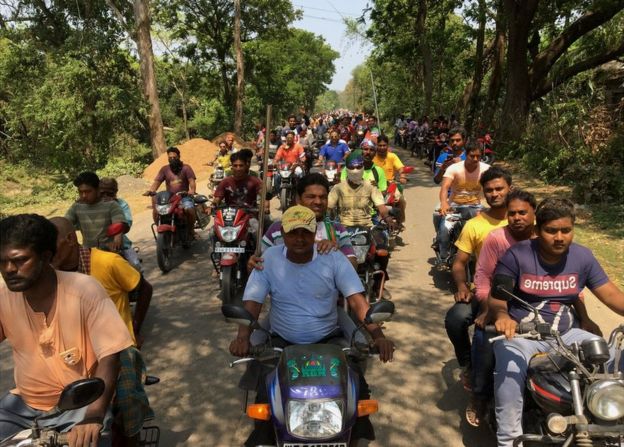
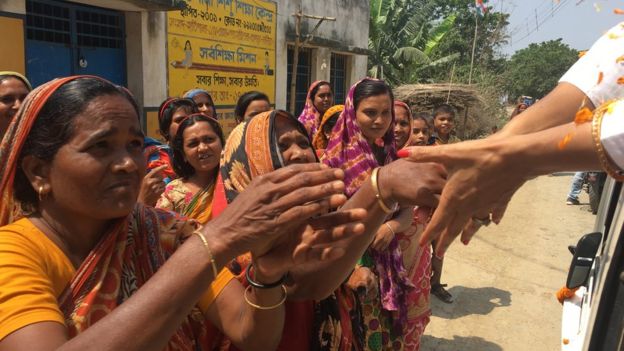
On a bright sunny morning, as an open jeep decorated with bright yellow and orange flowers hurtles along the dirt track from one village to the next, women in colourful saris and men rush to greet Mahua Moitra.
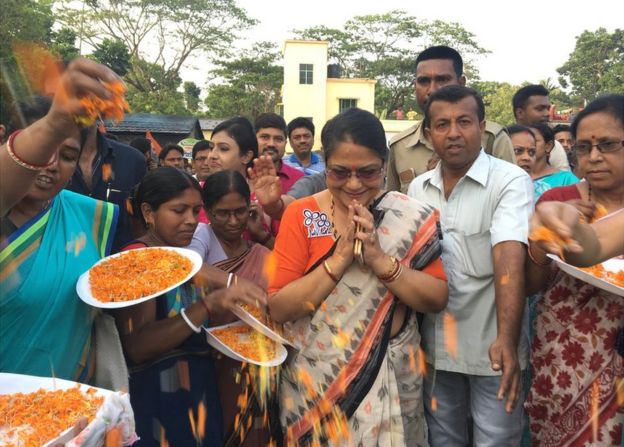
They shower bright orange marigold petals on her, place garlands around her neck and many reach out to shake and kiss her hands. She waves at them, greeting them with her palms joined: “Give me your blessings.”
Young men and women whip out their smartphones to take photos and selfies. On the way, she’s offered coconut water and sweets.
Ms Moitra, who is contesting the general election as a candidate of the state’s governing Trinamool Congress Party (TMC), is campaigning in her constituency Krishnanagar.
Image caption On the campaign trail, women offer coconut water and sweetsImage caption Supporters throw marigold petals at Mahua Moitra
In one village, party workers tell her about an old man who’s too ill to come to meet her, so she walks to his home to greet him.
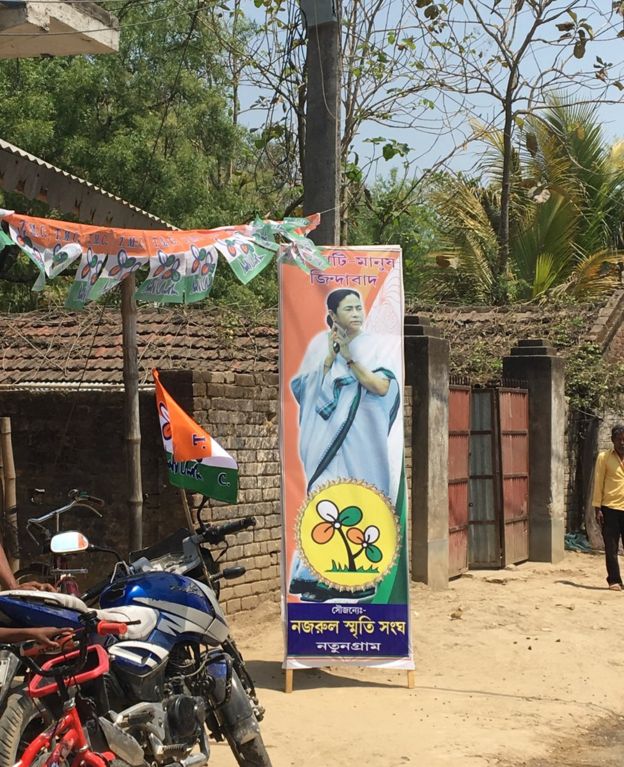
Her jeep is followed by dozens of bikes and their riders, all young men, chanting slogans like “Long live Trinamool Congress, Long live Mamata Banerjee.”
The loud, colourful procession is led by a small truck, fitted with loudspeakers, from which announcements asking people to vote for Ms Moitra are played on a loop.
With the election season well under way in India and political leaders criss-crossing the length and breadth of the country, addressing rallies, I’m travelling across the country to see if the high-decibel campaigns are addressing the real issues that actually affect millions of people. One of them is getting more women into parliament.
A bill to reserve 33% of seats for women in parliament and regional assemblies has been pending since 1996, so the decision by the TMC – led by West Bengal Chief Minister Mamata Banerjee – to give 41% of her party nominations to women has created a huge buzz.
Image caption Ms Moitra quit her banker’s job in London to return to India and enter politics
Ms Banerjee, who set up the TMC in 1998 after falling out with the Congress party, is a feisty politician who was named one of Time magazine’s 100 most influential people in the world in 2012.
Her female candidates, says my BBC Bengali colleague Subhajyoti Ghosh, are an “interesting mix” of career politicians and first-timers. They include actors, doctors, a tribal activist and the 25-year-old widow of a recently-murdered politician.
Ms Moitra, the TMC’s national spokesperson and a member of the state assembly since 2016, is among 17 women who have made it to the party’s list of 42 general election nominees.
A former investment banker with JP Morgan, she gave up a well-paying job in London in 2009 to return to the heat and dust of Indian politics.
Her decision left her family aghast. Her parents, she told me, thought she was “insane”. Some party workers too had their doubts – “she’s a memsahib”, they said at the time, “she won’t survive”.
Image caption Mamata Banerjee was named one of Time magazine’s 100 most influential people in the world in 2012But she has survived – and thrived. In 2016, she won the Karimpur assembly seat that no non-Left party had won since 1972 and has now set her eyes on the national parliament.
She’s agreed to let me follow her on the campaign trail, so for two days I’ve been a “fly on the wall” – standing behind her in her jeep, travelling in her car, watching her strategise with party workers, aides and confidants.
The previous evening, I had watched her be the chief guest at a college cricket match and address a gathering at the local market in Plassey.
A four-hour drive from Kolkata, Plassey is the site of the famous 1757 battle between the British East India Company and the local ruler supported by the French.
Image caption Her jeep is followed by dozens of supporters on bikesImage caption Many women reach out to shake hands with Ms Moitra
“What’s the point of saying you killed all those terrorists in Pakistan? It’s not important who you killed in Pakistan or how many. What’s important is you failed to protect our soldiers.”
She talks about how the government has failed to create jobs and accuses the BJP of trying to divide Hindus and Muslims.
“You have taken away our livelihoods and you’re trying to teach us about [the Hindu god] Ram and [Muslim saint] Rahim? I don’t have to write my religion on my forehead,” she declares to loud claps from her supporters.
Elections in the past were to change the government, she says, but this election is to save the constitution of India. “It is no ordinary vote.”
Her main rival is the BJP’s Kalyan Chaubey, a former footballer who played in goal for India. So drawing a football analogy, she declares: “I’m an A-league centre-forward player, stop my goal if you can. I am here to win.”
Kakoli Ghosh Dastidar, a founder member of the TMC and two-term MP, says to nominate so many women is part of a “continuous process” followed by Mamata Banerjee because “you can’t develop a society without uplifting the status of its women”.
In the last general election in 2014, she points out that the party nominated 33% women and 12 of their 34 MPs in the outgoing lower house were women.
Ms Banerjee, she says, believes that gender sensitive laws will come only if more women are in power.
At a campaign rally that Dr Ghosh Dastidar addresses in Kumhra Kashipur village in her constituency Barasat, women are seated in the front rows.
Their opinion though is divided over whether having more women in parliament will actually benefit other women.
Image caption Dr Kakoli Ghosh Dastidar is among the founder members of the TMC and a two-term MP
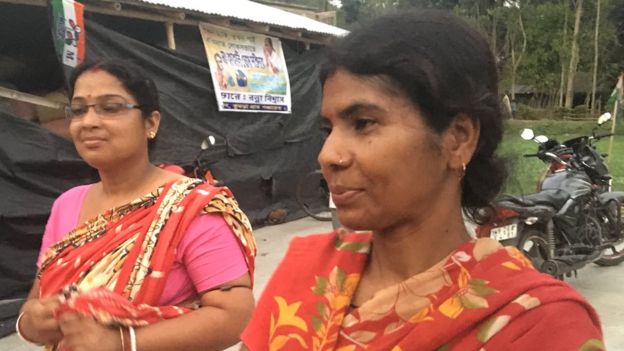
Supriya Biswas says it’s easier if their MP is a woman because then it’s easier to approach her. “For, who can understand a woman better than a woman?”
Archana Mallick and Meena Mouli, who live just across from the rally ground, point to the broken roads near their homes and complain about poor medical facilities in their village. They say that the candidate’s gender is “inconsequential” and what’s important is “who works for our benefit”.
Saswati Ghosh, professor of economics at Kolkata’s City College, says that politics in India is “still very patriarchal” and it’s “absolutely necessary” to elect more women MPs.
“It is important to have more women in lawmaking bodies because I think after a certain number, you’ll reach the threshold level and that will lead to change. I don’t know if 33% is the magic number that will change the quality of discourse, maybe 25% can do the trick?”
Image caption Archana Mallick and Meena Mouli say a candidate’s gender is “inconsequential”
Critics, however, question whether celebrities are the right candidates to bring about that change.
Prof Ghosh says actors and celebrities make for “winnable candidates” and that’s why all parties choose them even though sometimes they may not be the right candidates to reach that threshold.
But, she says that Ms Banerjee is a strong leader who’s regarded by many women as “a role model who inspires more women to come into politics”.
And that’s something that many Indians think the country sorely needs.
In their manifestos, the main opposition Congress party has promised to pass the women’s reservation bill, if elected to power. So has the ruling Bharatiya Janata Party, although it had made similar promises in its last manifesto and did nothing about it.
By allotting 41% seats to women, Ms Banerjee has shown that one doesn’t need to set artificial quotas to elect more women.
India has suspended trade across the Line of Control in Jammu and Kashmir with effect from Friday. The Ministry of Home Affairs issued the order to this effect on Thursday.
INDIAUpdated: Apr 18, 2019 20:20 IST
HT Correspondent
Hindustan Times, New Delhi
The Home Ministry said reopening of Line of Control trade will be revisited after placing a stricter regulatory and enforcement mechanism in place.(HT file photo)
India suspended trade across the Line of Control in Jammu and Kashmir over concern that the route was being misused by Pakistan-based elements to smuggle weapons, narcotics and fake currency, the Ministry of Home Affairs said on Thursday. New Delhi said the Centre will revisit the decision to suspend LoC trade at Jammu and Kashmir’s Salamabad and Chakkan-da-Bagh after putting in place a stricter regulatory and enforcement mechanism.
Cross-LoC trade is meant to facilitate exchange of goods of common use between local populations across the LoC in Jammu & Kashmir. The trade is allowed through two Trade Facilitation Centres located at Salamabad, Uri, District Baramulla and Chakkan-da-Bagh, District Poonch. The trade takes place four days a week. The Trade is based on Barter system and zero duty basis.
The home ministry decision comes after the federal anti-terror probe agency National Investigation Agency told the government that a “significant number of trading concerns engaged in LoC trade” were linked with banned terror organisations involved in fuelling terrorism”.
“Investigations have further revealed that some individuals, who have crossed over to Pakistan, and joined militant organizations have opened trading firms in Pakistan. These trading firms are under the control of militant organizations and are engaged in LoC trade,” a home ministry statement said.
The home ministry said there were also inputs to indicate the LoC route is likely to be misused to a “much larger extent” to evade higher duties after India withdrew the most favoured nation to Pakistan.
Relations between India and Pakistan have been under strain since Pulwama terror attack in February when 40 jawans of the Central Reserve Police Force were killed on Jammu-Srinagar highway.
The cross-LoC trade between Jammu and Kashmir and Pakistan-occupied Kashmir had resumed on Tuesday after nearly two weeks. The trade and travel across the LoC had been suspended on April 1 in the wake of heavy shelling from the Pakistani side. Three people including a Border Security Force officer, a woman and a five-year-old girl died in Poonch.
The relation between India and Pakistan has been under strain since Pulwama terror attack in February when 40 jawans of the Central Reserve Police Force were killed on Jammu-Srinagar highway.
Trade and travel across the LoC had been suspended on April 1 in the wake of heavy shelling from the Pakistani side. Three people including a Border Security Force officer, a woman and a five-year-old girl died in Poonch.
The cross-LoC trade between Jammu and Kashmir and Pakistan-occupied Kashmir had just resumed on Tuesday after nearly two weeks.


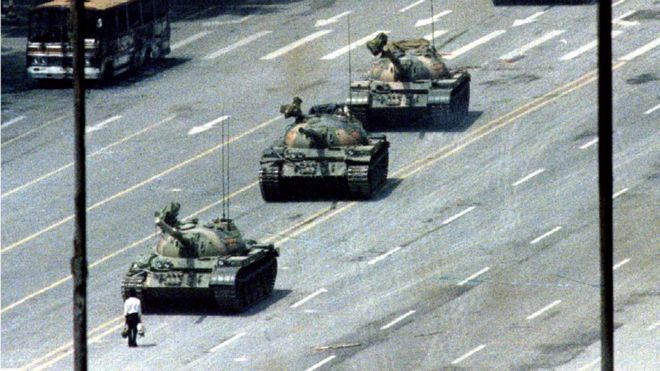 Image copyrightREUTERS





 CHINDIA ALERT: You'll be living in their world, very soon