Archive for ‘Chindia Alert’

19/07/2012

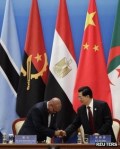
* China pledges $20bn in credit for Africa at summit

BBC News: “China has pledged $20bn (£12.8bn) in credit for Africa over the next three years, in a push for closer ties and increased trade.

President Hu Jintao made the announcement at a summit in Beijing with leaders from 50 African nations. He said the loans would support infrastructure, agriculture and the development of small businesses.

The Chinese leader also called for better co-operation with African countries on international affairs.

As developing nations, China and countries in Africa should work better together in response to “the big bullying the small, the strong domineering over the weak and the rich oppressing the poor” in international affairs, said Mr Hu.

The loan is double the amount China pledged in a previous three-year period in 2009, since which time China has been Africa’s largest trading partner.

Trade between the two hit a record high of $166bn (£106bn) in 2011, Chinese Commerce Minister Chen Deming wrote in the China Daily newspaper, ahead of the two-day forum.

“We want to continue to enhance our traditional friendship… rule out external interference and enhance mutual understanding and trust,” said Mr Hu.”

via BBC News – China pledges $20bn in credit for Africa at summit.

19/07/2012

* Pranab Mukherjee tipped to win India presidential poll

BBC News: “Voting is under way in India to elect a new president.

The front-runner is the country’s former finance minister Pranab Mukherjee. He is being challenged by opposition candidate, Purno Sangma.

The position is largely ceremonial, but the new president could play a decisive role in determining who forms the next government when national elections are held in 2014.

The results of the poll are expected to be announced on 22 July.

The winner will replace Pratibha Patil, who was India’s first woman president.

PRANAB MUKHERJEE

The veteran Congress party leader Pranab Mukherjee was born in 1935 in West Bengal.

He was a teacher, a journalist and a lawyer before being elected in 1969 to the upper house of parliament. He has served as finance, foreign and defence minister, and has held other influential positions in the government.

He fell out with the Congress leaders in 1986 and started his own party, but returned to the party fold two years later. He has served on the boards of the International Monetary Fund and the World Bank.

Indian presidents are not elected directly by the people but by an electoral college made up of members of parliament and state assemblies.”

via BBC News – Pranab Mukherjee tipped to win India presidential poll.

See also: Federal versus centralist rule

19/07/2012

Will justice be done, and seen to be done?

Also see: https://chindia-alert.org/2012/04/14/police-reinvestigate-death-of-neil-heywood-according-to-law/

19/07/2012

Bad as the situation for Chinese farmers, it pales into insignificance compared to the plight of Indian farmers. 10s of thousands of Indian farmers have committed suicide this year alone due to their inability to face the future with mounting debts, and poor harvests. Read http://www.indiatribune.com/index.php?option=com_content&view=article&id=5389:every-12-hours-one-farmer-commits-suicide-in-india&catid=106:magazine

18/07/2012

* As China Talks of Change, Fear Rises on Risks

NY Times: “A heavyweight crowd gathered last October for a banquet in Beijing’s tallest skyscraper. The son of Mao Zedong’s immediate successor was there, as was the daughter of the country’s No. 2 military official for nearly three decades, along with the half sister of China’s president-in-waiting, and many more.

“All you had to do,” said one attendee, Zhang Lifan, “was look at the number of luxury cars and the low numbers on the plates.”

Most surprising, though, was the reason for the meeting. A small coterie of children of China’s founding elites who favor deeper political and economic change had come to debate the need for a new direction under the next generation of Communist Party leaders, who are set to take power in a once-a-decade changeover set to begin this year. Many had met the previous August, and would meet again in February.

The private gatherings are a telling indicator of how even some in the elite are worried about the course the Communist Party is charting for China’s future. And to advocates of political change, they offer hope that influential party members support the idea that tomorrow’s China should give citizens more power to choose their leaders and seek redress for grievances, two longtime complaints about the current system.

But the problem is that even as the tiny band of political reformers is attracting more influential adherents, it is splintered into factions that cannot agree on what “reform” would be, much less how to achieve it. The fundamental shifts that are crucial to their demands — a legal system beyond Communist Party control as well as elections with real rules and real choices among candidates — are seen even among the most radical as distant dreams, at best part of a second phase of reform.

In addition, the political winds are not blowing in their favor. The spectacular fall this spring of Bo Xilai, the Politburo member who openly espoused a populist philosophy at odds with elite leaders, offered an object lesson in the dangers of challenging the status quo. And official silence surrounding his case underscores high-level fears that any public cracks in the leadership’s facade of unity could lead its power to crumble.

As a result, few people here expect the party to willingly refashion itself anytime soon. And even those within the elite prepared to discuss deeper changes, including the second-generation “princelings,” as they are known, have a stake in protecting their own privileges.

“Compare now to 1989; in ’89, the reformers had the upper hand,” said Mr. Zhang, a historian formerly associated with the government’s Chinese Academy of Social Sciences, referring to the pro-democracy student protests that enjoyed the support of a number of important party leaders but were crushed in Tiananmen Square. “Twenty years later, the reformers have grown weaker. Now there are so many vested interests that they’ll be taken out if they touch anyone else’s interests.”

To Mr. Zhang and others, this is the conundrum of China’s rise: the autocracy that back-flipped on Marxist ideology to forge the world’s second-largest economy seems incapable of embracing political changes that actually could prolong its own survival.

Much as many Americans bemoan a gridlocked government split by a yawning partisan gap, Chinese advocates for change lament an all-powerful Communist Party they say is gridlocked by intersecting self-interests. None of the dominant players — a wealthy and commanding elite; rich and influential state industries; a vast, entrenched bureaucracy — stand to gain by ceding power to the broader public.

Many who identify with the reform camp see change as inevitable anyway, but only, they say, because social upheaval will force it. In that view, discontent with growing inequality, corruption, pollution and other societal ills will inevitably lead to a more democratic society — or a sharp turn toward totalitarianism.

An overriding worry is that unless change is carefully planned and executed, China risks another Cultural Revolution-style upheaval that could set it back decades.”

via As China Talks of Change, Fear Rises on Risks – NYTimes.com.

See also: https://chindia-alert.org/prognosis/chinese-challenges/

17/07/2012

* Fracking in U.S. Lifts Guar Farmers in India

NY Times: “Sohan Singh’s shoeless children have spent most of their lives hungry, dirty and hot. A farmer in a desert land, Mr. Singh could not afford anything better than a mud hut and a barely adequate diet for his family.

Farmers waited this month to receive free guar seeds from an Indian company.

But it just so happens that when the hard little bean that Mr. Singh grows is ground up, it becomes an essential ingredient for mining oil and natural gas in a process called hydraulic fracturing.

Halfway around the world, earnings are down for an oil services giant, Halliburton, because prices have risen for guar, the bean that Mr. Singh and his fellow farmers raise.

Halliburton’s loss was, in a rather significant way, Mr. Singh’s gain — a rare victory for the littlest of the little guys in global trade. The increase in guar prices is helping to transform this part of the state of Rajasthan in northwestern India, one of the world’s poorest places. Tractor sales are soaring, land prices are increasing and weddings have grown even more colorful.

“Now we have enough food, and we have a house made of stone,” Mr. Singh said proudly while his rail-thin children stared in awe.

Guar, a modest bean so hard that it can crack teeth, has become an unlikely global player, and dirt-poor farmers like Mr. Singh have suddenly become a crucial link in the energy production of the United States.”

via Fracking in U.S. Lifts Guar Farmers in India – NYTimes.com.

17/07/2012

* Chinese Businesses Get Advice on U.S. Investment

WSJ: “Looking to ease the way for Chinese investment in the U.S., the U.S. Chamber of Commerce is advising Chinese businesses not to count on “personal relationships” with government officials as a key to success.

The advice came in a report prepared by the U.S. Chamber for an investment forum Tuesday in Beijing. The event, co-hosted by the China Center for International Economic Exchanges, a Chinese government think tank, was expected to draw about 400 business executives and government officials, current and past.

A subsidiary of Aviation Industry Group of China last year bought Cirrus Industries, a Minnesota maker of propeller aircraft.

The U.S. Chamber said it was acting on its own initiative, though the U.S. government, seeking to lift economic growth, also has been trying to encourage Chinese investment. Chinese business leaders regularly say they are interested in investing in the U.S. but fear political opposition.

“We’re trying to showcase Chinese investment in the U.S.,” said Myron Brilliant, a senior vice president at the U.S. Chamber. “In a lot of areas there aren’t a lot of hurdles to investment.”

The 38-page report is based on interviews with Chinese business officials who have invested in the U.S. Some of its suggestions are obvious: “win-win cooperation can create great opportunities,” said advice attributed to Cirrus Industries Inc., a Duluth, Minn., propeller-aircraft maker purchased last year by a subsidiary of Aviation Industry Group of China.

But other advice reflects important differences between how business is done in the U.S. and in China. “Unlike in China, personal relations with officials play a very small part in the enforcement of laws and regulation,” said the report’s introduction.

Another tidbit for would-be Chinese investors: “The U.S. media [are] completely independent of the government, so even if some local officials welcome your investment, others might voice opposition in the media. Do not be discouraged by this.”

Chinese direct investment in the U.S. last year totaled $4.5 billion, according to New York market research firm Rhodium Group, a tiny portion of the foreign-direct investment in the U.S. The Commerce Department, which uses a different methodology from Rhodium, said FDI in the U.S. reached $227 billion in 2011.

via Chinese Businesses Get Advice on U.S. Investment – WSJ.com.

17/07/2012

* WTO: China discriminates against foreign card companies

BBC News: “The World Trade Organisation has ruled that China discriminates against foreign credit-card and debit-card providers.

A panel of the trade body said China maintains a monopoly on yuan-denominated payment cards which breaks WTO rules. Only one company, China UnionPay, is allowed to process domestic currency transactions. This limits foreign providers such as Visa and Mastercard.

There is a 60-day period in which either side can appeal against the ruling.

The Obama administration first lodged the complaint in 2010.

US companies have been trying to get greater access to the massive China market.

“Today’s win highlights that tackling unfair Chinese trade practices has been a priority of this president”, Jay Carney, White House press secretary

Currently, they can only issue cards in partnership with Chinese banks and China UnionPay.

Visa said in a statement that the company is “hopeful that this ruling will pave the way for international payment companies to participate in the domestic payments marketplace in China”.

The decision by the WTO is being hailed as a “win” by the US government. The trade gap with China has become a campaign issue in the upcoming elections.

“Today’s win highlights that tackling unfair Chinese trade practices has been a priority of this president,” said Jay Carney, White House press secretary.

Tim Reif from the US Trade Representative’s office said the ruling would support about 6,000 jobs if it goes through.

However, the WTO did not agree with all the claims raised by the United States.”

via BBC News – WTO: China discriminates against foreign card companies.

16/07/2012

* Pakistan cricket team to visit India in December

BBC News: “India looks set to resume bilateral cricketing ties with Pakistan after a gap of several years, with plans for Pakistani cricketers to tour India.

India’s cricket board says three One Day Internationals and two Twenty20 matches have been planned for December.

Pakistan Cricket Board welcomed the proposal and said that millions of fans would be delighted.

The last bilateral series between India and Pakistan was in 2007-2008 when the Pakistani team visited India.

Cricketing ties were suspended after the 2008 Mumbai attacks, blamed on a Pakistan-based militant group.

Indian government approval is still needed for the series to go ahead but analysts say this is just a formality.”

via BBC News – Pakistan cricket team to visit India in December.

15/07/2012

* Google Tries Something Retro – Made in the U.S.A.

NYTimes: “Etched into the base of Google’s new wireless home media player that was introduced on Wednesday is its most intriguing feature. On the underside of the Nexus Q is a simple inscription: “Designed and Manufactured in the U.S.A.”

The Google executives and engineers who decided to build the player here are engaged in an experiment in American manufacturing. “We’ve been absent for so long, we decided, ‘Why don’t we try it and see what happens?’ ” said Andy Rubin, the Google executive who leads the company’s Android mobile business.

Google is not saying a lot about its domestic manufacturing, declining even to disclose publicly where the factory is in Silicon Valley. It also is not saying much about the source of many of its parts in the United States. And Mr. Rubin said the company was not engaged in a crusade.

Still, the project will be closely watched by other electronics companies. It has become accepted wisdom that consumer electronics products can no longer be made in the United States. During the last decade, abundant low-cost Chinese labor and looser environmental regulations have virtually erased what was once a vibrant American industry.

Since the 1990s, one American company after another, including Hewlett-Packard, Dell and Apple, has become a design and marketing shell, with production shifted to contract manufacturers in Shenzhen and elsewhere in China.

Now that trend may be showing early signs of reversing.

It’s a trickle, but some American companies are again making products in the United States. While many of those companies have been small, like ET Water Systems, there have also been some highly visible moves by America’s largest consumer and industrial manufacturers. General Electric and Caterpillar, for example, have moved assembly operations back to the United States in the last year. (Airbus, a European company, is said to be near a deal to build jets in Alabama.)

There is no single reason for the change. Rising labor and energy costs have made manufacturing in China significantly more expensive; transportation costs have risen; companies have become increasingly aware of the risks of the theft of intellectual property when products are made in China; and in a business where time-to-market is a competitive advantage, it is easier for engineers to drive 10 minutes on the freeway to the factory than to fly for 16 hours.

That was true for ET Water Systems, a California company. “You need a collaboration that is real time,” said Pat McIntyre, chief executive of the maker of irrigation management systems, which recently moved its manufacturing operation from Dalian, China, to Silicon Valley. “We prefer local, frankly, because sending one of our people to China for two weeks at a time is challenging.”

Harold L. Sirkin, a managing director at Boston Consulting Group, said, “At 58 cents an hour, bringing manufacturing back was impossible, but at $3 to $6 an hour, where wages are today in coastal China, all of a sudden the equation changes.”

The firm reported in April that one-third of American companies with revenue greater than $1 billion were either planning or considering to move manufacturing back to the United States. Boston Consulting predicted that the reversal could bring two million to three million jobs back to this country.”

via Google Tries Something Retro – Made in the U.S.A. – NYTimes.com.

This cost difference is continuing to erode away as China has been increasing its basic wages by between 10-15% per annum for the last 10 years and intends to continue doing so in order to improve the standard of living of the working person thereby passing on the benefits of the improving GDP.

See also:

Law of Unintended Consequences

continuously updated blog about China & India

ChiaHou's Book Reviews

continuously updated blog about China & India

What's wrong with the world; and its economy

continuously updated blog about China & India