Chindia Alert: You’ll be Living in their World Very Soon
aims to alert you to the threats and opportunities that China and India present. China and India require serious attention; case of ‘hidden dragon and crouching tiger’.
Without this attention, governments, businesses and, indeed, individuals may find themselves at a great disadvantage sooner rather than later.
The POSTs (front webpages) are mainly 'cuttings' from reliable sources, updated continuously.
The PAGEs (see Tabs, above) attempt to make the information more meaningful by putting some structure to the information we have researched and assembled since 2006.
Links between company accused of receiving confidential information and Beijing, according to report
Investigation follows US court ruling against six Chinese employees of semiconductor maker ASML
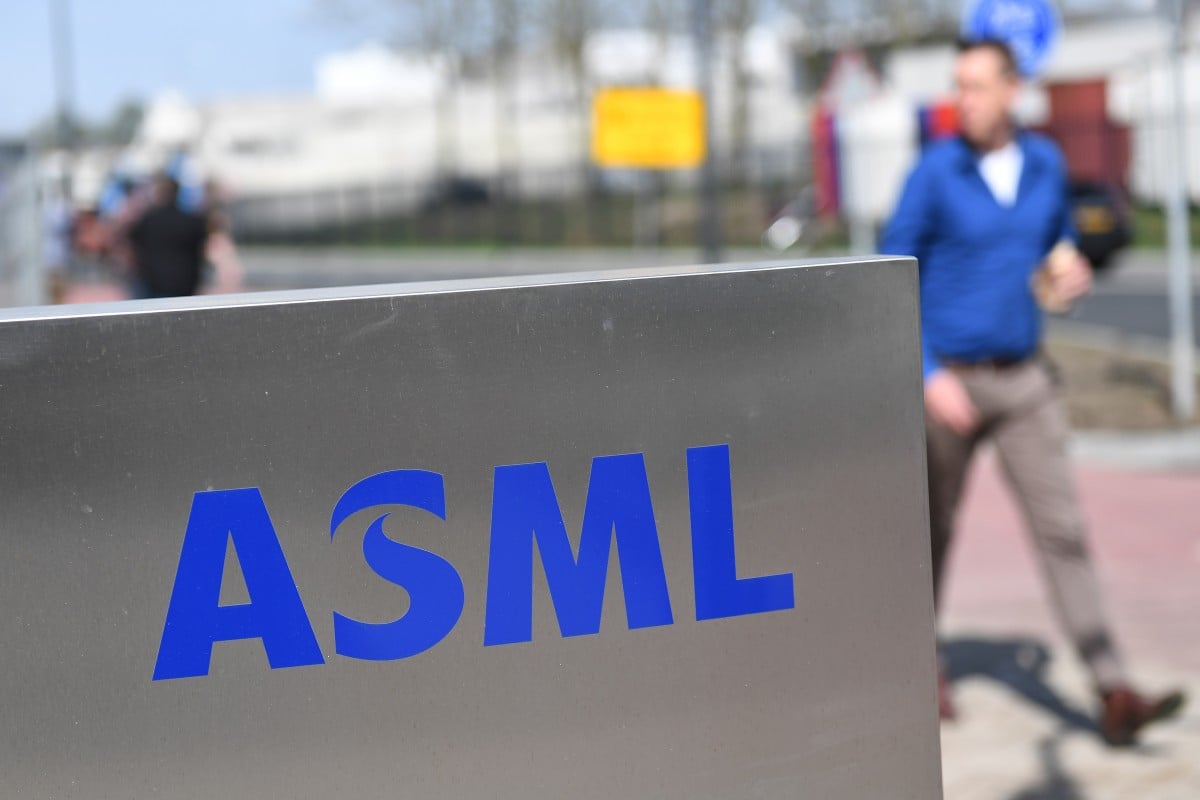
A newspaper in the Netherlands claims to have found evidence that six employees of Dutch semiconductor giant ASML passed corporate secrets to a company linked to the Chinese government. Photo: AFP
An investigation by a financial newspaper in the Netherlands has concluded that Chinese employees stole corporate secrets from Dutch semiconductor equipment giant ASML, resulting in hundreds of millions of dollars in losses.
The daily newspaper, Het Financieele Dagblad, reported on Thursday that ASML itself had “found no hard proof of involvement of the Chinese government” but that its own probe had determined that stolen technology had been ultimately leaked to a state-linked company.
According to the newspaper report, high-level Chinese employees in the research and development department of ASML’s US subsidiary were behind the breach.
An ASML spokeswoman said the company was aware of the report and was preparing a response.
The chip maker caught in US assault on China’s tech ambitions
ASML is the dominant maker of lithography systems, used to trace out the circuitry of semiconductor chips.
The newspaper based its report partly on company sources and partly on a November 2018 ruling by a California court in a suit between ASML’s US subsidiary and a subsidiary of a Chinese company, XTAL Inc.
The documents from the California Superior Court in Santa Clara show six former ASML employees, all with Chinese names, breached their employment contracts by sharing information on ASML software processes with XTAL, according to the report.
The Dutch intelligence agency has included warnings in its annual threat assessments for the past several years, saying that China is targeting tech companies in the Netherlands, as it does in other countries, for intellectual property theft.
In 2015, ASML disclosed a breach of its computer systems, but said at the time damage from the hack was limited and released few further details.
ASML’s sales to China doubled to 1.8 billion euros (US$2 billion) in 2018 from 919 million euros in 2017 as Beijing makes growth of its semiconductor industry a priority.
ASML CEO Peter Wennink said in January he saw no let-up in demand from China, despite an economic slowdown.
WASHINGTON (Reuters) – The United States and China have largely agreed on a mechanism to police any trade agreement they reach, including establishing new “enforcement offices,” U.S. Treasury Secretary Steven Mnuchin said on Wednesday.
Mnuchin, speaking on CNBC television, said that progress continues to be made in the talks, including a “productive” call with China’s Vice Premier Liu He on Tuesday night. The discussions would be resumed early on Thursday, Washington time, he added.
“We’ve pretty much agreed on an enforcement mechanism, we’ve agreed that both sides will establish enforcement offices that will deal with the ongoing matters,” Mnuchin said, adding that there were still important issues for the countries to address.
RELATED COVERAGE
China investigating U.S. request to lift anti-dumping tariffs on DDGS
Mnuchin declined to comment on when or if U.S. tariffs on $250 billion worth of Chinese goods would be removed. Although President Donald Trump said recently that a deal could be ready around the end of April, Mnuchin declined to put a timeframe on the negotiations, adding that Trump was focused on getting the “right deal.”
“As soon as we’re ready and we have this done, he’s ready and willing to meet with President Xi (Jinping) and it’s important for the two leaders to meet and we’re hopeful we can do this quickly, but we’re not going to set an arbitrary deadline,” Mnuchin added.
The United States is demanding that China implement significant reforms to curb the theft of U.S. intellectual property and end forced transfers of technology from American companies to Chinese firms.
Washington also wants Beijing to curb industrial subsidies, open its markets more widely to U.S. firms and vastly increase purchases of American agricultural, energy and manufactured goods.
The Chinese commerce ministry on Thursday confirmed that senior trade negotiators from both countries discussed the remaining issues in a phone call following the last round of talks in Washington.
“In the next step, both trade teams will keep in close communication, and work at full speed via all sorts of effective channels to proceed with negotiations,” Gao Feng, the ministry’s spokesman told reporters in a regular briefing in Beijing.
Mnuchin did not address whether the enforcement structure would allow the United States a unilateral right to reimpose tariffs without retaliation if China fails to follow through on its commitments.
People familiar with the discussions have said that U.S. negotiators are seeking that right, but that China is reluctant to agree to such a concession. Alternatively, the United States may seek to keep tariffs in place, only removing them when China meets certain benchmarks in implementing its reforms.
Mnuchin said he and U.S. Trade Representative Robert Lighthizer, who is leading the negotiations, are focused on “execution” of drafting the documents in the trade agreement.
The two sides are working on broad agreements covering six areas: forced technology transfer and cyber theft, intellectual property rights, services, currency, agriculture and non-tariff barriers to trade, according to two sources familiar with the progress of the talks.
“Some of the chapters are close to finished, some of the chapters still have technical issues,” Mnuchin said.
Some observers have billed this as the most important election in decades and the tone of the campaign has been acrimonious.
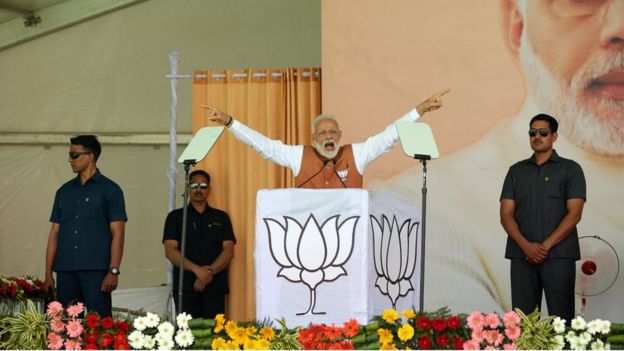
Mr Modi’s Hindu nationalist Bharatiya Janata Party (BJP) won a historic landslide in the last elections in 2014. He stakes his claim to lead India on a tough image and remains the governing BJP’s main vote-getter.
But critics say his promises of economic growth and job creation haven’t met expectations and India has become more religiously polarised under his leadership.
The BJP faces challenges from strong regional parties and a resurgent Congress party, led by Rahul Gandhi. Mr Gandhi’s father, grandmother and great-grandfather are all former Indian prime ministers. His sister, Priyanka Gandhi, formally joined politics in January.
Image captionMr Modi has made national security a key election issue
How has voting gone so far?
The Lok Sabha, or lower house of parliament has 543 elected seats and any party or coalition needs a minimum of 272 MPs to form a government.
Hundreds of voters began to queue up outside polling centres early Thursday morning. In the north-eastern state of Assam, lines of voters began forming almost an hour before voting officially began.
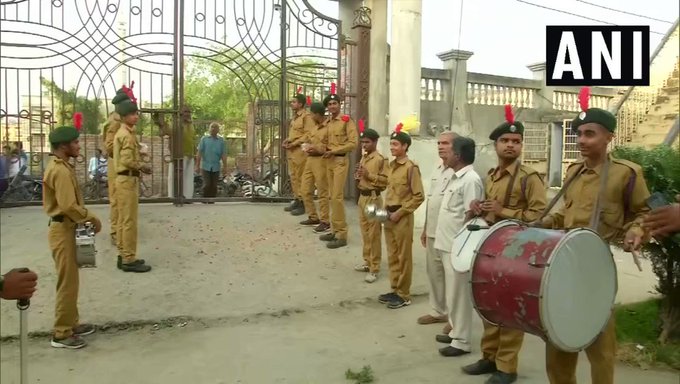
Voters at one polling booth in Baraut – in the northern state of Uttar Pradesh – got a royal welcome with people greeted by drums and a shower of flower petals.
But violence has flared in several places already. One person has died after clashes erupted at a polling station in Anantpur, in southern Andhra Pradesh state. Four others were critically injured in the fight that broke out between workers from two parties, BBC Telugu reports.
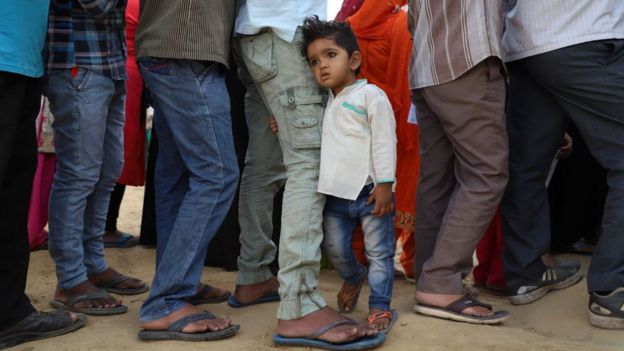
Image copyrightGETTY IMAGESImage caption A little boy clutches his father outside a polling booth in Ghaziabad in Uttar Pradesh state
In central Chhattisgarh state, suspected Maoists detonated an IED device near a polling booth at around 04:00 local time (23:30 BST) – no injuries were reported.
The mineral-rich state has witnessed an armed conflict for more than three decades and attacks by Maoist rebels on security forces are common. On Tuesday a state lawmaker was killed in a suspected rebel attack.
How big is this election?
It is mind-bogglingly vast – about 900 million people above the age of 18 will be eligible to cast their ballots at one million polling stations. At the last election, vote turn-out was around 66%.
More than 100 million people are eligible to vote in the first phase of the election on Thursday.
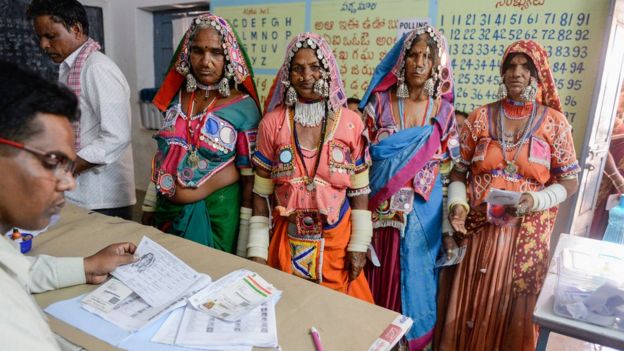
Image copyrightGETTY IMAGESImage caption Indian lambadi tribeswomen at a polling station in southern India
No voter is meant to have to travel more than 2km to reach a polling station. Because of the enormous number of election officials and security personnel involved, voting will take place in seven stages between 11 April and 19 May.
India’s historic first election in 1951-52 took three months to complete. Between 1962 and 1989, elections were completed in four to 10 days. The four-day elections in 1980 were the country’s shortest ever.
WASHINGTON, April 9 (Xinhua) — The International Monetary Fund (IMF) on Tuesday revised up the 2019 growth projection for China to 6.3 percent, up 0.1 percentage point from its previous estimation in January, according to the newly released April 2019 World Economic Outlook (WEO).
The upward revision reflected the combined impact of recent developments in the China-U.S. trade talks, China’s stronger-than-expected expansionary fiscal policy, and a slowing global economy, Changyong Rhee, director of the IMF’s Asia and Pacific Department, told Xinhua.
“We have to revise our growth forecast due to more fiscal expansion, at the same time, the global economy has started to slow down, that actually has negative impact on that,” Rhee said, adding that the IMF made the latest projection taking into account both positive and negative factors.
In its latest annual government work report, China set the 2019 gross domestic product (GDP) growth target at 6-6.5 percent. The world’s second-largest economy also pledges to continue pursuing high-quality development.
The IMF’s medium-term forecast sees a gradual slowdown in China “as internal rebalancing toward a private-consumption and services-based economy continues and regulatory tightening slows the accumulation of debt and associated vulnerabilities.”
In the latest WEO report, it projected a 6.1 percent growth rate for China in 2020, slightly down from the previous estimation of 6.2 percent.
The report highlighted trade tensions as one of the key sources of downside risk to the global outlook, noting that raising tariffs would lead to higher prices for consumers, and trade policy uncertainty would reduce business investment, disrupt supply chains, and dampen productivity growth.
BEIJING, April 9 (Xinhua) — There are many ways to understand China’s ecological civilization, among which is the indispensable knowledge that top Chinese leaders are serving as role models in the country’s afforestation efforts.
A day after China’s Tomb-sweeping holiday, Chinese President Xi Jinping and other state and party leaders made a tree-planting tour in suburban Beijing. Xi called for wide participation in China to plant trees, stressing that tremendous efforts are needed to increase forests, improve vegetation and tackle fragile ecological environment.
Afforestation has long been a tradition in China, a country which once suffered severe desertification. Since the Standing Committee of the National People’s Congress designated March 12 as the National Tree Planting Day in 1979, it has become an annual ritual for top Chinese officials to plant trees in suburban Beijing around the Tomb-sweeping Festival, which fell on April 5 this year, a perfect time for spring plowing and sowing according to China’s lunar calendar.
Actions like these by the top leadership are particularly meaningful as the country embarks on a carefully-designed journey of realizing an ecological civilization, a new catchphrase in the country, to make the world’s second-largest economy a more livable place.
Respect nature, follow its way and protect it. The Chinese leadership has been tirelessly promoting a simple, moderate, green, and low-carbon life for Chinese people, and asked them to treat the ecological environment with the same importance they treat their own lives.
While most industrialized countries in the world have bitter memories of pollution and environmental degradation in their early days of economic growth, it is not too surprising that doubts emerge on whether China, the world’s economic powerhouse, could keep its economy expanding at a reasonable pace while keeping its pollution and environmental degradation in check.
Chinese leadership’s rhetoric on ecological conservation is grounded in reality.
Thanks to painstaking efforts, the forest coverage rate of China has increased by nearly 10 percentage points since the late 1970s. In 2018, China planted 7.07 million hectares of trees, and the country is home to the world’s largest man-made forest in scale.
A recent Boston University study based on NASA satellite data shows that over the last two decades, “the greening of the planet represents an increase in leaf area on plants and trees equivalent to the area covered by all the Amazon rainforests,” with China and India leading the charge. China alone accounts for 25 percent of the global net increase in leaf area although the country holds only 6.6 percent of the global vegetated area. This remarkable progress is a result of decades of persistent efforts by the Chinese government and people.
Ancient Chinese philosophers believed the overriding purpose of life was to seek harmony in society and the universe, which could form the philosophical basis of an ecological civilization of today. Efforts must be made to blend ancient Chinese value with a modern undertaking to create an ecological civilization that fits with today’s economic, social and ecological environment.
China plans to add 6.73 million hectares of afforested areas in 2019 to further expand forest coverage. Spring is short, so plant trees and make a difference not only in China, but also the world.
BEIJING, April 9 (Xinhua) — China has over 200 million people taking massive open online courses (MOOC), leading the world in both the number and the scale of application of such courses.
This was announced at the China MOOC Conference held in Beijing on Tuesday.
With more than 12,500 courses, China has built an extensive MOOC network offering a wide range of courses across the disciplines over the past six years.
More than 1,000 universities and colleges have opened such courses. Among them, over 200 high-quality courses can be found on MOOC platforms in the United States, Britain, France, Spain and the Republic of Korea.
At Tuesday’s conference, Vice Education Minister Zhong Denghua presented credentials to providers of “excellent online courses.”
A declaration was issued at the conference, pledging to uphold the principles of fairness, inclusiveness, service, innovation and cooperation in developing China’s MOOCs.
Peng Liyuan (R), wife of Chinese President Xi Jinping, meets with Lis Cuesta Peraza, wife of Cuban President Miguel Diaz-Canel, in Beijing, capital of China, April 9, 2019. (Xinhua/Ding Lin)
BEIJING, April 9 (Xinhua) — Peng Liyuan, wife of Chinese President Xi Jinping, met here Tuesday with Lis Cuesta Peraza, wife of Cuban President Miguel Diaz-Canel.
Peng asked Lis Cuesta Peraza to convey President Xi’s sincere regards to Miguel Diaz-Canel, saying the visit by Lis Cuesta Peraza fully demonstrated their friendship with China and the Chinese people.
Peng said the two countries share a profound traditional friendship, and the new generation of Cuban leaders actively support the construction of the Belt and Road and are committed to strengthening all-round bilateral cooperation. She expressed the hope that Sino-Cuban cooperation would score fruitful results and bilateral friendship last forever.
Peng spoke highly of Lis Cuesta Peraza’s active efforts to promote bilateral people-to-people and cultural exchanges, and expressed the hope that the two countries would cement exchanges and cooperation in culture, art and tourism.
Peng also introduced her work as UNESCO special envoy for the advancement of girls’ and women’s education and a WHO goodwill ambassador for tuberculosis and HIV/AIDS, shared China’s experience in promoting education and health and expressed the hope that the two countries would enhance exchanges and cooperation in these fields.
Lis Cuesta Peraza asked Peng to convey the greetings and good wishes of Miguel Diaz-Canel to President Xi, saying that the Cuban people love Chinese culture and are full of friendly feelings toward the Chinese people.
Lis Cuesta Peraza said Cuba admires the achievements China has made in the past 70 years and expressed gratitude to China for its long-term support and help.
She said the Cuban side is willing to take the opportunity of the 60th anniversary of the establishment of diplomatic relations between the two countries next year to promote people-to-people and cultural exchanges, and consolidate the Cuba-China friendship.
ZAGREB, April 9 (Xinhua) — Chinese Premier Li Keqiang arrived in Croatia on Tuesday for an official visit to the country and the eighth leaders’ meeting of China and Central and Eastern European Countries (CEECs) in the Croatian seaside city Dubrovnik.
Upon Li’s arrival, Croatian Prime Minister Andrej Plenkovic and his wife Ana Plenkovic led a warm welcome ceremony at the Zagreb Airport. Children dressed in national costumes presented flowers to Premier Li and his wife Cheng Hong.
Li is the first Chinese premier that pays a visit to Croatia since the two countries established diplomatic ties 27 years ago.
The Chinese premier said he is happy to visit the beautiful country, adding that China and Croatia share a profound traditional friendship.
Bilateral relations enjoy healthy and stable development on the basis of mutual respect, equality and mutual benefits, and cooperation in all areas has continuously achieved significant breakthroughs, which has brought tangible benefits to both sides, Li said.
“I expect this visit can consolidate China-Croatia traditional friendship, enhance political mutual trust, strengthen the alignment of the two countries’ development strategies and policies, expand and deepen mutually beneficial cooperation between the two sides, so as to promote China-Croatia comprehensive cooperative partnership to a new higher level,” the premier said.
Li said that currently, cooperation between China and the 16 CEECs has shown strong vitality with significant outcomes achieved in areas including economy and trade, investment, finance, infrastructure, agriculture, and people-to-people and cultural exchanges.
It has become a vigorous inter-regional cooperation mechanism which has provided a new avenue for China’s cooperation with Europe, he added.
Li said China expects to work with the 16 CEECs, under the principles of equality and consultation, mutual benefits, openness and inclusiveness, and with pragmatic and innovative spirits, to make the cooperation mechanism an important platform for synergizing the Belt and Road Initiative and the EU strategy on Connecting Europe and Asia so as to inject new impetus into the development of the China-CEEC relations and the European integration process.
During the visit to Croatia, Li will have a meeting with Plenkovic, with whom he will hold a joint press conference, attend an opening ceremony of the Year of Tourism between China and Croatia, inspect the project of the Peljesac Bridge and witness the signing of cooperation deals in several areas. Li will also meet Croatian President Kolinda Grabar-Kitarovic and Parliament Speaker Gordan Jandrokovic.
During the China-CEEC leaders’ meeting themed “Building New Bridges through Openness, Innovation and Partnership,” the Chinese premier and leaders of 16 CEECs will plan practical cooperation in the future, witness the signing of cooperation deals, attend a series of activities including an economic and trade forum. Li will also hold bilateral meetings with CEEC leaders.
Before landing in Zagreb, the second stop of the premier’s five-day tour to Europe, Li concluded his trip in Brussels with the successful holding of the 21st China-European Union (EU) leaders’ meeting.
Online auction attracts fierce competition, sending value rocketing in first minutes of bidding
‘Auspicious’ numbers are popular in China because they sound like words which signify good fortune
An “auspicious” mobile phone number has sold for more than US$50,000 at an online auction in China. Photo: Shutterstock
An “auspicious” mobile phone number has fetched more than 350,000 yuan (US$52,000) at an online auction in northern China.
The number, which ended in five fives, sold for more than 30 times the starting price of 11,250 yuan, after fierce bidding saw its value rocket to more than 300,000 yuan in just 12 minutes.
A total of 140 people registered to participate in the 24-hour auction and 107 bids were recorded. The winning bid came from a user called Li Zisheng on Tuesday evening, according to Alibaba’s Sifa court auction platform which hosted the sale.
The South China Morning Post is owned by Alibaba.
Why you shouldn’t clip your nails at night and other superstitions
It is not uncommon for people in China to pay a premium for phone numbers or car licence plates featuring numbers which are considered lucky.
Six, eight and nine are particular favourites, as they sound like the words for strength, wealth and longevity, respectively. The number five is said to represent happiness or wealth.
One of the most expensive mobile numbers on record in China contained a combination of eights and fives and sold at auction for US$680,000 in 2004, according to the Oriental Morning Post.
Not everyone is willing to pay any price for a lucky number plate or phone number, with some internet users on China’s Twitter-like Weibo service questioning why people would pay so much money for such things.
“Are mobile and car plate numbers really this important?” a user from Hunan province, central China, wrote. “This type of number will have a higher chance of getting spam calls.”
Media caption The “Umbrella Movement” activists said they would continue to strive for democracy
Nine pro-democracy activists in Hong Kong have been found guilty of public nuisance charges for their role in a civil disobedience movement that called for free elections in the city.
Among them are three prominent activists, seen as figureheads of Hong Kong’s pro-democracy movement.
They could be jailed for up to seven years for their part in the “Umbrella Movement” protests of 2014.
Thousands marched demanding the right for Hong Kong to choose its own leader.
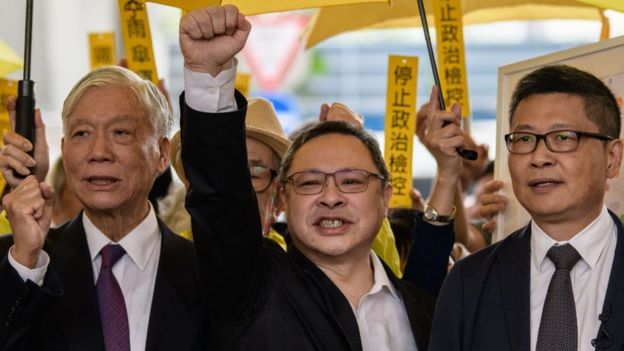
Those convicted include the so-called “Occupy trio” – sociology professor Chan Kin-man, 60, law professor Benny Tai, 54, and Baptist minister Chu Yiu-ming, 75.
They are seen as the founders of the movement that galvanised protesters in their campaign of civil disobedience.
“No matter what happens today… we will persist on and do not give up,” Mr Tai told reporters ahead of the verdict.
A large crowd gathered outside the court on Thursday to support them. It is not yet clear when they will be sentenced.
Image copyrightAFPChu Yiu-ming, Benny Tai and Chan Kin-man (left to right) were charged under colonial-era laws that carry possible jail terms of up to seven years
Like just another day
By Martin Yip, BBC News Chinese, Hong Kong
The nine defendants walked into the court building looking refreshed and in high spirits. All but one said a few words in what might have been their last hours of freedom before their predicted jail term.
Delivering his verdict, Justice Johnny Chan said the defendants had caused a nuisance – by occupying major roads – leading to injuries among civilians. The nine looked calm and not particularly emotional. They were later released on bail. Benny Tai, Chan Kin-man and Chu Yiu-ming smiled as they passed me, as if it was just another day.
They are yet to say if they will appeal. The court was adjourned for the day as the lawyers are yet to finish their mitigation submissions. The sentences have yet to be announced.
The broader pro-democracy camp already has bad relations with Beijing. Activists and politicians did express their anger but political analysts also warn that people might simply leave the movement out of frustration.
“Some people might feel dispirited and helpless. I hope they can see that other people haven’t given up,” Benny Tai told BBC News Chinese ahead of today’s verdict.
Seventy nine days of sit-in protests have already changed Hong Kong a lot. But today’s verdict might serve more as a reminder that this city remains divided.
What has the reaction been?
At the trial Judge Johnny Chan rejected the idea that this would have a substantial impact on society.
“It cannot be reasonably argued that a charge of conspiracy to cause public nuisance would generate a chilling effect in society,” he wrote in his ruling.
But rights groups criticised the ruling, with Humans Rights Watch saying the court was “sending a terrible message”.
“[This] will likely embolden the government to prosecute more peaceful activists, further chilling free expression in Hong Kong,” said researcher Maya Wang in a statement to the BBC.
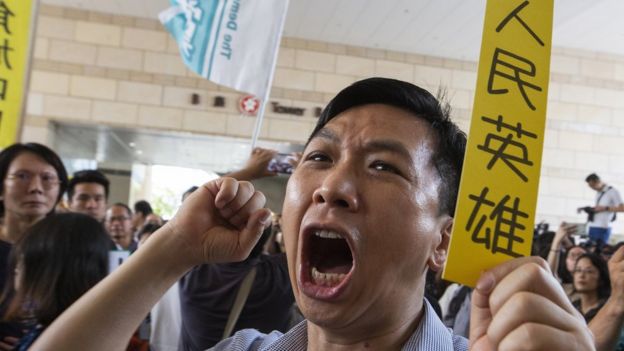
Image copyrightEPAOne pro-democracy supporter outside the court held up a sign saying “People’s Hero”
Lord Chris Patten, the last British governor of Hong Kong, released a statement saying that it was “appallingly divisive to use anachronistic common law charges in a vengeful pursuit of political events which took place in 2014”.
This verdict comes after a string of frustrations for pro-democracy activists. In the last few years the courts have removed six lawmakers for changing their swearing in oaths to include protest phrases. Others have also been disqualified from running for office.
What were the protests about?
The protests started in reaction to a decision made by China that it would allow direct elections in 2017, but only from a list of candidates pre-approved by Beijing.
Beijing is highly sensitive about Hong Kong’s status and any calls for more autonomy from China.
The former British colony was handed back in 1997 on condition it would retain “a high degree of autonomy, except in foreign and defence affairs” for 50 years.
Many people in Hong Kong believe they should have the right to elect their own leader.
In 2014, the three activists’ calls for non-violent civil disobedience joined with student-led protests and snowballed into the massive demonstrations.
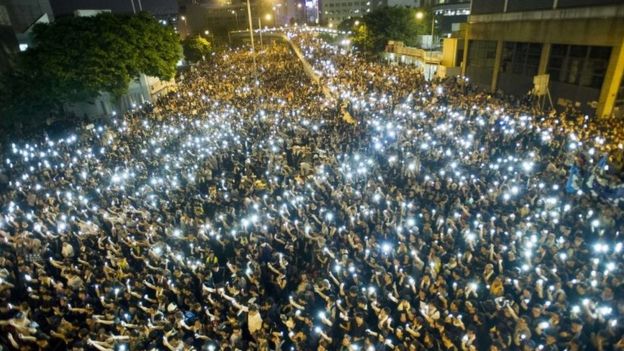
Tens of thousands of people camped in the streets and demanded the right to fully free leadership elections.
Image copyrightAFP The pro-democracy protests bought an area of central Hong Kong to a standstill for weeks in 2014
The protests became known as the “Umbrella Movement” after people used umbrellas to shield themselves from pepper spray fired by police to disperse the crowd.
Protesters accused the Chinese government of breaking its promise to allow full democracy in Hong Kong, and of encroaching more and more on the region.
But the number of protesters dwindled to just a few hundred as the weeks dragged on and they ultimately failed to achieve their goal.






 CHINDIA ALERT: You'll be living in their world, very soon