Chindia Alert: You’ll be Living in their World Very Soon
aims to alert you to the threats and opportunities that China and India present. China and India require serious attention; case of ‘hidden dragon and crouching tiger’.
Without this attention, governments, businesses and, indeed, individuals may find themselves at a great disadvantage sooner rather than later.
The POSTs (front webpages) are mainly 'cuttings' from reliable sources, updated continuously.
The PAGEs (see Tabs, above) attempt to make the information more meaningful by putting some structure to the information we have researched and assembled since 2006.
NEW YORK, Feb. 12 (Xinhua) — Bill Gates, co-chair of the Bill & Melinda Gates Foundation, said Tuesday that exciting progress against poverty and disease around the world has been made in 2018, and China has been a major contributor to this progress.
In a video speech exclusively broadcast via Xinhua, Gates said over the past four decades, China lifted over 800 million people out of poverty and became the second largest economy in the world. Now, it’s stepping up its efforts to help solve some of the toughest challenges in the rest of the world.
He said during his recent visit to China, he attended the Reinvented Toilet Expo and once again saw China’s innovation capacity, with companies showcasing game-changing products that will benefit billions who today do not have access to safe sanitation.
He met Chinese scientists who are developing new drugs to tackle infectious diseases like tuberculosis that affect the poor, and talked with Chinese partners who are sharing lessons from China’s own development, so that African countries can make progress on vital priorities such as strengthening health systems and controlling deadly diseases like malaria, and also improving agricultural transformation.
“I believe in China’s ability to help hundreds of millions of young people in the world’s poorest countries fulfil their potential. As we usher in the New Year, our foundation is committed, as always, to supporting China in building a better future for all,” he said.
The video coincides with the release of Bill and Melinda Gates 2019 Annual Letter, in which they focussed on nine surprises and what can be learned from them.
“Some surprises help people see when the status quo needs to change. Others underscore that needed transformation is already happening,” he said.
“In 2018, we continued to see exciting progress against poverty and disease around the world. But as many nations turn inward, we risk losing sight of crucial global priorities, especially the need to invest in the health and education of young people,” Gates said.
He said one surprise they share in the letter is how much Africa is the world’s youngest continent. Between now and the end of the century, an increasing proportion of young people will come from countries on the African continent.
“Whether we ensure that these people (who) grow up healthily and well-educated and have the opportunity to thrive will determine the future trajectory of the whole globe,” he stressed. “We hope observations like these will prod readers to take action to accelerate the progress the world has been making.”
WASHINGTON, Feb. 12 (Xinhua) — Data from NASA satellites have shown that China and India led the way in greening on land, thanks to ambitious tree-planting programs in China and intensive agriculture in both countries.
The study published in the latest edition in Nature Sustainability on Monday showed that at least 25 percent of the foliage expansion since the early 2000s globally came in China.
The researchers from Boston University found that global green leaf area has increased by 5 percent in the new century, an area equivalent to all of the Amazon rainforest.
“China and India account for one-third of the greening, but contain only nine percent of the planet’s land area covered in vegetation,” said lead author Chen Chi of Boston University.
“That is a surprising finding, considering the general notion of land degradation in populous countries from over-exploitation,” said Chen.
Rama Nemani, a research scientist at NASA’s Ames Research Center and a co-author of the study said: “When the greening of the Earth was first observed, we thought it was due to a warmer, wetter climate and fertilization from the added carbon dioxide in the atmosphere.”
But with data from NASA’s Terra and Aqua satellites, scientists realized that humans are also contributing.
“Humans are incredibly resilient. That’s what we see in the satellite data,” said Nemani.
China’s contribution to the global greening trend comes in large part from its programs to conserve and expand forests, accounting for about 42 percent of the greening contribution, according to the study.
Another 32 percent of the greening change in China, and 82 percent in India, resulted from intensive cultivation of food crops, since the farmland in China and India has not changed much since the early 2000s, while both increased their food production to feed large populations.
However, the researchers rang bells as well. They said that the gain in global greenness did not necessarily offset the loss of natural vegetation in tropical regions like Brazil and Indonesia.
The loss of sustainability and biodiversity in those ecosystems cannot be offset by the simple greenness of the landscape, according to the study.
LONDON, Feb. 12 (Xinhua) — China and UK should keep the long-term interests and larger picture in mind, look at each other’s development as opportunities, respect each other’s sovereignty, security and right to development, handle our differences properly and enhance strategic mutual trust, Chinese Ambassador to Britain Liu Xiaoming has said.
The Chinese diplomat made the remarks while attending the Chinese New Year Dinner by the Cities of London and Westminster Conservative Association on Monday night.
“If we compare China-UK relations to a building, it could not stand tall without a solid foundation. This foundation is the mutual confidence between our two countries,” he said.
Recalling that the world economy is under downward pressure, with surging protectionism and unilateralism making things doubly difficult. Against this situation, Liu said it is all the more important that China and the UK advocate free trade, oppose protectionism and promote open cooperation.
“We hope that the UK would continue to provide a fair, transparent and non-discriminatory business environment for Chinese companies. We hope you will make successful Chinese companies such as Huawei feel welcome here in Britain, and convince them that the UK is a trustworthy place to put their money,” said the Chinese ambassador.
Liu said both China and the UK are known for their profound cultural heritage and important contribution to the progress of human civilization.
“I hope that in the new year our two countries will continue to enhance cultural and people-to-people exchanges, and deepen mutual understanding and strengthen friendship.”
The ambassador also hoped that people from all walks of life in both China and UK will join hands to cement the foundation for a solid and magnificent edifice of bilateral relations.
British Prime Minister Theresa May sent a congratulatory message to the event, saying that it is an important moment to recognize the contribution of the Chinese community in London and across the whole of the United Kingdom.
“The Chinese community’s expanding business expertise, scientific inquiry and cultural heritage and traditions are of immense value to our country – not least here in London, where the vibrancy of Chinatown stands as a strong beacon for the Chinese community and a reminder of all that they have contributed to our society,” she said.
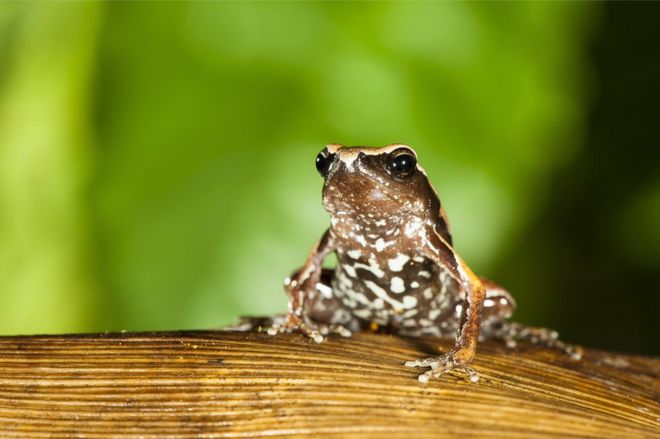
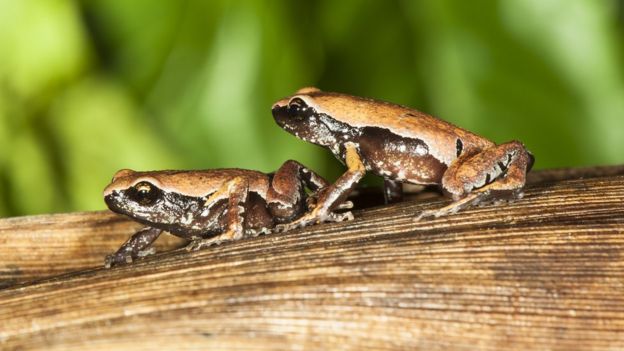
Indian researchers have discovered a new species of frog – in a roadside puddle.
Sonali Garg, a PhD student at Delhi University, and her supervisor SD Biju found the new species in the Western Ghats, a biodiversity hotspot in southern India.
The species belongs to a new Indian frog group or genus which the scientists have named Mysticellus.
The name is derived from Latin and means mysterious and diminutive.
The scientists discovered the narrow-mouthed frog after three years of extensive explorations, and have confirmed that it represents an entirely new species and genus of microhylid frogs.
The new genus is currently known only in a single locality.
“Our discovery of this new frog genus from one of the most explored and researched regions in the Western Ghats indicates that documentation of amphibians in this globally recognised biodiversity hotspot is still far from being complete,” says Sonali Garg.
“This frog went unnoticed until now probably because it appears for less than four days for breeding activities and lives a secretive lifestyle for the rest of the year.”
A number of new frog species have been discovered in the Western Ghats in the past decade, making it one of the leading biodiversity hotspots in the world.
“At the same time, Indian amphibians face various extinction threats, especially due to habitat loss and degradation. The only known population of the new genus is found in a wayside area disturbed with vehicular movement, plantation activities and human settlements,” says Ms Garg.
“Since little is known about the habitat requirements and the distribution range of the new frog, the specific site needs to be preserved to protect this frog.”
A new tadpole that burrows through sand was discovered in Western Ghats in 2016, and an extraordinary tree frog thought to have died out more than a century ago was also rediscovered in the same year.
NEW DELHI (Reuters) – In a putdown rare even for India’s sometimes dramatic court proceedings, the country’s Supreme Court told the former chief of federal police on Tuesday to “sit in one corner” and fined him 100,000 rupees for disobeying the court.
M Nageswara Rao, former chief of the Central Bureau of Investigation (CBI), was given the instruction after being found guilty of violating an earlier order that mandated seeking court permission before taking an investigating officer off a case.
“Please go and sit in one corner till the rising of the court. Fine to be deposited in one week,” Ranjan Gogoi, the court’s chief justice, told him after the court found him guilty of contempt of court.
Rao proceeded to sit in a corner and appeared to be avoiding eye contact with anyone, a Reuters witness said.
Bizarre orders and courtroom drama are fairly common in Indian courts, but lawyers and court officials said such a direction towards a senior CBI official in the Supreme Court was unprecedented.
Rao, now an additional director in the CBI, had ordered the transfer of a CBI officer investigating a sexual exploitation case at a shelter home in the eastern state of Bihar.
One of the injured students at the hospital in Pulwama on February 13.(ANI/Twitter Photo)
Twelve students were injured in an explosion at a private school in south Kashmir’s Pulwama on Wednesday. The blast took place around 2.30pm.
The injured are students of class 10 of the Falah-i-Millat school in Pulwama’s Narbal town. Seven of them have been referred to Srinagar Hospital for further treatment.
They have been rushed to the government district hospital in Pulwama for treatment.
“I was teaching and then suddenly an explosion occurred. I can’t say how many students are injured,” Jawed Ahmed, a teacher at the school where the blast took place told news agency ANI.
The police have lodged a case and are investigating the nature of the blast.
The CAG report said India has managed to save 17.08 per cent money for the India Specific Enhancements in the 36 Rafale contract, compared to the 126 aircraft deal.
SNS Web | New Delhi | February 13, 2019 12:54 pm
The report of the Comptroller and Auditor General (CAG) on the 2015 Rafale jet deal tabled in the Parliament on Wednesday, said the Rafale deal sealed by the Modi government is 2.8 per cent cheaper than the one negotiated by the previous UPA government.
The CAG report tabled before Rajya Sabha said India has managed to save 17.08 per cent money for the India Specific Enhancements in the 36 Rafale contract, compared to the 126 aircraft deal.
It further said the delivery schedule of the first 18 Rafale aircraft is better than the one proposed in the 126 aircraft deal, by five months.
The auditor report noted that the Indian Air Force did not define the ASQRs (Air Staff Qualitative Requirements) properly. As a result of which none of the vendors could fully meet the ASQRs. ASQRs were changed repeatedly during the procurement process, the report said.
This created difficulties during technical and price evaluation and affected the integrity of competitive tendering which was one of the main reasons for the delay in the acquisition process, the report said.
Objectivity, equity and consistency of technical evaluation process was not evident in the Technical Evaluation Report.
Finding issues with the UPA-era deal, the audit further said a Defence Ministry team in March 2015 had recommended the scrapping of the 126 Rafale deal saying that the Dassault Aviation was not the lowest bidder and EADS (European Aeronautic Defence & Space Company) was not fully compliant with the tender requirements.
The Defence Ministry team had said that the proposal of Dassault Aviation Rafale should have been rejected in technical evaluation stage itself as it was non-compliant with RFP requirements.
The report comes as a major victory for the Narendra Modi-led BJP government which had been cornered by the Opposition parties in the matter.
Reacting to the report, Union Minister Arun Jaitley in a series of tweets slammed the opposition Congress saying “the lies of ‘Mahajhootbandhan’ stand exposed by the CAG Report”.
Comparing the 2007 and 2016 terms of the deal, Jaitley said the NDA contract involved lower price of jets, faster delivery, better maintenance and lower escalation.
He said “the CAG Report on Rafale reaffirms the dictum” adding that “the truth shall prevail”.
The Congress and other opposition parties have dismissed the report as biased as auditor Rajiv Mehrishi was the Finance Secretary when the deal for 36 Rafale fighter jets was inked in 2016.
The Congress had on Sunday demanded that CAG Rajiv Mehrishi recuse himself from the audit citing conflict of interest.
“Finance ministry plays an important role in negotiations. How will CAG investigate himself?” said Congress leader Kapil Sibal.
The Congress has been accusing massive irregularities in the deal, alleging that the government was procuring each aircraft at a cost of over Rs 1,670 crore as against Rs 526 crore finalised by the UPA government when it was negotiating procurement of 126 Rafale jets.
It has also demanded a Joint Parliamentary Committee (JPC) probe into the deal.
The Supreme Court had earlier in December given a clean chit to the Centre on the procurement of 36 Rafale fighter jets from France.
A three-Judge bench headed by Chief Justice Ranjan Gogoi had dismissed all the petitions and said no Rafale probe was required.
India has signed an agreement with France to buy 36 Rafale fighter aircraft, costing approximately Rs 58,000-crore (about USD 8 billion), in a fly-away condition for Indian Air Force equipment upgrade.
LONDON (Reuters) – World shares and bond yields rode a renewed surge in risk appetite on Tuesday, as investors were optimistic about U.S.-China trade talks and cheered Washington’s deal to avoid another government shutdown.
Tokyo’s Nikkei set the tone with its best day of the year so far and Europe wasted little time in trying to lift the STOXX 600 back to the two-month high it set last week.
Germany’s DAX jumped more than 1.2 percent, after rising 1 percent on Monday, and Paris and Milan were up 0.8 percent, while London’s FTSE approached a four-month peak despite ongoing Brexit uncertainty.
The dollar hovered at a two-month high and the Australian dollar also gained. The yen and Swiss franc dipped while U.S. Treasury and German bund yields edged up as investors jettisoned safe havens.
“We have had two bits of relatively good news overnight – optimism about the U.S. shutdown not resuming and optimism about a trade deal,” said Societe Generale strategist Kit Juckes.
“Equities are higher, bond yields are a little bit higher, yen and Swiss franc weakest overnight of the major currencies so it’s sort of risk-on rules OK!”
Juckes said he reckoned there was now a 75 percent chance that a ratcheting up of U.S. tariffs on Chinese goods at the start of March will be avoided and a 95 percent chance that another U.S. government shutdown will be dodged.
Those odds got a boost on Monday after U.S. lawmakers reached a tentative deal on border security funding, though aides cautioned that it did not contain the $5.7 billion President Donald Trump wants to build a wall on the Mexican border.
S&P 500 e-mini futures were up nearly 0.5 percent, pointing to a solid start on Wall Street later after a choppy day on Monday.
U.S. and Chinese officials expressed hopes the new round of talks, which began in Beijing on Monday, would bring them closer to easing their months-long trade war.
Beijing and Washington are trying to hammer out a deal before a March 1 deadline, without which U.S. tariffs on $200 billion worth of Chinese imports are scheduled to increase to 25 percent from 10 percent.
“There will be no winner in a trade war. So at some point they will likely strike a deal,” said Mutsumi Kagawa, chief global strategist at Rakuten Securities in Tokyo.
BIG IN JAPAN
MSCI’s broadest index of Asia-Pacific shares outside Japan edged up 0.3 percent.
Shanghai rose 0.35 percent, South Korea’s KOSPI climbed 0.6 percent and Australian shares gained 0.3 percent.
The Nikkei rallied though, shooting up 2.6 percent after closing on Friday at its lowest level since early January. The Tokyo market was closed on Monday.
With the yen backtracking again, shares of exporters such as automakers and machinery makers led the charge. Separately, Deutsche Bank noted it was 20 years since Japan cut interest rates to zero, something now standard in large parts of Europe.
The dollar held firm, having gained for eight straight sessions against a basket of six major currencies until Monday, its longest rally in two years.
Although the Federal Reserve’s dovish turn dented the dollar earlier this month, some analysts noted the U.S. currency still has the highest yield among major peers and that the Fed continues to shrink its balance sheet.
Wall St wavers as investors eye trade talks, growth fears
“The dollar is the market’s pet currency at present regardless of whether concerns about the global economy are on the rise,” currency strategists at Commerzbank said in a note.
The dollar popped up to a six-week high of 110.65 yen. In contrast, the euro dropped to as low as $1.1267, its weakest in 2-1/2 months, and last traded at $1.1277.
In commodity markets, oil prices also ticked up as traders weighed support from OPEC-led supply restraint and a slowdown in the global economy.
U.S. crude futures traded at $52.68 per barrel, up 0.5 percent. Brent crude rose 0.6 percent to $61.89 per barrel. Gold was a touch stronger at $1,312 an ounce.
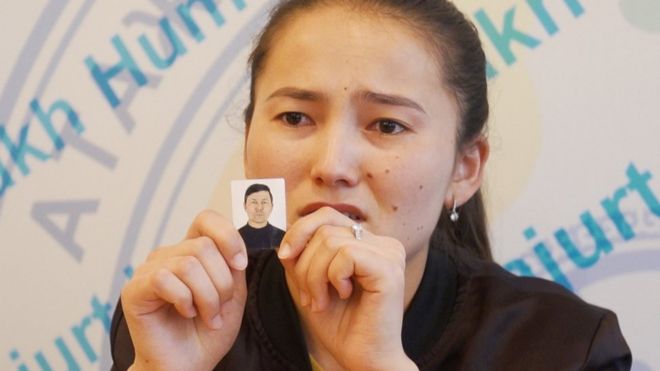
Image captionAibota Serik says her father has disappeared into China’s network of detention centres
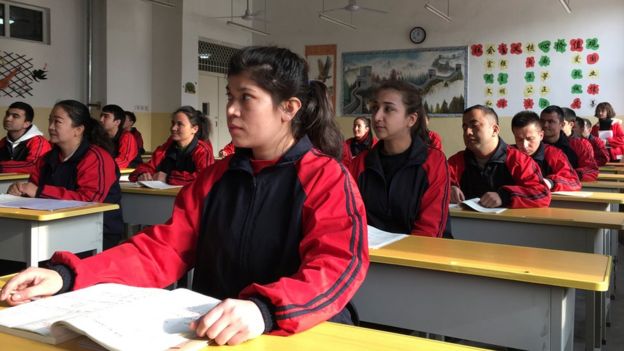
The Chinese government calls them free “vocational training centres”; Aibota Serik, a Chinese Kazakh whose father was sent to one, calls them prisons.
Her father Kudaybergen Serik was a local imam in Tarbagatay (Tacheng) prefecture of China’s western Xinjiang region. In February 2018 the police detained him and Aibota hasn’t heard from her father since then.
“I don’t know why my father was imprisoned. He didn’t violate any laws of China, he was not tried in a court,” she says, clutching a small photo of him, before breaking down in tears.
I met Aibota together with a group of other Chinese Kazakhs in Almaty, Kazakhstan’s largest city. They gathered in a small office to petition the Kazakh government to help secure the release of their relatives who had disappeared in “political re-education camps”.
There are more than a million Kazakhs living in China. After the collapse of the Soviet Union, thousands moved to oil-rich Kazakhstan, encouraged by its policy to attract ethnic Kazakhs. Today, these people feel cut off from their relatives who stayed in China.
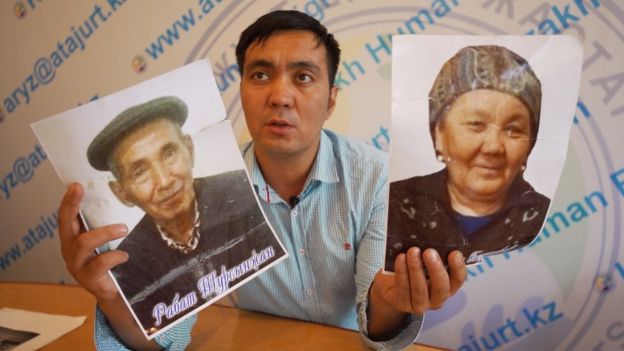
Image captionNurbulat Tursunjan says the Chinese authorities have confiscated his parents’ passports
Nurbulat Tursunjan uulu, who moved to the Almaty region in 2016, says his elderly parents are unable to leave China and come to Kazakhstan because the authorities took away their passports.
Another petitioner, Bekmurat Nusupkan uulu, says that relatives in China are afraid to talk on the phone or on the popular Chinese messaging app WeChat. And they are right to be afraid, he says.
“My father-in-law visited me in February 2018. From my place, he called his son in China, he asked how he was and so on. Shortly after that his son Baurzhan was detained. He was told that he had received phone calls from Kazakhstan two or three times and was sent to a political camp.”
Human Rights Watch says detainees are held “without any due process rights – neither charged nor put on trial – and have no access to lawyers and family”.
Image copyrightREUTERSImage captionChina insists its detention centres, such as this one in the city of Kashgar, are for “vocational training”
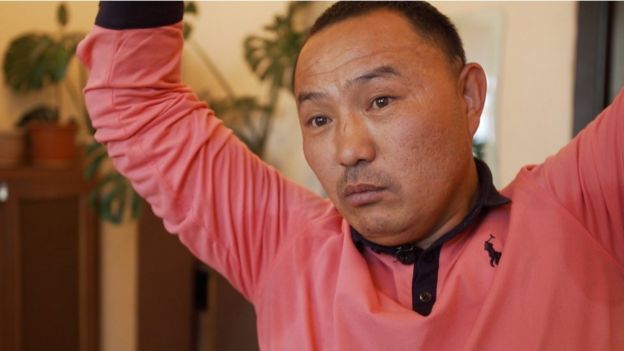
Orynbek Koksybek is an ethnic Kazakh who spent several months in camps.
“I spent seven days of hell there,” he says. “My hands were handcuffed, my legs were tied. They threw me in a pit. I raised both my hands and looked above. At that moment, they poured water. I screamed.
“I don’t remember what happened next. I don’t know how long I was in the pit but it was winter and very cold. They said I was a traitor, that I had dual citizenship, that I had a debt and owned land.”
A week later Mr Koksybek was taken to a different place where he learnt Chinese songs and language. He was told he would leave if he learnt 3,000 words.
Image captionOrynbek Koksybek says he was thrown into a pit
“In Chinese they call it re-education camps to teach people but if they wanted to educate, why do they handcuff people?
“They detain Kazakhs because they’re Muslims. Why imprison them? China’s aim is to turn Kazakhs into Chinese. They want to erase the whole ethnicity,” he says.
It is not possible to independently verify Orynbek Koksybek’s story, but his account is similar to many documented by Human Rights Watch and other activists.
The Chinese embassy in Kazakhstan has not replied to the BBC’s request for comment, but the Chinese authorities have been quoted in state media as saying the camps are “vocational training centres”, which aim to “get rid of an environment that breeds terrorism and religious extremism”.
The Kazakh government says that any restrictions on Chinese citizens in China are their internal matter, and it does not interfere. However, Kazakhstan says it will try to assist any Kazakh citizens who are detained in China.





 CHINDIA ALERT: You'll be living in their world, very soon