30/05/2020
- Embassy in France removes ‘false image’ on Twitter in latest online controversy amid accusations of spreading disinformation
- After months of aggressive anti-US posts by Chinese diplomats Beijing is cracking down on ‘smear campaigns’ at home
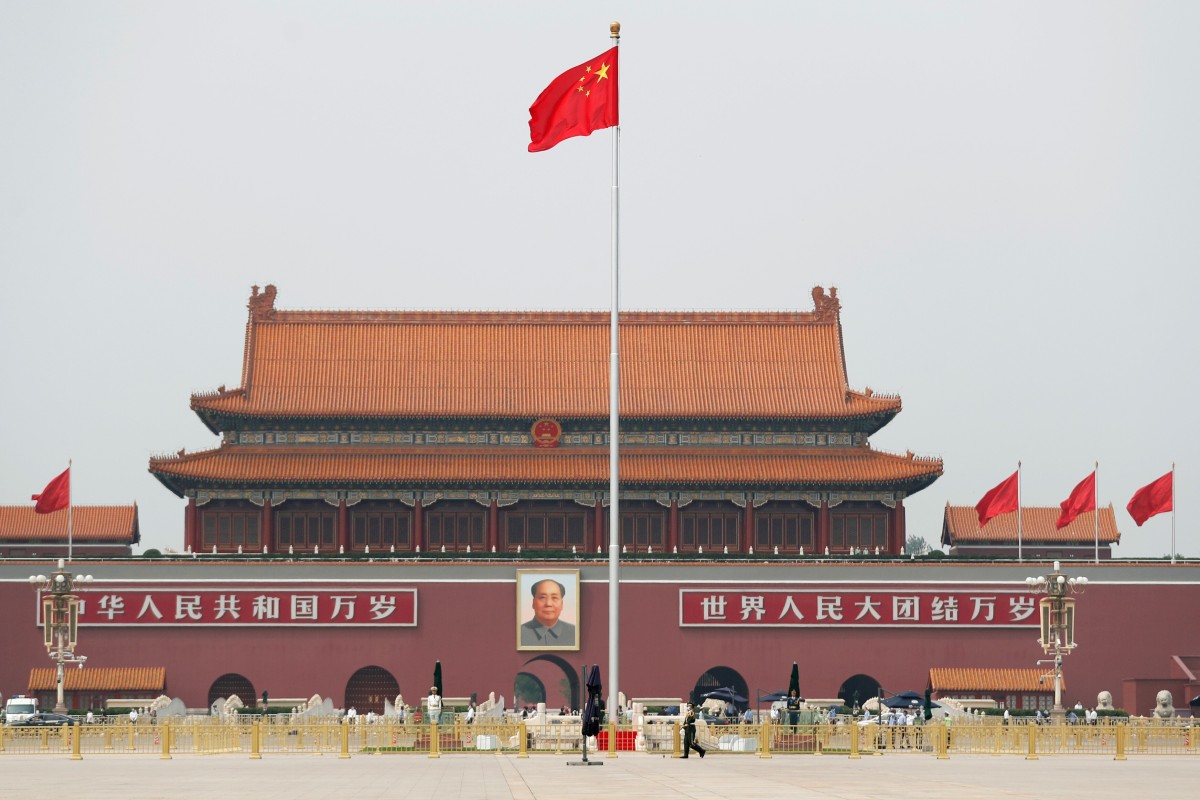
Beijing’s ‘Wolf Warrior’ diplomacy has coincided with a rise of nationalist content on Chinese social media. Photo: Reuters
Beijing is battling allegations that it is running a disinformation campaign on social media, as robust posts by its diplomats in Western countries promoting nationalist sentiment have escalated into a spat between China and other countries, especially the United States.
In the latest in a series of online controversies, the Chinese embassy in France claimed its official Twitter account had been hacked after it featured a cartoon depicting the US as Death, knocking on a door marked Hong Kong after leaving a trail of blood outside doors marked Iraq, Libya, Syria, Ukraine and Venezuela. The inclusion in the image of a Star of David on the scythe also prompted accusations of anti-Semitism.
Top China diplomats call for ‘Wolf Warrior’ army in foreign relations
25 May 2020
“Someone posted a false image on our official Twitter account by posting a cartoon entitled ‘Who is Next?’. The embassy would like to condemn it and always abides by the principles of truthfulness, objectivity and rationality of information,” it said on Monday.
The rise of China’s aggressive “Wolf Warrior” diplomacy has been regarded by analysts as primarily aimed at building support for the government at home but the latest incident is seen as an attempt by Beijing to take back control of the nationalist narrative it has unleashed.
Florian Schneider, director of the Leiden Asia Centre in the Netherlands, said the removal of the embassy’s tweet reflected a constant concern in Beijing about the range of people – including ordinary citizens – who were involved in spreading nationalistic material online.
“The state insists that its nationalism is ‘rational’, meaning it is meant to inspire domestic unity through patriotism but without impacting national interests or endangering social stability,” he said.
“This makes nationalism a mixed blessing for the authorities … if nationalist stories demonise the US or Japan or some other potential enemy, then any Chinese leader dealing diplomatically with those perceived enemies ends up looking weak.
“Trying to guide nationalist sentiment in ways that further the leadership’s interests is a difficult balancing act and I suspect this is partly the reason why the authorities are currently trying to clamp down on unauthorised, nationalist conspiracy theories.”
Too soon: Chinese advisers tell ‘Wolf Warrior’ diplomats to tone it down
The report came after months of social media posts – including by Chinese diplomats – defending China against accusations it had mishandled the coronavirus pandemic and attacking the US and other perceived enemies.
In March, Chinese foreign ministry spokesman Zhao Lijian promoted a conspiracy theory on Twitter suggesting the virus had originated in the US and was brought to China by the US Army. His comments were later downplayed, with China’s ambassador to the US Cui Tiankai saying questions about the origin of the virus should be answered by scientists.
Schneider said this showed that the state-backed nationalistic propaganda online was at risk of backfiring diplomatically.
“The authorities have to constantly worry that they might lose control of the nationalist narrative they unleashed, especially considering how many people produce content on the internet, how fast ideas spread, and how strongly commercial rationales drive misinformation online,” he said.
Last month, a series of widely shared social media articles about people in different countries “yearning to be part of China” resulted in a diplomatic backlash against Beijing. Kazakhstan’s foreign ministry summoned the Chinese ambassador in April to lodge a formal protest against the article.
Following the incident, the Cyberspace Administration of China, the country’s internet regulator which manages the “firewall” and censors material online, announced a two-month long “internet cleansing” to clear privately owned accounts which engage in “smear campaigns”.
A popular account named Zhidao Xuegong was shut down by the Chinese social media platform WeChat’s owner Tencent on Sunday after publishing an article which claimed Covid-19 may have killed 1 million people in the US and suggested the dead were “very likely” being processed as food.
The article had at least 100,000 readers, with 753 people donating money to support the account. According to Xigua Data, a firm that monitors traffic on Chinese social media, the account garnered more than 1.7 million page views for 17 articles in April.
According to a statement from WeChat, the account was closed for fabricating facts, stoking xenophobia and misleading the public.
A journalism professor at the University of Hong Kong said this case differed from the Chinese embassy’s tweet, despite both featuring anti-US sentiment.
Masato Kajimoto, who leads research on news literacy and the misinformation ecosystem, said the closure of the WeChat account seemed to be more about Chinese authorities feeling the need to regulate producers of media content whose motivations were often financial rather than political.
“I would think the government doesn’t like some random misinformation going wild and popular, which affects the overall storylines they would like to push, disseminate and control,” he said.
One way for China to respond to the situation was to fact-check social media and to position itself as a protector facts and defender of the integrity of public information, he said.
“In the age of social media, both fake news and fact-checking are being weaponised by people who try to influence or manipulate the narrative in one way or another,” Kajimoto said.
“Not only China but also many other authoritarian states in Asia are now fact-checking social media. Governments in Singapore, Thailand, Indonesia and other countries all do that.
“Such initiatives benefit them because they can decide what is true and what is not.”
Source: SCMP
Posted in abides, accusations, aggressive, allegations, anti-Semitism, anti-US posts, at home, ‘false image’, ‘smear campaigns’, ‘Who is Next?, ‘Wolf Warrior’ army, “internet cleansing”, “Wolf Warrior”, battles, battling, Beijing, campaign, cartoon, censors, China, Chinese ambassador, Chinese diplomats, chinese foreign ministry spokesman, Chinese social media, coincided, condemn it, conspiracy theories, control, controversy, coronavirus outbreak, Coronavirus pandemic, cracking down, Death, diplomacy, disinformation, door, doors, embassy, European Union, firewall, foreign relations, France, Hong Kong, Indonesia, information, Iraq, Kazakhstan’s foreign ministry, knocking, leaving, Leiden Asia Centre, Libya, marked, narrative, nationalist, nationalist content, objectivity, online, principles, prompted, rationality, removes, running, scythe, Singapore, social media, spreading, Star of David, Syria, TENCENT, Thailand, the Netherlands, trail of blood, truthfulness, Twitter, Ukraine, Uncategorized, United States, University of Hong Kong, Venezuela, weaponised, WeChat’s, xenophobia, Xigua Data |
Leave a Comment »
18/05/2020
- Details remain scant one day after body of 57-year-old diplomat Du Wei is found at his home in Tel Aviv
- Top Israeli foreign ministry official extends condolences to deputy ambassador Dai Yuming
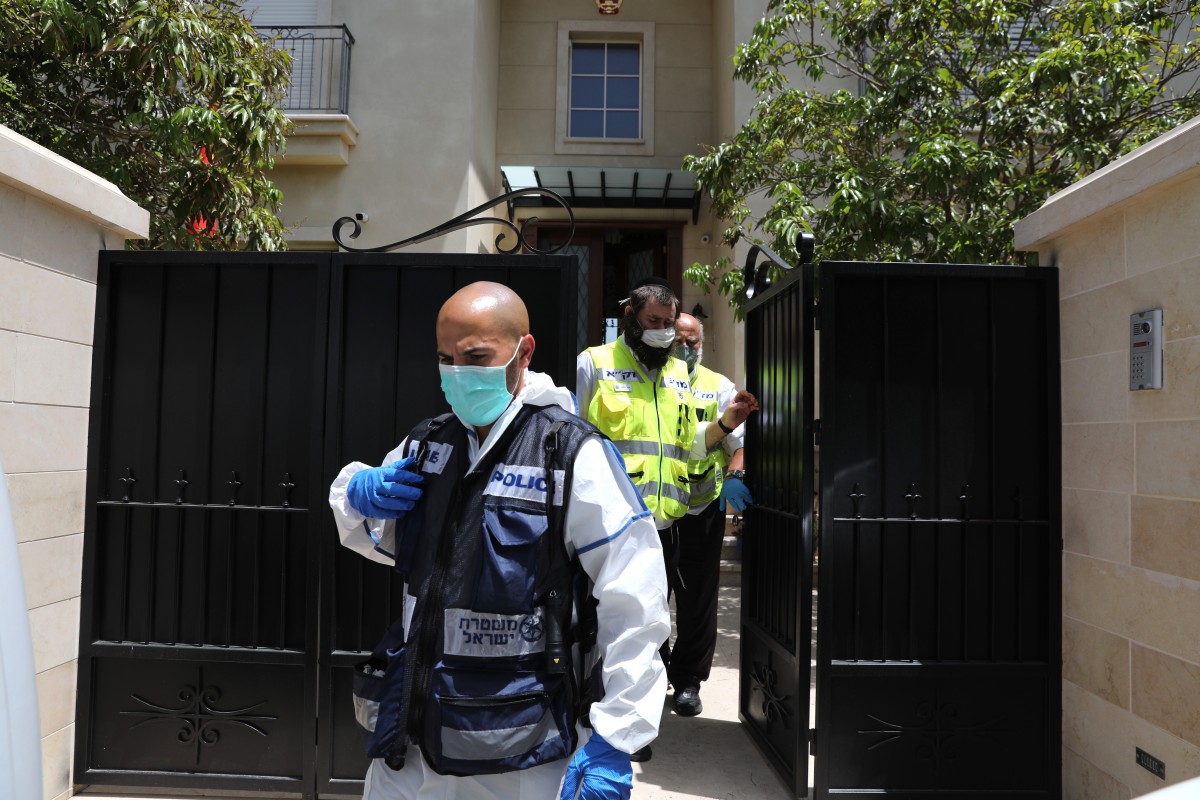
Police, ambulance and embassy staff at the residence where Chinese ambassador Du Wei was found dead on Sunday. Photo: EPA-EFE
China is sending a special investigative team to Israel following
the sudden death of its ambassador Du Wei, whose body was found at his residence on Sunday.
The team, accompanied by a member of Du’s family, was due to travel on Monday, and will handle arrangements for the remains, as well as conducting its own internal investigation, according to Israeli newspaper Haaretz.
Israel’s foreign ministry said its director general Yuval Rotem had spoken with deputy ambassador Dai Yuming to express his condolences. Local police are continuing to investigate at Du’s residence in a suburb of Herzliya, near Tel Aviv.
Details from the Chinese side have been scant. China’s foreign ministry provided a statement to AFP on Sunday which said the preliminary verdict was that Du, 57, had died unexpectedly for health reasons, and details awaited further confirmation. AFP also reported that Du’s wife and son were not with him in Tel Aviv.
“As far as I know, China’s ambassador to Israel Du Wei passed away in ambassador’s residence in Tel Aviv this morning for physical reasons. It happened abruptly,” said Hu Xijin, editor-in-chief of state media tabloid Global Times in a tweet late on Sunday night.
Du was last seen in public on Tuesday in a video conference with an official from Israel’s foreign affairs ministry, according to the embassy website.
James Dorsey, senior fellow at the S. Rajaratnam School of International Studies in Singapore, said Du’s untimely death should be seen as a personal, rather than a political, tragedy for the growing relationship between China and Israel, but he said it came at an important moment for the two countries because of rising US-China tensions.
Dorsey said Israel’s increasing hi-tech cooperation with China, as well as continuing US hostility to Iran – which has close ties with China – were potentially problematic for relations between the two countries.
“I’m not sure that the China-Israel relationship can be seen as independent of the Israel-US relationship. One could argue that the Chinese may be well advised to very quickly replace him soon,” Dorsey said. “Israel could find itself on the fault line of deepening US-China decoupling,” he added.
Israel’s ambassador to China in quarantine after ‘infected’ flight to Seoul
Following a brief trip to Jerusalem on Wednesday – his first foreign visit since March – US Secretary of State Mike Pompeo renewed warnings about China-Israel ties in an interview with Israeli state-owned media outlet Kan News.
“We do not want the Chinese Communist Party to have access to Israeli infrastructure, Israeli communication systems, all of the things that put Israeli citizens at risk,” he said.
China’s embassy in Tel Aviv blasted Pompeo’s comments as “absurd” and “ill-intentioned”. However, the embassy statement was not written by Du, but by a spokesperson.
Du had only served in Israel since February. Just before his arrival,
the Chinese embassy had to issue an apology after then-acting ambassador Dai denounced Israel’s tightened restrictions on Chinese visitors by comparing them to the Holocaust.
During his brief tenure, Du gave frequent interviews to local media, speaking mainly about China’s virus control measures, US-China tensions, and friendship between China and the Jewish people.
Du had worked as a career diplomat since entering China’s foreign service in 1989. Before his appointment in Tel Aviv, he served as China’s ambassador to Ukraine from 2016-2019.
Source: SCMP
Posted in ambassadors, Ambulance, career diplomat, China, Chinese ambassador, chinese communist party, condolences, dead, Death, diplomat, embassy staff, foreign ministry official, Global Times, Holocaust, investigation, Israel, Israeli communication systems, Israeli infrastructure, Jerusalem, Mike Pompeo, Police, quarantine, residence, S. Rajaratnam School of International Studies, sends, Singapore, special, Sunday, team, Tel Aviv, Ukraine, Uncategorized, US Secretary of State |
Leave a Comment »
29/02/2020
WASHINGTON, Feb. 28 (Xinhua) — Chinese Ambassador to the United States Cui Tiankai on Friday called on Beijing and Washington to cooperate to address global challenges, warning against “political virus” disseminated by politically-motivated people.
In an article published in USA Today, Cui said that Beijing has responded on an epic scale since the outbreak of the COVID-19 in China.
“From the top leadership to grassroots, from medical professionals to ordinary people, the Chinese people have united and displayed extraordinary fortitude and devotion to fight the disease,” Cui said.
As a responsible country, China has also erected a Great Wall of disease prevention for the world, he said, adding that China has been releasing the disease-related information in an open, transparent and responsible manner.
The Chinese diplomat praised medical professionals, who made a great sacrifice, as everyday heroes, and listed their heart-warming acts.
“To save more time for work, women doctors have had their long hair cut and men have shaved their hair off. To save medical supplies, they drink less or even no water so that they will remove the protective suits and use the bathroom less often, as the suits have to be disposed of once taken off,” he said.
Cui extended gratitude for people’s gesture of solidarity and goodwill from all around the world, expressing China’s readiness to “repay the kindness shown to us by offering assistance to the countries and regions where the epidemic is taking a toll, and this is what we can and should do.”
He also noted that while the Chinese people are fighting the visible virus from nature, China is also under attack from “political virus” that is disseminated by some politically motivated people.
“To be frank, compared with the coronavirus, these invisible viruses are more poisonous and harmful, as they are attacking the leading force of the epidemic control in an attempt to break down our line of defense,” he said.
Cui called on China and the United States, the world’s two largest economies, to cooperate to address global challenges and problems, as “the interests of the 1.7 billion Chinese and American people and of the 8 billion world population are at stake.”
“Disease knows no borders. This unexpected epidemic reminds us again how vulnerable mankind is and how essential it is to help each other in the face of difficulties,” he added.
Source: Xinhua
Posted in Beijing, Chinese ambassador, Chinese Ambassador to the United States, COVID-19, Great Wall of disease prevention, Uncategorized, USA Today, Washington |
Leave a Comment »
21/09/2019
BAKU, Sept. 21 (Xinhua) — China and Azerbaijan enjoy promising prospects in co-building the Belt and Road, Chinese Ambassador to Azerbaijan Guo Min said in a recent exclusive interview with Xinhua.
With a sound and steady development of bilateral relations, Guo praised the advantages of the China-proposed Belt and Road Initiative (BRI) for both sides, emphasizing Azerbaijan’s full support for and involvement in the construction of the Belt and Road.
She said Azerbaijan sees the development of relationship with China as a diplomatic priority. “China and Azerbaijan have exchanged frequent high-level visits since the beginning of this year, with mutual political trust deepening even further.”
Azerbaijani President Ilham Aliyev attended the second Belt and Road Forum for International Cooperation held in Beijing in April, said Guo, adding “the leaders of the two countries reached important consensus to further develop bilateral relations and practical cooperation in various fields.”
“Cooperation in trade, energy, transportation, humanities and other fields has yielded fruits,” she said, noting bilateral trade reached 1.5 billion U.S. dollars from January to August, an increase of 104 percent from the same period last year.
“In recent years, the two nations have been promoting cooperation in a number of areas, including education, culture, health, sports and tourism on a continuous basis,” said the ambassador.
The two countries “have exchanged the visits of culture and art figures and held a wide range of film festivals, art exhibitions and other activities to actively promote unity, mutual understanding and friendly exchanges between the people,” according to Guo.
“At the next stage, the two nations should capitalize on the existing potential and focus on more points of interest,” the ambassador said.
She described the deep traditional friendship, high-level mutual political trust and the highly complementary practical cooperation as key foundations and effective guarantees for the stability and improvement of bilateral relations.
“China is willing to work together with Azerbaijan to push Sino-Azerbaijani friendship and cooperation to a new level and benefit the two countries and their peoples,” the ambassador added.
Source: Xinhua
Posted in art exhibitions, Azerbaijan, Azerbaijani President, Belt and Road Forum for International Cooperation (BRF), Belt and Road Initiative (BRI), bilateral trade, China alert, Chinese ambassador, Chinese Ambassador to Azerbaijan, co-building, cooperation, Culture, education, energy, enjoy, film festivals, fruits, health, humanities, Ilham Aliyev, promising prospects, Sino-Azerbaijani friendship and cooperation, sports, Tourism, Trade, transportation, Uncategorized, Xinhua, Xinhua News Agency |
Leave a Comment »
30/07/2019
MANILA, July 29 (Xinhua) — The military-to-military relationship between China and the Philippines has become an important part of the bilateral relations, Chinese Ambassador to the Philippines Zhao Jianhua said on Monday.
“China-Philippines relations have achieved positive turnaround, consolidation and elevation over the past three years, and have entered a new stage of development,” Zhao said in a speech at a reception marking the 92nd anniversary of the founding of the People’s Liberation Army (PLA) of China.
“We have increased contacts and exchanges,” he said, referring to the series of recent military exchanges made by both countries.
In January 2019, the Chinese naval escort fleet, composed of three vessels, paid a five-day friendly visit to the Philippines, he said.
In April 2019, the Philippine Navy sent its amphibious warfare ship BRP Tarlac to participate in the international fleet review during the 70th anniversary celebration of PLA Navy in Qingdao, China, he added.
He further said that members of the Command and General Staff College students of the Armed Forces of the Philippines (AFP) just concluded their educational and cultural tour in China recently.
“PLA stands ready to deepen the mutual understanding, mutual trust and mutual confidence with our Filipino counterparts, and to jointly safeguard regional peace and stability,” Zhao said.
As a result of the concerted efforts of China, the Philippines and other countries in the region, the situation in the South China Sea “has been stabilized in general, with growing momentum for cooperation and increasing positive factors,” Zhao said, adding that China stays committed to peace and stability in the South China Sea.
“China respects and upholds the freedom of navigation and overflight enjoyed by all states under international law in the South China Sea, and stays ready to work with other coastal states and the international community to ensure the safety of and the unimpeded access to the international shipping lanes in the South China Sea,” Zhao said.
For his part, Philippine Defense Secretary Delfin Lorenzana said at the reception that the Philippines is also “committed to the resolution of disputes through peaceful means.”
Lorenzana added that he is looking forward to “more shared endeavors, mutually productive and beneficial cooperation and partnership agreements” with China “to create understanding and friendship between our two nations.”
Source: Xinhua
Posted in amphibious warfare ship, Armed Forces of the Philippines (AFP), BRP Tarlac, China-Philippines ties, Chinese ambassador, Chinese naval escort fleet, Command and General Staff College, Filipino, important part, international shipping lanes, Military-to-military relationship, People's Liberation Army (PLA), Philippine Defense Secretary, Philippine Navy, pla navy, Qingdao, South China Sea, Uncategorized |
Leave a Comment »
22/06/2019
LONDON, June 21 (Xinhua) — Chinese Ambassador to the United Kingdom Liu Xiaoming on Friday said he trusted that Britain will make its decision independently, in the UK’s national interest and in the interest of Sino-UK cooperation.
Liu said in an exclusive interview with Sky News that even though there have always been differences between China and Britain, these differences have not prevented the countries from working for the common good.
Liu said Huawei is a good company and it has made its contribution to the telecom industry in the country.
The Ambassador said Huawei is the leader in 5G technology. “I do hope that the UK will keep Huawei for the benefit,” he said.
Source: Xinhua
Posted in 5G technology, believes, Chinese ambassador, Huawei, independent decision, Sky News, telecom industry, UK, Uncategorized |
Leave a Comment »
12/05/2019
KIEV, May 11 (Xinhua) — Ukraine’s president-elect Volodymyr Zelensky on Friday met with Chinese Ambassador to Ukraine Du Wei in Kiev to discuss bilateral cooperation.
During the talks, Zelensky said that he attaches particular importance to Ukraine’s relations with China and wants to learn from China’s success of development.
Zelensky said cooperation between the two countries has great prospects, since Ukraine has a number of advantages — a favorable geographical position, rich resources and a large number of highly qualified personnel.
After assuming the office, the president-elect pledged to take all necessary measures to protect the legitimate rights and interests of all foreign investors including the Chinese investors.
Zelensky called on Chinese businessmen to invest more actively in the construction of factories in Ukraine and develop cooperation in such areas as deep processing of agricultural products, information technology, green energy, digitalization and others.
For his part, Du said that China and Ukraine have been developing friendly relations and cooperating with each other under the Belt and Road Initiative.
Du hopes that cooperation between the two countries would achieve new breakthroughs and tremendous success during the presidential tenure of Zelensky.
Zelensky was elected as the sixth president of Ukraine on April 21, and he is expected to take office no later than June 3.
Source: Xinhua
Posted in Chinese ambassador, cooperation, Du Wei, Kiev, meet, president-elect, Ukraine, Uncategorized, Volodymyr Zelensky |
Leave a Comment »
08/04/2019
AMMAN, April 7 (Xinhua) — Li Chengwen, ambassador for China-Arab States Cooperation Forum Affairs of China’s Foreign Ministry, refuted on Sunday the criticism that China’s Belt and Road Initiative (BRI) will create so-called “debt trap” for some participating countries.
“China is trying to find mechanisms to avoid the ‘debt trap,'” Li said during a session on the second day of the World Economic Forum on the Middle East and North Africa 2019 held in the Dead Sea area of Jordan.
The Chinese envoy was responding to the criticism directed at the BRI by some people in the United States and Europe ahead of the second Belt and Road Forum for International Cooperation, due to be hosted by China later this month in Beijing.
The initiative, proposed by China in 2013, aims at building a trade and infrastructure network connecting Asia with Europe and Africa along the ancient trade routes of the Silk Road to seek common development and prosperity.
As of July 2018, more than 100 countries and international organizations had signed Belt and Road cooperation documents with China, extending the initiative’s scope from the Eurasian continent to Africa, Latin America and the Caribbean, and the South Pacific region.
Li pointed out that no participating country has complained of falling into the so-called “trap” of Chinese loans.
“The Belt and Road Initiative aims to increase the economic prosperity of a country. It does not aim at expanding the political and geographical authority of China in the world,” he said.
Many participants at the forum in Jordan agreed with Li’s comments.
“If you keep your interest first, you will not find China an unfair partner,” said Shandana Gulzar Khan, Pakistan’s parliamentary secretary for commerce. “But it depends on how well you do your homework.”
In Pakistan, a major BRI participating country, the China-Pakistan Economic Corridor has created tens of thousands of jobs and revived the economy of an entire region, Khan noted.
Speaking at the session, He Wenping, a research fellow of the Institute of West-Asian and African Studies, Chinese Academy of Social Sciences, echoed Li’s remarks.
“The biggest worry on the ‘debt-trap diplomacy’ should come from China’s side, not from outside. It is tax payers’ money,” the Chinese professor said.
“China is not waving the ‘China First’ flag,” she said.
The upcoming Belt and Road forum to be held in Beijing later this month could be an opportunity to kickstart a “second phase” of the initiative, she added.
Source: Xinhua
Posted in Beijing, Belt and Road Initiative (BRI), China alert, China-Arab States Cooperation Forum Affairs of China's Foreign Ministry, China-Pakistan Economic Corridor (CPEC), Chinese Academy of Social Sciences, Chinese ambassador, Dead Sea, Europe, He Wenping, Institute of West-Asian and African Studies, Jordan, Li Chengwen, Middle East and North Africa, Pakistan, Pakistan's parliamentary secretary for commerce, research fellow, Shandana Gulzar Khan, Silk Road, Uncategorized, United States, World Economic Forum |
Leave a Comment »
28/02/2019
Yu Jianhua, head of the Chinese Mission to the UN Office in Geneva, attends the 40th session of the UN Human Rights Council (UNHRC) in Geneva, Switzerland, Feb. 27, 2019. The 56 ethnic groups in China, living together like brothers and sisters, are all parts of the big family of the Chinese nation, Yu Jianhua told the UNHRC session. “The people of all ethnic groups are tightly held together like pomegranate seeds, and together they are making arduous efforts for the great rejuvenation of the Chinese nation where they can all live a happy life,” Yu said, when elaborating on China’s human rights propositions and expounding achievements of the human rights undertakings in Xinjiang Uygur Autonomous Region in northwest China. (Xinhua/Xu Jinquan)
GENEVA, Feb. 27 (Xinhua) — The 56 ethnic groups in China, living together like brothers and sisters, are all part of the big family of the Chinese nation, a Chinese envoy said Wednesday at the ongoing UN Human Rights Council (UNHRC) session in Geneva.
“The people of all ethnic groups are tightly held together like pomegranate seeds, and together they are making arduous efforts for the great rejuvenation of the Chinese nation where they can all live a happy life,” said Yu Jianhua, head of the Chinese Mission to the UN Office at Geneva, when elaborating on China’s human rights propositions and expounding achievements of the human rights undertakings in Xinjiang Uygur Autonomous Region in northwestern China, during the UNHRC’s 40th session.
Yu said that as unilateralism and protectionism are on the rise in today’s world, coupled with the still outstanding problem of unbalanced, uncoordinated and unsustainable development, it’s particularly important for countries to firmly practise multilateralism and to jointly build a community with a shared future for mankind.
To that end, Yu put forward China’s propositions on advancing undertakings for human rights internationally. Firstly, mutual respect should be taken as a premise, by which all countries should respect their peoples’ choice of development path for human rights.
Secondly, all countries should adhere to the principle of fairness and justice, abide by the purposes and principles of the UN Charter, respect the sovereignty and territorial integrity of each country, and oppose interference into other countries’ internal affairs under the pretext of human rights.
Thirdly, all countries should aim for win-win results through cooperation; and lastly, all countries should champion a people-centered vision and promote human rights through development.
On the topic concerning China’s Xinjiang Uygur Autonomous Region, the Chinese ambassador said that the stance adopted by some countries is biased and entirely based on misjudgment, which runs counter to facts.
He said that the Chinese government has adopted a series of anti-terrorism and de-extremization measures in Xinjiang, including the establishment of vocational training facilities, which aim to help the few people who have been influenced by extremism to get rid of their terrorist and extremist thoughts and reintegrate them into the society as soon as possible.
These measures, carried out in full accordance with the law, have greatly improved the security situation in Xinjiang and effectively safeguarded the human rights of the people of all ethnic groups and thus received sincere support from the people, Yu said.
Source: Xinhua
Posted in China alert, Chinese ambassador, Chinese Mission to the UN Office, ethnic groups, Geneva, Human rights, UN Charter, UN Human Rights Council (UNHRC), Uncategorized, Uygur Autonomous Region, Xinjiang, Yu Jianhua |
Leave a Comment »




 CHINDIA ALERT: You'll be living in their world, very soon